
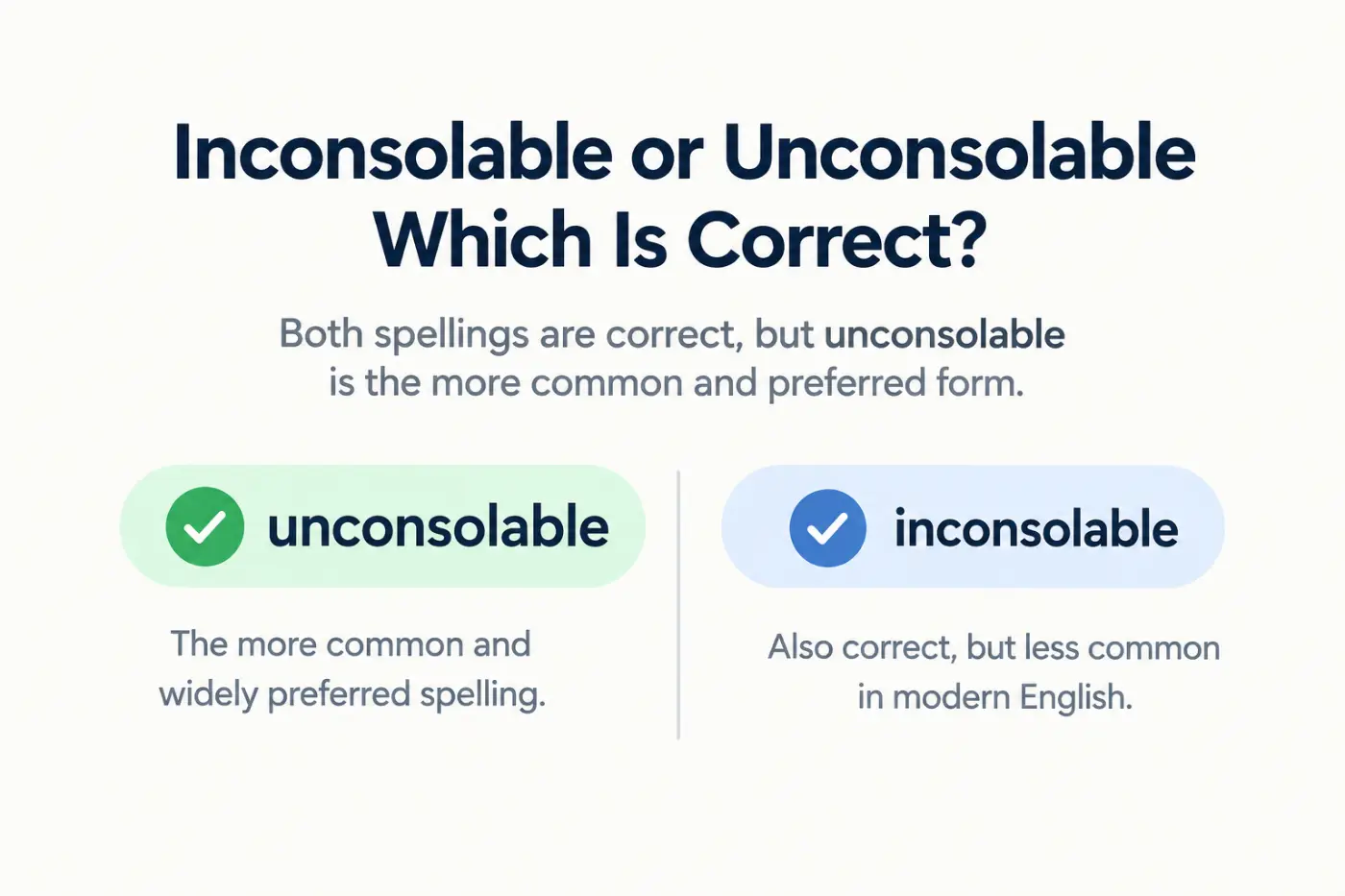
If you are unsure about the spelling inconsolable or unconsolable, the key is to know which form is standard in modern English. Inconsolable is the established and preferred spelling. It describes someone who is so sad, upset, or distressed that other people cannot comfort them. Unconsolable is also recorded as a word in some dictionaries, but it is much less common and is not the usual choice in American English.
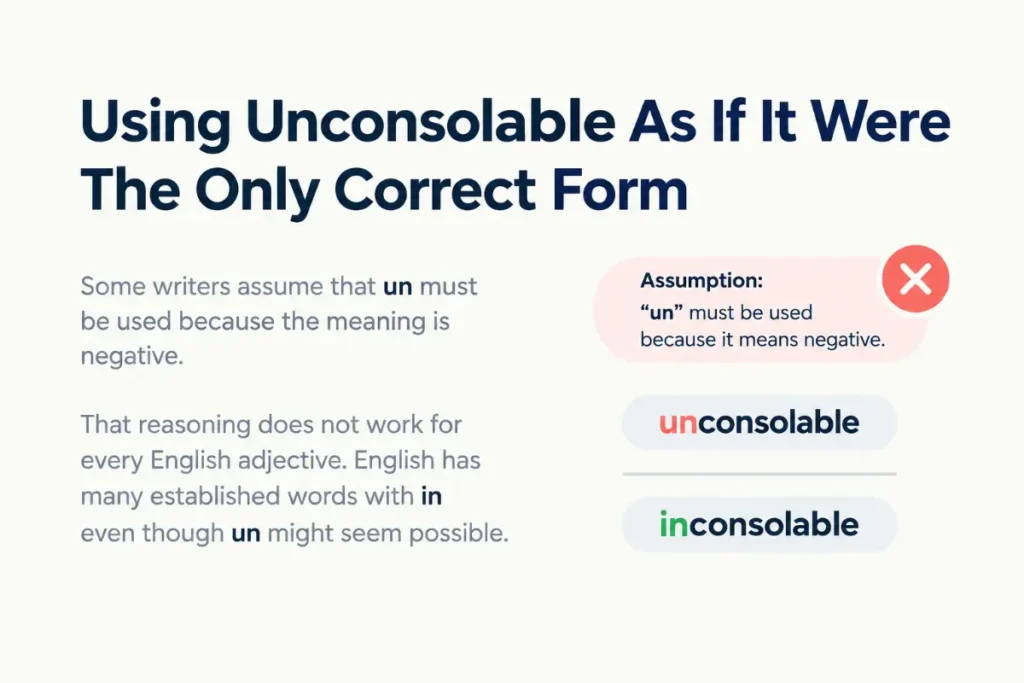
The confusion makes sense because English uses both the prefixes in and un to express negation. Both can appear in words that describe the opposite of a quality or state. However, English spelling does not always follow a simple rule that lets you exchange one prefix for another.
Knowing the difference helps you choose the right word for personal messages, school assignments, professional writing, and creative work. It also helps you describe deep sadness more precisely without making your writing sound unnatural.
Many readers also check To Fast or Too Fast Which Phrase Is Correct.
Quick Answer
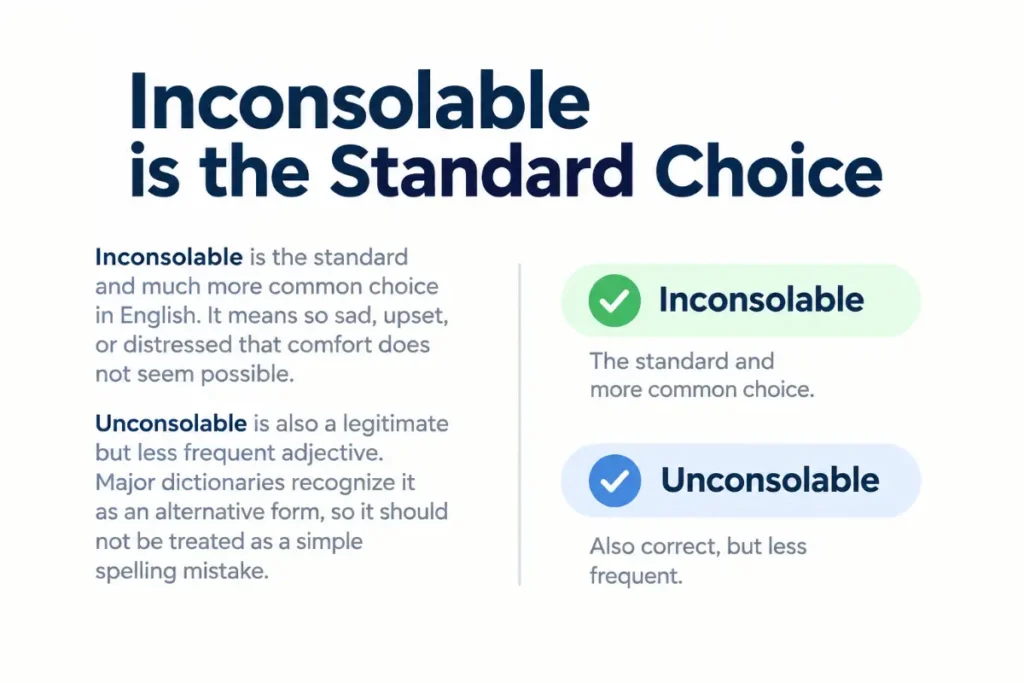
Inconsolable is the standard and preferred spelling in American English. It describes someone who cannot be comforted because of intense sadness or distress. Unconsolable is a rare alternative found in some English usage, but most writers should choose inconsolable for everyday communication and formal writing.
Comparison Table
| Feature | Inconsolable | Unconsolable |
|---|---|---|
| Spelling status | Established standard form | Rare alternative |
| Meaning | Unable to be comforted | Unable to be comforted |
| Part of speech | Adjective | Adjective |
| Prefix | In | Un |
| American English | Preferred | Uncommon |
| British English | Established and preferred | Uncommon |
| Formality | Suitable for formal and informal writing | Usually avoid unless context justifies it |
| Common contexts | Grief, loss, disappointment, emotional distress | Rare or unusual usage |
| Example | She was inconsolable after the loss. | The rare alternative may appear in some writing. |
Meaning and Definition
What Inconsolable Means
Inconsolable is an adjective that describes a person who feels such deep sadness or emotional pain that other people cannot comfort them. The word suggests more than ordinary disappointment. It often describes a strong emotional response to death, separation, heartbreak, or another painful experience.
For example, a child who cries for hours after losing a beloved pet might be inconsolable. An adult who loses a longtime partner may also feel inconsolable during the first days or weeks of grief. In both cases, the word emphasizes the depth of the person’s sorrow and the difficulty of offering comfort.
The word does not mean that the person will never feel better. It describes their emotional state at a particular time. Someone who seems impossible to comfort today may gradually find peace and support as time passes.
Meaning of Unconsolable
Unconsolable carries the same basic meaning as inconsolable. It describes someone who cannot be consoled or comforted. The main difference is not the definition but the frequency and familiarity of the two forms.
The spelling with un appears in some English dictionaries and written usage. However, it is far less common than the established form beginning with in. Most readers will recognize the latter immediately, so it remains the safer choice for standard writing.
If you encounter the less common form in a book or another text, you do not automatically need to treat it as a spelling error. Consider the source and context. In your own writing, though, the more familiar form is almost always the better option.
Key Differences Explained
Spelling
The most noticeable difference is the first two letters. One form begins with in, while the other begins with un. Both spellings are recognizable, but they do not have equal standing in everyday use.
English contains many words that begin with in, such as invisible, incomplete, and inaccurate. It also contains words that begin with un, such as unhappy, unfair, and unable. These patterns can make it tempting to choose a prefix based on how a word sounds or what seems logical.
However, common English words often preserve established spellings that cannot be predicted from a general prefix rule. That is why checking familiar usage matters more than guessing.
Meaning
There is no major difference in meaning between the two forms. Both express the idea of being beyond comfort or difficult to console.
The standard form is especially common in descriptions of grief and profound sadness. For instance, a person may be inconsolable after receiving tragic news. The less common alternative can communicate the same idea, but it may distract readers who are unfamiliar with it.
Grammar
Both forms function as adjectives. They describe a noun or follow a linking verb such as be, seem, remain, or become.
- The grieving family was inconsolable.
- She seemed inconsolable after the argument.
- The child remained inconsolable for several hours.
In each sentence, the adjective describes a person’s emotional condition. You do not need to change its form to match a singular or plural noun.
Pronunciation
The two forms are generally pronounced similarly when used with the same intended meaning. The standard form has five syllables, with the main stress on the third syllable.
Because the spellings differ only at the beginning, pronunciation alone may not help you identify the preferred form. Learning the spelling as a complete word is more reliable than trying to choose between prefixes by sound.
Formality and Context
In professional writing, academic work, journalism, and everyday American English, inconsolable is the natural choice. It communicates intense grief without sounding overly technical or unfamiliar.
The alternative is not automatically meaningless, but its rarity makes it less suitable for most general audiences. A professional editor would normally change it to the established form unless the original spelling serves a specific purpose.
Which Form Is Correct
Inconsolable is the best choice for nearly all standard English writing. It is an established adjective with a clear meaning and a long history of use. It works naturally in both casual conversation and formal prose.
Unconsolable is a rare alternative rather than a form that should always be labeled an outright misspelling. Still, its limited use means that writers gain little by choosing it over the familiar spelling.
Consider these examples.
- Preferred: The mother was inconsolable after hearing the news.
- Less common: The mother was unconsolable after hearing the news.
Both sentences communicate the same idea. The first sounds more familiar and natural to most English readers.
The practical rule is simple. When you want to describe someone who cannot be comforted, write inconsolable. This choice reduces the chance of distracting readers and follows established modern usage.
Sentence Examples
The following examples show how the standard adjective works in different situations.
- Everyday conversation. My little brother was inconsolable when his favorite toy broke.
- Family loss. The family felt inconsolable after their grandfather passed away.
- Text messages. I tried calling her, but she was inconsolable after the breakup.
- Workplace communication. His colleague was inconsolable after receiving the news about her father.
- School writing. The main character became inconsolable when she learned that her best friend had moved away.
- Academic writing. The novel portrays the grieving mother as inconsolable following the sudden loss of her child.
- Social situations. Even her closest friends struggled to comfort her because she was inconsolable.
- News reporting. Relatives were inconsolable as they gathered to mourn the victims.
- Personal storytelling. I was inconsolable for days after my dog died.
- Formal writing. The report describes the family as inconsolable in the immediate aftermath of the tragedy.
These examples also show that the word can describe different people and situations. It does not belong only in stories about death. Heartbreak, serious disappointment, separation, and other painful experiences can also leave someone feeling impossible to comfort.
Common Mistakes and Misspellings
Writers sometimes confuse the preferred spelling with other forms that look or sound similar. These are the most useful distinctions to remember.
1. Unconsolable instead of inconsolable. The first form is a rare alternative, but the second is the normal choice in modern writing. Write, She was inconsolable after the loss.
2. Inconsolible instead of inconsolable. This error replaces the final a in the ending with an i. Remember the established spelling and its ending, able. Write, The child was inconsolable.
3. Inconsolabel instead of inconsolable. This typo changes the order of the final letters. Check the word ending carefully, especially when typing quickly.
4. In consolable instead of inconsolable. Writing the word as two separate words changes the spelling. The standard adjective is written as one word.
5. Inconsole instead of inconsolable. This shortened form leaves out important letters and is not the standard adjective. Use the complete word when describing someone who cannot be comforted.
A helpful editing habit is to read the entire word rather than checking only its first letters. Many spelling mistakes happen because writers focus on the prefix and overlook the rest of the word.
Pronunciation Guide
The standard pronunciation of inconsolable is:
Pronunciation
1×PlayStop
inconsolable
in-kuhn-SOH-luh-buhl
Add to flashcards
Give feedback
The word has five syllables: in, con, sol, a, ble. The main stress falls on the third syllable, which carries the strongest emphasis when you say the word aloud.
Its International Phonetic Alphabet transcription in American English is commonly represented as /ˌɪn.kənˈsoʊ.lə.bəl/. The exact sound can vary slightly among speakers, but the main stress remains on the syllable containing the long o sound.
Common Pronunciation Mistakes
- Placing stress on the first syllable. The main emphasis belongs on the third syllable, not the beginning.
- Rushing through the middle. Say the word slowly at first so the stressed syllable stays clear.
- Confusing spelling with sound. The initial letters do not determine the whole pronunciation. Learn the word as a complete unit.
You do not need to exaggerate every syllable in normal conversation. Once you know the stress pattern, the word should flow naturally into the rest of your sentence.
Many readers also check function vs functionality Which Word Should You Use.
Etymology and Word Origin
The word inconsolable comes from the verb console, which means to comfort someone who is sad, disappointed, or distressed. The verb traces back through French to Latin consolari, meaning to comfort or console.
The prefix in expresses negation in this word. Together, the parts convey the idea of someone who cannot be consoled. The ending able commonly forms adjectives that express a capacity or possibility, as seen in words such as readable and manageable.
This history helps explain the meaning, but it does not mean that every English word can be formed by combining the same parts. English vocabulary developed over many centuries through borrowing and changes in usage. Established spelling often depends on the history of an individual word rather than a single rule that works everywhere.
The less common form with un follows a different familiar English prefix pattern. Its existence does not make the two spellings equally common. In modern writing, the established form remains the natural choice.
Regional Usage
American English
In American English, inconsolable is the preferred spelling. It appears naturally in conversations about grief, family loss, heartbreak, and severe disappointment. It is suitable for school assignments, workplace communication, newspaper writing, and literature.
American readers are likely to understand the rare alternative, but many will find the standard form more familiar. For that reason, writers addressing a general US audience should use inconsolable.
British English
British English also uses inconsolable as the established form. There is no major difference in meaning between American and British usage, and the standard spelling does not change between the two varieties.
A British writer describing a grieving parent or a distressed child can use the same word as an American writer. The rare alternative may appear in some texts, but it is not a major regional spelling distinction.
Australian English
Australian English follows the same general pattern. Inconsolable is the familiar form for describing someone who cannot be comforted. There is no established Australian spelling rule that requires the alternative.
Canadian English
Canadian English also uses inconsolable in standard writing. Although Canadian spelling sometimes follows British conventions and sometimes aligns with American conventions, this word does not present a meaningful regional spelling conflict.
Across these varieties of English, the practical recommendation remains the same. Use inconsolable unless you have a specific reason to preserve a less common form in a source text.
Grammar Rules and Part of Speech
Inconsolable is an adjective. Its job is to describe a person or sometimes another living being experiencing deep distress. It can appear before a noun or after a linking verb.
Before a Noun
An adjective can appear directly before the noun it describes.
- The inconsolable child reached for her mother.
- An inconsolable father sat quietly beside the hospital bed.
- The story follows an inconsolable widow through her first year of grief.
In these sentences, the adjective gives readers a clearer picture of the person’s emotional state.
After a Linking Verb
The word also works after verbs such as be, seem, look, and remain.
- She was inconsolable after the phone call.
- He seemed inconsolable when his team lost.
- The family remained inconsolable throughout the evening.
This pattern is especially common because the adjective describes a condition rather than an action.
Using Intensifiers
You can place an adverb before the adjective to show the strength of the emotion. Common choices include deeply, completely, and utterly.
For example, She was deeply inconsolable is understandable, but it sounds less natural than She was inconsolable or She was utterly inconsolable. Since the adjective already expresses an extreme state, adding too many intensifiers can make the sentence feel repetitive.
Choose the simplest wording that conveys the intended emotion.
Singular and Plural Agreement
The adjective does not change when the noun becomes plural.
- The child was inconsolable.
- The children were inconsolable.
- The grieving relatives remained inconsolable.
Only the verb changes to agree with the subject. The adjective stays the same.
Common Grammar Errors
One common mistake is treating the adjective as a noun without a suitable structure. For instance, The inconsolable was crying sounds incomplete because the adjective needs a noun or a clear noun phrase in ordinary usage. A natural version is The inconsolable child was crying.
Another mistake is using the word for ordinary frustration when a milder expression would be more accurate. Someone who is briefly annoyed about a delayed delivery is usually upset or frustrated, not inconsolable. Reserve the stronger term for intense emotional distress.
Real Life Usage Examples
Daily Conversation
In everyday speech, this adjective helps people describe grief or sadness that ordinary reassurance cannot ease.
- I tried to cheer him up, but he was inconsolable after losing his beloved dog.
- Her daughter was inconsolable when her best friend moved to another city.
The word adds emotional depth to a story. It tells the listener that a simple apology or comforting remark was not enough to ease the person’s pain.
Email and Workplace Communication
In a workplace message, the adjective may appear when someone explains a serious personal situation. Use it with care because it communicates intense distress.
- The team offered its support to a colleague who was inconsolable after a family tragedy.
- Her manager gave her time away from work after learning that she was inconsolable following the loss.
In professional communication, a compassionate tone matters more than dramatic language. Include the word only if it accurately reflects the situation.
Academic Writing
In literary analysis and psychology related discussions, the adjective can describe a character’s or person’s emotional state. Avoid treating it as a formal diagnosis. It is a descriptive word, not a clinical label.
- The author presents the protagonist as inconsolable to show the lasting emotional impact of the loss.
- The scene portrays a community that is inconsolable after the sudden death of its leader.
These examples focus on the role of emotion in a text or event rather than making unsupported claims about a person’s mental health.
News and Journalism
Journalists may use the word to describe relatives or witnesses affected by a tragedy. Because it expresses a strong emotional state, it should reflect the available evidence and not serve as a substitute for verified reporting.
- Relatives were inconsolable as they gathered to remember those who had died.
- Witnesses described the parents as inconsolable after the accident.
In factual reporting, avoid presenting an emotional description as a direct quote unless the words were actually spoken. A writer can describe observed grief without inventing a statement from a person involved.
Literature and Storytelling
Writers often use the word to show the intensity of a character’s feelings. It can create a vivid scene without requiring a long explanation.
- Inconsolable after the farewell, Mara sat beside the window until dawn.
- The old man became inconsolable when he found the letters his wife had left behind.
In fiction, the adjective works best when the surrounding details support it. A character’s actions, memories, or silence can make the emotion feel real instead of simply telling readers how to feel.
Related and Confused Terms
Several words describe sadness or the need for comfort. However, each carries a slightly different meaning. Choosing the right one helps you express an emotion with greater accuracy.
1. Consoled. This means comforted or reassured. A grieving person may be consoled by a friend, even if the sadness does not disappear completely.
2. Inconsolable. This describes someone whose sadness is so intense that comfort seems unable to help. It is stronger than simply feeling upset.
3. Comfortless. This describes a state that lacks comfort or reassurance. It can describe a person, place, or situation, depending on the sentence.
4. Grief stricken. This describes someone deeply affected by loss or sorrow. It often refers to bereavement, but the exact meaning depends on context.
5. Distraught. This describes someone who is extremely upset, worried, or emotionally shaken. Unlike inconsolable, it does not specifically focus on the inability to receive comfort.
6. Devastated. This means deeply shocked or emotionally crushed by a painful event. Someone can feel devastated and still accept comfort from others.
7. Heartbroken. This commonly describes intense sadness caused by a breakup, loss, rejection, or another painful experience. It is often used in personal conversations and storytelling.
8. Despondent. This describes someone who has lost hope or feels deeply discouraged. It focuses more on hopelessness than on the inability to be comforted.
These words overlap, but they are not perfect substitutes. A person can be distraught without being inconsolable, and someone can be devastated while finding comfort in family and friends. The best word depends on the emotion you want to communicate.
Expert Editor Insight
An experienced English editor would normally choose inconsolable because readers recognize it immediately and its meaning is clear. The confusion arises from familiar English prefixes that express negation, along with the unusual spelling patterns found in words borrowed from older languages. Spelling tools may flag the rare alternative as unfamiliar or suggest the standard form, but software suggestions are not a complete guide to language. Editors consider context, audience, meaning, and established usage before changing a word. A useful editing tip is to check the whole word in a trusted dictionary instead of deciding its spelling from the prefix alone.
Key Takeaways
- Inconsolable is the standard and much more common form.
- Unconsolable is a legitimate but less frequent alternative.
- Both words mean unable to be comforted.
- The word is an adjective.
- It commonly describes intense grief, sadness, disappointment, or emotional distress.
- It can appear before a noun or after a linking verb.
- Inconsolably is the related adverb.
- The word is connected to console, consolation, and consolable.
- Its history traces back through French and Latin roots connected with comfort and consolation.
- For American English writing, inconsolable is the best default choice.
- Do not automatically label unconsolable as a misspelling because dictionaries recognize it as an alternative.
- If you need one simple memory rule, connect the spelling with console and choose inconsolable for normal writing.
For another common grammar confusion, see Coachs or Coaches Which Spelling Is Correct.
Conclusion
The choice between inconsolable or unconsolable comes down to established usage and familiarity. Inconsolable is the preferred spelling in modern American English and the natural choice for most British, Australian, and Canadian writing as well. Both forms express the idea of being unable to receive comfort, but the less common alternative may distract readers or appear unfamiliar.
Use the standard form when describing deep grief, heartbreak, or intense emotional distress. A simple editing habit can help you remember it. Learn the complete spelling rather than guessing from the prefix. When you need a reliable choice, inconsolable is the word to use.
FAQs
Is Unconsolable a Real Word?
Yes. Unconsolable appears in some English dictionaries and written usage as an alternative to inconsolable. However, it is much less common in modern English. For everyday writing, schoolwork, professional communication, and general American audiences, inconsolable is the more familiar and reliable choice.
What Does Inconsolable Mean?
Inconsolable describes someone who feels such intense sadness or distress that other people cannot comfort them. The word commonly appears in situations involving bereavement, heartbreak, separation, or tragic news. It describes the person’s emotional state at a particular time and does not mean that they will remain sad forever.
Which Is Correct Inconsolable or Unconsolable?
Inconsolable is the established and preferred form in standard American English. Unconsolable has the same basic meaning but appears far less often. Since both forms can be found in English usage, the distinction is mainly about standard usage and familiarity rather than a completely different definition.
How Do You Pronounce Inconsolable?
Inconsolable has five syllables, with the main stress on the third syllable. In American English, the pronunciation is commonly represented in IPA as /ˌɪn.kənˈsoʊ.lə.bəl/. Say the word naturally and give the strongest emphasis to the syllable containing the long o sound.
Can Inconsolable Start a Sentence?
Yes. Inconsolable can start a sentence when it functions as an adjective in an introductory phrase. For example, Inconsolable after the loss, she sat quietly with her family. It can also begin a sentence when it forms part of the subject, as in Inconsolable children sometimes need patience and reassurance.
What Is a Synonym for Inconsolable?
Useful alternatives include distraught, grief stricken, heartbroken, devastated, and deeply sorrowful. Each word expresses a slightly different shade of emotion. Distraught emphasizes intense upset, while despondent emphasizes hopelessness. Choose a synonym based on the person’s emotional state rather than replacing the original word automatically.
Why Do People Confuse These Spellings?
People often confuse the two forms because English uses both in and un as negative prefixes. Since both patterns appear in familiar words, the less common spelling may seem reasonable. However, English spelling depends on established word forms and historical development, so a prefix cannot always be substituted freely.
Is Inconsolable Appropriate for Formal Writing?
Yes. Inconsolable is suitable for formal reports, academic essays, journalism, and literary analysis when it accurately describes intense emotional distress. In factual writing, use it only when the description is supported by the available information. For mild sadness or ordinary disappointment, a less intense word may communicate the situation more accurately.