
If you’ve ever added a footnote to a paper, article, essay, or report, you’ve probably paused for a moment and wondered about one small detail. Does the footnote go before the period or after it? It seems minor, but punctuation placement matters in formal writing. A misplaced footnote can make academic work look unpolished and can even violate a style guide’s rules.
The confusion exists because different writing situations use punctuation and citations differently. People often mix up footnotes, endnotes, references, and in text citations. On top of that, various style guides have their own formatting requirements.
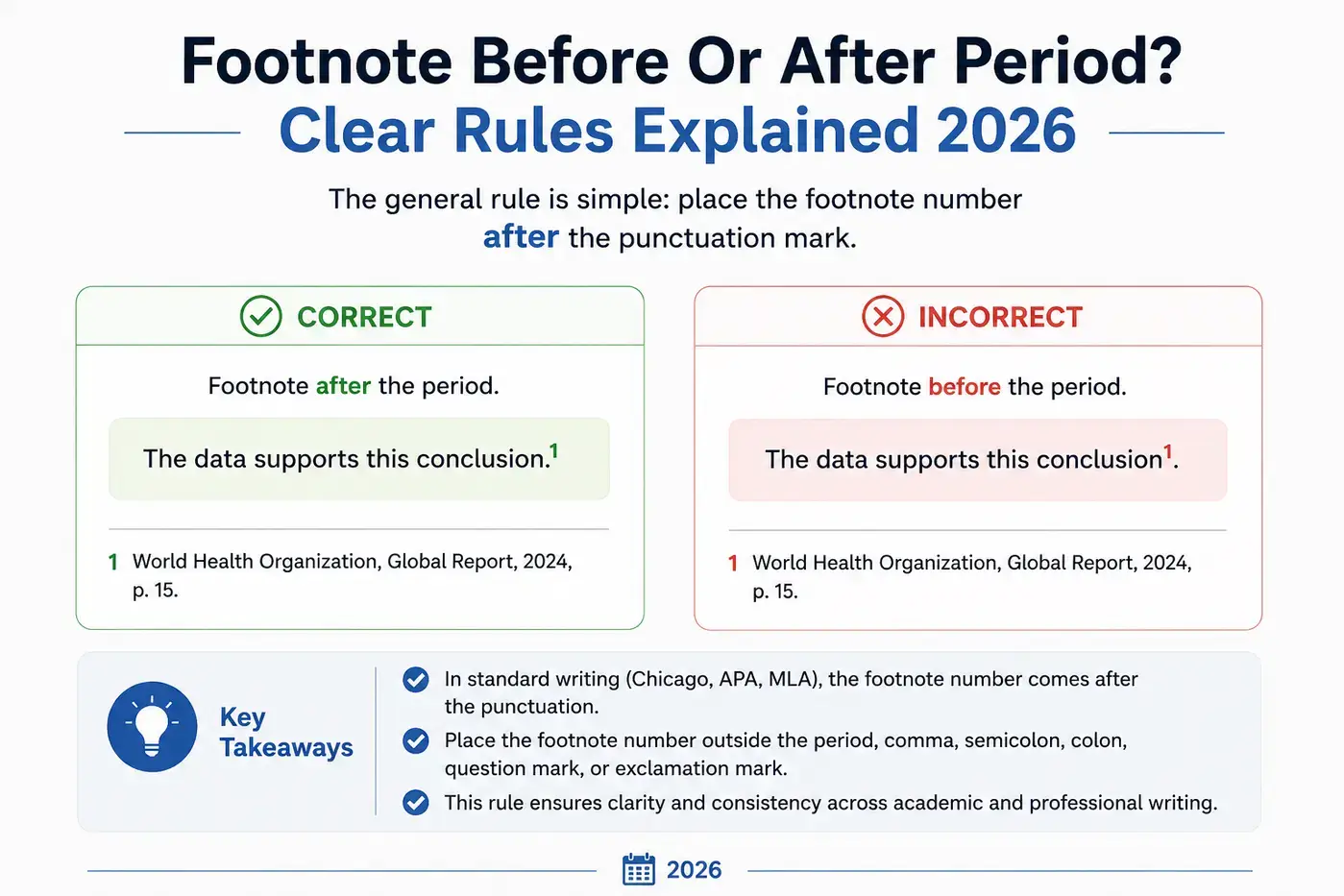
The good news is that the rule for footnotes is surprisingly straightforward in most cases. The standard practice is to place the footnote number after the period at the end of a sentence. Most major style guides, including Chicago style, follow this approach. There are a few exceptions, but they are uncommon.
In this guide, you’ll learn exactly where a footnote belongs, why the rule exists, examples of correct and incorrect usage, style guide differences, common mistakes, and practical tips used by editors, teachers, researchers, and professional writers.
A related grammar guide is Laid or Layed Which Word Should You Use in 2026.
Footnote Before Or After Period Quick Definition
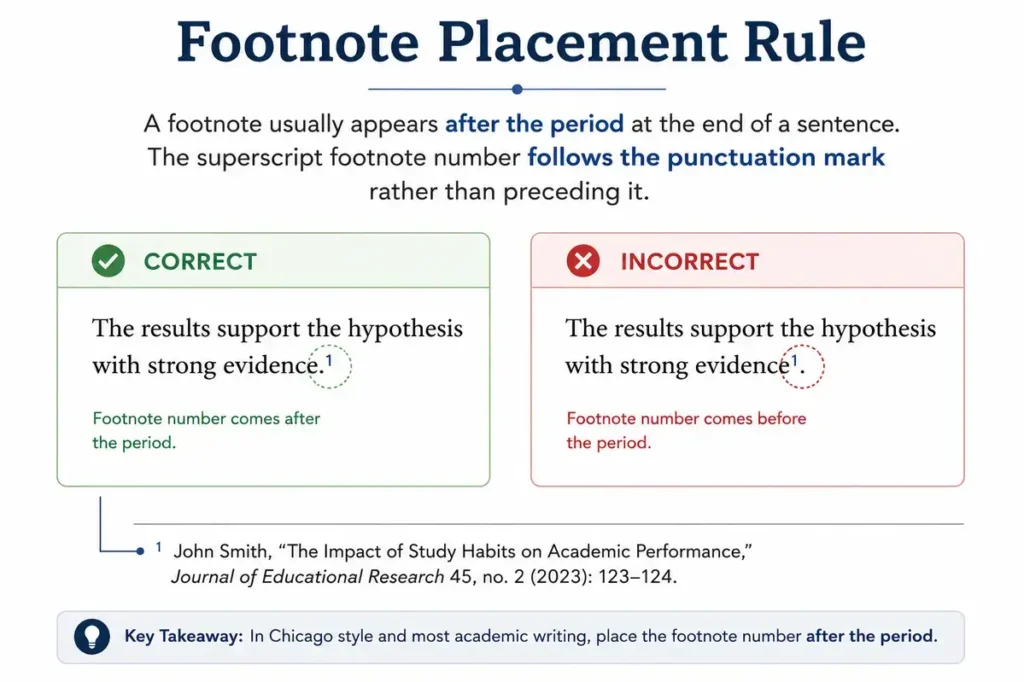
A footnote usually appears after the period at the end of a sentence. The superscript footnote number follows the punctuation mark rather than preceding it. This placement is the standard rule in most academic, professional, and publishing contexts, especially when using Chicago style formatting.
Footnote Before Or After Period Quick Answer
The short answer is simple.
Place the footnote number after the period.
Correct:
The research findings were published in 2025.¹
Incorrect:
The research findings were published in 2025.In most academic and professional writing, the footnote marker follows the sentence ending punctuation.
Footnote Before Or After Period Comparison Table
| Feature | Footnote After Period | Footnote Before Period |
|---|---|---|
| Correct form in most cases | Yes | No |
| Meaning | Indicates note applies to sentence | Often considered incorrect |
| Part of speech | Not applicable | Not applicable |
| Style guide preference | Strongly preferred | Rarely preferred |
| Usage frequency | Very common | Uncommon |
| Formality level | Academic and professional standard | Usually avoided |
| Common contexts | Essays reports books journals | Rare exceptions |
| Reader expectation | Meets standard conventions | Can look incorrect |
| Publishing acceptance | Widely accepted | Often edited out |
| Example | The study was successful.¹ | The study was successful¹. |
Meaning Of A Footnote
Before discussing footnote placement, it’s helpful to understand what a footnote actually does. A footnote is a note placed at the bottom of a page. It gives readers extra information without interrupting the main text. Footnotes commonly serve several purposes.
- Cite a source.
- Provide additional context.
- Explain a technical point.
- Offer commentary that does not fit naturally into the sentence.
- Credit ideas or quotations.
A footnote marker appears in the text as a small superscript number. The corresponding note appears at the bottom of the page.
Example:
Climate patterns have shifted significantly during the past decade.¹ The reader can then look at footnote 1 for more information.
Footnote Before Or After Period In Academic Writing
Academic writing follows strict formatting standards because consistency helps readers focus on content instead of formatting. When using footnotes in research papers, dissertations, scholarly articles, or university assignments, the footnote number generally comes after the period.
Example:
The experiment produced statistically significant results.² This approach keeps punctuation intact and makes sentences easier to read. Editors and academic publishers prefer this format because it creates a cleaner visual structure. The sentence ends naturally. Then the citation marker appears.
Why Footnotes Usually Come After The Period
Many writers ask why this rule exists. The reason is practical. The footnote generally refers to the entire sentence rather than a single word. Since the note applies to the completed thought, the marker appears after the sentence has ended. Think of the footnote marker as a small sign attached to the finished statement.
Example:
Artificial intelligence is transforming healthcare delivery.³ The note supports the complete statement, not just the last word. This placement improves readability and avoids visual clutter.
Footnote Before Or After Period In Chicago Style
Chicago style is one of the most widely used systems for footnotes. According to Chicago style conventions, footnote numbers typically appear after punctuation marks.
Examples:
- The manuscript was discovered in a private archive.⁴
- The policy was revised after extensive consultation.⁵
- Several historians support this interpretation.⁶
Because Chicago style relies heavily on notes and citations, this rule appears throughout academic books, history papers, and scholarly publishing. For most writers using footnotes, Chicago style serves as the primary reference point.
Footnote Before Or After Period In Books And Publishing
Professional publishers follow established editorial conventions. In books, footnote markers almost always appear after periods and commas.
Example:
The city experienced rapid growth during the nineteenth century. This format creates consistency across hundreds of pages. Publishing houses value consistency because readers notice formatting irregularities quickly. A misplaced footnote marker can stand out like a crooked picture frame on an otherwise perfect wall.
Footnote Before Or After Period With Quotations
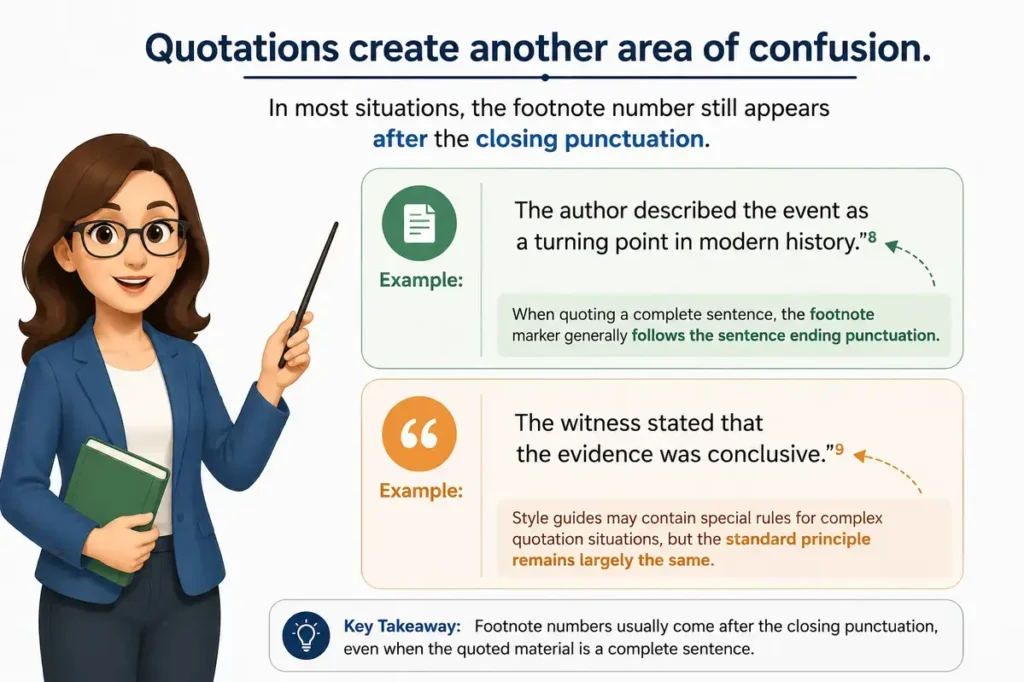
Quotations create another area of confusion. In most situations, the footnote number still appears after the closing punctuation.
Example:
The author described the event as a turning point in modern history.⁸ When quoting a complete sentence, the footnote marker generally follows the sentence ending punctuation.
Example:
The witness stated that the evidence was conclusive.⁹ Style guides may contain special rules for complex quotation situations, but the standard principle remains largely the same.
Common Reasons Writers Get This Rule Wrong
Many mistakes come from habits formed by other citation systems. Some writers use parenthetical citations regularly and assume footnotes work the same way. Others place the marker immediately after a quoted word because it feels logical. Common causes of confusion include:
- Mixing footnotes with APA citations.
- Mixing footnotes with MLA citations.
- Copying inconsistent examples found online.
- Following software defaults without checking style guidelines.
- Learning different rules from different instructors.
Fortunately, once you understand the basic principle, the rule becomes easy to remember. Sentence first. Footnote second.
Footnote Before Or After Period For Multiple Sentences
Sometimes a single source supports several sentences. In those cases, writers often wonder where the marker belongs.
Example:
The project lasted three years. Researchers collected data from five countries. The final report included more than 10,000 participants.¹⁰ The footnote appears after the final sentence supported by the source. This tells readers exactly which information the citation covers.
Expert Editor Insight Footnote Before Or After Period
After reviewing academic manuscripts, business reports, journal submissions, and book chapters for years, one pattern appears again and again. Writers tend to overthink footnote placement. The simplest approach is usually the correct one. If the footnote supports the entire sentence, place the marker after the period.
Professional editors routinely correct misplaced footnote markers because standard placement improves consistency and readability. Readers rarely notice correct formatting, but they often notice incorrect formatting. That makes proper footnote placement one of those small details that quietly strengthens your credibility.
Footnote Before Or After Period In Different Style Guides
While the general rule is straightforward, many writers encounter different citation systems throughout school, university, and professional work. Understanding how major style guides handle footnotes can eliminate confusion.
Footnote Before Or After Period In Chicago Style
Chicago style is the most common style guide that relies heavily on footnotes. The rule is simple. Place the footnote number after the period.
Example:
The discovery changed historians’ understanding of the period. This formatting appears throughout academic books, history journals, and scholarly publications that follow Chicago style.
Footnote Before Or After Period In MLA Style
Modern Language Association style primarily uses parenthetical citations instead of footnotes for source documentation. However, when MLA uses footnotes for additional information, the note number generally appears after punctuation.
Example:
The novel influenced several later writers.² Although footnotes are less common in MLA, the placement rule remains largely consistent with Chicago style.
Footnote Before Or After Period In APA Style
American Psychological Association style rarely uses footnotes for citations. Instead, APA relies on in text citations such as:
(Smith, 2025)
When APA includes a footnote for supplementary information, the note number typically appears after punctuation.
Example:
The survey included responses from more than 2,000 participants.³
A related grammar guide is Reins and Reigns Definitions Examples and Grammar Guide 2026.
Footnote Before Or After Period In Legal Writing
Legal writing often follows specialized citation systems such as the The Bluebook. Even in legal documents, footnote markers commonly appear after punctuation. However, legal citation can involve unique formatting requirements, so writers should always follow the specific rules required by courts, law schools, or publishers.
Key Differences Between Correct And Incorrect Placement
The difference may seem small, but it affects readability.
Correct
The company expanded into three new markets.⁴
Incorrect
The company expanded into three new markets⁴. The first example allows the sentence to end naturally. The second interrupts the visual flow of the sentence and does not follow standard publishing conventions.
Which One Is Correct
The correct answer is clear.
Footnotes belong after the period in most writing situations.
Correct:
The meeting concluded after two hours.⁵
Incorrect:
The meeting concluded after two hours⁵. If you’re writing an academic paper, research article, book manuscript, professional report, or business document, placing the footnote after the period is almost always the safest choice.
Rare Exceptions To The Rule
English grammar loves exceptions, and footnotes are no different. A few specialized situations may require a footnote marker near a specific word, phrase, table, figure, or quotation.
Examples include:
- Scientific publications with unique formatting rules.
- Legal documents with specialized citation systems.
- Publisher specific style requirements.
- Footnotes attached to table entries.
- Notes connected directly to chart labels.
Even then, these are exceptions rather than the norm. For ordinary writing, the after the period rule remains the standard.
Grammar Rules Behind Footnote Placement
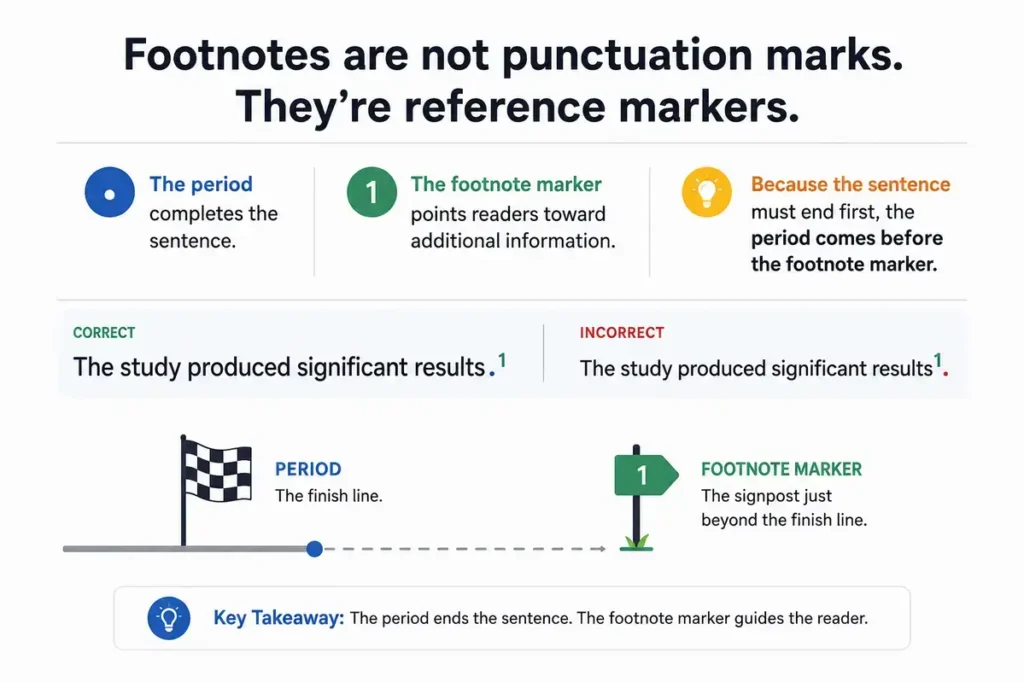
Footnotes are not punctuation marks. They’re reference markers. That distinction matters. The period completes the sentence. The footnote marker points readers toward additional information. Because the sentence must end first, the period comes before the footnote marker. Think of the period as the finish line and the footnote as a signpost standing just beyond it.
Parts Of Speech And Footnotes
A footnote itself is not a traditional part of speech.
It functions as a reference tool.
However, footnotes can support any grammatical element, including:
- Nouns.
- Verbs.
- Adjectives.
- Adverbs.
- Clauses.
- Entire sentences.
In practice, editors often attach footnotes to complete thoughts rather than individual words.
Footnote Before Or After Period Examples In Sentences
Here are ten natural examples showing proper footnote placement.
Correct Examples
- The museum opened a new exhibit last spring.¹
- Researchers gathered data across four continents.²
- The policy remained unchanged for decades.³
- Several experts disputed the findings.⁴
- The company reported record revenue last year.⁵
- The manuscript was preserved in a private collection.⁶
- Climate patterns continue to shift globally.⁷
- The survey included participants from every state.⁸
- The project exceeded initial expectations.⁹
- Historians still debate the exact timeline.¹⁰
Incorrect Examples
- The museum opened a new exhibit last spring¹.
- Researchers gathered data across four continents².
- The policy remained unchanged for decades³.
- Several experts disputed the findings⁴.
- The company reported record revenue last year⁵.
- The manuscript was preserved in a private collection⁶.
- Climate patterns continue to shift globally⁷.
- The survey included participants from every state⁸.
- The project exceeded initial expectations⁹.
- Historians still debate the exact timeline¹⁰.
Common Mistakes With Footnote Before Or After Period
Many writers make the same errors repeatedly.
Putting The Footnote Before The Period
This is the most common mistake.
Incorrect:
The article received widespread attention¹.
Correct:
The article received widespread attention.¹
Mixing Citation Styles
Writers sometimes combine Chicago, MLA, and APA formatting in the same document. That creates inconsistency and confusion.
Following Random Online Examples
Not every website provides accurate grammar advice. Always verify information against recognized style guides and trusted editorial sources.
Using Multiple Formats In One Document
Consistency matters.
Once you choose a style guide, follow it throughout the entire document.
Pronunciation Guide
Since many people searching for this topic are language learners, let’s cover pronunciation.
Footnote
IPA pronunciation:
/ˈfʊtˌnoʊt/
Syllable breakdown:
Foot • note
Sounds like:
FOOT note
Common Pronunciation Mistakes
- Stressing the second syllable instead of the first.
- Pronouncing foot as food.
- Softening the final t sound too much.
In American English, the first syllable carries the primary stress.
Etymology And Word Origin
The word footnote combines two older English words.
Foot
Derived from Old English and originally referred to the lower part of the body.
Note
Comes from Latin nota, meaning mark, sign, or written observation. The term footnote developed because these notes appear at the foot, or bottom, of a page. The concept became increasingly important after the growth of scholarly publishing in Europe. Historians, researchers, and academics needed a reliable way to document sources and add commentary without interrupting the main text. Over time, footnotes became a cornerstone of academic writing.
Regional Usage
The rule remains remarkably consistent across major English speaking countries.
American English
Footnotes generally appear after the period.
British English
The same convention is widely followed.
Canadian English
Publishers and universities typically place footnotes after punctuation.
Australian English
Academic and professional writing follows the same standard practice. This consistency is helpful because writers moving between countries rarely need to relearn footnote placement.
Footnote Before Or After Period In Real Life Usage
Daily Communication
Footnotes are uncommon in everyday conversations but may appear in newsletters, reports, and presentations.
Academic Writing
Footnotes are frequently used in research papers, dissertations, and scholarly books.
Professional Communication
Business reports sometimes use footnotes to explain data sources or provide additional details.
Literature
Many nonfiction books rely on footnotes for historical references, commentary, and source attribution.
Media And Journalism
Journalists typically use hyperlinks and references rather than traditional footnotes, though long form investigative work occasionally includes them.
Related Words And Commonly Confused Terms
Writers often confuse footnotes with similar concepts.
Footnote
Appears at the bottom of the same page.
Endnote
Appears at the end of a chapter or document.
Citation
A reference to a source.
Reference
A complete source entry.
Bibliography
A list of sources consulted.
Works Cited
An MLA specific list of sources used.
In Text Citation
A source reference included directly within the text.
Annotation
An explanatory note added to a text. Understanding these distinctions helps writers choose the right citation method.
Expert Language Insight Footnote Before Or After Period
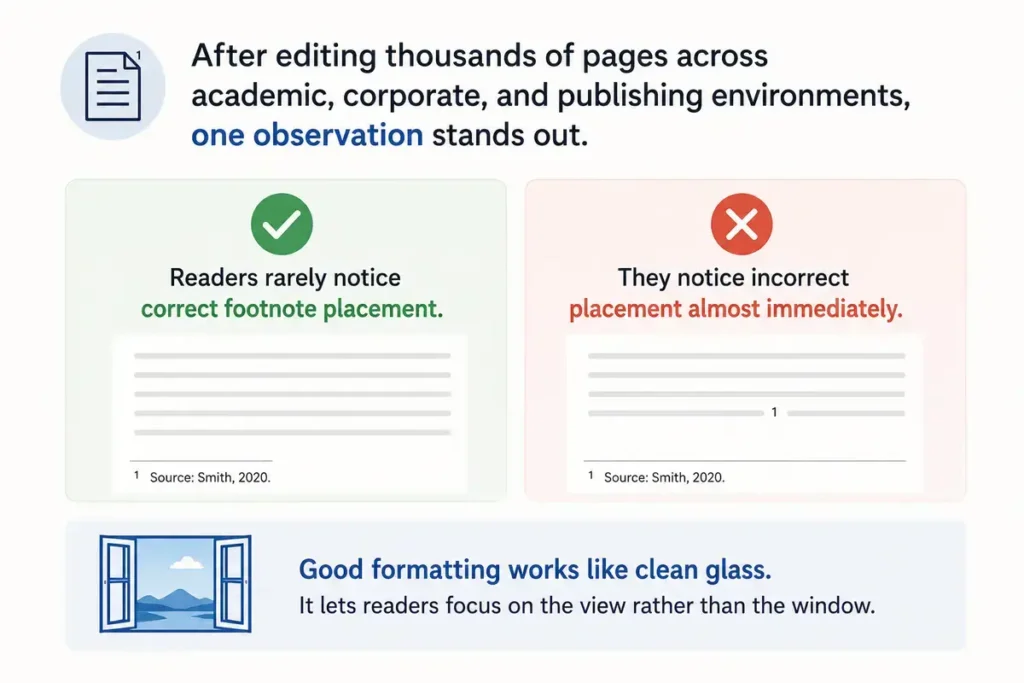
After editing thousands of pages across academic, corporate, and publishing environments, one observation stands out. Readers rarely notice correct footnote placement. They notice incorrect placement almost immediately. Good formatting works like clean glass. It lets readers focus on the view rather than the window.
Native English speakers generally don’t think about footnote rules consciously. They simply expect published writing to follow standard conventions. That’s why placing footnotes after periods feels natural to experienced readers. If you’re unsure during writing, remember a simple phrase: Finish the sentence first. Add the footnote second. That rule will be correct nearly every time.
Frequently Asked Questions Footnote Before Or After Period
Is A Footnote Placed Before Or After A Period?
A footnote is usually placed after the period. The sentence ends with its normal punctuation, and the superscript footnote number follows immediately afterward. This format is accepted by most academic publishers, universities, and professional style guides.
Why Do Footnotes Go After The Period?
Footnotes often support an entire sentence rather than a single word. Since the note relates to the completed thought, the sentence ends first with a period, and the footnote marker appears afterward.
Does Chicago Style Put Footnotes After The Period?
Yes. Chicago style places footnote numbers after periods, commas, quotation marks, and most other punctuation marks. This is one of the most widely followed footnote conventions in academic writing.
Can A Footnote Ever Go Before A Period?
In rare specialized situations, it can. Some legal documents, scientific materials, tables, or publisher specific formats may require different placement. For standard writing, the footnote should appear after the period.
Do Footnotes And Endnotes Follow The Same Rule?
Yes. The marker within the text generally follows the same placement principles. The difference is where the note itself appears. Footnotes appear at the bottom of the page, while endnotes appear at the end of a chapter or document.
What Happens If I Put A Footnote Before The Period?
Many editors, professors, and publishers will treat it as a formatting error. It may not change the meaning of the sentence, but it can make the writing appear less polished and less professional.
Is Footnote Placement Different In British English?
Not usually. British English and American English generally follow the same convention of placing footnote markers after the period in formal writing.
How Can I Remember The Correct Rule?
Think of the period as the end of the sentence. Once the thought is complete, add the footnote marker. A simple memory aid is: sentence first, footnote second.
Learn the difference in Thank You For Your Concern Meaning And Usage.
Conclusion Footnote Before Or After Period
The answer to footnote before or after period is straightforward. In almost every academic, professional, and publishing context, the footnote number belongs after the period. This convention improves readability, aligns with major style guides, and meets reader expectations. While a few specialized exceptions exist, they’re uncommon and usually governed by specific formatting rules. If you’re writing a paper, report, article, dissertation, or book manuscript, place the period first and the footnote marker second. It’s a small detail, but strong writing often comes down to getting the small details right.
3 thoughts on “Footnote Before Or After Period Clear Rules Explained 2026”