
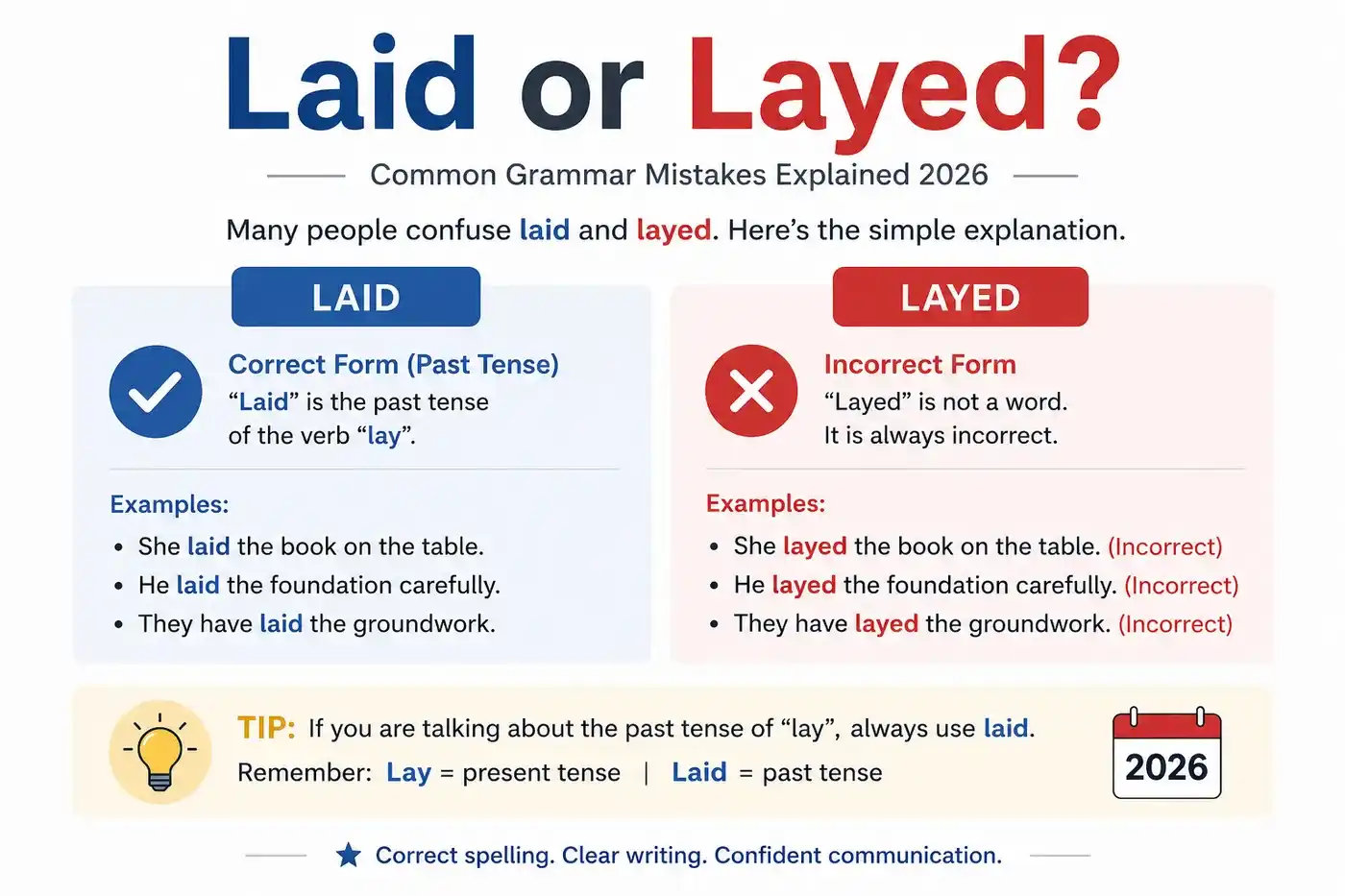
The confusion between laid or layed is one of the most common spelling mistakes in English. Many writers assume that because verbs like play become played, the verb lay should become layed. At first glance, that seems logical. English, however, doesn’t always follow predictable patterns.
The correct past tense and past participle form of the verb lay is laid. The spelling layed is considered incorrect in standard English and rarely appears outside spelling mistakes, historical references, or highly specialized contexts. This mistake shows up everywhere, from social media posts and emails to academic papers and professional documents. Even experienced writers occasionally type layed because it looks natural.
Understanding the difference is important because using the wrong form can make otherwise strong writing appear careless. In this guide, you’ll learn exactly why laid is correct, why layed is usually wrong, how the grammar works, pronunciation rules, examples, common mistakes, historical origins, and expert tips for remembering the correct spelling every time.
You may also want to read Thank You For The Information Correct Usage And Meaning.
Laid or Layed Quick Definition
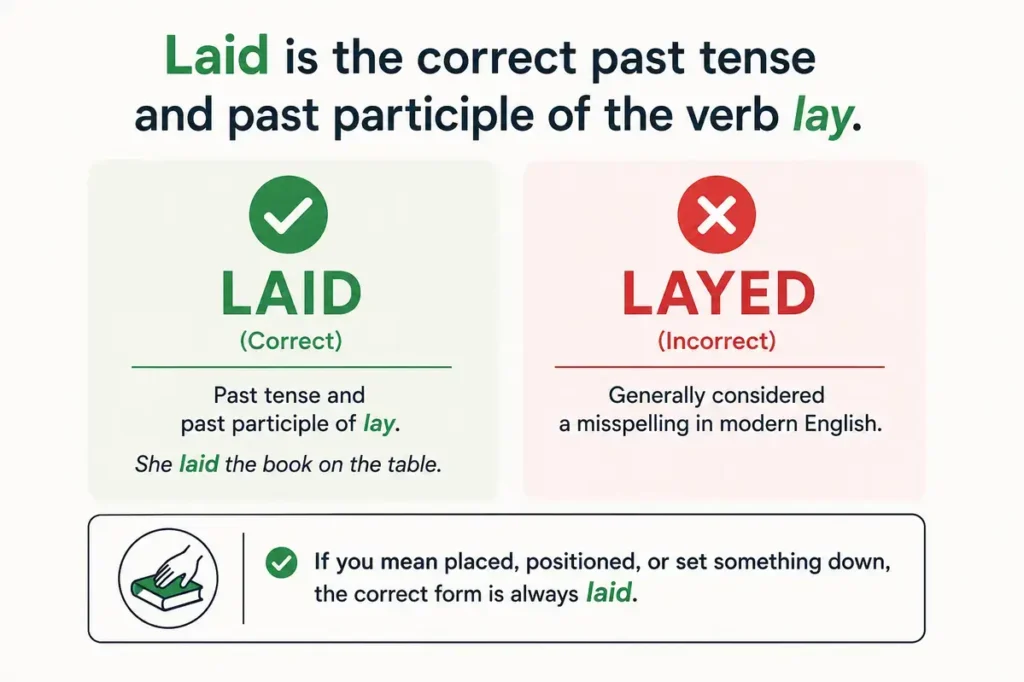
Laid is the correct past tense and past participle of the verb lay. Layed is generally considered a misspelling in modern English. If you mean placed, positioned, or set something down, the correct form is always laid.
Laid Or Layed Quick Answer
The answer is simple.
Use laid.
Avoid layed.
Correct:
- She laid the book on the table.
- The workers laid new flooring.
- He had laid the tools aside.
Incorrect:
- She layed the book on the table.
- The workers layed new flooring.
- He had layed the tools aside.
In standard English, laid is the accepted form.
Laid Or Layed Comparison Table
| Feature | Laid | Layed |
|---|---|---|
| Correct Standard English | Yes | No |
| Meaning | Past tense of lay | Usually a misspelling |
| Part Of Speech | Verb | Nonstandard form |
| Usage Frequency | Extremely common | Rare |
| Accepted In Formal Writing | Yes | No |
| Dictionary Recognition | Yes | Limited and specialized |
| Educational Usage | Standard | Incorrect |
| Grammar Status | Correct | Usually incorrect |
| Example | She laid the blanket down. | She layed the blanket down. |
Meaning Of Laid Or Layed
What Does Laid Mean?
Laid is the past tense and past participle form of the verb lay. Lay means to place, put, set, position, or arrange something.
Examples:
- She laid the keys on the counter.
- They laid fresh concrete yesterday.
- The farmer laid the equipment aside.
- He laid the papers on my desk.
- Workers laid railroad tracks across the region.
In every example, an object is being placed somewhere.
What Does Layed Mean?
In modern English, layed is generally considered an incorrect spelling of laid. Most dictionaries, teachers, editors, and style guides identify layed as a spelling error when writers intend to use the past tense of lay. There are a few rare technical and historical exceptions involving specialized terminology, but these do not apply to normal writing. For everyday English, writers should use laid.
Key Differences Between Laid Or Layed
This comparison differs from many grammar articles because only one option is correct in standard English.
Spelling Difference
- Laid is the accepted spelling.
- Layed is usually a misspelling.
Grammar Difference
- Laid functions as the past tense and past participle of lay.
- Layed does not function as a standard verb form.
Dictionary Difference
- Laid appears in all major dictionaries.
- Layed is generally marked as nonstandard or limited to rare contexts.
Professional Writing Difference
- Laid is appropriate for academic, business, and professional writing.
- Layed should be avoided.
Usage Difference
- Native speakers regularly use laid.
- Native speakers rarely use layed intentionally.
Why People Confuse Laid Or Layed
The confusion is understandable. English contains many verbs that form the past tense by adding ed.
Examples:
- Play becomes played.
- Stay becomes stayed.
- Delay becomes delayed.
- Display becomes displayed.
Many writers assume lay follows the same pattern.
It doesn’t.
Lay is an irregular verb.
Its forms are:
- Lay.
- Laid.
- Laid.
Examples:
- I lay the book down every evening.
- Yesterday I laid the book down.
- I have laid the book down many times.
Because this pattern breaks expectations, people often write layed by mistake.
Laid Or Layed In Everyday Writing
Most instances of layed online are simple spelling errors. Common examples include:
Incorrect:
- I layed the phone on the table.
- She layed the baby in the crib.
- We layed the foundation last year.
Correct:
- I laid the phone on the table.
- She laid the baby in the crib.
- We laid the foundation last year.
The correct form remains laid in every example.
Laid Or Layed In Professional Communication
Professional writing requires correct verb forms.
Examples:
- The contractor laid the foundation.
- Engineers laid the pipeline.
- The company laid new fiber optic cables.
- Staff members laid out the proposal.
- Workers laid new flooring throughout the building.
Using layed in business documents, reports, or academic work can reduce credibility and create a negative impression.
Which Form Appears More Often?
Laid appears millions of times across books, newspapers, academic journals, websites, and professional publications. Layed appears mostly in:
- Typing mistakes.
- Informal online writing.
- Grammar discussions.
- Rare specialized references.
The overwhelming preference for laid reflects standard English usage.
Quick Memory Trick For Laid Or Layed
If you’re tempted to write layed, stop and test the sentence. Ask yourself:
Does the verb come from lay? If the answer is yes, use laid.
Examples:
- She laid the notebook down.
- They laid the carpet yesterday.
- The workers laid bricks all afternoon.
Think of it this way: Play becomes played. Lay becomes laid. The spelling changes because lay is irregular. That simple reminder prevents one of the most common spelling mistakes in English.
For another common grammar confusion, see Preform vs Perform Meaning and Usage Guide in 2026.
Which One Is Correct In Laid Or Layed?
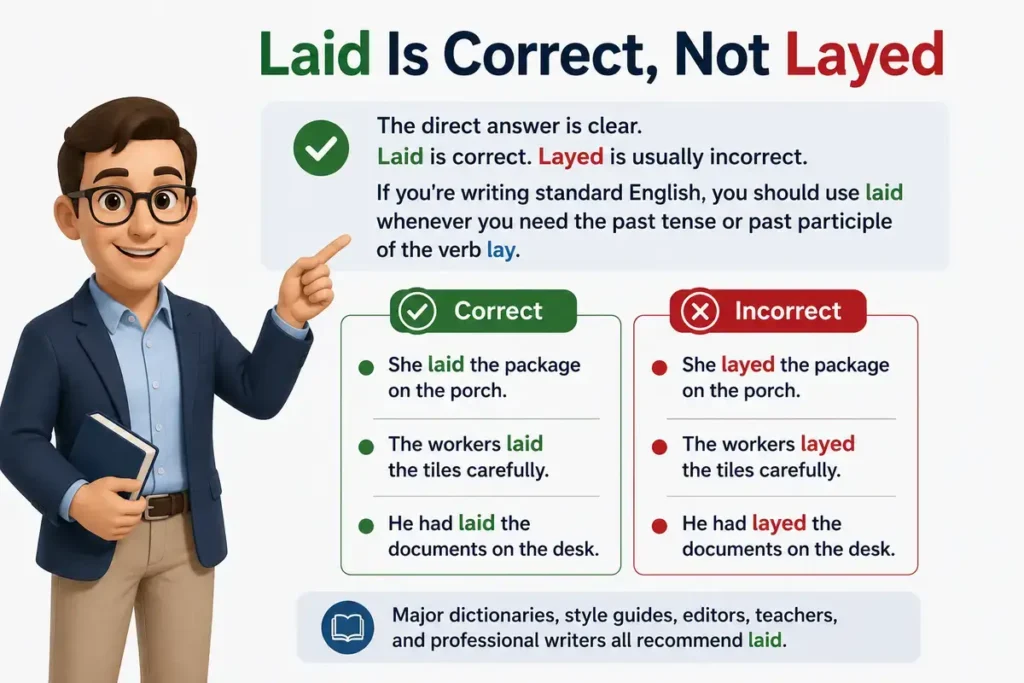
The direct answer is clear. Laid is correct. Layed is usually incorrect. If you’re writing standard English, you should use laid whenever you need the past tense or past participle of the verb lay.
Examples:
Correct:
- She laid the package on the porch.
- The workers laid the tiles carefully.
- He had laid the documents on the desk.
Incorrect:
- She layed the package on the porch.
- The workers layed the tiles carefully.
- He had layed the documents on the desk.
Major dictionaries, style guides, editors, teachers, and professional writers all recognize laid as the standard form.
Why Is Laid Correct?
The verb lay is irregular.
Its forms are:
| Verb Form | Word |
|---|---|
| Base Form | Lay |
| Past Tense | Laid |
| Past Participle | Laid |
| Present Participle | Laying |
Examples:
- I lay the book on the table every night.
- Yesterday I laid the book on the table.
- I have laid the book on the table many times.
- I am laying the book on the table now.
Notice that layed never appears.
Laid Or Layed Examples In Sentences
Examples help reinforce the correct usage.
Correct Examples Using Laid
- She laid the blanket across the bed.
- The farmer laid the tools beside the barn.
- Workers laid fresh asphalt on the road.
- He laid the keys on the counter.
- The teacher laid the papers on her desk.
- They laid the foundation last spring.
- The chef laid the ingredients on the table.
- We laid the plans aside for later review.
- The company laid new cables underground.
- She carefully laid the baby in the crib.
Incorrect Examples Using Layed
These examples show common mistakes.
- She layed the blanket across the bed.
- The farmer layed the tools beside the barn.
- Workers layed fresh asphalt on the road.
- He layed the keys on the counter.
- The teacher layed the papers on her desk.
- They layed the foundation last spring.
- The chef layed the ingredients on the table.
- We layed the plans aside.
- The company layed new cables underground.
- She layed the baby in the crib.
Every sentence above should use laid instead.
Common Mistakes In Laid Or Layed
This spelling issue appears so frequently because English contains many regular verbs ending in ed. Let’s examine the most common errors.
Assuming Lay Follows The Same Pattern As Play
Many writers think:
- Play becomes played.
- Stay becomes stayed.
- Lay becomes layed.
That logic seems reasonable. However, lay is irregular. The correct form is laid.
Confusing Lay And Lie
This is another major source of confusion. Lay and lie are different verbs. Lay means to place something.
Examples:
- I lay the book down.
- Yesterday I laid the book down.
Lie means to recline or rest.
Examples:
- I lie on the couch.
- Yesterday I lay on the couch.
Notice that lay can actually be the past tense of lie. This overlap confuses many writers.
Using Layed In Professional Documents
Business reports, academic papers, and professional emails should always use laid.
Example:
Correct:
- The contractor laid the foundation.
Incorrect:
- The contractor layed the foundation.
Trusting Spellcheck Too Much
Some writing tools fail to catch contextual grammar mistakes. Writers should still understand the underlying rule.
Laid Or Layed Pronunciation Guide
Pronunciation is surprisingly easy because only one form is standard.
Laid Pronunciation
IPA:
/leɪd/
Syllable Breakdown:
Laid
The word contains one syllable.
It rhymes with:
- Made.
- Paid.
- Fade.
- Grade.
- Trade.
Examples:
- She laid the book down.
- They laid the bricks yesterday.
Layed Pronunciation
Because layed is generally a misspelling, speakers who use it typically pronounce it exactly like laid.
IPA:
/leɪd/
The pronunciation is the same. The issue involves spelling rather than sound.
Common Pronunciation Mistakes
- Adding an extra syllable.
- Overemphasizing the vowel sound.
- Assuming pronunciation differs because spelling differs.
In practice, native speakers pronounce both spellings the same way.
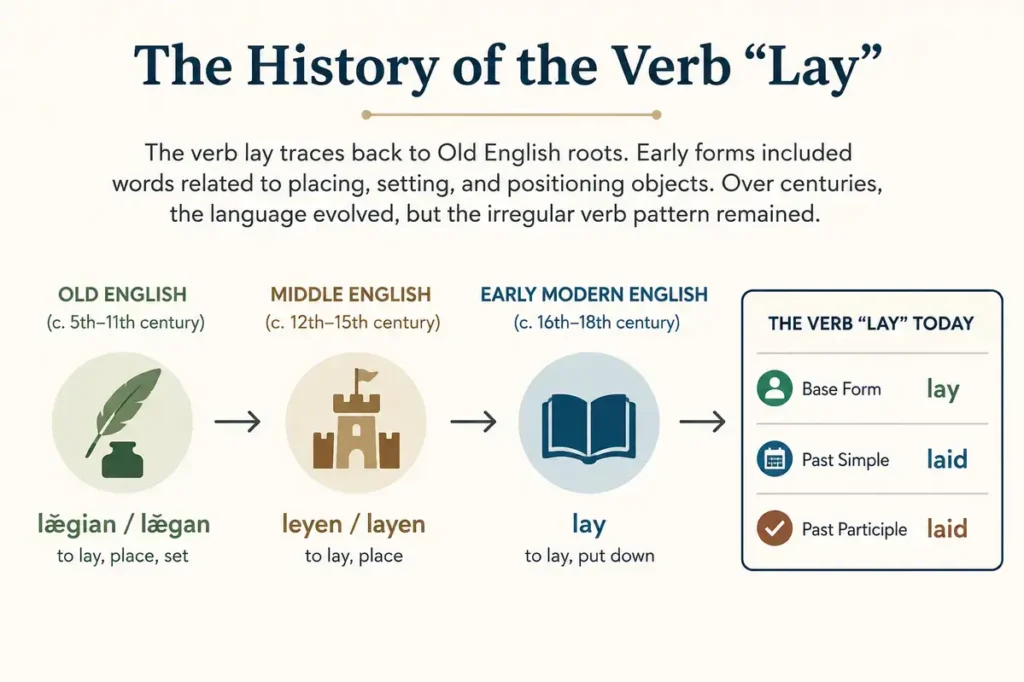
Etymology And Word Origin Of Laid Or Layed
The history of laid helps explain why its spelling appears unusual.
Old English Origins
The verb lay traces back to Old English roots. Early forms included words related to placing, setting, and positioning objects. Over centuries, the language evolved, but the irregular verb pattern remained.
Development Of Laid
The past tense eventually developed into laid rather than layed. This change occurred through historical sound and spelling evolution. Many common English verbs retain similar irregular patterns.
Examples include:
- Say becomes said.
- Pay becomes paid.
- Lay becomes laid.
Because these forms developed centuries ago, they don’t follow modern spelling expectations.
Why Layed Appears Logical
Modern English speakers naturally expect verbs ending in y to take ed.
Examples:
- Play becomes played.
- Delay becomes delayed.
- Enjoy becomes enjoyed.
Since lay resembles these verbs, many writers mistakenly create layed. The historical development of English grammar prevents that form from becoming standard.
Laid Or Layed Regional Usage
One interesting aspect of this topic is the lack of regional variation. Unlike many spelling differences, this rule remains consistent across major English speaking countries.
American English
American English uses laid.
Examples:
- The workers laid the concrete.
- She laid the book on the table.
British English
British English also uses laid.
Examples:
- The builders laid the bricks.
- He laid the documents aside.
Australian English
Australian English follows the same rule.
Examples:
- The crew laid the pipeline.
- She laid the equipment down.
Canadian English
Canadian English also uses laid.
Examples:
- Workers laid new tracks.
- The contractor laid the flooring.
International English
Across virtually all English speaking regions:
- Laid is standard.
- Layed is considered incorrect.
This makes the rule unusually straightforward.
Laid Or Layed Grammar Rules
Understanding the grammar behind laid helps eliminate confusion permanently.
Part Of Speech
Laid functions as a verb. Specifically, it serves as:
- Past tense of lay.
- Past participle of lay.
Present Tense Forms
Examples:
- I lay the book on the table.
- They lay the equipment carefully.
Past Tense Forms
Examples:
- I laid the book on the table.
- They laid the equipment carefully.
Present Participle Forms
Examples:
- I am laying the book down.
- They are laying the equipment carefully.
Past Participle Forms
Examples:
- I have laid the book down.
- They have laid the equipment carefully.
Common Sentence Structures
Subject + Laid + Object
Examples:
- She laid the blanket down.
- He laid the phone beside the bed.
- Workers laid the pavement.
Subject + Has/Have + Laid + Object
Examples:
- She has laid the groundwork.
- They have laid new pipes.
- We have laid the plans aside.
Editor’s Grammar Observation
As an editor, I’ve found that laid or layed errors often appear in otherwise excellent writing. The reason is simple. People rely on spelling patterns rather than memorizing irregular verbs. The fastest way to avoid mistakes is remembering that lay belongs to the same family as say and pay.
Examples:
- Say becomes said.
- Pay becomes paid.
- Lay becomes laid.
Once writers make that connection, the temptation to write layed usually disappears.
Strong writing depends on accurate grammar, and this is one rule worth mastering because it appears frequently in everyday communication.
Laid Or Layed In Real Life Usage
Grammar rules become easier to remember when you see how native speakers use words in everyday situations.
Laid Or Layed In Daily Conversation
In ordinary conversation, native speakers consistently use laid.
Examples:
- I laid my phone on the kitchen counter.
- She laid the groceries on the table.
- We laid the blankets out before the guests arrived.
- He laid the remote beside the couch.
- They laid the boxes in the garage.
Using layed in these situations would sound incorrect to most native English speakers.
Laid Or Layed In Academic Writing
Academic writing requires standard grammar and spelling.
Examples:
- Researchers laid the foundation for future studies.
- The scientist laid out the methodology clearly.
- The author laid the evidence before the committee.
- Scholars laid the groundwork for modern theories.
- The report laid out several recommendations.
Universities, journals, and academic publishers expect laid rather than layed.
Laid Or Layed In Professional Communication
Business writing follows the same rule.
Examples:
- The manager laid out the project timeline.
- The company laid new infrastructure last year.
- Engineers laid the cables beneath the roadway.
- The consultant laid out a strategic plan.
- Staff members laid the documents on the conference table.
Using layed in a professional report or proposal may create an impression of poor proofreading.
Laid Or Layed In Literature
Writers have used laid for centuries.
Examples:
- The knight laid his sword upon the stone.
- She laid her hand gently on his shoulder.
- The traveler laid his belongings beside the fire.
- The mother laid the child in bed.
- The artist laid brushstrokes across the canvas.
Classic and modern literature consistently uses laid.
Laid Or Layed In Media
News organizations and professional publications also follow standard grammar.
Examples:
- Workers laid hundreds of miles of track.
- Officials laid out plans for the project.
- The company laid new fiber optic lines.
- Engineers laid the foundation for expansion.
- The committee laid out its findings.
You’ll rarely see layed in reputable publications unless the article discusses spelling mistakes themselves.
Related Words And Confused Terms
Many writers searching for laid or layed are actually struggling with a broader group of confusing verbs. Understanding these related terms helps eliminate future grammar mistakes.
Lay
Lay means to place or put something somewhere.
Examples:
- Please lay the book on the table.
- Lay the keys near the door.
Laying
Laying is the present participle form of lay.
Examples:
- She is laying the plates on the table.
- Workers are laying new pavement.
Lie
Lie means to recline or rest.
Examples:
- I want to lie down.
- The dog likes to lie by the fireplace.
Lay As The Past Tense Of Lie
This creates major confusion.
Examples:
- Today I lie on the couch.
- Yesterday I lay on the couch.
Notice that lay can function as the past tense of lie.
Lain
Lain is the past participle of lie.
Examples:
- He has lain there all afternoon.
- The papers have lain untouched for weeks.
Laid Out
This common phrasal verb means arranged, explained, or organized.
Examples:
- She laid out the schedule.
- The proposal was laid out clearly.
Laid Off
This phrase means dismissed from employment.
Examples:
- Several workers were laid off.
- The company laid off employees during the recession.
These related forms are common in everyday English and often appear alongside discussions about laid.
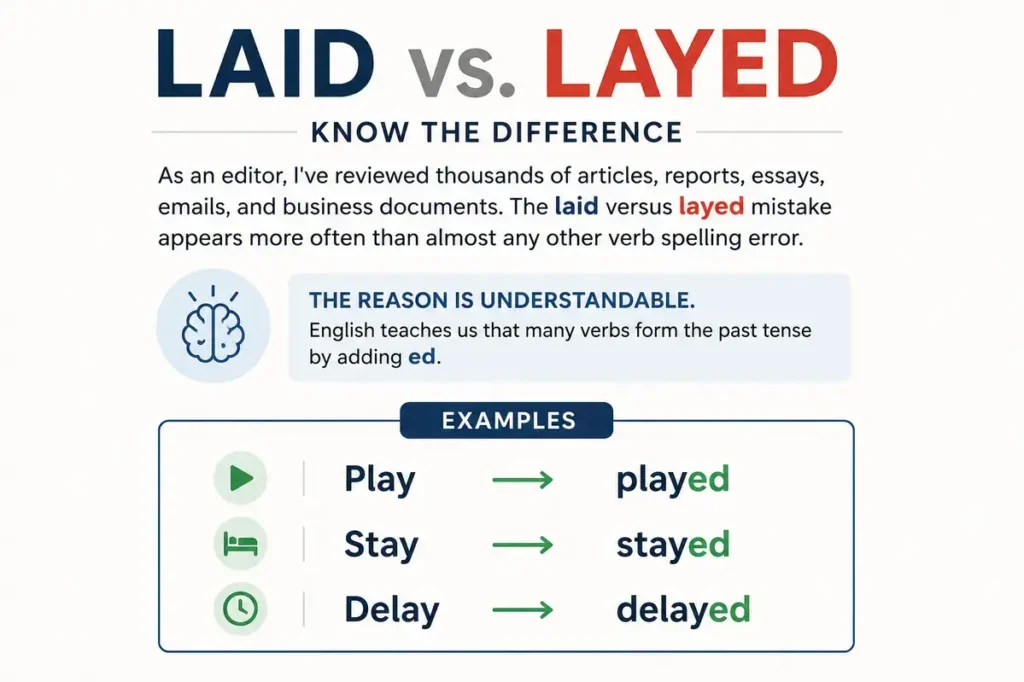
Expert Language Insight
As an editor, I’ve reviewed thousands of articles, reports, essays, emails, and business documents. The laid versus layed mistake appears more often than almost any other verb spelling error. The reason is understandable. English teaches us that many verbs form the past tense by adding ed.
Examples include:
- Play becomes played.
- Stay becomes stayed.
- Delay becomes delayed.
Writers naturally expect lay to follow the same pattern. English has other plans. The language is filled with irregular verbs that developed over centuries and ignored modern spelling logic. Lay belongs to that group. Native speakers almost always write laid. In fact, many people who accidentally write layed recognize the mistake immediately when reading the sentence aloud. A useful editing strategy is to connect lay with pay and say.
Examples:
- Pay becomes paid.
- Say becomes said.
- Lay becomes laid.
That mental pattern helps many writers remember the correct spelling instantly. Another observation from years of editing is that readers often notice layed immediately. Even if the rest of the content is excellent, the error tends to stand out because it appears in such a common verb. Learning this rule once can improve your writing for the rest of your life.
A related grammar guide is Reins and Reigns Definitions Examples and Grammar Guide 2026.
Laid Or Layed Conclusion
The answer to laid or layed is simple. Laid is the only correct spelling in standard English. It is the past tense and past participle of the verb lay, while layed is a common misspelling that should be avoided in formal and everyday writing.
You will see laid in books, newspapers, academic writing, business communication, and everyday conversation because it follows the correct grammar rule for the irregular verb lay. If you use layed, most readers and grammar checkers will treat it as an error.
An easy way to remember the correct spelling is to think of other irregular verbs. Pay becomes paid, say becomes said, and lay becomes laid. Keeping this pattern in mind makes it easy to choose the correct word every time you write.
Frequently Asked Questions About Laid Or Layed
Is laid or layed correct?
Laid is correct in standard English. It serves as the past tense and past participle of the verb lay. Layed is generally considered a spelling mistake in modern writing.
Why is laid correct instead of layed?
Lay is an irregular verb. English does not form its past tense by adding ed. Instead, the accepted historical form is laid, similar to how pay becomes paid.
Is layed ever a real word?
In rare technical or historical contexts, some dictionaries note limited uses of layed. However, these situations are extremely uncommon. For everyday writing, laid is the correct choice.
How do I remember the difference between laid and layed?
Think of similar irregular verbs. Pay becomes paid and lay becomes laid. This pattern helps many writers remember the correct spelling quickly.
Is laid the past tense of lay?
Yes. The verb forms are:
- Lay.
- Laid.
- Laid.
- Laying.
Layed does not belong in the standard verb pattern.
Do Americans and British people both use laid?
Yes. American English, British English, Canadian English, and Australian English all use laid as the standard form.
Is layed accepted in academic writing?
No. Academic institutions, journals, publishers, and style guides expect the standard form laid.
Why do so many people write layed?
People often apply regular verb rules to an irregular verb. Since words like play become played, many assume lay should become layed. English grammar treats lay differently.
1 thought on “Laid or Layed Which Word Should You Use in 2026”