
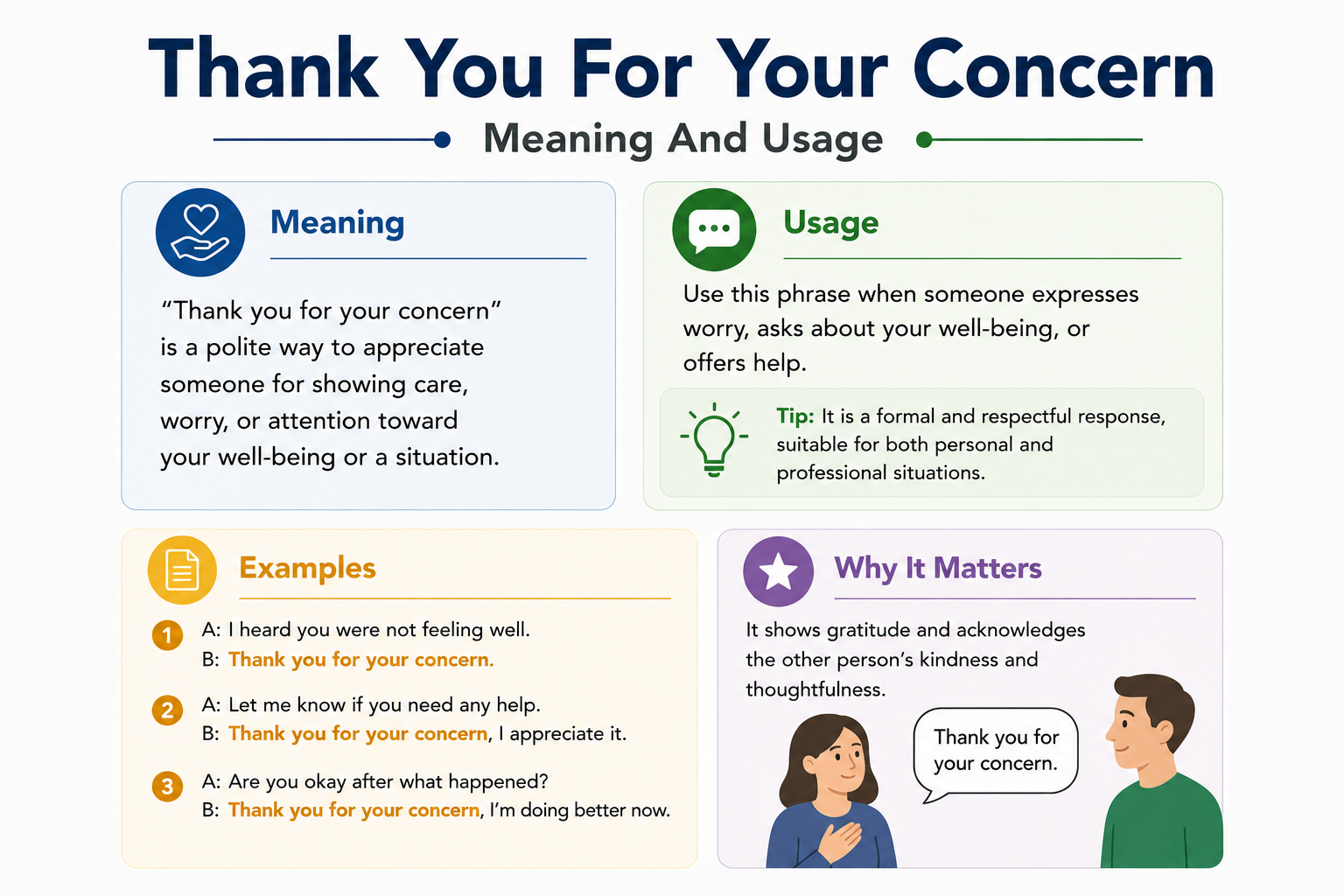
When someone says they care about your situation, you may want to respond politely without sounding cold or overly formal. Thank you for your concern is a standard English expression used for exactly that purpose. It shows appreciation for another person’s care or attention.
The phrase can sound warm and sincere, but its tone depends heavily on context. In a friendly conversation, it can express genuine gratitude. In a difficult conversation, it can also create polite distance. A person might use it when discussing health, work problems, family matters, complaints, or another personal issue.
The good news is that the grammar is simple. The phrase is correct and natural English. The real challenge is choosing the right tone and knowing when a warmer or more casual alternative would sound better. This guide explains the meaning, grammar, pronunciation, examples, common mistakes, alternatives, and subtle differences in tone.
For another common grammar confusion, see is incode a word Correct Spelling Meaning and Usage.
Quick Answer
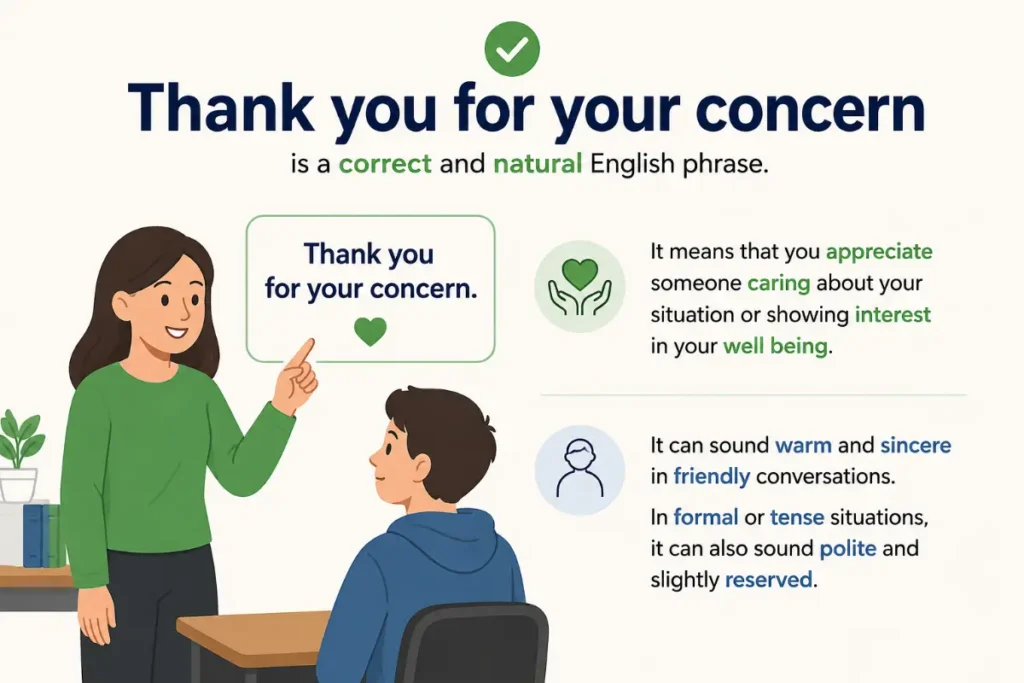
Thank you for your concern is a correct and natural English phrase. It means that you appreciate someone caring about your situation or showing interest in your well being. It can sound warm and sincere in friendly conversations. In formal or tense situations, it can also sound polite and slightly reserved.
Quick Answer For Everyday Use
If someone tells you that they are worried about you, you can use this phrase to acknowledge their kindness.
For example:
Thank you for your concern. I really appreciate it.
You can also make the expression warmer by adding a personal response.
Thank you for your concern. I’m doing much better now.
The phrase doesn’t necessarily mean that you agree with the other person’s worries. It simply acknowledges their concern and expresses appreciation for their attention.
Meaning And Definition
The phrase expresses gratitude toward someone who has shown concern about you or a situation affecting you.
Here concern means care, interest, or worry about a person or matter. It doesn’t always mean serious fear. Someone can show concern because they care about your health, your work, your safety, your family, or your general well being.
Consider this example:
I was sick last week, but I’m feeling better now. Thank you for your concern.
The speaker appreciates the other person’s care.
The phrase can also refer to concern about a situation rather than a person.
Thank you for your concern about the project.
Here the speaker is acknowledging someone’s interest or worry about the project.
The expression is therefore broader than a simple thank you. It specifically recognizes another person’s care or attention.
Grammar And Structure
The phrase contains three main parts.
- Thank is a verb used to express gratitude.
- You is the person receiving the gratitude.
- For your concern explains the reason for the thanks.
The word your is a possessive determiner. It shows that the concern belongs to the person being addressed.
Concern functions as a noun in this expression.
The basic pattern is:
Thank + person + for + noun.
You can use the same structure in many everyday expressions.
Thank you for your help.
Thank you for your kindness.
This pattern makes the expression easy to understand and use correctly.
Is The Phrase Grammatically Correct
Yes. The phrase follows a standard English grammar pattern.
The verb thank commonly takes a person as its object and uses for to introduce the reason for gratitude.
For example:
Thank you for your advice.
Thank you for your patience.
All four sentences follow the same grammatical structure.
The phrase also works well as a complete response because the subject and verb are understood from the expression itself. English commonly uses this type of structure in polite conversation.
Comparison With Similar Expressions
The best alternative depends on the situation and the relationship between the speakers.
| Expression | Meaning | Formality | Common Context | Example |
|---|---|---|---|---|
| Thank you for your concern | Appreciation for someone’s care or worry | Neutral to formal | Personal and professional situations | Thank you for your concern. I’m feeling better now. |
| I appreciate your concern | Stronger acknowledgment of someone’s care | Formal | Work and serious conversations | I appreciate your concern about the issue. |
| Thanks for checking in | Appreciation for someone asking how you are | Casual | Friends and coworkers | Thanks for checking in. I’m doing fine. |
| Thanks for caring | Appreciation for emotional support | Casual | Close relationships | Thanks for caring about me. |
| Thank you for asking | Appreciation for someone’s question | Neutral | Conversation | Thank you for asking. I’m doing well. |
| I appreciate you asking | Appreciation for someone’s interest | Neutral | Personal and professional settings | I appreciate you asking about my family. |
These expressions overlap in meaning, but they aren’t always interchangeable.
What Concern Means In This Phrase
Concern has several meanings in English. That can make the phrase slightly confusing for learners.
In this context, concern means care, worry, or interest in someone’s condition or situation.
For example:
Her parents expressed concern about her health.
The word describes their worry and care.
Concern can also mean something that affects or involves a person.
The rising cost of housing is a major concern for many families.
Here concern means an important issue rather than emotional worry.
It can also function as a verb.
The decision concerns every employee.
In the phrase being discussed here, however, concern is clearly a noun.
When To Use The Expression
You can use the expression whenever someone has shown care or worry about you or something connected to you.
Common situations include health concerns.
Thank you for your concern about my health. I’m recovering well.
You can also use it after someone asks about a difficult personal situation.
Thank you for your concern. Things are getting better.
It works in professional communication too.
Thank you for your concern regarding the delay. We’re working to resolve the issue.
The expression can also be useful when you want to remain polite during a disagreement.
Thank you for your concern. I understand your point.
That last example shows an important feature of the phrase. It acknowledges the other person without necessarily agreeing with them.
When The Phrase Sounds Warm
Tone comes from the surrounding words and the situation.
If you add a personal statement after the phrase, it usually sounds warmer.
Thank you for your concern. That means a lot to me.
Thank you for your concern. I really appreciate your kindness.
Thank you for your concern. I’m lucky to have supportive friends.
These versions clearly communicate genuine gratitude.
A warm tone also comes from the relationship between the speakers. Among close friends or family members, a more personal phrase such as thanks for caring may sound more natural.
When The Phrase Sounds Formal
The expression often sounds more formal than thanks for checking in or thanks for caring.
That makes it useful in workplaces and serious conversations.
For example:
Thank you for your concern regarding my absence.
Thank you for your concern. I’ll keep you updated.
This tone can be helpful when you want to remain respectful and professional.
It can also sound slightly distant if used with someone close to you during an emotional conversation. In that setting, a warmer response may feel more natural.
Can It Sound Sarcastic
Yes. Context can completely change the emotional effect of a polite phrase.
Imagine someone repeatedly gives unwanted advice. You might respond with:
Thank you for your concern. I’ll handle it.
The words are polite on the surface, but the speaker may be signaling that they don’t want further advice.
The same phrase can therefore express sincere gratitude or polite distance.
This isn’t a grammar problem. It’s a matter of pragmatics. Pragmatics is the study of how meaning changes according to context, speaker intention, relationship, and situation.
In writing, punctuation and surrounding sentences can also influence how readers interpret tone.
In speech, facial expression, voice, and emphasis play an even bigger role.
Ten Natural Sentence Examples
- Thank you for your concern. I’m feeling much better today.
- Thank you for your concern about my family. Everyone is doing well now.
- I appreciate your message. Thank you for your concern.
- Thank you for your concern regarding the delay. We’re working on a solution.
- Thank you for your concern. I’ll let you know if anything changes.
- She thanked her coworkers for their concern after the accident.
- Thank you for your concern about my health. I’ve already spoken with my doctor.
- We appreciate your concern about the changes and understand why you asked.
- Thank you for your concern. Your support has been very helpful.
- He sent a short message to thank his friends for their concern.
These examples show how flexible the phrase can be. It works in personal conversations, professional messages, and more serious situations.
Examples In Everyday Conversation
A friend might ask:
Are you okay? You seemed upset earlier.
You could answer:
I’m okay now. Thank you for your concern.
A family member might call after hearing that you were sick.
Thank you for your concern. I’m recovering well.
A neighbor might ask about an accident near your home.
Thank you for your concern. Nobody in our family was hurt.
In everyday speech, the phrase is polite and clear. However, close friends often choose more relaxed alternatives.
Thanks for checking in.
Thanks for asking.
I appreciate you checking on me.
Thanks for caring.
These options usually feel more conversational.
Examples In Workplace Communication
Professional communication often requires a respectful and measured tone.
You might write:
Thank you for your concern regarding the missed deadline. We have already adjusted the schedule.
Another example is:
Thank you for your concern about the issue. I’m reviewing the matter and will respond soon.
The phrase can help you respond politely without becoming overly emotional.
It also works when responding to a manager, client, coworker, or business partner.
Thank you for your concern about the project. We’re taking the necessary steps to address the problem.
In professional writing, the expression is especially useful because it recognizes another person’s concern without making the message too personal.
Examples In Academic Writing
The phrase can appear in academic or institutional communication when someone raises a legitimate concern.
For example:
Thank you for your concern regarding the research process. The issue has been reviewed.
Another example:
Thank you for your concern about the proposed changes. Your feedback has been recorded.
Academic writing usually favors a more neutral tone. The phrase fits that purpose well.
Still, don’t use it simply because you want your writing to sound sophisticated. Simple language often communicates more effectively.
Examples In Emails
Email tone depends on the relationship and subject.
A formal response might say:
Thank you for your concern regarding my recent absence. I’m recovering and expect to return soon.
A slightly warmer email could say:
Thank you for your concern. I really appreciate you checking on me.
A casual email to a coworker might sound more natural as:
Thanks for checking in. I’m doing much better now.
Choose the version that matches the relationship.
Examples In Difficult Conversations
This phrase can be useful when someone is worried about a decision you have made.
For example:
Thank you for your concern. I’ve considered the situation carefully.
This response is respectful but doesn’t invite an argument.
You can also say:
I appreciate your concern. I understand why you’re worried.
That version sounds more empathetic because it directly recognizes the other person’s feelings.
If you want to close the conversation politely, you could say:
Thank you for your concern. I’ll take it from here.
This wording is firm but still courteous.
Common Mistakes
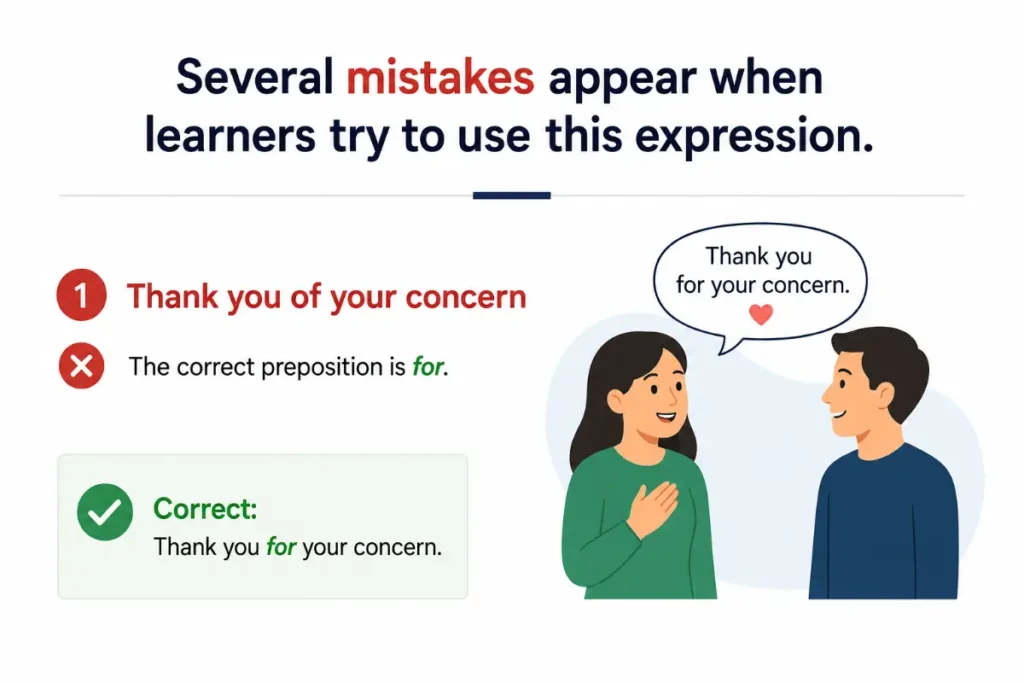
Several mistakes appear when learners try to use this expression.
- Thank you of your concern
The correct preposition is for.
Correct:
Thank you for your concern.
The mistake often happens because learners transfer patterns from another language.
- Thank you for you concern
The possessive form your is needed.
Correct:
Thank you for your concern.
You refers to the person. Your shows possession.
- Thank you for concern
This version isn’t always grammatically impossible in English, but it sounds unnatural in this context because the speaker normally identifies whose concern they appreciate.
The natural form is:
Thank you for your concern.
- Thanks you for your concern
Thanks is already an informal expression of gratitude. Thank you uses the verb thank.
Correct:
Thank you for your concern.
Or:
Thanks for your concern.
- Thank you about your concern
The normal structure uses for after thank when explaining the reason for gratitude.
Correct:
Thank you for your concern.
Pronunciation Guide
The phrase can be pronounced naturally as:
Thank you for your concern.
The IPA pronunciation is approximately:
/θæŋk juː fər jʊr kənˈsɜːrn/
American English speakers often reduce for in connected speech. It may sound closer to fer in casual conversation.
The main stress usually falls on concern when the speaker wants to emphasize the subject of the gratitude.
The word concern has two syllables.
con CERN
The second syllable receives the main stress.
A common learner mistake is putting equal stress on every word. Native English speech usually gives more emphasis to important content words while reducing small function words.
Is Concern A Noun Or Verb
In this expression, concern is a noun.
That distinction matters because the same word can also function as a verb.
As a noun:
Her concern was understandable.
As a verb:
The issue concerns several employees.
The noun concern can refer to worry, care, interest, or an important matter.
The exact meaning comes from context.
In the expression under discussion, it refers to another person’s care or worry about you or your situation.
A related grammar guide is Thank You For The Information Correct Usage And Meaning.
Etymology And Word Origin
The word concern has roots in Latin. It developed through French before becoming established in English.
Its historical development is connected with ideas such as being connected with something or having a direct relation to it. Over time, the word developed several related meanings involving interest, involvement, care, and worry.
The modern meanings still show that connection.
If something concerns you, it affects or involves you.
If you have concern for someone, you care about that person or worry about their situation.
The word thank also has a long history in English and is related to the broader Germanic family of words associated with thought and gratitude. Its modern use became closely connected with expressing appreciation.
Together, the words form a standard expression of gratitude for another person’s care.
American English Usage
The expression is standard in American English.
American speakers use it in personal, professional, medical, workplace, and institutional communication.
The level of formality depends on context.
Thank you for your concern.
This sounds neutral and polite.
Thanks for checking in.
This sounds more casual.
I really appreciate you checking on me.
This sounds warmer and more personal.
There isn’t a special American spelling of the phrase. The standard form remains the same.
British English Usage
British English also uses the phrase naturally.
The meaning is essentially the same in British and American English.
A British speaker might also choose expressions such as:
Thank you for your concern.
I appreciate your concern.
Thanks for asking.
Thanks for checking in.
The main difference comes from personal style and context rather than grammar.
Canadian English Usage
Canadian English uses the phrase in much the same way as American and British English.
There is no major regional distinction in the expression itself.
Canadian speakers can use it in formal correspondence, workplace communication, personal conversations, and situations involving concern about health or safety.
The surrounding language determines the level of warmth or formality.
Australian English Usage
Australian English also recognizes the phrase as standard English.
In casual Australian conversation, speakers may prefer shorter expressions such as thanks for checking in or thanks for asking.
The full expression can still sound completely natural in professional or serious situations.
Regional English varieties often differ more in conversational style than in the basic grammar of a common expression like this one.
Formal And Informal Alternatives
The best alternative depends on what you want to communicate.
- I appreciate your concern
This is slightly more formal and can sound especially appropriate in professional communication.
- Thanks for checking in
This is casual and friendly. It works well when someone asks how you’re doing.
- Thanks for asking
This is simple and natural after someone asks about your situation.
- Thanks for caring
This sounds more personal and emotional. It works best with people you know well.
- I appreciate you asking
This is warm but still fairly neutral.
- Thank you for checking on me
This directly recognizes someone’s effort to make sure you’re okay.
- I really appreciate your support
This focuses more on emotional or practical support than concern itself.
- That means a lot to me
This is warmer and more personal. It works well when you genuinely feel touched by someone’s kindness.
Difference Between Concern And Care
Concern and care overlap but aren’t identical.
Care usually suggests affection, kindness, or personal attachment.
Concern often suggests worry or attention because something may be wrong.
For example:
Thanks for caring about me.
This sounds affectionate.
Thank you for your concern about my health.
This emphasizes worry or attention.
That’s why the two expressions can create different emotional impressions even though both communicate appreciation.
Difference Between Concern And Worry
Worry usually has a stronger negative feeling.
If you say:
I was worried about you.
You clearly communicate anxiety or fear that something might be wrong.
Concern is often softer and more formal.
I was concerned about you.
This can still express worry, but it sounds more measured.
The noun concern therefore works well in professional settings where the speaker wants to acknowledge an issue without sounding overly emotional.
Difference Between Concern And Interest
Interest can be neutral.
Concern often carries a stronger sense of care or worry.
For example:
Thank you for your interest in the project.
This means you appreciate someone’s attention to the project.
Thank you for your concern about the project.
This suggests that the person may be worried about a problem or possible consequence.
The difference is subtle but important.
Related Terms And Expressions
The following expressions are closely connected to the meaning of the phrase.
- Concern
This can mean worry, care, or an important matter.
- Care
This usually suggests kindness, affection, or attention.
- Worry
This refers more directly to anxious thoughts about a possible problem.
- Support
This refers to help or encouragement provided during a difficult situation.
- Sympathy
This expresses understanding or sadness about another person’s difficulty.
- Empathy
This involves understanding another person’s feelings or experience.
- Kindness
This describes considerate and helpful behavior.
- Compassion
This suggests deep concern for another person’s suffering and a desire to help.
These words overlap, but they aren’t perfect synonyms. Good writing depends on choosing the word that matches the exact feeling or relationship.
Can You Start A Sentence With The Phrase
Yes.
The expression can appear at the beginning of a sentence.
Thank you for your concern. I appreciate your support.
It can also appear after another statement.
I’m feeling better now, so thank you for your concern.
The phrase works especially well as a complete sentence in emails and messages.
You don’t need to add another verb after it for the grammar to be complete.
Can You Use It In A Text Message
Yes. However, the tone may feel formal depending on the relationship.
If a friend sends:
Hey, I heard you weren’t feeling well. Are you okay?
You could reply:
Thank you for your concern. I’m doing much better.
That is correct, but a close friend might expect:
Thanks for checking in. I’m much better now.
The second version sounds more relaxed.
There is no universally best response. The right choice depends on your relationship and the emotional situation.
Can You Say It To A Friend
Yes, but context matters.
If your friend has shown serious concern, the phrase can sound sincere.
Thank you for your concern. I really appreciate it.
If you’re having a relaxed conversation, a casual alternative may sound more natural.
Thanks for checking on me.
Thanks for caring.
I appreciate you asking.
The phrase isn’t too formal to use with friends. It simply carries a more measured tone.
Can You Say It At Work
Yes. It is especially useful in workplace communication.
For example:
Thank you for your concern regarding my absence. I’m recovering well.
It can also work when responding to a manager or coworker.
I appreciate your concern. I’m taking care of the issue.
The expression helps maintain professionalism without sounding overly complicated.
How To Make The Phrase Warmer
If the basic expression feels too formal, add a personal statement.
Thank you for your concern. That really means a lot.
Thank you for your concern. I appreciate you reaching out.
Thank you for your concern. Your message made me feel supported.
These additions give the phrase emotional warmth.
Another option is to use a more conversational expression.
Thanks for checking in. I really appreciate it.
That often feels more natural in everyday American English.
How To Make The Phrase More Formal
For a formal email, you can use:
I appreciate your concern regarding this matter.
This sounds more professional and less personal.
Another option is:
Thank you for expressing your concern regarding the situation.
This version is appropriate for institutional or formal communication.
However, don’t make your writing formal just for the sake of sounding professional. Clear language usually works best.
Expert Editor Insight
An experienced editor looks beyond grammar and asks what the sentence communicates emotionally. This expression is grammatically simple, but its tone can shift from warm gratitude to polite distance depending on the surrounding words. In a friendly message, thanks for checking in may sound more natural. In professional writing, the fuller expression can provide a respectful and controlled tone. Editors also pay attention to the preposition for and the possessive word your because those small details determine the natural structure of the phrase.
A Simple Memory Trick
Remember the pattern:
Thank you for your + noun.
You can use the same structure with many words.
Thank you for your help.
Thank you for your concern.
Once you recognize the pattern, the grammar becomes easy to remember.
The word your belongs before the noun because it identifies the person whose concern you are acknowledging.
Why People Sometimes Sound Too Formal
English learners often believe longer phrases sound more polite. That isn’t always true.
A short sentence can sound warmer than a formal one.
Thanks for checking in.
This may feel more personal than:
Thank you for your concern regarding my situation.
Both are correct. The second simply creates more distance.
Good communication isn’t about choosing the most formal phrase. It’s about matching your words to the situation.
What To Say After Someone Shows Concern
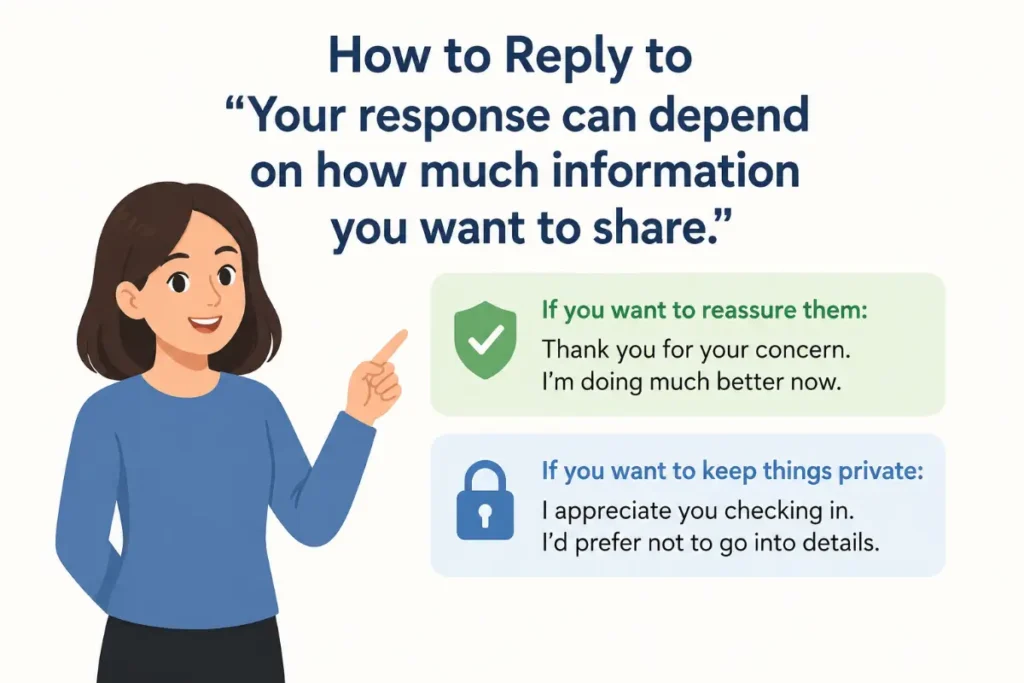
Your response can depend on how much information you want to share. If you want to reassure them: Thank you for your concern. I’m doing much better now. If you want to keep things private: Thank you for your concern. I appreciate you asking. If you want to show warmth: Thank you for your concern. It really means a lot to me. If you want to end the conversation politely: Thank you for your concern. I’ll keep you updated. If you want a casual response: Thanks for checking in. I’m okay. These options let you control both the amount of information and the emotional tone.
Many readers also check jersies or jerseys Correct Spelling And Usage.
Final Takeaway
Thank you for your concern is correct standard English. It expresses appreciation when someone shows care, attention, or worry about you or a situation. The phrase works in both personal and professional settings, although it can sound more formal than thanks for checking in or thanks for asking.
The best choice depends on the relationship and tone you want. With friends, a casual expression may feel warmer. At work, the full phrase can sound respectful and professional. A useful editing tip is to read the sentence with the surrounding context. If it feels too distant, add a personal statement such as I really appreciate it. If you need a neutral and polite response, the standard phrase works perfectly.
Common Questions About The Phrase
Is thank you for your concern correct?
Yes. It is a grammatically correct and widely used English expression. It communicates appreciation for someone’s care, worry, or attention toward you or a situation. The phrase works in personal and professional communication. Its tone can sound warm or formal depending on the surrounding words and the relationship between the speakers.
What does thank you for your concern mean?
It means that you appreciate someone caring about you or showing worry about your situation. Concern can refer to emotional care, practical attention, or worry about a possible problem. The phrase doesn’t necessarily mean you agree with the person’s concerns. It simply acknowledges their attention and expresses gratitude.
Is thank you for your concern formal?
It can sound somewhat formal or measured, especially compared with thanks for checking in or thanks for asking. It is common in professional communication and serious conversations. With close friends, it may still work, but a more casual expression can sound warmer and more natural.
Can I use the phrase in an email?
Yes. It works well in professional emails, especially when someone has contacted you about your health, work, safety, or another personal matter. You can make it warmer by adding I really appreciate it or that means a lot to me. Keep the surrounding language simple so the message doesn’t sound unnecessarily formal.
What is a casual alternative?
Thanks for checking in is one of the most natural casual alternatives. Thanks for asking and thanks for caring can also work. The best choice depends on the situation. Thanks for checking in focuses on someone’s effort to contact you, while thanks for caring carries a more personal and emotional tone.
Can the phrase sound rude?
The words themselves aren’t rude. However, tone and context can make any polite expression sound distant or sarcastic. In a tense conversation, a short response such as thank you for your concern may suggest that you don’t want additional advice. Adding a warmer sentence can make your intention clearer.
What is the difference between concern and care?
Care often suggests kindness, affection, or emotional attachment. Concern can suggest care but often includes worry about a problem. For example, thanks for caring about me sounds personal and affectionate. Thank you for your concern about my health sounds more measured and may fit a professional situation better.
Is the phrase suitable for formal writing?
Yes. The phrase is suitable for formal emails, workplace communication, institutional messages, and other serious contexts. You can also use I appreciate your concern for a slightly more formal tone. The key is to keep the rest of the sentence clear and natural rather than adding unnecessary formal language.