
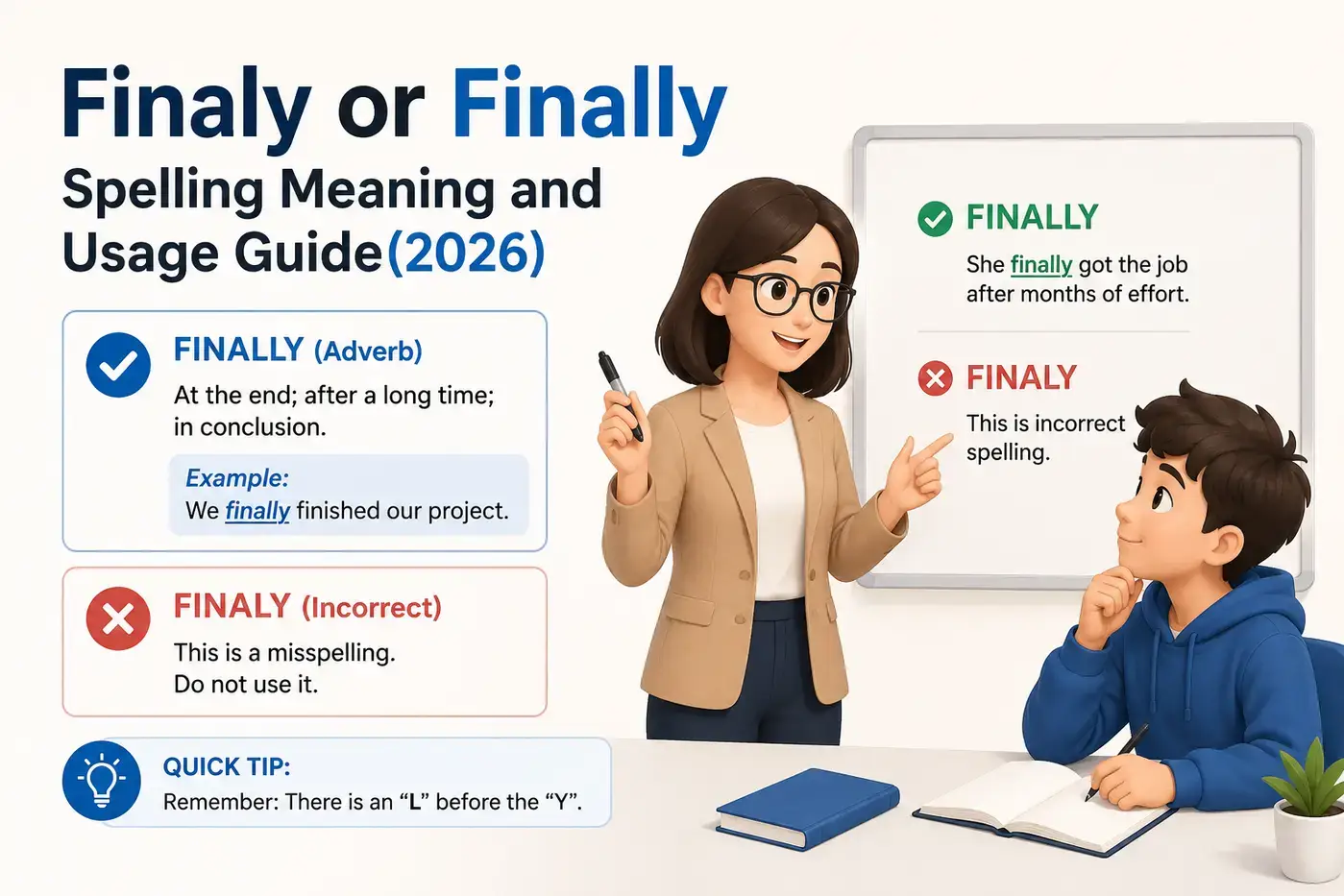
If you’ve ever paused while writing because you weren’t sure if finaly or finally was correct, you’re in good company. This spelling mistake is surprisingly common, even among experienced writers. The good news is that the answer is simple. Finally is the correct spelling. Finaly is a misspelling that isn’t recognized in standard English.
The confusion usually happens because English spelling doesn’t always follow the patterns people expect. Since the base word is final, many assume adding y creates the adverb. In reality, English keeps every letter in the original word before adding the ending, giving us finally with two letters l.
A single missing letter might seem harmless, but it can affect how readers view your writing. Correct spelling builds credibility, makes your message easier to read, and shows attention to detail. This guide explains the difference between the two spellings, how dictionaries treat them, why people make the mistake, and how to remember the correct form. You’ll also find grammar tips, pronunciation help, real examples, and practical advice you can use every time you write.
Learn the difference in Tweek vs Tweak Which Spelling Is Correct?.
Featured Snippet
Finally is the correct English spelling. Finaly is a misspelling and isn’t accepted by standard English dictionaries or editorial style guides. Use finally to describe the last event in a sequence, something that happens after a delay, or the concluding point in speech or writing.
Finaly vs Finally Quick Answer
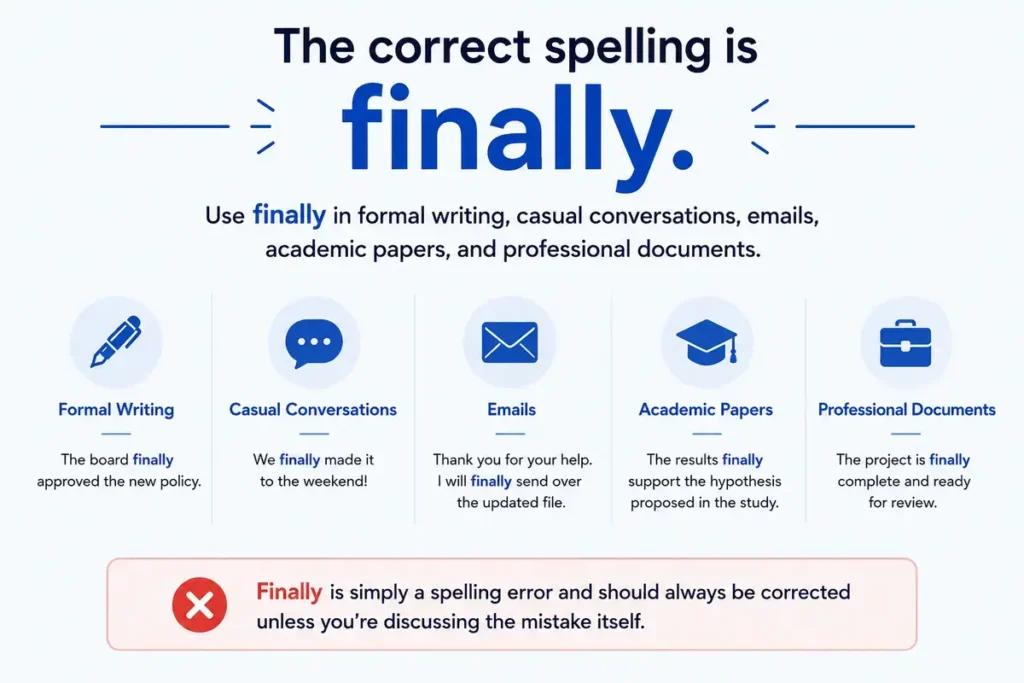
The correct spelling is finally. Use finally in formal writing, casual conversations, emails, academic papers, and professional documents. Finaly is simply a spelling error and should always be corrected unless you’re discussing the mistake itself.
Comparison Table
| Correct Form | Meaning | Part Of Speech | Origin | Usage Frequency | Formality | Common Contexts | Example |
|---|---|---|---|---|---|---|---|
| Finaly | Not a standard English word. Misspelling of finally. | None | Typing error | Very rare | Not accepted | Accidental spelling mistakes | I finaly finished. ❌ |
| Finally | At the end. After a delay. As the last point. | Adverb | From final plus the suffix ly. Rooted in Latin through Old French. | Very common | Formal and informal | Everyday speech, business, education, journalism, books | We finally reached home. |
Meaning And Definition
Meaning Of Finaly
Quick Answer
Finaly isn’t a real English word. It doesn’t appear in major dictionaries as a standard word, accepted spelling, or regional variation. Nearly every example comes from a typing mistake or a simple spelling error. Professional editors treat finaly as a typo instead of an alternative spelling. You may occasionally see it in online posts, text messages, or unedited documents. That doesn’t make it correct. Spelling mistakes spread quickly across the internet, especially when people type in a hurry or rely on memory instead of proofreading.
Some people also wonder if finaly is slang.
The answer is no. It isn’t recognized as slang, informal vocabulary, or a shortened version of another word in modern English. Brand names and usernames can sometimes use unusual spellings, but those are unique names instead of accepted English words. Unless you’re referring to a specific product or company that intentionally uses this spelling, finaly should always be corrected.
Meaning Of Finally
Quick Answer
Finally is an adverb that means at the end, after a long wait, or as the last point in a sequence. It’s one of the most common adverbs in English and appears in every style of writing. You can use finally in several ways. The first meaning describes something that happens after waiting.
Example.
We finally arrived after six hours on the road. The second meaning introduces the last step in a process.
Example.
Finally mix the flour with the butter. The third meaning introduces the concluding point in a discussion or presentation.
Example.
Finally I’d like to thank everyone who supported this project. Because the word often follows effort, delay, or anticipation, it can also express relief.
Compare these examples.
We arrived.
We finally arrived. The second sentence feels more natural because it tells readers the journey took time and has now reached its end.
Etymology
The word comes from the adjective final combined with the adverb ending ly. Its deeper history traces back to the Latin word finalis, which referred to something connected with an ending or limit. The word entered English through Old French before becoming part of Modern English. The meaning has remained remarkably consistent for centuries.
Common Contexts
You’ll regularly see finally in situations like these.
- Completing a project.
- Reaching a destination.
- Solving a difficult problem.
- Ending a long wait.
- Giving the last point in a speech.
- Describing the conclusion of a story.
Its flexibility makes it useful in everyday conversation and professional writing alike.
Key Differences Explained
Quick Answer
The difference is simple.
Finally is the correct English word.
Finaly is a spelling mistake.
Spelling
- Finally contains two letters l before the ending y.
- Finaly leaves out one l, making it incorrect.
Grammar Role
- Finally is an adverb.
- It modifies verbs, adjectives, or entire sentences.
- Finaly has no grammatical function because it isn’t a recognized word.
Meaning
- Finally means at the end, after waiting, or as the last point.
- Finaly has no accepted meaning in English.
Tone
- Finally works naturally in formal and informal communication.
- Finaly looks like an editing mistake and may reduce the credibility of your writing.
Context
Use finally in every type of writing.
- School assignments.
- Business emails.
- Academic papers.
- Blog posts.
- News articles.
- Books.
- Social media.
Avoid finaly unless you’re explaining the spelling mistake itself.
Which Spelling Is Correct
Direct Answer
Finally is the only correct spelling in standard English. Every major dictionary, grammar reference, and editorial style guide recognizes finally. None accepts finaly as a correct word.
Why Finally Is Correct
English forms many adverbs by adding ly to adjectives. Since the adjective is final, every letter stays in place before adding the ending.
Final.
Finally.
The second l doesn’t appear by accident. It already exists in the base word. This spelling follows established English word formation instead of creating a special exception.
What Dictionaries Say
Leading language authorities all recognize finally as the accepted spelling, including the Merriam Webster, Cambridge Dictionary, Oxford English Dictionary, and Collins Dictionary.
These references define finally as an adverb used to describe the last event in a sequence, something that happens after a delay, or the concluding point in a discussion. None of these authorities lists finaly as a standard English word.
Sentence Examples
Ten Natural Examples Using Finally
These examples show how native speakers naturally use finally in everyday communication.
- We finally reached the beach just before sunset.
- She finally finished the novel after reading it for three weeks.
- The customer finally received the replacement package yesterday.
- I finally understand the difference between these two grammar rules.
- They finally announced the winner after hours of waiting.
- Our team finally solved the software issue that had delayed the project.
- The kids finally fell asleep after a busy day.
- Finally I’d like to thank everyone who made this event possible.
- He finally admitted that he needed help.
- The weather finally cleared and we enjoyed the rest of the trip.
Five Examples Showing Finaly As A Common Misspelling
These examples contain the incorrect spelling followed by the corrected version.
- I finaly finished my homework. ❌
I finally finished my homework. ✅ - She finaly answered my message. ❌
She finally answered my message. ✅ - We finaly found the restaurant. ❌
We finally found the restaurant. ✅ - They finaly completed the renovation. ❌
They finally completed the renovation. ✅ - Finaly everything worked perfectly. ❌
Finally everything worked perfectly. ✅
Every example above points to the same conclusion. The version with one l is always a spelling mistake.
Common Mistakes And Misspellings
Quick Answer
Most people don’t misunderstand the meaning of finally. They simply make a typing mistake while writing it. Here are the most common errors.
1. Leaving Out One Letter
This is the mistake behind finaly. Because the base word ends with l, some writers accidentally remove one letter when adding ly.
2. Typing Too Quickly
Fast typing is one of the biggest reasons this error appears. Your brain knows the word, but your fingers skip a letter before you notice.
3. Depending Only On Spell Check
Spell check helps, but it isn’t perfect. Some programs miss mistakes, especially after copying and editing text several times.
4. Confusing Similar Word Patterns
English contains words like.
- Really.
- Usually.
- Normally.
- Carefully.
Writers sometimes expect every word to follow the same visual pattern and accidentally shorten finally.
5. Copying Incorrect Online Content
Not everything published online has been edited. If someone copies text containing finaly, the mistake spreads even farther.
Related NLP Confusion Terms
People searching for this topic also search for similar spelling questions.
- Definately or definitely.
- Recieve or receive.
- Seperate or separate.
- Alot or a lot.
- Then or than.
- Loose or lose.
- Everyday or every day.
- Principal or principle.
These words create confusion for many of the same reasons. They look familiar, but one version follows standard English while the other doesn’t.
For another common grammar confusion, see Faves or Favs Which Spelling Is Correct 2026.
Pronunciation Guide
Quick Answer
The pronunciation doesn’t change because finaly isn’t a real word. The correct pronunciation belongs to finally.
IPA
American English.
/ˈfaɪnəli/
British English.
/ˈfaɪnəli/
The pronunciation is almost identical across major English speaking countries.
Syllable Breakdown
Fi.
Na.
Ly.
The word has three syllables.
Audio Style Spelling
Fine uh lee.
This simple breakdown helps many English learners hear the rhythm more clearly.
Stress Pattern
The strongest stress falls on the first syllable.
FI na ly.
The remaining syllables sound lighter and shorter.
Common Pronunciation Mistakes
Some learners place too much emphasis on the second syllable. Others pronounce every syllable with equal force. Native speakers naturally stress the beginning of the word and reduce the remaining sounds.
Etymology And Word Origin
Quick Answer
Finally has existed in English for hundreds of years and comes from a long chain of language development that begins in Latin.
Latin Origins
The root comes from the Latin word finalis, meaning relating to an end or boundary. This root also gave English several familiar words.
- Final.
- Finale.
- Finalist.
- Finalize.
Each shares the idea of completion or ending.
Old French Influence
As Latin evolved into Old French, the word became final. English borrowed many French words after the Norman Conquest, including this one.
Development In English
English speakers later created the adverb finally by adding the ending ly to final. Its meaning remained stable through the centuries. It consistently referred to the last stage of a process or something that happened after waiting.
Modern Meaning
Today finally appears in almost every kind of English. You’ll find it in novels, newspapers, research papers, business reports, emails, speeches, and everyday conversation. Its spelling hasn’t changed in modern standard English.
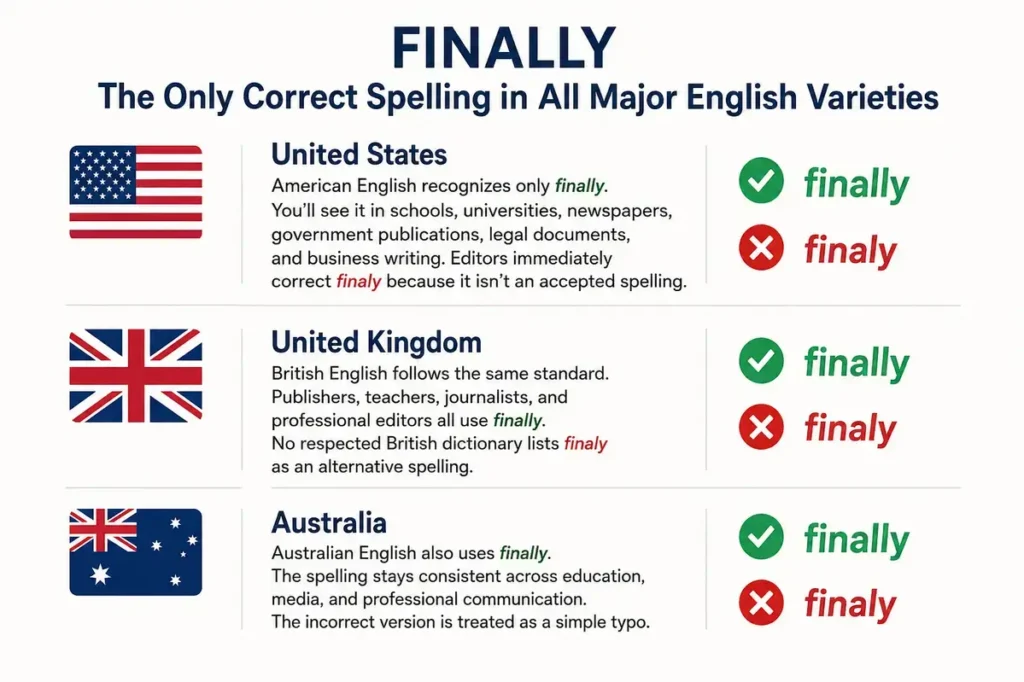
Finaly vs Finally Regional Usage
United States
American English recognizes only finally. You’ll see it in schools, universities, newspapers, government publications, legal documents, and business writing. Editors immediately correct finaly because it isn’t an accepted spelling.
United Kingdom
British English follows the same standard. Publishers, teachers, journalists, and professional editors all use finally. No respected British dictionary lists finaly as an alternative spelling.
Australia
Australian English also uses finally. The spelling stays consistent across education, media, and professional communication. The incorrect version is treated as a simple typo.
Canada
Canadian English follows the same rule. Unlike words such as colour and center, this word has no regional spelling variation. Every major English speaking country uses finally.
Grammar Rules And Part Of Speech
Quick Answer
Finally is an adverb. It tells readers when something happens or introduces the final point in a sequence.
Part Of Speech
The word belongs to the adverb category. Adverbs modify verbs, adjectives, other adverbs, or complete sentences. In most cases, finally modifies the action by showing that it happened at the end or after some delay.
Placement In A Sentence
You can place finally in different positions.
Beginning.
Finally we reached an agreement.
Middle.
We finally reached an agreement.
End.
We reached an agreement finally.
The middle position sounds most natural in everyday American English.
Punctuation Rules
When finally begins a sentence and introduces the last point in a discussion, writers often place a comma after it.
Example.
Finally, we can move forward.
Inside a sentence, punctuation usually isn’t needed.
Example.
She finally answered the question.
Choose punctuation based on sentence structure instead of treating finally as a special case.
Common Grammar Patterns
You’ll often see finally with these verbs.
- Arrived.
- Finished.
- Found.
- Solved.
- Won.
- Completed.
- Understood.
- Returned.
These combinations sound natural because they describe reaching an ending or conclusion.
Real Life Usage Examples
Daily Conversation
- We finally made it before the movie started.
- I finally cleaned out the garage.
Professional Email
- We finally completed the quarterly report and attached the latest version.
- I finally had time to review your proposal and added a few suggestions.
Academic Writing
- Finally the results support the original hypothesis.
- The researchers finally identified the source of the error after repeated testing.
News Reporting
- City officials finally approved the redevelopment plan after months of discussion.
- The athlete finally returned to competition following a long recovery.
Literature
- The traveler finally saw the lights of the village beyond the hills.
- She finally understood the truth hidden inside the old letter.
These examples show why finally remains one of the most useful adverbs in English. It fits naturally into almost every style of writing while clearly expressing completion, conclusion, or relief.
Related And Confused Terms
Quick Answer
Several English words share a similar meaning with finally, but they are not perfect substitutes. Each one adds a slightly different idea. Choosing the right word makes your writing more precise and natural.
At Last
At last expresses relief after a long wait.
Example.
We arrived at last.
Compared with finally, this phrase usually carries more emotion.
Eventually
Eventually means something happened after a period of time or after several events.
Example.
They eventually reached an agreement. It focuses on the passage of time more than the ending itself.
Ultimately
Ultimately refers to the final outcome or conclusion after considering everything.
Example.
Ultimately the decision is yours. This word appears often in academic and professional writing.
At The End
At the end refers to the last part of something.
Example.
We met at the end of the conference. Unlike finally, it describes a point in time or place instead of acting as an adverb for the action.
Conclusively
Conclusively means something settles a question beyond doubt.
Example.
The evidence conclusively proved the claim. This word focuses on certainty instead of completion.
In The End
In the end emphasizes the final result after everything happened.
Example.
In the end we stayed home because of the weather. It often summarizes an outcome instead of describing an action.
Lastly
Lastly introduces the final point in a list, speech, or presentation.
Example.
Lastly I’d like to thank everyone for attending. It sounds slightly more formal than finally in many situations.
Final
The adjective final describes the last stage or last item.
Example.
This is the final chapter. Don’t confuse the adjective final with the adverb finally.
Finaly vs Finally Expert Editor Insight
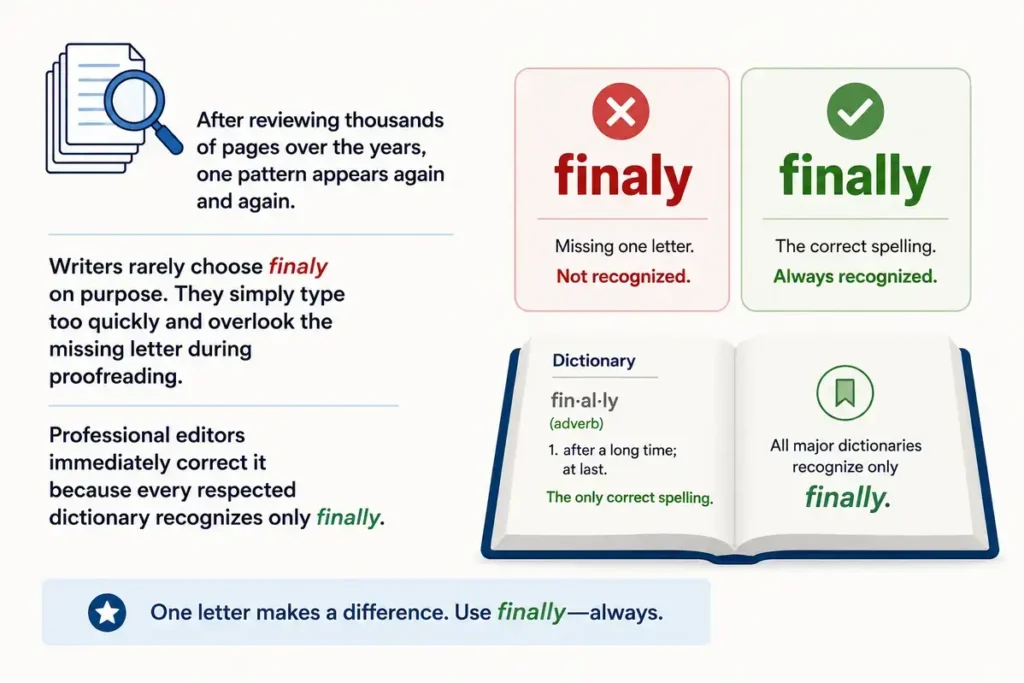
After reviewing thousands of pages over the years, one pattern appears again and again. Writers rarely choose finaly on purpose. They simply type too quickly and overlook the missing letter during proofreading. Professional editors immediately correct it because every respected dictionary recognizes only finally. Grammar tools such as spell checkers usually flag the mistake, but no software catches every error. That’s why experienced editors still read documents carefully before publication. A slow final review often catches mistakes that automated tools miss.
For another common grammar confusion, see Seing Vs Seeing Which Is Correct In English in 2026.
Conclusion
The answer couldn’t be clearer. Finally is the correct spelling, and finaly is simply a misspelling. The difference comes down to one missing letter, but that small detail has a real impact on the quality of your writing.
Remember that finally is an adverb used to describe the last event in a sequence, something that happens after waiting, or the concluding point in a discussion. It appears in every major dictionary and follows standard English spelling rules.
A practical way to remember the correct form is to start with the word final. Keep every letter exactly as it is, then add ly. That simple habit will help you avoid this common mistake in emails, school assignments, professional documents, articles, and everyday conversations. Once you build that pattern into your writing, you’ll use finally with confidence every time.
Frequently Asked Questions
Is Finaly A Real Word?
No. Finaly is not a recognized English word. Major dictionaries, grammar references, and editorial style guides list only finally. If you see finaly, treat it as a spelling mistake instead of an accepted variation. The error usually appears because someone accidentally leaves out one l while typing.
What Does Finally Mean?
Finally means at the end, after a delay, or as the last point in a sequence. It can also express relief after something takes longer than expected. You’ll hear it in everyday conversation, business communication, academic writing, and public speaking because it fits naturally in almost every style of English.
Finaly Or Finally Which Is Correct?
Finally is the correct spelling in standard English. Finaly is always considered a misspelling unless you’re discussing the mistake itself. Every major English dictionary accepts finally, and professional editors consistently correct the version with one l.
How Do You Pronounce Finally?
The standard pronunciation is /ˈfaɪnəli/. The word has three syllables, and the stress falls on the first one. A simple pronunciation guide is fine uh lee. Native speakers use the same pronunciation in American, British, Canadian, and Australian English with only slight accent differences.
Can Finally Start A Sentence?
Yes. Finally can begin a sentence without creating a grammar problem. Writers often place it at the beginning when introducing the last point in a discussion or describing the conclusion of a series of events. This placement is common in speeches, essays, articles, and everyday conversation.
What Is A Synonym Of Finally?
Common alternatives include eventually, at last, ultimately, in the end, and lastly. Each has a slightly different meaning. Pick the one that best matches your intended message instead of replacing finally automatically.
Why Do People Misspell Finally?
Most people misspell finally because they type quickly and accidentally remove one l. Others assume adding y to final creates the adverb. Careful proofreading and remembering the complete base word usually prevent the mistake.
Is Finally Appropriate In Formal Writing?
Yes. Finally works perfectly in formal writing. You’ll see it in academic papers, research articles, business reports, legal documents, books, and professional emails. It is accepted by dictionaries and major editorial style guides, making it suitable for every standard writing situation.