
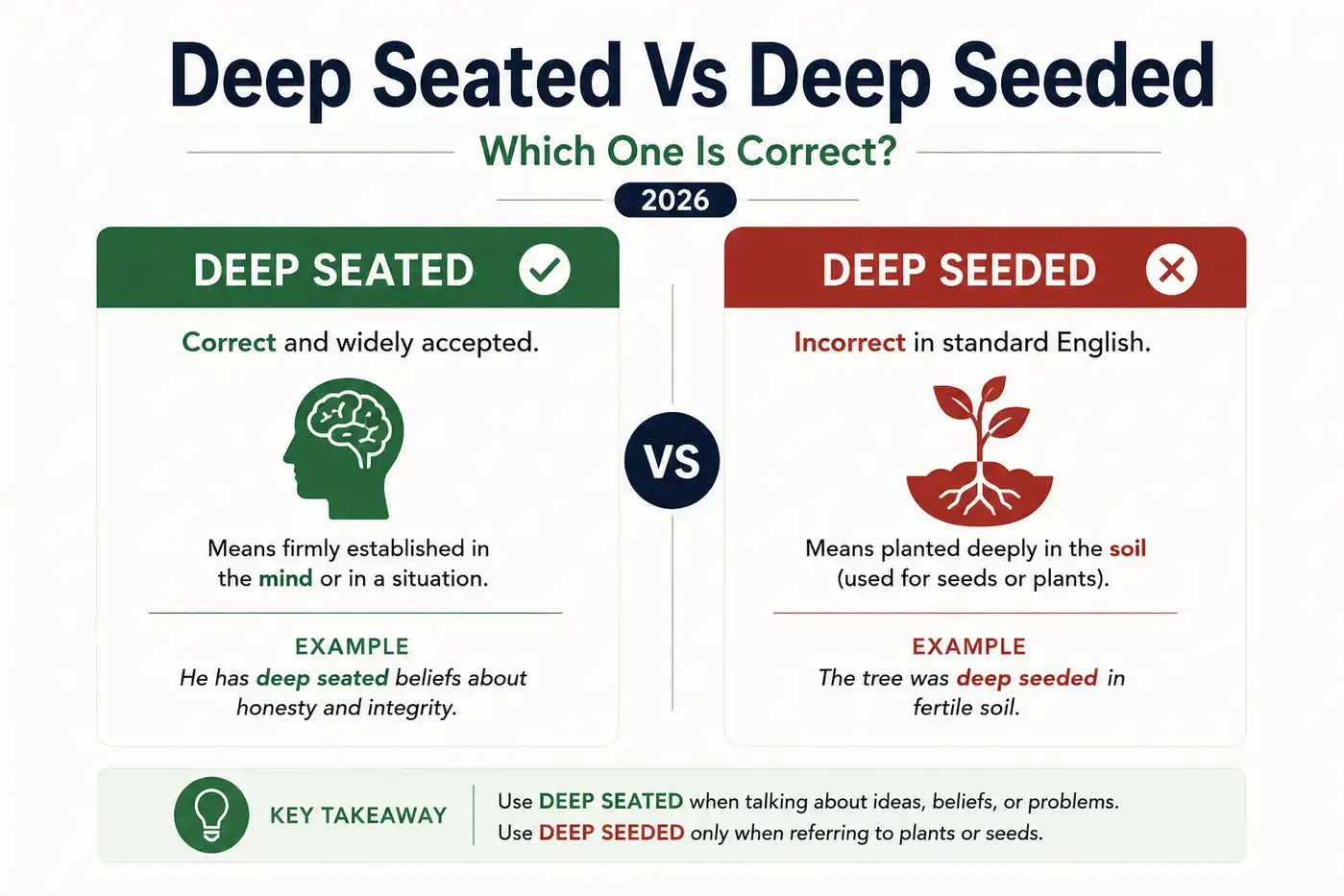
If you’ve ever paused while writing deep seated vs deep seeded, you’re in good company. This is one of the most commonly confused expressions in English. The phrases sound almost identical when spoken, which makes it easy to assume both are correct. Many people use deep seeded in conversation, social media posts, articles, and even professional writing without realizing there’s an important difference.
The short answer is simple. Deep seated is the traditional and widely accepted expression. It describes something firmly established, strongly rooted, or difficult to change. Deep seeded is usually considered a mistaken version of the phrase, although its popularity has grown because it seems logical to many speakers.
The confusion happens because the idea of a seed growing deep into the ground feels meaningful. People naturally connect deeply held beliefs, emotions, and habits with roots and seeds. As a result, deep seeded sounds correct even though the original phrase is deep seated.
Understanding the distinction can help you write with greater confidence and avoid a mistake that editors frequently notice. In this guide, you’ll learn the meaning, history, grammar, pronunciation, usage, examples, regional preferences, and expert insights behind these words.
Need another quick comparison? Read Signer or Signor Pronunciation, Meaning and Differences in 2026.
Quick Definition
When comparing deep seated and deep seeded, deep seated is the standard and traditionally correct expression. It means firmly established, strongly ingrained, or deeply rooted. Deep seeded is generally considered a mistaken variation that emerged because speakers associated the phrase with seeds growing deep in the ground.
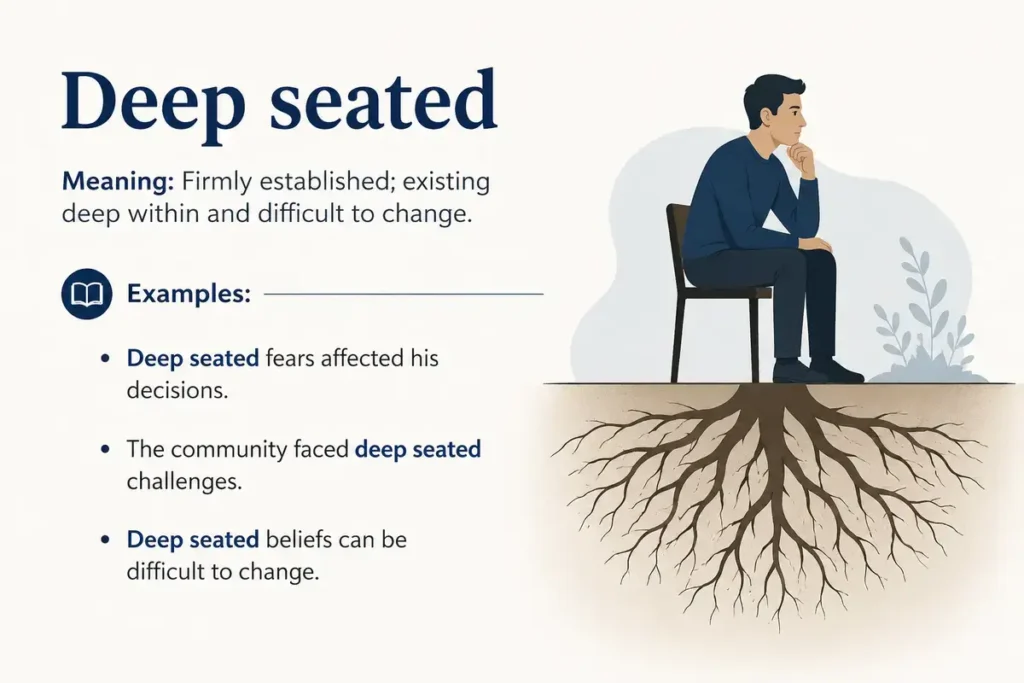
Deep Seated Vs Deep Seeded Quick Answer
Use deep seated in formal, academic, professional, and edited writing.
Examples:
- Deep seated fears affected his decisions.
- The community faced deep seated challenges.
- Deep seated beliefs can be difficult to change.
This word is widely used in casual speech and online writing, but most dictionaries and editors still prefer deep seated.
Deep Seated Vs Deep Seeded Comparison Table
| Feature | Deep Seated | Deep Seeded |
|---|---|---|
| Standard expression | Yes | Usually no |
| Dictionary acceptance | Yes | Limited or disputed |
| Meaning | Firmly established | Often intended to mean the same thing |
| Part of speech | Adjectival phrase | Nonstandard variation |
| Historical origin | Traditional English expression | Later reinterpretation |
| Usage frequency | Very common in formal writing | Common in informal writing |
| Formality level | Accepted in all contexts | Often avoided in formal contexts |
| Editorial preference | Strongly preferred | Usually corrected |
| Example | Deep seated resentment remained. | Often treated as an error |
| Professional usage | Yes | Generally discouraged |
Deep Seated and Deep Seeded Meaning Explained
Understanding the meaning behind each expression reveals why confusion developed in the first place.
Meaning Of Deep Seated
Deep seated describes something firmly established within a person, group, system, or society.
It often refers to:
- Beliefs.
- Emotions.
- Habits.
- Attitudes.
- Social issues.
- Cultural traditions.
- Long standing problems.
Examples:
- She has a deep seated fear of failure.
- The organization struggled with deep seated inefficiencies.
- Deep seated cultural values shaped the community.
The expression suggests something embedded so deeply that changing it requires significant effort.
Context And Usage
Deep seated frequently appears in:
- Psychology.
- Sociology.
- Journalism.
- Academic writing.
- Professional communication.
- Literature.
Writers use it when describing ideas or conditions that have existed for a long time and resist change.
Meaning Of Deep Seeded
Deep seeded is usually intended to mean exactly what deep seated means.
People often use it because:
- Seeds naturally grow beneath the ground.
- The image feels logical.
- The phrase sounds almost identical to deep seated.
- Many speakers have heard the expression but never seen it written.
As a result, deep seeded became a classic example of what linguists call an eggcorn. An eggcorn occurs when a familiar phrase is mistakenly replaced with a similar sounding expression that appears logical.
Examples of other well known eggcorns include:
- For all intensive purposes instead of for all intents and purposes.
- Nip it in the butt instead of nip it in the bud.
- Free reign instead of free rein.
Deep seeded belongs to the same category.
Deep Seated or Deep Seeded Key Differences
Although the two expressions are often used interchangeably in conversation, important differences exist.
Meaning Difference
In practical use, both expressions usually communicate the same idea.
However:
- Deep seated is the accepted form.
- Deep seeded is a reinterpretation.
Editorial Difference
Professional editors overwhelmingly prefer deep seated.
Most style guides recommend correcting deep seeded.
Historical Difference
Deep seated appeared first.
Deep seeded emerged later as speakers reshaped the phrase into something that sounded more intuitive.
Usage Difference
Deep seated dominates in:
- Newspapers.
- Academic journals.
- Books.
- Professional publications.
This word also appears more often in:
- Informal writing.
- Online discussions.
- Social media.
- Everyday conversation.
Deep Seated Vs Deep Seeded Which One Is Correct
The standard answer is straightforward.
Deep seated is correct.
If you’re writing:
- A school assignment.
- A business report.
- A professional email.
- A published article.
- A book.
- Academic research.
Use deep seated.
Examples:
- The conflict stemmed from deep seated tensions.
- The company faced deep seated organizational problems.
- Deep seated beliefs often influence behavior.
These examples follow accepted English usage.
Deep seeded may appear in informal contexts, but most editors still consider it nonstandard.
Deep Seated Vs Deep Seeded Examples In Sentences
Ten Examples Using Deep Seated
- The nation struggled with deep seated economic challenges.
- She carried a deep seated fear of rejection.
- Deep seated traditions shaped local customs.
- The conflict reflected deep seated political divisions.
- He overcame a deep seated lack of confidence.
- Deep seated resentment affected the relationship.
- The reforms targeted deep seated problems.
- The organization faced deep seated cultural issues.
- Deep seated habits can be difficult to break.
- The debate exposed deep seated disagreements.
Ten Examples Using Deep Seeded
These examples reflect common real world usage, although editors often revise them.
- He had deep seeded fears about public speaking.
- The town faced deep seeded challenges.
- Deep seeded beliefs influenced the discussion.
- She struggled with deep seeded anxiety.
- The company had deep seeded management issues.
- Deep seeded mistrust slowed progress.
- They discussed deep seeded concerns.
- The conflict came from deep seeded tensions.
- Deep seeded attitudes shaped opinions.
- The issue revealed deep seeded divisions.
In formal writing, deep seated would typically replace deep seeded in every sentence above.
Deep Seated Vs Deep Seeded Common Mistakes
Several mistakes repeatedly appear in editing work.
Assuming Deep Seeded Is The Original Phrase
This is the most common misunderstanding.Many writers believe the phrase comes from seeds because the imagery feels natural.Historically, that isn’t the case.
Using Deep Seeded In Academic Writing
Academic and professional audiences generally expect deep seated.Using deep seeded can undermine credibility.
Believing Both Forms Are Equally Accepted
Language evolves, but deep seated remains the preferred form in most authoritative references.
Learning The Phrase By Sound Alone
People often hear the expression long before seeing it written.That creates opportunities for reinterpretation and spelling confusion.
Pronunciation Guide
One reason this confusion persists is pronunciation.The two expressions sound remarkably similar.
Deep Seated Pronunciation
IPA:
/diːp ˈsiːtɪd/
Syllable breakdown:
Deep • seat • ed
Deep Seeded Pronunciation
IPA:
/diːp ˈsiːdɪd/
Syllable breakdown:
Deep • seed • ed
In rapid speech, many listeners struggle to distinguish them.
This similarity helps explain why the nonstandard version became so widespread.
Etymology And Word Origin
The history behind deep seated is fascinating.The word seated originally referred to something firmly fixed in place. Imagine a person sitting securely in a chair or an object positioned firmly within a structure.Over time, English speakers extended this idea to abstract concepts.
A deep seated belief became a belief firmly situated within someone’s mind.A deep seated problem became a problem firmly embedded within a system.The phrase gradually evolved into a powerful metaphor for anything deeply established and resistant to change.Deep seeded emerged much later.Writers and speakers reinterpreted the expression through the image of seeds planted deep in the ground. Although the metaphor made sense, it was not the original source of the phrase.
Regional Usage
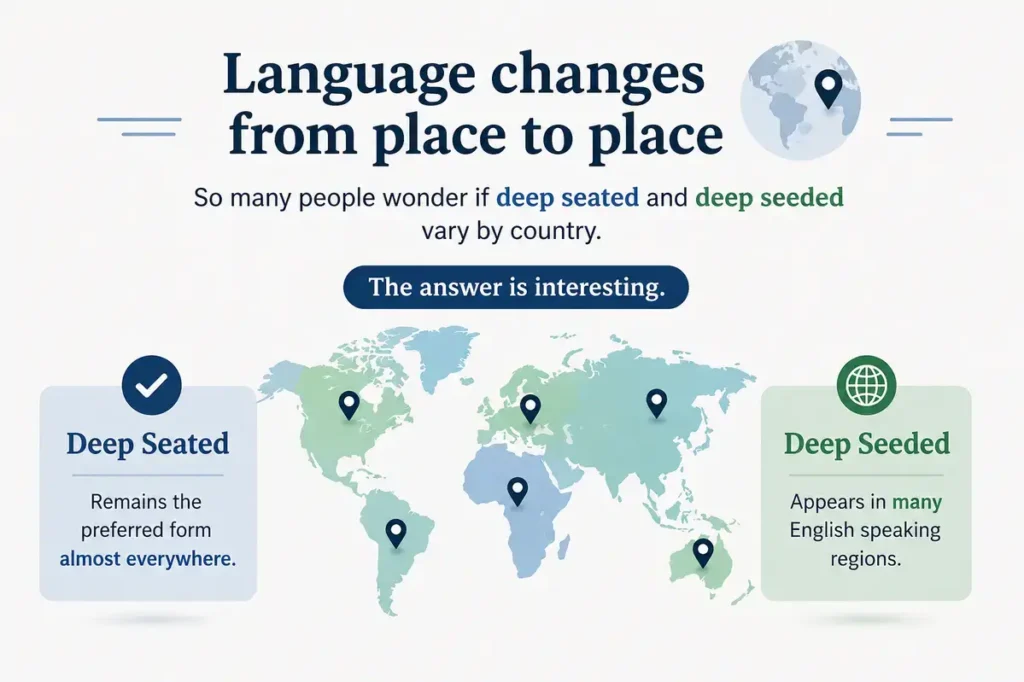
Language changes from place to place, so many people wonder if deep seated and deep seeded vary by country. The answer is interesting.While deep seeded appears in many English speaking regions, deep seated remains the preferred form almost everywhere.
Deep Seated or Deep Seeded In American English
American English strongly favors deep seated in professional and edited writing.
Examples:
- The report identified deep seated social issues.
- Deep seated mistrust affected negotiations.
- The organization faced deep seated structural problems.
Although deep seeded appears in conversation and online content, editors generally replace it with deep seated.
Deep Seated or Deep Seeded In British English
British English follows the same pattern.
Examples:
- The country faced deep seated economic concerns.
- Deep seated cultural traditions influenced behavior.
- The dispute reflected deep seated differences.
Major British publications typically use deep seated.
Deep Seated or Deep Seeded In Canadian English
Canadian English also prefers deep seated.
Examples:
- The study examined deep seated attitudes.
- Deep seated concerns shaped public opinion.
- The issue revealed deep seated divisions.
Professional Canadian writers generally avoid deep seeded.
Deep Seated or Deep Seeded In Australian English
Australian English mirrors other major varieties of English.
Examples:
- The reforms addressed deep seated problems.
- Deep seated beliefs influenced the outcome.
- The debate exposed deep seated tensions.
Deep seated remains the standard choice.
Global Usage Summary
Across:
- The United States.
- The United Kingdom.
- Canada.
- Australia.
- New Zealand.
- Ireland.
Deep seated is the preferred expression.
It exists in spoken language and informal writing but has not replaced the traditional form.
Deep Seated and Deep Seeded Grammar Rules
Understanding the grammar behind the expression helps you use it correctly.
Part Of Speech
Deep seated functions as an adjective phrase.
It modifies a noun.
Examples:
- Deep seated fear.
- Deep seated resentment.
- Deep seated prejudice.
- Deep seated problem.
- Deep seated belief.
The phrase describes the noun by showing that it is firmly established.
Position In A Sentence
The expression usually appears before the noun it modifies.
Examples:
- They discussed deep seated concerns.
- The organization faced deep seated challenges.
- She carried deep seated anxiety.
It can also appear after a linking verb.
Examples:
- The problem is deep seated.
- Their disagreement was deep seated.
- The issue remains deep seated.
Singular And Plural Usage
The phrase itself does not change.
Examples:
- A deep seated problem.
- Several deep seated problems.
- A deep seated belief.
- Many deep seated beliefs.
Only the noun changes.
Common Structures
Deep seated frequently appears with:
- Fear.
- Anger.
- Resentment.
- Prejudice.
- Distrust.
- Anxiety.
- Problems.
- Issues.
- Beliefs.
- Traditions.
These combinations appear regularly in books, newspapers, and academic writing.
Real Life Usage Examples
The phrase becomes easier to understand when viewed in everyday situations.
Daily Conversation
Examples:
- His deep seated fear of heights kept him from traveling.
- She has a deep seated love for music.
- Their disagreement came from deep seated differences.
These examples sound natural because the phrase describes something firmly rooted within a person.
For another common grammar confusion, see atleast or at least correct spelling meaning and usage.
Academic Writing
Researchers often use deep seated when discussing social, cultural, or psychological issues.
Examples:
- The study examined deep seated social inequalities.
- Deep seated attitudes influenced voting behavior.
- The research identified deep seated cultural patterns.
Academic writing strongly favors deep seated.
Professional Communication
Business professionals use the phrase when discussing organizational challenges.
Examples:
- The company struggled with deep seated inefficiencies.
- Leadership addressed deep seated communication problems.
- The changes targeted deep seated operational issues.
Literature And Creative Writing
Authors often use the phrase to add emotional depth.
Examples:
- A deep seated sadness lingered beneath his smile.
- Her deep seated loyalty never wavered.
- The town carried a deep seated memory of the disaster.
The phrase helps writers communicate powerful emotions and long standing conditions.
Media And Journalism
Journalists commonly use deep seated to describe complex societal issues.
Examples:
- The report highlighted deep seated economic challenges.
- The crisis exposed deep seated political divisions.
- Deep seated distrust complicated negotiations.
This usage appears frequently in newspapers and news websites.
Deep Seated or Deep Seeded Related Words And Confused Terms
Several related expressions carry similar meanings.
Understanding them can improve your vocabulary and writing precision.
Deep Rooted
Deep rooted is perhaps the closest synonym.
Examples:
- Deep rooted beliefs.
- Deep rooted traditions.
- Deep rooted prejudice.
Unlike deep seeded, deep rooted is fully accepted in standard English.
Entrenched
Entrenched describes something firmly established and difficult to change.
Examples:
- Entrenched attitudes.
- Entrenched interests.
- Entrenched behaviors.
The meaning closely overlaps with deep seated.
Ingrained
Ingrained refers to habits, beliefs, or attitudes that have become firmly fixed.
Examples:
- Ingrained habits.
- Ingrained assumptions.
- Ingrained cultural values.
This word often appears in psychology and sociology.
Embedded
Embedded suggests something fixed deeply within a system or structure.
Examples:
- Embedded beliefs.
- Embedded processes.
- Embedded traditions.
Rooted
Rooted implies a strong connection or foundation.
Examples:
- Rooted in history.
- Rooted in experience.
- Rooted in tradition.
Eggcorn
Eggcorn is an important linguistic term connected to this discussion. An eggcorn occurs when people replace an unfamiliar phrase with a similar sounding phrase that seems logical. Deep seeded is widely considered an eggcorn because it sounds meaningful even though it differs from the original expression.
Why The Confusion Persists
Some language mistakes disappear quickly.Others survive for generations.Deep seeded continues because it makes intuitive sense.Think about the image it creates.
A seed planted deep in the ground grows roots and becomes firmly established. That metaphor aligns perfectly with the meaning people intend when discussing beliefs, fears, or habits.
As a result, many speakers assume deep seeded must be correct.Ironically, the phrase sounds so logical that many people never realize it began as a misunderstanding.This is one reason linguists find the expression fascinating.
It shows how speakers naturally reshape language to fit familiar mental images.
Deep Seated Vs Deep Seeded In Search Trends
Search engines process thousands of queries about this phrase every month.
Common searches include:
- Deep seated or deep seeded.
- Is deep seeded correct.
- Deep seated meaning.
- Deep seated definition.
- Deep seeded meaning.
- Correct phrase deep seated or deep seeded.
- Deep seated examples.
- Deep seated vs deep seeded.
The popularity of these searches highlights how widespread the confusion remains.People often hear the expression in conversation but don’t encounter it often enough in writing to know the standard form.
Expert Language Insight
As an editor, this is one of those expressions that stands out immediatelyWriters rarely choose deep seeded intentionally. Most genuinely believe it is the correct phrase.That’s understandable.
The imagery behind deep seeded feels natural. In fact, many people find it more logical than deep seated.However, effective writing depends on accepted usage, not just logical interpretation.Readers expect familiar expressions. Using the standard form prevents distractions and keeps attention focused on your message.
Professional writers, publishers, journalists, academics, and editors overwhelmingly choose deep seated.If your goal is clear and credible writing, that remains the safest option.
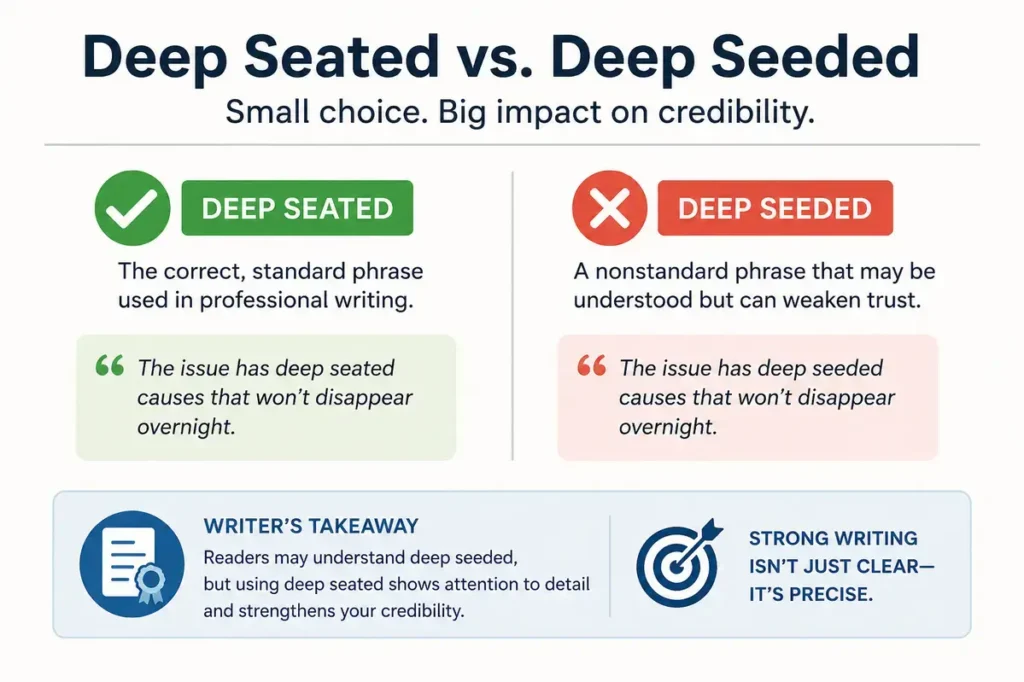
Deep Seated Vs Deep Seeded Advanced Usage Guidance
As you become a stronger writer, you’ll notice that some language choices are technically understandable but still raise eyebrows among editors. Deep seated and deep seeded fall into that category.
Most readers understand what deep seeded means. The problem isn’t comprehension. The issue is credibility.In professional writing, readers often judge expertise through small details. A nonstandard phrase can distract from an otherwise strong argument.
That’s why experienced writers usually stick with deep seated.
In Formal Writing
Formal writing requires consistency and accepted usage.
Examples include:
- Academic essays.
- Research papers.
- Business reports.
- Government documents.
- Professional emails.
- News articles.
- Published books.
In these settings, deep seated is the preferred choice.
Examples:
- The study identified deep seated social challenges.
- The organization faced deep seated operational problems.
- Deep seated cultural beliefs influenced decision making.
Most editors would revise deep seeded in these sentences.
In Informal Writing
Casual communication is more flexible.
Examples include:
- Text messages.
- Social media posts.
- Personal blogs.
- Online forums.
- Informal emails.
In these contexts, you’ll encounter deep seeded more frequently.Even so, deep seated remains the standard expression.Choosing deep seated demonstrates stronger command of written English.
In Academic Contexts
Universities and academic publishers generally favor traditional usage.
Examples:
- Deep seated biases affected participant responses.
- Researchers examined deep seated social attitudes.
- The paper explored deep seated political divisions.
Using deep seeded in academic writing may result in corrections from professors, editors, or peer reviewers.
In Business Communication
Business writing values clarity and professionalism.
Examples:
- The company addressed deep seated workflow issues.
- Leadership identified deep seated communication problems.
- The organization worked to overcome deep seated resistance to change.
These examples sound natural because they follow accepted usage.
Deep Seated or Deep Seeded Memory Tricks
Simple memory aids can help you remember the correct phrase.
Think About Sitting Firmly
The original expression comes from the idea of something being firmly seated in place.Imagine a heavy stone seated deep in the ground.It doesn’t move easily.That image matches the meaning of beliefs, fears, habits, and problems that are difficult to change.
Remember What Editors Use
Professional editors almost always choose deep seated.When you’re uncertain, follow the version that appears in:
- Books.
- Newspapers.
- Academic journals.
- Major publications.
That version is deep seated.
Associate It With Established Ideas
Deep seated often describes things that have become firmly established.
Examples:
- Deep seated beliefs.
- Deep seated traditions.
- Deep seated prejudice.
- Deep seated anxiety.
The phrase suggests permanence and stability.
Common Editor Recommendations
Professional editors often follow several practical guidelines.
- Use deep seated in formal writing.
- Avoid deep seeded in academic work.
- Choose accepted expressions when credibility matters.
- Review commonly confused phrases during proofreading.
- Follow dictionary and style guide recommendations.
- Consider audience expectations.
- Prioritize clarity over personal preference.
- Maintain consistency throughout a document.
These practices improve readability and professionalism.
Deep Seated Vs Deep Seeded Final Expert Verdict
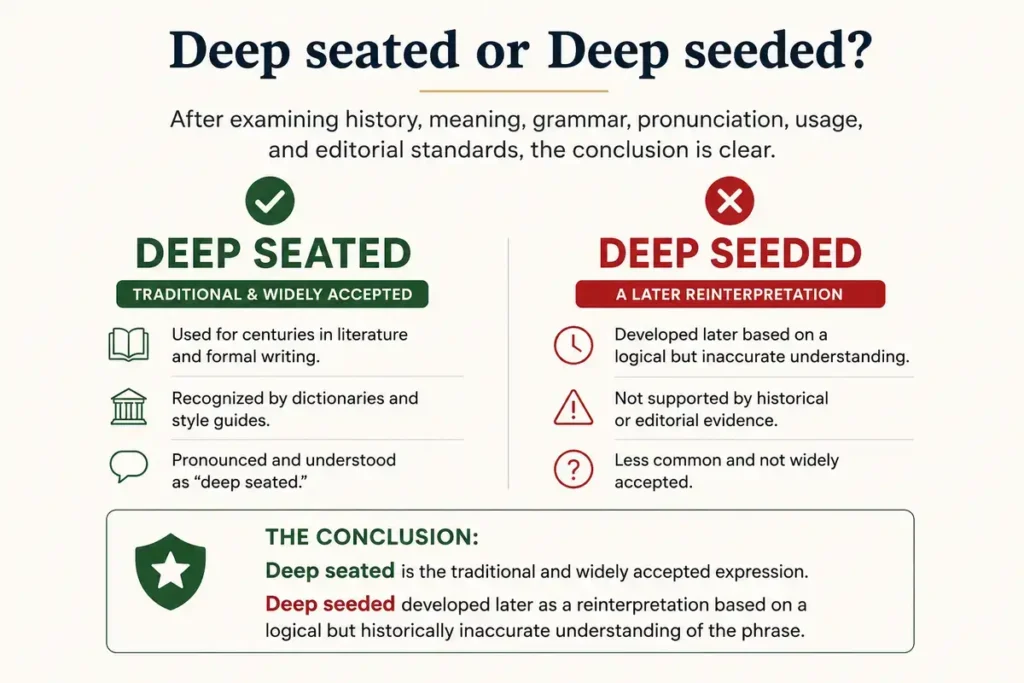
After examining history, meaning, grammar, pronunciation, usage, and editorial standards, the conclusion is clear.Deep seated is the traditional and widely accepted expression.Deep seeded developed later as a reinterpretation based on a logical but historically inaccurate understanding of the phrase.
The popularity of deep seeded demonstrates how language evolves. It also highlights the way speakers reshape expressions to match familiar images and ideas.Despite that evolution, deep seated remains the preferred form in professional writing.If you’re writing for an audience that values accuracy, deep seated is the safest and strongest choice.
Deep Seated Vs Deep Seeded Frequently Asked Questions
Is Deep Seated Or Deep Seeded Correct?
Deep seated is the traditional and widely accepted expression. Deep seeded is usually considered a mistaken variation, although it appears frequently in everyday speech and online writing.
What Does Deep Seated Mean?
Deep seated means firmly established, deeply ingrained, or difficult to change. It often describes beliefs, emotions, habits, attitudes, traditions, and long standing problems that have become strongly embedded over time.
Is Deep Seeded A Real Phrase?
Deep seeded is a commonly used phrase, but many dictionaries, editors, and style guides treat it as a nonstandard variation of deep seated. In formal writing, deep seated remains the preferred choice.
Why Do People Say Deep Seeded?
People often use deep seeded because it creates a logical image of seeds growing deep beneath the ground. Since the phrase sounds similar to deep seated, many speakers assume it is the correct form.
What Is An Eggcorn?
An eggcorn is a word or phrase that results from replacing a familiar expression with a similar sounding alternative that seems logical. Deep seeded is frequently cited as an example of an eggcorn.
Is Deep Seeded Ever Acceptable?
In casual conversation, many people use deep seeded without issue. However, professional editors generally recommend deep seated in academic, business, journalistic, and formal writing.
Do Native Speakers Use Deep Seeded?
Yes. Many native English speakers use deep seeded in speech and informal writing. Its popularity does not change the fact that deep seated remains the traditional and preferred expression.
What Is Another Word For Deep Seated?
Common alternatives include:
- Deep rooted.
- Ingrained.
- Entrenched.
- Embedded.
- Established.
- Rooted.
Each conveys the idea of something firmly fixed or difficult to change.
Still confused? Compare Writen Or Written: Correct Spelling and Differences (2026).
Conclusion
When comparing deep seated vs deep seeded, the traditional and accepted expression is deep seated.It describes beliefs, emotions, habits, attitudes, and problems that are firmly established and difficult to change. The phrase has a long history in English and remains the preferred choice among editors, publishers, educators, journalists, and professional writers.
Deep seeded became popular because it sounds logical. The image of a seed growing deep into the ground naturally connects with ideas that are deeply rooted. Even so, it originated as a reinterpretation rather than the original expression. For formal, academic, professional, and published writing, use deep seated.
Doing so aligns your writing with standard English usage and helps you communicate with clarity and confidence.When in doubt, remember this simple rule:
Deep seated is the established phrase. Deep seeded is the commonly mistaken version.