
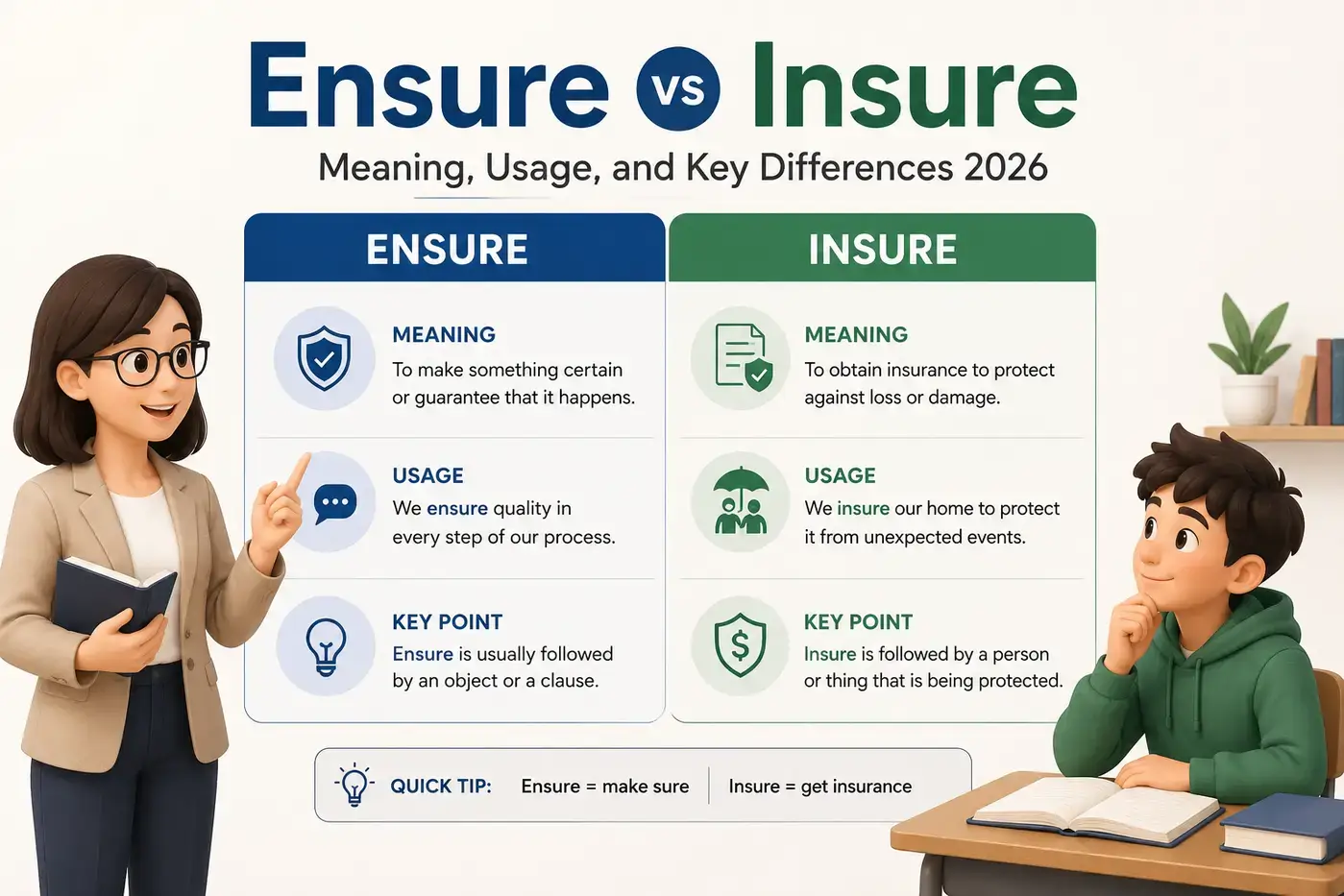
Choosing between ensure vs insure can feel surprisingly tricky. The two words look alike, sound similar, and share historical roots. Many writers use them interchangeably, while others believe each word has a strict and separate meaning. That uncertainty leads to mistakes in emails, business documents, academic papers, and everyday writing.
The short answer is simple. Both words are correct English words, but they mean different things. In most situations, ensure means to make certain that something happens. Insure usually relates to insurance and financial protection against loss or damage.The confusion exists because both words evolved from the same linguistic family and were often used interchangeably in older English. Over time, modern usage developed clearer distinctions, especially in American English.
Understanding the difference matters because choosing the wrong word can change the meaning of a sentence. If you tell someone you’ll insure success, readers may wonder if you’re talking about an insurance policy. If you say you’ll ensure success, your meaning becomes immediately clear.This guide explains the difference between ensure and insure, their meanings, grammar rules, pronunciation, history, real world examples, common mistakes, regional preferences, and expert writing advice. By the end, you’ll know exactly which word belongs in every situation.
For another common grammar confusion, see Mather vs Mother Which Spelling Is Correct.
Ensure Vs Insure Quick Definition
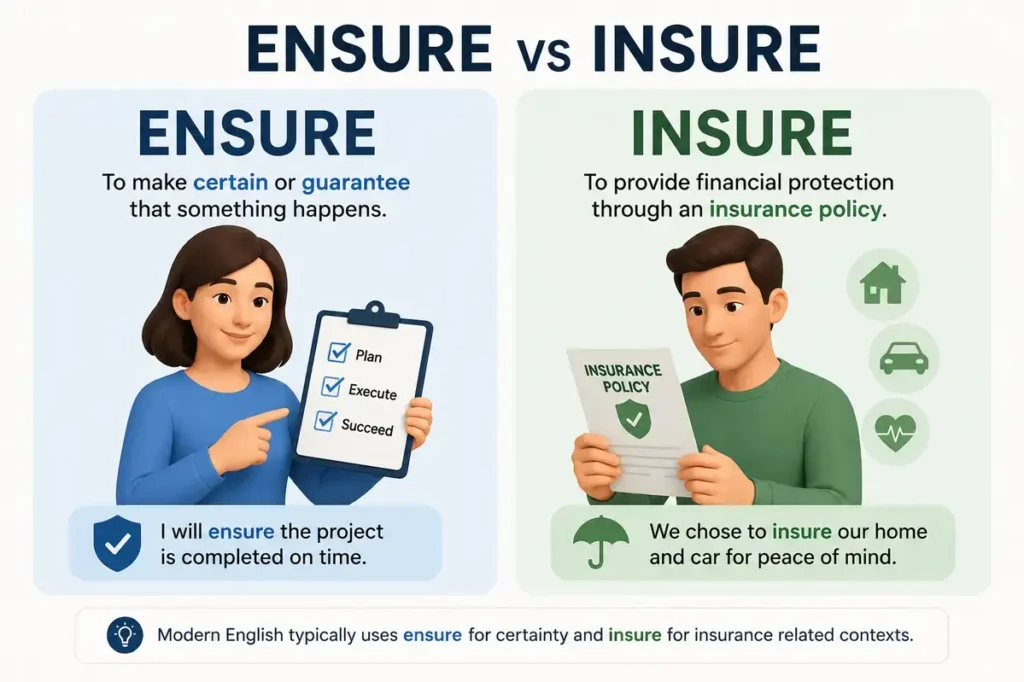
When comparing ensure vs insure, ensure means to make certain or guarantee that something happens. Insure means to provide financial protection through an insurance policy. Modern English typically uses ensure for certainty and insure for insurance related contexts.
Ensure or Insure Quick Answer
Use ensure when you mean make certain, guarantee, or make sure.Use insure when you mean provide insurance coverage or protect against financial loss.
Examples:
- We must ensure customer satisfaction.
- You should insure your car against accidents.
In most non insurance situations, ensure is the correct choice.
Ensure Vs Insure Comparison Table
| Feature | Ensure | Insure |
|---|---|---|
| Correct word | Yes | Yes |
| Primary meaning | Make certain | Provide insurance coverage |
| Part of speech | Verb | Verb |
| Origin | Latin through French | Latin through French |
| Common usage | Very common | Common in insurance contexts |
| Formality level | Standard in all writing | Standard in insurance writing |
| Main context | Certainty and guarantees | Financial protection |
| Typical industries | Education business communication journalism | Insurance banking finance |
| Example | We must ensure accuracy. | They insured the building. |
| Modern preference | General writing | Insurance related writing |
Meaning Of Ensure and Insure
Understanding each word separately makes the distinction much easier.
Meaning Of Ensure
Ensure means to make certain that something happens or continues to happen.It expresses certainty, confidence, assurance, or a guarantee of an outcome.
Examples:
- We need to ensure quality control.
- The teacher ensured that every student understood the lesson.
- Regular maintenance helps ensure safety.
In everyday English, ensure is often similar to:
- Guarantee.
- Secure.
- Confirm.
- Assure.
- Make certain.
The focus is on creating confidence in an outcome.
Meaning Of Insure
Insure means to protect something financially through an insurance policy.The word is closely connected to insurance companies, coverage, risk management, and financial protection.
Examples:
- You should insure your home.
- The company insured its equipment.
- They insured the shipment against damage.
The focus is financial protection if something goes wrong.
Ensure or Insure Meaning Differences
Although the words look related, their meanings serve different purposes.
Certainty Versus Protection
Ensure focuses on certainty.Insure focuses on protection against financial loss.
Examples:
- We ensured the event ran smoothly.
- We insured the event against cancellation losses.
Action Versus Coverage
Ensure refers to actions that help achieve an outcome.Insure refers to obtaining insurance coverage.
Examples:
- The manager ensured compliance.
- The company insured its vehicles.
Everyday Communication Versus Insurance Industry
Ensure appears in nearly every type of writing.Insure appears most often in legal, financial, and insurance related contexts.
Ensure or Insure Which One Is Correct
Both words are correct.The question is not which word is right.The real question is which word fits your meaning.Choose ensure if you’re talking about certainty.Choose insure if you’re talking about insurance coverage.
Examples:
- Correct: We must ensure customer satisfaction.
- Correct: We should insure the building.
Examples of misuse:
- Incorrect: We must insure customer satisfaction.
- Awkward: The teacher insured student success.
In modern writing, ensure is usually preferred outside insurance contexts.
In Professional Writing
Editors frequently encounter confusion between these words.Professional writers generally follow a simple rule.
Use Ensure For
- Accuracy.
- Quality.
- Compliance.
- Safety.
- Success.
- Reliability.
- Consistency.
- Efficiency.
Examples:
- We ensure quality through regular testing.
- The process ensures accuracy.
Use Insure For
- Cars.
- Homes.
- Businesses.
- Equipment.
- Property.
- Liability.
- Health coverage.
- Financial risks.
Examples:
- Always insure valuable equipment.
- They insured the warehouse.
Ensure and Insure Examples In Sentences
Ten Examples Using Ensure
- We must ensure every customer receives support.
- Regular inspections ensure workplace safety.
- The editor ensured consistency throughout the article.
- Good planning helps ensure success.
- Parents ensure their children arrive safely.
- The software update ensures better security.
- The manager ensured everyone understood the instructions.
- Clear communication ensures fewer mistakes.
- Proper training ensures quality performance.
- These measures ensure compliance with regulations.
Ten Examples Using Insure
- You should insure your vehicle.
- The company insured its headquarters.
- We insured the shipment before transport.
- Many homeowners insure their property.
- She insured her jewelry against theft.
- Businesses often insure expensive equipment.
- They insured the artwork for millions of dollars.
- The organization insured its event.
- He insured his boat before summer.
- The family insured their new home immediately.
Ensure or Insure Common Mistakes
Several mistakes appear repeatedly in professional editing.
Using Insure Instead Of Ensure
This is the most common error.
Incorrect:
- We insured quality control.
Correct:
- We ensured quality control.
Quality control involves certainty, not insurance.
Using Ensure In Insurance Contexts
Incorrect:
- We ensured the building for fire damage.
Correct:
- We insured the building for fire damage.
The sentence discusses insurance coverage.
Assuming The Words Are Interchangeable
Historically they sometimes overlapped.Modern usage separates them more clearly.Professional writing benefits from maintaining that distinction.
Pronunciation Guide
Although the words have different meanings, their pronunciations are very similar.
Ensure Pronunciation
IPA:
/ɪnˈʃʊr/
Syllable breakdown:
En • sure
Insure Pronunciation
IPA:
/ɪnˈʃʊr/
Syllable breakdown:
In • sure
In most accents, they sound nearly identical.
That’s one reason confusion remains common.
Common Pronunciation Mistakes
- Overemphasizing the first syllable.
- Pronouncing the final part like shore.
- Adding extra syllables.
- Stressing the wrong syllable.
Native speakers generally stress the second syllable.
Ensure Vs Insure Etymology And Word Origin
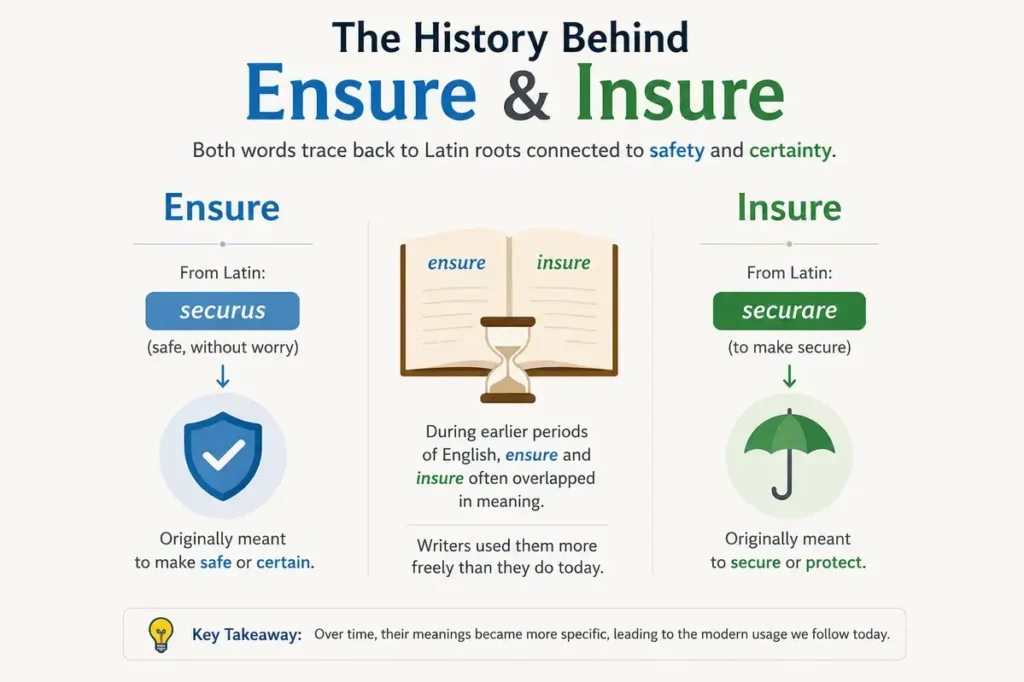
The history behind these words explains their similarity. Both words ultimately trace back to Latin roots connected to safety and certainty. During earlier periods of English, ensure and insure often overlapped in meaning. Writers used them more freely than they do today.
Over time, language evolved toward specialization. Ensure gradually became associated with certainty and guarantees. Insure became associated with financial protection and insurance policies. This separation improved clarity for readers. Today, major style guides and dictionaries generally support this distinction.
Historical Evolution Of Ensure
The word developed through French and entered English with meanings related to making something secure or certain.Over centuries, the meaning narrowed toward:
- Guarantee.
- Make certain.
- Confirm.
- Secure an outcome.
Modern writers overwhelmingly use ensure for these meanings.
Regional Usage
One reason people continue searching these words is that different English speaking regions have handled these words slightly differently over time. Today, the distinction is widely accepted, but regional preferences still exist.
Ensure Vs Insure American English
American English strongly favors a clear separation between the two words.
General rule:
- Use ensure for certainty.
- Use insure for insurance coverage.
Examples:
- We must ensure compliance with company policies.
- You should insure your vehicle against accidents.
Most American editors, publishers, and style guides recommend this distinction.
Ensure Vs Insure British English
British English traditionally allowed more overlap between ensure and insure.In older British writing, insure occasionally appeared in situations involving certainty rather than financial protection.However, modern British English increasingly follows the same distinction used in American English.
Examples:
- The manager ensured all procedures were followed.
- The company insured its property.
This approach improves clarity and reduces ambiguity.
Ensure Vs Insure Canadian English
Canadian English generally follows modern North American conventions.
Examples:
- We ensure quality through regular inspections.
- Homeowners should insure valuable possessions.
Professional Canadian publications usually maintain the distinction.
Australian English
Australian English also favors the modern separation.
Examples:
- Proper planning ensures a successful outcome.
- The business insured its equipment.
Readers expect insure to relate to insurance and ensure to relate to certainty.
Global Usage Summary
Across major English speaking countries:
- Ensure means make certain.
- Insure means provide insurance coverage.
Following this distinction makes your writing clearer everywhere.
Ensure or Insure Grammar Rules
Understanding the grammar behind these words helps you choose correctly every time.
Parts Of Speech
Both ensure and insure are verbs.
Examples:
- We ensure quality.
- We insure property.
Neither word functions as a noun in standard English.
Present Tense
Ensure:
- I ensure accuracy.
- They ensure consistency.
Insure:
- I insure my vehicle.
- They insure commercial buildings.
Past Tense
Ensure becomes ensured.
Examples:
- She ensured everything was ready.
- The team ensured customer satisfaction.
Insure becomes insured.
Examples:
- They insured the warehouse.
- He insured his equipment.
Present Participle Forms
Ensure becomes ensuring.
Examples:
- Ensuring quality takes effort.
- We are ensuring compliance.
Insure becomes insuring.
Examples:
- The company is insuring new properties.
- They are insuring additional assets.
Common Sentence Structures
Ensure commonly follows patterns like:
- Ensure that something happens.
- Ensure quality.
- Ensure success.
- Ensure compliance.
Examples:
- We ensured that everyone received instructions.
- The process ensures accuracy.
Insure commonly follows patterns like:
- Insure something against risk.
- Insure property.
- Insure assets.
- Insure a vehicle.
Examples:
- They insured the building against fire.
- We insured the shipment against damage.
In Real Life Usage
Looking at real world examples makes the distinction easier to remember.
Daily Conversation
Ensure Examples
- I’ll ensure everything is ready before the meeting.
- We need to ensure the kids arrive safely.
- Double checking helps ensure accuracy.
Insure Examples
- Did you insure your new car?
- We should insure the house before moving in.
- Many people insure expensive electronics.
Academic Writing
Ensure Examples
- Researchers must ensure data accuracy.
- Clear methodology helps ensure reliable results.
- Ethical standards ensure participant protection.
Insure Examples
Insurance discussions are less common in academic writing, but examples include:
- Businesses often insure valuable assets.
- Organizations insure facilities against loss.
Professional Communication
Ensure Examples
- We will ensure timely delivery.
- These procedures ensure compliance.
- Our team ensures consistent quality.
Insure Examples
- The company insured all fleet vehicles.
- We recommend clients insure high value equipment.
- The organization insured the event venue.
Literature And Creative Writing
Authors frequently use ensure when describing actions or outcomes.
Examples:
- She checked the map again to ensure they stayed on course.
- He locked every window to ensure the family’s safety.
- The captain ensured the crew understood the plan.
Insure appears mainly when a story involves finances, property, or risk management.
Need another quick comparison? Read Appendices vs Appendixes Which Spelling Is Correct.
Media And Journalism
News organizations use ensure regularly.
Examples:
- Officials introduced measures to ensure public safety.
- New regulations aim to ensure transparency.
Insure appears in business and financial reporting.
Examples:
- Property owners are encouraged to insure against flood damage.
- Companies insured facilities after the storm.
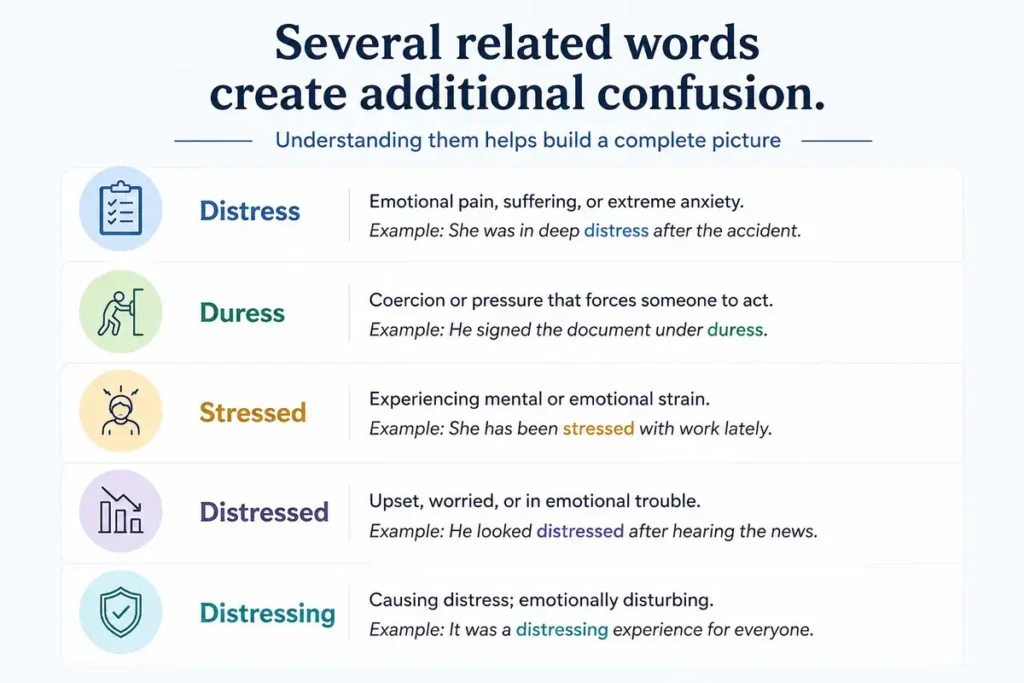
Ensure Vs Insure Related Words And Confused Terms
Several related words create additional confusion.Understanding them helps build a complete picture.
Assure
Assure means to remove doubt or give confidence to a person.
Examples:
- She assured him that everything would be fine.
- The manager assured employees about the changes.
A useful memory tip:
- Assure relates to people.
- Ensure relates to outcomes.
- Insure relates to insurance.
Guarantee
Guarantee is often similar to ensure.
Examples:
- This process guarantees accuracy.
- We guarantee customer satisfaction.
Guarantee tends to sound slightly stronger and more formal.
Secure
Secure means to make safe or obtain something successfully.
Examples:
- We secured additional funding.
- The company secured customer data.
In some contexts, secure and ensure overlap.
Protect
Protect means defend against harm or damage.
Examples:
- Helmets protect riders.
- Insurance protects financial interests.
Protect often appears alongside insure in insurance related writing.
Coverage
Coverage is closely related to insure.
Examples:
- Health coverage.
- Property coverage.
- Liability coverage.
Coverage refers to the protection provided by an insurance policy.
In Business Writing
Business communication relies heavily on precision.A single word can change the meaning of a document.Consider these examples.
Correct
- We ensure compliance with regulations.
- We ensure quality across all departments.
- We ensure customer satisfaction.
Also Correct
- We insure company vehicles.
- We insure business assets.
- We insure warehouse inventory.
Now compare this sentence:”We insure customer satisfaction.”Most readers will pause because the sentence suggests financial coverage rather than certainty.”We ensure customer satisfaction.”This version immediately communicates the intended meaning.
Ensure or Insure Memory Tricks
Many writers remember the difference through simple associations.
The E In Ensure
Think of E as standing for outcome or expectation.You ensure that something happens.
Examples:
- Ensure success.
- Ensure accuracy.
- Ensure safety.
The I In Insure
Think of I as standing for insurance.You insure something against financial loss.
Examples:
- Insure a car.
- Insure a house.
- Insure business property.
Quick Test
Ask yourself:
“Am I talking about an insurance policy?”
If the answer is yes, use insure.If the answer is no, use ensure.This simple test works almost every time.
Ensure and Insure In Modern English
Modern English has moved toward clearer distinctions than earlier generations used.Professional editors generally recommend:
- Ensure for certainty.
- Insure for insurance.
This approach avoids confusion and improves readability.Readers immediately understand your meaning.That’s why newspapers, publishers, universities, businesses, and style guides increasingly follow this standard.
Expert Language Insight
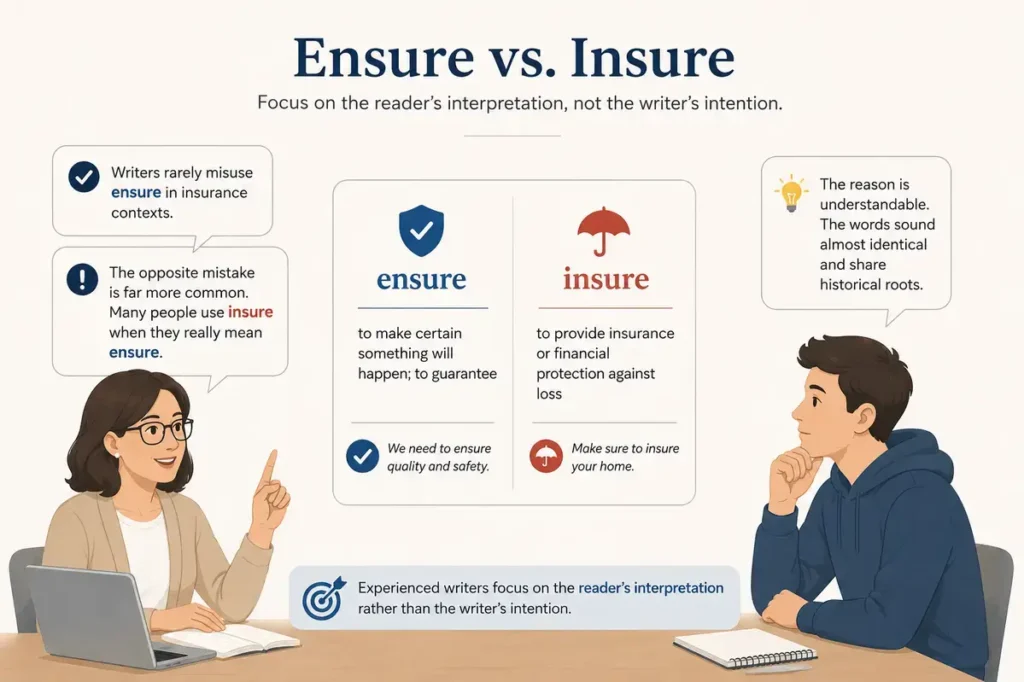
As an editor, one pattern appears repeatedly.Writers rarely misuse ensure in insurance contexts. The opposite mistake is far more common.Many people use insure when they really mean ensure.The reason is understandable. The words sound almost identical and share historical roots.However, experienced writers focus on the reader’s interpretation rather than the writer’s intention.
If a word creates even a moment of uncertainty, a better option usually exists.That’s exactly why modern English favors a distinction between ensure and insure.Using ensure for certainty and insure for insurance eliminates unnecessary confusion.Readers understand your meaning instantly, which is always the goal of effective communication.
Advanced Usage Guidance
As your writing becomes more professional, you’ll encounter situations where word choice affects clarity and credibility. Ensure and insure are a perfect example.Many grammar mistakes aren’t technically wrong because the writer lacks knowledge. They happen because similar words create confusion during the writing process.The safest professional approach is simple:
- Use ensure when discussing certainty, results, outcomes, success, accuracy, safety, compliance, or reliability.
- Use insure when discussing insurance policies, financial coverage, risk management, property protection, or liability.
This distinction is understood by readers across industries and English speaking countries.
In Formal Writing
Formal writing values precision.
Examples include:
- Academic papers.
- Business reports.
- Government documents.
- Legal correspondence.
- Professional emails.
- Technical manuals.
In these situations, editors almost always prefer ensure for certainty.
Examples:
- The policy ensures transparency.
- These procedures ensure workplace safety.
- The review process ensures consistency.
Using insure in these examples would distract readers and weaken clarity.
In Informal Writing
Informal writing allows more flexibility, but the distinction still helps.
Examples:
- I want to ensure everyone has fun at the party.
- Don’t forget to insure your new motorcycle.
- We checked everything twice to ensure nothing was missing.
Even in casual conversation, the modern meanings remain easy to understand.
In Legal And Financial Contexts
Legal and financial writing often uses insure in its most literal sense.
Examples:
- The company insured the building against fire damage.
- The policy insures business assets.
- Property owners should insure valuable possessions.
In these contexts, insure is not optional. It directly refers to insurance protection.Meanwhile, legal documents frequently use ensure when discussing obligations and outcomes.
Examples:
- The agreement ensures compliance.
- These safeguards ensure confidentiality.
- The procedures ensure accountability.
The distinction remains important even within the same document.
In Editing And Proofreading
Professional editors often perform a quick substitution test.
Ask:
Can I replace the word with “make certain”?
If yes, ensure is usually correct.
Example:
- We must ensure quality.
Becomes:
- We must make certain of quality.
The meaning remains intact.
Now try the same test with insure.
- We insured the warehouse.
Becomes:
- We made certain the warehouse.
The meaning changes.
This reveals that insure refers to insurance protection, not certainty.
Search Intent
People searching these words are usually trying to solve one of five problems.
- They want the correct word for a sentence.
- They are writing a professional document.
- They are studying grammar.
- They are preparing for an exam.
- They want to understand the difference in meaning.
In nearly every case, the key lesson is the same.Ensure means make certain.Insure means provide insurance coverage.Everything else builds from that foundation.
Common Editor Recommendations
Professional editors often follow these recommendations.
- Use ensure for outcomes and results.
- Use insure for financial protection.
- Avoid using insure as a substitute for ensure.
- Check context carefully before choosing a word.
- Prioritize reader understanding over tradition.
- Maintain consistency throughout a document.
- Follow modern style guide preferences.
- Revise sentences that could create ambiguity.
These practices improve clarity and professionalism.
Final Expert Verdict
After examining meaning, grammar, pronunciation, history, usage, and modern style conventions, the distinction becomes clear.Ensure and insure are both legitimate English words.The difference lies in purpose.Ensure focuses on making something certain.Insure focuses on protecting something financially through insurance.
Although historical overlap existed, modern English strongly favors separating the two meanings. This distinction improves readability, reduces confusion, and aligns with professional writing standards.For most everyday writing, ensure will be the word you need.Insure becomes appropriate when discussing insurance policies, coverage, and financial protection.
Ensure Vs Insure Frequently Asked Questions
What Is The Difference Between Ensure And Insure?
Ensure means to make certain that something happens. Insure means to provide financial protection through an insurance policy. Modern English uses ensure for certainty and insure for insurance related situations.
Is Ensure Or Insure Correct?
Both words are correct. The correct choice depends on meaning. Use ensure when talking about guaranteeing an outcome. Use insure when talking about insurance coverage or protection against financial loss.
Can Ensure And Insure Be Used Interchangeably?
Modern English generally treats them as separate words. Older forms of English sometimes allowed overlap, but current style guides recommend using ensure for certainty and insure for insurance. This approach improves clarity and avoids confusion.
Why Do Ensure And Insure Sound The Same?
Both words share similar linguistic roots and evolved through related historical pathways. Their pronunciations became nearly identical over time, which explains why many writers confuse them despite their different meanings.
Should I Use Ensure In Business Writing?
Yes. Ensure is the preferred choice when discussing accuracy, compliance, quality, safety, performance, or successful outcomes. Business documents frequently use ensure because it clearly communicates certainty and responsibility.
When Should I Use Insure?
Use insure when discussing insurance policies, financial coverage, liability protection, property coverage, health insurance, or risk management. If an insurance company is involved, insure is usually the correct choice.
Is Ensure More Common Than Insure?
Yes. Ensure appears more frequently in everyday communication because people often discuss outcomes, plans, and certainty. Insure appears most commonly in financial, legal, and insurance related contexts.
How Can I Remember The Difference Between Ensure And Insure?
A simple memory trick works well.
- Ensure equals make certain.
- Insure equals insurance.
If you’re discussing an insurance policy, choose insure. If you’re discussing an outcome or guarantee, choose ensure
Many readers also check Armor or Armour: Correct Spelling and Usage Guide.
Conclusion
If you’re deciding between ensure vs insure, remember one simple rule. Use ensure when you mean make certain, guarantee, secure an outcome, or confirm that something happens .Use insure when you’re talking about insurance coverage, financial protection, or protection against loss. The words share similar origins and nearly identical pronunciations, which explains why so many writers confuse them.
However, modern English has developed a practical distinction that helps readers understand your meaning immediately.When you write with clarity, readers spend less time interpreting your words and more time understanding your message.That’s why choosing ensure for certainty and insure for insurance remains the best practice in professional and everyday writing.