
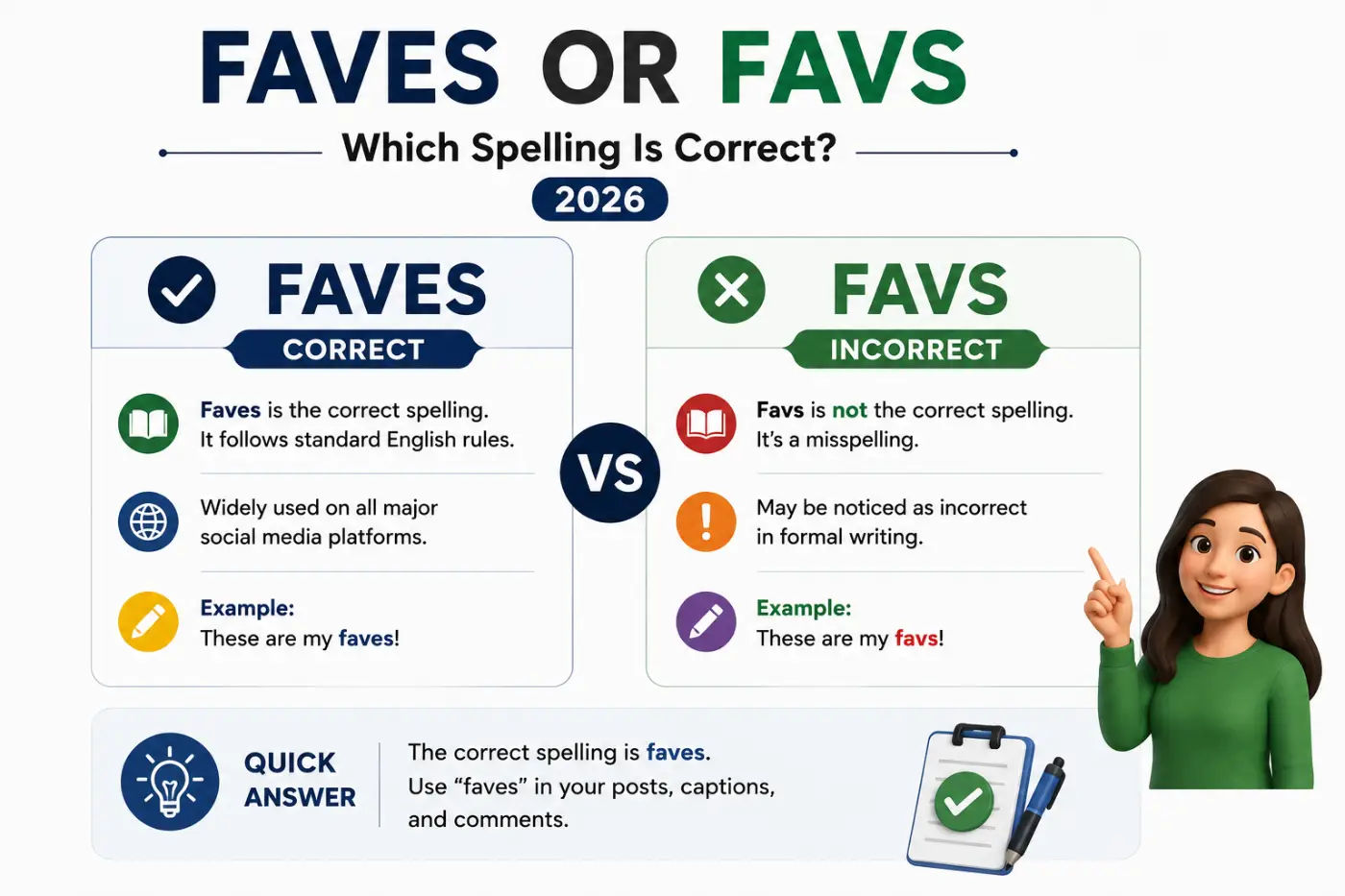
English often turns familiar words into shorter forms, especially in casual conversation, texting, and online writing. Favorite is a good example. You’ll often see fave or fav used as an informal shorter form, with faves and favs as their plural forms.
Both faves and favs are understandable and accepted in informal modern English. Faves is the plural of fave, while favs is the plural of fav. The main difference is spelling preference. Some writers keep the e from fave, while others shorten the word further to fav.
The choice can feel confusing because informal English doesn’t always follow the spelling patterns used in formal vocabulary. In this guide, you’ll learn the meaning, pronunciation, grammar, and usage of faves vs favs, along with examples showing how native speakers use each form in everyday writing. You’ll also learn which version may sound more natural in different informal contexts.
For another common grammar confusion, see waring vs wearing Correct Spelling Meaning and Usage.
Quick Definition
Faves and favs are informal plural forms related to favorite. Faves comes from fave while fav is another spelling of fave. Both refer to people things places or activities that someone likes best. Faves is slightly more visually transparent while favs is a shorter casual form. Both work well in informal English.
Quick Answer
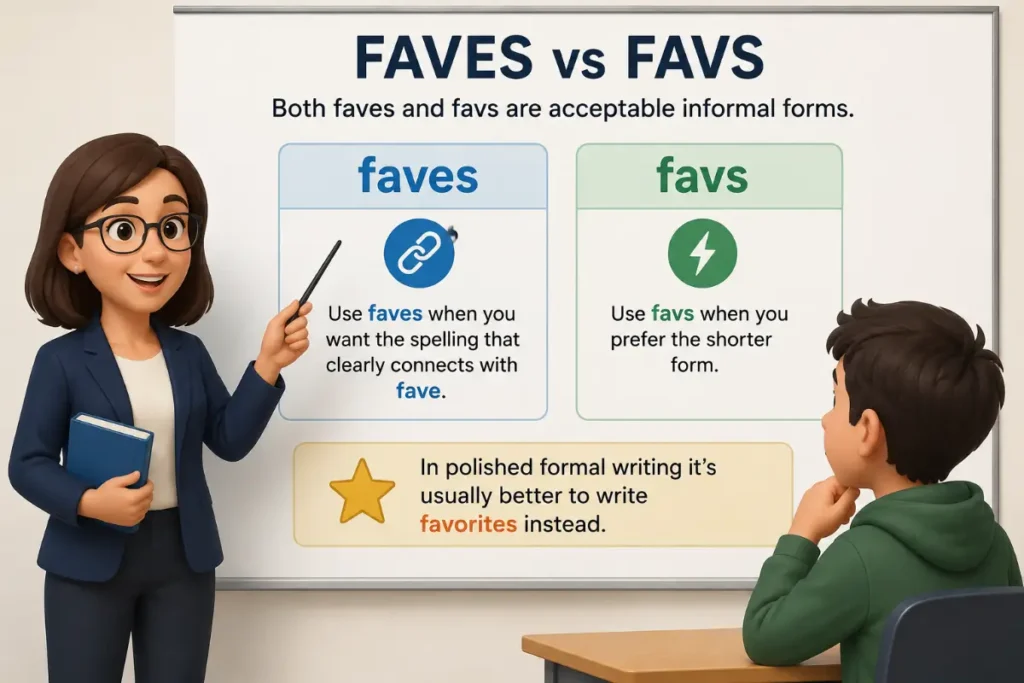
Both faves and favs are acceptable informal forms.
Use faves when you want the spelling that clearly connects with fave. Use favs when you prefer the shorter form. In polished formal writing it’s usually better to write favorites instead.
Cambridge Dictionary recognizes both fave and fav as informal forms. Oxford lists fave as an informal noun and adjective.
Comparison Table For Faves And Favs
| Correct Form | Meaning | Part of Speech | Origin | Usage Frequency | Formality | Common Contexts | Example |
|---|---|---|---|---|---|---|---|
| faves | Favorite people or things | Noun plural | Shortened from favorite through fave | Common in casual English | Informal | Conversation social media blogs messages | These are my faves |
| favs | Favorite people or things | Noun plural | Shortened from favorite through fav | Common in casual English | Informal | Social media texts comments messages | Those songs are my favs |
Meaning and Definition
Meaning of Fave
Fave is an informal shortening of favorite in American English and favourite in British English. It can work as a noun or adjective.
As a noun it means a person or thing that someone likes best.
For example:
My fave is the chocolate cake.
That singer is one of my faves.
As an adjective it describes something that a person likes especially well.
For example:
That’s my fave restaurant.
Oxford lists fave as an informal noun meaning a favorite person or thing. It also lists an informal adjective meaning favorite.
The plural noun is faves.
That distinction matters. Fave is singular while faves is plural.
You might say:
This movie is my fave.
These movies are my faves.
Meaning of Fav
Fav carries essentially the same meaning as fave. Cambridge Dictionary defines it as an informal noun and adjective and describes it as another spelling of fave.
For example:
This is my fav song.
Those are my favs.
The form fav is especially convenient in short digital messages. It removes one more letter while keeping the pronunciation almost identical. Some people prefer fav because it looks compact. Others prefer fave because the connection to favorite feels clearer. Neither spelling changes the basic meaning.
Meaning of Faves Or Favs
When you use faves or favs as plural nouns you’re talking about several favorite people or things.
For example:
These are my favorite books.
These are my faves.
These are my favs.
The full form sounds more neutral and works in formal writing. The shortened versions sound relaxed and conversational.
Oxford gives the example That song is one of my faves. Cambridge also provides examples of fave and faves in informal usage.
Key Differences Explained
Spelling
Faves comes from fave with the regular plural ending s.
Favs comes from fav with the regular plural ending s.
The difference is simply the spelling of the shortened singular form.
Grammar Role
Fave can function as a noun or adjective. Fav can also function as a noun or adjective according to Cambridge Dictionary. Faves and favs normally function as plural nouns.
Meaning
There is no meaningful difference in the basic sense.
Both forms refer to people or things that someone likes best.
Tone
Both forms are informal.
Faves can look slightly more natural in general casual prose because fave is a familiar shortened form. Favs can feel more compact and digital.
The difference is mostly one of personal preference and writing style.
Context
You can see both forms in texts social media comments casual blogs fan communities and friendly messages.
Formal reports academic papers business documents and professional applications usually benefit from the full word favorite.
Which Spelling Is Correct
Both faves and favs are correct informal spellings.
That answer is supported by dictionary evidence rather than simply by internet usage. Cambridge lists fave as an informal noun and adjective and separately lists fav as another spelling of fave. Oxford also records fave as an informal noun and adjective.
There is an important distinction between being informal and being incorrect. A shortened word can be perfectly legitimate while still being unsuitable for a formal document. Think of the difference between conversation and a job application. You might write That’s my fave in a text to a friend. In a formal review you’d probably write That’s my favorite choice.
The dictionary evidence also gives fave strong editorial support. Oxford records its pronunciation and grammatical roles. Cambridge explicitly connects fav with fave. So if someone asks which spelling should you use, the practical answer is this.
Use faves or favs in relaxed communication. Use favorites in formal American English.
Sentence Examples
Here are natural examples with faves.
- These are my faves from the new collection.
- Chocolate chip cookies are among my faves.
- She shared a list of her favorite movies and included several faves from the 1990s.
- Those two restaurants are longtime faves in our family.
- I asked my friends to name their summer faves.
- These books are some of my all time faves.
- The final three songs were my personal faves.
- We tried several dishes and picked our faves before leaving.
- That actor has become one of my faves.
- The article includes recipes for some of our favorite desserts and a few new faves.
Here are natural examples with favs.
- These songs are my favs right now.
- What are your favs from the album?
- I saved a few of my favs for later.
- Those are definitely among my favs.
- We compared our favs after watching the show.
Notice how these examples sound casual. That tone is exactly where these shortened forms work best.
Common Mistakes and Misspellings
Writing Faves As Fave
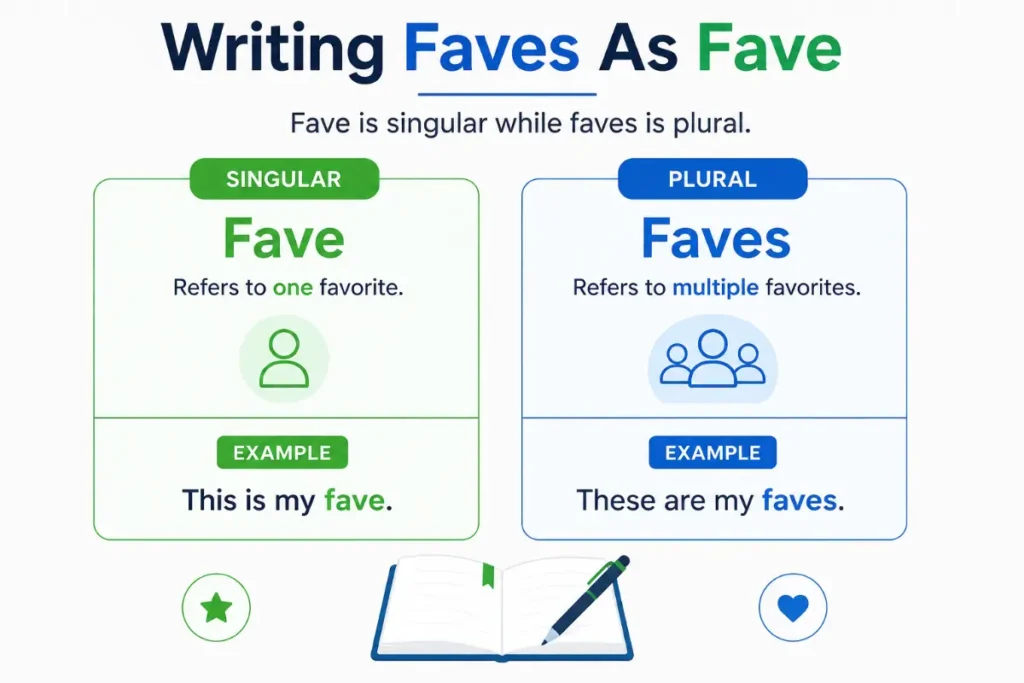
Fave is singular while faves is plural.
You can write:
This is my fave.
You can also write:
These are my faves.
The mistake happens when writers forget that the noun refers to more than one favorite person or thing.
Writing Favs As Fav
The same rule applies to fav.
Fav is singular.
Favs is plural.
For example:
That is my fav.
Those are my favs.
Assuming Fav Is Always Incorrect
Some people think fav is merely a typing mistake because it looks unusually short. Dictionary evidence says otherwise. Cambridge specifically lists fav as another spelling of fave and identifies it as an informal form.
Using Faves In Formal Academic Writing
A word can be correct and still be inappropriate for a particular context.
Faves is casual. A university essay would normally use favorites.
The same principle applies to professional reports and formal business communication.
Why People Type Favs Instead Of Faves
There is a straightforward reason.
English speakers often shorten frequently used words. Favorite is common in everyday conversation so it naturally lends itself to informal shortening.
The shorter form fav removes the final e. The plural then becomes favs.
This is also an example of a common NLP pattern. Readers recognize a familiar word from its strongest semantic signals even when part of the original spelling disappears.
The brain does not process every word as a completely new object. Familiar vocabulary often gets recognized through patterns built from sound spelling context and meaning.
That helps explain why fav is immediately understandable to many English speakers.
Other confusion terms include favorite favourite fave fav favorites favourites faves and favs. They belong to the same semantic family but differ in spelling form register and regional convention.
Pronunciation Guide
The pronunciation of fave and fav is the same.
The standard IPA pronunciation is:
/feɪv/
You can think of it as sounding like the word save with the first consonant changed.
A simple audio style spelling is:
fayv
The word has one syllable.
The plural forms add a final z sound.
faves sounds like fayvz.
favs also sounds like fayvz.
This is one reason the two spellings create little confusion in speech. You cannot hear the spelling difference.
The pronunciation of the full word favorite is longer. Cambridge gives the American pronunciation as /ˈfeɪ.vər.ət/ while Oxford gives fave as /feɪv/.
A common mistake is to pronounce the shortened form as if it contained a second syllable. It doesn’t.
Say:
fayv.
Not:
fay vee.
The plural also stays compact:
fayvz.
Etymology and Word Origin
The history of these forms starts with the much older word favorite.
Oxford traces favourite to the late sixteenth century. The word came through obsolete French favorit from Italian favorito and ultimately from Latin roots connected with favor and showing kindness.
The modern informal form fave developed much later.
Etymonline records fave as a slang shortening of favorite and dates its frequent use in Variety magazine to 1933. It later developed adjective usage as well.
That history is useful because it shows that fave did not appear randomly on the internet.
The word has been part of informal English for many decades.
Fav is a further spelling variation of fave. Cambridge explicitly identifies fav as another spelling of fave.
So the progression can be understood simply.
Favorite became fave in informal English.
Fave developed the plural faves.
Fav emerged as another short spelling.
Fav developed the plural favs.
Language often moves in this direction. Common words become shorter when speakers use them frequently. People naturally look for efficient ways to communicate while keeping the meaning clear.
Regional Usage In The US
American English normally spells the full word as favorite.
Informal American English also uses fave and fav.
You might see faves in lifestyle writing social media posts entertainment discussions and casual conversation.
Favs is also familiar in digital communication.
The main regional distinction is not between faves and favs. It is between the full American spelling favorite and the British spelling favourite.
Cambridge identifies favorite as the US spelling of favourite.
Regional Usage In The UK
British English normally uses favourite for the full word.
Informal British English also uses fave.
Cambridge describes fave as an informal form of favourite and gives its pronunciation as /feɪv/.
Fav can also appear because it functions as a short informal spelling rather than a spelling that depends strictly on the American form.
The safest formal choice in British English remains favourite.
Learn the difference in Bearable vs Bareable Which Is Correct? 2026.
Regional Usage In Australia
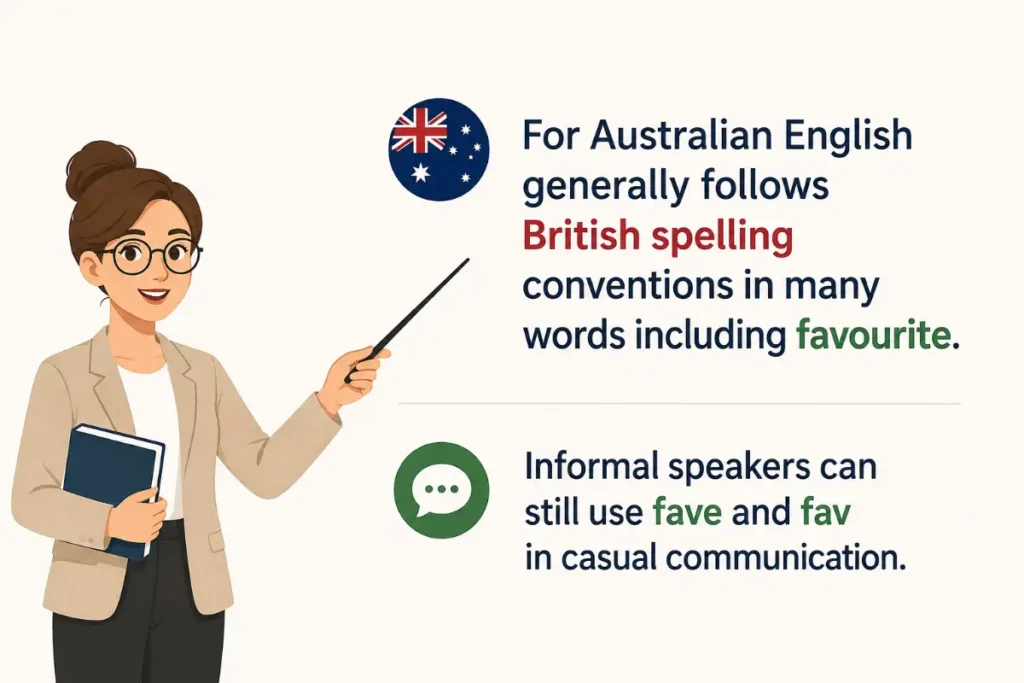
Australian English generally follows British spelling conventions in many words including favourite.
Informal speakers can still use fave and fav in casual communication.
The shortened forms are especially natural in personal messages social media and other relaxed settings.
There is no strong reason to treat faves as an American only form. Informal vocabulary can travel easily across English speaking communities.
Regional Usage In Canada
Canadian English commonly uses favourite while also sharing many features with American English.
Informal forms such as fave and fav can appear in casual communication.
For formal Canadian writing the safest choice depends on the publication or style guide being followed. If the context calls for standard Canadian spelling then favourite is the natural full form.
The shortened forms remain useful when the goal is a relaxed conversational tone.
Grammar Rules and Part of Speech
Fave can work as a noun.
For example:
That movie is my fave.
It can also work as an adjective.
For example:
That’s my fave movie.
Cambridge and Oxford both support these grammatical uses.
Fav can also function as a noun or adjective.
For example:
That restaurant is my fav.
This is my fav restaurant.
The plural forms faves and favs normally act as nouns.
For example:
These are my faves.
Those songs are my favs.
Placement is flexible because the word can serve different grammatical roles.
You can place it after a linking verb.
That’s my fave.
You can place it before a noun.
That’s my fave book.
You can also use the plural form after a possessive.
These are my faves.
Punctuation follows normal sentence rules. The informal status of the word does not require special punctuation.
You don’t need quotation marks around fave or fav simply because they are informal.
Real Life Usage Examples
Daily Talk
In everyday conversation you might say:
That’s my fave.
Those are my faves.
The tone feels friendly and relaxed. It works especially well when the people involved already understand the casual style.
In a friendly personal email you might write:
I tried the three restaurants you recommended. The Italian place was my fave.
In a formal business email the full word favorite would usually sound more polished.
Academic Writing
Academic writing normally favors the full form.
Instead of:
This was one of the students’ faves.
A formal paper might say:
This was one of the students’ favorite choices.
The shorter forms are not automatically ungrammatical. They simply carry a casual tone that can clash with academic style.
News Writing
News and entertainment writing may use fave or faves when the tone is deliberately informal.
For example:
The singer shared some of her faves with fans.
A serious news report would usually choose favorite when the shorter form adds no useful tone.
Literature
Writers can use fave or faves in dialogue to reflect natural speech.
A character might say:
That’s always been my fave.
This can make dialogue sound contemporary and relaxed.
The choice depends on the voice of the character and the period being represented.
Related and Confused Terms
At Last
At last usually highlights the moment something finally happens after waiting.
Example:
At last we reached the station.
It is not a synonym for favorite.
Eventually
Eventually means something happens after some time or after a sequence of events.
Example:
She eventually found her lost notebook.
Ultimately
Ultimately refers to the final result or conclusion.
Example:
The decision ultimately helped the team.
At The End
At the end points to the final part of a period event place or sequence.
Example:
At the end of the movie everyone applauded.
In The End
In the end often introduces the final outcome.
Example:
In the end we decided to stay home.
Lastly
Lastly introduces the final item in a sequence.
Example:
Lastly we need to check the budget.
In Conclusion
In conclusion introduces a final summary or judgment.
Example:
In conclusion the evidence supports the proposal.
Finally
Finally can indicate the last item in a sequence or something that happens after a long wait.
Example:
Finally we found the right answer.
These terms belong to a related semantic field but they don’t mean favorite. The similarity comes from the way language learners often group words by surface appearance or broad context rather than exact meaning.
Expert Editor Insight
As an editor I’d make the choice based on audience before making it based on spelling preference. Faves and favs are both legitimate informal forms and dictionary evidence supports that classification. Fave has particularly strong dictionary support from Oxford while Cambridge explicitly records fav as another spelling of fave. If I were editing a casual blog post or social media caption I wouldn’t automatically change faves to favorites. If I were editing a formal report I’d normally replace the shortened form with favorite. The best editor doesn’t remove personality just to make every sentence sound formal. The goal is to match the word to the situation.
Expert Tip
If you’re unsure which informal spelling to choose use faves.
It has a clear relationship with fave and closely resembles the spelling that major dictionaries recognize. Favs is also acceptable but can look more abbreviated.
For formal writing skip both and use favorites.
That simple three way rule covers most situations.
A Note About Faves And Favs
The forms faves and favs should not be confused with finally.
They belong to completely different parts of the vocabulary.
Faves means favorite people or things.
Favs means the same thing in another informal spelling.
Finally means at last or as the last point in a sequence.
The spelling confusion can happen when a search query combines unrelated terms. Search engines also surface similar looking words because users often type quickly and make small spelling errors.
That is why a good language guide should separate spelling from meaning rather than treating every similar looking form as a genuine variant.
Faves Or Favs In Formal Writing
For most formal situations the best choice is neither.
Use favorites in American English.
For example:
These are my favorite books.
That sentence is neutral and suitable for professional communication.
In informal writing you can comfortably use:
These are my faves.
You can also write:
These are my favs.
The choice then becomes a matter of style.
Faves often feels a little more familiar because readers can immediately connect it with fave. Favs feels shorter and more compressed.
Neither one changes the meaning.
Faves Or Favs On Social Media
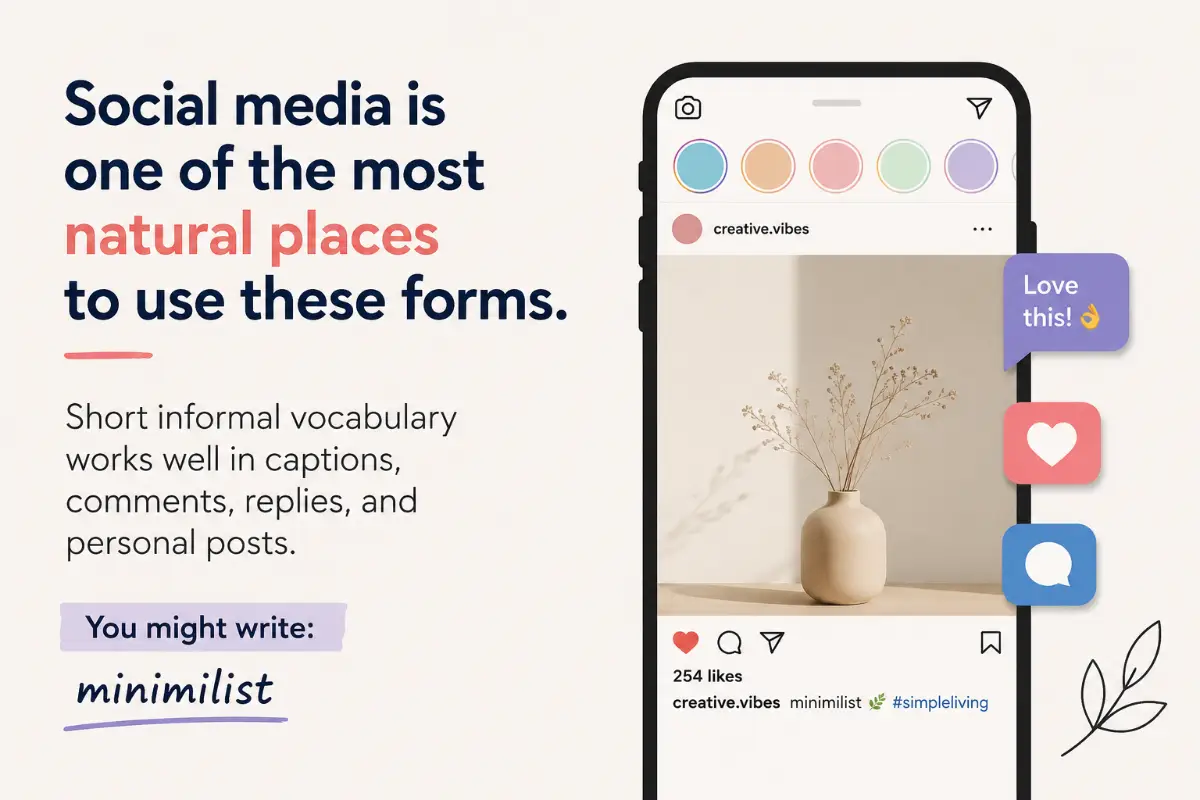
Social media is one of the most natural places to use these forms.
Short informal vocabulary works well in captions comments replies and personal posts.
You might write:
Here are my weekend faves.
Or:
These are my current favs.
Both sound natural.
The choice can even reflect personal writing style. Some people prefer words that retain recognizable spelling patterns. Others prefer maximum brevity.
The important point is that casual writing gives you more freedom than formal prose.
Why Informal English Creates Short Forms
English speakers shorten familiar words all the time.
Advertisement can become ad.
Application can become app.
Telephone can become phone.
Favorite can become fave or fav.
These forms save effort while keeping the meaning obvious.
Once a shortened form becomes familiar enough a community can understand it without needing the full word.
Fave has been around for much longer than many people realize. Etymonline traces its frequent use back to 1933.
That history gives the word some perspective. It isn’t simply a modern internet invention.
The Best Choice For Your Sentence
If you’re writing to friends use whichever informal form matches your style.
If you’re writing a casual blog post either can work.
If you’re writing a social media caption both are natural.
If you’re writing an academic paper use favorite.
If you’re writing a professional report use favorite.
If you’re writing for a British audience use favourite in formal prose.
If you want the most broadly recognizable informal form use fave for singular and faves for plural.
This approach keeps your writing natural without turning a simple spelling choice into a bigger problem than it needs to be.
Still confused? Compare Encorporate vs Incorporate Meaning and Usage 2026.
Conclusion
Faves and favs are both accepted informal plural forms related to favorite. Faves comes from fave, while fav is another informal shortened form. Both are commonly understood in casual modern English.
For texts, social media, online conversations, and other informal writing, you can use either form. Faves may look more familiar because it closely follows the spelling of fave, while favs is shorter and works well in quick digital communication.
For formal, academic, or professional writing, favorites is the better choice. The simple rule is to use faves or favs for a relaxed tone and favorites when you need a more standard and formal style.
Frequently Asked Questions
Is Faves Or Favs Correct?
Faves is the more established spelling and the plural form of fave, an informal word meaning favorite. Favs is also used in casual online writing, but it is less established.
Is Favs A Correct Spelling?
Yes. Favs is commonly used as an informal shortened form, especially in texts, social media, and online conversations. However, faves is more widely recognized as the plural of fave.
What Does Faves Mean?
Faves is an informal plural noun that means favorite people or things. For example, you might call your favorite books, songs, movies, or restaurants your faves.
Can I Use Faves In Formal Writing?
It’s better to use favorites in formal writing. Faves has a casual tone and is more suitable for conversations, social media, blogs, messages, and other informal contexts.
Is Faves Or Favs More Common?
Faves is generally more recognizable and established in informal English. Favs is also common online, especially where writers prefer a shorter form.
Is Faves A Short Form Of Favorite?
Yes. Fave is an informal shortened form of favorite, and faves is its plural form. The shortened form is common in casual English.
Can I Use Faves In Social Media Posts?
Yes. Faves fits naturally in social media captions, comments, messages, and other casual online writing. It gives the sentence a relaxed and conversational tone.
Should I Use Faves Or Favorites?
Use faves when you want a casual and friendly tone. Choose favorites for formal, academic, professional, or more polished writing.