
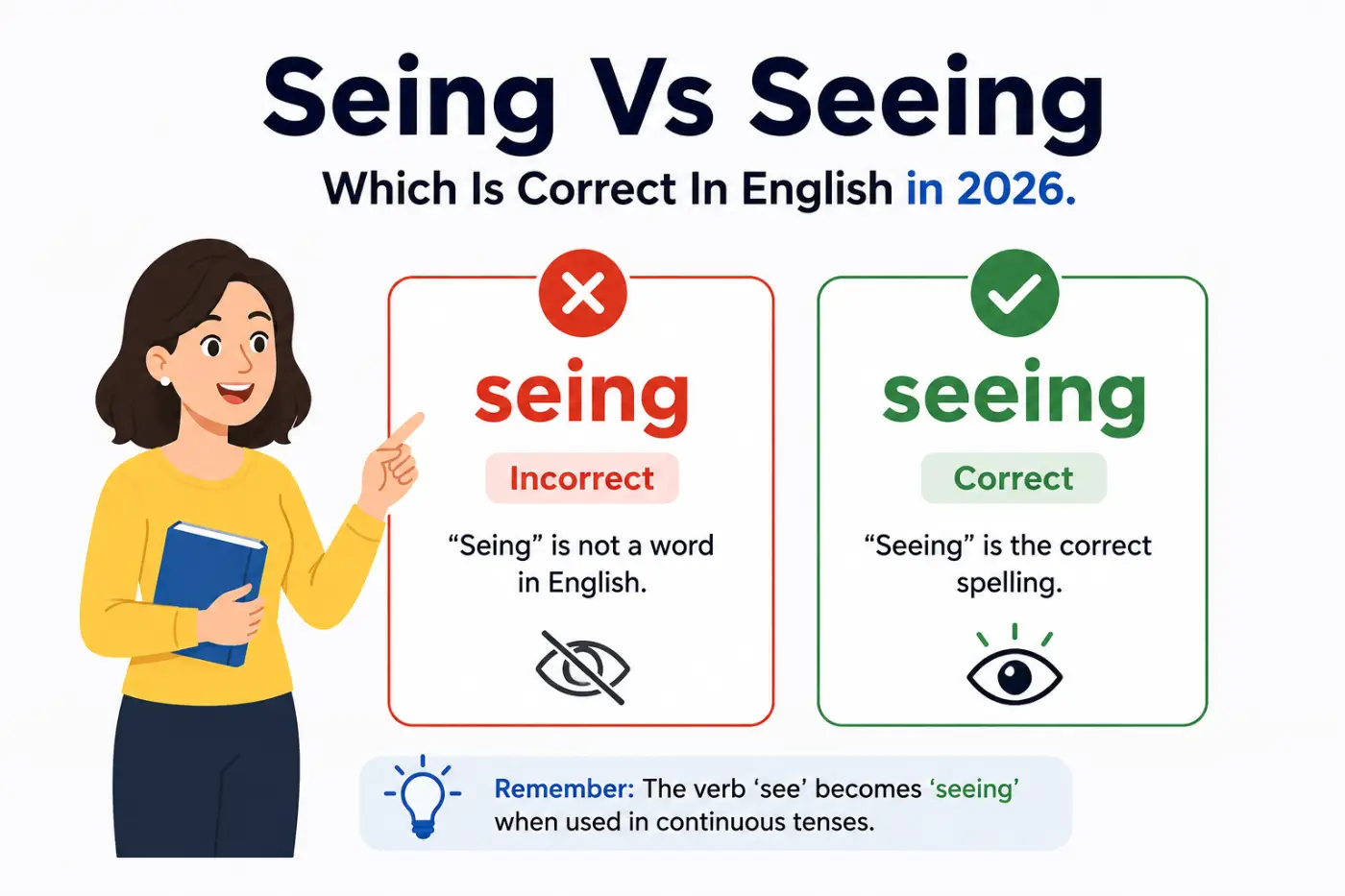
If you’re searching for seing vs seeing, you’re probably trying to find the correct spelling after noticing a typo or seeing a spell checker flag the word. You’re not alone. This is one of the most common English spelling mistakes because the verb see follows a spelling pattern that catches many writers off guard.
The correct spelling is seeing. Seing is a misspelling and isn’t recognized as a standard English word.
The confusion comes from English spelling rules. Many verbs drop a final e before adding ing, such as make becoming making. The verb see works differently because it already ends with two e letters. Instead of removing one, English keeps both letters and simply adds ing, creating seeing.
Learn the difference in Afterward or Afterwards Correct Usage Guide.
Quick Definition
Seeing is the correct present participle and gerund form of the verb see. Seing is an incorrect spelling caused by dropping one e from the original word. In standard English, dictionaries, style guides, schools, publishers, and professional editors all recognize seeing as the only correct form.
Quick Answer
If you’re deciding between seing vs seeing, choose seeing every time.
- Seeing is the correct English spelling.
- Seing is a spelling mistake.
- Seeing functions as both a verb form and a noun called a gerund.
- Every major English dictionary accepts seeing.
- Native speakers use seeing in everyday speech, writing, education, business, journalism, and literature.
Seing Vs Seeing Comparison Table
| Feature | Seing | Seeing |
|---|---|---|
| Correct spelling | No | Yes |
| Meaning | None in standard English | Present participle and gerund of see |
| Part of speech | Not a recognized English word | Verb and gerund |
| Origin | Typographical error | Derived from Old English seon |
| Usage frequency | Extremely rare and incorrect | Extremely common |
| Formality level | Never appropriate | Suitable in every style of writing |
| Common contexts | Misspellings and typing errors | Everyday conversation academic writing business communication literature media |
| Example | Incorrect: I am seing the stars. | Correct: I am seeing the stars. |
Understanding The Search Intent Behind Seing Vs Seeing
People searching seing vs seeing usually want one clear answer. They aren’t comparing two accepted English words. They’re trying to confirm the correct spelling after noticing a spelling correction or receiving an error message. The dominant search intent includes several related questions.
- Which spelling is correct.
- Why does seeing keep two e letters.
- How should the word be pronounced.
- How do you use seeing correctly in a sentence.
- How can you avoid making the same spelling mistake again.
Answering all of those questions gives readers complete confidence instead of a quick correction without an explanation.
Meaning Of Seing
The word seing has no accepted meaning in modern English. It doesn’t appear as a standard entry in major English dictionaries because it isn’t considered a legitimate English word. Almost every appearance of seing comes from a typing mistake, a spelling error, or an early draft that wasn’t proofread. People commonly write seing because English often removes the final e before adding ing. That familiar pattern leads many writers to apply the same rule where it doesn’t belong. If you see seing in a document, article, email, or assignment, it should almost always be corrected to seeing.
Meaning Of Seeing
Seeing is the present participle and gerund form of the verb see. As a verb, it describes the act of using your eyes to notice something.
Examples include:
- I am seeing a rainbow after the storm.
- We’re seeing better results this year.
- She’s seeing the doctor tomorrow.
As a gerund, seeing acts like a noun.
Examples include:
- Seeing is believing.
- Seeing new places changes your perspective.
- Seeing the problem early saved everyone time.
Beyond literal vision, seeing also expresses understanding, recognizing, meeting someone, visiting someone, or experiencing something. That flexibility makes it one of the most frequently used verb forms in English.
Seing Vs Seeing Which One Is Correct
The correct spelling is seeing. English spelling rules preserve both e letters from see, then add ing to create seeing. This spelling appears in dictionaries, textbooks, newspapers, novels, government publications, and professional writing across the English speaking world. The spelling seing is always considered incorrect in standard English. A simple way to remember the correct form is this. The base verb see already has two e letters. Keep both of them before adding ing.
See.
Seeing.
Nothing disappears. That small memory trick prevents one of the most common spelling mistakes English learners make.
Why People Write Seing Instead Of Seeing
This mistake isn’t random. It happens because English contains several spelling patterns that seem similar but don’t always follow the same rule.
For example:
- Make becomes making.
- Take becomes taking.
- Ride becomes riding.
Those verbs lose their final e before ing. Many writers expect see to behave the same way. Instead, English keeps both e letters.
Compare the patterns.
- Make → Making.
- Write → Writing.
- Dance → Dancing.
- See → Seeing.
The double e stays because the spelling reflects the original verb and helps preserve pronunciation. Professional editors notice this mistake immediately because seing stands out as a nonstandard spelling.
Key Differences Between Seing And Seeing
Although these words look similar, only one belongs in standard English.
- Seeing is a real English word.
- Seing is a misspelling.
- Seeing appears in dictionaries.
- Seing doesn’t appear as an accepted dictionary entry.
- Seeing works as both a verb and a gerund.
- Seing has no grammatical function in standard English.
- Seeing belongs in formal and informal writing.
- Seing should always be corrected before publishing.
Grammar Rules Behind Seeing
Understanding the grammar makes the spelling much easier to remember. he verb see is an irregular verb with several important forms.
| Form | Word |
|---|---|
| Base verb | See |
| Third person singular | Sees |
| Present participle | Seeing |
| Past tense | Saw |
| Past participle | Seen |
Notice that seeing keeps the original spelling of the base verb. This pattern differs from many verbs ending in a single silent e, making it important to memorize rather than guess.
Pronunciation Guide For Seeing
Correct spelling is only part of using a word well. Pronunciation matters too, especially if you use English in conversations, presentations, or public speaking.
IPA Pronunciation
Seeing is pronounced:
UK: /ˈsiː.ɪŋ/
US: /ˈsiː.ɪŋ/
The pronunciation stays almost identical across major English speaking countries.
Syllable Breakdown
The word has two syllables.
See ing
The first syllable carries the stress.
Common Pronunciation Mistakes
Many English learners make one of these mistakes.
- They pronounce it as a single syllable instead of two.
- They shorten the long ee sound.
- They rush through the ending and make the word sound like sing.
- They confuse seeing with saying because the words look somewhat similar.
Speaking each syllable clearly makes your pronunciation sound more natural.
You may also want to read Aswell vs As Well Which One Is Correct.
Etymology And Word Origin
Understanding a word’s history often makes its spelling easier to remember. The verb see comes from the Old English word seon, which meant to perceive with the eyes, observe, understand, or experience. Its roots go back even further to the Proto Germanic form sehwaną, which also referred to the act of seeing or perceiving.
As English evolved over centuries, see became the standard modern spelling. When English speakers needed the present participle, they simply added ing without removing either e. That produced seeing, the spelling still used today. The incorrect form seing never became part of standard English. It appeared only as an accidental spelling error created by applying the wrong spelling rule. This history explains why the double e remains in the modern word.
Regional Usage Of Seeing
One question appears often among English learners. Does any English speaking country accept seing? The answer is no.
American English
American English always uses seeing. You’ll find this spelling in schools, universities, newspapers, legal writing, business communication, and everyday conversations.
British English
British English also uses seeing exclusively. Major British dictionaries, publishers, and educational institutions recognize only this spelling.
Australian English
Australian English follows the same rule. Professional and informal writing both use seeing.
Canadian English
Canadian English also accepts only seeing. Although Canadian English sometimes mixes British and American spelling conventions, this word stays exactly the same. No major English variety recognizes seing as a correct spelling.
Examples Of Seeing In Sentences
These examples show how naturally seeing fits into different situations.
Everyday Conversation
- I’m seeing my grandparents this weekend.
- She’s seeing a movie with her friends tonight.
- We’re seeing more people at the park today.
- He’s seeing improvements after practicing every day.
- I’m seeing your point now.
Academic Writing
- Researchers are seeing encouraging results from the latest study.
- Students learn better by seeing practical demonstrations.
Professional Communication
- Our team is seeing steady growth this quarter.
- We’re seeing increased customer satisfaction after the update.
Literature And Creative Writing
- Seeing the sunrise filled her with quiet hope.
Examples Using Seing
The following sentences are intentionally incorrect. They show mistakes that editors regularly correct.
- I am seing my teacher tomorrow.
- We’re seing better results this year.
- She’s seing the mountains for the first time.
- They’re seing their relatives this weekend.
- He kept seing the same mistake.
- I’m seing what you mean now.
- She enjoys seing wildlife in national parks.
- We are seing more visitors this summer.
- The doctor is seing patients today.
- They were seing beautiful paintings at the museum.
Every sentence above becomes correct by replacing seing with seeing.
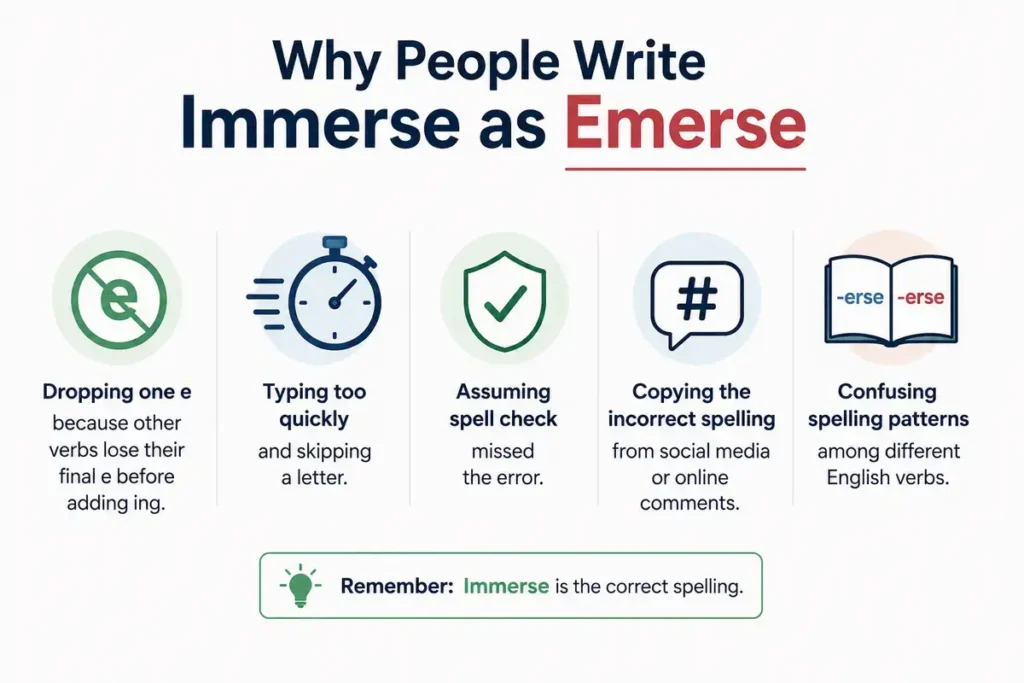
Common Mistakes People Make
The spelling mistake usually comes from habit instead of misunderstanding the word’s meaning. Here are the mistakes editors notice most often.
- Typing too quickly and skipping a letter.
- Dropping one e because other verbs lose their final e before adding ing.
- Assuming spell check missed the error.
- Copying the incorrect spelling from social media or online comments.
- Confusing spelling patterns among different English verbs.
The easiest solution is to remember that see already ends with two e letters. Keep both letters before adding ing.
Grammar Mistakes Related To Seeing
Even after spelling the word correctly, writers sometimes use it incorrectly.
Consider these examples.
Incorrect.
I seen the movie yesterday.
Correct.
I saw the movie yesterday.
Incorrect.
I have saw that before.
Correct.
I have seen that before.
Incorrect.
I am seeing the difference.
Correct.
I am seeing the difference.
Learning the complete set of verb forms makes these mistakes much less likely.
Seeing synonym
Here are common synonyms for “seeing”, grouped by meaning.
When “seeing” means looking at something
- Looking.
- Watching.
- Observing.
- Viewing.
- Glancing.
- Staring.
- Gazing.
- Eyeing.
- Noticing.
- Spotting.
When “seeing” means understanding
- Realizing.
- Recognizing.
- Understanding.
- Comprehending.
- Grasping.
- Perceiving.
- Appreciating.
- Acknowledging.
- Identifying.
- Interpreting.
Seeing as a Way to Say Meeting Someone
- Meeting.
- Visiting.
- Dating.
- Spending time with.
- Encountering.
- Greeting.
- Catching up with.
- Consulting.
- Calling on.
- Getting together with.
Real Life Usage Examples
Daily Conversation
People use seeing constantly in everyday speech.
- I’m seeing my cousins tomorrow.
- We’re seeing more traffic this morning.
- She’s seeing someone new.
- I’m seeing things more clearly now.
Academic Writing
Teachers and researchers often use seeing to describe observations.
- Scientists are seeing measurable improvements.
- Students begin seeing patterns after repeated practice.
Professional Communication
Businesses frequently use the word in reports and meetings.
- We’re seeing higher sales this month.
- The company is seeing positive customer feedback.
- Our department is seeing fewer support requests.
Literature
Writers often use seeing to create vivid descriptions.
- Seeing the old house brought back forgotten memories.
- Seeing the ocean reminded him of childhood summers.
Media
Journalists regularly write sentences like these.
- Experts are seeing changes in consumer behavior.
- Hospitals are seeing increased patient numbers during flu season.
These examples show that seeing appears naturally across every style of English.
Related Words And Confused Terms
People searching for seing vs seeing often struggle with other similar spellings too.
Some closely related words include:
- See.
- Seen.
- Saw.
- Sees.
- Sight.
- Vision.
- Observe.
- Notice.
- Watch.
- View.
- Look.
- Witness.
- Perceive.
- Glance.
- Behold.
Other commonly confused spelling pairs include:
- Writing or writting.
- Coming or comming.
- Hoping or hopeing.
- Dying or dieing.
- Truly or truely.
- Begining or beginning.
- Useing or using.
- Glueing or gluing.
Learning these patterns strengthens your spelling across many English verbs instead of just one.
Expert Language Insight
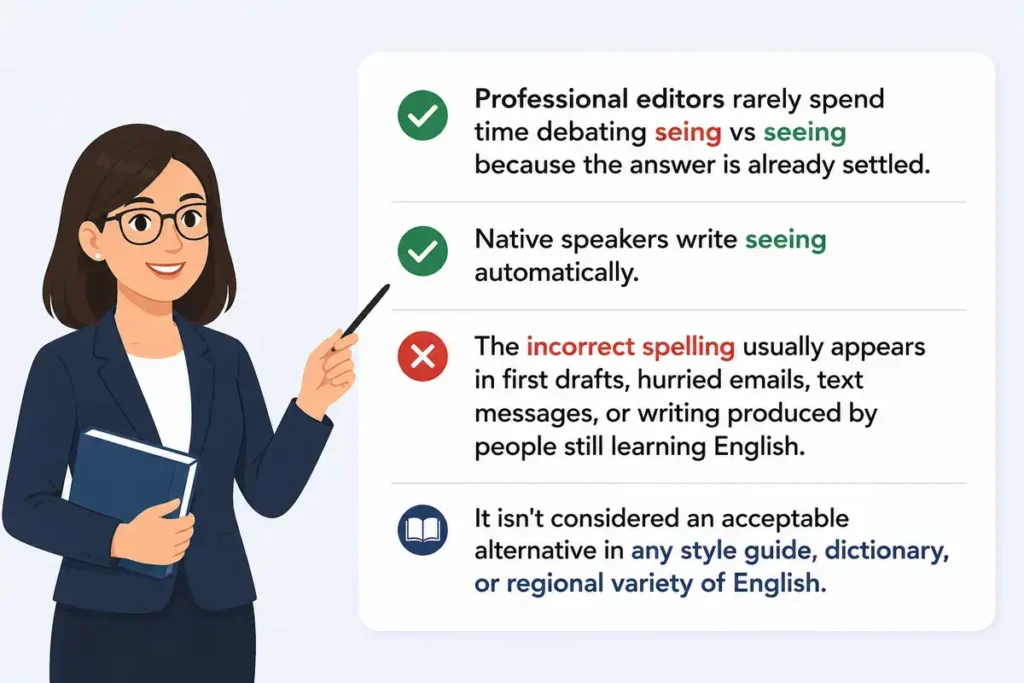
Professional editors rarely spend time debating seing vs seeing because the answer is already settled. Native speakers write seeing automatically. The incorrect spelling usually appears in first drafts, hurried emails, text messages, or writing produced by people still learning English. It isn’t considered an acceptable alternative in any style guide, dictionary, or regional variety of English. One useful habit separates experienced writers from everyone else. They don’t memorize isolated spellings. They learn patterns. When you remember the complete verb family, the correct spelling becomes much easier.
- See.
- Sees.
- Seeing.
- Saw.
- Seen.
Thinking of the whole family instead of a single word helps you recognize mistakes almost instantly. That approach improves spelling accuracy far beyond this one example and builds stronger writing habits over time.
Learn the difference in Laser Or Lazer Definition, Spelling And Usage in 2026.
Final Verdict On Seing Vs Seeing
The answer is straightforward. Seeing is the only correct spelling in modern English, while seing is always a misspelling. The confusion is understandable because many English verbs remove a final e before adding ing. The verb see follows a different pattern. It keeps both e letters and becomes seeing.
Remember these key points.
- Seeing is the correct spelling.
- Seing is never correct in standard English.
- Seeing serves as both the present participle and the gerund of see.
- Every major English dictionary and style guide accepts seeing.
- The spelling stays the same in American English, British English, Australian English, and Canadian English.
If you’re ever unsure, start with the base verb. See contains two e letters, so seeing keeps both before adding ing. That simple habit will help you avoid one of the most common spelling mistakes English learners and native speakers make.
Frequently Asked Questions
Is Seing Ever A Correct English Word?
No. Seing is never correct in standard English. It is a spelling mistake. Every major English dictionary, grammar guide, and style manual recognizes seeing as the correct spelling.
Why Does Seeing Keep Two E Letters?
The verb see ends with two e letters. Unlike many verbs ending in a single silent e, it keeps both letters before adding ing. That is why the correct spelling is seeing, not seing.
Is Seeing A Verb Or A Noun?
It can be both. Seeing is the present participle of the verb see. It can also function as a gerund, which is a verb form that acts like a noun. The meaning depends on how it is used in the sentence.
Do British And American English Spell Seeing Differently?
No. British English, American English, Australian English, and Canadian English all use the spelling seeing. There is no regional variation for this word, and seing is considered incorrect everywhere.
Why Do So Many People Write Seing?
Most people write seing because they apply the wrong spelling rule. Many English verbs drop a final e before adding ing, so writers naturally expect see to do the same. This verb is an exception because it already ends with two e letters.
How Can I Remember The Correct Spelling Of Seeing?
A simple memory trick is to think about the base word first. See already has two e letters. Keep both letters and then add ing. If you remember see plus ing equals seeing, you’ll avoid this mistake every time.
Is Seeing Used In Formal Writing?
Yes. Seeing is appropriate in every type of writing, including academic papers, business emails, professional reports, news articles, books, and everyday conversations. It is the standard spelling in formal and informal English.
Can Spell Check Catch Seing?
Most modern spell checkers and grammar tools identify seing as a misspelling and suggest seeing as the correction. Still, proofreading remains important because automated tools can occasionally miss typing errors in certain situations.