
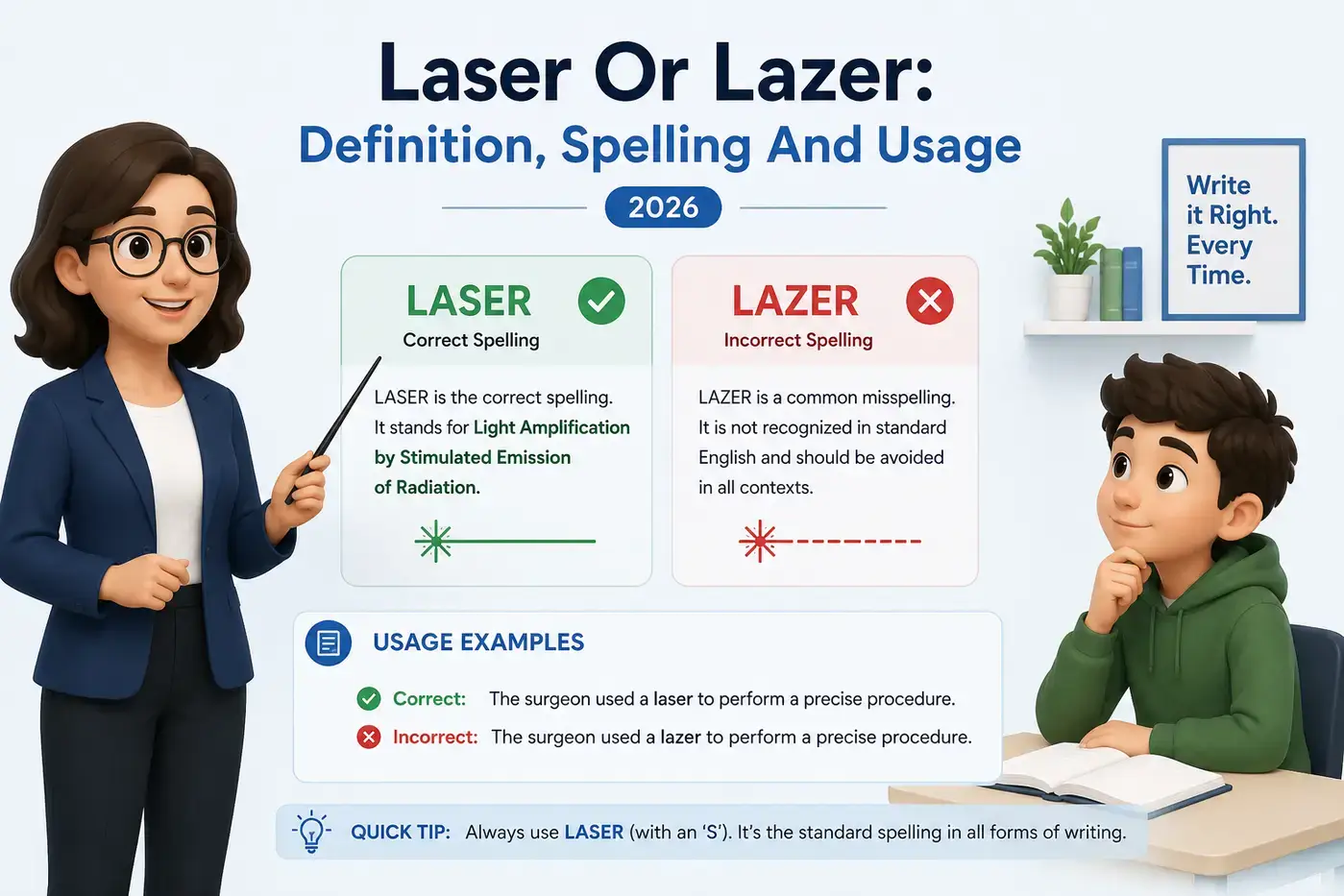
If you’ve ever paused while writing and wondered if you should use laser or lazer, you’re asking a question that many English speakers search every day. The short answer is simple. Laser is the correct spelling in standard English. Lazer is usually a misspelling, although it can appear as a brand name, a stage name, or part of a product name.
The confusion makes sense. Both words sound exactly the same when spoken, and English has plenty of words that can be spelled in more than one accepted way. That leads some people to assume the same rule applies here. It doesn’t.
Using the correct spelling matters because laser is a scientific term with a well established history. It’s recognized by dictionaries, style guides, schools, publishers, and professionals around the world. Choosing the wrong spelling can make otherwise polished writing look careless. This guide explains the meaning of both terms, why one is correct, how dictionaries treat them, where the incorrect spelling sometimes appears, and how to remember the right choice every time.
You may also want to read Passtime or Pastime Which Is Correct? 2026.
Featured Snippet
Laser is the correct English spelling. It refers to a device that produces a focused beam of light through light amplification by stimulated emission of radiation. Lazer is not a standard English word and is usually a misspelling, although some companies, products, and entertainers use it as part of a name.
Laser Or Lazer Quick Answer
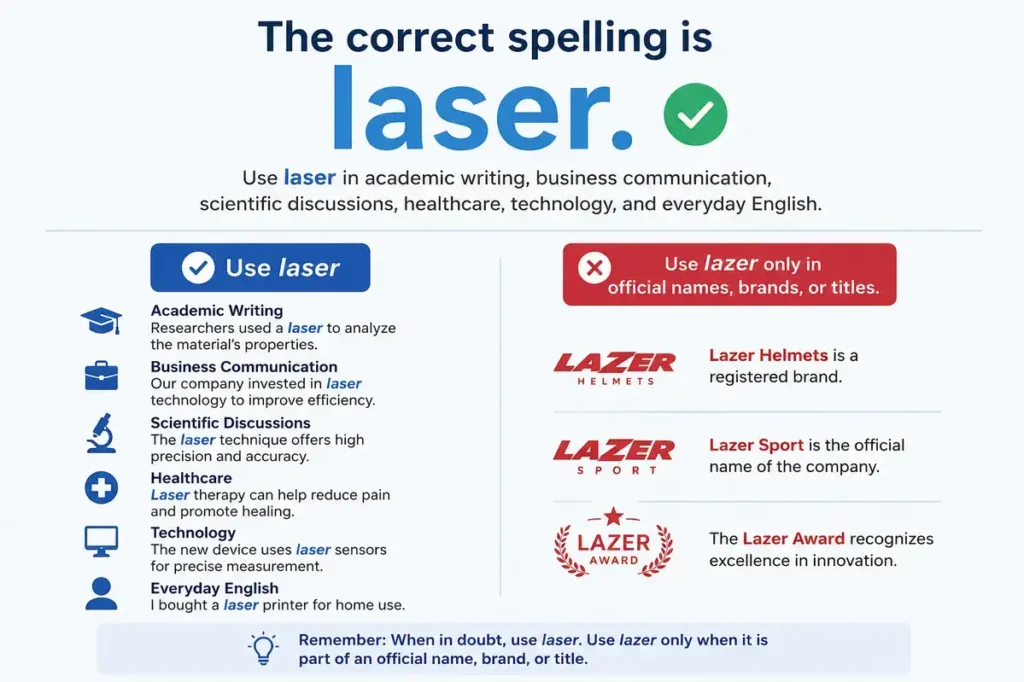
The correct spelling is laser. Use laser in academic writing, business communication, scientific discussions, healthcare, technology, and everyday English. Lazer should only be used when it is part of an official name, brand, or title.
Comparison Table
| Correct Form | Meaning | Part Of Speech | Origin | Usage Frequency | Formality | Common Contexts | Example |
|---|---|---|---|---|---|---|---|
| Laser | A device or beam of concentrated light | Noun | Acronym formed in the twentieth century | Extremely common | Standard in all writing | Science medicine engineering entertainment | The surgeon used a laser during the procedure. |
| Lazer | Usually a misspelling or a proper name | Proper noun in some cases | Modern brand or personal naming | Rare | Only when officially named | Brands musicians products games | The company launched its new Lazer helmet. |
Meaning And Definition
Meaning Of Laser
A laser is a device that generates a narrow and highly focused beam of light. The word began as an acronym for Light Amplification by Stimulated Emission of Radiation. Over time the acronym became an ordinary English word written in lowercase except at the beginning of a sentence.
Lasers are used in many fields including medicine, manufacturing, communications, scientific research, military technology, education, entertainment, and consumer electronics.
Common examples include.
- Laser eye surgery.
- Laser printers.
- Laser scanners.
- Laser cutting machines.
- Laser measuring tools.
- Laser pointers.
Because the technology has become part of everyday life, the word appears regularly in newspapers, textbooks, business reports, and casual conversations.
Meaning Of Lazer
Lazer is not a standard English word. Major dictionaries don’t list it as an accepted spelling of laser. In ordinary writing, it is considered a spelling mistake. That said, Lazer sometimes appears as part of an official name. Companies, products, musicians, games, and entertainment brands occasionally choose this spelling because it looks distinctive or memorable. In those situations, the spelling should remain exactly as the owner intended.
Examples include.
- Brand names.
- Product lines.
- Artist names.
- Video game titles.
- Business names.
Outside those specific cases, professional editors replace lazer with laser.
Editorial Observation
One reason this mistake happens so often is pronunciation. Since both spellings sound identical, many people rely on what they hear instead of what dictionaries recognize. English contains several accepted spelling variations, but this isn’t one of them. Standard English recognizes only laser.
Key Differences Explained
Quick Answer
The difference is straightforward. Laser is the accepted English spelling. Lazer is generally a misspelling unless it forms part of an official name.
Spelling
- Laser follows the standard English spelling found in dictionaries.
- Lazer replaces the letter s with z, creating a nonstandard form.
Grammar Role
- Laser functions as a noun.
- Lazer has no grammatical role in standard English unless it serves as a proper noun.
Meaning
- Laser describes a device or beam that emits concentrated light.
- Lazer has no dictionary meaning outside official names.
Tone
- Laser sounds professional, technical, and appropriate in every context.
- Lazer often gives an informal, commercial, or stylized impression because of its use in branding.
Context
Use laser in every type of writing, including academic papers, scientific articles, business documents, technical manuals, and everyday communication. Use Lazer only when referring to an official brand, organization, product, or person that intentionally uses that spelling.
Which Spelling Is Correct
Direct Answer
Laser is the correct spelling in standard English.
Why Is Laser Correct
The word originated as an acronym for Light Amplification by Stimulated Emission of Radiation. As its use became widespread, English adopted it as a common noun while keeping the original spelling. Changing the s to z creates a different spelling that isn’t recognized by standard dictionaries.
Dictionary Guidance
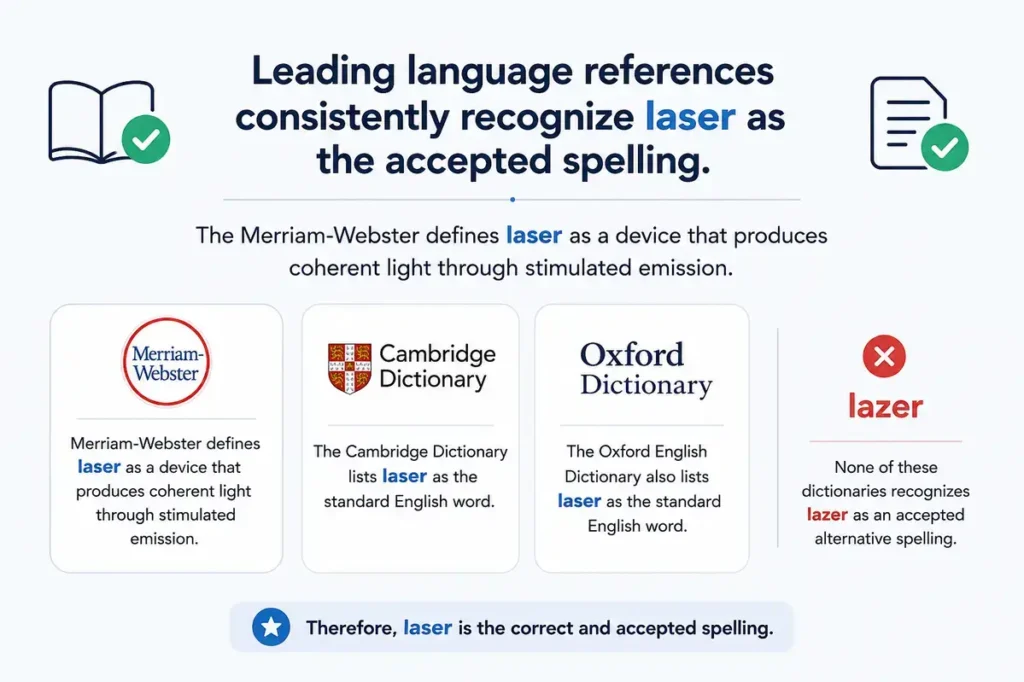
Leading language references consistently recognize laser as the accepted spelling. The Merriam Webster defines laser as a device that produces coherent light through stimulated emission. The Cambridge Dictionary and Oxford English Dictionary also list laser as the standard English word. None of these dictionaries recognizes lazer as an accepted alternative spelling.
Editorial Recommendation
Professional editors, teachers, publishers, and technical writers consistently use laser. If lazer appears in ordinary writing, it should be corrected unless it is part of an official name that intentionally uses that spelling.
Sentence Examples
Ten Natural Examples Using Laser
These examples show how laser appears in real world English.
- The doctor used a laser to remove the damaged tissue with remarkable precision.
- Our office printer uses laser technology to produce sharp documents.
- The engineer measured the distance with a laser device.
- She had laser eye surgery and no longer needed glasses.
- The museum displayed one of the earliest working laser systems.
- A laser scanner created an accurate three dimensional model of the building.
- The scientist adjusted the laser before starting the experiment.
- The concert featured colorful laser effects that filled the arena.
- The technician repaired the laser cutting machine this morning.
- Modern factories rely on laser equipment for precise manufacturing.
Five Examples Showing Lazer As A Common Misspelling
These examples show incorrect usage in standard English.
- The doctor recommended lazer surgery. ❌
Correct: The doctor recommended laser surgery. - I bought a new lazer pointer yesterday. ❌
Correct: I bought a new laser pointer yesterday. - The engineer tested the lazer system. ❌
Correct: The engineer tested the laser system. - We watched an amazing lazer show. ❌
Correct: We watched an amazing laser show. - The machine uses a powerful lazer beam. ❌
Correct: The machine uses a powerful laser beam.
If you see Lazer as part of an official company or product name, keep the original spelling. In every other situation, use laser.
Common Mistakes
Quick Answer
Most spelling mistakes happen because people write words the way they sound. Since laser and lazer have the same pronunciation, many writers replace the letter s with z without realizing the mistake.
Mistake One
Replacing s with z. People assume the sound determines the spelling. English spelling doesn’t always follow pronunciation, and laser keeps the letter s.
Mistake Two
Copying Brand Names. Some products and companies intentionally use Lazer as part of their branding. Readers sometimes assume that spelling is acceptable everywhere.
It isn’t.
Mistake Three
Typing Too Quickly. Fast typing often leads to accidental spelling errors. Many people don’t notice the mistake because both words sound identical in their minds.
Mistake Four
Trusting Autocorrect Completely. Spell check tools are helpful, but they aren’t perfect. Some editing software may ignore a capitalized brand name and leave the spelling unchanged.
Mistake Five
Following Incorrect Online Content. Not every website follows professional editorial standards. Copying text from unreliable sources can spread spelling mistakes.
Related NLP Confusion Terms
People searching for this topic often look for related terms such as.
- Laser spelling.
- Lazer meaning.
- Laser definition.
- Laser pronunciation.
- Laser acronym.
- Laser beam.
- Laser vs lazer.
- Correct spelling of laser.
For another common grammar confusion, see According to Alternatives for Clearer Writing.
Pronunciation Guide
Quick Answer
Both words are pronounced the same.
The standard pronunciation is /ˈleɪzər/.
IPA
American English.
/ˈleɪzər/
British English.
/ˈleɪzə/
Syllable Breakdown
La.
Ser.
The word has two syllables.
Audio Style Pronunciation
LAY zer.
The first syllable receives the strongest stress.
Common Pronunciation Mistakes
Some English learners pronounce every letter separately or place too much stress on the second syllable. Native speakers naturally stress the first syllable.
Speaking Tips
Practice using the word in complete sentences.
- The laser measured the distance.
- The surgeon used a laser.
- The students learned how a laser works.
Listening to native speakers in documentaries, science videos, or news reports can also help reinforce natural pronunciation.
Etymology And Word Origin
Quick Answer
The word laser began as an acronym before becoming an everyday English word.
Historical Development
In 1959, the scientist Gordon Gould popularized the acronym LASER, which stands for Light Amplification by Stimulated Emission of Radiation. As the technology became widely used, people stopped writing the word in capital letters except in historical or technical discussions. Today, dictionaries treat laser as a standard common noun.
Evolution In English
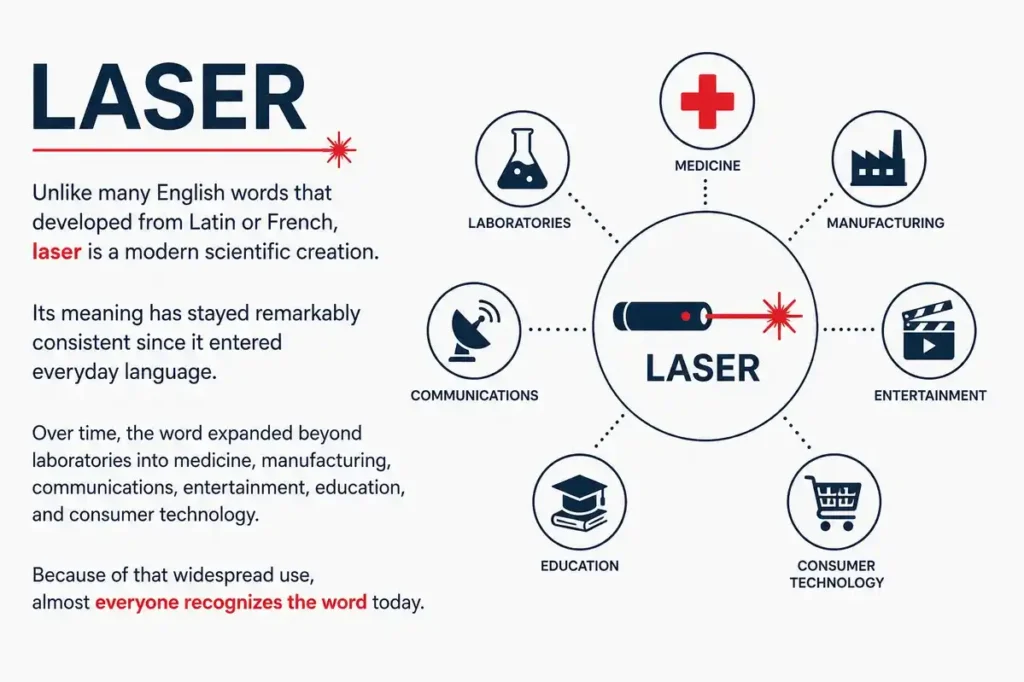
Unlike many English words that developed from Latin or French, laser is a modern scientific creation. Its meaning has stayed remarkably consistent since it entered everyday language. Over time, the word expanded beyond laboratories into medicine, manufacturing, communications, entertainment, education, and consumer technology. Because of that widespread use, almost everyone recognizes the word today.
Regional Usage
United States
American English uses laser in every professional and everyday context. Medical organizations, universities, publishers, and businesses all follow this spelling. The spelling lazer appears only in brand names or creative marketing.
United Kingdom
British English follows the same standard. Schools, newspapers, scientific journals, and publishers consistently use laser. There is no accepted British variant with the letter z.
Canada
Canadian English also recognizes only laser. Professional editors correct lazer unless it belongs to an official name.
Australia
Australian English follows the same pattern. Government publications, universities, and media organizations all use laser.
Does Any Region Prefer Lazer
No.
Unlike spelling differences such as color and colour or center and centre, no English speaking region recognizes lazer as a standard alternative spelling.
Grammar Rules And Part Of Speech
Quick Answer
Laser is primarily a noun, although it can occasionally function as a verb in informal or technical contexts.
As A Noun
Most often, laser refers to a device or the beam it produces.
Examples.
- The laser stopped working.
- The laser produced a bright beam.
As A Verb
Specialized industries sometimes use laser as a verb.
Examples.
- They laser cut the metal sheets.
- The clinic lasers skin imperfections.
This usage appears mainly in technical and professional settings.
Sentence Placement
As a noun, laser follows normal English sentence structure.
Example.
The technician repaired the laser.
As a verb.
The factory lasers hundreds of parts every day.
Common Grammar Patterns
You’ll often see laser with words such as.
- Beam.
- Surgery.
- Printer.
- Scanner.
- Cutting.
- Technology.
- Pointer.
- Treatment.
These combinations are common because they describe real products and applications.
Real Life Usage
Daily Conversation
- I bought a laser measure for home projects.
- The concert had an incredible laser show.
Professional Email
- Please inspect the laser equipment before tomorrow’s demonstration.
- The replacement laser module will arrive next week.
Academic Writing
- Researchers evaluated the laser under controlled laboratory conditions.
- The experiment demonstrated how laser energy interacts with different materials.
News Reporting
- Scientists developed a new laser capable of higher precision.
- The hospital introduced advanced laser technology for eye treatment.
Literature
- A thin laser beam cut through the darkness.
- The detective followed the laser dot across the empty warehouse.
These examples show that laser fits naturally into casual conversations, technical writing, journalism, fiction, and professional communication without changing its spelling or meaning.
Related And Commonly Confused Terms
Quick Answer
People often confuse laser with words that have similar meanings or appear in related situations. Knowing the differences helps you choose the right word with confidence.
Beam
A beam is any concentrated stream of light or energy. A laser produces a beam, but not every beam is a laser.
Light
Light is the visible form of electromagnetic radiation. A laser is a highly focused and controlled type of light.
Photon
A photon is the smallest unit of light. Laser beams consist of enormous numbers of photons moving in a highly organized way.
Optical
Optical relates to light or vision. Many laser technologies belong to the field of optics.
Laser Beam
A laser beam is the focused light produced by a laser device. People often shorten the phrase to simply laser.
Laser Pointer
A laser pointer is a handheld device that projects a narrow beam of light. It is commonly used during presentations, in classrooms, and for astronomy.
Laser Cutting
Laser cutting uses a concentrated beam of light to cut materials with exceptional precision. It is widely used in manufacturing and engineering.
Laser Surgery
Laser surgery uses focused light instead of traditional cutting tools for specific medical procedures. It is common in eye care, dermatology, and other specialized treatments.
Expert Editor Insight
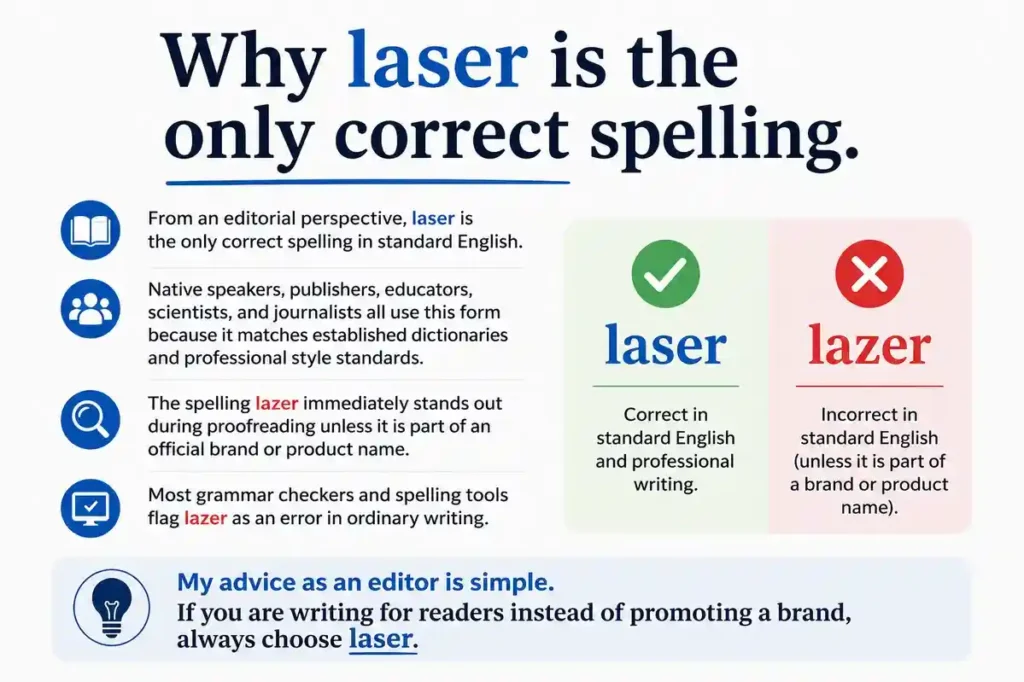
From an editorial perspective, laser is the only correct spelling in standard English. Native speakers, publishers, educators, scientists, and journalists all use this form because it matches established dictionaries and professional style standards. The spelling lazer immediately stands out during proofreading unless it is part of an official brand or product name. Most grammar checkers and spelling tools flag lazer as an error in ordinary writing. My advice as an editor is simple. If you are writing for readers instead of promoting a brand, always choose laser.
Many readers also check Gradual Vs Insidious Which Word Should You Use in 2026.
Conclusion
The answer is clear. Laser is the correct spelling in standard English, while lazer is generally a misspelling unless it appears as part of an official brand, product, or personal name. Dictionaries, editorial style guides, educators, and professional writers all agree on this standard.
The confusion comes from pronunciation because both spellings sound the same. Still, pronunciation does not determine correct spelling. If you remember that laser began as the acronym for Light Amplification by Stimulated Emission of Radiation, you’ll have an easy way to recall the correct form. Use laser in every piece of professional, academic, and everyday writing, and reserve Lazer only for official names that intentionally use that spelling.
Frequently Asked Questions
Is Lazer A Real Word?
In standard English, no. Lazer is not recognized as the correct spelling of the scientific term. You may see it used by companies, products, entertainers, or games as part of an official name, but that does not make it an accepted dictionary word.
What Does Laser Mean?
A laser is a device that produces a concentrated beam of light through the process known as light amplification by stimulated emission of radiation. It is widely used in medicine, manufacturing, communications, research, education, and entertainment.
Laser Or Lazer Which Is Correct?
Laser is the correct spelling for standard English. Dictionaries, style guides, schools, publishers, and scientific organizations all recognize this form. Use Lazer only when referring to an official name that intentionally uses that spelling.
How Do You Pronounce Laser?
In American English, the pronunciation is /ˈleɪzər/. It sounds like LAY zer with the stress on the first syllable. British English uses nearly the same pronunciation with only a slight difference in the final vowel sound.
Can Laser Be Used As A Verb?
Yes. Although it is primarily a noun, laser also functions as a verb in technical and professional contexts. For example, manufacturers may say they laser cut metal, and medical professionals may refer to laser treating specific conditions.
What Are Common Synonyms For Laser?
The word itself has few true synonyms because it describes a specific technology. Related expressions include laser beam, light beam, optical device, cutting beam, scanning device, and focused light. The best choice depends on the context.
Why Do People Misspell Laser?
Most spelling mistakes happen because laser and lazer sound identical. Others copy the spelling from brand names, online usernames, or product names without realizing those are intentional marketing choices instead of standard English.
Is Laser Appropriate In Formal Writing?
Yes. Laser is completely appropriate in academic papers, scientific journals, business documents, legal writing, technical manuals, and everyday communication. It is the standard spelling accepted across every major English speaking region.