
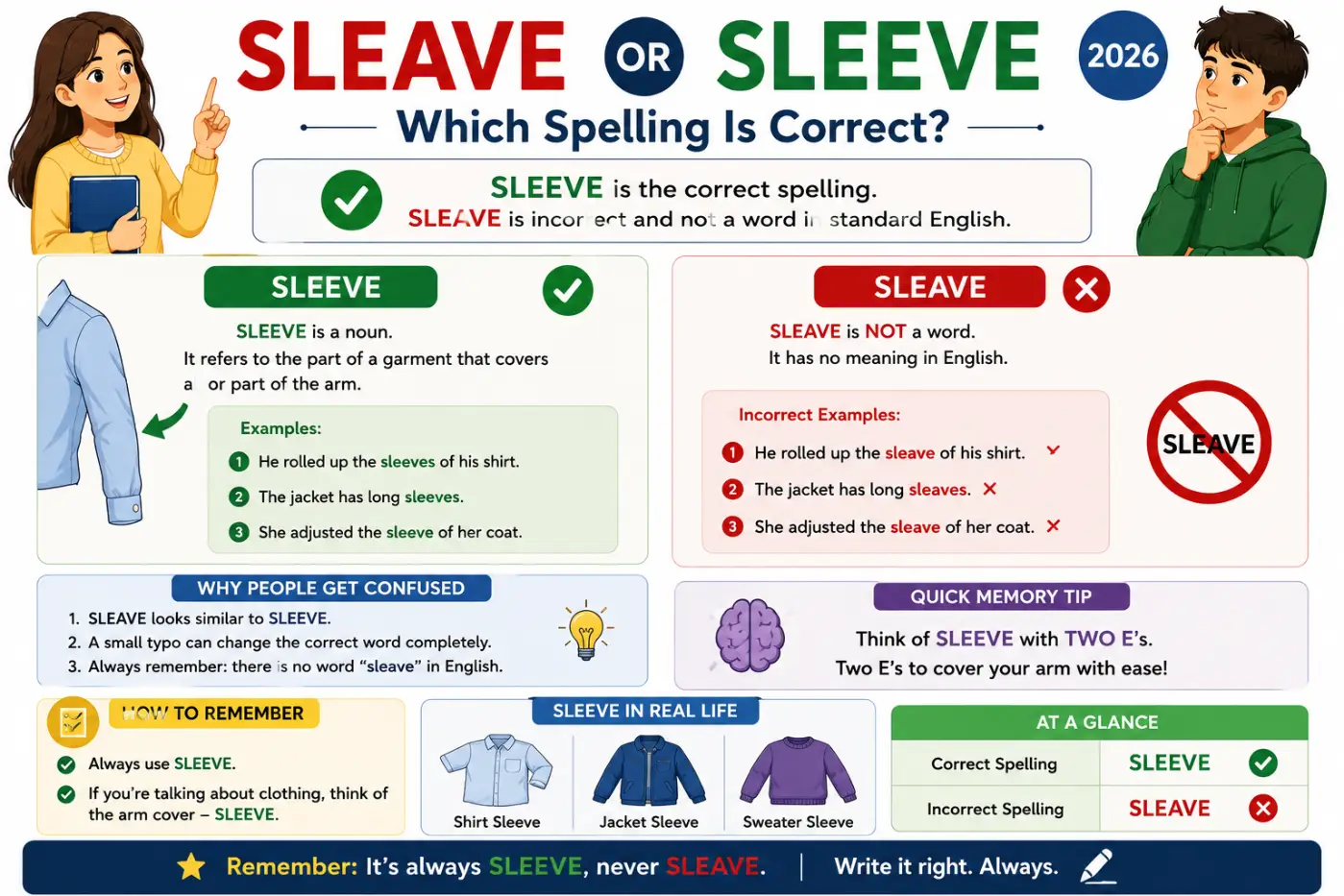
If you’ve searched for sleave or sleeve, you’re probably trying to figure out which spelling is correct. The confusion is understandable because both words exist in English, but they are not interchangeable. One is an everyday word that appears in clothing, engineering, sports, and countless other contexts. The other is an extremely rare literary word that most native English speakers never use outside classic literature.
This difference catches many writers off guard. Spell-checkers sometimes overlook the mistake because sleave is a legitimate English word, even though it is almost never used in modern writing. As a result, someone intending to write about a shirt sleeve or a jacket sleeve may accidentally type sleave and assume it is simply another accepted spelling.
The good news is that the answer is straightforward. In nearly every situation, sleeve is the correct word. Sleave survives mainly as an archaic literary term found in historical texts and famous works such as Shakespeare. Understanding this distinction helps you avoid spelling mistakes and write with confidence.
Many readers also check gizmo vs gismo: Which Spelling Is Correct?.
Quick Definition
Sleeve is the correct spelling in almost every modern context. It refers to the part of a garment that covers the arm or a protective covering around an object. Sleave is a rare, archaic English word meaning untwisted silk or thread and appears mainly in historical or literary writing.
Quick Answer
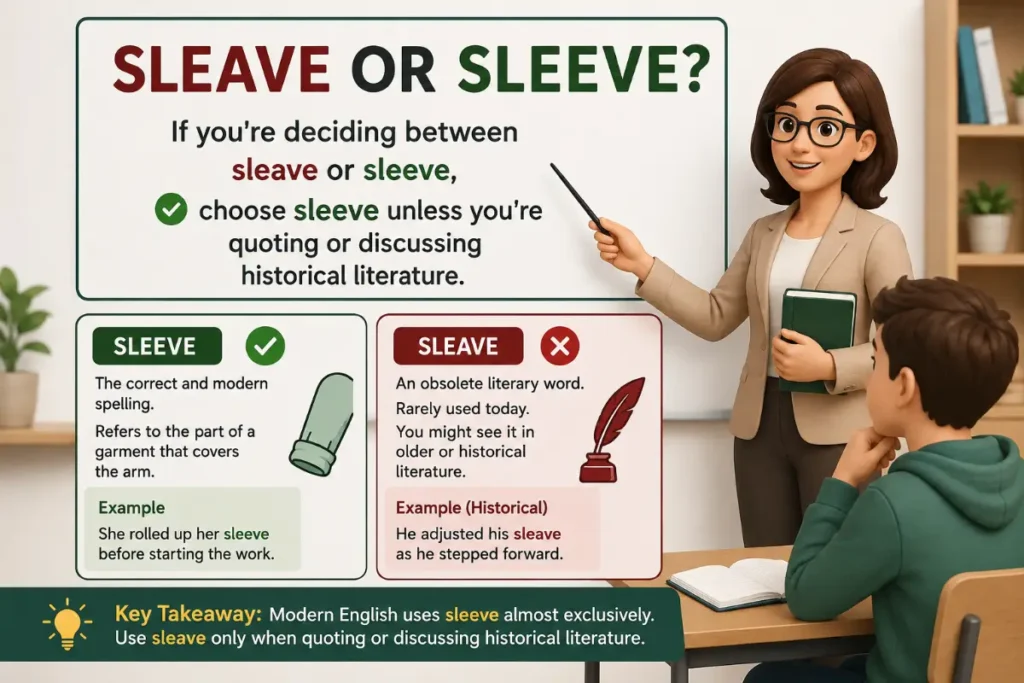
If you’re deciding between sleave or sleeve, choose sleeve unless you’re quoting or discussing historical literature. Modern English uses sleeve almost exclusively, while sleave has become an obsolete literary word.
Sleave or Sleeve Comparison Table
| Feature | Sleeve | Sleave |
|---|---|---|
| Correct modern spelling | Yes | Rarely |
| Current usage | Very common | Extremely rare |
| Part of speech | Noun and verb | Noun |
| Primary meaning | Part of clothing or protective covering | Fine untwisted silk or thread |
| Origin | Old English | Middle English |
| Usage frequency | Very high | Very low |
| Formality | Neutral | Literary and historical |
| Common contexts | Clothing, machinery, sports, engineering | Shakespeare, historical literature |
| Suitable for everyday writing | Yes | Almost never |
| Dictionary status | Standard English | Archaic English |
Search Intent Analysis
People searching for sleave or sleeve usually want one or more of these answers.
- Which spelling is correct.
- Why both words appear in dictionaries.
- Which word should be used in modern English.
- How to pronounce each word.
- Examples showing the correct usage.
- The difference between the two words.
The dominant search intent is a spelling comparison with usage guidance. Most readers simply want to avoid making a writing mistake.
What Does Sleeve Mean?
Sleeve is one of the most common nouns in English. It primarily refers to the part of a garment that covers all or part of the arm. Over time, its meaning expanded into many technical and figurative uses.
Definition
As a noun, sleeve means:
- The part of a shirt, jacket, sweater, or dress that covers the arm.
- A protective covering around another object.
- A mechanical tube or fitting surrounding another component.
As a verb, to sleeve means to place something into a sleeve or protective covering.
Etymology
The word sleeve comes from Old English slēfe, which referred to the arm covering of a garment. It has remained remarkably stable for over a thousand years and continues to carry essentially the same core meaning.
Common Contexts
You will see sleeve used in many fields.
- Clothing.
- Fashion.
- Manufacturing.
- Construction.
- Electronics.
- Sports.
- Music.
- Medical equipment.
- Packaging.
Everyday Examples
- She rolled up her sleeves before painting the wall.
- His jacket sleeve was slightly torn.
- The mechanic replaced the metal sleeve inside the engine.
- Slide the document into the plastic sleeve.
- The baseball pitcher wore a compression sleeve.
- Her sweater has long sleeves.
- The cable passes through a protective sleeve.
- He wiped his glasses with his shirt sleeve.
- The artist stored the poster in a clear sleeve.
- The card remained protected inside its plastic sleeve.
What Does Sleave Mean?
Unlike sleeve, sleave is unfamiliar to most English speakers.
Definition
Sleave is an archaic noun referring to fine untwisted silk, soft thread, or delicate fiber. Today, the word survives almost entirely in literary discussion and historical dictionaries.
Historical Context
The best-known appearance of sleave comes from Shakespeare’s Macbeth, where it appears in the phrase:
“The sleave of care.”
In this context, the word symbolizes the delicate threads that make up human worries or life’s burdens.
Outside literary studies, very few writers use sleave today.
Etymology
The word comes from Middle English and originally referred to fine silk fibers before spinning. As English evolved, everyday usage disappeared while sleeve remained common.
Modern Usage
You might encounter sleave in:
- Shakespeare analysis.
- Historical dictionaries.
- Literary criticism.
- Academic discussions of early English.
It is almost never appropriate in ordinary communication.
Sleave or Sleeve Which One Is Correct?
For modern English, the answer is simple.
Sleeve is the correct spelling in nearly every situation.
Choose sleeve when writing about:
- Clothing.
- Shirts.
- Jackets.
- Dresses.
- Protective coverings.
- Machine parts.
- Plastic protectors.
- Athletic wear.
Use sleave only if you are:
- Quoting Shakespeare.
- Discussing historical English.
- Analyzing classical literature.
- Explaining obsolete vocabulary.
For everyone else, sleeve is the right choice.
Why Do People Confuse Sleave and Sleeve?
Several factors contribute to the confusion.
Both Are Real Words
Many spelling mistakes involve a fake word. That is not the case here.Both sleave and sleeve appear in major dictionaries, making the mistake harder to notice.
Nearly Identical Pronunciation
The words sound almost identical in normal speech. Because English spelling is not always phonetic, writers sometimes guess incorrectly.
Spell Check Does Not Always Help
Since sleave is a legitimate dictionary entry, some spell-check tools will not flag it as an error. That is why proofreading matters.
Rare Encounters With Shakespeare
Students occasionally encounter sleave while studying Macbeth. Later, they may mistakenly assume it is simply another accepted spelling of sleeve.
Key Differences Between Sleave and Sleeve
Although the words look similar, they differ in almost every practical way.
Meaning
Sleeve refers to clothing or protective coverings. Sleave refers to fine untwisted silk or thread.
Frequency
Sleeve appears millions of times across books, websites, newspapers, and conversations. Sleave appears only rarely in historical and literary works.
Grammar
Sleeve functions as both a noun and a verb. Sleave functions almost exclusively as a noun.
Audience
Nearly everyone understands sleeve.
Most native English speakers have never encountered sleave.
Writing Context
Sleeve belongs in everyday writing. Sleave belongs in literary scholarship.
Meaning Differences in Context
Compare these examples.
Correct:
- Roll up your sleeves before washing the car.
- The wire is covered by a rubber sleeve.
- She repaired the torn sleeve.
Historical:
- Shakespeare used sleave symbolically to describe delicate threads.
Notice how replacing sleeve with sleave in ordinary writing immediately looks incorrect.
Tone Differences
The two words create very different impressions. Sleeve sounds natural, modern, and familiar. Sleave sounds poetic, historical, and highly literary. An editor would almost always replace sleave with sleeve unless the historical meaning is intentional.
Pronunciation Guide
Although sleave and sleeve have different meanings, they are pronounced almost the same in modern English.
| Word | IPA | Syllables | Pronunciation |
|---|---|---|---|
| Sleeve | /sliːv/ | sleeve | SLEEV |
| Sleave | /sliːv/ | sleave | SLEEV |
Syllable Breakdown
Sleeve
Single syllable.
Sleave
Single syllable.
Common Pronunciation Mistakes
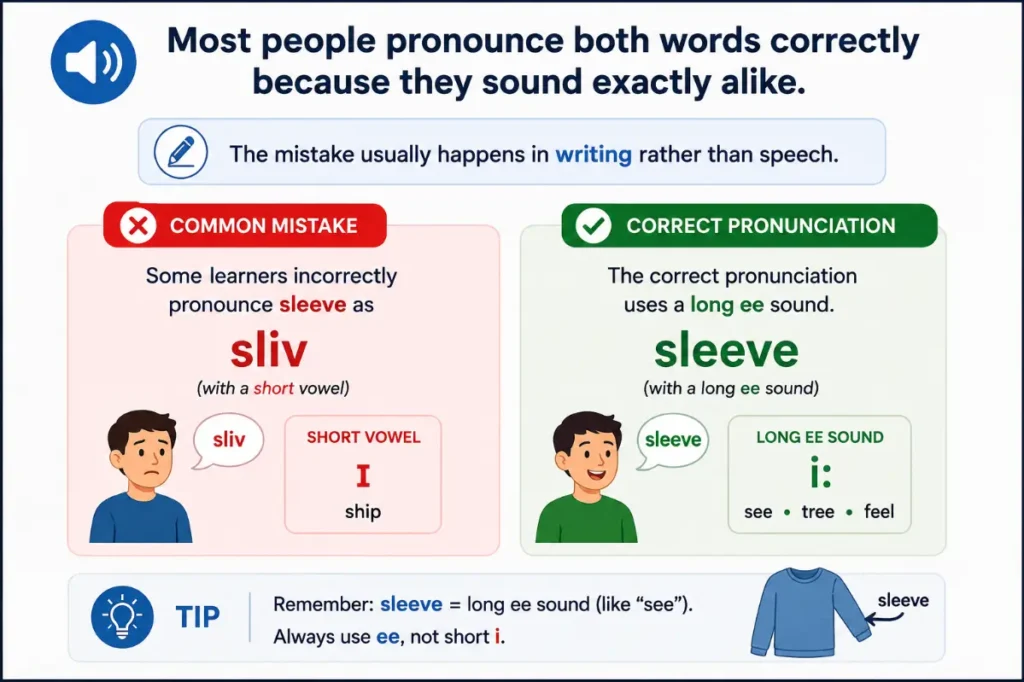
Most people pronounce both words correctly because they sound exactly alike. The mistake usually happens in writing rather than speech. Some learners incorrectly pronounce sleeve as sliv with a short vowel. The correct pronunciation uses a long ee sound.
Think of these words:
- leave
- believe
- achieve
- sleeve
They all share the same long vowel sound.
You may also want to read kurt or curt: Which One Is Correct?.
Grammar Rules for Sleeve and Sleave
Understanding the grammar behind these words makes choosing the correct spelling much easier.
Sleeve as a Noun
Most often, sleeve is a noun.
Examples:
- Her sweater has short sleeves.
- The coat sleeve needs repairing.
- The cable fits inside the protective sleeve.
- He pulled the card from its plastic sleeve.
- The mechanic installed a new bearing sleeve.
Sleeve as a Verb
Less commonly, sleeve functions as a verb.
Examples:
- Please sleeve the trading cards before storing them.
- The technician sleeved the wires to prevent damage.
- They sleeved every document for protection.
- She sleeved the photographs before filing them.
- Always sleeve important certificates.
Sleave as a Noun
Sleave functions almost exclusively as a noun.
Because it is archaic, most writers will never need to use it outside literary discussion.
Example:
The scholar explained that sleave once referred to fine untwisted silk.
Plural Forms
| Word | Singular | Plural |
|---|---|---|
| Sleeve | sleeve | sleeves |
| Sleave | sleave | sleaves (rare and seldom used) |
The plural sleaves exists grammatically but is almost never seen in modern English.
Sleave or Sleeve in American English
American English overwhelmingly prefers sleeve.
You will find it in:
- Fashion.
- Sports.
- Manufacturing.
- Medical writing.
- Technical manuals.
- Everyday conversation.
- Journalism.
Americans rarely encounter sleave unless studying Shakespeare or historical English.
Sleave or Sleeve in British English
British English follows the same pattern. Sleeve is the standard spelling for clothing, machinery, and protective coverings. British dictionaries may still list sleave, but they clearly identify it as archaic or obsolete.
Australian English
Australian English also uses sleeve in everyday writing.
Examples include:
- Shirt sleeve.
- Long sleeve shirt.
- Sleeve tattoo.
- Protective sleeve.
The word sleave remains limited to historical references.
Canadian English
Canadian English matches both American and British usage. Modern writers use sleeve almost exclusively.
Regional Preference Summary
| Region | Preferred Word | Notes |
|---|---|---|
| United States | Sleeve | Standard modern usage |
| United Kingdom | Sleeve | Standard modern usage |
| Canada | Sleeve | Standard modern usage |
| Australia | Sleeve | Standard modern usage |
Across major English-speaking countries, there is no regional variation. Sleeve is universally accepted in contemporary English.
Ten Sentence Examples Using Sleeve
- She rolled up her sleeves before cooking dinner.
- My jacket sleeve caught on the door handle.
- The engineer replaced the worn metal sleeve.
- Please place the document inside a plastic sleeve.
- His shirt sleeve was stained with paint.
- The athlete wore a compression sleeve during the game.
- We inserted the cable through a protective sleeve.
- The mechanic checked every bearing sleeve carefully.
- She brushed the dust away with her sleeve.
- The baseball cards stayed safe inside clear sleeves.
Ten Sentence Examples Using Sleave
These examples reflect its historical and literary meaning.
- The professor explained the meaning of sleave in Macbeth.
- Medieval writers occasionally mentioned fine sleave in textile descriptions.
- The dictionary defines sleave as untwisted silk.
- Students often confuse sleave with sleeve after reading Shakespeare.
- The rare word sleave appears in several historical references.
- Literary scholars recognize sleave as an obsolete English noun.
- Few modern readers know the original meaning of sleave.
- The editor preserved the historical spelling sleave in the quotation.
- Researchers discussed how sleave disappeared from common English.
- The manuscript contained several references to delicate sleave fibers.
Common Mistakes
Several mistakes appear repeatedly in online searches and writing.
Using Sleave Instead of Sleeve
Incorrect:
I bought a new shirt sleave.
Correct:
I bought a new shirt sleeve.
Assuming Both Spellings Are Interchangeable
They are not.
One is standard modern English. The other is an obsolete literary word.
Ignoring Context
If you’re writing about clothing, equipment, sports, engineering, or everyday life, always choose sleeve.
Trusting Spell Check
Since sleave is a real dictionary word, some spell-checkers will not flag it. Always proofread your writing.
Confusing Literary English With Modern English
Historical texts preserve many obsolete words. That does not mean those spellings belong in modern writing.
Real Life Usage Examples
Daily Conversation
Can you roll up your sleeves before washing the dishes?
Academic Writing
The experiment required placing the sample inside a protective sleeve.
Professional Communication
Please insert each contract into a transparent document sleeve before shipping.
Engineering
The technician replaced the damaged cylinder sleeve during maintenance.
Medicine
The patient wore a compression sleeve to reduce swelling.
Sports
Many basketball players wear arm sleeves for support and comfort.
Publishing
Store valuable magazines in archival sleeves to prevent damage.
Literature
The phrase the sleave of care remains one of Shakespeare’s best-known uses of the obsolete word.
Related Words and Commonly Confused Terms
Learning nearby vocabulary strengthens your understanding of English.
Related to Sleeve
- Cuff.
- Collar.
- Hem.
- Pocket.
- Jacket.
- Coat.
- Glove.
- Garment.
- Fabric.
- Covering.
Technical Relatives
- Cylinder sleeve.
- Cable sleeve.
- Wire sleeve.
- Protective sleeve.
- Plastic sleeve.
- Compression sleeve.
- Bearing sleeve.
- Insulating sleeve.
Commonly Confused Words
- Sleave.
- Leave.
- Cleave.
- Weave.
- Sheath.
- Cover.
Although some look or sound similar, none shares the everyday meaning of sleeve.
Expert Language Insight
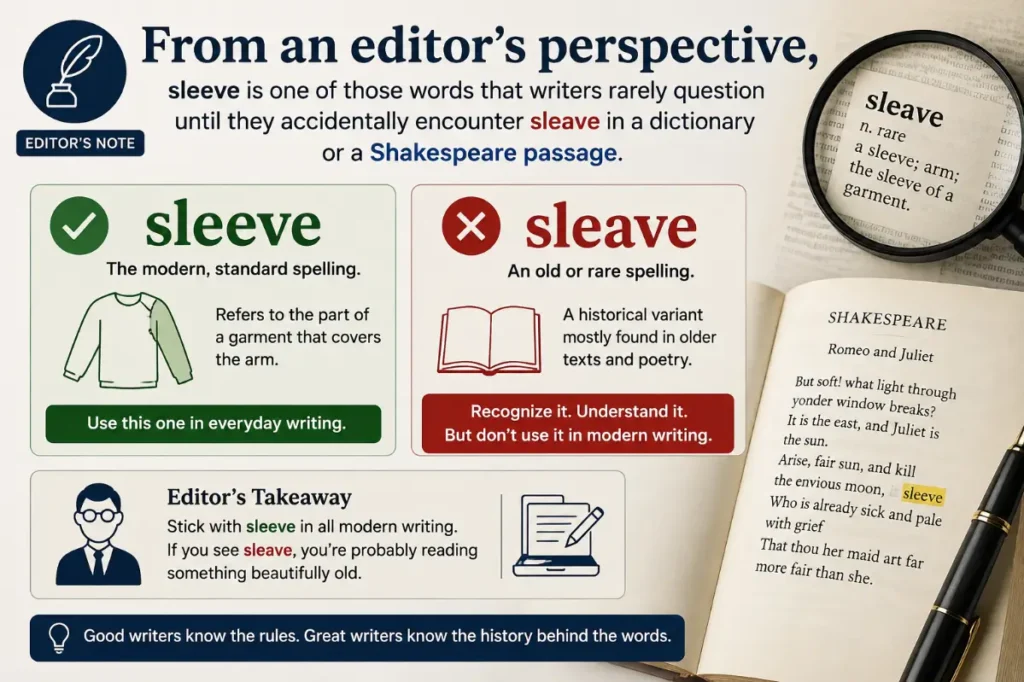
From an editor’s perspective, sleeve is one of those words that writers rarely question until they accidentally encounter sleave in a dictionary or a Shakespeare passage. Professional editors almost always correct sleave to sleeve unless the text intentionally discusses historical English or quotes an original literary source. Native speakers naturally recognize sleeve because they encounter it throughout life in clothing, sports, engineering, medicine, fashion, and everyday conversation. In contrast, many educated native speakers have never seen sleave outside literature classes. A useful editing habit is to ask yourself a simple question. Am I writing about clothing, protection, machinery, or something modern? If the answer is yes, the correct word is sleeve. If you are analyzing Shakespeare, discussing historical textiles, or quoting an old manuscript, sleave may be appropriate. This simple distinction prevents almost every mistake.
Learn the difference in Fewer Meaning And How To Use It Correctly.
Conclusion
If you’re choosing between sleave or sleeve, the correct answer for modern English is almost always sleeve. It is the standard spelling used for clothing, protective coverings, mechanical components, sports equipment, and countless everyday situations. Native speakers, professional editors, and major style guides all recognize sleeve as the appropriate choice.
Sleave, by contrast, is a rare historical word that survives mainly in literary works, particularly Shakespeare, and in discussions of older forms of English. Although it remains a legitimate dictionary entry, it has virtually disappeared from modern communication.
A simple rule will keep your writing accurate. If you’re talking about a shirt, jacket, document protector, cable covering, or machine part, write sleeve. Reserve sleave only for quotations, historical texts, or literary analysis.
Frequently Asked Questions
Is sleave a real English word?
Yes. Sleave is a genuine English word, but it is archaic. It originally referred to fine untwisted silk or thread and now appears mainly in historical dictionaries and literary discussions.
Which spelling is correct, sleave or sleeve?
For modern English, sleeve is almost always the correct spelling. It refers to the arm covering of a garment or a protective covering around another object. Sleave is reserved for historical and literary contexts.
Why does my spell checker accept sleave?
Many dictionaries include obsolete words. Since sleave is historically valid, some spell-check tools recognize it even though it is rarely appropriate in everyday writing.
Does Shakespeare use the word sleave?
Yes. Shakespeare famously used sleave in Macbeth in the phrase the sleave of care, where it symbolizes the delicate threads of human worries.
Are sleeve and sleave pronounced differently?
No. They are generally pronounced the same in modern English with the IPA pronunciation /sliːv/. The difference lies in spelling and meaning rather than pronunciation.
Can I use sleave in everyday writing?
Generally, no. Unless you are quoting literature or discussing historical English, sleeve is the appropriate choice.
Is sleeve used as both a noun and a verb?
Yes. As a noun, it refers to part of a garment or a protective covering. As a verb, it means to place something into a sleeve or protective covering.
Is there any regional difference between sleave and sleeve?
No. American, British, Canadian, and Australian English all use sleeve as the standard modern spelling. Sleave remains an obsolete literary word across all major English varieties.