
Have you ever paused while writing because two words sound exactly alike but mean completely different things? The difference between discreet vs discrete causes this kind of confusion because both words share the same pronunciation, yet they serve different purposes in English.
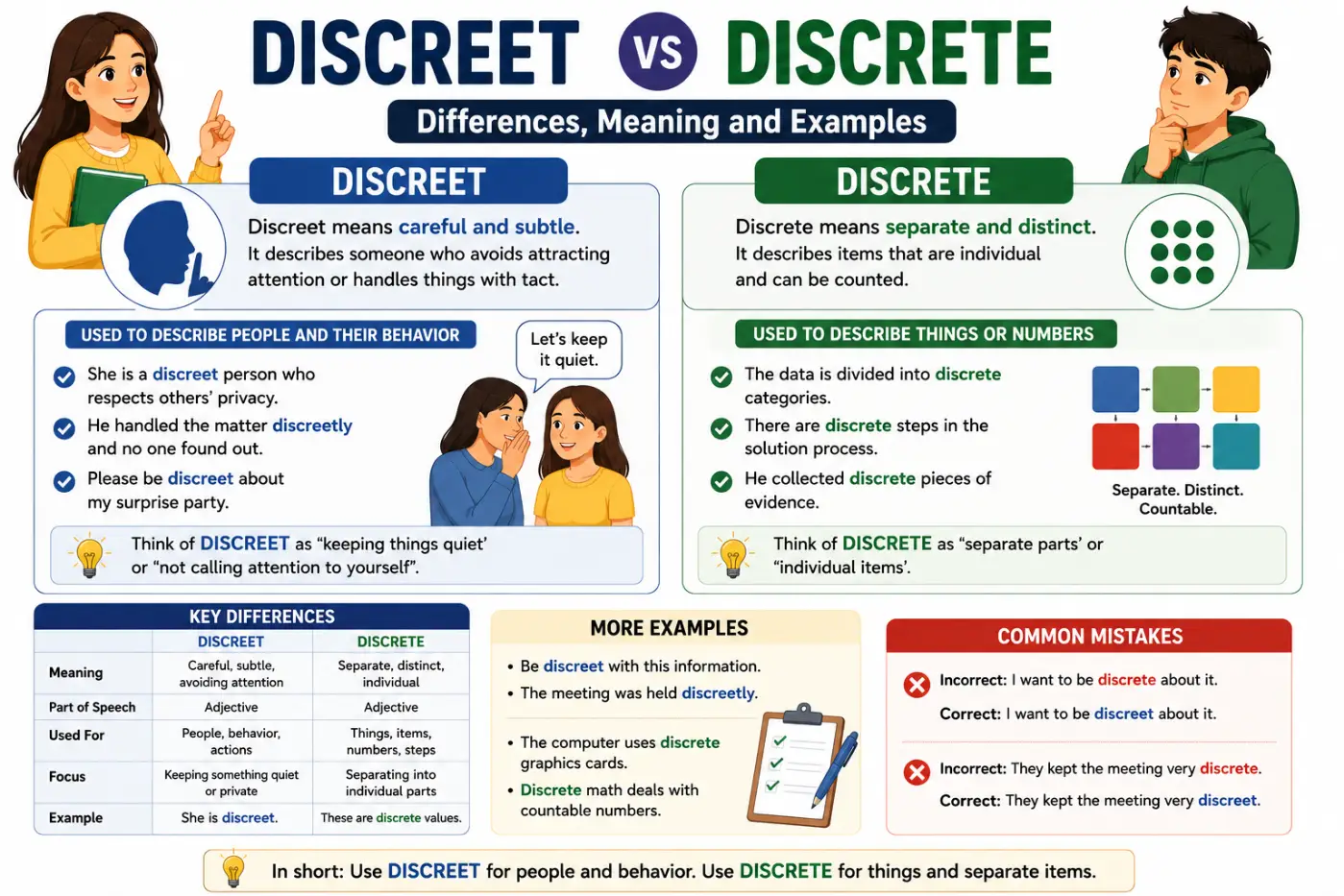
The distinction is simple once you connect each word to its main idea. Discreet means careful, tactful, or private. Discrete means separate, distinct, or individually identifiable. You might ask a coworker to handle a sensitive conversation discreetly, but a scientist might study several discrete groups of data.
Both spellings are correct. Neither is a misspelling of the other, and you cannot use them interchangeably without changing the meaning of your sentence. The challenge comes from their similar sounds and nearly identical appearance.
Understanding the difference will help you write clearer emails, avoid awkward mistakes, and express your ideas more accurately. The key is to focus on the meaning you want to convey rather than relying on how the word sounds.
Need another quick comparison? Read Moral vs Morale Meaning and Usage Explained.
Discreet and discrete Short Answer
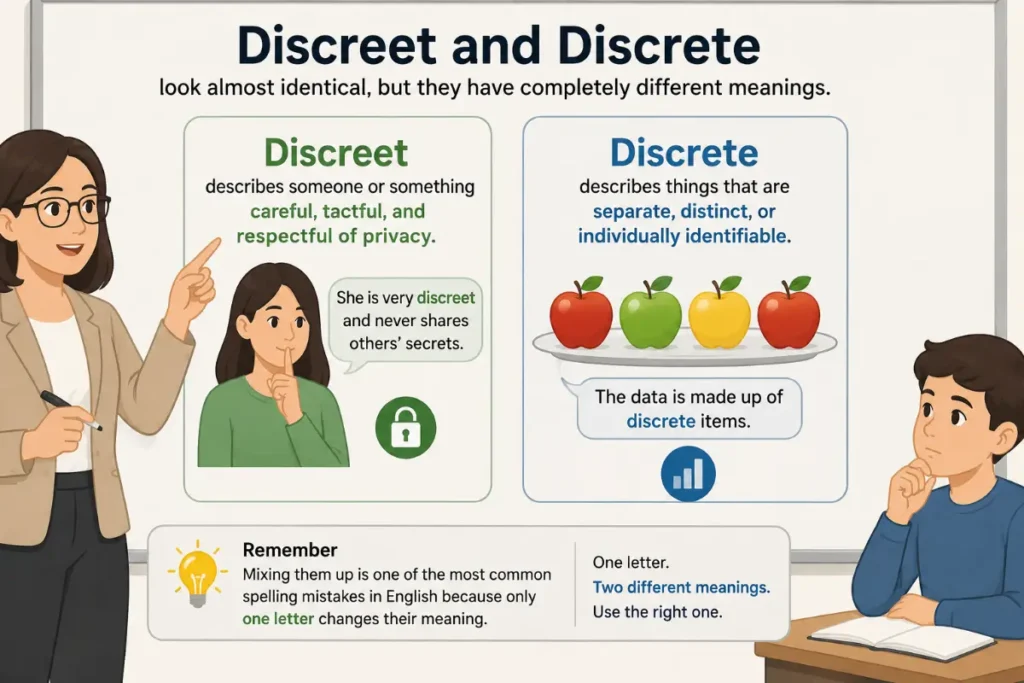
Discreet means careful about what you say or do, especially when privacy or sensitive information matters. Discrete means separate, distinct, or individually distinguishable. Both are correct English words, but they have different meanings. Use discreet for tact and confidentiality, and use discrete for separate items, categories, or units.
Comparison Table
| Feature | Discreet | Discrete |
|---|---|---|
| Meaning | Careful, tactful, or private. | Separate, distinct, or individual. |
| Part of speech | Adjective. | Adjective. |
| Main idea | Protecting privacy or avoiding unwanted attention. | Showing that things are separate from one another. |
| Common contexts | Personal conversations, confidential matters, workplace communication. | Mathematics, science, data analysis, business, and classification. |
| Typical phrase | Discreet conversation. | Discrete categories. |
| Example | Please be discreet about the news. | The survey divides customers into discrete groups. |
| Formality | Standard in formal and informal English. | Standard in formal and informal English. |
| Spelling status | Correct word. | Correct word. |
The easiest distinction is this. Discreet describes how someone behaves when handling sensitive information. Discrete describes things that remain separate or can be distinguished from one another.
Meaning and Definition
What Discreet Means
Discreet is an adjective that describes someone who acts with care, good judgment, and respect for privacy. A discreet person understands that some information should stay private and that certain situations call for tact.
For example, a manager might speak discreetly with an employee about a personal concern. A friend might ask you to be discreet about a surprise party. In both situations, the word suggests care and restraint.
The term can also describe actions or arrangements that avoid attracting attention. A discreet entrance, for instance, might offer privacy to visitors who prefer not to be noticed.
Common expressions include discreet behavior, discreet questions, discreet service, and discreet handling of confidential information.
The central idea is careful judgment that protects privacy or avoids unnecessary attention.
What Discrete Means
Discrete is an adjective that describes things that are separate, distinct, or individually identifiable. The items may belong to the same larger group, but each item has its own identity.
For example, a teacher might divide a lesson into three discrete sections. A researcher might compare discrete groups of participants. An accountant might examine discrete transactions instead of treating every transaction as one combined amount.
The word appears often in technical fields because people need precise ways to describe separate units, categories, or values.
In mathematics, a discrete set contains distinct elements. In statistics, a discrete variable can take specific, separate values rather than any value across a continuous range. In computing, discrete events or data points can be treated as individual units.
Common expressions include discrete units, discrete categories, discrete values, and discrete steps.
The central idea is separation that allows each item or category to be identified on its own.
Is Either Word Incorrect?
No. Both are established English words with different meanings. The mistake happens when a writer selects one based on sound alone instead of checking the intended meaning.
Consider these two sentences.
- The assistant was discreet when discussing the client’s complaint.
- The report separates the complaints into discrete categories.
The first sentence describes careful behavior. The second describes distinct groups. Changing the spelling would change the intended meaning.
Key Differences Explained
The difference becomes easier to remember when you compare the purpose of each word.
Meaning and Context
Discreet focuses on behavior. It often describes a person who knows how to handle a private matter without embarrassing someone or revealing information unnecessarily.
Discrete focuses on separation. It describes things that can be distinguished from other things, even when they belong to the same larger system.
Compare these examples.
- The receptionist gave the visitor a discreet answer. The receptionist handled the question tactfully.
- The receptionist recorded each visitor as a discrete entry. Each entry remained separate in the records.
The setting can be identical, but the words communicate different ideas.
Spelling Differences
The two words differ by only two letters near the end. Both begin with discre and have the same number of letters. This small difference makes it easy to select the wrong spelling while typing.
A useful visual clue is the pair of e’s in discreet. Think of keeping something private and keeping your information close. The word discrete contains a final sequence that can remind you of distinct items.
This is a memory aid rather than a formal spelling rule. Meaning remains the most reliable way to choose the correct form.
Grammar and Part of Speech
Both words are adjectives. They describe nouns and can appear before a noun or after a linking verb.
Examples of discreet include the following.
- She offered a discreet suggestion.
- His response was discreet.
- We need a discreet way to discuss the issue.
Examples of discrete include the following.
- The study examined discrete populations.
- These categories are discrete.
- The software processes discrete events.
Both adjectives can appear after verbs such as be, seem, and remain. Neither word changes its basic meaning because of its position in a sentence.
Pronunciation
The words are homophones in standard American English. That means they share the same pronunciation even though their spelling and meaning differ.
Both are generally pronounced /dɪˈskriːt/. The stress falls on the second syllable, and the final sound resembles the word treat without the initial t.
Because pronunciation does not distinguish them, listening alone will not help you select the correct spelling. You need to consider the meaning of the sentence.
Formality and Context
Neither word is more formal or more correct than the other. Both work in everyday conversation, professional communication, academic writing, and formal documents.
However, discrete appears frequently in technical discussions involving separate units or values. Discreet appears naturally in conversations about privacy, tact, and confidential matters.
The context determines the choice, not the level of formality.
Regional Usage
American, British, Canadian, and Australian English generally maintain the same distinction between these words. There is no major regional spelling difference that changes their meanings.
Writers in all four varieties use discreet for tact and privacy and discrete for separation. If you’re writing for an international audience, you can follow this distinction with confidence.
Which Form Is Correct
Both spellings are correct. The right choice depends on the message you want to communicate.
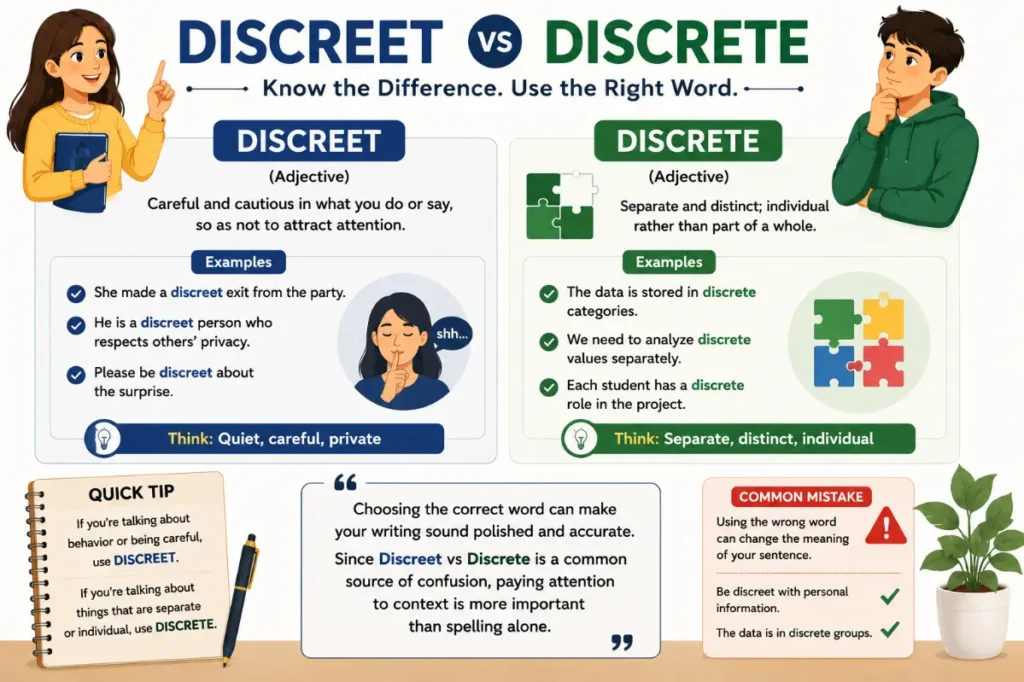
Use discreet when describing someone who acts carefully, respects confidentiality, or avoids attracting unwanted attention. Use discrete when describing separate objects, units, groups, events, or categories.
Established dictionary usage supports this distinction. Standard English dictionaries recognize both as separate adjectives with different meanings and word histories. Neither is simply a less formal version of the other.
Here is a practical way to check your sentence.
- Ask yourself if the sentence describes privacy, tact, or careful behavior. If it does, choose discreet.
- Ask yourself if the sentence describes separate items or distinct categories. If it does, choose discrete.
- Read the sentence again with the chosen word. Confirm that the meaning makes sense in context.
For example, a company might require discreet handling of employee complaints. The same company might organize those complaints into discrete types for analysis.
The words can appear in the same document because they serve different purposes. Accuracy comes from matching the word to the intended meaning.
Sentence Examples
These examples show how both words work in everyday situations, professional writing, education, and technical contexts.
Examples Using Discreet
- Please be discreet about the promotion until the company makes the announcement.
- She asked a discreet question to avoid embarrassing her friend.
- The hotel offers discreet service to guests who value their privacy.
- My coworker was discreet when discussing the customer’s personal information.
- The doctor spoke in a discreet manner while explaining the test results.
- We found a discreet place to discuss the surprise celebration.
- He gave me a discreet signal to let me know the meeting had started.
- The journalist handled the sensitive details with discreet judgment.
- The company arranged a discreet meeting with the employee.
- She made a discreet exit before the crowd gathered around her.
In each sentence, the word describes careful behavior or an effort to avoid unwanted attention.
Examples Using Discrete
- The teacher divided the assignment into four discrete tasks.
- Each customer received a discrete identification number.
- The researcher studied three discrete groups of participants.
- The report lists each expense as a discrete transaction.
- The software tracks discrete events as they occur.
- The scientist measured discrete changes in the sample.
- Students learned to identify discrete shapes in the geometry lesson.
- The database stores each order as a discrete record.
- The analyst grouped survey responses into discrete categories.
- The program uses discrete values rather than a continuous range.
In these sentences, the word emphasizes separation or the ability to identify individual units.
Examples in Professional Communication
At work, the choice often depends on the task at hand. A human resources manager might ask a colleague to be discreet about an employee concern. An analyst might then organize the information into discrete categories to identify patterns.
These examples show that one word describes professional judgment while the other describes the structure of information.
Professional Writing Tips
Choosing the correct word can make your writing sound polished and accurate. Since Discreet vs Discrete is a common source of confusion, paying attention to context is more important than spelling alone.
Common Mistakes and Misspellings
The most common error is using one of these words in place of the other. Several related mistakes can also cause confusion.
Using Discrete for Confidential Information
Incorrect: Please be discrete about my medical appointment.
Correct: Please be discreet about my medical appointment.
The sentence concerns privacy, so discreet is the correct choice. The writer wants someone to handle personal information carefully.
Using Discreet for Separate Groups
Incorrect: The survey divided respondents into discreet groups.
Correct: The survey divided respondents into discrete groups.
The groups are separate categories, not people acting tactfully. The correct adjective is discrete.
Assuming One Spelling Is a Typo
Some writers believe discrete is simply a misspelling of discreet, or the other way around. That assumption is incorrect. Both forms are standard English words, and both have distinct meanings.
The solution is to check the meaning rather than automatically replacing one form with the other.
Relying on Pronunciation Alone
Since the words sound alike, spelling by sound can lead to errors. A spell checker may accept both words even when the selected word doesn’t fit the sentence.
For example, a sentence about a private conversation might contain discrete and still pass a basic spelling check. A grammar or context aware review may help identify the mismatch, but a human reader should confirm the intended meaning.
Confusing Discrete With Discreetly
Discreet is an adjective. Discreetly is the adverb used to describe how an action takes place.
For example, She spoke discreetly describes how she spoke. The word discrete does not form an adverb with the same meaning. You should not use discretely to mean privately or tactfully, although it can appear in contexts related to separate units.
Pronunciation Guide
Both words share the same standard pronunciation in American English.
Many readers also check Bailer or Baler Meaning and Correct Usage.
Discreet and discrete
IPA pronunciation
/dɪˈskriːt/
Easy pronunciation guide
dih SKREET
Syllables
Two syllables
Stress pattern
The second syllable receives the main stress.
The first syllable has a short vowel sound, and the second has a long ee sound. The final t is clearly pronounced. Both words sound like discreet, so pronunciation alone cannot tell you which spelling belongs in a sentence.
A useful practice is to say the sentence aloud and then ask what the word means. If the sentence concerns confidentiality, choose discreet. If it concerns separate items, choose discrete.
Etymology and Word Origin
The words have related historical roots, which helps explain their similar appearance and sound. Their meanings developed along different paths.
The Origin of Discreet
Discreet entered English through French and Latin. Its history connects to the Latin word discretus, associated with distinguishing or separating and with the idea of making judgments. Over time, the English adjective developed its familiar sense of being prudent, tactful, and careful in what one says or does.
This connection helps explain why a discreet person shows good judgment. The word is not simply about hiding information. It also suggests knowing what to say, what to leave unsaid, and how to act appropriately in a sensitive situation.
The Origin of Discrete
Discrete also comes through French and Latin from the same historical word family. Its modern English meaning focuses on things that are distinct or separate from one another.
In technical fields, this meaning is especially useful. Mathematics and computing often require people to distinguish individual elements, values, or events rather than treat them as one continuous whole.
The shared history explains the spelling similarity. Their modern meanings, however, have become distinct enough that writers must choose carefully.
Regional Usage
The distinction stays consistent across major English varieties. Writers in the United States, the United Kingdom, Canada, and Australia use the same spelling for each meaning.
American English
In American English, discreet is the usual choice for privacy and tact. For example, a company might promise discreet service when handling sensitive customer information.
Discrete is common in technical and general writing when separate elements matter. A researcher might compare discrete samples, while a teacher might explain discrete steps in a process.
British English
British English follows the same distinction. A person can be discreet during a private conversation, while a collection of separate objects can form discrete units.
There is no standard British spelling change that turns one word into the other.
Australian English
Australian English also uses both forms with their established meanings. A discreet approach suggests tact or privacy, while discrete groups contain distinct members or elements.
Canadian English
Canadian English follows the same pattern. Writers can use either word in formal or informal settings, provided the meaning matches the sentence.
For all four varieties, the safest rule is to focus on the intended meaning instead of regional spelling preferences.
Grammar Rules and Part of Speech
Both words are adjectives, so they modify nouns or describe subjects through linking verbs. Their grammar is similar, but their meanings determine the correct sentence.
Using the Words Before Nouns
An adjective can appear directly before the noun it describes.
- The assistant arranged a discreet meeting.
- The report identified several discrete patterns.
- We need a discreet way to share the news.
- The experiment tested discrete samples.
In the first and third sentences, the adjective describes a careful or private arrangement. In the second and fourth, it describes separate patterns or samples.
Using the Words After Linking Verbs
Both adjectives can follow linking verbs such as is, was, seems, and remains.
- Her response was discreet.
- The categories are discrete.
- The manager remained discreet throughout the discussion.
- The values remained discrete in the final analysis.
The linking verb connects the subject to a description. The word choice still depends on the meaning.
Using the Adverb Discreetly
The adverb discreetly describes an action performed with tact or care. It often appears after a verb or near the action it modifies.
For example, The receptionist discreetly informed the manager explains how the receptionist delivered the information. Similarly, He discreetly left the room suggests that he avoided attracting attention.
Is Discretely Also a Word?
Yes. Discretely is a legitimate adverb formed from discrete. It means in a separate or distinct manner, especially in technical contexts. However, it is less common in everyday writing than discreetly.
Compare the meanings.
- The assistant discreetly shared the news with the manager. The assistant handled the information carefully.
- The software processes each event discretely. The software handles events as separate units.
The difference between the two adverbs follows the same distinction as their base adjectives.
Punctuation and Sentence Position
Neither adjective requires special punctuation. You can use either at the beginning, middle, or end of a sentence when the grammar supports that position.
For example, Discreet communication matters in this situation is correct. So is These are discrete categories. Capitalizing either word at the start of a sentence does not change its meaning.
Real Life Usage Examples
Context makes the difference easier to understand. These examples show how the words appear in ordinary conversation, workplace messages, academic writing, news reporting, and storytelling.
Daily Conversation
A friend might say, Please be discreet about the gift because I want the surprise to stay secret. The word describes the care needed to protect the surprise.
Someone discussing a collection might say, I sorted the photographs into discrete groups by year. Here, the word describes separate categories.
Email and Workplace Communication
A manager might write, Please handle this employee concern discreetly until we can speak privately. The adverb describes how the manager expects the concern to be handled.
An analyst might write, The attached report separates the costs into discrete categories for review. The adjective describes the separate cost groups.
Academic Writing
A psychology student might write, The researchers examined three discrete age groups. The groups are separate parts of the study.
A student writing about research ethics might say, Researchers should be discreet when discussing participants’ personal information. The word describes careful conduct and respect for privacy.
News and Journalism
A news report might describe a public official as discreet when handling a sensitive meeting. The description concerns the official’s behavior and judgment.
A data focused article might explain that a survey divided responses into discrete categories. The word helps readers understand how the information was organized.
Literature and Storytelling
A novelist might write, Mara gave her brother a discreet nod before leaving the room. The action communicates something quietly without drawing attention.
Another story might describe a town as a collection of discrete communities separated by a river. The word emphasizes that the communities remain distinct.
These examples show why context matters more than sound. The same speaker can use both words correctly in different situations.
Related and Confused Terms
Several words share part of the meaning of these adjectives. Understanding the distinctions can make your writing more precise.
1. Discreetly
This adverb describes an action performed tactfully or without attracting unwanted attention. For example, The assistant discreetly moved the conversation to a private room.
2. Discretely
This adverb describes separate or distinct actions, units, or processes. For example, The system stores each record discretely. In ordinary conversation, a clearer alternative might be as a separate record.
3. Discretion
Discretion is a noun connected to careful judgment, tact, and the responsible handling of information. A manager might say, Use discretion when sharing customer details.
4. Distinct
Distinct means clearly different or recognizable. It often overlaps with discrete, but the emphasis can differ. Two distinct styles may look different, while two discrete groups are treated as separate units.
5. Separate
Separate means not joined or kept apart. It is a useful everyday alternative to discrete. For example, Keep the two files separate may sound more natural than Keep the files discrete in a simple instruction.
6. Confidential
Confidential describes information intended to remain private or restricted to authorized people. It relates closely to the privacy side of discreet, but the words are not identical. Information can be confidential, while a person can handle it discreetly.
7. Tactful
Tactful describes communication that considers other people’s feelings and avoids unnecessary offense. A tactful answer may also be discreet, but tactful emphasizes sensitivity and good manners rather than privacy alone.
8. Continuous
Continuous describes something that proceeds without interruption or contains no gaps in the relevant range. It contrasts with discrete in many technical settings. For example, a continuous range can include values between two points, while a discrete set contains individually specified values.
Expert Editor Insight
An experienced editor checks meaning before changing either spelling. A spell checker may accept both words because both are valid, so a technically correct spelling can still be wrong for the sentence. I recommend replacing the target word with a short definition during editing. If the sentence means careful and private, use discreet. If it means separate and distinct, use discrete. This quick test catches many errors that a standard spelling tool misses.
Key Takeaways
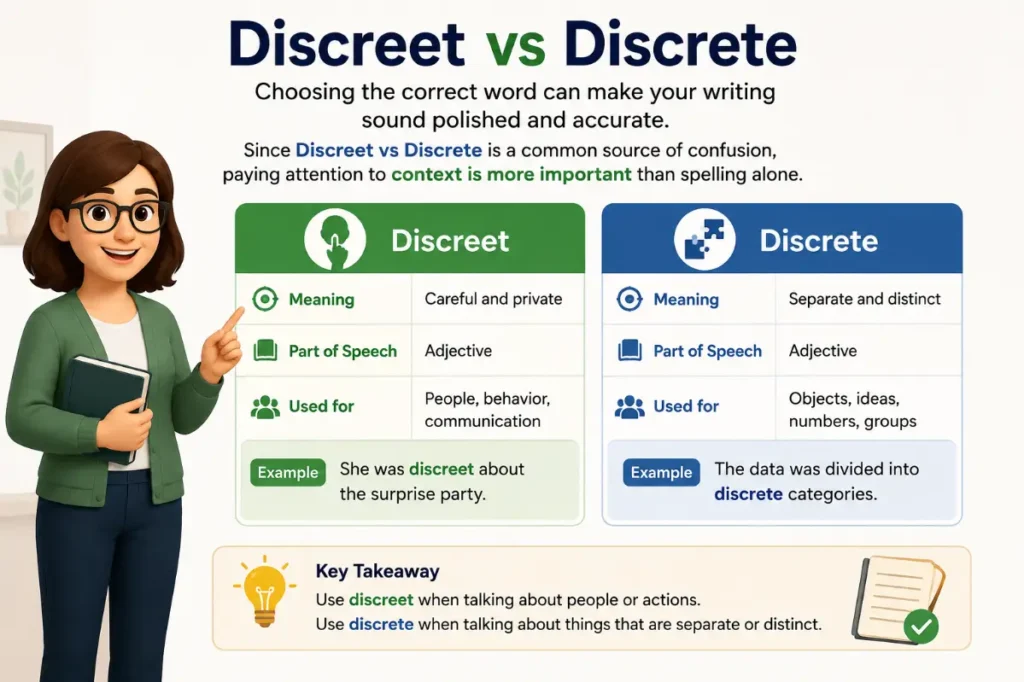
- Discreet means careful, private, tactful, or respectful of confidentiality.
- Discrete means separate, distinct, or independent.
- Both words are adjectives.
- Both words are pronounced exactly the same.
- They are homophones but not synonyms.
- Use discreet for people, conversations, behavior, services, and confidential situations.
- Use discrete for groups, categories, numbers, systems, stages, variables, and independent parts.
- If your sentence involves privacy, choose discreet.
- If your sentence involves separation, choose discrete.
- Remember the shortcut:
Need another quick comparison? Read Arised or Arose Which Is Correct.
Conclusion
The difference between discreet vs discrete comes down to two simple ideas. Discreet describes tact, privacy, and careful behavior, while discrete describes separate and distinct things. Both are correct English words, and neither should replace the other without changing the sentence’s meaning.
Remember this practical editing tip. If you’re talking about protecting private information, choose discreet. If you’re talking about separate groups, units, or values, choose discrete. When you proofread, check the meaning rather than the spelling alone. That small habit will help you avoid confusion in emails, school assignments, reports, and professional writing.
FAQs
Is discreet the same as discrete?
No. Discreet means tactful, careful, or private, while discrete means separate or distinct. Both words sound alike, but they serve different purposes. You might be discreet when handling confidential information, but you might organize that information into discrete categories for analysis.
Is discrete a real word?
Yes. Discrete is a standard English adjective used to describe separate or individually identifiable things. It appears in everyday writing as well as mathematics, statistics, science, and computing. It is not a misspelling of discreet. The correct choice depends on the meaning you want to express.
What does discreet mean in simple terms?
Discreet means using good judgment to protect privacy or avoid unwanted attention. A discreet person knows how to handle sensitive information without causing embarrassment or revealing details unnecessarily. For example, a discreet coworker respects a private conversation and doesn’t share its contents with others.
How do you pronounce discreet and discrete?
Both words are pronounced /dɪˈskriːt/ in standard American English. Each has two syllables, with the stress on the second syllable. They sound alike, so pronunciation cannot tell you which spelling to use. Read the sentence for meaning and choose the word that fits the situation.
Can discreet and discrete start a sentence?
Yes. Both adjectives can begin a sentence when the sentence structure supports them. For example, Discreet communication helps protect personal information is correct. Likewise, Discrete categories make the data easier to analyze is correct. Capitalization doesn’t change the meaning of either word.
What is a synonym for discreet?
Useful synonyms include tactful, private, prudent, and subtle. The best choice depends on the sentence. Tactful emphasizes sensitivity to other people’s feelings, while private emphasizes confidentiality. Discreet can suggest both careful judgment and a desire to avoid unnecessary attention.
What is a synonym for discrete?
Useful synonyms include separate, distinct, individual, and independent. These words can overlap in meaning, but they aren’t always interchangeable. Discrete is especially useful when you need to describe individually identifiable units or categories. In technical writing, its precise meaning can matter more than a broader synonym.
Why do people confuse these two words?
People confuse them because they look almost identical and share the same pronunciation. A spell checker may accept both forms, even when one doesn’t fit the sentence. The easiest solution is to remember the meaning of each word and review the sentence in context instead of relying on sound or spelling alone.