

Confusing principal vs principle can turn a simple sentence into an embarrassing mistake. Both words sound almost identical in American English, and both appear in school assignments, workplace emails, news reports, and everyday conversations. However, they have different meanings and serve different purposes in a sentence.
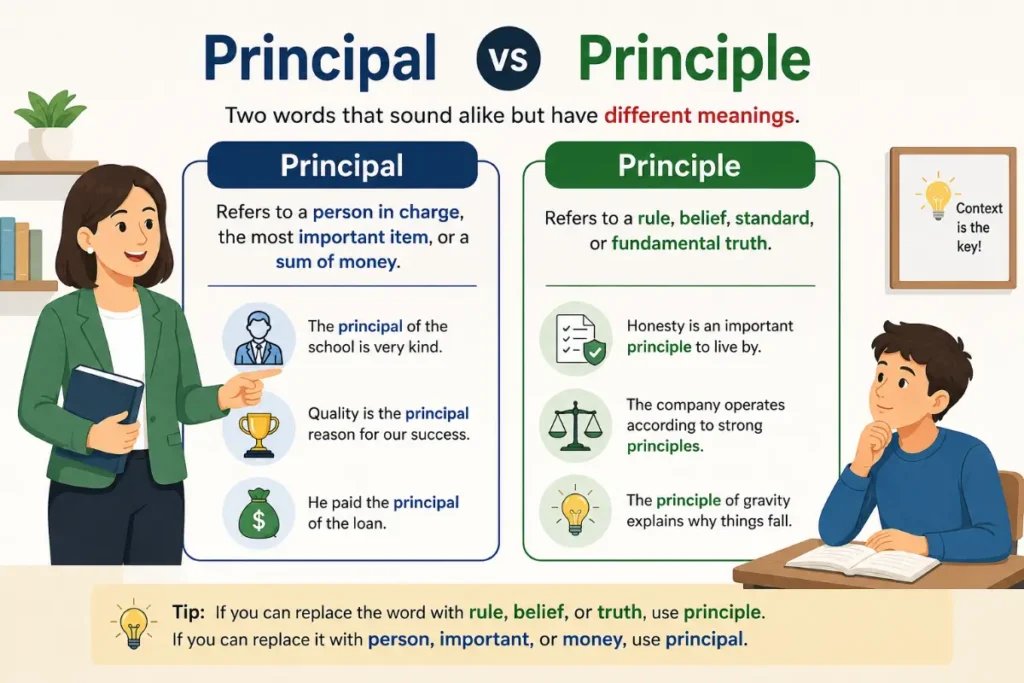
The good news is that neither spelling is wrong. The key is knowing what you want to say. Principal usually refers to a person in charge or something that ranks first in importance. Principle refers to a basic rule, belief, or value that guides decisions and behavior.
For example, a school principal manages a school, while a school principle might refer to a rule about learning or student conduct. The first word identifies a person or something primary. The second describes an idea or standard.
Once you understand this distinction, choosing the right word becomes much easier. You’ll learn how to use both forms correctly, spot common mistakes, pronounce them naturally, and remember the difference without second guessing yourself every time you write.
For another common grammar confusion, see run vs ran Which Form Is Correct.
Short Answer
Principal refers to a person in charge, the main part of something, or the original amount of a loan or investment. Principle refers to a basic rule, belief, or moral standard. Both words are correct English spellings, but they aren’t interchangeable. Choose the word that matches your intended meaning.
Principal vs Principle Comparison Table
| Feature | Principal | Principle |
|---|---|---|
| Part of speech | Noun or adjective | Noun |
| Main meaning | A person in charge or something most important | A rule belief or basic truth |
| School context | The person who runs a school | A rule that guides learning |
| Business context | The main goal or a loan’s original amount | A business rule or ethical standard |
| Finance context | The original amount borrowed or invested | A financial rule or concept |
| Grammar | Can describe a noun or name a person or amount | Names an idea rule or belief |
| Pronunciation | /ˈprɪn.sə.pəl/ | /ˈprɪn.sə.pəl/ |
| Example | The principal approved the schedule. | Honesty is a guiding principle. |
Both forms are standard English. The difference lies in meaning and grammar rather than spelling preference.
What Principal Means
Principal can function as a noun or an adjective. As a noun it often identifies someone who holds authority. As an adjective it describes the main or most important person or thing in a group.
Principal as a noun
In American English the word commonly refers to the person who leads a school. That person oversees school operations and supports teachers and students. For example, you might say, The principal called a meeting with the parents.
The noun also appears in finance. The principal of a loan is the original amount borrowed, not the interest charged on that amount. If you borrow $10,000, that amount is your starting principal. Interest and fees may add to what you owe, but they aren’t part of the original principal.
The word can also describe a leading performer in a production or a person who authorizes another person to act on their behalf in certain business or legal settings. These meanings share a general idea of a leading role or primary position.
Principal as an adjective
As an adjective, principal means main, chief, or most important. It helps readers identify the leading reason, goal, concern, or feature.
Consider these examples.
- Our principal concern is student safety.
- The principal reason for the delay was bad weather.
- Customer service is the company’s principal focus.
- The principal ingredient in the recipe is fresh tomatoes.
In each sentence, the word points to something that stands above other things in importance. You can often replace it with main without changing the basic meaning.
For example, The principal reason for leaving was the long commute becomes The main reason for leaving was the long commute.
That substitution offers a useful editing test. If main fits naturally, principal may be the word you need.
What Principle Means
Principle is a noun. It refers to a basic rule, belief, value, or truth that guides actions or explains how something works.
People use the word in moral discussions, science, law, education, business, and everyday life. Unlike the noun principal, it doesn’t normally identify a school leader or the original amount of a loan.
Principle as a moral rule
A moral principle helps a person decide how to act. Honesty, fairness, respect, and responsibility can all guide personal choices.
For example, a manager might refuse to hide a mistake because honesty is one of her guiding principles. A student might return a lost wallet because doing the right thing matters more than keeping the money.
The word also appears in familiar expressions such as on principle, a matter of principle, and a person of principle.
- He refused to take credit for someone else’s work on principle.
- She stood by her principles even when the decision cost her a promotion.
- Fair treatment is a matter of principle for our team.
These sentences focus on beliefs that guide behavior rather than people who hold authority.
Principle as a basic rule or truth
A principle can also explain how a system works. Scientific principles describe patterns or rules that help explain natural events. Legal principles guide the interpretation and application of law. Business principles can shape decisions about customers, employees, and money.
For example, a science teacher might explain the principles of motion before introducing a more complex experiment. A company might follow the principle that customers deserve honest information.
In these cases, the word refers to an underlying idea or rule. It isn’t a person or a label for the most important item.
Principle in everyday expressions
Several common phrases use this noun in a consistent way.
- In principle. This means in general or as an idea. Someone might agree with a plan in principle but still want to discuss its details.
- On principle. This means acting according to a belief or standard. For example, she doesn’t share private information on principle.
- A matter of principle. This describes a situation where a person’s values guide a decision.
- Guiding principle. This refers to a rule or belief that shapes choices over time.
Learning these expressions gives you practical clues about the correct spelling. If a sentence describes a belief or basic rule, the noun ending in ple is usually the right choice.
Key Differences Explained
The main difference comes down to what the word represents. One can name a leader or describe the leading item. The other names a rule, belief, or basic truth.
Meaning and word function
Principal has two major grammatical roles. It can be a noun, as in the school principal, or an adjective, as in the principal reason. Principle is a noun that identifies an idea or standard.
This distinction matters because the words don’t fill the same role in every sentence. You can write, The principal explained the principle. Here, the first word identifies a person, and the second identifies the rule that person explained.
Spelling
The words differ by their final letters.
- Principal ends with pal.
- Principle ends with ple.
That small difference carries a large change in meaning. Since both forms are legitimate words, a spell checker may accept either one even when the sentence uses the wrong meaning.
Pronunciation
In standard American English, both words are pronounced the same. They are homophones, meaning they share a pronunciation but have different meanings and spellings.
This explains why listening alone often won’t help you choose the correct form. You need to consider the sentence and the message you want to communicate.
Formality and context
Both words work in casual conversation and formal writing. Neither is more correct or more professional than the other. The right choice depends on context.
A school newsletter might mention the principal’s office. An academic paper might discuss the principles of scientific research. A mortgage statement might show the remaining principal on a loan.
The setting helps reveal the meaning, but grammar provides the final check.
Regional usage
The spelling distinction stays the same in American, British, Canadian, and Australian English. There is no standard regional rule that swaps one form for the other.
However, the school title principal is especially common in the United States. British English often uses headteacher for the person in charge of a school. The word principal still appears in British English, especially in college and university settings.
Which Form Is Correct
Both forms are correct. Use principal for a school leader, the original amount of a loan, or the main part of something. Use principle for a moral belief, a basic rule, or a general truth.
The easiest way to make the right choice is to focus on meaning instead of sound. If you’re describing a person or something that ranks first in importance, choose the form ending in pal. If you’re describing a rule or belief, choose the form ending in ple.
For example, consider this sentence.
The school principal believes that fairness is a basic principle.
Both words belong in the sentence because they perform different jobs. The first identifies the school leader. The second identifies a belief that guides behavior.
Established English dictionaries make the same distinction between the adjective and noun uses of principal and the noun uses of principle. You don’t need to treat either spelling as an error. You need to match the spelling to the meaning.
Ten Natural Sentence Examples
These examples show how both words appear in everyday life, education, business, and formal writing.
- School. The principal welcomed new students during the first assembly of the year.
- Work. Our principal goal this quarter is to improve customer service.
- Everyday conversation. My principal concern is getting home before the storm starts.
- Personal values. She believes honesty is the most important principle in a friendship.
- Education. The teacher explained the principles of effective reading.
- Finance. I made an extra payment to reduce the principal on my car loan.
- Business ethics. The company follows the principle that customers deserve clear and accurate information.
- Academic writing. The principal finding of the study supports the original research question.
- Social situations. He apologized because taking responsibility is one of his guiding principles.
- Formal writing. The proposal rests on the principle that every employee should receive equal treatment.
Notice how each word fits a different meaning. The examples also show that principal can describe a main goal or finding, while principle can describe a personal value or a rule behind a decision.
Common Mistakes and How to Fix Them
Most errors happen because the words sound alike. Writers may choose a spelling based on habit instead of checking what the sentence means. These five mistakes are easy to correct once you know what to look for.
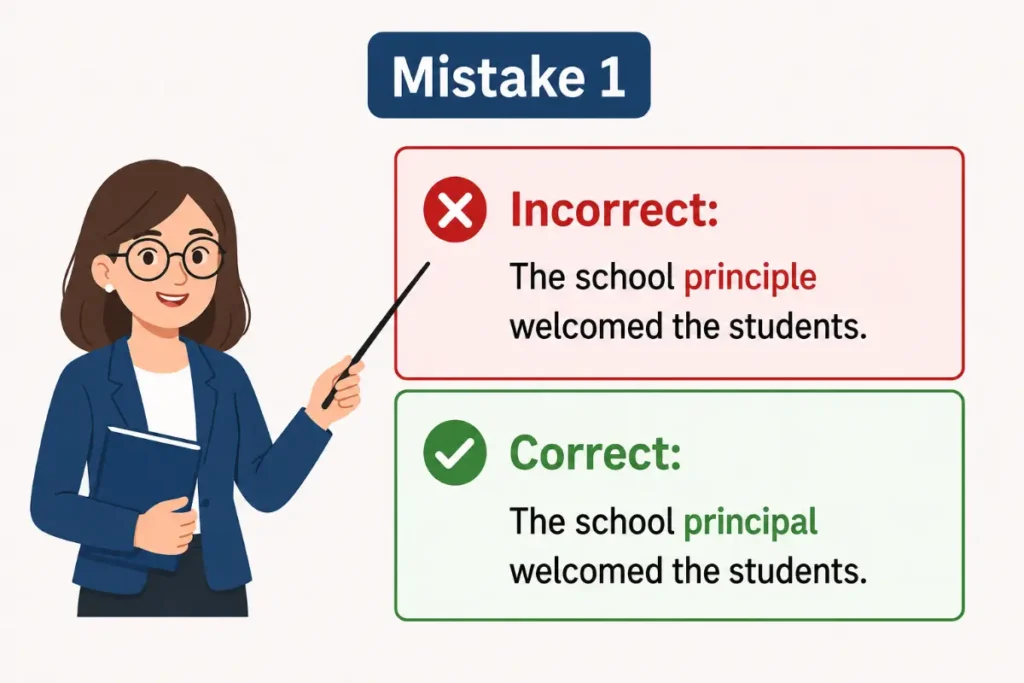
Using principle for a school leader
Incorrect: The principle called a meeting with the teachers.
Correct: The principal called a meeting with the teachers.
The sentence refers to a person who runs a school. That meaning requires the noun principal.
Using principal for a moral belief
Incorrect: Respect is an important principal in our home.
Correct: Respect is an important principle in our home.
Respect is a value that guides behavior. It isn’t a person or the main item in a group.
Choosing the wrong word before a noun
Incorrect: The principle reason for the change was cost.
Correct: The principal reason for the change was cost.
Here, the word describes the main reason. Since it functions as an adjective, principal is the correct form.
Confusing a loan amount with a rule
Incorrect: I paid extra to reduce the principle on my mortgage.
Correct: I paid extra to reduce the principal on my mortgage.
In lending, the principal is the amount borrowed or the outstanding amount on which interest may be calculated. A principle is a rule or belief, so it doesn’t fit the financial meaning.
Assuming one spelling is always wrong
Incorrect: Principle is always a misspelling of principal.
Correct: Both words are standard English, but their meanings differ.
Neither spelling is inherently incorrect. The mistake occurs when a writer uses one word to express the meaning of the other.
A good proofreading habit is to check the meaning of the sentence before changing the spelling. Automatic correction tools may recognize both words as valid and leave the error untouched.
Pronunciation Guide
Both words have the same standard pronunciation in American English. Their shared sound explains much of the confusion, especially in conversations where you can’t see the spelling.
A related grammar guide is Affect vs Effect: Meaning and Correct Usage.
Principal
IPA
/ˈprɪn.sə.pəl/
Three syllables.
Principle
IPA
/ˈprɪn.sə.pəl/
Three syllables.
How to say the words naturally
- Start with the sound prin.
- Follow it with a relaxed middle syllable.
- Finish with a soft sound similar to the ending of people in some American pronunciations.
- Put the strongest stress on the first syllable.
The exact vowel quality can vary slightly among speakers. However, the spelling distinction doesn’t normally create a pronunciation difference in standard American English.
Common pronunciation mistakes
Some learners try to pronounce the final letters differently because they look different on the page. In everyday American speech, that distinction usually disappears. Both forms sound alike, so don’t rely on pronunciation to determine the spelling.
Instead, use the meaning as your guide. If you hear someone discuss a school leader or a loan balance, the context may point to principal. If the conversation concerns ethics, science, or basic rules, principle is more likely.
Etymology and Word Origin
The two words have related historical roots, which helps explain their similar spelling and sound. However, they developed distinct meanings in English.
The origin of principal
Principal entered English through Middle French and ultimately comes from the Latin word principalis, meaning first or chief. That history connects naturally with its modern meanings.
A school principal holds a leading position. A principal goal is the main goal. The principal amount of a loan is the original capital sum rather than the interest earned or charged.
The idea of being first or chief ties these uses together.
The origin of principle
Principle developed from the Latin principium, meaning a beginning, source, or foundation, through French and into English. Its modern meanings include a basic rule, a fundamental idea, and a belief that guides conduct.
Think of a principle as the foundation beneath a decision or system. A scientific principle helps explain how something works. A moral principle supports a person’s choices.
Although the two words share a historical connection, modern English gives each a distinct job. Their origins can help you understand the relationship, but their present day meanings should guide your spelling.
Regional Usage in English
The difference remains consistent across major English varieties. You don’t need a separate spelling rule for each country.
American English
In the United States, principal commonly refers to the person who leads a school. It also appears in phrases such as principal reason, principal amount, and principal objective.
The noun principle appears in discussions of personal values, scientific laws, and basic rules. American writers use expressions such as on principle and guiding principle in both everyday and professional settings.
British English
British English follows the same spelling distinction. The main difference is the preferred title for a school leader. Headteacher is common in British schools, while principal is widely used for that role in the United States.
British speakers still use principal as an adjective meaning main or most important. They also use principle for a rule, belief, or theory.
Canadian English
Canadian English uses both forms with the same meanings. Principal may refer to a school leader or a loan amount, while principle refers to a guiding idea or rule.
The title principal is also used in Canadian education, though job titles can vary by province and institution.
Australian English
Australian English keeps the same distinction as American and British English. Principal can describe a school leader or the main part of something. Principle describes a basic rule or belief.
Across these varieties, the spelling choice depends on meaning rather than location.
Grammar Rules and Part of Speech
Understanding how each word works in a sentence makes the spelling choice more reliable. The biggest grammatical difference is that principal can be a noun or an adjective, while principle is a noun.
When principal works as a noun
A noun names a person, place, thing, or idea. As a noun, principal often identifies a person in charge or a sum of money.
You can use it with articles and possessive words.
- The principal spoke to the parents.
- Our principal announced the new attendance policy.
- The bank applied my payment to the loan principal.
- The principal of the school reviewed the safety plan.
The surrounding words often make the meaning clear. References to students, teachers, or school offices suggest a school leader. Words such as loan, balance, interest, and repayment suggest the financial meaning.
When principal works as an adjective
An adjective describes a noun. In this role, principal means main or most important.
For example, the principal reason, the principal concern, and the principal objective all identify something central to a situation.
You can often replace the word with main or primary. If the sentence still makes sense, you’re probably using the adjective correctly.
How principle works as a noun
Principle names an idea, rule, or belief. It can be singular or plural depending on the sentence.
- Fairness is a basic principle.
- The team follows three guiding principles.
- Her decision reflects a strong personal principle.
- The principle behind the experiment is simple.
The noun can appear after articles and adjectives such as a, the, basic, moral, scientific, and guiding. It can also follow prepositions in familiar expressions such as on principle and in principle.
Punctuation and sentence position
Neither word requires special punctuation. Both can appear at the beginning, middle, or end of a sentence when the grammar supports that position.
For example, Principal Lee welcomed the class starts with a title and name. Principle comes before practice in this discussion starts with a noun that names an idea. Capitalize Principal when it forms part of a title before a name or when normal capitalization rules require it. Otherwise, use lowercase.
Real Life Usage Examples
The same distinction appears in everyday speech, professional communication, academic work, journalism, and storytelling. Seeing the words in different settings helps you build a stronger instinct for the correct spelling.
Daily conversation
People often use principal when talking about school, money, or a main concern.
- The principal wants everyone to arrive before the bell.
- My principal reason for choosing this apartment was its location.
They use principle to discuss personal beliefs and everyday rules.
- I don’t borrow money from friends as a matter of principle.
- One principle I follow is to treat people with respect.
Email and workplace communication
Professional writing often uses principal to identify a leading goal or a person responsible for a decision.
- Our principal objective is to complete the project by Friday.
- The school principal will review the proposed schedule.
Use principle when explaining a policy or ethical standard.
- Our hiring process follows the principle of equal opportunity.
- The proposal is based on the principle that every customer deserves honest service.
Academic writing
In academic work, principal often describes a main finding, factor, cause, or objective.
- The principal finding suggests a link between sleep and memory.
- The principal cause of the error was a faulty measurement.
Principle is useful when describing theories and basic rules.
- The experiment demonstrates a key principle of physics.
- The paper examines the principles that guide ethical research.
News and journalism
News reports use principal to describe major issues or identify people in authority.
- The principal challenge facing the city is a shortage of affordable housing.
- The school principal announced a review of campus security.
Reports may use principle when covering public policy, ethics, or law.
- The court considered the principle of equal treatment under the law.
- The organization said the policy violated its founding principles.
Literature and storytelling
In fiction, principal can describe a leading character or the main conflict.
- The principal character struggled to choose between duty and ambition.
- Her principal fear was losing the trust of her family.
Writers use principle to reveal a character’s values or the rules of a fictional world.
- He refused to betray his principles even when danger closed in.
- The village lived by the principle that no neighbor should go hungry.
Related Words and Expressions
Several related terms can help you express the intended meaning more precisely. These words don’t all mean the same thing, so choose them based on the message you want to convey.
- Main. This means the most important or central. It often replaces principal in everyday writing. For example, the main reason for leaving was the cost.
- Primary. This means first in importance or order. It’s useful in academic and professional writing. For example, safety is our primary concern.
- Chief. This means leading or most important. It often appears in formal language, as in the chief reason for the decision.
- Rule. A rule tells people what they should or must do. It may be a practical instruction rather than a personal belief.
- Belief. A belief is something a person accepts as true. A principle may grow from a belief and guide repeated actions.
- Value. A value is something a person or group considers important. Honesty and fairness are common examples of values that can shape principles.
- Standard. A standard describes a level of quality or behavior that people expect. For example, a school may maintain high standards for student conduct.
- Foundation. A foundation is the base on which something rests. A principle can serve as the foundation for a policy, theory, or decision.
These terms can help you avoid repetition without changing the meaning of your writing. However, don’t replace a precise word just to make a sentence sound different. Clear meaning matters more than variety.
Expert Editor Insight
An experienced editor checks the sentence’s meaning rather than relying on the sound of the word. Both spellings are valid, so basic spell checkers may miss the error. A grammar tool may catch some mistakes through context, but it won’t always understand the writer’s intent. The safest method is to ask what the sentence describes. If it names a leader or identifies something as the main item, use principal. If it describes a rule or belief, use principle. This simple meaning check catches many errors that automated tools overlook.
Key Takeaways
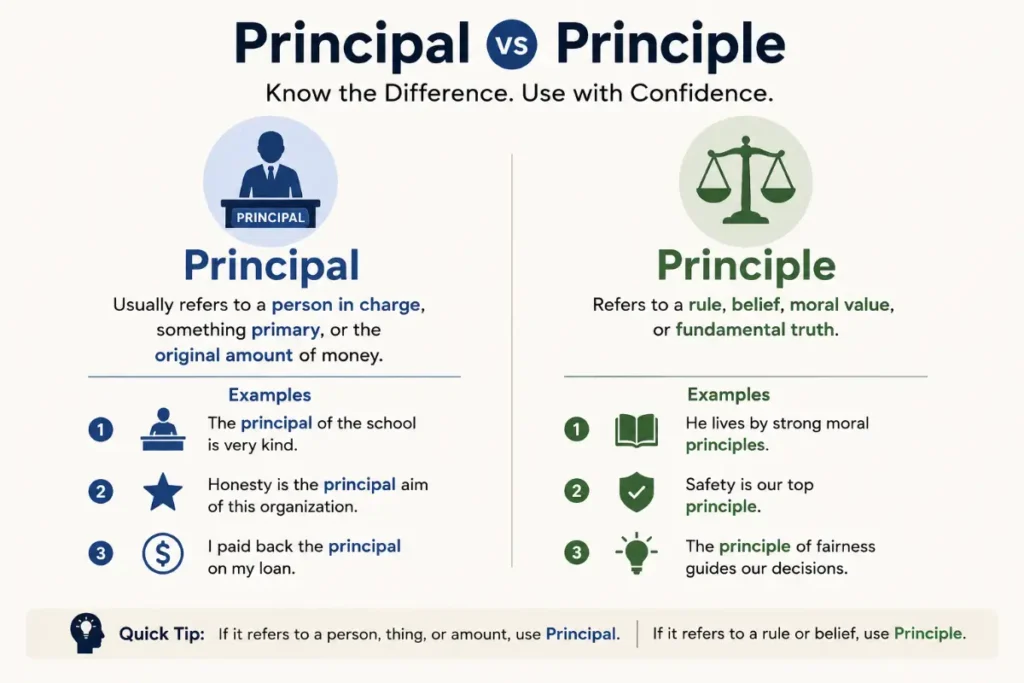
- Principal usually refers to a person in charge, something primary, or the original amount of money.
- Principle refers to a rule, belief, moral value, or fundamental truth.
- Principal can be a noun or an adjective.
- Principle is always a noun.
- The words are perfect homophones but have different meanings.
- They are never interchangeable.
- The memory trick “The principal is your pal” is an easy way to remember the correct spelling.
- Checking the meaning of the sentence is the best way to choose the right word.
A related grammar guide is Emigrate vs Immigrate and How to Use Each Word.
Conclusion
The difference between principal vs principle comes down to meaning, not spelling preference. Both words are correct, but each serves a different purpose. Use principal for a school leader, a main concern, or the original amount of a loan. Use principle for a basic rule, belief, or guiding value.
The simplest way to remember the distinction is to connect principal with a person or something primary and principle with a rule or belief. Before you finish writing, read the sentence and ask what the word describes. That quick check can help you catch mistakes that spell checkers often miss.
FAQs
Is principal or principle correct in American English?
Both spellings are correct in American English. The choice depends on meaning. Use principal for a school leader, the main reason for something, or the original amount of a loan. Use principle for a rule, belief, or basic truth. Neither word is a misspelling of the other.
What does principal mean in a school?
A principal is the person responsible for leading a school. In the United States, this person typically oversees staff, supports students, manages school operations, and works with families. The same word can also describe something most important, as in the principal reason for changing a school policy.
What does principle mean in simple words?
A principle is a basic rule, belief, or idea that guides how people act or how something works. For example, honesty can be a personal principle. In science, a principle can explain a pattern in nature. The word always refers to an idea or rule rather than a school leader.
How can I remember the difference between these words?
Think of the word pal at the end of principal. Your school principal is a person, so the spelling ending in pal can remind you of a person. For principle, think of a rule or belief. This memory trick isn’t a grammar rule, but it can make the distinction easier to remember.
How do you pronounce principal and principle?
Both words share the same standard pronunciation in American English. Each has three syllables, with the strongest stress on the first. Since they sound alike, pronunciation alone won’t tell you which spelling to use. Focus on the meaning of the sentence and the grammatical role the word plays.
Is principle a noun or an adjective?
Principle is a noun. It names a rule, belief, or basic truth. For example, fairness is an important principle. By contrast, principal can function as a noun or an adjective. It can identify a school leader or describe the main reason for a decision.
Should I use principal or principle for a loan?
Use principal when discussing a loan. The principal is the original amount borrowed or the remaining amount of that debt. Interest is the cost of borrowing money and is separate from the principal. For example, an extra payment toward your loan principal can reduce the amount on which future interest is calculated.
Can I use principal and principle in the same sentence?
Yes. Both words can appear naturally in the same sentence because they have different meanings. For example, the principal explained the principle behind the new school policy. The first word identifies the school leader, while the second refers to the rule that guides the policy.