
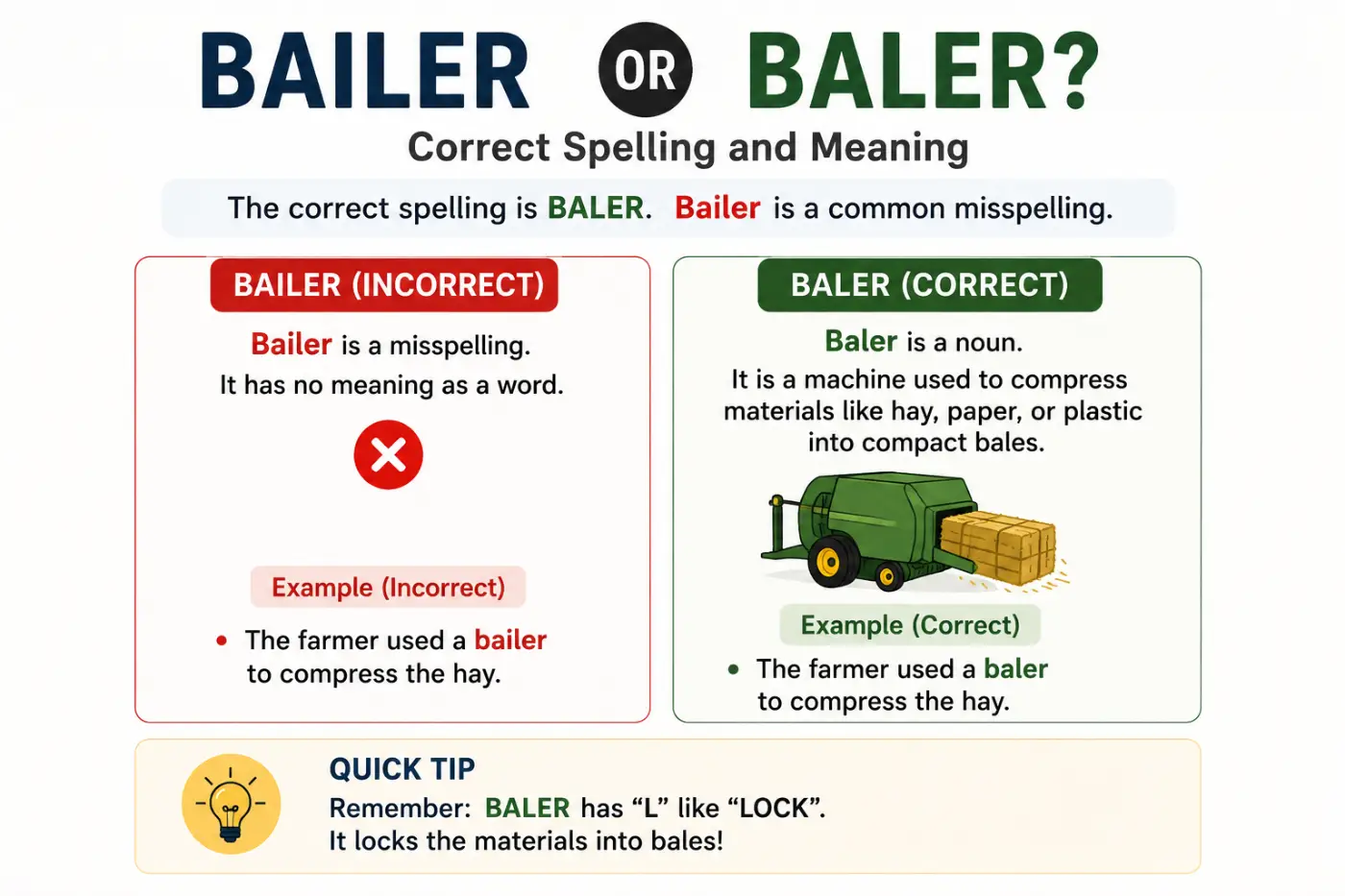
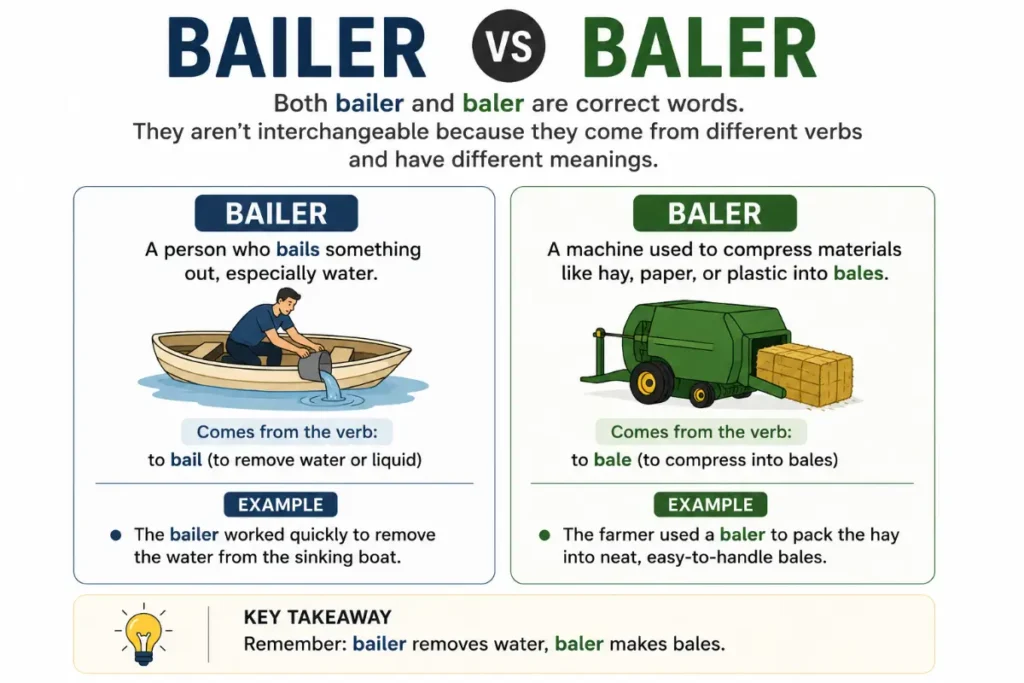
Confused about bailer or baler? Both spellings are correct, but they refer to different things. A bailer is a person or device that removes water from a boat, container, or other space. A baler is a machine that compresses loose materials such as hay, straw, paper, or recyclable waste into compact bundles called bales.
The confusion comes from their similar spelling and pronunciation. Both words sound alike in standard American English, yet the letter i changes the meaning entirely. Choosing the wrong one can create confusion in workplace instructions, agricultural reports, equipment manuals, and everyday writing.
The easiest way to remember the difference is to connect each word with its job. A bailer removes liquid, while a baler compresses solid material. Once you understand that distinction, the spelling becomes much easier to remember.
This guide explains both definitions, their grammatical roles, pronunciation, word origins, regional usage, and common mistakes. You’ll also find practical examples and answers to common questions so you can choose the right word confidently in conversation, professional documents, and academic writing.
Many readers also check Mute Point or Moot Point Which Is Correct.
Quick Answer
Bailer refers to a person or tool that removes water or another liquid from a container or enclosed space. Baler refers to a machine that compresses loose material into tightly packed bundles called bales. Both are correct English words, so neither is a general misspelling of the other. Use the spelling that matches the intended meaning.
Comparison Table for the Two Words
| Feature | Bailer | Baler |
|---|---|---|
| Part of speech | Noun | Noun |
| Main meaning | A person or tool that removes liquid | A machine that compresses material into bales |
| Related verb | Bail or bail out | Bale or bale up |
| Common setting | Boats and water removal | Farms and recycling facilities |
| Typical object | Water | Hay, straw, paper, or cardboard |
| Example | The bailer removed water from the boat. | The baler compressed the cardboard. |
| Correct usage | When referring to removing liquid | When referring to making compact bundles |
The key distinction is the action involved. One word relates to removing liquid, while the other relates to compressing solid materials.
Meaning and Definition
What Does Bailer Mean?
A bailer is a person or device that removes water or another liquid from a place where it has collected. The word is especially useful when describing small boats, containers, tanks, and spaces that need to be emptied.
For example, a small boat may take on water during heavy rain. Someone can use a scoop or container to remove that water. The tool used for this job can be called a bailer.
The word comes from the verb bail, which means to remove water from a boat or another place. The related expression bail out often describes the act of removing unwanted water from a vessel.
Bailer can also refer to a person who performs this task. Its exact meaning depends on the sentence and the field in which the word appears.
Consider these examples.
- The sailor kept a plastic bailer inside the boat.
- The crew used a bailer to remove water after the storm.
- The old wooden bailer was stored beside the fishing equipment.
In each sentence, the word relates to removing liquid. It doesn’t describe a machine that makes bundles of hay or paper.
What Does Baler Mean?
A baler is a machine that presses loose material into compact bundles called bales. These bundles are easier to handle, store, transport, and sometimes recycle.
Farmers commonly use this equipment to collect and compress hay or straw after cutting and drying crops. Recycling facilities use similar machines to compress cardboard, paper, plastic, and other suitable materials.
The word comes from bale, which means to pack material into a bundle. Adding the ending er forms a noun that identifies the machine performing the action.
For example, a hay baler compresses dried grass into bundles that can be stored for animal feed. A cardboard baler reduces the volume of discarded boxes so workers can move and transport the material more efficiently.
Here are three examples.
- The farmer repaired the baler before the harvest.
- The recycling center installed a larger baler.
- The operator checked the machine before compressing the straw.
All three examples describe equipment that creates compact bundles. None refers to removing water.
Is Bailer a Misspelling of Baler?
No. Bailer is a legitimate word with its own meaning. It isn’t an incorrect version of the agricultural or recycling term.
Likewise, baler isn’t a misspelling of the water removal term. The two words share a similar sound, but they come from different verbs and describe different functions.
A spelling checker may not flag either word because both are valid English. The real challenge is choosing the right one for the context. A writer discussing a boat should normally choose bailer for a water removal tool, while a writer describing farm machinery should choose baler.
Key Differences Explained
Spelling
The most visible difference is the letter i in bailer. Baler doesn’t contain that letter.
Although the difference is small, it changes the word’s meaning. Remember the related words to help keep the spellings straight.
- Bailer comes from bail.
- Baler comes from bale.
Think of the spelling as a clue to the job. A bailer removes water. A baler makes bales.
Meaning
The words describe separate actions.
A bailer removes liquid from a boat or container. A baler compresses loose material into bundles.
Imagine a farm where a worker uses a machine to compress hay. That machine is a baler. If the worker later takes a small boat onto a pond and uses a scoop to remove water, that tool is a bailer.
The setting alone doesn’t always determine the answer. The action and the object being described provide the strongest clues.
Grammar and Part of Speech
Both words function mainly as nouns. They name a person, tool, or machine rather than an action.
The verbs behind them help explain their grammar.
- Bail is a verb in the water removal sense. For example, the crew bailed water from the boat.
- Bale is a verb meaning to pack material into bales. For example, the farmer baled the hay.
- Bailer names the person or device that removes liquid.
- Baler names the machine that compresses material into bundles.
This pattern is common in English. The ending er often identifies a person or thing that performs an action.
Pronunciation
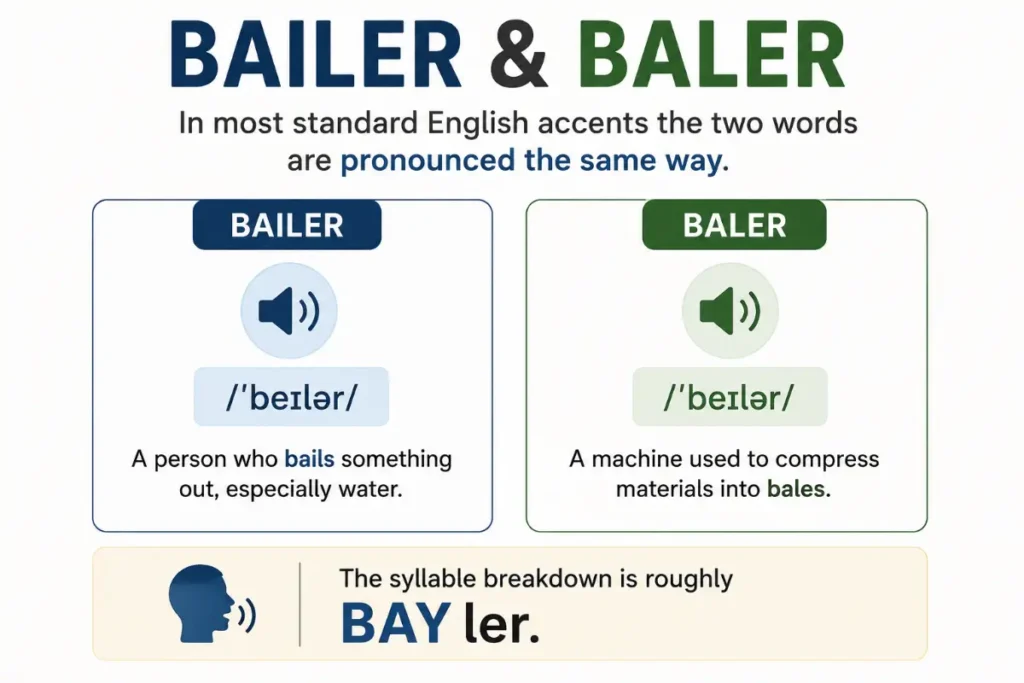
In standard American English, both words are generally pronounced the same way, with one syllable and a long A sound.
Their shared pronunciation explains why people sometimes confuse them in conversation. You can’t reliably identify the intended spelling by listening to the word alone. You need to consider its meaning.
For example, if someone says the machine is ready to process cardboard, the context points to baler. If someone asks for a tool to remove water from a canoe, the context points to bailer.
Formality and Context
Both words are appropriate in formal and informal English. Neither is slang when used in its ordinary sense.
Bailer appears in boating instructions, equipment descriptions, and discussions of water removal. Baler appears in agricultural manuals, industrial safety documents, recycling reports, and equipment specifications.
In professional writing, accuracy matters more than choosing one spelling as more formal. The correct term is the one that describes the intended object.
Regional Usage
The basic distinction remains the same in American and British English. A water removal tool can be called a bailer, and a machine that makes bales can be called a baler.
Some technical fields may use more specific terms for particular equipment. A manual might name a particular type of pump, scoop, or baling machine rather than use either general noun.
There is no general American versus British spelling rule that makes one of these words correct and the other incorrect.
Which Form Is Correct?
Both forms are correct. The choice depends on the meaning you want to express.
Use bailer when you mean a person or tool that removes water or another liquid. Use baler when you mean a machine that compresses material into compact bundles.
This distinction follows the way each noun is formed from its related verb. The first connects to bail, while the second connects to bale.
Compare these sentences.
- Correct: The bailer was hanging beside the boat.
- Correct: The baler was parked near the barn.
- Incorrect for the intended meaning: The farmer used a bailer to compress the hay.
- Incorrect for the intended meaning: The sailor used a baler to remove water.
The last two sentences aren’t wrong because the words themselves are misspelled. They’re wrong because the nouns don’t match the actions described.
When editing a sentence, identify the task first. If the task involves removing liquid, choose the first spelling. If it involves compressing material into bales, choose the second.
Sentence Examples
The following examples show how both words appear in everyday and professional English.
Ten Natural Examples Using the Correct Forms
1. Everyday conversation: Can you hand me the bailer so I can empty the water from the canoe.
2. Boating: We kept a small bailer under the front seat in case rainwater collected inside the boat.
3. Fishing: The fisherman used a plastic bailer to remove water before heading back to shore.
4. Workplace communication: Please inspect the baler before starting the morning recycling shift.
5. Agriculture: The farmer used a hay baler to prepare the dried grass for storage.
6. School writing: A baler compresses loose materials into compact bundles that are easier to transport.
7. Technical documentation: The operator must follow the manufacturer’s safety instructions before servicing the baler.
8. Formal reporting: The facility installed a new cardboard baler to reduce the volume of waste awaiting collection.
9. Online communication: Does anyone know where I can buy a lightweight bailer for a small fishing boat.
10. Storytelling: As the rain poured into the old fishing boat, Mara grabbed the bailer and began emptying the water.
These examples demonstrate how the surrounding words clarify the intended meaning. References to boats and water point toward one term. References to hay, cardboard, and compressed material point toward the other.
Five Examples of Incorrect Word Choice
These examples show how choosing the wrong spelling can confuse the reader.
1. Incorrect: The farmer used a bailer to bundle the hay. Correct: The farmer used a baler to bundle the hay.
2. Incorrect: The sailor reached for the baler to remove water from the boat. Correct: The sailor reached for the bailer to remove water from the boat.
3. Incorrect: The recycling center bought a new bailer for its cardboard. Correct: The recycling center bought a new baler for its cardboard.
4. Incorrect: We stored the baler beside the canoe to scoop out rainwater. Correct: We stored the bailer beside the canoe to scoop out rainwater.
5. Incorrect: The hay baler was used to empty the flooded compartment. Correct: The bailer was used to empty the flooded compartment.
The corrections depend on the intended meaning. If the sentence describes a specialized device with a different function, its technical name may vary. In ordinary usage, however, these examples show the standard distinction.
Common Mistakes and Misspellings
Writers often confuse these terms because they sound alike. The best way to avoid errors is to focus on the action described in the sentence.
Mistake One Using Bailer for Farm Machinery
Incorrect: The farmer bought a new bailer to compress straw.
Correct: The farmer bought a new baler to compress straw.
The mistake comes from choosing a familiar spelling without checking its meaning. Since the machine creates bales, the correct noun comes from bale.
Mistake Two Using Baler for Water Removal
Incorrect: We used a baler to remove rainwater from the boat.
Correct: We used a bailer to remove rainwater from the boat.
The correct choice connects to the verb bail, which describes removing water from a vessel or another space.
Mistake Three Confusing Bale and Bail
The verbs bale and bail have different meanings in these contexts.
- Incorrect: The workers bailed the hay into bundles.
- Correct: The workers baled the hay into bundles.
- Correct: The crew bailed water out of the boat.
The distinction between these verbs also helps you choose the right noun.
Mistake Four Assuming One Form Is Incorrect
Some writers assume that the shorter spelling must be correct or that the longer spelling is a typo. Neither assumption works here.
Both forms are standard words. The error occurs when a writer uses one in place of the other without considering the meaning.
Mistake Five Relying Only on Spell Check
A spelling checker may accept both words because each is correctly spelled. It may not recognize that the noun doesn’t fit the sentence.
For example, a sentence about compressing paper may contain bailer without triggering a spelling warning. The writer must still check the meaning.
A useful editing habit is to read the sentence again and ask what the equipment actually does. That simple step catches errors that basic spelling tools can miss.
Pronunciation Guide
Both words have the same usual pronunciation in standard American English.
Bailer
IPA: /ˈbeɪlər/
Sounds like the word baler.
Need another quick comparison? Read Accross vs Across Which Spelling Is Correct.
Baler
IPA: /ˈbeɪlər/
Sounds like the word bailer.
Syllables and Stress
Both words have two syllables: bail plus er, or bale plus er. The stress falls on the first syllable.
The vowel sound is the long A sound heard in words such as day, make, and take. The final syllable has a relaxed sound, similar to the ending in worker.
Although the spellings differ, the sounds generally do not. That makes this a homophone pair in standard American English.
Common Pronunciation Errors
- Trying to pronounce the extra letter. The letter i in bailer doesn’t create a separate syllable or a different vowel sound.
- Adding an extra syllable. Both words normally have two syllables rather than three.
- Using pronunciation to determine spelling. Since the words sound alike, pronunciation alone can’t tell you which one to write.
When speaking, use the context to make your meaning clear. When writing, connect the noun to its related verb.
Etymology and Word Origin
Understanding the origins of these words gives you a useful memory aid. They developed from separate English words that describe different actions.
The Origin of Bailer
The noun bailer comes from the verb bail in the sense of removing water. The verb is used in expressions such as bail out a boat, which means to remove water that has collected inside it.
The ending er turns the action word into a noun for a person or tool associated with that action. This is a common word formation pattern in English, as seen in cleaner, worker, and builder.
The meaning remains connected to water removal in ordinary boating contexts.
The Origin of Baler
The noun baler comes from the verb bale, meaning to pack material into a bundle. The noun bale has a long history in English and refers to a bound or packed bundle of goods or material.
The word baler came into use for the machine that forms such bundles. Historical etymological records date this machinery sense to the late nineteenth century.
The word formation is straightforward. A baler performs the work of baling, just as a builder performs the work of building.
A Simple Memory Trick
Connect each noun to its base word.
- Bail and bailer: Think of water being removed from a boat.
- Bale and baler: Think of hay being packed into a bundle.
The related verbs provide a stronger memory aid than the spelling alone. Once you remember the action, the correct noun becomes easier to choose.
Regional Usage
The meanings of these words remain broadly consistent across major English varieties. Differences in pronunciation may occur among speakers, but the central spelling distinction does not change.
American English
Both words are standard in American English. Bailer is appropriate for a person or tool that removes water, while baler is the usual term for equipment that compresses material into bales.
The second word is especially common in farming, waste management, and recycling. The first appears more often in boating and water removal contexts.
British English
British English uses the same basic distinction. A baler makes bales from materials such as hay or paper, while a bailer removes water from a boat or similar space.
Some British speakers may use the related verb bale in water removal contexts as an alternative form of bail. This doesn’t make the machinery noun baler interchangeable with bailer.
Australian English
The same distinction applies in Australian English. Agricultural equipment is commonly described as a baler, while a device for removing water may be called a bailer.
Local equipment terminology can differ by industry or region. When writing a technical document, use the term found in the equipment manufacturer’s documentation.
Canadian English
Canadian English follows the same general spelling pattern. A baler compresses materials into bales, and a bailer removes liquid.
In all four varieties, the intended action is the most reliable guide to the correct spelling.
Grammar Rules and Part of Speech
Both words are countable nouns. You can use them with articles such as a and the, and you can make them plural by adding s.
For example, you can write a bailer, the bailer, or several bailers. Similarly, you can write a baler, the baler, or several balers.
Using the Words in a Sentence
A noun can serve as the subject or object of a sentence.
- Subject: The bailer was easy to use.
- Object: The sailor cleaned the bailer.
- Subject: The baler stopped working.
- Object: The operator repaired the baler.
Both nouns can also modify another noun when used before it. For example, a bailer bucket may refer to a bucket used for removing water, while a hay baler identifies machinery used to make hay bales.
Related Verb Forms
The verbs help explain how the nouns work in a sentence.
| Base verb | Present participle | Past tense | Example |
|---|---|---|---|
| Bail | Bailing | Bailed | We bailed water from the boat. |
| Bale | Baling | Baled | The farmer baled the hay. |
Notice that baling has one letter less than bailing. This is another point where writers may make mistakes.
The noun baler refers to the machine. The verb bale describes the action performed with that machine. A farmer can operate a baler to bale hay.
Singular and Plural Forms
Use bailer for one person or tool and bailers for more than one. Use baler for one machine and balers for several machines.
Examples include:
- The boat carries two bailers.
- The farm has three balers.
- Each bailer is stored near the boat.
- Each baler requires regular maintenance.
Neither word needs a special apostrophe to form its plural. Use an apostrophe only when the sentence requires possession or another grammatical function that calls for one.
Real Life Usage Examples
The best way to learn the difference is to see how the words appear in different settings. Their meanings stay consistent, but the details around them change with the situation.
Daily Conversation
- Can you pass me the bailer? There’s water collecting in the bottom of the boat.
- The farmer said the baler was ready, so we could start gathering the hay.
In casual speech, people often rely on the surrounding conversation to identify the intended word. In writing, choosing the correct spelling prevents confusion.
Email and Workplace Communication
- Please store the bailer with the other boating supplies after the inspection.
- The recycling team should check the baler before processing the next load of cardboard.
Workplace messages should name equipment clearly. This is especially useful when several tools or machines have similar names.
Academic Writing
- A bailer can help remove water from a small vessel when a suitable pump isn’t available.
- A baler reduces the volume of recyclable materials by compressing them into manageable bundles.
Academic writing benefits from accurate terms because readers need to understand the process being described. If a technical paper concerns a specialized machine, define the equipment clearly when first mentioning it.
News and Journalism
- Rescue workers used a bailer to remove water from a small boat after heavy rain.
- The recycling plant added a new baler to handle the growing volume of cardboard waste.
News reports often describe events or equipment in a few words. The right noun helps readers understand the action without needing a long explanation.
Literature and Storytelling
- Daniel grabbed the bailer and worked quickly as water crept across the floor of the boat.
- At sunset, the farmer watched the baler form the final bundle of hay before taking the equipment back to the barn.
In storytelling, a precise word helps readers picture the scene. A water removal tool and a machine that compresses hay create very different images.
Related and Confused Terms
Several related words can help you understand these nouns more clearly. Some share a root, while others describe similar equipment or actions.
Bail
Bail is a verb that can mean to remove water from a boat. It also has other meanings, including the legal process of securing someone’s release from custody under specified conditions. The intended meaning depends on context.
Example: The crew had to bail water out of the boat.
Bail Out
Bail out often means to remove water from a boat. In informal English, it can also mean to leave a difficult situation or withdraw from an activity.
Example: We had to bail out the canoe after the storm.
Bailing
Bailing is the present participle or gerund form of bail. It describes the action of removing water.
Example: Bailing water by hand took nearly twenty minutes.
Bale
A bale is a compact bundle of material, such as hay, cotton, or paper. The word can also function as a verb meaning to pack material into bundles.
Example: The workers tied the bale securely before moving it.
Baling
Baling is the process of packing material into bales. Farmers use the term when preparing hay or straw, while recycling facilities may use it for paper and cardboard.
Example: Baling the dry grass made storage easier.
Hay Baler
A hay baler is a machine used to compress cut and dried grass into bundles. These bundles can then be stored or transported for use as animal feed.
Example: The hay baler worked across the field throughout the afternoon.
Cardboard Baler
A cardboard baler compresses discarded cardboard into compact bundles. Businesses and recycling centers use these machines to make storage and collection easier.
Example: The warehouse installed a cardboard baler near the loading area.
Pump
A pump moves liquid from one place to another. It can perform a job similar to water removal with a bailer, but it works differently. A bailer may be a simple hand tool, while a pump moves liquid through a mechanical or powered system.
Example: The crew used a pump to remove water from the flooded compartment.
Expert Tip
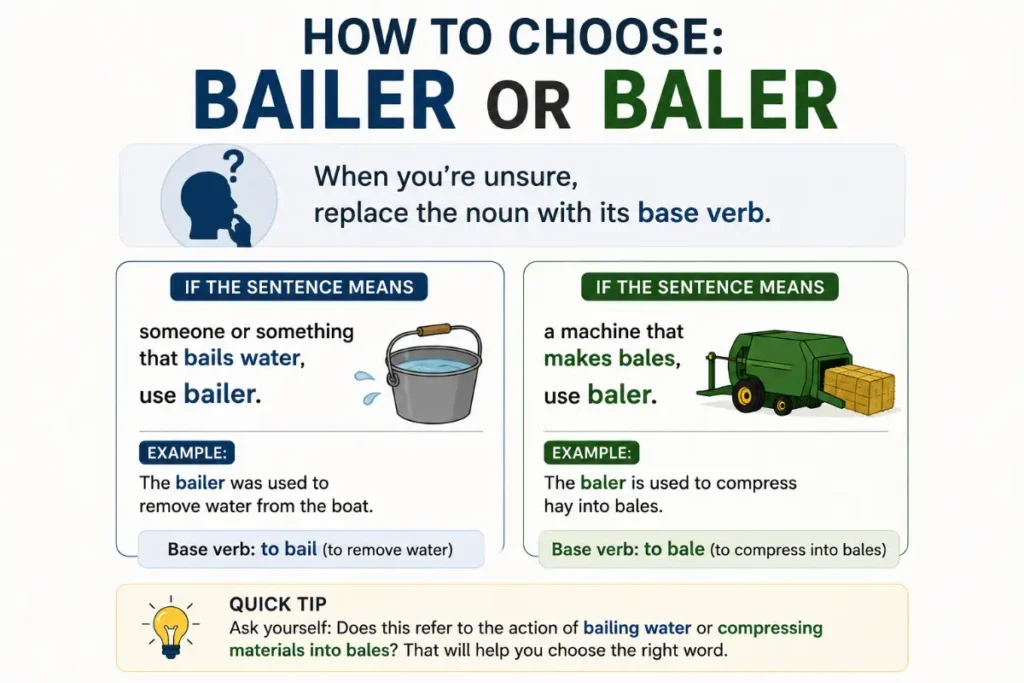
When you’re unsure, replace the noun with its base verb.
If the sentence means someone or something that bails water, use bailer.
If the sentence means someone or something that bales material, use baler.
This quick test takes only a second and works better than relying on pronunciation.
Expert Editor Insight
An experienced editor looks at meaning before spelling. Since both forms are legitimate and sound alike, a standard spelling checker may accept the wrong choice without warning. The most reliable editing method is to identify the action in the sentence, check the related verb, and confirm that the noun matches the intended function. If the sentence describes water removal, check bail. If it describes compressing material into bundles, check bale. This approach catches errors that a simple spell check can miss and keeps technical writing clear.
Many readers also check former vs latter Explained With Clear Examples.
Conclusion
The difference between bailer or baler comes down to meaning rather than spelling preference. A bailer removes water from a boat or another space, while a baler compresses loose materials into compact bundles. Both are correct English words, and neither is a general misspelling of the other.
Remember the related verbs to make the distinction easier. Bail connects to removing water, while bale connects to making bundles. Before submitting an article, report, or work document, check the action described in the sentence. This simple habit will help you choose the right word and communicate your meaning clearly.
FAQs
Is Bailer a Real Word?
Yes. Bailer is a standard English noun that can describe a person or device that removes water from a boat or another space. It comes from the verb bail. The word isn’t a misspelling of baler. Its correct use depends on the meaning of the sentence and the equipment being described.
What Does Baler Mean?
A baler is a machine that compresses loose materials into compact bundles called bales. Farmers use balers for hay and straw, while recycling facilities use them for materials such as paper and cardboard. The machine makes these materials easier to store and transport. The word comes from the verb bale, meaning to pack material into bundles.
Which Is Correct for Farm Equipment?
Baler is the correct word for machinery that compresses hay, straw, or similar materials into bales. The spelling connects to the verb bale. Bailer refers to a person or tool that removes water. If you’re writing about harvesting crops or operating agricultural machinery, use baler unless the context specifically concerns water removal.
How Do You Pronounce Bailer and Baler?
In standard American English, both words are usually pronounced /ˈbeɪlər/. Each has two syllables, with stress on the first syllable. They sound alike, so pronunciation alone won’t tell you which spelling to use. Pay attention to the meaning and the action described in the sentence to choose the correct form.
Can Bailer or Baler Start a Sentence?
Yes. Both words can begin a sentence when they function as nouns. For example, Bailer is the tool we use to remove water from the boat. You could also write, Baler is the machine used to compress hay into bundles. Capitalize the first letter because each word begins the sentence.
What Is a Synonym for Bailer?
Useful alternatives include scoop and dipper when referring to a simple tool for removing water. In some settings, a pump may serve a similar purpose, although it works differently. The best substitute depends on the equipment and the sentence. In technical writing, use the specific equipment name when greater precision is needed.
Why Do People Confuse These Two Words?
People confuse them because they look similar and usually sound identical in American English. Both also use the common noun ending er, which identifies a person or thing associated with an action. Since spell check may accept both forms, writers need to check the meaning rather than rely only on automatic spelling corrections.
Is Baler Appropriate in Formal Writing?
Yes. Baler is appropriate in formal writing about agriculture, recycling, industrial equipment, and related subjects. Bailer is also appropriate in formal writing about water removal. Neither word is informal by nature. For reports, manuals, and academic work, choose the term that accurately describes the equipment and use the same term consistently throughout the document.