
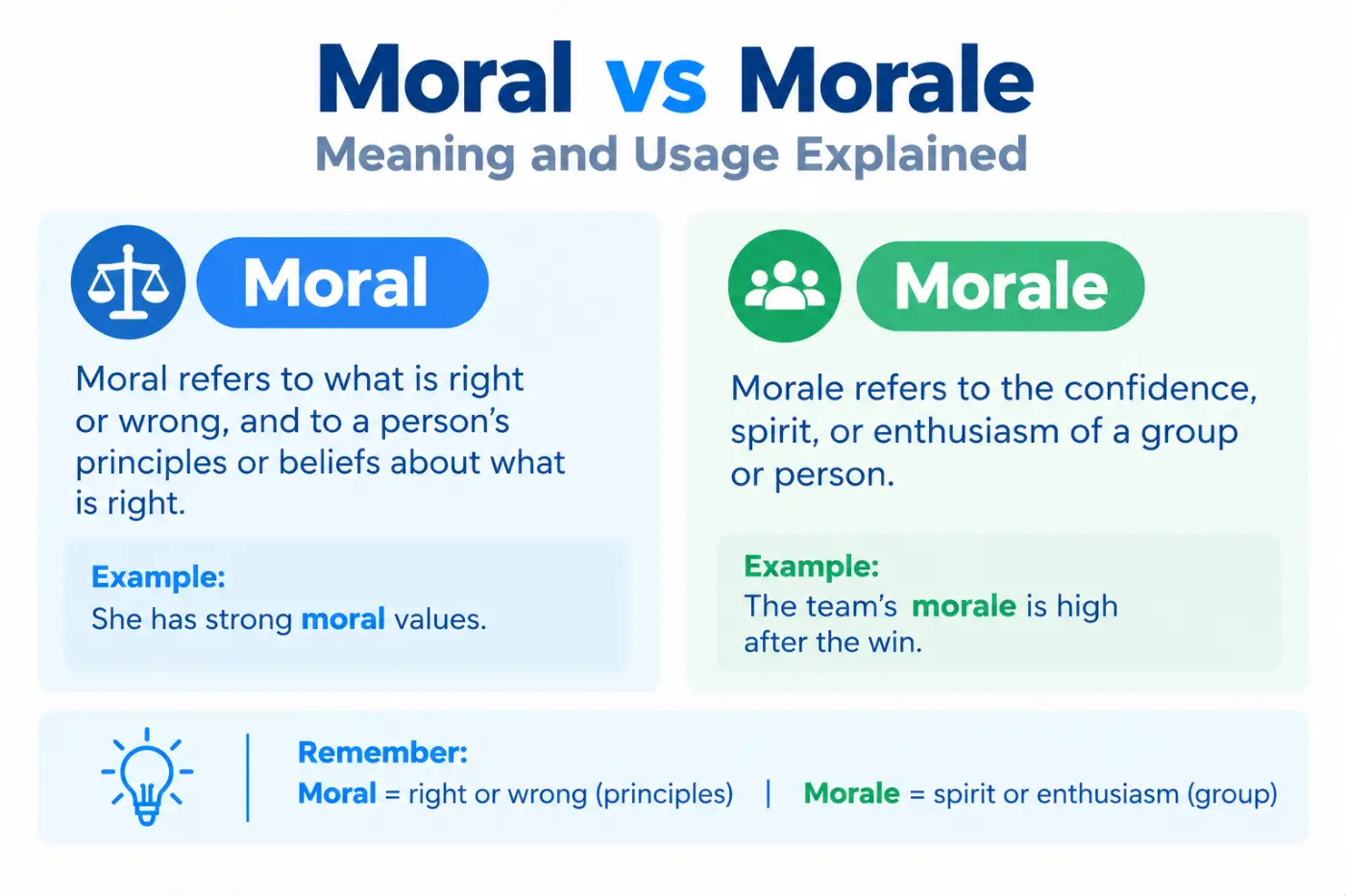
Moral vs morale can confuse even careful writers because the two words look almost identical and sound similar. However, they have different meanings, and using one in place of the other can change the message of a sentence.
Moral relates to right and wrong, good behavior, and the principles people use to make ethical choices. Morale describes the confidence, enthusiasm, and shared spirit of a person or group, especially at work, in school, or during a difficult time.
For example, a manager might discuss the moral responsibility to treat employees fairly while also trying to improve team morale. Both words fit the same situation, but each describes something different.
The easiest way to remember the distinction is to connect moral with values and morale with the mood of a group. Once you understand this simple difference, you can choose the right word in emails, essays, workplace reports, everyday conversations, and formal writing.

Still confused? Compare Who vs Whom Explained With Simple Grammar Rules.
Quick Answer
Moral refers to principles of right and wrong, ethical behavior, or a lesson about good and bad choices. Morale refers to the confidence, enthusiasm, and emotional spirit of a person or group. Both are correct English words, but they aren’t interchangeable. Use moral to discuss values and morale to discuss motivation or group spirit.
Comparison Table for Moral and Morale
| Feature | Moral | Morale |
|---|---|---|
| Meaning | Principles of right and wrong or a lesson from a story. | Confidence, enthusiasm, and group spirit. |
| Part of speech | Noun or adjective. | Noun. |
| Pronunciation | MOR uhl. | muh RAL. |
| Main context | Ethics, behavior, stories, and values. | Work, school, sports, and group motivation. |
| Common phrase | Moral responsibility. | High morale. |
| Example | She made a moral choice. | The victory boosted team morale. |
| Opposite concept | Immorality or unethical behavior in some contexts. | Low spirits or discouragement. |
| Standard English | Correct. | Correct. |
The key difference is meaning, not spelling correctness. The final letters help distinguish the words, but their role in the sentence gives you the clearest clue.
What Does Moral Mean
The word moral relates to ideas about right and wrong. It can describe a person’s values, an action that follows ethical principles, or a lesson about behavior. It can also refer to the lesson a reader takes from a story.
This word has two common grammatical roles. It works as an adjective when it describes a person, action, decision, or responsibility. It works as a noun when it names a lesson or principle.
Moral as an Adjective
As an adjective, moral describes something connected to ethics, fairness, honesty, or a sense of responsibility. People often use it when discussing decisions that affect other people.
Consider these examples.
- The judge faced a difficult moral question.
- She felt a moral duty to tell the truth.
- The company has a moral responsibility to protect its workers.
- He refused to take part in the dishonest scheme because it violated his moral principles.
In each sentence, the word connects an action or responsibility to ideas about right and wrong. It doesn’t describe how cheerful or confident someone feels.
The word can also describe a person who tries to follow ethical standards. For instance, someone might be called a moral leader because they act honestly and treat people fairly.
Moral as a Noun
As a noun, moral often means the lesson a story teaches. You may have heard the phrase the moral of the story in school or everyday conversation.
For example, the moral of a story about a boy who lies might be that honesty builds trust. A tale about a selfish king might teach readers that kindness matters more than wealth.
The noun can also refer to a guiding principle. Someone might say that honesty is one of their morals, although the plural morals is more natural when discussing a person’s overall principles.
Common Expressions With Moral
These expressions appear in everyday speech and formal writing.
- Moral values. Principles that guide a person’s choices about right and wrong.
- Moral responsibility. An ethical duty to do what is right.
- Moral support. Encouragement and emotional backing for someone facing a challenge.
- Moral lesson. A message about behavior or values.
- Moral dilemma. A difficult situation in which competing ethical choices create a problem.
Notice that moral support sounds similar in meaning to encouragement, but it doesn’t refer to the general spirit of a whole team. It usually means helping a particular person feel supported during a hard time.
What Does Morale Mean
Morale describes the confidence, enthusiasm, satisfaction, and shared spirit that influence how a person or group feels about a situation. The word often appears in workplaces, schools, sports teams, military units, and other groups that work toward a common goal.
High morale generally means people feel encouraged, confident, and ready to contribute. Low morale suggests discouragement, frustration, or a loss of motivation.
For example, a school principal might organize a celebration to improve teacher morale after a demanding semester. A sports coach might praise players after a tough loss to keep team morale strong.
How Morale Works in Everyday English
The word is a noun. Writers commonly use it with adjectives such as high, low, strong, and poor. It also appears with verbs such as boost, improve, maintain, damage, and raise.
Here are some natural examples.
- The new manager improved employee morale by listening to staff concerns.
- Three straight losses hurt the team’s morale.
- A friendly message from the principal lifted the teachers’ morale.
- Unclear expectations can lower morale in the workplace.
In these sentences, the word describes people’s emotional state or their sense of confidence and belonging. It doesn’t refer to a lesson about right and wrong.
High Morale and Low Morale
High morale can help a group work together, handle pressure, and stay focused on shared goals. People may feel that their work matters and that their efforts receive fair recognition.
Low morale can develop when employees feel ignored, students feel discouraged, or teammates lose confidence in their chances of success. Poor communication, unfair treatment, and constant uncertainty can all contribute to the problem.
However, morale isn’t the same as performance. A team can feel confident and still lose a game. Employees can have high spirits and still face a difficult workload. The word describes how people feel, not a guaranteed result.
Common Expressions With Morale
- High morale. A strong sense of confidence and enthusiasm.
- Low morale. A lack of confidence or motivation.
- Team morale. The shared spirit of a group working together.
- Employee morale. How workers feel about their jobs, workplace, and organization.
- Boost morale. To help people feel more confident or encouraged.
- Damage morale. To reduce confidence or enthusiasm.
These phrases appear frequently in conversations about leadership, education, sports, and group performance.
Key Differences Explained
The distinction becomes easier to remember when you compare the words across several areas.
Meaning and Purpose
Moral focuses on ethics, values, and lessons about behavior. Morale focuses on confidence, enthusiasm, and emotional spirit.
For example, a supervisor might believe that paying workers fairly is a moral responsibility. The same supervisor might introduce flexible schedules to improve employee morale.
The first statement concerns what is right. The second concerns how employees feel.
Grammar and Part of Speech
Moral can function as an adjective or a noun. Morale functions as a noun.
You can write a moral decision because the adjective describes the decision. You can also write the moral of the story because the noun identifies a lesson and You can write strong morale because the noun names a group’s emotional spirit.
Spelling
The words differ by one final letter. Moral ends in al, while morale ends in ale.
That small change signals a different word with a different meaning. Neither spelling is a mistake when used in the right context.
Pronunciation
Both words have two syllables, but their stress patterns differ in common American English pronunciation.
Moral places stress on the first syllable. Morale places stress on the second syllable. Listening for that difference can help you recognize the intended word during conversation.
Context and Formality
Both words work in casual conversation, academic writing, business communication, and formal documents. The right choice depends on the subject.
A school essay about honesty might discuss moral principles. A workplace report about staff satisfaction might examine employee morale. Neither word is more formal in every situation.
Regional Usage
American, British, Canadian, and Australian English use both words with the same basic distinction. There is no major regional spelling difference to learn for ordinary use.
If you write for a US audience, follow the same rule: use moral for ethics and lessons, and morale for confidence and group spirit.
Which Form Is Correct
Both forms are correct. The right choice depends on the meaning you want to express.
Use moral when discussing ethical principles, right and wrong, or the lesson a story teaches. Use morale when describing the confidence, enthusiasm, or emotional condition of a person or group.
For example, The coach gave a speech about sportsmanship and moral responsibility discusses values. The coach gave a speech to improve team morale describes an effort to encourage the players.
Established English dictionaries recognize both as separate words. Their similar spelling doesn’t make one a variant or a misspelling of the other. Instead, each has its own meaning and grammatical function.
If you’re unsure, ask yourself one simple question. Am I talking about right and wrong, or am I talking about how people feel? The answer will usually point you toward the correct word.
Ten Sentence Examples
These examples show how the two words work in realistic situations. Pay attention to the subject of each sentence to see why one form fits better than the other.
- Everyday conversation. My parents taught me that honesty is a moral value worth protecting.
- Workplace communication. The team leader praised everyone’s effort to improve morale during a stressful month.
- School. Our teacher asked us to explain the moral of the fable in our own words.
- Sports. The team’s last minute victory lifted everyone’s morale.
- Academic writing. The researcher examined the moral questions raised by the use of artificial intelligence.
- Business. Fair pay and clear communication can help maintain employee morale.
- Family life. She made the moral choice to admit her mistake instead of blaming her brother.
- Text message. Keep your head up. Your support means a lot to our team’s morale.
- News reporting. The prolonged strike weakened morale among workers who had already faced months of uncertainty.
- Storytelling. The moral of the tale is that kindness often matters more than personal gain.
Each sentence uses the word that matches its meaning. Notice that the first, third, fifth, and seventh examples concern values or lessons, while the others focus on confidence and group spirit.

Common Mistakes and How to Fix Them
Writers often confuse these words because their spelling differs by only one letter. The best way to avoid errors is to check the meaning of the sentence rather than relying on appearance alone.
Mistake One Using Moral for Group Spirit
Incorrect: The unexpected defeat damaged team moral.
Correct: The unexpected defeat damaged team morale.
The sentence describes the players’ confidence and emotional state after a loss. The noun morale fits because it refers to their shared spirit.
Mistake Two Using Morale for Ethics
Incorrect: The decision raised serious morale concerns.
Correct: The decision raised serious moral concerns.
The intended meaning concerns right and wrong. The adjective moral describes the ethical concerns created by the decision.
Mistake Three Confusing Moral Support With Morale
Incorrect: I went to the hospital to give my friend morale.
Better: I went to the hospital to give my friend moral support.
The phrase moral support means encouragement or emotional backing. You might also say that your visit helped boost your friend’s morale, but those sentences use different grammatical structures.
Mistake Four Treating Both Words as Adjectives
Incorrect: The manager made a morale decision.
Correct: The manager made a moral decision.
The adjective moral describes the decision. The noun morale doesn’t normally modify a noun in this way. You could write a decision that improved morale to express a different idea.
Mistake Five Assuming One Spelling Is Incorrect
Incorrect assumption: Morale is just another spelling of moral.
Correct explanation: They are separate words with different meanings.
This mistake can cause problems because a spell checker may accept both words. A sentence can contain a correctly spelled word and still communicate the wrong idea. Always check the meaning in context.
Pronunciation Guide
Both words have two syllables, but the main stress falls in a different place.
Still confused? Compare Imply vs Infer The Difference Explained.
Moral
IPA: /ˈmɔːrəl/
MOR uhl
Stress the first syllable. The word sounds similar to the first part of the word morning.
Morale
IPA: /məˈræl/
muh RAL
Stress the second syllable. The final sound rhymes with words such as pal in many American accents.
Pronunciation can vary slightly by accent, especially the vowel sounds. The main stress difference remains a useful clue.
To practice, say moral choice and team morale aloud. In the first phrase, emphasize the first syllable of moral. In the second, emphasize the final syllable of morale.
Don’t rely on pronunciation alone when writing. Speakers can reduce unstressed vowels in casual conversation, making the words sound closer together. Meaning and sentence structure provide stronger clues when the spoken difference isn’t clear.
Etymology and Word Origin
The two words share a historical connection to ideas about character and behavior, but English developed distinct meanings for them.
Where Moral Comes From
Moral entered English through French and Latin. It traces back to the Latin word moralis, which relates to customs, habits, and conduct. That root is also connected to mos, meaning a custom or manner.
Over time, English used the word to describe matters of right and wrong. It also developed the noun meaning a lesson or principle, especially in stories that teach readers something about human behavior.
Where Morale Comes From
Morale entered English through French usage. Its modern sense centers on the mental and emotional condition of a person or group, including confidence, enthusiasm, and willingness to continue.
Today, the word appears often in discussions about military units, workplaces, schools, and teams. Its meaning focuses on group spirit rather than ethical judgment.
The shared historical background helps explain why the words look similar. Their modern meanings, however, are distinct enough that you shouldn’t use one as a substitute for the other.
Regional Usage in English
The same basic distinction applies across major English varieties. There is no standard US spelling rule that makes one word acceptable and the other incorrect.
American English
In the United States, moral appears in expressions such as moral obligation, moral values, and moral of the story. Morale appears in phrases such as employee morale, team morale, and low morale.
These uses are standard in schoolwork, workplace communication, news writing, and everyday conversation.
British English
British English follows the same distinction. A writer might discuss the moral issues surrounding a public decision or describe low morale among workers.
The spelling and core meanings remain the same. Differences in surrounding vocabulary or style don’t change which word fits each meaning.
Australian English
Australian English also uses both words in their established senses. Moral relates to ethics and lessons, while morale describes confidence and group spirit.
There is no special Australian spelling change that requires writers to learn a different rule.
Canadian English
Canadian English follows the same pattern as American and British English. Writers use moral for ethical questions and morale for emotional confidence or group enthusiasm.
For all four varieties, context determines the correct choice.
Grammar Rules and Part of Speech
Understanding how each word behaves in a sentence makes the distinction easier to apply. The main grammatical difference is that moral can be a noun or an adjective, while morale is a noun.
How to Use Moral Correctly
As an adjective, moral usually appears before a noun or after a linking verb.
- She faced a moral dilemma.
- His decision was moral and fair.
- They debated the moral impact of the new policy.
As a noun, it can identify the lesson of a story or a guiding principle.
- The moral of the story is simple.
- Honesty is one of her strongest morals.
The plural morals commonly refers to a person’s principles or standards of conduct.
How to Use Morale Correctly
Because morale is a noun, it can act as the subject or object of a sentence. It often appears with descriptive adjectives or verbs that express change.
- Morale improved after the team received positive feedback.
- The long hours lowered staff morale.
- The supervisor worked hard to maintain high morale.
- Regular recognition can boost employee morale.
In ordinary usage, morale is generally treated as an uncountable noun. Writers usually say high morale or a decline in morale rather than a morale or several morales.
Punctuation and Sentence Position
Neither word requires special punctuation. Choose the word that expresses your intended meaning and apply normal sentence rules.
For example, The moral is clear uses a noun. The moral argument is clear uses an adjective. The morale is improving uses the noun, although morale is improving is usually more natural because the word generally doesn’t need an article.
These patterns help you identify each word even when the sentence is more complex.
Real Life Usage Examples
The best way to learn the difference is to see how these words appear in situations people encounter every day.
Daily Conversation
- My grandfather always said that keeping your promises is a moral responsibility.
- Everyone felt better after our coach gave a short speech to lift morale.
The first sentence concerns personal values. The second describes a change in how people feel.
Email and Workplace Communication
- Subject: Workplace Conduct. We expect every employee to follow the company’s moral standards and treat colleagues fairly.
- Subject: Team Update. Thank you for your patience and teamwork. Your efforts have helped maintain morale during a busy period.
The first example concerns ethical behavior. The second recognizes the spirit and effort of a team.
Academic Writing
- The essay explores the moral questions surrounding the use of genetic technology.
- The study examines the relationship between leadership style and employee morale.
Academic writing often uses the first word in discussions of ethics and the second in discussions of motivation or group psychology.
News and Journalism
- The investigation prompted a wider debate about the moral responsibilities of public officials.
- Continued uncertainty has weakened morale among local business owners.
News writers use these words to distinguish ethical questions from people’s confidence or emotional state.
Literature and Storytelling
- The moral of the story is that patience can be more valuable than pride.
- The soldiers entered the final chapter with their morale restored by news from home.
The first example describes a lesson for readers. The second describes renewed confidence among a group of people.
Related Words and Expressions
Several related terms can help you express the intended meaning more precisely. Some connect to ethics, while others describe confidence, motivation, or emotional support.
- Ethics. The principles used to judge right and wrong. Ethics often refers to a system of standards, while moral can describe a particular principle or decision.
- Morality. The quality or system of being concerned with right and wrong. For example, a class might study the morality of a difficult decision.
- Values. Beliefs or principles that guide choices. Values may include honesty, fairness, loyalty, and kindness.
- Integrity. The quality of acting honestly and consistently with your principles. A person with integrity tries to do the right thing even when no one is watching.
- Motivation. The desire or drive to take action. Motivation can affect morale, but the terms aren’t identical. A person may feel motivated to complete one task without feeling especially positive about the larger group.
- Team spirit. A sense of unity and enthusiasm among group members. This phrase is close in meaning to team morale and often sounds more conversational.
- Confidence. Belief in your own ability or in the chance of success. Confidence can contribute to high morale, but it can also describe an individual’s belief in a specific skill.
- Encouragement. Words or actions that help someone feel supported. Encouragement may boost morale or provide moral support to a person facing a challenge.
These distinctions matter because related words don’t always mean the same thing. Choosing a precise term makes your writing clearer and helps readers understand the point you’re making.

Expert Editor Insight
An experienced editor checks the meaning of a sentence before checking the spelling. Both words are legitimate English terms, so a spell checker may accept either one even when the writer has chosen the wrong meaning. Look at the surrounding words for clues. Terms such as ethical, responsibility, and lesson often point to moral, while team, employee, confidence, and boost often point to morale. These clues aren’t absolute rules, but they provide a quick and reliable editing check.
Still confused? Compare Mute Point or Moot Point Which Is Correct.
Conclusion
Moral vs morale comes down to one simple difference. Moral relates to right and wrong, ethical principles, and lessons about behavior. Morale describes confidence, enthusiasm, and the shared spirit of a person or group. Both words are correct, but they aren’t interchangeable. Use moral responsibility when discussing ethics and high morale when discussing a motivated team.
For a quick memory trick, connect the word moral with values and the word morale with team spirit. Before you finish a sentence, check its meaning rather than relying only on spelling. That small habit will help you write with greater confidence and accuracy.
FAQs
Is Morale a Real Word?
Yes. Morale is a standard English noun that describes the confidence, enthusiasm, and spirit of a person or group. People commonly use it in workplace, military, school, and sports settings. For example, a manager might organize a team event to improve employee morale. The word is not a misspelling of moral because it has its own established meaning.
What Does Moral Mean in Simple English?
Moral relates to knowing or deciding what is right and wrong. It can describe an ethical choice, a person’s values, or a lesson from a story. For example, telling the truth can be described as a moral choice. In a fable, the moral is the lesson the story teaches readers about behavior or character.
Which Word Should I Use for Team Spirit?
Use morale when you mean team spirit, confidence, or enthusiasm. For example, you could write, The coach’s encouraging words boosted team morale. Use moral when you mean something related to right and wrong, such as a moral obligation to treat teammates fairly. The subject of your sentence will help you choose the correct word.
How Do You Pronounce Moral and Morale?
In common American English, moral is pronounced MOR uhl, with stress on the first syllable. Morale is pronounced muh RAL, with stress on the second syllable. The vowel sounds can vary slightly across accents, but the difference in stress is useful. If the words sound similar in fast conversation, use their meaning to identify the intended word.
Can Moral Start a Sentence?
Yes. You can begin a sentence with moral when it fits the grammar and meaning. For example, Moral responsibility can guide difficult decisions. You can also begin with a complete noun phrase such as The moral of the story is that honesty matters. Capitalize the first word as you normally would at the start of a sentence.
What Is a Synonym for Morale?
Useful alternatives include team spirit, confidence, enthusiasm, and group motivation. The best choice depends on the context. Team spirit works well in casual conversation, while employee morale fits workplace discussions. Confidence focuses more on belief in success or ability. None of these terms matches every use of morale, so choose the one that expresses your exact meaning.
Why Do People Confuse These Two Words?
People confuse them because their spellings differ by only one final letter, and their pronunciation can sound similar in casual speech. Both also appear in conversations about behavior, leadership, and relationships. However, their meanings remain distinct. Connecting moral with ethics and morale with group spirit provides a simple memory aid that works in most everyday writing situations.
Is Moral or Morale Better for Formal Writing?
Both words are appropriate for formal writing when used correctly. Use moral in essays about ethics, legal arguments about ethical duties, or discussions of a story’s lesson. Use morale in reports about staff confidence, workplace culture, or team spirit. Neither word is inherently more formal than the other. Accuracy depends on choosing the word that expresses the intended idea.