
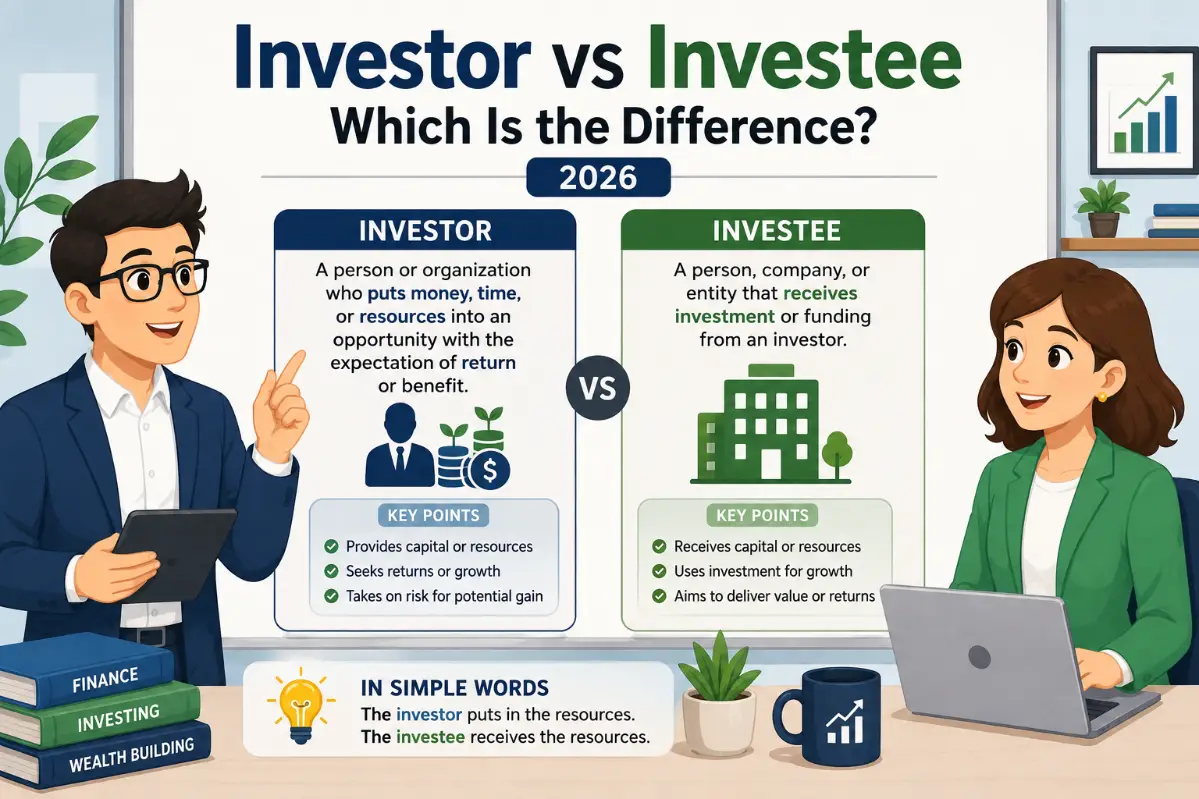
Investor vs investee is a comparison many people search for when reading financial statements, startup funding news, business agreements, or investment reports. Since both words come from the verb invest, it’s easy to assume they mean the same thing. In reality, they describe two completely different roles in the same financial relationship.
An investor is the person, company, or institution that provides money or other assets with the expectation of earning a return. An investee is the business or organization that receives that investment. Mixing up these terms can cause confusion in accounting, finance, corporate law, and professional communication.
This guide explains the difference in simple language while also covering the deeper financial meaning used by accountants, investors, business owners, and legal professionals. You’ll learn what each term means, when to use it, how they differ, how native English speakers use them, and the common mistakes to avoid. By the end, you’ll know exactly which word fits every situation.
For another common grammar confusion, see shoyu vs tonkotsu Which Ramen Should You Choose.
Quick Definition
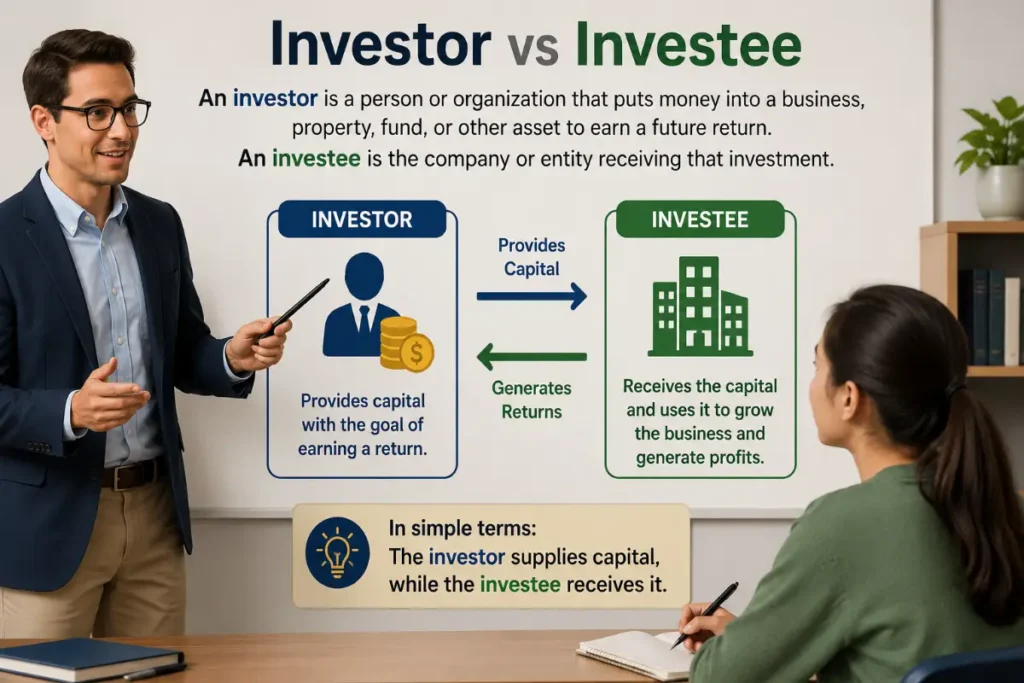
An investor is a person or organization that puts money into a business, property, fund, or other asset to earn a future return. An investee is the company or entity receiving that investment. The investor supplies capital, while the investee receives it.
Quick Answer
The correct word depends entirely on the role you are describing.
- Use investor for the person or organization providing money.
- Use investee for the company or entity receiving that money.
Neither word is more correct than the other. They simply describe opposite sides of the same investment relationship.
Investor vs Investee Comparison Table
| Feature | Investor | Investee |
|---|---|---|
| Meaning | Person or organization that invests money | Company or entity receiving the investment |
| Part of Speech | Noun | Noun |
| Word Formation | Invest + -or | Invest + -ee |
| Main Role | Provides capital | Receives capital |
| Common Users | Individual investors, banks, venture capital firms, mutual funds | Companies, startups, subsidiaries, associates |
| Usage Frequency | Very common | Less common and mainly used in finance and accounting |
| Formality | Used in both everyday and professional English | Mostly formal and technical |
| Common Contexts | Stock market, real estate, venture capital, retirement accounts | Financial reporting, mergers, acquisitions, IFRS, GAAP |
| Goal | Earn a financial return | Obtain funding for growth |
| Example | The investor purchased shares in the company. | The investee used the funding to expand internationally. |
Meaning of Investor
An investor is an individual, business, institution, or government that commits money or other valuable resources with the expectation of earning future financial benefits. The investment may generate returns through capital appreciation, dividends, rental income, interest, royalties, or business profits. Investors accept some level of risk because future returns are never guaranteed. Although many people think only of stock markets, investors participate in many different areas of finance.
Definition
An investor is a person or organization that provides capital to purchase assets or finance businesses with the goal of earning future returns.
Etymology
The word investor comes from the verb invest, which entered English through Medieval Latin investire, meaning “to clothe” or “to endow.” Over time, English speakers expanded the meaning to describe committing money for future profit. The suffix -or identifies the person performing an action. Similar examples include:
- Creator.
- Inventor.
- Director.
- Editor.
- Operator.
Just as a creator creates something, an investor invests money.
Where Investor Is Commonly Used
You will frequently see investor in the following areas.
- Stock market investing.
- Venture capital.
- Angel investing.
- Mutual funds.
- Real estate.
- Retirement planning.
- Cryptocurrency.
- Corporate acquisitions.
- Private equity.
- Government bonds.
Types of Investors
The word investor covers many different kinds of people and organizations.
Individual Investor
An individual who invests personal savings into stocks, bonds, funds, or property.
Example
Sarah became an investor after purchasing shares in several technology companies.
Institutional Investor
Large organizations that manage investments on behalf of clients or members.
Examples include:
- Pension funds.
- Insurance companies.
- Mutual fund companies.
- Investment banks.
- Sovereign wealth funds.
Angel Investor
A wealthy individual who provides funding to startups during their early stages.
Venture Capital Investor
A professional investment firm that finances companies with high growth potential.
Real Estate Investor
Someone who purchases residential, commercial, or industrial property to generate income or appreciation.
Meaning of Investee
An investee is the company, partnership, nonprofit organization, or other business entity that receives an investment from another party. Unlike the investor, the investee is not supplying money. Instead, it receives funding that can be used to expand operations, hire employees, develop products, acquire equipment, or enter new markets. Outside accounting and finance, the word appears far less often than investor. However, it is an important technical term in corporate reporting and international accounting standards.
Definition
An investee is the organization or business receiving investment capital from an investor.
Etymology
The suffix -ee traditionally identifies the receiver of an action.
Other familiar examples include:
- Employee.
- Trainee.
- Nominee.
- Payee.
- Addressee.
Following the same pattern, an investee is the party receiving an investment.
Where Investee Is Commonly Used
The word investee appears most often in professional and regulatory documents, including:
- Annual reports.
- Corporate financial statements.
- International Financial Reporting Standards.
- Accounting textbooks.
- Investment agreements.
- Merger and acquisition documents.
- Equity accounting.
- Business valuation reports.
- Corporate governance reports.
- Legal contracts involving ownership interests.
Types of Investees
Although the term usually refers to businesses, an investee can take several forms.
Startup
Many early-stage companies become investees after receiving seed funding or venture capital.
Private Company
A privately owned business may receive investment from individuals, private equity firms, or institutional investors.
Public Company
A listed company can also be an investee when another corporation purchases a significant ownership stake.
Joint Venture
Businesses participating in a joint venture often become investees under accounting standards governing shared ownership.
Associate Company
When an investor holds significant influence but not full control, the receiving company is often described as the investee in financial reporting.
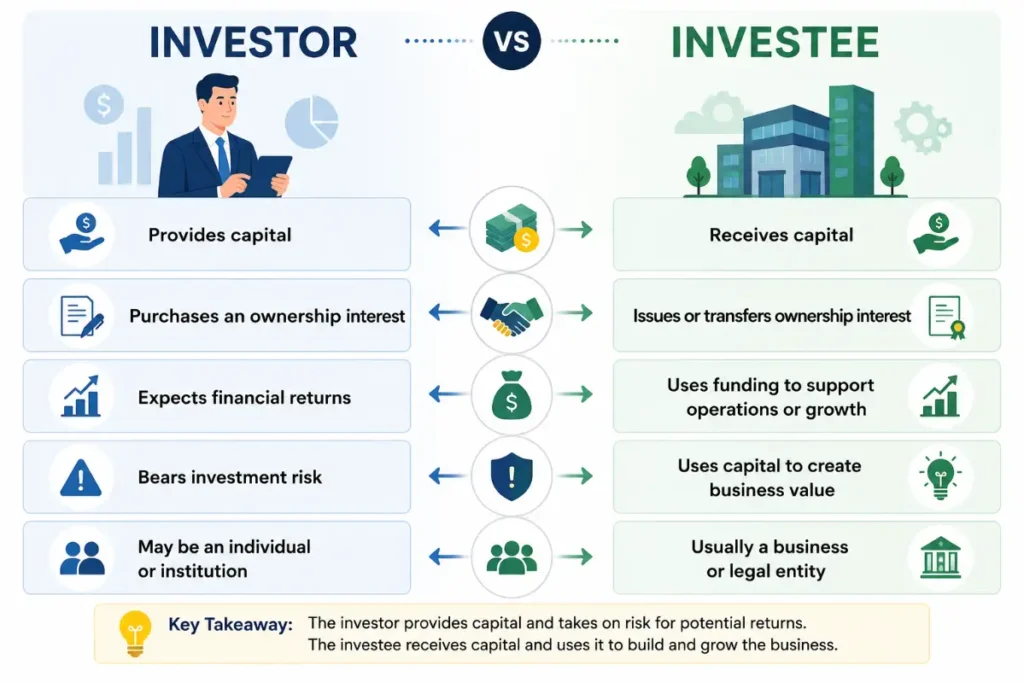
Investor vs Investee Key Differences
Although these terms are closely connected, they describe opposite roles within the same investment relationship.
| Investor | Investee |
|---|---|
| Provides capital | Receives capital |
| Purchases an ownership interest | Issues or transfers ownership interest |
| Expects financial returns | Uses funding to support operations or growth |
| Bears investment risk | Uses capital to create business value |
| May be an individual or institution | Usually a business or legal entity |
Meaning Difference
The investor commits money or assets in the hope of earning future profits. The investee receives that money and uses it to operate, expand, or develop the business.
Role Difference
An investor makes the investment. An investee accepts the investment.
Accounting Difference
From an accounting perspective, the investor records the investment as an asset on its financial statements. The investee records the received funds according to the nature of the transaction, such as equity, debt, or another financing arrangement.
Practical Difference
Imagine a venture capital firm invests five million dollars in a software startup. The venture capital firm is the investor. The software startup is the investee. Understanding this simple relationship makes financial news, investment agreements, and corporate reports much easier to read.
Investor vs Investee Which One Is Correct?
A common question is, “Which word is correct: investor or investee?” The answer is simple. Both words are correct, but they describe different participants in an investment relationship. Choose investor when referring to the person or organization supplying money. Choose investee when referring to the business or entity receiving that money.
Think of it this way.
- An investor gives.
- An investee receives.
Neither word replaces the other because each has a distinct meaning.
A Simple Memory Trick
One easy way to remember the difference is by looking at the suffix.
- -or usually identifies the person performing an action.
- -ee usually identifies the person or entity receiving the action.
Examples include:
| Action | Person Performing | Person Receiving |
|---|---|---|
| Employ | Employer | Employee |
| Pay | Payer | Payee |
| Train | Trainer | Trainee |
| Nominate | Nominator | Nominee |
| Invest | Investor | Investee |
Although English has some exceptions, this pattern works perfectly for investor and investee.
Investor vs Investee Examples in Sentences
Seeing the words in context is one of the easiest ways to understand the difference.
10 Examples Using Investor
- The investor purchased shares in the renewable energy company.
- Every investor hopes to earn a positive return over time.
- The investor reviewed the company’s financial statements before investing.
- A private investor funded the startup during its first year.
- The investor attended the annual shareholders’ meeting.
- The experienced investor diversified her portfolio across several industries.
- Foreign investors continue to support the country’s technology sector.
- The investor sold part of his holdings after the stock price increased.
- Each investor received a detailed performance report at the end of the year.
- The investor negotiated favorable terms before signing the agreement.
10 Examples Using Investee
- The investee used the new capital to hire additional engineers.
- The investee reported strong revenue growth after securing funding.
- The accounting report identified the investee as an associate company.
- The investee expanded into international markets.
- Management presented the investee’s financial results during the meeting.
- The investor monitored the investee’s quarterly performance.
- The investee completed several major infrastructure projects.
- The annual report included detailed information about each investee.
- The investee issued additional shares during the financing round.
- The board approved strategic changes for the investee following the acquisition.
Still confused? Compare Holistic or Wholistic Which Spelling Is Correct? 2026.
Common Mistakes
Although the difference is straightforward, several mistakes appear regularly in business writing and online discussions.
1. Using Investor Instead of Investee
Many people accidentally call the receiving company the investor.
Incorrect
The investor received funding from a venture capital firm.
Correct
The investee received funding from a venture capital firm.
2. Using Investee for the Person Providing Money
This mistake reverses the relationship.
Incorrect
The investee purchased shares in the company.
Correct
The investor purchased shares in the company.
3. Assuming Investee Is Incorrect English
Some writers believe investee is not a real English word because they encounter it less often. It is a legitimate English term widely used in:
- Accounting.
- Corporate finance.
- International Financial Reporting Standards.
- Investment law.
- Annual reports.
4. Confusing Investee With Investment
These words are related but not interchangeable.
- Investee refers to the receiving company.
- Investment refers to the money or asset itself.
Correct
The investor increased its investment in the investee.
5. Treating Investor and Shareholder as Identical
An investor often becomes a shareholder after buying stock, but the words are not always interchangeable.
Someone may invest in:
- Bonds.
- Real estate.
- Mutual funds.
- Private businesses.
- Commodities.
Not every investment creates shareholder status.
6. Using Investee in Everyday Conversation
Native speakers rarely use investee outside professional finance. In casual conversations, people usually say:
- The company receiving funding.
- The business receiving investment.
- The funded startup.
Using investee in technical documents is perfectly appropriate, but simpler wording often sounds more natural in everyday English.
Pronunciation Guide
Correct pronunciation helps avoid confusion in professional discussions.
Investor
IPA
American English: /ɪnˈvɛstər/
British English: /ɪnˈvɛstə/
Syllable Breakdown
in • VEST • or
The stress falls on the second syllable.
Common Pronunciation Mistakes
Some learners place the stress on the first syllable.
Incorrect emphasis:
IN vest or
Correct emphasis:
in VEST or
Investee
IPA
American English: /ˌɪnˌvɛsˈtiː/
British English: /ˌɪnˌvɛsˈtiː/
Syllable Breakdown
in • ves • TEE
The final syllable receives the primary stress.
Common Pronunciation Mistakes
Some speakers pronounce the ending like tay or tee-uh. The correct ending sounds like the word tea.

Etymology and Word Origin
Understanding the history of these words explains why they have different meanings.
Origin of Invest
The English verb invest comes from the Latin investire, meaning “to clothe,” “to cover,” or “to endow.” During the Middle Ages, the meaning expanded to describe formally granting authority, property, or rights. By the seventeenth century, English speakers began using invest in the financial sense of committing money to earn future profits.
Development of Investor
The noun investor appeared after the verb became common in financial English. The suffix -or has long identified the person performing an action.
Examples include:
- Creator.
- Inventor.
- Instructor.
- Translator.
Following this pattern, an investor performs the act of investing.
Development of Investee
The word investee developed much later as finance and accounting became increasingly specialized. The suffix -ee traditionally identifies the receiver of an action.
Examples include:
- Employee.
- Nominee.
- Payee.
- Trainee.
- Addressee.
By applying the same structure, English created investee to describe the recipient of investment.
Although less common than investor, the word is now well established in financial reporting and international accounting standards.
Regional Usage
Unlike many English word pairs, investor and investee show very little regional variation.
American English
Investor appears frequently in newspapers, investment platforms, financial education, and everyday business discussions.
Investee is mainly used in accounting, corporate law, and financial reporting.
British English
The usage is almost identical. British financial professionals regularly use both words in annual reports and investment documentation. Outside finance, investee remains relatively uncommon.
Australian English
Australian business publications use investor extensively.
Investee appears primarily in legal, accounting, and corporate governance documents.
Canadian English
Canadian English follows the same pattern. Financial professionals commonly understand both terms, while everyday speakers generally use only investor.
Regional Preference Summary
| Region | Investor | Investee |
|---|---|---|
| United States | Extremely common | Mainly professional |
| United Kingdom | Extremely common | Mainly professional |
| Australia | Extremely common | Technical usage |
| Canada | Extremely common | Technical usage |
Across all major English varieties, the meanings remain consistent.
Investor vs Investee Grammar Rules
Although investor and investee are finance terms, they also follow standard English grammar rules. Understanding how they function in sentences helps you use them naturally and accurately.
Parts of Speech
Both investor and investee are countable nouns.
Examples:
- The investor reviewed the proposal carefully.
- The investee received funding from two venture capital firms.
- Every investor should understand investment risks.
- The investee expanded into three new markets.
Singular and Plural Forms
| Singular | Plural |
|---|---|
| Investor | Investors |
| Investee | Investees |
Examples:
- Several investors attended the annual meeting.
- The company has multiple investees across Asia.
- New investors joined the funding round.
- The investment firm manages dozens of investees.
Articles
Use articles just as you would with other countable nouns.
Examples:
- An investor requested additional financial information.
- The investor voted in favor of the proposal.
- An investee announced a new product launch.
- The investee exceeded revenue expectations.
Common Sentence Structures
Investor as the subject:
- The investor purchased additional shares.
- The investor expects long-term growth.
Investee as the subject:
- The investee secured another round of financing.
- The investee improved its profitability.
Both words together:
- The investor worked closely with the investee.
- The investor evaluated the investee before increasing its ownership stake.
Possessive Forms
Examples:
- The investor’s portfolio grew significantly.
- The investee’s revenue increased after the investment.
- Investors’ expectations remained high throughout the year.
- Investees’ financial performance was reviewed quarterly.
Real Life Usage Examples
Understanding how these terms appear in real communication makes them much easier to remember.
Daily Conversation
Although investee is uncommon in everyday speech, investor appears regularly.
Examples:
- My uncle is an investor in several local businesses.
- She hopes to become a real estate investor.
- They found an investor for their startup.
- Every investor should understand basic financial planning.
Instead of saying investee, people often say:
- The company receiving investment.
- The funded business.
- The startup.
- The business they invested in.
Academic Writing
Business schools and finance textbooks regularly use both terms.
Example:
The investor exercises significant influence over the investee through its ownership interest.
Professional Communication
Corporate reports often contain sentences like these.
- The investor increased its ownership in the investee during the fiscal year.
- Management assessed the investee’s financial performance using the equity method.
- The investee continued expanding despite challenging market conditions.
- The investor recognized dividend income during the reporting period.
Literature
General literature rarely uses investee, but novels and biographies discussing finance frequently mention investors.
Example:
Every investor believed the young entrepreneur had extraordinary potential.
Business News
Financial journalists regularly write sentences such as:
- The investor acquired an additional ten percent stake.
- The investee announced record quarterly earnings.
- International investors showed renewed confidence in the market.
- The investee completed another successful funding round.
Related Words and Commonly Confused Terms
Many finance terms appear alongside investor and investee. Knowing the differences improves both reading and writing.
| Word | Meaning | Difference |
|---|---|---|
| Investment | Money or assets committed | Refers to the asset, not the people involved |
| Shareholder | Owner of company shares | A shareholder is often an investor, but not every investor owns shares |
| Stakeholder | Anyone affected by a business | Broader term than investor |
| Venture Capitalist | Professional startup investor | A specific type of investor |
| Angel Investor | Individual funding early startups | A specific kind of investor |
| Founder | Person who starts a business | May later become both an investor and an investee |
| Lender | Provides loans | Expects repayment rather than ownership |
| Borrower | Receives a loan | Different from an investee because loans create debt |
| Equity Holder | Owns equity in a business | Often another way to describe certain investors |
| Portfolio Company | Company owned by an investment firm | Often functions as the investee |
Investor vs Shareholder
A shareholder owns shares. An investor may own shares, bonds, real estate, commodities, or many other assets. Every shareholder is generally an investor, but not every investor is a shareholder.
Investor vs Lender
An investor accepts investment risk in exchange for potential returns. A lender expects repayment with interest.
Investee vs Borrower
An investee receives investment capital. A borrower receives a loan that must usually be repaid. These relationships are legally and financially different.
Expert Language Insight
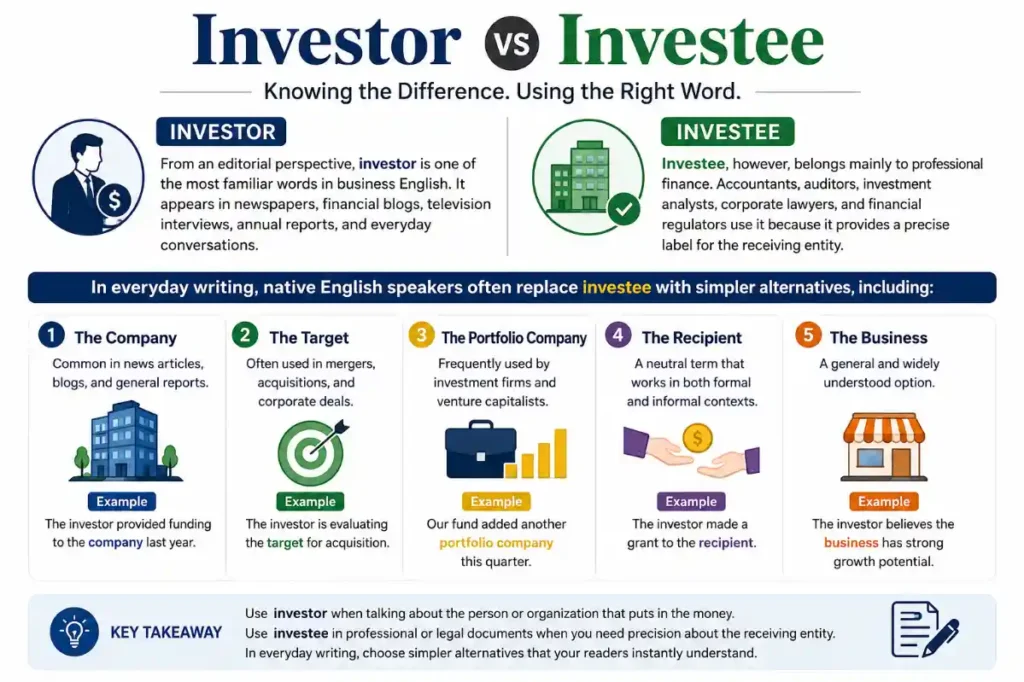
From an editorial perspective, investor is one of the most familiar words in business English. It appears in newspapers, financial blogs, television interviews, annual reports, and everyday conversations. Investee, however, belongs mainly to professional finance. Accountants, auditors, investment analysts, corporate lawyers, and financial regulators use it because it provides a precise label for the receiving entity. In everyday writing, native English speakers often replace investee with simpler alternatives, including:
- The company receiving investment.
- The funded business.
- The portfolio company.
- The startup.
- The business being invested in.
Professional writers choose investee when precision matters, especially in accounting standards, financial reporting, and legal agreements. For general audiences, simpler wording often improves readability without changing the meaning. A useful editing tip is to imagine the flow of money. If money is flowing from someone, that person is the investor. If money is flowing to someone, that business is the investee. Keeping that picture in mind makes choosing the correct word almost automatic.
For another common grammar confusion, see To Small or Too Small: Which Is Correct?.
Conclusion
The difference between investor and investee is simple once you understand the roles each word represents. An investor provides money or other assets with the expectation of earning future returns. An investee is the business or organization that receives that investment to support growth, operations, or expansion.
Both terms are correct, but they are never interchangeable. Investor is widely used in everyday business English, while investee appears mainly in accounting, finance, legal documents, and corporate reporting.
Whenever you encounter these words, focus on the direction of the investment. If the person or organization is supplying capital, use investor. If the business is receiving capital, use investee. This simple distinction will help you read financial reports more confidently and communicate accurately in professional settings.
Frequently Asked Questions
Is investor the same as investee?
No. An investor provides money or other assets with the expectation of earning a return. An investee is the company or organization receiving that investment. They describe opposite roles within the same financial relationship.
Is investee a real English word?
Yes. Investee is a legitimate English word used primarily in accounting, finance, corporate law, and investment reporting. Although it is less common than investor, it appears frequently in professional financial documents.
Can a company be both an investor and an investee?
Yes. A company may invest in another business while also receiving investment from someone else. In one transaction it acts as the investor, and in another it acts as the investee.
Why is investor more common than investee?
Investor appears in everyday financial discussions, news articles, and personal finance conversations. Investee is more specialized and is mainly used by accountants, lawyers, auditors, and financial professionals.
Is an investee always a company?
Usually, yes. Most investees are companies, partnerships, joint ventures, or similar business entities. The exact meaning depends on the investment arrangement and the applicable accounting rules.
How do accountants use the word investee?
Accountants use investee to identify the entity receiving an investment. The term commonly appears in financial statements, consolidation rules, equity accounting, and reporting standards such as IFRS and GAAP.
Can an individual be an investee?
In most financial and accounting contexts, an investee is a business entity rather than an individual. However, in a broader sense, an individual receiving investment in a business venture could be described as part of the investee organization.
How can I easily remember the difference between investor and investee?
Remember the direction of the money. The investor sends the money, while the investee receives it. The suffix -or usually identifies the person performing an action, while -ee often identifies the receiver.