
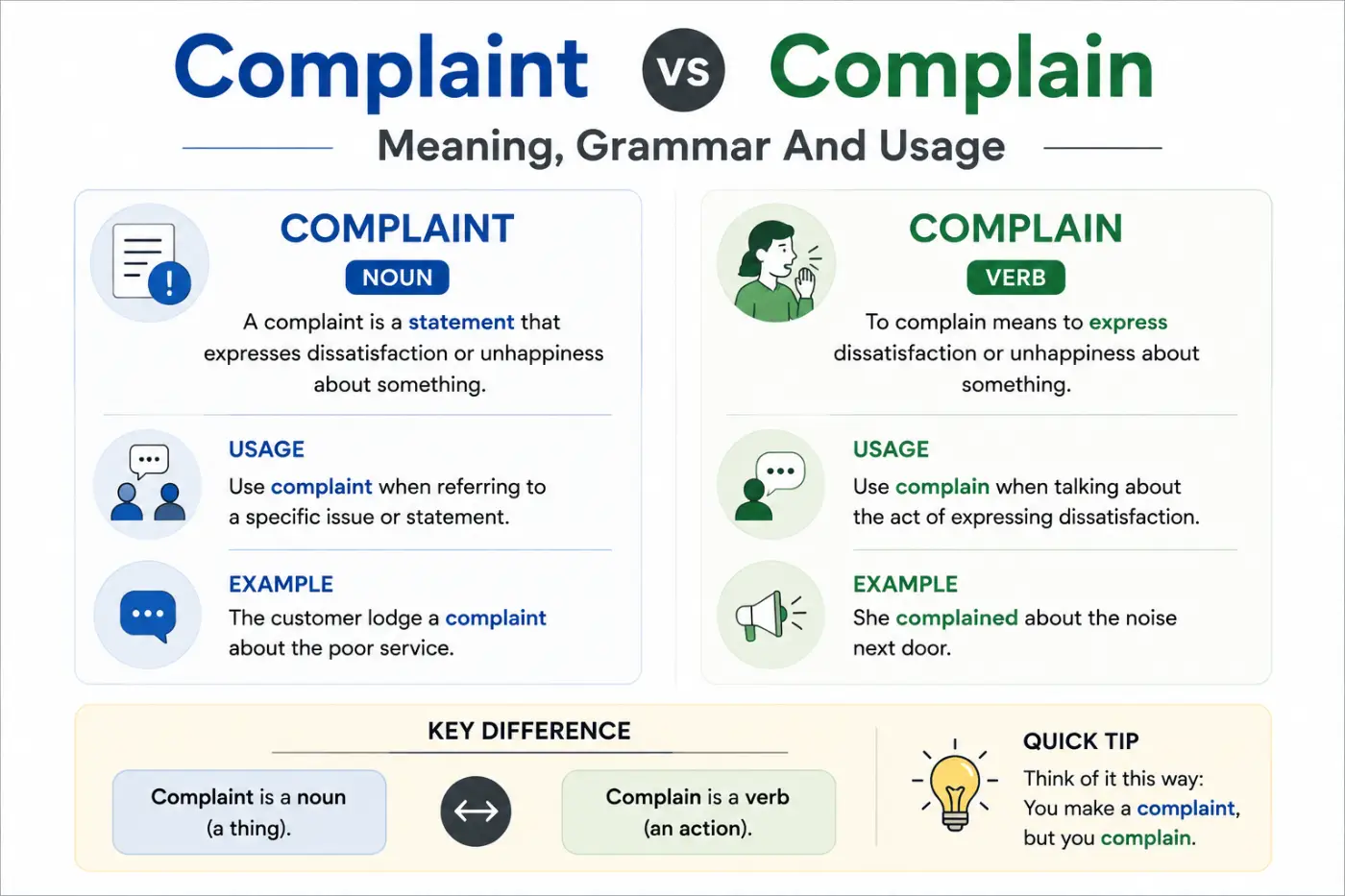
complaint vs complain can be confusing because the two words look and sound closely related. The difference becomes clear once you focus on grammar. Complaint is a noun for an expression of dissatisfaction while complain is a verb that describes the act of expressing dissatisfaction.
For example, you can say, I have a complaint about the service. Here complaint names the issue or expression of dissatisfaction. You can also say, I want to complain about the service. In this sentence, complain describes the action you want to take. The words belong to the same word family, so their connection is easy to see. The tricky part is choosing the form that fits the grammar of your sentence.
This distinction matters in everyday conversation, customer service messages, workplace emails, school writing, and formal communication. You’ll learn how each word works, where it belongs in a sentence, how to pronounce both forms, which common mistakes to avoid, and how native English speakers use them naturally. You’ll also see why one small change in a sentence can turn a noun into a verb.
A related grammar guide is Partys Vs Parties Correct Plural Form In English 2026.
Quick Definition
Complaint is a noun that means an expression of dissatisfaction or a statement about something considered wrong or unsatisfactory. Complain is a verb that means to express dissatisfaction, make a protest, or state that something is causing a problem. The words share the same basic idea but perform different grammatical jobs.
Quick Answer
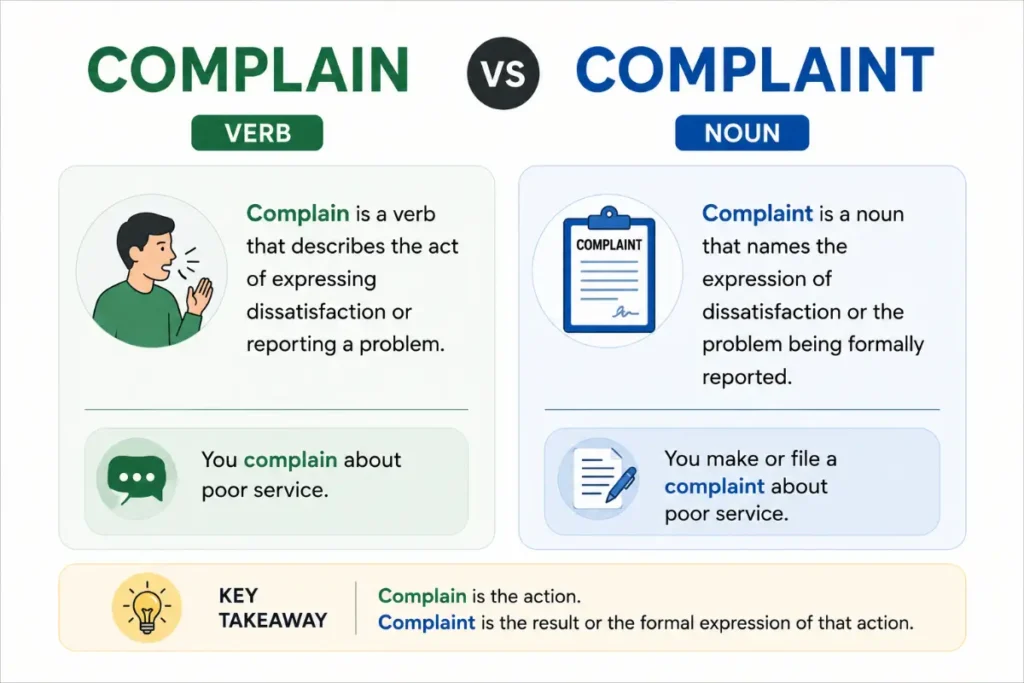
Complaint is a noun. Complain is a verb.
Use complaint when you are naming the problem, concern, or expression of dissatisfaction.
Use complain when you are describing the action of expressing dissatisfaction.
Compare these sentences.
I filed a complaint about the service.
I complained about the service.
The first sentence names the complaint. The second describes the action of making it.
Comparison Table
| Form | Meaning | Part of Speech | Origin | Usage Frequency | Formality | Common Contexts | Example |
|---|---|---|---|---|---|---|---|
| Complaint | An expression of dissatisfaction or a statement about a problem | Noun | From Old French and Latin roots related to lament or expression of distress | Very common | Neutral to formal | Customer service, workplace, law, everyday speech | She filed a complaint about the delay. |
| Complain | To express dissatisfaction or state that something is wrong | Verb | Related to the same French and Latin word family | Very common | Neutral | Conversation, emails, workplace, formal writing | She complained about the delay. |
The table shows the main rule. Complaint names something. Complain describes an action.
Meaning And Definition
Meaning Of Complaint
Complaint is a noun. It refers to an expression of dissatisfaction, an objection, or a statement that something is wrong or unsatisfactory.
For example:
I have a complaint about my order.
Here complaint is the thing the speaker has. It names the concern.
Complaint can refer to something informal and personal.
His complaint was that the room was too cold.
It can also describe a formal statement submitted to an organization.
The customer submitted a complaint about the damaged product.
In legal or professional settings, complaint can have a more specific meaning. A formal complaint may be a documented statement accusing someone or identifying a problem that requires action.
The word can also appear in medical contexts. Historically and traditionally, complaint can refer to a health problem or condition reported by a patient. In modern everyday English, however, the most familiar meaning involves dissatisfaction or an objection.
The plural form is complaints.
Customers submitted several complaints about the new policy.
Complaint often appears with verbs such as make, file, submit, receive, handle, investigate, address, resolve, and respond to.
These combinations are useful because they help you recognize the noun form quickly.
Meaning Of Complain
Complain is a verb. It describes the act of expressing dissatisfaction or saying that something is wrong.
For example:
I want to complain about the service.
Here complain describes what the speaker wants to do.
You can use complain in casual situations.
She always complains about the weather.
You can also use it in professional contexts.
Several customers complained about the new billing system.
The verb can describe a direct statement of dissatisfaction.
He complained to the manager about the delay.
It can also describe repeated expressions of unhappiness.
My brother keeps complaining about his homework.
The word does not always mean that someone is making a formal complaint. A person can complain casually without submitting anything official.
That distinction matters.
If you say, She complained about the food, you may simply mean she said the food was bad.
If you say, She filed a complaint about the food, you suggest a formal action.
The Main Grammar Difference
The central grammar rule is easy.
Complaint is a noun.
Complain is a verb.
A noun can act as the subject or object of a sentence.
The complaint was reasonable.
I received a complaint.
A verb describes an action or state.
The customer complained.
They complained about the delay.
You can often test the difference by placing a helping verb before the word.
You can say:
I will complain.
I want to complain.
She did complain.
You cannot normally use complaint in those same structures because complaint is a noun.
You can instead use:
I have a complaint.
I made a complaint.
She filed a complaint.
This simple grammar test solves many usage questions.
How To Use Complaint Correctly
Complaint usually appears after an article or determiner because it is a countable noun when you mean a specific expression of dissatisfaction.
Common patterns include:
I have a complaint.
She made a complaint.
They filed a complaint.
We received a complaint.
He submitted a complaint.
The complaint was investigated.
The customer withdrew the complaint.
You can also use complaint with about.
I have a complaint about the product.
She made a complaint about the service.
The company received several complaints about delivery times.
You can use complaint with against in certain formal contexts.
The employee filed a complaint against the company.
The exact preposition depends on the situation and the meaning you want to express.
How To Use Complain Correctly
Complain is a verb and commonly appears with about when you identify the subject of dissatisfaction.
She complained about the noise.
They complained about the price.
I complained about the delay.
You can also use complain to identify the person or organization receiving the complaint.
I complained to the manager.
She complained to customer service.
They complained to the landlord.
When you need both the topic and the recipient, you can use both patterns.
I complained to the manager about the poor service.
Here to identifies the person who received the complaint while about identifies the issue.
This structure is extremely useful in everyday English.
Key Differences Explained
- Part of speech. Complaint is a noun. Complain is a verb.
- Basic function. Complaint names an expression of dissatisfaction. Complain describes the act of expressing dissatisfaction.
- Common patterns. Complaint often appears with make, file, submit, receive, or address. Complain commonly appears with about or to.
- Formal use. A complaint can refer to an official or documented statement. Complain can describe anything from casual criticism to a formal expression of dissatisfaction.
- Pronunciation. The two words sound different. Complaint has a stronger final t sound while complain ends with the long vowel sound in mean.
- Spelling. Complaint ends in a written t sound pattern. Complain ends with ain.
- Sentence role. Complaint can be a subject or object. Complain normally acts as the main verb or part of a verb phrase.
- Related forms. Complaint belongs to the same word family as complain but has a different grammatical role.
Once you recognize the part of speech you need, choosing the right form becomes much easier.
Which Form Should You Use
Use complaint when the sentence needs a noun.
For example:
I submitted a complaint.
Use complain when the sentence needs a verb.
For example:
I complained about the service.
A useful editing trick is to look at the word immediately before the blank.
If you need an action after words such as want to, will, can, should, or did, you probably need complain.
I want to complain.
You should complain.
They did complain.
If you need something that can be described with an article such as a or the, you may need complaint.
I have a complaint.
The complaint was reviewed.
This is not a perfect test for every sentence, but it works extremely well in common usage.
Sentence Examples
Here are natural examples showing how the noun form works.
- I have a complaint about the quality of the food.
- The company received a complaint from a customer.
- She filed a complaint after her package arrived damaged.
- His complaint was taken seriously by the manager.
- We need to address the customer’s complaint quickly.
- The school received several complaints from parents.
- Her main complaint was the lack of clear instructions.
- The company investigated the complaint before responding.
- He submitted a formal complaint to the department.
- The customer withdrew the complaint after receiving a refund.
Now compare those sentences with the verb form.
- I want to complain about the quality of the food.
- The customer complained to the manager.
- She complained after her package arrived damaged.
- He complained that the instructions were unclear.
- We complained about the long wait.
- Several parents complained to the school.
- She complained about the lack of information.
- The customer complained because the order was late.
- He complained to the department about the decision.
- They complained that the room was too noisy.
The meaning stays closely connected, but the grammar changes.
Common Mistakes
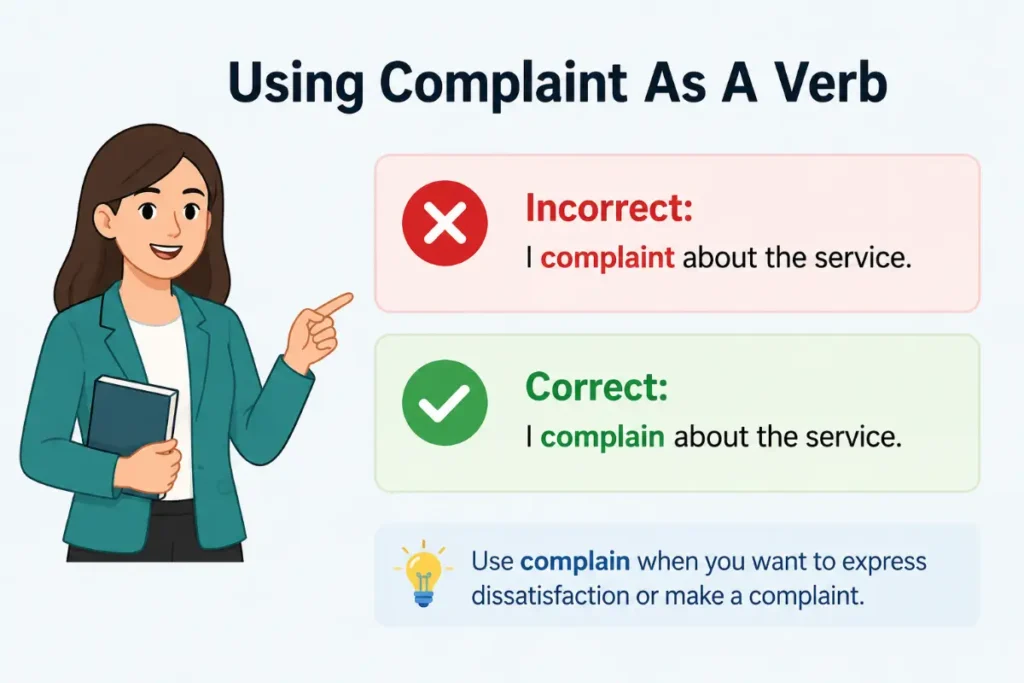
Using Complaint As A Verb
Incorrect:
I complaint about the service.
Correct:
I complain about the service.
The error happens because complaint and complain share the same basic meaning. The ending makes the grammatical difference.
Using Complain As A Noun
Incorrect:
I made a complain.
Correct:
I made a complaint.
After made a, you need a noun. Complaint fits that structure.
Confusing Complained And Complaint
Incorrect:
She complaint about the delay.
Correct:
She complained about the delay.
Complained is the past tense of complain. Complaint is a noun.
Using The Wrong Preposition
Incorrect:
I complained the manager.
Better:
I complained to the manager.
If you want to identify the issue, use about.
I complained about the delay.
If you want to identify the person who received the complaint, use to.
I complained to the manager.
You can use both.
I complained to the manager about the delay.
Treating Every Complaint As Formal
A complaint does not always mean a formal document.
You can say:
I have a complaint about this coffee.
That can simply mean you are dissatisfied.
If you say:
I filed a complaint with the company.
The word suggests a formal process.
Context gives the word its level of seriousness.
Pronunciation Guide
Complaint is commonly pronounced /kəmˈpleɪnt/.
A simple pronunciation guide is:
kuhm PLAYNT.
The main stress falls on the second syllable.
Complain is commonly pronounced /kəmˈpleɪn/.
A simple pronunciation guide is:
kuhm PLAYN.
The main stress also falls on the second syllable.
The most noticeable difference is the final sound.
Complaint ends with a clear t sound.
Complain ends with the n sound.
Compare:
complaint
complain
The spelling difference becomes easier to hear when you say the words slowly.
A common pronunciation mistake is dropping the final t in complaint when speaking quickly. Another is adding a t to complain because the words belong to the same family.
The final sound matters because it helps listeners distinguish the noun from the verb.
Learn the difference in Make Do Or Make Due Which Is Correct 2026.
Etymology And Word Origin
Complaint and complain belong to the same historical word family.
Complain entered English through Old French and ultimately traces back to Latin roots associated with lamenting or expressing distress. The French form developed into English forms related to expressing dissatisfaction or sorrow.
Over time, English developed both the verb complain and the noun complaint.
The relationship is similar to many other word families in English where a verb and noun share a common root but have different endings and grammatical roles.
This history explains why the two words are so closely related in spelling and meaning.
It also explains why learners often confuse them. They are supposed to look related because they are related.
The important point for modern English is not the historical development itself. It is knowing that the noun and verb now perform different jobs in a sentence.
Regional Usage
American English
Both complaint and complain are standard in American English.
Americans use complain in everyday speech.
I’m not trying to complain.
They use complaint in casual and formal situations.
I have a complaint about my order.
The difference between the two forms is grammatical rather than regional.
British English
British English uses both words with the same basic distinction.
The customer complained about the service.
The customer made a complaint about the service.
British speakers may use slightly different expressions depending on context, but the core grammar remains the same.
Australian English
Australian English also uses complaint as a noun and complain as a verb.
The words are standard and do not have a major regional difference in meaning.
Canadian English
Canadian English follows the same basic pattern.
Complaint functions as a noun while complain functions as a verb. The distinction remains consistent across standard English varieties.
This makes the rule especially useful for learners because it does not depend on choosing an American or British spelling.
Grammar Patterns You Should Know
The easiest way to master these words is to learn common sentence patterns.
Complaint With A Noun
You can use complaint after a determiner.
I have a complaint.
She has several complaints.
The complaint was serious.
Our main complaint concerns the price.
Complaint With About
Complaint commonly appears with about when you identify the subject of dissatisfaction.
We received a complaint about the service.
Her complaint about the noise was reasonable.
The customer made a complaint about the delivery.
Complain With About
Complain commonly takes about when you identify the problem.
They complained about the price.
She complained about the noise.
I complained about the delay.
Complain With To
Use to when identifying the person or organization receiving the complaint.
He complained to the manager.
She complained to customer service.
They complained to the landlord.
Complain With That
Complain can also introduce a clause with that.
She complained that the room was too cold.
He complained that the instructions were unclear.
They complained that the service was slow.
In everyday speech, that is sometimes omitted.
She complained the room was too cold.
However, keeping that can make formal writing clearer.
Formal And Informal Usage
Both words work in formal and informal English.
The difference comes from the context rather than the words themselves.
In casual conversation, you might say:
I’m not trying to complain, but this coffee is cold.
That sounds natural and relaxed.
In a formal email, you might write:
I am writing to make a complaint about the service I received.
The second sentence clearly identifies a formal concern.
Still, formal writing does not require complicated language. A simple sentence can be professional.
I am writing to complain about the delayed delivery.
That is direct and perfectly suitable in many workplace situations.
In fact, using the verb complain can sometimes make formal writing more direct than using a longer noun phrase.
Real Life Usage Examples
Daily Conversation
I hate to complain, but this table is really dirty.
I have a complaint about the music. It’s too loud.
The first sentence focuses on the action of expressing dissatisfaction. The second names the concern.
Workplace Communication
A customer complained about the delayed shipment.
The company received a complaint about the same issue from several customers.
These sentences are common in workplace communication because businesses often need to distinguish between an action and a documented concern.
Academic Writing
The participants complained about the length of the survey.
The researchers recorded each complaint made during the study.
Academic writing may use both forms in the same paragraph because they serve different grammatical roles.
News Writing
Several residents complained about the noise from the construction site.
Officials received a formal complaint from local residents.
News writing often uses complain when describing what people said and complaint when referring to an official submission.
Literature And Storytelling
Maria complained about the rain as she walked home.
Her only complaint was that she had left her umbrella at work.
The words can help create realistic dialogue and narration.
Related And Confused Terms
Criticism
Criticism refers to comments that identify faults or weaknesses. A complaint usually expresses dissatisfaction about a particular issue.
Objection
An objection is an expression of opposition. It is common in debates, meetings, legal settings, and formal discussions.
Protest
A protest is a stronger expression of opposition. It can describe individual speech or organized public action.
Grievance
A grievance is a formal or serious complaint about unfair treatment or an unresolved problem. It often appears in workplace and legal contexts.
Concern
Concern is often softer than complaint. Someone can raise a concern without expressing strong dissatisfaction.
Feedback
Feedback provides information about performance, products, services, or experiences. It can be positive, negative, or neutral.
Criticize
Criticize is a verb meaning to express disapproval or identify faults.
Object
Object is a verb meaning to express opposition or disagreement.
These words overlap in meaning, but they are not perfect substitutes. Choosing the right one depends on how strong the response is and what kind of issue you are describing.
Complaint And Complain In Customer Service
Customer service is one of the clearest places to see the difference.
A customer might say:
I want to complain about my order.
The customer is describing an action.
A company employee might say:
We received a complaint about the order.
Now the employee is naming the issue that was reported.
The distinction becomes even clearer in business writing.
The customer complained to the representative about the damaged package.
The representative recorded the complaint in the system.
The same situation uses both forms because the grammar changes.
This pattern appears frequently in customer service communication.
Complaint And Complain In Workplace English
Workplace communication often requires a careful balance between being direct and remaining professional.
You might write:
I would like to complain about the repeated delays.
That is direct but still professional.
You might also write:
I would like to make a complaint about the repeated delays.
The second version is more noun based and can sound more formal.
For internal communication, clarity matters more than choosing one form simply because it sounds formal.
If you need to describe an employee’s action, use complain.
The employee complained about the schedule.
If you need to identify the issue that was submitted or recorded, use complaint.
The manager reviewed the employee’s complaint.
Complaint And Complain In Formal Writing
Formal writing often uses both forms.
For example:
The committee received a complaint from several residents.
Later in the same report:
The residents complained about excessive noise.
This is perfectly natural because the first sentence describes a documented concern while the second describes what the residents did.
One editing mistake is to force every sentence into noun form because noun based writing can seem more formal.
That can make writing heavy.
For example:
The customer made a complaint about the delay.
A simpler sentence is:
The customer complained about the delay.
Both are correct. The second is shorter and more direct.
Strong formal writing does not mean turning every verb into a noun.
A Fast Editing Test
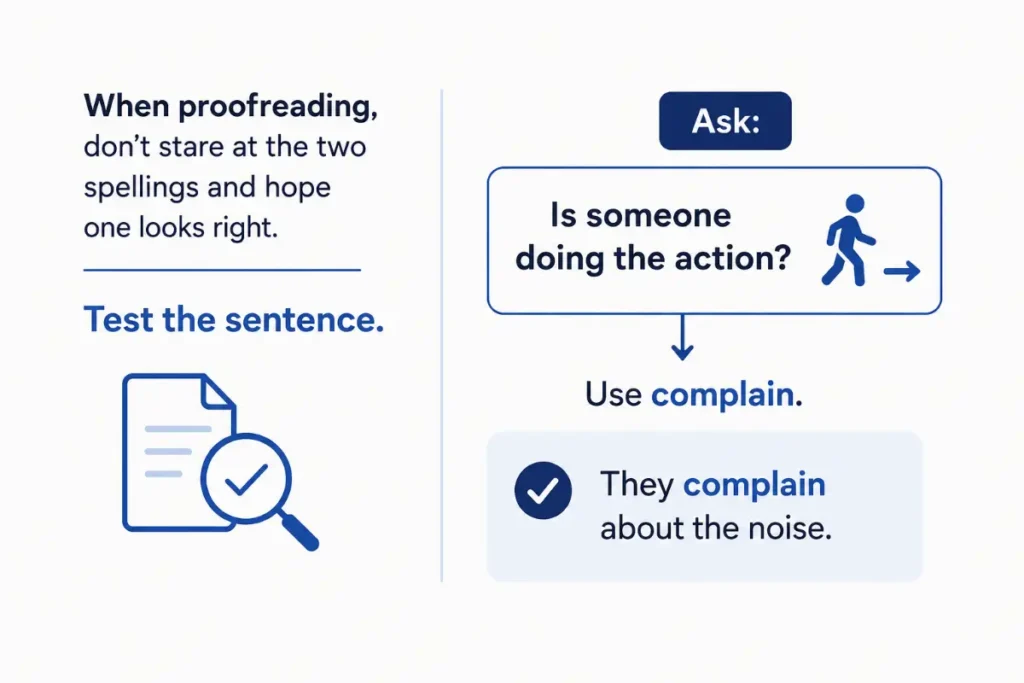
When proofreading, don’t stare at the two spellings and hope one looks right. Test the sentence.
Ask:
Is someone doing the action?
Use complain.
They complain about the noise.
Is the sentence naming the report or issue?
Use complaint.
Their complaint was investigated.
Then look at common helper verbs.
If you see made, filed, submitted, received, or investigated, the noun complaint is often the natural choice.
If you see will, did, is, was, or another verb structure requiring an action, complain or one of its tense forms may be appropriate.
This simple check can catch most mistakes in seconds.
Here’s a clear, concise conclusion you can use for your article.
Expert Editor Insight
An experienced editor looks at the grammatical job a word needs to perform before choosing between complaint and complain. If the sentence needs an action, complain is usually the answer. If it needs the name of an issue, statement, or formal concern, complaint fits. Editors also watch for unnecessary noun phrases because they can make simple writing feel stiff. A useful editing test is to replace the word with a clear action or object and see which structure sounds natural.
A related grammar guide is begun or began The Simple Grammar Rule 2026.
Conclusion
complaint vs complain becomes simple once you identify the part of speech you need. Complaint is a noun that names an expression of dissatisfaction or a concern. Complain is a verb that describes the action of expressing dissatisfaction. The two words belong to the same word family, which explains their similar spelling and meaning.
Use complaint after structures such as a complaint, the complaint, or several complaints. Use complain after structures such as want to complain, should complain, or complained about the issue. Remember one practical rule during editing: if you can ask what someone did, you probably need the verb complain. If you can ask what the person submitted or expressed, you probably need the noun complaint.
FAQs
What is the difference between complaint and complain?
Complaint is a noun while complain is a verb. Complaint names an expression of dissatisfaction or a concern. Complain describes the action of expressing that dissatisfaction. You can say, I filed a complaint, because complaint is a noun. You can say, I complained about the service, because complained is the past tense of the verb complain.
Is complaint a noun or a verb?
Complaint is a noun. It names an expression of dissatisfaction, an objection, or a concern. For example, The customer made a complaint about the service. You cannot normally use complaint as the main verb in that sentence structure. If you need a verb, use complain or one of its forms such as complained or complaining.
Is complain a noun or a verb?
Complain is a verb. It describes the act of expressing dissatisfaction or saying that something is wrong. For example, She complained about the noise. The word can appear in several verb forms including complains, complained, and complaining. The noun related to this verb is complaint.
Should I say make a complaint or complain?
Both are correct. Make a complaint uses the noun complaint while complain uses the verb. In many everyday situations, complain is shorter and more direct. For example, I complained about the service sounds natural. Make a complaint can sound more formal and may fit situations involving a documented or official concern.
Do you complain to someone or about something?
You can use both structures because they identify different parts of the situation. Use to for the person or organization receiving the complaint. Use about for the issue. For example, I complained to the manager about the delay. You can also use only one of these structures when the context is already clear.
What is the past tense of complain?
The past tense of complain is complained. For example, She complained about the noise yesterday. Do not use complaint as the past tense. Complaint is a noun. A useful comparison is complain in the present, complained in the past, and complaining for the present participle or gerund form.
Can complaint be used in formal writing?
Yes. Complaint is common in formal writing, especially in customer service, workplace, legal, administrative, and business contexts. For example, The company received a formal complaint from the customer. The word can also appear in ordinary conversation. The level of formality depends more on the surrounding sentence and situation than on the word itself.
What is a synonym for complain?
Common alternatives include object, protest, criticize, grumble, and express dissatisfaction. The best choice depends on the meaning and tone. Grumble often suggests repeated low level dissatisfaction. Protest can suggest stronger opposition. Criticize focuses on identifying faults. Object means to express opposition. Complain is the broad everyday choice for expressing dissatisfaction about a problem.