
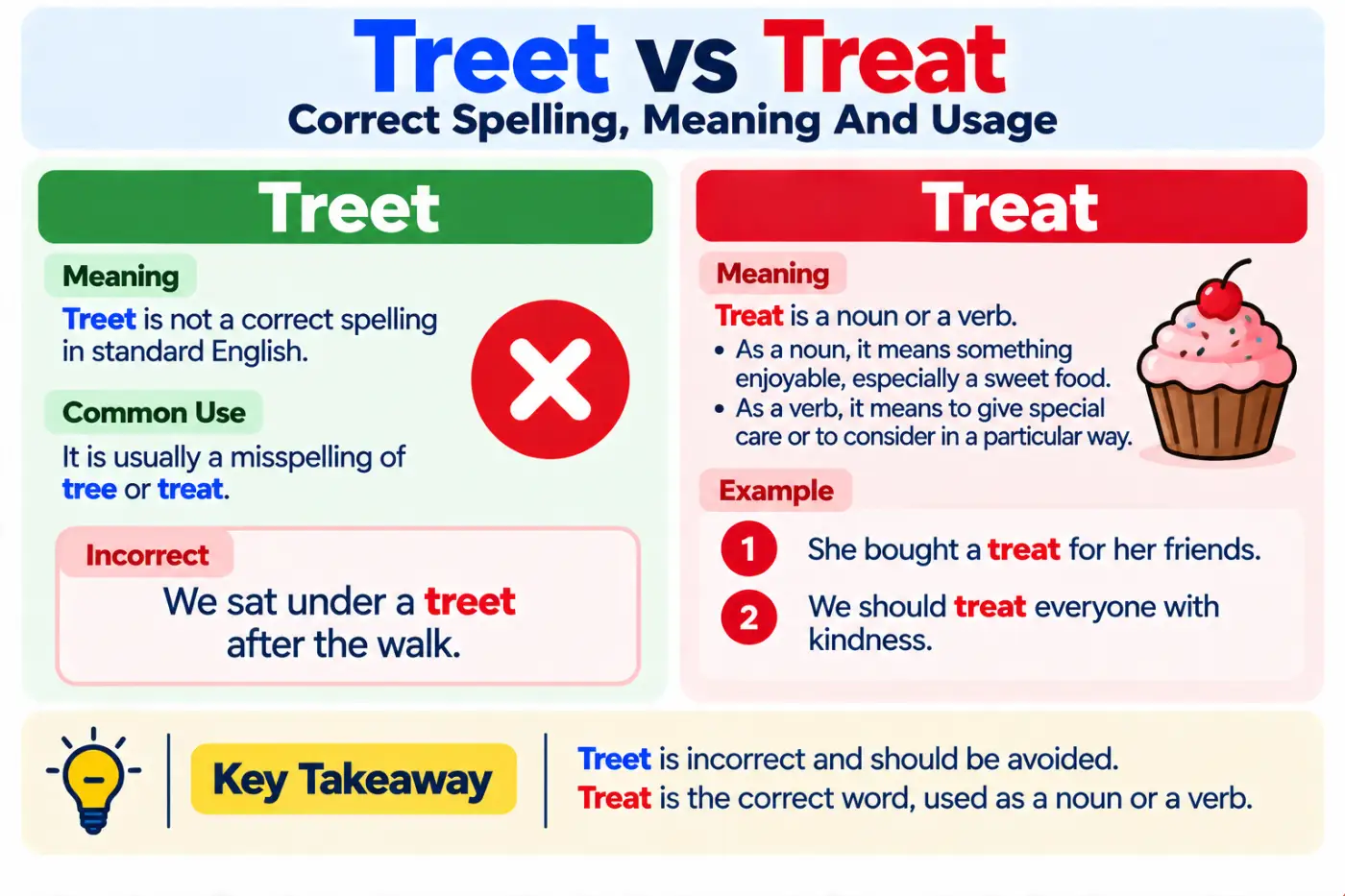
treet vs treat is a common spelling question because the two forms look and sound close enough to cause confusion. If you mean to say that you give someone something enjoyable, behave toward someone in a certain way, or deal with a problem, treat is the correct standard English word. Treet is generally a spelling mistake in these contexts.
The confusion is easy to understand. When people hear treat in fast speech, the final sound can make the word feel as if it could be spelled with ee. English spelling does not always follow pronunciation perfectly, so writing the sound you hear can lead to forms that look reasonable but are not standard. The word treat also has several meanings, which makes it especially useful in everyday English.
This guide explains the difference between the two forms, the meaning and grammar of treat, its pronunciation, word history, common mistakes, regional usage, and natural examples. You’ll also learn why people type treet, how to remember the correct spelling, and which related words can help you express the same idea more precisely.
Many readers also check Distress Vs Duress Which Word Fits Your Sentence 2026.
Quick Definition
Treat is the standard English word. As a verb, it can mean to behave toward someone in a particular way, give medical care, handle something, or provide something enjoyable. As a noun, it can mean something special or enjoyable. Treet is generally a misspelling of treat and is not the standard form for these meanings.
Quick Answer
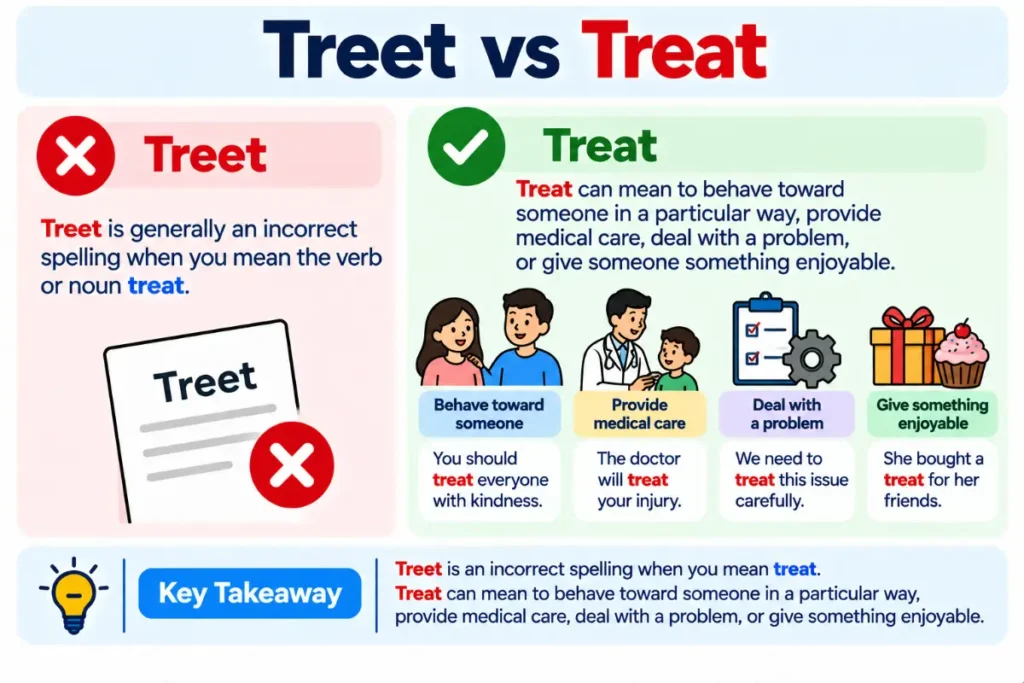
The correct spelling is treat.
Treet is generally an incorrect spelling when you mean the verb or noun treat. Treat can mean to behave toward someone in a particular way, provide medical care, deal with a problem, or give someone something enjoyable.
For example:
My parents treated us to dinner.
The doctor treated the patient.
That cake was a real treat.
The key spelling point is simple. Treat contains ea, not ee.
Comparison Table For Treet And Treat
| Form | Meaning | Part of Speech | Origin | Usage Frequency | Formality | Common Contexts | Example |
|---|---|---|---|---|---|---|---|
| Treat | To behave toward someone, provide care, deal with something, or give something enjoyable | Verb and noun | From Old French and Latin roots | Very common | Neutral | Conversation, healthcare, work, food, writing | We treated our guests to dinner. |
| Treat | Something enjoyable or special | Noun | From the same historical word family | Very common | Neutral | Food, gifts, rewards, celebrations | The ice cream was a special treat. |
| Treet | Usually an incorrect spelling of treat | Not a standard form for the intended meanings | Not applicable as the standard spelling | Uncommon | Nonstandard | Typing errors and spelling mistakes | Treet is usually a misspelling of treat. |
Meaning And Definition
Meaning Of Treet
Treet is generally not the standard spelling of the common English word treat.
If someone writes:
She gave me a treet.
They almost certainly mean:
She gave me a treat.
The same applies to sentences such as:
The doctor treeted him.
The correct spelling is:
The doctor treated him.
Treet can appear in usernames, names, creative writing, product names, or other special uses. A proper name can have its own spelling. However, those special cases do not make treet a standard alternative spelling of the ordinary English word treat.
For normal school work, professional writing, emails, articles, and everyday communication, use treat.
Meaning Of Treat
Treat is a versatile English word with several related meanings.
As a verb, treat can describe how you behave toward another person.
She treated everyone with respect.
Here treat means behave toward someone in a particular manner.
Treat can also mean to provide medical care.
The doctor treated the infection.
In this context, treat refers to medical action intended to improve a health condition. The noun treatment comes from the same word family.
Treat can also mean to deal with or handle a subject, issue, or situation.
The article treats the subject carefully.
Here treat means discuss, handle, or consider something in a particular way.
Another common use appears when someone provides something enjoyable for another person.
I’ll treat you to dinner.
This means the speaker will pay for or provide dinner as something enjoyable.
As a noun, treat means something special, enjoyable, or unusual.
The children received ice cream as a treat.
That simple word can cover everything from a small piece of candy to a special experience.
Key Differences Explained
- Spelling. Treat is spelled t r e a t. Treet uses ee and is generally incorrect when you mean the standard word.
- Meaning. Treat has several established meanings. Treet normally does not function as the standard spelling for any of them.
- Grammar. Treat can work as both a verb and a noun.
- Pronunciation. Treat is commonly pronounced with a long e sound. The pronunciation does not justify changing the spelling to treet.
- Formality. Treat works in casual conversation and formal writing. The misspelled form should be corrected in polished writing.
- Context. Treat can appear in medical, social, academic, professional, culinary, and everyday contexts.
- Regional usage. English speaking regions generally use treat as the standard spelling.
- Standard usage. Treat is the established English form. Treet is normally a spelling error unless it appears as a special name or label.
The main issue is therefore not a difference in meaning between two standard words. It is a spelling distinction between a standard English word and a common error.
Which Form Is Correct?
Treat is the correct standard English spelling.
The spelling contains ea, as in several other common English words such as great, meat, heat, and seat. The pronunciation of these words does not always give learners enough information to choose the correct vowel letters, so spelling must be learned from the written form as well.
Treet is generally produced when someone spells the sound rather than remembering the conventional spelling.
This is a useful example of a larger English spelling pattern. English has many words where vowel combinations represent sounds that learners may try to write in a simpler way. A person who hears treat may naturally think of treet because the word sounds like it contains a long e.
That reasoning makes sense phonetically, but standard spelling decides the written form.
If you are proofreading a sentence and see treet, ask yourself if you mean the common verb or noun treat. In most ordinary contexts, the answer will be yes.
How Treat Works As A Verb
Treat is often used as a transitive verb. That means it commonly takes an object.
She treated her guests kindly.
The doctor treated the patient.
The teacher treated the question seriously.
In each sentence, the verb describes an action directed toward someone or something.
Treat can also appear in several common patterns.
Treat Someone Well
This means to behave kindly or fairly toward someone.
You should treat your coworkers with respect.
Treat Someone Badly
This means to behave unfairly, unkindly, or disrespectfully.
He treated his employees badly.
Treat Someone To Something
This means to provide something enjoyable for another person.
I treated my sister to lunch.
Treat Something As Something Else
This means to consider or handle something in a particular way.
The law treats the two cases differently.
Treat Something With Care
This means to handle something carefully.
Please treat the equipment with care.
These patterns show why treat appears in so many different kinds of writing.
Treat As A Medical Verb
One of the most important meanings appears in healthcare.
Doctors treat illnesses, injuries, infections, symptoms, and other medical conditions.
For example:
The doctor treated the patient for an infection.
The hospital treated several injured people.
The medication is used to treat high blood pressure.
The noun treatment comes from the same word family.
This use is common in both everyday and professional English. The meaning is more specific than simply help because treatment involves an action or method intended to address a condition.
Treat can also describe nonmedical care in broader contexts.
The damaged wood was treated to protect it from moisture.
Here treat means applying something to the material for a particular purpose.
Treat As A Social Verb
Another very common meaning involves behavior toward other people.
How you treat someone can describe your attitude and actions toward that person.
She treats everyone with kindness.
He treated me like family.
The manager treated the staff fairly.
The expression treat someone well is especially common.
If you say:
She treats her employees well.
You mean she behaves toward them in a positive and respectful way.
This meaning also appears in questions about relationships.
How did he treat you?
The question asks about his behavior toward the person.
This use is very different from the food related meaning, but the same verb connects both ideas.
Treat As Something Enjoyable
Treat also has a friendly everyday meaning connected with pleasure.
For example:
I bought myself a little treat.
That dessert was a real treat.
The children received a special treat after the game.
Here treat is a noun. It refers to something enjoyable that is not necessarily part of an ordinary routine.
A treat can be food, an activity, a gift, a trip, or simply a pleasant experience.
For example:
The concert was a real treat.
In this sentence, the concert itself was an enjoyable experience.
This flexible meaning makes treat especially common in everyday American English.
Treat Someone To Something
The pattern treat someone to something deserves special attention because learners often misunderstand it.
If you say:
I treated my friends to dinner.
You mean you paid for or provided dinner for your friends as a special gesture.
The person receiving the experience comes after treat.
The thing being provided follows to.
Here are more examples.
She treated her parents to a nice meal.
He treated his children to ice cream.
We treated our guests to a home cooked dinner.
This construction is common and natural.
Do not confuse it with:
I treated my friends well.
That sentence describes behavior toward the friends. It does not necessarily mean the speaker bought them something.
Sentence Examples
Here are natural examples using the standard word in different situations.
- My parents always treated their guests with kindness.
- I’m going to treat myself to a new pair of shoes.
- The doctor treated the patient for a serious infection.
- We treated our friends to dinner after the graduation ceremony.
- She treats every customer with respect.
- The article treats the subject in a clear and balanced way.
- The children received ice cream as a special treat.
- The movie was a real treat for fans of classic comedy.
- Please treat the equipment carefully.
- He treated the opportunity as a chance to learn something new.
These examples show why context matters. The same word can describe personal behavior, medical care, academic discussion, careful handling, or something enjoyable.
Common Misspellings And Confusion
Writing Treet Instead Of Treat
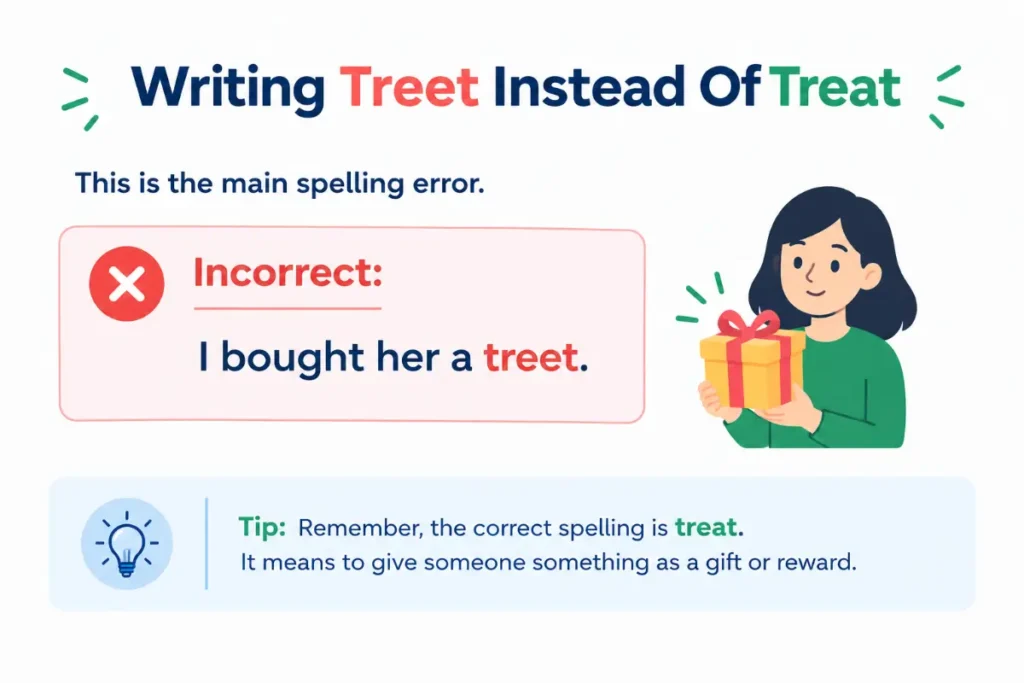
This is the main spelling error.
Incorrect:
I bought her a treet.
Correct:
I bought her a treat.
The mistake usually comes from spelling the sound instead of recalling the conventional written form.
Writing Treated As Treeted
The past tense of treat is treated.
Incorrect:
The doctor treeted the patient.
Correct:
The doctor treated the patient.
When adding ed, the spelling remains connected to treat.
Writing Treatement
Another common mistake is adding an extra e.
Incorrect:
The patient received treatement.
Correct:
The patient received treatment.
The noun is treatment, not treatement.
Confusing Treat And Treatment
Treat is commonly the verb.
Doctors treat patients.
Treatment is commonly the noun.
The patient received treatment.
The words belong to the same family but serve different grammatical roles.
Confusing Treat And Threat
Treat and threat look somewhat similar but have completely different meanings.
Treat can mean behave toward, provide care, or give something enjoyable.
Threat means a statement or situation suggesting possible harm.
One small spelling change creates a completely different word.
For another common grammar confusion, see optimize or optimise Correct Spelling And Usage.
Why People Type Treet
The spelling error has a straightforward explanation.
The vowel sound in treat is the long e sound. A learner may hear that sound and naturally associate it with the spelling ee.
For example, see, green, sleep, and tree all contain ee and use the same broad vowel sound.
That can create a mental spelling pattern.
When someone hears treat, the brain may process the pronunciation correctly while choosing the wrong letter combination during writing. In linguistic terms, this is a sound to spelling mismatch.
Typing speed can make the problem worse. When people write quickly, they often rely on familiar sound patterns instead of consciously checking every letter.
Autocorrect may catch the error in some situations, but it is better to know the correct form yourself. Spellcheckers are useful safety nets, not replacements for spelling knowledge.
Pronunciation Guide
Treat is commonly pronounced /triːt/.
A simple pronunciation guide is:
treet
This is where the spelling confusion becomes understandable. The word is pronounced in a way that sounds very close to the incorrect written form treet.
The word has one syllable.
Treat
The vowel sound is the long e sound.
The same broad vowel appears in words such as:
see
tree
green
sleep
The final t sound is pronounced clearly in careful speech.
Because treat and treet can look like different spellings of the same pronunciation, pronunciation alone cannot tell you which written form is standard.
This is a useful lesson for English learners. A word can have a pronunciation that strongly suggests one spelling while the established spelling uses another letter pattern.
Etymology And Word Origin
Treat has a long history in English and entered the language through French from Latin roots associated with handling or dealing with something.
The word is related historically to forms that developed around the idea of handling, discussing, managing, or dealing with something.
Over time, English expanded its use. The modern verb can describe how someone behaves toward another person, how a doctor deals with an illness, how a writer discusses a subject, or how someone provides something enjoyable.
The noun developed related meanings involving an enjoyable experience or special pleasure.
This broad semantic development explains why treat now works in several different contexts.
The word did not develop from the spelling treet. The double e form is simply a modern spelling error when used to represent the ordinary word.
Regional Usage
American English
Treat is the standard spelling in American English. It is extremely common in everyday speech and writing.
Americans use it in expressions such as:
Treat yourself.
Treat someone to dinner.
A special treat.
Treat an illness.
Treat a subject carefully.
Treet is generally treated as a spelling mistake in these contexts.
British English
British English also uses treat as the standard spelling. The same core meanings and grammatical patterns apply.
There is no major British spelling variant that changes treat to treet.
Australian English
Australian English uses treat as the standard form as well. The word appears in everyday speech, professional writing, healthcare contexts, and informal expressions.
The spelling remains the same.
Canadian English
Canadian English also uses treat as the standard spelling. Speakers and writers use the word in the same broad range of contexts found in American and British English.
The spelling treet is not a standard regional alternative.
Grammar Rules And Part Of Speech
Treat can function as both a verb and a noun.
As a verb, it describes an action.
She treated me kindly.
As a noun, it describes something enjoyable.
The cake was a treat.
The verb can appear in several grammatical patterns.
Treat Plus Object
She treated her guests well.
The object is her guests.
Treat Plus Object Plus Adverb
He treated everyone fairly.
The adverb fairly explains how he behaved.
Treat Plus Object Plus To
She treated us to dinner.
This pattern means she provided dinner as a special gesture.
Treat Plus Object Plus As
They treated the issue as a serious problem.
This means they considered or handled the issue in that way.
Treat Plus Object Plus For
The doctor treated him for an infection.
This pattern is especially common in medical contexts.
Treat Plus Subject Complement In Passive Structures
The patient was treated successfully.
This passive construction focuses on the patient rather than the person providing the treatment.
These patterns make treat a highly flexible verb.
Punctuation And Sentence Position
Treat does not require special punctuation. It follows ordinary English sentence rules.
For example:
I treated my sister to lunch.
She treated everyone kindly.
The doctor treated the injury.
As a noun it works in the same way.
The birthday cake was a special treat.
The children were excited about the treat.
Punctuation depends on the larger sentence rather than the word itself.
If treat appears at the beginning of a sentence, capitalize it normally.
Treat yourself kindly.
There is no need for a comma simply because the word starts the sentence.
Formal And Informal Usage
Treat is suitable for both informal and formal English.
In casual conversation you might say:
I’m going to treat myself to ice cream.
In professional writing you might see:
The study treats the two groups as separate populations.
In healthcare writing:
The medication is used to treat bacterial infections.
In academic writing:
The paper treats the issue as a question of public policy.
This wide range makes treat different from many informal vocabulary items. It is not restricted to casual conversation.
The noun sense can also work in formal writing when the context calls for it.
The museum visit was a special treat for the students.
Still, more formal contexts may favor specific alternatives when precision matters.
Real Life Usage Examples
Daily Conversation
I’m going to treat myself to coffee after work.
That little bakery is always a treat.
These sentences sound completely natural in everyday American English.
Email And Workplace Communication
We’d like to treat the team to lunch after the project is completed.
The report treats customer feedback as an important source of information.
The first example is friendly workplace communication. The second uses the more formal meaning of treat as handle or consider.
Academic Writing
The paper treats language change as a natural part of linguistic development.
The researchers treated the two groups differently during the experiment.
Academic writing uses the verb in a precise and neutral way.
News Writing
Doctors treated several people after the accident.
The event was described as a special treat for local families.
Journalists can use treat in both medical and everyday contexts.
Literature And Storytelling
She treated the old man with unusual kindness.
The children thought the surprise trip was the best treat of the summer.
In storytelling, treat can describe both human behavior and enjoyable experiences.
Related And Confused Terms
Treatment
Treatment is the noun connected with the verb treat. It often refers to medical care or the way something is handled.
The patient received treatment.
Treating
Treating is the present participle or gerund form of treat.
She is treating everyone fairly.
Treated
Treated is the simple past and past participle form.
The doctor treated the injury.
Therapy
Therapy is a method of treatment, especially in healthcare or mental health contexts. It is not a direct replacement for every use of treat.
Care
Care can refer to attention, protection, or assistance. It overlaps with treatment in some contexts but has a broader meaning.
Reward
A reward is something given in recognition of achievement or good behavior. A treat can be a reward, but not every treat is a reward.
Gift
A gift is something given to another person. A treat usually carries the idea of enjoyment or special pleasure.
Threat
Threat is a completely different word. It refers to possible harm or danger and should not be confused with treat.
These related terms show how much meaning depends on context. Treat can move from healthcare to hospitality to academic discussion without changing its spelling.
Treat In Common Expressions
Some expressions with treat appear so often that they are worth learning as complete phrases.
Treat Yourself
This means to give yourself something enjoyable.
I treated myself to a new book.
It often suggests a small pleasure after work, effort, or a difficult period.
Treat Someone Well
This means to behave kindly or respectfully toward someone.
She always treats her employees well.
Treat Someone Badly
This means to behave unfairly or unkindly.
Nobody deserves to be treated badly.
Treat Someone To Something
This means to provide something enjoyable.
I’ll treat you to dinner.
A Special Treat
This refers to something enjoyable that is not part of an ordinary routine.
The concert was a special treat.
Trick Or Treat
This familiar expression is strongly associated with Halloween in the United States. Children traditionally use it while going from house to house asking for candy.
This phrase also helps show that treat has a long established place in everyday English.
How To Remember The Correct Spelling
The biggest challenge is remembering that treat uses ea even though it sounds like a word with ee.
A simple memory strategy is to connect treat with other familiar words containing ea.
Think of:
treat
meat
heat
seat
The pronunciation can vary among these words, but the spelling pattern can help reinforce the written form.
Another useful trick is to remember the related words treated and treatment.
If you know that the noun is treatment and the past form is treated, it becomes easier to keep the base spelling treat in mind.
Think:
treat → treated → treatment
Not:
treet → treeted → treetement
That simple word family gives you a strong spelling anchor.
Why Spelling Tools May Not Always Solve The Problem
Spellcheck tools can identify many spelling errors, but they do not replace language knowledge.
A tool may flag treet because it does not recognize it as the expected word in ordinary English. However, automated systems can sometimes struggle with unusual names, usernames, brands, or specialized vocabulary.
Context matters.
If a fictional character is named Treet, the system should not automatically change the name to treat.
If a sentence says:
I bought him a treet.
The intended word is almost certainly treat.
This is where human proofreading still matters. Good editing considers meaning, context, grammar, and audience rather than looking only at isolated words.
Expert Editor Insight
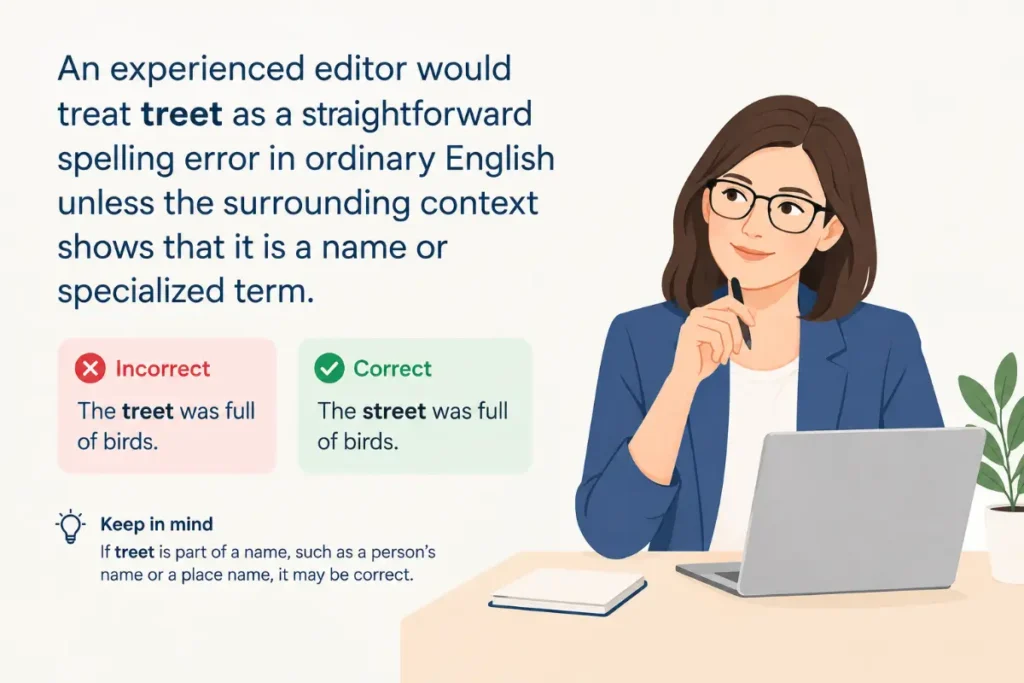
An experienced editor would treat treet as a straightforward spelling error in ordinary English unless the surrounding context shows that it is a name or specialized term. The pronunciation makes the mistake understandable because treat sounds close to the way many people imagine treet should sound. Professional proofreading checks the entire word family too. If you see treet, treated, or treetment in an ordinary sentence, stop and check the intended form. In most cases, the correct family is treat, treated, treating, and treatment.
Need another quick comparison? Read Bellies vs Bellys Which Spelling Is Correct in 2026?.
Conclusion
treet vs treat has a straightforward answer. Treat is the standard English spelling for the word used to describe behavior, medical care, handling a subject, or something enjoyable. Treet is generally a spelling mistake in ordinary English, even though its pronunciation may make the incorrect form seem reasonable.
The confusion comes mainly from sound. Treat contains ea but has the long e sound, so it can sound like the written form treet. That is why learning the spelling together with related forms such as treated, treating, and treatment can help.
For a simple editing check, remember treat has ea. If you see treet in ordinary writing, pause and check the sentence. In most cases, changing it to treat will give you the standard and correct form.
FAQs
Is treet a real English word?
Treet is generally not the standard spelling of the common English word treat. If you mean something enjoyable, medical care, behavior toward someone, or handling a subject, use treat. Treet may appear as a special name, username, brand, or fictional term, but those uses do not make it a standard alternative spelling of treat.
What is the correct spelling treet or treat?
Treat is the correct standard spelling. It can function as both a verb and a noun. For example, you can treat someone kindly, treat an illness, treat someone to dinner, or call a dessert a treat. Treet is generally a spelling error created by writing the long e sound with ee instead of using the established ea spelling.
Why do people spell treat as treet?
The main reason is pronunciation. Treat is pronounced with a long e sound, which resembles the vowel sound represented by ee in words such as tree and green. A writer may therefore spell the word according to its sound. Fast typing and uncertainty about English vowel patterns can make the error more likely.
How do you pronounce treat?
Treat is commonly pronounced /triːt/. It has one syllable and begins with a t sound, followed by the long e vowel, and ends with another t sound. A simple pronunciation guide is treet. Interestingly, the spoken form can resemble the incorrect written form. That is why pronunciation alone cannot tell you the standard spelling.
Can treat be a noun?
Yes. Treat can be a noun meaning something enjoyable or special. For example, The ice cream was a treat. It can describe food, an activity, an experience, or another pleasant surprise. Treat can also function as a verb, so its grammatical role depends on how it appears in the sentence.
What does treat someone to something mean?
Treat someone to something means to provide something enjoyable for another person, often by paying for it. For example, I treated my parents to dinner means the speaker provided or paid for dinner. The expression is common in everyday English and can describe meals, trips, entertainment, drinks, or other enjoyable experiences.
Is treat appropriate in formal writing?
Yes. Treat is fully appropriate in formal English. It appears in academic writing, professional communication, healthcare writing, reports, and other serious contexts. Its meaning changes according to context. A researcher may treat two groups differently, a doctor may treat a condition, and an academic paper may treat a topic in a particular way.
What is the difference between treat and treatment?
Treat is commonly a verb, while treatment is a noun. For example, doctors treat patients, while patients receive treatment. The two words belong to the same word family. Treat can also be a noun when it means something enjoyable. Treatment usually refers to the action or method of dealing with a medical condition or other situation.