
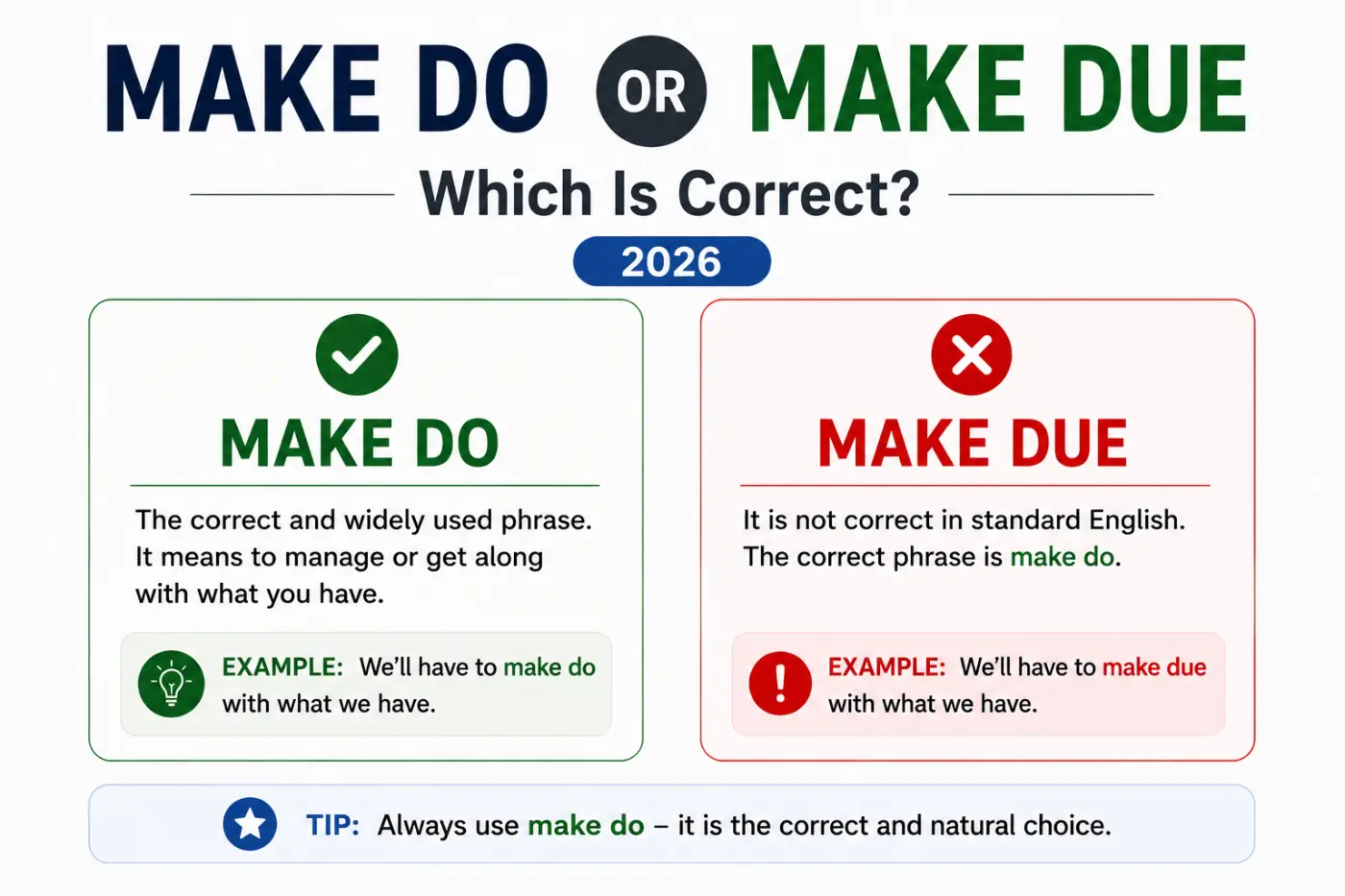
If you’ve ever paused before writing make do or make due you’re not alone. These two expressions sound exactly alike in many varieties of English. That makes the spelling easy to mix up especially when you’re writing quickly.
The correct form of the common idiom is make do. It means to manage with what you have even when what you have isn’t ideal. You might make do with an old laptop. You might make do with the food already in your kitchen. You might simply say that you’ll make do until a better option becomes available. Cambridge defines make do as managing without something you would like or managing with something of lower quality than you would prefer.
The confusion comes from the word due. It has several legitimate meanings connected with things that are owed or expected. It also sounds like do in many accents. That creates a classic spelling trap.
A related grammar guide is Instalments or Installments Which Spelling Is Correct 2026.
Quick Definition
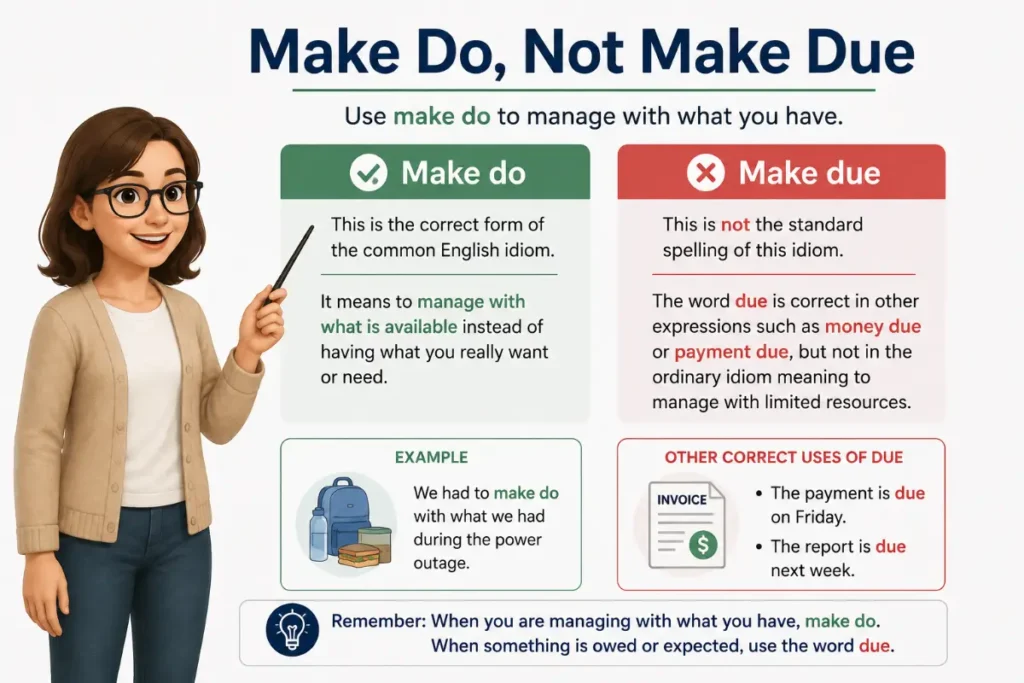
Make do is the correct form of the common English idiom. It means to manage with what is available instead of having what you really want or need. Make due is not the standard spelling of this idiom. The word due is correct in other expressions such as money due or payment due but not in the ordinary idiom meaning to manage with limited resources.
Quick Answer
The correct expression is make do.
Use make do when you mean to manage with something available even though it may not be ideal.
For example:
We don’t have enough chairs so we’ll make do with the stools.
Make due is not the standard form of this idiom. The confusion mainly comes from the similar pronunciation of do and due. Oxford also gives a natural example of make do in which people manage with a quick snack because they are in a hurry.
Comparison Table
| Feature | Make do | Make due |
|---|---|---|
| Correct form | Yes | No for the common idiom |
| Meaning | Manage with what is available | Not the standard idiomatic expression |
| Part of speech | Idiomatic verb phrase | Nonstandard form in this usage |
| Basic idea | Cope with limited or imperfect options | Confused spelling of make do |
| Origin | Established English idiom | Often created from the sound of do and due |
| Usage frequency | Common | Rare in the intended idiomatic sense |
| Formality level | Neutral and conversational | Avoid in edited English |
| Common context | Limited resources or imperfect choices | Usually a spelling mistake |
| Correct example | We had to make do with what we had. | Incorrect for this meaning |
| Related expression | Make do with something | Due has separate meanings |
The key point is simple. Make do is an established idiom. Make due does not replace it.
That distinction matters in professional writing because a reader may understand what you mean but still recognize make due as a spelling error.
Meaning of Make Do
Make do means to manage with what is available when you don’t have the thing you would ideally prefer. The phrase often carries a quiet sense of compromise. You can get the job done but your current option isn’t perfect.
Imagine your phone charger stops working the night before a trip. You don’t have time to buy a new one so you borrow an older charger that works slowly. You make do with it. The expression can also describe financial limitations.
We can’t afford a new sofa right now so we’ll make do with the old one.
It can describe a temporary solution.
The printer is broken but we can make do with the digital copies.
It can even describe a situation where you simply accept an imperfect choice.
I wanted a window seat but I’ll make do with an aisle seat.
Cambridge places make do among expressions related to coping and defines it as managing without something desired or managing with something of a lower quality.
That gives the phrase an important emotional shade. It usually suggests that the speaker would prefer something better but can still cope with the present situation.
Meaning of Make Due
Make due is not the standard form of the idiom described above. The word due itself is completely legitimate English. The problem is the combination make due when a writer intends the familiar idiom about coping with limited resources.
Due can describe something that is owed.
The payment is due tomorrow.
It can describe something expected.
The train is due at six.
It can describe something deserved or owed to someone.
She received the recognition due to her work.
None of these meanings creates the idiom make due meaning to manage with what you have.
That is why substituting due for do changes the standard expression.
Make Do Or Make Due In Meaning
The difference becomes much easier when you focus on the meaning instead of the sound.
Make do means cope.
Due relates to something owed expected scheduled or deserved.
Consider these examples.
We’ll make do with the old computer.
The meaning is that the old computer will have to serve for now.
Now compare:
The payment is due on Friday.
Here due has nothing to do with coping. It means the payment is expected or required at that time.
The two words may sound similar but their meanings are miles apart.
Think of do in make do as part of an established expression. Don’t try to replace it with another word simply because due sounds similar.
Which One Is Correct
Make do is correct.
If your intended meaning is to manage with what you have then write make do.
Use:
We’ll make do with the supplies we have.
Not:
We’ll make due with the supplies we have.
The standard dictionaries support make do as the established idiom. Cambridge lists make do as an idiom and provides examples involving people coping with things that are unavailable or less suitable than they want. Oxford likewise includes make do among established uses of the verb make.
For careful writing this is one of those cases where the safest answer is also the simplest answer. Write make do.
Make Do Or Make Due In Everyday Writing
You’ll often see make do in situations involving money time equipment food transportation or temporary arrangements.
- We don’t have enough money for a new car so we’ll make do with this one.
- The hotel was full so we had to make do with a smaller room.
- I forgot my lunch so I’ll make do with a granola bar.
- The store is out of batteries but we can make do until tomorrow.
- Our kitchen is being renovated so we’re making do with a microwave.
- I wanted a larger desk but this one will make do for now.
- The team lost two players so the coach had to make do with a smaller squad.
- We didn’t have the right tools but we managed to make do.
- The power went out so we made do with candles.
- My old laptop is slow but I can make do until I can replace it.
Notice something important in these examples. The expression often appears with with.
The most common structure is:
make do with something
You can also use make do by itself when the object is already clear from context.
We don’t have everything we need but we’ll make do.
That shorter version sounds completely natural.
Make Due In Sentences
Because make due is not the standard idiom you should not use it in the examples above.
Instead use make do.
However due remains useful in many ordinary sentences. This is where writers sometimes get tangled up. They know due is a real word so they assume it can replace do in the idiom.
It cannot.
Compare these sentences.
The rent is due tomorrow.
We’ll make do with the money we have.
The report is due on Monday.
We’ll make do with the information available.
In the first and third sentences due has its normal meaning. In the second and fourth sentences do belongs to the idiom. That distinction is worth remembering because it solves the problem at its root.
Common Mistakes
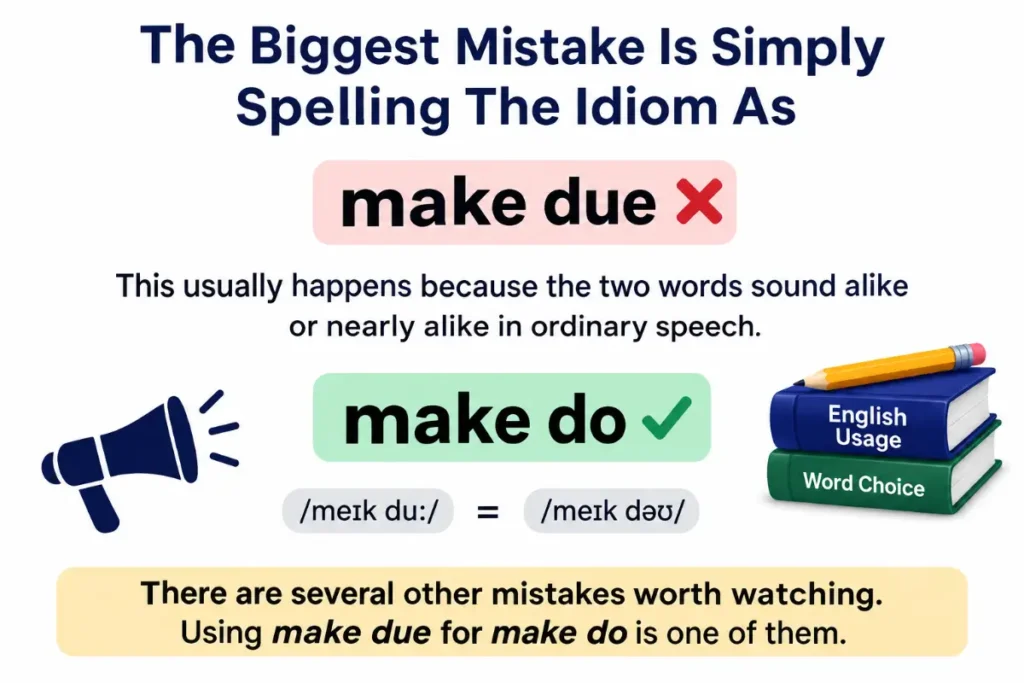
The biggest mistake is simply spelling the idiom as make due. This usually happens because the two words sound alike or nearly alike in ordinary speech.
There are several other mistakes worth watching.
- Using make due for make do.
Incorrect:
We’ll make due with the old equipment.
Correct:
We’ll make do with the old equipment.
- Adding an unnecessary word.
Incorrect:
We’ll make do up with what we have.
Correct:
We’ll make do with what we have.
- Using the wrong preposition.
The most natural construction is make do with.
Correct:
She made do with a temporary solution.
- Assuming make do means make something.
It doesn’t. In this idiom make do means manage or cope.
- Confusing make do with make it.
These expressions can overlap in some situations but they are not identical.
We’ll make do with the old computer.
This emphasizes accepting an imperfect resource.
We’ll make it work.
This emphasizes successfully finding a way to achieve the goal.
- Treating make due as an accepted alternative spelling.
Pronunciation Guide
The pronunciation explains much of the confusion.
Make do is commonly pronounced:
/meɪk duː/
The word make has one syllable.
The word do in this expression has one syllable.
So the phrase has two stressed lexical words and is generally heard as:
make do
The word due is commonly pronounced:
/duː/
in many varieties of American English.
In some accents due may have a noticeable /j/ sound and can be pronounced closer to /djuː/.
That difference can disappear in everyday speech depending on the speaker’s accent. This creates a classic homophone or near homophone problem. You hear the sound and then have to choose the spelling from meaning. That is why spelling the phrase correctly requires knowing the idiom rather than relying only on pronunciation.
Many readers also check cleverer vs more clever Which Form Should You Use.
Etymology and Word Origin
The history of make do is more interesting than the phrase first appears.
The expression is an established English idiom meaning to manage or cope with available resources. Its structure can seem unusual because make and do are both verbs. Yet English has long allowed verb combinations and constructions in which one verb helps create a specialized meaning.
The exact historical development of make do is not as simple as saying that it came directly from the famous wartime phrase make do and mend.
That point matters because the wartime expression became culturally prominent in Britain but it did not create the basic idiom.
Historical discussion of the expression points to uses of make do that appeared before the Second World War. One documented example discussed in historical language research comes from the early twentieth century.
The later expression make do and mend became strongly associated with wartime Britain.
The British government promoted the Make Do and Mend campaign during the Second World War. The campaign encouraged people to extend the life of clothing and household goods because shortages and rationing made replacement difficult. The UK National Archives documents the campaign and explains how people were encouraged to repair and reuse clothes instead of discarding them.
The phrase therefore gained a powerful cultural association with thrift resourcefulness and practical problem solving.
That history also helps explain why make do often carries more than a simple meaning of “use.” It can suggest ingenuity.
You don’t have the perfect resource.
You find a way forward anyway.
That is the heart of the expression.
Make Do Or Make Due In Regional English
The expression make do is widely understood across major varieties of English.
American English
In American English make do is a normal and familiar expression. You can hear it in everyday conversation when people talk about limited money missing supplies temporary arrangements or imperfect choices.
We’ll make do until the new one arrives.
That sounds completely natural to an American English speaker.
British English
British English also uses make do extensively. The expression has an especially strong cultural connection with the phrase make do and mend because of its wartime history. The National Archives records the British government campaign that encouraged people to reuse repair and extend the life of clothing during the Second World War.
Australian English
Australian English also uses make do as part of ordinary English vocabulary. The meaning remains essentially the same. A speaker can use it to describe coping with limited resources or accepting a temporary alternative.
Canadian English
Canadian English uses make do in the same general sense as American and British English. There is no need to switch to make due in Canadian English. The safest conclusion across these varieties is simple. Make do is the established form of the idiom.
Grammar Rules
Understanding the grammar of make do helps prevent another common problem. Some writers know the phrase but aren’t sure how to change it for different tenses. The good news is that the pattern is straightforward.
Present tense
I make do with what I have.
We make do with the space available.
Third person present
She makes do with a small kitchen.
He makes do without a car.
Notice that make changes to makes because the subject is third person singular.
Past tense
We made do with the old equipment.
She made do with a temporary desk.
The expression uses made rather than changing do.
Present progressive
We are making do with what we have.
She is making do until the repairs are finished.
Here the first verb carries the progressive form.
Perfect tense
They have made do with limited resources for years.
He had made do with the old system before the company upgraded it.
The past participle is made.
Infinitive structure
After another verb you can use make do in its base form.
We need to make do until Friday.
They decided to make do with the available materials.
The grammar remains stable even though the tense of make changes.
The Common Pattern With With
One of the most useful grammar patterns is:
make do with something
This structure means to use something available even though it isn’t ideal.
We had to make do with one computer.
She made do with a borrowed dress.
They’re making do with a temporary office.
The word with introduces the thing that serves as the substitute or limited resource.
You can also leave the object unstated when the context makes it obvious.
We don’t have everything we need but we’ll make do.
That sentence sounds natural because the listener already understands the situation.
Make Do Or Make Due In Professional Writing
In professional writing accuracy matters because small spelling errors can distract from otherwise strong work.
Suppose an employee writes:
We’ll make due with the current software until the upgrade arrives.
Most readers will understand the intended meaning. Still the spelling can make the sentence look careless.
The polished version is:
We’ll make do with the current software until the upgrade arrives.
The difference is only one letter but the correction matters.
In reports emails proposals academic work and published content use make do when you mean cope with what is available.
For formal writing you can also choose a more direct alternative when it fits the sentence.
We’ll manage with the current software.
We’ll work with the available resources.
We’ll use the existing equipment for now.
We’ll rely on the current system until the replacement arrives.
These alternatives can sound more precise in technical or highly formal contexts. Still make do itself is perfectly standard English.
Real Life Usage Examples
The phrase works well because real life is full of imperfect solutions.
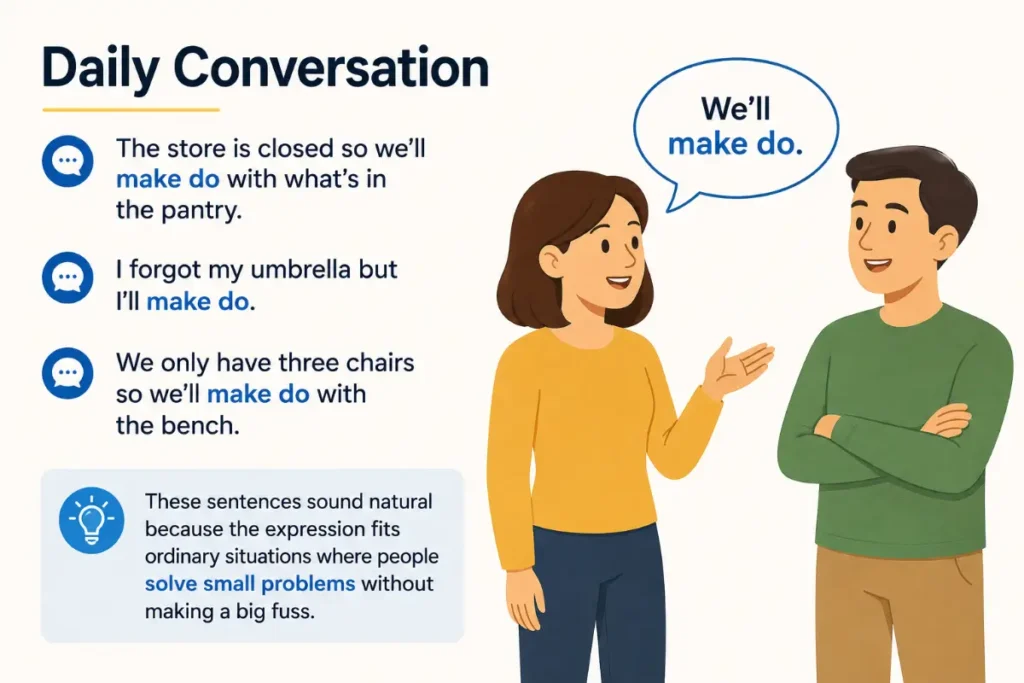
Daily Conversation
The store is closed so we’ll make do with what’s in the pantry.
I forgot my umbrella but I’ll make do.
We only have three chairs so we’ll make do with the bench.
These sentences sound natural because the expression fits ordinary situations where people solve small problems without making a big fuss.
Academic Writing
Academic writing can use make do when discussing limited resources or practical adaptation.
Students in underfunded schools may have to make do with outdated technology.
The researchers had to make do with a smaller sample than originally planned.
In highly technical writing you may prefer a more precise phrase such as work with limited resources. The choice depends on the tone of the document.
Professional Communication
We can make do with the current staffing level for the short term.
The team made do with the equipment already available.
We’ll make do until the replacement system is installed.
These examples show that the expression is not limited to casual conversation.
Literature
Writers often use expressions like make do because they capture a character’s attitude toward hardship in a compact way.
A character who says we’ll make do may sound practical calm resourceful or resigned depending on context.
The phrase can therefore communicate personality as well as circumstance.
Media
News articles interviews documentaries and lifestyle writing often use make do when discussing families communities organizations or individuals dealing with shortages or limited choices.
The expression is particularly effective when the writer wants to emphasize practical resourcefulness rather than dramatic hardship.
Related Words and Confused Terms
Several words and phrases sit close to make do in meaning.
- Manage means to succeed in dealing with something.
- Cope means to deal successfully with a difficult situation.
- Get by means to survive or function with limited resources.
- Get along can describe managing in a situation or relationship depending on context.
- Settle for means to accept something less desirable because a better option is unavailable or not chosen.
- Make the best of means to deal positively with an imperfect situation.
- Work with what you have expresses the same practical idea in more literal language.
- Do without means to live or function without something.
- Make it work means to find a way for something to succeed despite difficulties.
These expressions overlap but they are not perfect substitutes.
Make do focuses strongly on using what is available.
Settle for often focuses on accepting something less desirable.
Do without focuses on going without something entirely.
Make the best of often emphasizes a positive attitude toward an imperfect situation.
Choosing the right expression can sharpen your meaning.
Make Do Or Make Due And The Sound Confusion
The central problem is pronunciation.
When you hear someone say make do you don’t see the spelling.
You only hear the sound.
If your accent makes do and due sound identical then both spellings can seem possible.
This is the same kind of problem that creates confusion with other English word pairs such as their and there or right and write.
The solution is not to memorize the sound.
Memorize the meaning and grammatical pattern.
If the sentence means manage with what is available then the spelling you need is make do.
That one mental shortcut will solve most cases.
Expert Language Insight
From an editing perspective make do is best treated as a fixed idiomatic expression.
That matters because writers sometimes try to analyze the phrase word by word.
They see make.
They see do.
Then they wonder why due cannot work.
The answer is that idioms often develop meanings that cannot be predicted simply by replacing one component with a similar sounding word.
English contains thousands of such expressions.
Once a phrase becomes established in the language its conventional form matters.
That is why an experienced editor would normally correct make due to make do when the writer intends the familiar meaning of coping with limited resources.
There is another useful editorial point here.
Don’t automatically replace make do with a more formal expression simply because it is an idiom. The phrase is clear standard English. It can work perfectly well in an email article essay interview transcript or general professional document.
The real question is tone.
If you want warmth and natural speech then make do works beautifully.
If you want highly technical precision then manage with available resources may fit better.
Good editing is not about making every sentence sound formal. It is about choosing the clearest expression for the reader and purpose.
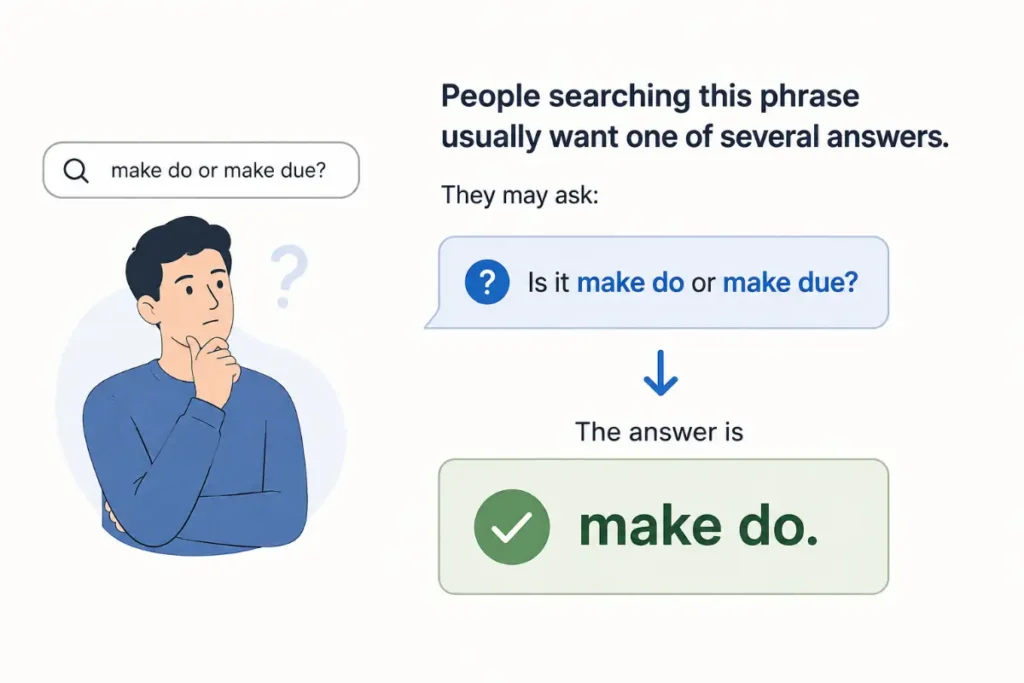
Make Do Or Make Due In Search Questions
People searching this phrase usually want one of several answers.
They may ask:
Is it make do or make due?
The answer is make do.
They may ask:
What does make do mean?
It means to manage with what you have when a better or preferred option is unavailable.
They may ask:
How do you spell make do?
Spell it as two words:
make do
They may ask:
Is make due grammatically correct?
Not as the standard spelling of the idiom meaning to cope with limited resources.
Need another quick comparison? Read Investor vs Investee Which Is the Difference? 2026.
Final Takeaway
When you’re choosing between make do or make due the answer is straightforward. Use make do. It means to manage with what you have when your preferred option isn’t available or isn’t practical.
It can describe money problems temporary equipment shortages limited supplies or simple everyday compromises. Make due is not the standard spelling of this idiom. The easiest way to remember the difference is to connect make do with the idea of doing with what you have. We don’t have the perfect option but we’ll make do.
Frequently Asked Questions
Is it make do or make due?
The correct form of the common idiom is make do. It means to manage with what is available even when the available option is less desirable than what you wanted. Make due is not the standard spelling of this idiom. The word due is still correct in other contexts involving something owed expected or scheduled.
What does make do mean?
Make do means to manage with what you have. It often describes a situation in which someone lacks the ideal option but finds a practical way to continue. For example you can make do with an old computer until you can buy a replacement. Cambridge defines the idiom in terms of managing without something desired or using something less suitable.
Is make due ever correct?
The spelling due is correct as an English word but make due is not the standard form of the idiom meaning to cope with limited resources. For example The payment is due Friday is correct. If you mean to manage with what you have then write We’ll make do with the supplies available.
How do you use make do in a sentence?
The most common structure is make do with something. For example We didn’t have enough chairs so we made do with the benches. You can also use make do without an object when the context is already clear. For example We don’t have everything we need but we’ll make do.
Is make do formal or informal?
Make do is standard English and can appear in both everyday and professional writing. It has a natural conversational quality so it may sound less formal than phrases such as manage with available resources. Still there is nothing grammatically incorrect or unprofessional about using make do when the tone fits the situation.
What is the difference between make do and settle for?
Make do focuses on managing with what is available. Settle for focuses on accepting something less desirable than what you originally wanted. For example We’ll make do with the old printer emphasizes practical coping. We settled for the old printer emphasizes accepting a less preferred choice.
What is the past tense of make do?
The past form is made do. For example We made do with the supplies we had. The expression does not become made did. The verb make changes to made while do remains in its base form. This pattern is one reason it helps to learn the phrase as a complete idiom.
Why do people write make due?
People often write make due because due and do sound alike or nearly alike in many accents. The brain naturally connects the sound with a familiar spelling. The word due is also a common English word so the incorrect spelling can look convincing. When the meaning is manage with what you have the correct spelling is make do.