
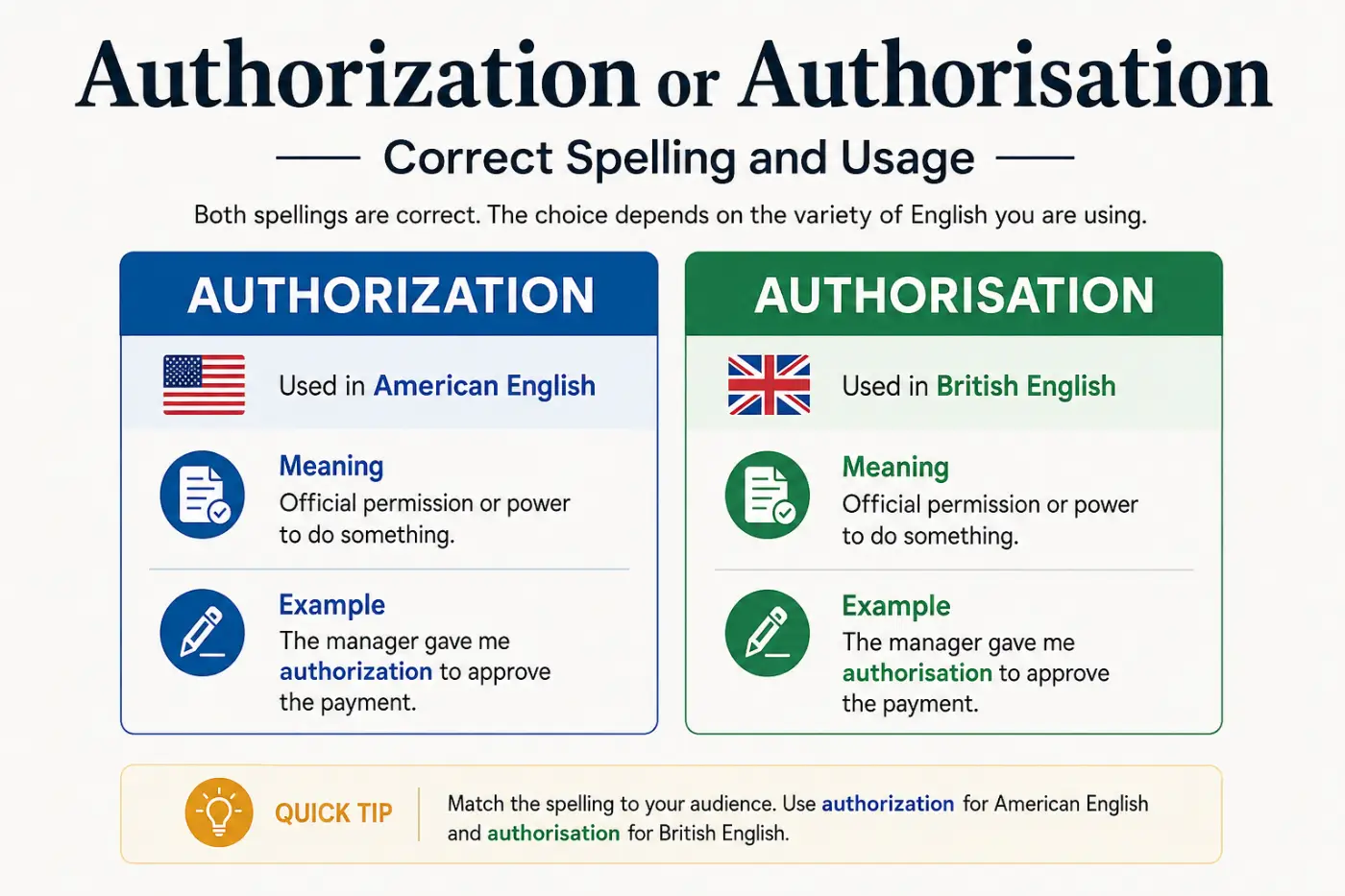
authorization or authorisation often creates confusion because the two forms have the same meaning and nearly identical pronunciation. The main difference is regional spelling. Authorization is the standard spelling in American English, while authorisation is the standard spelling in British English and is also common in several other varieties that follow British spelling conventions.
The word refers to official permission, approval, or the act of giving someone the power to do something. You might see it in a workplace policy, a legal document, a banking message, a software setting, or an official request. The difference between the two forms is the letter used before the final part of the word. American English normally uses z in authorization, while British English normally uses s in authorisation.
This guide explains the meaning, spelling pattern, pronunciation, grammar, etymology, regional usage, common mistakes, and everyday examples. You’ll also learn which form to choose for American writing and how related words such as authorize, authorise, authorization, and authorisation fit together.
Need another quick comparison? Read Cryer vs Crier Which Spelling Is Correct 2026.
Quick Definition
Authorization and authorisation are two regional spellings of the same noun. Both mean official permission, approval, or the act of giving someone authority to do something. Authorization is standard in American English. Authorisation is standard in British English and is also used in other varieties that generally follow British spelling conventions.
Quick Answer
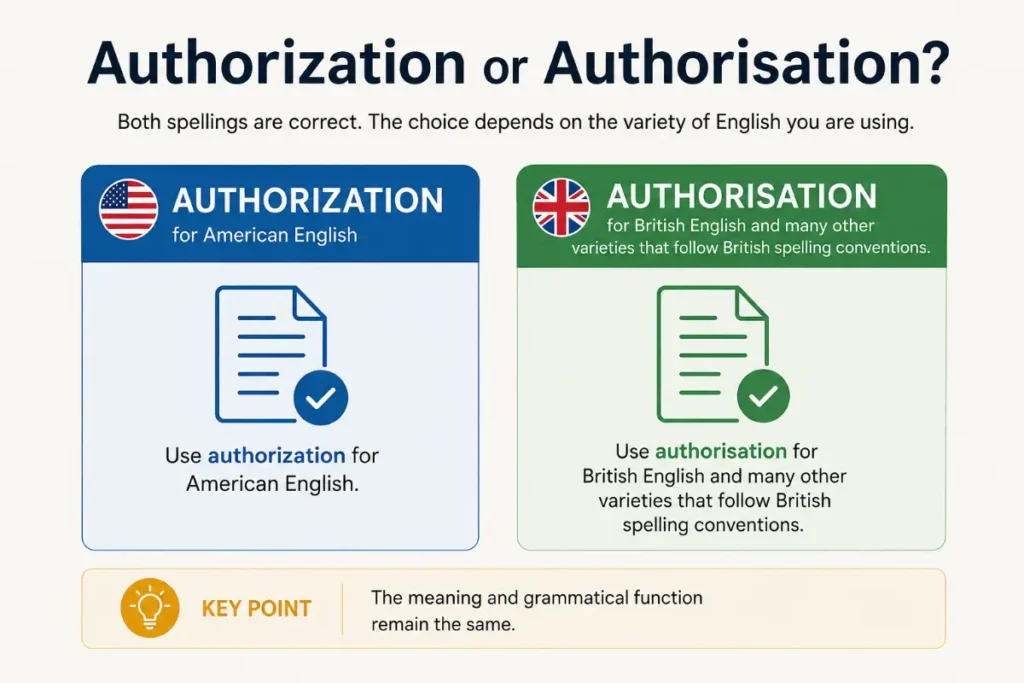
Both spellings are correct. Authorization is the preferred spelling in American English, while authorisation is the preferred spelling in British English.
The difference comes from a broader spelling pattern. American English often uses z in words ending in ization, while British English frequently uses s in corresponding forms ending in isation.
For example:
The bank requires authorization before processing the payment.
The bank requires authorisation before processing the payment.
The meaning is the same. The spelling reflects the English variety used by the writer.
Comparison Table
| Form | Meaning | Part of Speech | Origin | Usage Frequency | Formality | Common Contexts | Example |
|---|---|---|---|---|---|---|---|
| Authorization | Official permission or approval | Noun | From authorize and ultimately Latin roots | Very common in American English | Formal and neutral | Business, banking, law, technology, government | The transaction requires authorization. |
| Authorisation | Official permission or approval | Noun | From authorise and ultimately Latin roots | Very common in British English | Formal and neutral | Business, banking, law, technology, government | The transaction requires authorisation. |
Neither spelling changes the basic meaning. The main distinction is the regional spelling system.
Meaning And Definition
Meaning Of Authorization
Authorization means official permission to do something or the act of giving someone permission or authority.
For example:
The employee needs authorization before accessing the records.
This sentence means that the employee must receive official permission before gaining access.
The word often appears in situations where access, control, approval, or responsibility matters. Banks may require authorization for transactions. Companies may require authorization before employees purchase equipment. Government agencies may require authorization before taking certain actions.
The term also appears heavily in technology.
A website may ask for authorization before allowing access to an account. A computer system can use authorization rules to decide what an authenticated user is allowed to do.
This gives the word a useful distinction from authentication.
Authentication asks who you are.
Authorization asks what you are allowed to do.
That difference is especially important in cybersecurity and software development.
Meaning Of Authorisation
Authorisation has the same meaning as authorization. It refers to official permission, approval, or the granting of authority.
The main difference is spelling rather than meaning.
For example:
The manager must give authorisation before the purchase can proceed.
A British English reader will recognize this as the standard spelling.
The word appears in the same kinds of settings as its American counterpart. You can find it in business communication, legal writing, government documents, financial services, technology, education, and everyday formal communication.
If a document follows British spelling conventions, authorisation is the natural choice.
The Key Difference
The distinction becomes simple once you focus on the letter before the final part of the word.
- Authorization uses z. This is the standard American English spelling.
- Authorisation uses s. This is the standard British English spelling.
- The meaning is identical. Both forms refer to permission, approval, or the granting of authority.
- The pronunciation is essentially the same. The spelling difference does not normally create a different spoken form.
- The related verbs also differ. American English generally uses authorize, while British English generally uses authorise.
- Consistency matters. If your document follows American spelling, use authorization. If it follows British spelling, use authorisation.
- Neither form is a misspelling in its proper regional context. Calling one incorrect without considering the variety of English would be misleading.
Why The Spelling Changes
The difference is part of a larger pattern involving words that end in forms such as ize and ise.
American English commonly uses forms such as:
authorize
organization
realization
recognize
British English commonly allows and often prefers forms such as:
authorise
organisation
realisation
recognise
This pattern can make the choice easier to remember.
If your writing uses American forms such as organization and recognize, authorization will usually fit that spelling system.
If your writing uses British forms such as organisation and recognise, authorisation will usually fit better.
There is one important detail. British English spelling is not completely uniform across every word ending in ise or ize. Some British dictionaries and publishers accept both patterns in different circumstances. However, authorise and authorisation are well established British forms.
For a writer who wants consistent American English, using the z spelling throughout is the straightforward choice.
Which Form Should You Use?
If you are writing for a US audience, use authorization.
This applies to school papers, websites, business documents, software interfaces, professional emails, reports, and general American English writing.
For example:
The customer must provide authorization before the refund is issued.
If you are following British English conventions, use authorisation.
For example:
The customer must provide authorisation before the refund is issued.
The important thing is consistency. Switching between American and British spelling in the same document can make your writing look uneven.
Imagine a document that uses organization, color, center, and authorization in one paragraph but organisation, colour, centre, and authorisation in another. The reader may notice the mixed spelling system even though every individual word is understandable.
A consistent spelling system creates a cleaner impression.
Sentence Examples
Here are natural examples using the American form.
- The manager gave authorization for the purchase.
- You need authorization before entering the restricted area.
- The bank requested authorization for the transaction.
- The application requires authorization from an administrator.
- We received authorization to begin the project.
- The system checks authorization before displaying sensitive information.
- Please obtain written authorization before making the change.
- The employee cannot access the file without proper authorization.
- The company requires parental authorization for certain activities.
- The doctor requested authorization from the insurance provider before starting the treatment.
The British spelling works in the same sentences.
- The manager gave authorisation for the purchase.
- You need authorisation before entering the restricted area.
- The bank requested authorisation for the transaction.
- The application requires authorisation from an administrator.
- We received authorisation to begin the project.
The grammar and meaning remain unchanged. Only the regional spelling changes.
Common Spelling Mistakes
Authorization And Authorisation Mixed In One Document
A common editing problem is switching between the two forms.
For example:
The organization requires authorization.
Later:
The organisation requires authorisation.
The sentences are not grammatically wrong, but the document now mixes spelling systems.
Choose one variety and stay consistent.
Authorization With An Incorrect Ending
Some writers produce forms such as authorizaton or authorizition.
These errors usually happen because the word contains several unstressed syllables. The pronunciation can make the middle of the word difficult to spell from sound alone.
Break it into parts:
author + ization.
The exact historical structure is more complex, but this visual pattern can help with spelling.
Authorisation In American English
Authorisation is understandable to American readers, but it follows British spelling conventions.
If your assignment, website, or professional document is specifically written in American English, authorization is the better choice.
Authorization In A British Document
The reverse situation can also happen. A British document may use authorization because the writer follows American spelling habits.
That does not change the meaning, but it can make the document look inconsistent with the rest of its language.
Confusing Authorization With Authentication
These terms are closely related in technology but have different meanings.
Authentication verifies identity.
Authorization determines permission.
For example, logging into an account can involve authentication. Deciding if that account can access a particular file involves authorization.
This distinction is especially important in technical writing.
Pronunciation Guide
The two spellings are normally pronounced the same way.
A common American pronunciation is represented approximately as:
/ˌɔːθərɪˈzeɪʃən/
A simple pronunciation guide is:
aw thor uh ZAY shun.
The main stress falls on the syllable that sounds like zay.
The British pronunciation is very similar:
aw thor uh ZAY shun.
The spelling changes from z to s, but the sound in the middle is generally pronounced with a z sound in both forms.
This can seem surprising at first. English spelling does not always give a perfect guide to pronunciation.
The related verbs show the same issue.
Authorize is commonly pronounced with a z sound.
Authorise is also commonly pronounced with a z sound even though it contains the letter s.
That is why choosing between the two forms is mainly a written spelling decision.
Etymology And Word Origin
The word belongs to a long family of English terms connected with authority and permission.
The deeper root comes from Latin auctor, connected with the idea of an originator, promoter, or person who gives authority. Latin auctoritas developed into the source of English authority and related words.
English later developed authorize as a verb meaning to give authority or permission. The noun authorization developed from that verb.
The British spelling authorisation reflects the same word family. The difference between the two modern forms is primarily a matter of spelling convention rather than separate word origins.
This shared history explains why the words authorization and authorisation mean exactly the same thing.
The same family includes:
authority
authoritative
authorize
authorisation
authorization
authorized
authorised
Understanding the family can make the vocabulary easier to remember.
American English Usage
American English normally uses the z spelling in this word.
You will see authorization in areas such as banking, technology, government, business, education, law, and customer service.
Examples include:
payment authorization
security authorization
authorization code
authorization form
written authorization
These expressions are common in American professional and technical writing.
The same pattern appears in many related words.
American English commonly uses:
authorize
authorization
organization
realization
modernization
The z spelling is therefore part of a broader American convention.
For a US audience, authorization is the natural default.
British English Usage
British English commonly uses authorisation with an s.
You may encounter phrases such as:
payment authorisation
security authorisation
authorisation code
authorisation request
written authorisation
The related verb is commonly authorise.
British English also uses many other forms ending in ise or isation.
Examples include:
organise
organisation
realise
realisation
modernise
modernisation
There is variation in British spelling practices, and some publishers or style guides prefer ize forms. However, authorisation is an established and widely recognized British form.
The key point is that the s spelling is not a typing error when used in British English.
Learn the difference in faring or fairing Which One Is Correct.
Australian English Usage
Australian English generally follows British spelling conventions, so authorisation is widely used.
You can expect to see the s spelling in Australian government documents, business writing, educational material, and professional communication.
For example:
The customer must provide authorisation before the account can be changed.
Australian English can have its own vocabulary and style preferences, but the spelling distinction here largely follows the British pattern.
If you are writing specifically for Australia, authorisation is a sensible default.
Canadian English Usage
Canadian English sits between American and British influences in several areas of spelling.
Both z and s forms can appear in Canadian writing, depending on the word, publisher, organization, and style guide being followed.
For a Canadian document, consistency is more useful than assuming that every word must follow one rigid system.
If the organization uses American style, authorization may be preferred.
If it follows British influenced Canadian conventions, authorisation may appear.
The important point is to follow the style guide or house style used by the publication or organization.
Grammar Rules And Part Of Speech
Both forms are nouns.
They describe the act of giving permission or the permission itself.
For example:
The employee received authorization.
Here the word names the permission granted to the employee.
The noun can appear after determiners such as the, an, or some.
The authorization was approved yesterday.
We need authorization before proceeding.
You can also use it with common noun phrases.
written authorization
official authorization
prior authorization
special authorization
legal authorization
security authorization
The word often appears with verbs such as:
give authorization
grant authorization
receive authorization
request authorization
obtain authorization
require authorization
deny authorization
provide authorization
These combinations are useful because they show how the noun naturally behaves in real sentences.
Authorization And The Verb Forms
The noun is easier to understand when you connect it with its related verb.
American English:
authorize
authorization
British English:
authorise
authorisation
The basic relationship is straightforward.
The manager authorized the purchase.
The manager gave authorization for the purchase.
The first sentence uses the verb.
The second uses the noun.
The British versions follow the same grammatical structure.
The manager authorised the purchase.
The manager gave authorisation for the purchase.
This is a useful word family to learn as a group rather than memorizing each form separately.
Authorization Versus Permission
Authorization and permission overlap, but they can have different tones.
Permission is a broad everyday word.
I got permission to leave early.
Authorization often sounds more official.
I received authorization to access the records.
Permission can come from a parent, friend, teacher, or supervisor. Authorization often suggests an official process, formal approval, or a defined level of authority.
That does not mean authorization is always legal or highly formal. It is common in everyday technology and business language too.
For example, an app may request authorization to access your contacts.
The word fits naturally because the system is asking for a specific form of access.
Authorization Versus Approval
Approval means that someone accepts, supports, or agrees with something.
Authorization focuses more directly on granting permission or authority to act.
For example:
The director approved the plan.
The director authorized the team to begin work.
The first sentence says the director accepted the plan.
The second says the director gave the team permission to act.
The two concepts can overlap, but they are not always identical.
Authorization Versus Authentication
This distinction deserves special attention in technology.
Authentication answers:
Who are you?
Authorization answers:
What are you allowed to do?
Imagine logging into a company system.
The login process may authenticate your identity.
After the system recognizes you, authorization rules determine if you can view payroll information, edit customer records, or access administrative settings.
A user can therefore be authenticated but not authorized for a particular action.
This distinction appears frequently in cybersecurity, software development, cloud services, and access control.
Real Life Usage Examples
Daily Conversation
I need authorization before I can make that change.
The manager gave me authorization to use the equipment.
These examples sound somewhat formal, but the word is common when the situation itself involves official permission.
Email And Workplace Communication
Please confirm that you have received authorization before proceeding with the purchase.
We cannot release the documents until the appropriate authorization has been received.
Workplace writing frequently uses the noun because business processes often involve approvals and permissions.
Academic Writing
The researchers obtained authorization before collecting the data.
The study required authorization from the relevant institution.
Academic writing may use the term when describing formal permission for research activities.
News Writing
Officials said the project received authorization before construction began.
The agency requested additional authorization for the proposed program.
News writing often uses the word because government and institutional decisions involve formal approval.
Literature And Storytelling
The captain gave the crew authorization to enter the restricted area.
She waited for authorization before opening the sealed room.
In storytelling, the word can establish a formal relationship between someone with authority and someone seeking permission.
Common Collocations
Learning common word combinations can make your English sound more natural.
Prior Authorization
Prior authorization means permission that must be obtained before an action occurs.
The procedure requires prior authorization.
This phrase is especially common in administrative and healthcare settings.
Written Authorization
Written authorization means permission provided in written form.
We need written authorization before releasing the records.
Official Authorization
Official authorization emphasizes that the permission comes from a recognized authority.
The project received official authorization.
Authorization Code
An authorization code is a code used in certain systems to confirm permission or approve an action.
Enter the authorization code to continue.
Authorization Request
An authorization request is a request for permission or access.
The system sent an authorization request.
Authorization Process
The authorization process refers to the steps required to grant permission.
The authorization process may take several days.
Authorization Form
An authorization form is a document used to give or request permission.
Please complete the authorization form.
Access Authorization
Access authorization refers to permission to enter or use a system, facility, account, or resource.
Employees need access authorization to enter the secure area.
Related And Confused Terms
Authority
Authority means the power or right to make decisions or give orders.
The manager has authority over the department.
Permission
Permission means consent or approval to do something.
She asked for permission to leave early.
Approval
Approval means acceptance or agreement.
The project received approval from the board.
Consent
Consent means agreement to something, often after being asked.
The participant gave consent before the interview.
Authentication
Authentication is the process of verifying identity.
The system uses authentication before granting account access.
Access
Access means the ability or right to enter, use, or obtain something.
Employees have access to the database.
Approval Process
An approval process is a series of steps through which a request is reviewed and accepted.
The purchase must go through the approval process.
Authorization Code
An authorization code is information used to confirm or permit a particular action in a system.
Enter the authorization code before continuing.
These terms are related, but they should not be treated as exact synonyms. The best choice depends on the action and context.
Common Style Questions
Is The Z Spelling More Correct?
No. The z spelling is not universally more correct.
It is the standard American form.
The s spelling is also standard in British English and other varieties that use related spelling conventions.
Regional standards matter in English.
Is The S Spelling Wrong In America?
Not necessarily wrong in every context, but it is not the usual American spelling.
A US publication may edit authorisation to authorization to maintain American style.
However, an American reader will understand the s form without difficulty.
Is The Z Spelling Wrong In Britain?
No. The z form is recognized in British English, and some British style traditions use ize and related forms.
Still, authorisation is a very familiar British spelling.
The best approach is to follow the style guide used by your publication, school, workplace, or organization.
Expert Editor Insight
A professional editor would treat both forms as legitimate regional spellings rather than marking one as a simple spelling mistake. The first question is audience. For US English, authorization is the natural choice. For British or Australian English, authorisation is usually the better fit. Editors also check related forms such as authorize and authorise so the document stays consistent. Spelling tools may accept both forms, so software alone cannot determine the best regional choice.
For another common grammar confusion, see Channel Vs Chanel Which One Is Correct? (2026).
Conclusion
authorization or authorisation presents a regional spelling difference rather than a difference in meaning. Authorization is the standard choice for American English, while authorisation is widely used in British English and other varieties influenced by British spelling. Both forms describe official permission, approval, or the granting of authority.
The simplest way to remember the distinction is to connect the z spelling with American English and the s spelling with British English. Also check related words such as authorize and authorise so your spelling stays consistent throughout the document. If you are writing for a US audience, choose authorization. If you are following British style, authorisation is a natural choice.
The key is not to treat one spelling as universally correct. Match the form to your audience and keep your spelling system consistent.
FAQs
Is authorization or authorisation correct?
Both forms are correct. Authorization is the standard American English spelling, while authorisation is widely used in British English and other varieties that follow British spelling patterns. They have the same meaning and pronunciation. The choice depends on the English variety and style guide you are following. For a US audience, authorization is normally the preferred form.
What is the difference between authorization and authorisation?
There is no difference in basic meaning. Both words mean official permission, approval, or the act of giving someone authority to do something. The difference is regional spelling. American English generally uses authorization with z, while British English commonly uses authorisation with s. The same distinction appears in the related verbs authorize and authorise.
Which spelling should I use in American English?
Use authorization in American English. This spelling matches the broader American preference for forms such as organization, realization, and modernization. If you are writing a US school assignment, business document, website, report, or professional email, authorization is the natural default. The British form will still be understood, but it may look inconsistent with an otherwise American spelling style.
Which spelling is preferred in British English?
Authorisation is a common and standard British English spelling. It follows the s pattern used in words such as organisation and realisation. British spelling practices can vary by publisher and style guide, so some organizations may use z forms. If you are following a British style that uses ise and isation forms, authorisation fits that system.
Are authorization and authorisation pronounced differently?
They are normally pronounced the same way. The spelling difference does not usually create a meaningful difference in pronunciation. The central sound is generally pronounced with a z sound in both forms. This can seem unusual because the British spelling contains s, but English spelling does not always represent sounds in a simple one to one way.
Is authorization a noun or a verb?
Authorization is a noun. It refers to permission, approval, or the act of giving authority. The related verb is authorize in American English and authorise in British English. For example, The manager authorized the purchase uses the verb, while The manager gave authorization for the purchase uses the noun. Both forms describe related actions.
What is the difference between authorization and authentication?
Authentication verifies who a person or system is. Authorization determines what that authenticated person or system is allowed to access or do. For example, logging into an account can authenticate your identity. Permission to view a private file is controlled by authorization. The distinction is especially important in software, cybersecurity, and access control.
Is authorization formal or informal?
Authorization is generally neutral to formal. It is common in business, government, law, banking, healthcare, technology, and other settings involving official permission or access. In casual conversation, people may use simpler words such as permission. The word itself is not unusually difficult or technical, but its formal tone often reflects the type of situation in which it appears.