
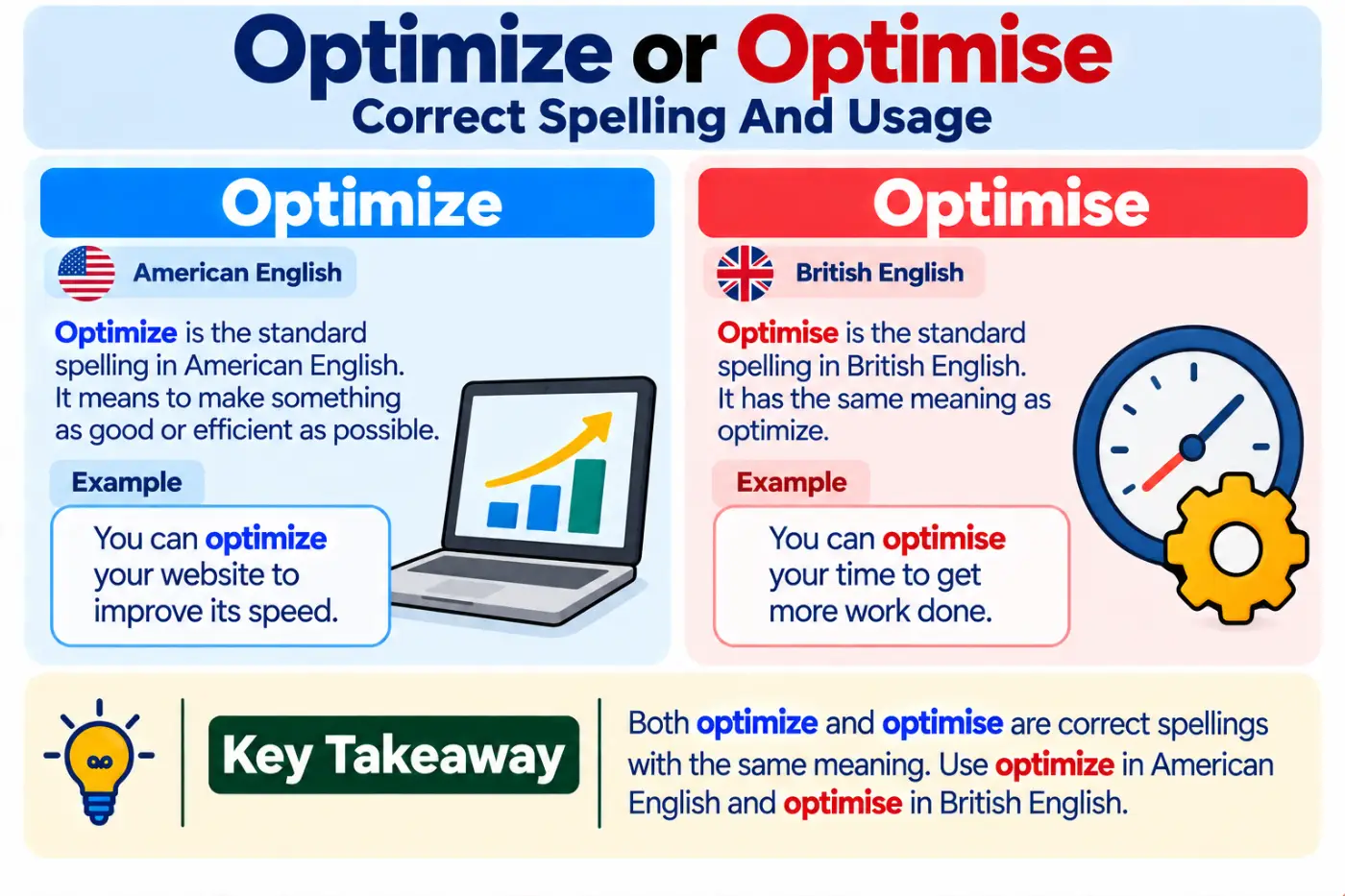
If you have ever paused over optimize or optimise while writing an email, report, article, or school assignment, you’re dealing with a genuine difference between major varieties of English. Both spellings are correct. Optimize is the standard spelling in American English, while optimise is the standard spelling in British English and is also widely used in other varieties that follow British spelling conventions.
The two forms have exactly the same basic meaning. They both mean to make something as effective, useful, efficient, or successful as possible. The difference is mainly regional spelling rather than meaning or grammar. You can use either form correctly as long as you match the spelling to your intended variety of English.
The confusion comes from a larger spelling pattern. American English often uses ize in words such as organize, realize, recognize, and optimize, while British English commonly uses ise in these words. This article explains the difference clearly, shows how each form works in real sentences, covers pronunciation and word history, and gives you a simple way to choose the right spelling for your audience.
You may also want to read Tear vs Tare: What is the Difference? (2026).
Quick Definition
Optimize and optimise are two accepted spellings of the same verb. Optimize is the usual American English spelling, while optimise is widely used in British English. Both mean to improve something so it works as effectively or efficiently as possible. The pronunciation and basic meaning stay the same even though the spelling changes.
Quick Answer
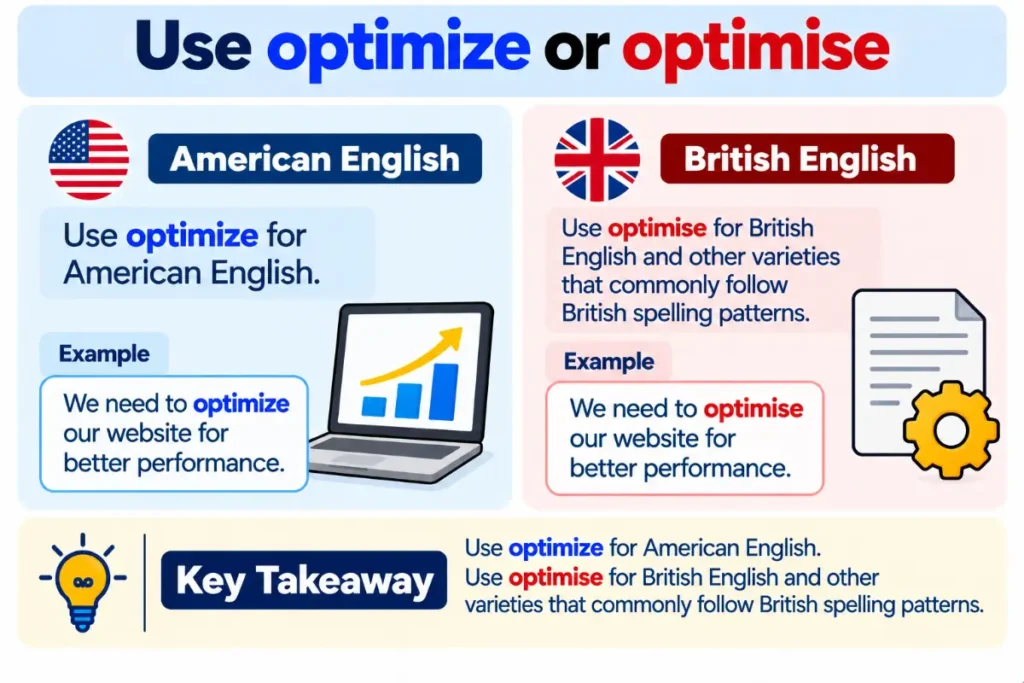
Both optimize and optimise are correct.
Use optimize for American English. Use optimise for British English and other varieties that commonly follow British spelling patterns.
The difference is regional spelling. Neither form is a misspelling when used in the appropriate English variety.
For example:
American English: We need to optimize the website.
British English: We need to optimise the website.
The meaning does not change.
Comparison Table For Optimize And Optimise
| Form | Meaning | Part of Speech | Origin | Usage Frequency | Formality | Common Contexts | Example |
|---|---|---|---|---|---|---|---|
| Optimize | To improve something for the best possible result | Verb | Greek origin through later European forms | Very common in American English | Neutral and professional | Business, technology, science, writing, websites | We need to optimize the process. |
| Optimise | To improve something for the best possible result | Verb | Same word family and origin | Very common in British English | Neutral and professional | Business, technology, science, writing, websites | We need to optimise the process. |
The two forms carry the same meaning. The main distinction is spelling convention.
Meaning And Definition
Meaning Of Optimize
Optimize is a verb meaning to make something as effective, efficient, useful, or successful as possible.
For example:
We need to optimize the production process.
This means the people involved want to improve the process so it produces the best practical result.
The word can describe many different kinds of improvement. You might optimize a website for users.
The word is especially common in technical, business, scientific, and professional writing. However, it is not limited to those fields.
You can also use it in ordinary conversation.
I’m trying to optimize my morning routine.
Here the speaker simply means they want to make the routine work better.
Meaning Of Optimise
Optimise has the same meaning as optimize. The only standard difference is the spelling.
For example:
The company plans to optimise its delivery system.
This sentence means exactly the same thing as:
The company plans to optimize its delivery system.
The choice between them depends mainly on the English variety being used.
British English commonly uses optimise. American English normally uses optimize.
This distinction applies to many related words too. British English often uses forms such as organise, recognise, realise, and maximise, while American English commonly uses organize, recognize, realize, and maximize.
That pattern can help you remember the spelling.
The Main Difference
The central difference is simple. Both forms describe the same action, but they follow different spelling conventions.
- American English uses optimize. This is the standard form for US audiences.
- British English uses optimise. This spelling is standard in British usage.
- The meaning stays the same. Both forms mean to improve something for the best possible result.
- The pronunciation is essentially the same. The final spelling difference does not create a different standard pronunciation.
- The grammar is the same. Both forms function as verbs.
- The tense forms follow the same pattern. For example, optimized and optimised express the past tense and past participle in their respective spelling systems.
- The related noun also changes spelling by region. American English commonly uses optimization, while British English commonly uses optimisation.
- The related adjective follows the same pattern. You will see optimized in American English and optimised in British English.
So the issue is not meaning. It is consistency.
Which Spelling Is Correct
Both spellings are correct. The best choice depends on the variety of English you are writing.
For a US audience, choose optimize.
For a British audience, choose optimise.
This regional distinction is well established in English dictionaries and style conventions. The spelling with ize is standard in American English, while the spelling with ise is widely established in British English.
One useful point often gets lost in this discussion. British English does not universally turn every American ize spelling into ise. English spelling has several historical and lexical patterns, so individual words can have their own conventions. For this particular word, however, optimize and optimise are established regional variants.
The safest editorial rule is to follow the spelling system used by the rest of your document.
If your document uses American forms such as organization, realize, and recognize, optimize fits naturally.
If your document uses British forms such as organisation, realise, and recognise, optimise fits naturally.
Consistency matters more than treating one spelling as universally correct.
Why American English Uses Optimize
The difference between ize and ise has a long history. American English generally prefers ize in many verbs that end with this sound pattern.
You can see the pattern in:
organize
recognize
realize
modernize
centralize
maximize
optimize
This does not mean the letter z makes the words more American in every possible situation. It simply reflects a spelling convention that became strongly established in American English.
American dictionaries and major US style guides generally follow this pattern.
For American readers, optimize therefore looks completely normal. In a US business document, you might naturally write:
We should optimize the workflow before the next release.
Using optimise in that setting would not make the sentence incomprehensible, but it would look noticeably British to many American readers.
Why British English Uses Optimise
British English commonly uses ise in this word.
The same pattern appears in words such as:
organise
recognise
realise
modernise
centralise
maximise
optimise
This spelling convention is widely established in British writing.
You may therefore see:
The team plans to optimise the system.
A British reader will understand the word immediately and generally see nothing unusual about the spelling.
The important point is that British spelling is not a lower standard or an alternative that exists because of an error. It is a legitimate regional variety of English.
Spelling Patterns With Related Words
Learning the spelling pattern can make the difference easier to remember.
If you are writing in American English, you will commonly see:
- organize.
- recognize.
- realize.
- maximize.
- minimize.
- optimize.
If you are writing in British English, you will commonly see:
- organise.
- recognise.
- realise.
- maximise.
- minimise.
- optimise.
This creates a useful visual pattern.
American English often favors ize.
British English often favors ise.
Still, don’t turn this into an absolute rule for every English word. Some words have fixed spellings that do not follow the same pattern. Good editing means checking the particular word and keeping your overall style consistent.
Grammar And Part Of Speech
Optimize and optimise are verbs.
They can describe an action performed by a person, organization, system, or process.
For example:
The engineer optimized the software.
The engineer performed the action.
You can also use the verb after modal verbs.
We need to optimize the system.
The company wants to optimise its website.
The forms also work naturally with infinitives.
Our goal is to optimize performance.
Their aim is to optimise the process.
The present participle follows the same regional spelling pattern.
American English:
optimizing.
British English:
optimising.
The past tense and past participle also follow the regional pattern.
American English:
optimized.
British English:
optimised.
The noun form changes too.
American English:
optimization.
British English:
optimisation.
The underlying grammar remains the same. Only the spelling changes.
Common Grammatical Patterns
The verb commonly appears with an object.
We need to optimize the website.
The object is the website.
You can also use it with phrases that explain the goal.
We optimized the schedule to save time.
The company optimized the system for better performance.
Another common pattern uses the passive voice.
The website was optimized for mobile users.
The British equivalent is:
The website was optimised for mobile users.
The choice between active and passive voice is separate from the spelling issue.
For clearer professional writing, active voice is often useful when the person responsible for the action matters.
The developer optimized the page for mobile devices.
This sentence tells the reader exactly who performed the action.
Sentence Examples
Here are natural examples using the American spelling.
- We need to optimize the website before launching the new campaign.
- She changed her schedule to optimize her study time.
- The engineers optimized the software to reduce loading time.
- Our team is working to optimize the checkout process.
- He wants to optimize his budget before making the purchase.
- The company optimized its delivery routes to save fuel.
- You can optimize the settings for better battery life.
- The researchers optimized the experiment to improve accuracy.
- I’m trying to optimize my morning routine.
- The designer optimized the page for mobile users.
Now look at the same idea using the British spelling.
- We need to optimise the website before launching the new campaign.
- She changed her schedule to optimise her study time.
- The engineers optimised the software to reduce loading time.
- Our team is working to optimise the checkout process.
- The company optimised its delivery routes to save fuel.
The meaning has not changed. Only the regional spelling has changed.
Common Mistakes
Mixing American And British Spellings
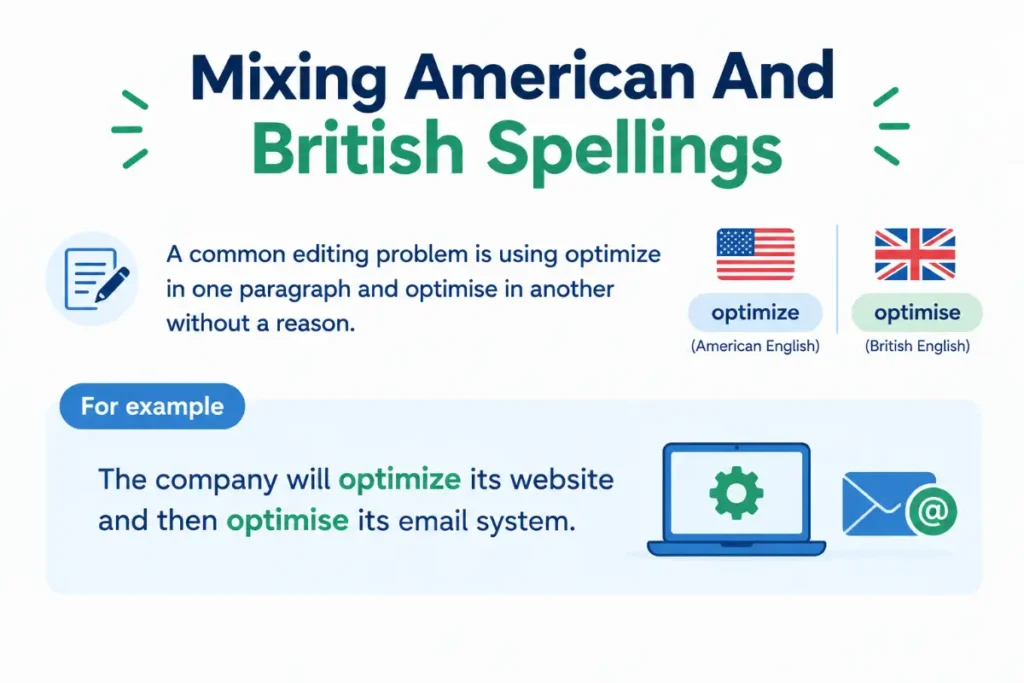
A common editing problem is using optimize in one paragraph and optimise in another without a reason.
For example:
The company will optimize its website and then optimise its email system.
The sentence is understandable, but the spelling is inconsistent if both words belong to the same English variety.
Choose one system and keep it throughout the document.
Changing The Meaning
Some writers assume the two forms describe different levels or types of improvement. They do not.
Optimize and optimise have the same basic meaning.
The difference is spelling rather than meaning.
Misspelling The Related Forms
Once writers learn the main verb, they may forget that related forms also follow regional patterns.
American English uses:
optimization.
optimized.
optimizing.
British English uses:
optimisation.
optimised.
optimising.
The spelling system should remain consistent across the word family.
Using British Spelling In An American Document
This is not technically a grammar error, but it can create a style mismatch.
If your document uses American spelling throughout, optimize will normally fit better than optimise.
This matters particularly in professional writing where consistency affects the overall polish of the document.
Assuming Ise Is Always British
The ize and ise distinction is useful but not universal. English has many spelling patterns that developed through different historical paths.
Do not change every word ending in ize simply because you are writing British English. Check the established spelling of the specific word.
You may also want to read arial vs aerial Which Word Should You Use.
Pronunciation Guide
Optimize and optimise are normally pronounced the same way.
A common American pronunciation is represented as:
/ˈɑːptəmaɪz/
A simple pronunciation guide is:
OP tuh myze.
The main stress falls on the first syllable.
You can divide the word into three sound parts:
OP + tuh + myze.
The final sound is similar to the word prize.
The spelling difference between optimize and optimise does not normally change the pronunciation of the verb.
This is one reason learners may find the two forms confusing. When spoken, you cannot hear which spelling the writer would choose. The distinction becomes visible only on the page.
The related forms follow the same general pronunciation pattern.
Optimized ends with a sound similar to the ending in realized.
Optimised has the same basic pronunciation in British English.
The noun optimization also keeps the same basic word family.
Etymology And Word Origin
The word optimize ultimately belongs to a word family connected with the Latin word optimus, meaning best.
The English word developed through modern European scientific and technical vocabulary. Its central idea has remained closely tied to making something as good or effective as possible.
The word became increasingly useful as English developed specialized vocabulary for mathematics, science, engineering, business, computing, and systems analysis.
That history fits the modern meaning well. When you optimize something, you try to move it toward the best practical result available under the relevant conditions.
The regional spelling difference came from broader English spelling traditions rather than from a difference in meaning.
The American form uses ize.
The British form commonly uses ise.
Both forms belong to the same word family and trace back to the same underlying concept.
Regional Usage
American English
American English normally uses optimize.
This spelling appears across business writing, software documentation, science, education, marketing, engineering, and everyday professional communication.
For example:
The team optimized the workflow.
If you are writing for a US audience, optimize is the natural default.
The related forms also normally use z.
optimization.
optimized.
optimizing.
British English
British English commonly uses optimise.
You will see it in professional, academic, technical, and everyday writing.
For example:
The team optimised the workflow.
The related forms generally follow the same pattern.
optimisation.
optimised.
optimising.
The spelling is standard British usage rather than a typo.
Australian English
Australian English generally follows British spelling conventions in many areas, so optimise is commonly used.
You may therefore see:
The company plans to optimise its operations.
The exact style can vary across organizations and publications, but optimise is an established form in Australian English.
Canadian English
Canadian English can show influence from both American and British spelling traditions. Usage may therefore vary depending on the publication, institution, or writer.
Both optimize and optimise can be encountered in Canadian writing.
If you are following a particular Canadian style guide, use its preferred spelling consistently.
For a general audience, consistency throughout the document is the key editorial principle.
Formal And Informal Usage
Both forms are suitable for formal writing.
This is different from many spelling comparisons where one version is informal slang and the other is standard English.
Optimize and optimise are professional words.
You can use them in:
- Academic papers.
- Business reports.
- Technical documentation.
- Software writing.
- Scientific research.
- Workplace emails.
- Marketing documents.
- Government communication.
The important choice is not formality. It is regional style.
An American academic paper would normally use optimize.
A British academic paper would normally use optimise.
Both can sound professional.
Optimize And Optimise In Technology
The word is especially common in technology because developers and engineers frequently improve systems for performance, speed, memory use, reliability, or efficiency.
For example:
The developer optimized the code.
The team optimized the database.
The application was optimized for mobile devices.
British technical writing may use the corresponding spelling:
The developer optimised the code.
The team optimised the database.
The application was optimised for mobile devices.
This explains why people often encounter the two forms online. Technology is a global field, so American and British spelling systems appear side by side.
That does not mean one version is technically different from the other.
Optimize And Optimise In Business
Businesses use the word when discussing processes, resources, costs, schedules, customer experiences, and performance.
For example:
We need to optimize our hiring process.
The company wants to optimize inventory levels.
The team is trying to optimize customer support.
These sentences describe improvement toward a desired result.
The British forms would use optimise in the same contexts.
A useful caution applies here. Optimize can sound vague if the writer does not explain what is being improved.
For example:
We need to optimize the business.
That sentence is broad.
A stronger version might say:
We need to optimize the delivery process to reduce delays.
The second sentence tells the reader what action is intended and why.
That is a useful editing principle. Specific writing usually communicates more than broad improvement language.
Optimize And Optimise In Writing
The word can also describe improvements to written material.
For example:
The editor optimized the article for clarity.
That means the editor changed the article to make it clearer or more effective.
In a different context, someone might say:
The article was optimised for search visibility.
The word has the same underlying meaning.
However, strong writing should not use optimize as a vague substitute for every kind of improvement.
If you mean simplify, say simplify.
If you mean improve efficiency, say improve efficiency.
A precise verb tells the reader exactly what happened.
Related And Confused Terms
Improve
Improve is the broadest everyday alternative. It simply means to make something better.
Enhance
Enhance means to improve or increase the quality, value, appearance, or effect of something.
Refine
Refine often means to make something more polished, precise, or effective through small improvements.
Maximize
Maximize means to make something as large or great as possible. It can overlap with optimize but often focuses more directly on achieving the highest amount.
Minimize
Minimize means to reduce something as much as possible.
Streamline
Streamline means to simplify a process by removing unnecessary steps or complications.
Improve Efficiency
This phrase directly describes making a process use less time, money, energy, or effort.
Fine Tune
Fine tune means to make small adjustments that improve performance or results.
These terms are related but not identical. Optimize is broader because the desired outcome depends on the situation. The goal may involve speed, quality, cost, accuracy, convenience, or another measure.
Optimize Vs Maximize
These words are sometimes treated as synonyms, but they can express different ideas.
Maximize usually focuses on reaching the highest possible amount.
For example:
We want to maximize profits.
Optimize is broader.
We want to optimize the pricing strategy.
The goal of optimization may involve balancing several factors rather than simply pushing one measurement as high as possible.
A pricing strategy might need to balance profit, customer demand, sales volume, and long term growth.
That is why optimize is common in technical and analytical contexts.
Optimize Vs Improve
Improve is the simpler everyday word.
I want to improve my schedule.
Optimize sounds more specific because it often suggests deliberate adjustment toward a particular goal.
I want to optimize my schedule so I can finish work earlier.
The second sentence tells us that the speaker is not merely making the schedule better in a general sense. They have a defined goal.
In casual conversation, improve may sound more natural. In technical or analytical writing, optimize can be more precise when the context involves measurable performance.
Real Life Usage Examples
Daily Conversation
I’m trying to optimize my morning routine so I have more time before work.
She optimized her grocery list to save money.
These examples show that the word is not limited to computers or business.
Workplace Communication
We should optimize the process before the next project begins.
The team optimized its schedule to reduce unnecessary meetings.
These examples work naturally in professional communication.
Academic Writing
The researchers optimized the experimental conditions to improve measurement accuracy.
The model was optimized to reduce processing time.
Academic writing often uses the word in technical contexts.
News Writing
The company announced plans to optimize its distribution network.
The new system was designed to optimize energy use.
Journalistic writing may use the word when reporting business, technology, science, or economic developments.
Literature And Storytelling
She spent the summer trying to optimize every part of her daily routine.
He changed the arrangement of the room to optimize the available space.
The word is less common in traditional literary prose but can appear naturally in modern nonfiction and contemporary storytelling.
How To Choose The Right Spelling
Choosing the correct spelling becomes easy once you identify your audience.
If you are writing for readers in the United States, use optimize.
If you are working with an international organization, check the organization’s established style. Some global companies use American English across all markets. Others use British English.
If no style has been specified and your main audience is American, optimize is the straightforward choice.
The same rule should guide related forms.
Do not write:
The team optimized the process and then reviewed the optimisation results.
That mixes spelling systems.
For American English, write:
The team optimized the process and then reviewed the optimization results.
For British English, write:
The team optimised the process and then reviewed the optimisation results.
Consistency makes the document feel intentional and polished.
Expert Editor Insight
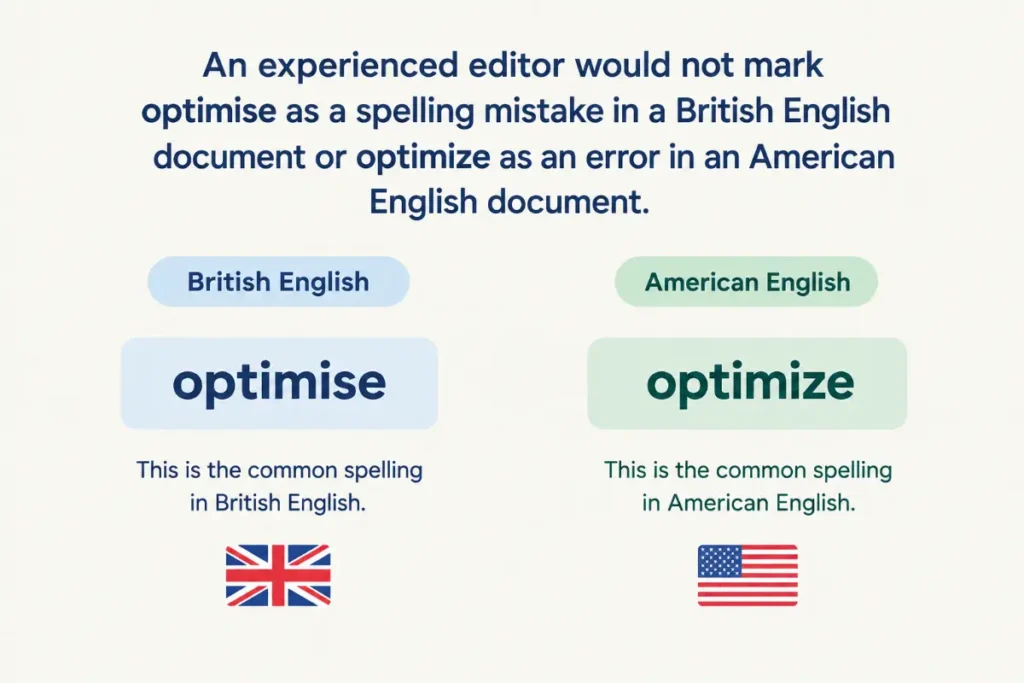
An experienced editor would not mark optimise as a spelling mistake in a British English document or optimize as an error in an American English document. The first question is always the document’s style system and intended audience. Professional editing tools can flag regional differences if a document is set to the wrong language variety, but the software setting itself does not determine universal correctness. The practical tip is simple: decide on your English variety before proofreading, then check the entire word family for consistency.
Learn the difference in Miss vs Missed Meaning Grammar and Usage 2026.
Conclusion
optimize or optimise presents a regional spelling difference rather than a right versus wrong choice. Optimize is the standard American English form, while optimise is widely used in British English and other varieties that follow British spelling conventions. Both words mean to improve something so it works as effectively or efficiently as possible.
The grammar and pronunciation remain essentially the same. The spelling changes across the related word family too, so American English uses optimized and optimization, while British English commonly uses optimised and optimisation. The meaning does not change with the spelling.
The easiest editing tip is to choose your English variety before proofreading. For US readers, remember optimize with z. For British readers, remember optimise with s. Then keep that spelling consistent throughout the entire document.
FAQs
Is optimize or optimise correct?
Both spellings are correct. Optimize is the standard American English spelling, while optimise is widely used in British English and related spelling systems. They have the same meaning and grammatical function. The difference is regional spelling rather than a difference in quality, correctness, or definition. Choose the form that matches the English variety used throughout your document.
Is optimize American or British English?
Optimize is the spelling normally associated with American English. US dictionaries, publications, and professional writing commonly use the ize ending in this word. British English generally uses optimise. If you are writing for an American audience, optimize is the natural choice. If you are following British spelling conventions, use optimise instead.
Is optimise wrong in American English?
Optimise is understandable to American readers and is a legitimate English spelling, but it is not the usual American spelling. In a document written consistently in American English, optimize is the expected form. Using optimise can make the text look British or inconsistent with other American spellings. It is better to match the spelling to your chosen regional style.
Is optimize wrong in British English?
Optimize is not an incomprehensible or meaningless form in British English. It is a recognized variant and can appear in British contexts, especially in international or technical material. However, optimise is the traditional spelling preferred by many British publications and style systems. If your document follows British English, consistency usually favors optimise.
Do optimize and optimise sound the same?
Yes. The two forms normally have the same pronunciation. The spelling difference appears in writing rather than speech. A common pronunciation is similar to OP tuh myze. Because listeners cannot hear the spelling choice, the distinction matters mainly when you are writing. This is one reason regional spelling differences can cause uncertainty for English learners.
What is the noun form of optimize?
The noun is optimization in American English and optimisation in British English. Both forms describe the process of making something as effective or efficient as possible. For example, American English uses website optimization, while British English commonly uses website optimisation. The same regional spelling pattern continues across the word family.
What is the past tense of optimize?
The American English past tense is optimized. The British English form is optimised. For example, an American writer might say the team optimized the system, while a British writer might say the team optimised the system. The meaning remains the same. The spelling simply follows the regional convention used by the writer.
Is optimize suitable for formal writing?
Yes. Optimize is fully suitable for formal American English writing. It commonly appears in academic, scientific, technical, business, and professional documents. The British equivalent optimise is equally suitable for formal British English. The key consideration is consistency. If your document follows American spelling, use optimize and related forms such as optimized and optimization throughout.