
English spelling can be surprisingly tricky, especially when words change from singular to plural forms. One common question writers, students, and English learners ask is partys vs parties. At first glance, both spellings may seem reasonable because they look similar and sound nearly identical. However, only one follows standard English grammar rules.
The confusion usually comes from uncertainty about what happens when a noun ends with the letter y. Some words simply add -s to become plural, while others require a spelling change before the plural ending is added. Without knowing the rule, it is easy to write the wrong form.
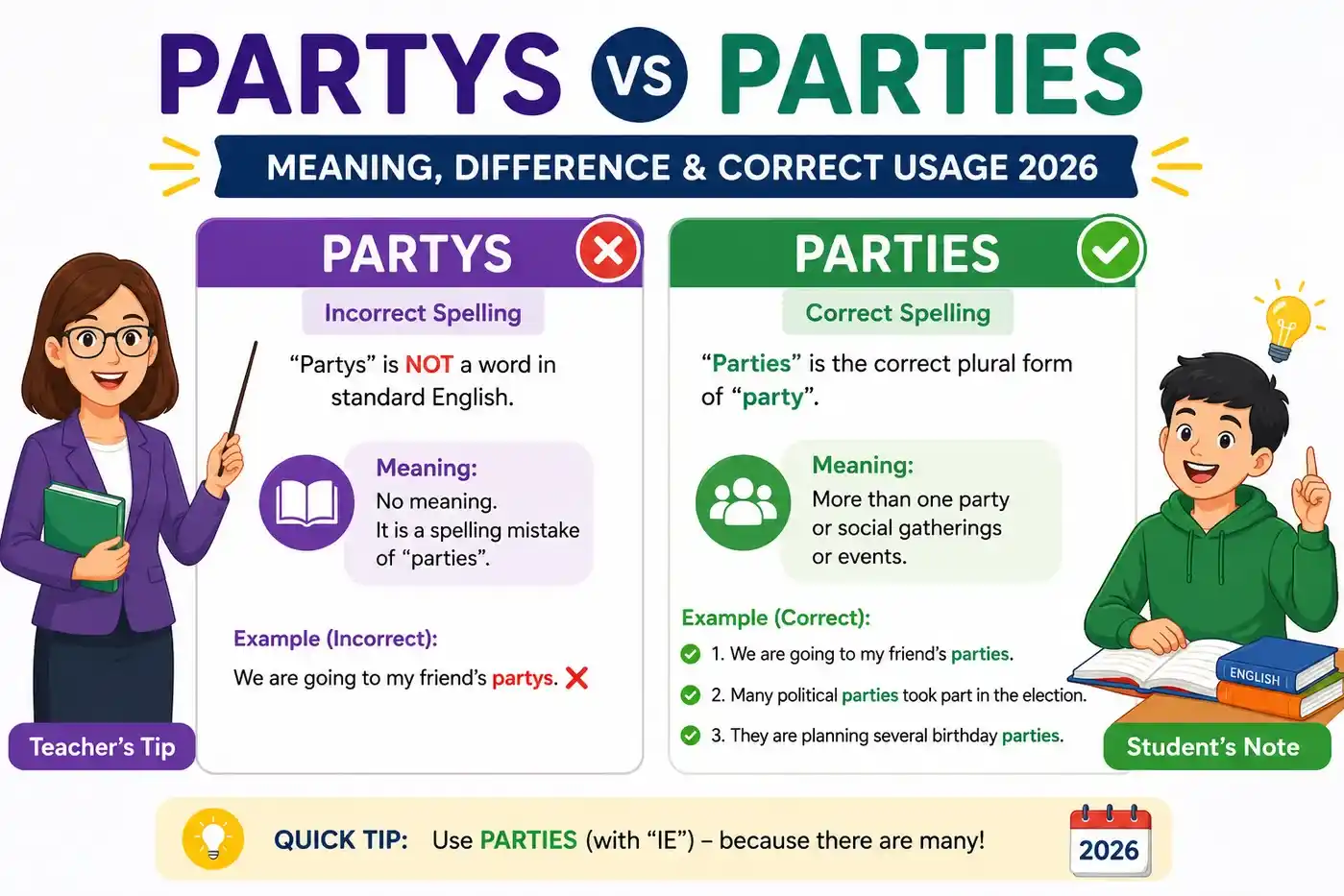
The short answer is simple: parties is the correct plural spelling of party, while partys is considered a misspelling in standard English. In this guide, you’ll learn the difference between these words, the grammar rule behind the correct spelling, pronunciation, etymology, usage examples, common mistakes, regional preferences, and expert writing advice. By the end, you’ll know exactly which form to use and why.
A related grammar guide is Gait vs gate and the correct usage.
Partys vs Parties Quick Definition
Parties is the correct plural form of the noun party. When a noun ends in a consonant followed by y, English grammar requires changing the y to i and adding -es. Therefore, party becomes parties. The spelling partys is incorrect in standard English and should generally be avoided.
Partys vs Parties Quick Answer
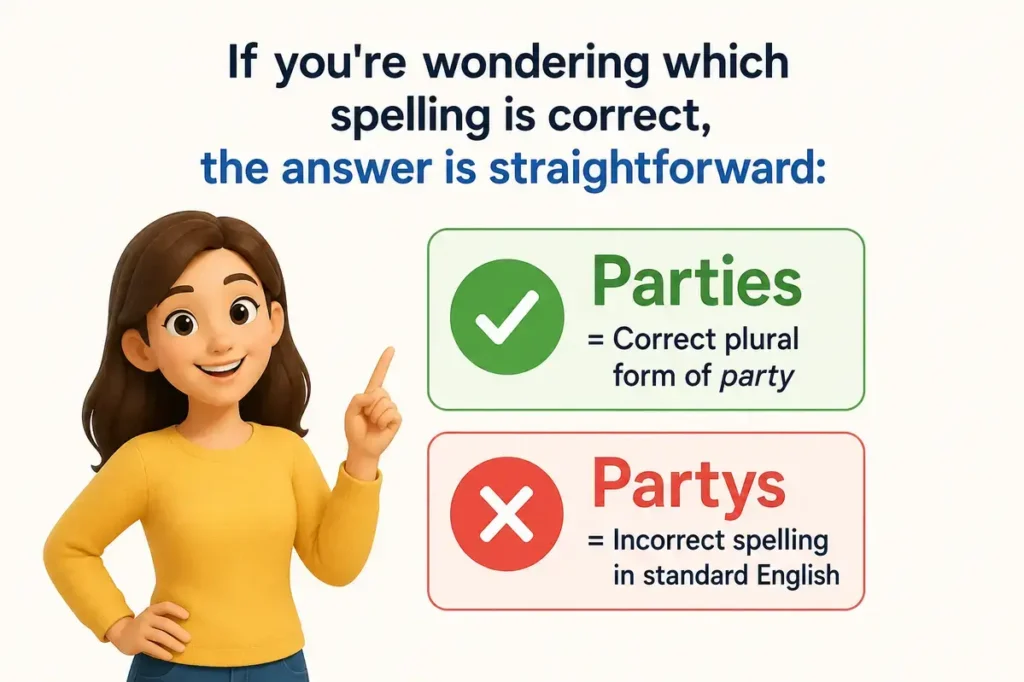
If you’re wondering which spelling is correct, the answer is straightforward:
- ✅ Parties = Correct plural form of party
- ❌ Partys = Incorrect spelling in standard English
Examples:
- We attended several parties last summer.
- Political parties are preparing for the election.
- The company hosts holiday parties every year.
In professional writing, academic work, journalism, and everyday communication, parties is the accepted spelling.
Comparison Table
| Feature | Partys | Parties |
|---|---|---|
| Correct spelling | No | Yes |
| Meaning | Intended plural of party | Plural of party |
| Part of speech | Misspelled noun | Plural noun |
| Grammar status | Incorrect | Correct |
| Dictionary recognition | Not accepted as standard | Accepted |
| Usage frequency | Extremely rare | Very common |
| Formality level | Incorrect in formal writing | Appropriate in all contexts |
| Academic use | Not recommended | Standard |
| Business use | Not recommended | Standard |
| Example | Incorrect: Several partys were held. | Correct: Several parties were held. |
Meaning of Partys and Parties
Parties Mean
Parties is the plural form of party.Depending on context, it can refer to:
- Social gatherings.
- Political organizations.
- Legal participants in a contract or lawsuit.
- Groups involved in negotiations or agreements.
Examples:
- The neighborhood hosts summer parties.
- Several political parties competed in the election.
- Both parties signed the contract.
Partys Mean
Partys is generally considered a spelling error.Writers sometimes create this form by mistakenly adding -s to the singular noun without applying the correct pluralization rule.
Examples of incorrect usage:
- ❌ Many partys were canceled.
- ❌ Birthday partys are popular.
Correct versions:
- ✅ Many parties were canceled.
- ✅ Birthday parties are popular.
Grammar Rule Explained
The reason parties is correct comes from a standard English spelling rule.
The Rule
When a noun ends with:
- A consonant + y
Change the y to i and add -es.
Examples:
| Singular | Plural |
|---|---|
| Party | Parties |
| City | Cities |
| Baby | Babies |
| Country | Countries |
| Family | Families |
| Story | Stories |
Because party ends with t + y, the plural becomes:
party → parties
Not:
party → partys
Why English Uses This Rule
The spelling change helps preserve readability and follows long-established English conventions. Over centuries, these plural forms became standardized through dictionaries, education systems, and publishing practices.
Easy Memory Trick
Remember this simple formula:
Consonant + Y = Replace Y with IES
Examples:
- Party → Parties
- Lady → Ladies
- Penny → Pennies
- Country → Countries
If you remember this one rule, you’ll never confuse partys vs parties again.
Key Differences
Although the two words look similar, the differences are significant.
Spelling Difference
- Parties follows standard grammar.
- Partys breaks standard grammar rules.
Dictionary Status
- Parties appears in major dictionaries.
- Partys generally does not appear as a valid standard word.
Professional Usage
- Parties is accepted in business, education, law, and publishing.
- Partys is viewed as a spelling mistake.
Reader Perception
Using parties demonstrates strong language skills.
Using partys may create a negative impression and distract readers from your message.
Search and Publishing Standards
Books, newspapers, academic papers, and professional websites overwhelmingly use parties, making it the recognized standard worldwide.
Correct word is: Partys or Parties
The correct spelling is parties. English grammar requires nouns ending in a consonant plus y to change the y into i before adding -es.
Correct:
- Parties
- Cities
- Babies
- Families
Incorrect:
- Partys
- Citys
- Babys
- Familys
This rule applies consistently across standard English writing.Using parties ensures your writing remains grammatically correct, professional, and easy to understand.
Examples in Sentences
One of the best ways to remember the correct spelling is to see it used in real sentences. Notice that every correct example uses parties, not partys.
10 Correct Examples Using Parties
- We attended three birthday parties last month.
- Several political parties participated in the debate.
- The company organizes holiday parties for employees.
- Both parties agreed to the contract terms.
- Neighborhood parties are common during summer.
- The wedding season brought many family parties.
- Different parties expressed their opinions during the meeting.
- Schools often host graduation parties for students.
- The legal dispute was settled by both parties.
- Their annual parties attract hundreds of guests.
10 Incorrect Examples Using Partys
The following examples demonstrate common mistakes:
- ❌ We attended three birthday partys last month.
- ❌ Several political partys participated in the debate.
- ❌ The company organizes holiday partys.
- ❌ Both partys signed the agreement.
- ❌ Community partys were held downtown.
- ❌ The school planned graduation partys.
- ❌ Different partys discussed the issue.
- ❌ Family partys are popular in December.
- ❌ Many partys were canceled due to weather.
- ❌ Business partys help with networking.
Each sentence becomes correct when partys is replaced with parties.
Common Mistakes
Many writers make avoidable errors when pluralizing nouns ending in y.
Mistake 1: Simply Adding S
Many people assume every noun becomes plural by adding s.
Examples:
- ❌ Partys
- ❌ Babys
- ❌ Citys
- ❌ Familys
Correct versions:
- ✅ Parties
- ✅ Babies
- ✅ Cities
- ✅ Families
Mistake 2: Forgetting the Consonant Rule
The rule only applies when y follows a consonant.
Examples:
- Party → Parties
- Country → Countries
- Story → Stories
Because the letter before y is a consonant, the spelling changes.
Mistake 3: Applying the Rule Everywhere
Some learners overcorrect and use ies even when they should not.
Examples:
- Boy → Boys
- Toy → Toys
- Key → Keys
Since the letter before y is a vowel, the word simply takes s.
Mistake 4: Trusting Autocorrect Too Much
Most modern spell checkers catch partys, but not all software does. Writers should still understand the rule instead of relying entirely on technology.
Mistake 5: Using Informal Internet Spellings
Social media posts sometimes contain nonstandard spellings. Just because a word appears online does not make it grammatically correct.
Need another quick comparison? Read cleverer vs more clever Which Form Should You Use.
Partys vs Parties Pronunciation Guide
Interestingly, pronunciation is not what causes the confusion.
Pronunciation of Party
IPA:
/ˈpɑːrti/ (British English)
/ˈpɑːrti/ or /ˈpɑrti/ (American English)
Syllable Breakdown:
Par-ty
Pronunciation of Parties
IPA:
/ˈpɑːrtiz/
Syllable Breakdown:
Par-ties
Why Spelling Causes Confusion
When spoken quickly, the plural ending may not sound dramatically different from other plural nouns. Because learners often write words based on sound, they may mistakenly produce partys instead of parties.
Common Pronunciation Mistakes
- Overemphasizing the final syllable.
- Pronouncing “ties” as a separate word.
- Dropping the plural sound entirely.
Native speakers naturally pronounce parties as a smooth two-syllable word.
Partys and Parties Etymology and Word Origin
Understanding a word’s history often makes its spelling easier to remember.
Origin of Party
The word party comes from:
- Old French partie
- Latin partire
Both roots relate to the idea of dividing, sharing, or forming a group.Over time, English adopted party to describe:
- A social gathering.
- A political group.
- A person or group involved in a legal matter.
Development of the Plural Form
As English spelling rules evolved, nouns ending in consonant + y followed a standard pluralization pattern:
- Party → Parties
- Story → Stories
- Country → Countries
This rule became firmly established through dictionaries, grammar books, and educational systems.
Why Partys Never Became Standard
Although some writers occasionally used simplified spellings, English standardized around parties centuries ago. As a result, partys never gained acceptance in formal writing.
Birthday Party’s Or Parties
The correct choice depends on what you want to say. Birthday parties is the correct plural form when you’re talking about more than one celebration. For example, We attended three birthday parties this month. The word parties is simply the plural of party.
Birthday party’s uses an apostrophe to show possession. It means something belongs to a single birthday party. For example, The birthday party’s decorations matched the theme. In this sentence, the decorations belong to one birthday party.
If you’re referring to multiple celebrations, always use birthday parties. Use birthday party’s only when showing ownership.
Partys Vs Parties On Reddit
Reddit discussions about partys vs parties almost always reach the same conclusion. Native speakers, English learners, teachers, and editors agree that parties is the correct plural form of party. The spelling partys is widely recognized as a common mistake rather than an accepted English word.
Many Reddit users explain that the plural follows a standard grammar rule. When a noun ends in a consonant followed by y, change the y to i and add es. That’s why party becomes parties, just as city becomes cities and baby becomes babies.
The general consensus is clear. If you’re referring to more than one party, parties is always the correct spelling, while partys should be avoided in both formal and everyday writing.
Partys vs Parties Regional Usage
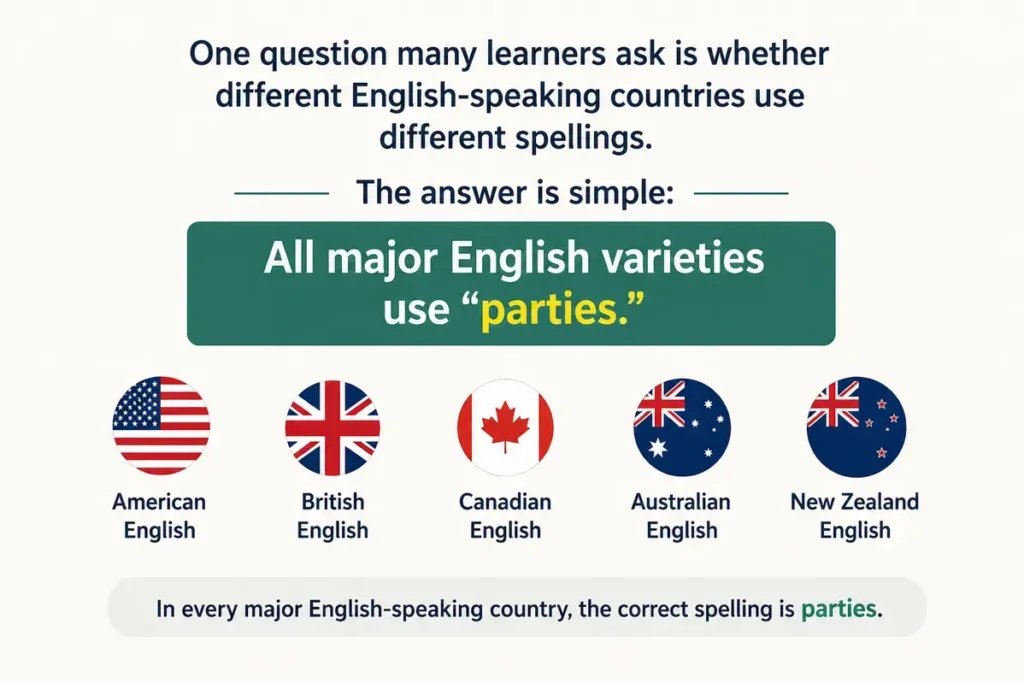
One question many learners ask is whether different English-speaking countries use different spellings.
The answer is simple:
All major English varieties use “parties.”
American English
American English uses:
- Parties
Examples:
- Birthday parties
- Political parties
- Business parties
British English
British English also uses:
- Parties
Examples:
- Garden parties
- Political parties
- Christmas parties
Australian English
Australian English follows the same rule:
- Parties
The spelling partys is considered incorrect.
Canadian English
Canadian English likewise uses:
- Parties
Across North America, Europe, Australia, and other English-speaking regions, parties remains the accepted spelling.
Is Partys Ever Acceptable Regionally?
No.
Unlike some spelling differences such as:
- Color vs Colour
- Center vs Centre
There is no regional standard that recognizes partys as correct.
Grammar Rules
This topic ultimately comes down to grammar.
Rule 1: Consonant Plus Y
If a noun ends in a consonant followed by y, replace y with ies.
Examples:
- Party → Parties
- Family → Families
- Country → Countries
- Story → Stories
- Lady → Ladies
Rule 2: Vowel Plus Y
If a noun ends in a vowel followed by y, simply add s.
Examples:
- Boy → Boys
- Toy → Toys
- Key → Keys
- Monkey → Monkeys
Rule 3: Apply the Rule Consistently
Once you know which category the word belongs to, the plural form becomes predictable.
Rule 4: Check the Letter Before Y
Ask yourself:
“What letter comes immediately before the y?”
If it is:
- A consonant → change y to ies.
- A vowel → add s.
This single question solves most plural spelling problems.
Real-Life Usage Examples
Daily Conversation
- We’re attending two birthday parties this weekend.
- Several parties were happening across town.
Academic Writing
- Multiple political parties influenced the election results.
- Researchers interviewed representatives from various parties.
Professional Communication
- All parties agreed to the revised proposal.
- The contract was reviewed by both parties.
Legal Writing
- The parties entered into a legally binding agreement.
- Both parties must fulfill their obligations.
Literature and Media
Writers frequently use parties when describing:
- Celebrations
- Political organizations
- Legal participants
- Social events
Major newspapers, books, academic journals, and publishing houses consistently use parties, reinforcing its status as the correct spelling.
Related Words and Confused Terms
When researching partys vs parties, learners often encounter other words that follow similar spelling patterns. Understanding these related terms helps reinforce the pluralization rule.
Similar Plural Forms
| Singular | Correct Plural |
|---|---|
| Party | Parties |
| City | Cities |
| Baby | Babies |
| Family | Families |
| Country | Countries |
| Story | Stories |
| Lady | Ladies |
| Company | Companies |
Commonly Confused Spellings
Many writers make similar mistakes with:
- Citys vs Cities
- Babys vs Babies
- Countrys vs Countries
- Storys vs Stories
- Ladys vs Ladies
- Companys vs Companies
In every case, the noun ends with a consonant plus y, so the plural requires ies.
Expert Language Insight on Partys vs Parties
As editors and language professionals, we often notice that spelling mistakes involving plural nouns are among the most common writing errors.The reason is simple. English contains multiple pluralization patterns rather than one universal rule. Writers naturally assume every noun becomes plural by adding s, which works for many words but not all.
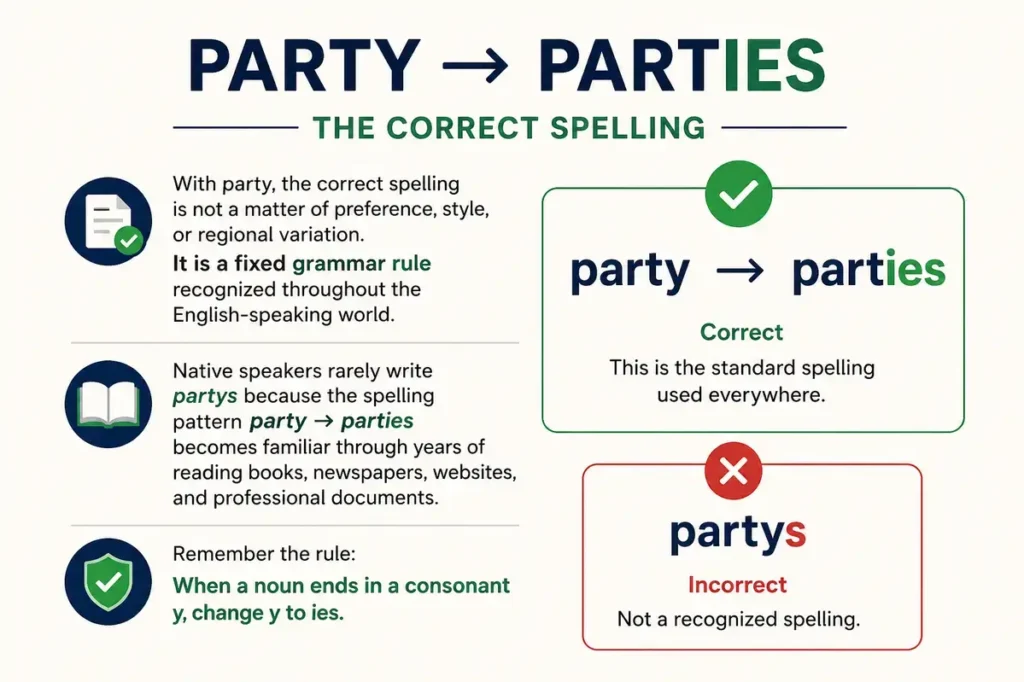
With party, the correct spelling is not a matter of preference, style, or regional variation. It is a fixed grammar rule recognized throughout the English-speaking world.Native speakers rarely write partys because the spelling pattern party → parties becomes familiar through years of reading books, newspapers, websites, and professional documents.
For learners, the most effective strategy is to focus on the underlying rule rather than memorizing individual words. Once you understand why party becomes parties, you can correctly pluralize hundreds of similar nouns.Professional editors generally view partys as an obvious spelling error. Using parties ensures your writing appears polished, credible, and grammatically accurate.
Frequently Asked Questions
Is partys a real word?
No. In standard English, partys is not considered the correct plural form of party. Dictionaries, style guides, and grammar authorities recognize parties as the proper spelling.
Why is parties correct instead of partys?
The noun party ends with a consonant followed by y. English grammar requires changing the y to i and adding es, creating the plural form parties.
Do American and British English use different spellings?
No. Both American English and British English use parties. There is no regional variation that treats partys as correct.
Is parties used only for celebrations?
No. Parties can refer to social gatherings, political organizations, legal participants, business groups, or any collection of people involved in a shared activity.
How do I remember the rule?
Use this formula:
Consonant + Y = IES
Examples:
- Party → Parties
- City → Cities
- Family → Families
This simple pattern works for many English nouns.
What happens when a word ends in a vowel plus y?
In those cases, simply add s.
Examples:
- Boy → Boys
- Toy → Toys
- Key → Keys
The spelling change only occurs after a consonant.
Can partys ever be acceptable in informal writing?
Even in casual writing, parties remains the preferred spelling. While people occasionally type partys online, it is still considered a spelling mistake.
Is parties singular or plural?
Parties is plural.
Examples:
- Several parties attended the event.
- Two political parties competed in the election.
The singular form is party.
Still confused? Compare arial vs aerial Which Word Should You Use.
Conclusion
The debate over partys vs parties has a clear answer. Parties is the correct plural form of party, while partys is considered a spelling error in standard English. The rule behind the difference is straightforward. When a noun ends with a consonant followed by y, the y changes to i before adding es. That is why:
- Party → Parties
- City → Cities
- Family → Families
This spelling remains consistent across American, British, Canadian, and Australian English. If you want writing that looks professional, polished, and grammatically correct, always choose parties. Learning this single rule will help you avoid similar mistakes with dozens of other English words. The key takeaway is simple:
whenever you are unsure between these words, remember that parties is the only correct standard spelling.