

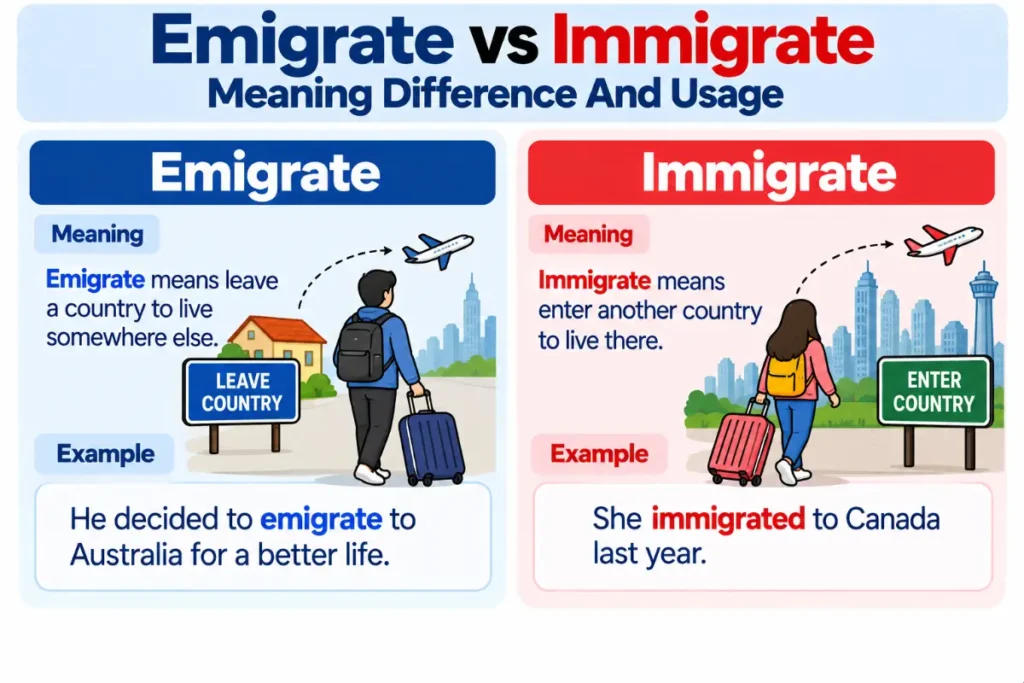
Confusing two similar words can change the meaning of a sentence. The difference between emigrate vs immigrate comes down to the direction of a move. Both words describe moving from one country to another, but each focuses on a different side of that journey.
To emigrate means to leave your home country to live somewhere else. To immigrate means to enter another country to establish a new home there. For example, someone who leaves Mexico to settle in the United States emigrates from Mexico and immigrates to the United States. Both descriptions are correct because they focus on different parts of the same move.
This distinction becomes easier once you connect each word with its starting point or destination. It also helps you write more clearly in everyday conversations, school assignments, workplace emails, travel discussions, and formal documents. The following guide explains the meanings, grammar, pronunciation, word origins, common mistakes, and real life examples so you can choose the right word with confidence.
Learn the difference in function vs functionality Which Word Should You Use.
Quick Answer
Emigrate means to leave one country to live in another. Immigrate means to enter a different country to live there. Both are correct English verbs. Use the first to describe departure from the original country and the second to describe arrival in the destination country.
Comparison Table
| Feature | Emigrate | Immigrate |
|---|---|---|
| Meaning | To leave a country to live elsewhere. | To enter another country to live there. |
| Part of speech | Verb. | Verb. |
| Main perspective | Starting country. | Destination country. |
| Common pattern | Emigrate from a country. | Immigrate to a country. |
| Noun form | Emigration. | Immigration. |
| Person | Emigrant. | Immigrant. |
| Formality | Standard in formal and informal English. | Standard in formal and informal English. |
| American usage | Describes leaving one’s country of residence. | Describes moving into the United States or another country. |
| Example | They emigrated from Ireland. | They immigrated to Canada. |
Meaning and Definition
What Emigrate Means
Emigrate is a verb that means leaving one country to establish a home in another. The word focuses on the place a person leaves rather than the place they plan to enter.
For example, if a family leaves Italy and settles in the United States, the family emigrates from Italy. The sentence describes the move from the Italian side of the journey. It doesn’t need to explain the destination unless that detail matters to the reader.
The word often appears in discussions about family history, international relocation, economic opportunities, political change, and major life decisions. It can describe a single person, a family, or a large group of people.
Common grammatical patterns include these examples.
- She plans to emigrate from India.
- Several families emigrated from the region.
- His grandparents emigrated in search of better opportunities.
- They decided to emigrate to a country with more job openings.
The fourth example names the destination, but the verb still emphasizes departure from the original country. English speakers can use the word with a destination when the context calls for it. The key idea remains leaving one country to live in another.
What Immigrate Means
Immigrate is a verb that means entering a country to establish a new home. It focuses on the destination rather than the place someone leaves.
Imagine that a person moves from Brazil to the United States and plans to live there permanently. From the destination country’s perspective, that person immigrates to the United States. The sentence emphasizes the arrival and the plan to live in the new country.
This word frequently appears in discussions about immigration laws, residency applications, employment opportunities, family reunification, and the experiences of newcomers. It also appears in conversations about how people become part of a new community.
Common grammatical patterns include these examples.
- He hopes to immigrate to the United States.
- Her family immigrated to Australia last year.
- Many people immigrate for work or family reasons.
- They immigrated legally and began building a new life.
The verb doesn’t automatically describe a person’s legal status. Someone’s immigration status depends on the applicable laws and the person’s circumstances. The word itself describes movement into a country to live there.
Key Differences Explained
The Starting Point and Destination
The most useful distinction is the direction of the move.
Emigrate looks backward toward the country a person leaves. Immigrate looks forward toward the country a person enters. Both words can describe the same person and the same journey without contradicting each other.
Consider a family moving from Japan to the United States. The family emigrates from Japan and immigrates to the United States. One sentence describes the departure while the other describes the destination.
This perspective matters because readers often assume the words describe two different types of people. They don’t. A person can be an emigrant in relation to one country and an immigrant in relation to another.
Grammar and Word Forms
Both words function as verbs. They can appear in different tenses and grammatical structures.
- Present tense. She emigrates from her home country and immigrates to Canada.
- Past tense. They emigrated from Peru and immigrated to Spain.
- Future expression. He plans to emigrate next year and immigrate to another country.
- Present perfect. Her family has emigrated from its home country and immigrated to a new one.
The related nouns also follow different patterns. Emigration describes the act or process of leaving a country to live elsewhere. Immigration describes the act or process of entering another country to establish a home.
The people involved have corresponding names. An emigrant is someone who leaves a country to settle elsewhere. An immigrant is someone who enters a country to live there.
Pronunciation and Spelling
The words look similar and share several sounds, which makes them easy to mix up. However, their opening sounds provide a useful clue.
Emigrate begins with an initial sound similar to the letter E in the word exit. Immigrate begins with a short I sound, as in the word in. The middle and ending sounds are very similar.
Neither spelling is incorrect. The mistake happens when a writer chooses the right word form but uses it from the wrong perspective. Correct spelling alone doesn’t guarantee correct meaning.
Formality and Context
Both verbs work in casual conversations and formal writing. Neither is more correct simply because it appears in a legal document, newspaper article, school paper, or everyday discussion.
The choice depends on the point of view. A report about people leaving a region may use emigrate. A report about people entering a country may use immigrate.
For example, a historian might explain that families emigrated from Germany during a period of change. A researcher studying population patterns might describe how those families immigrated to the United States. Each word gives readers a different piece of information.
Which Form Is Correct
Both forms are correct English words. Neither is a misspelling of the other, and neither should replace the other in every situation.
Use emigrate when the sentence emphasizes leaving a country to live elsewhere. Use immigrate when the sentence emphasizes entering a country to establish a home. The prepositions from and to often make the distinction clear.
Compare these sentences.
- Maria emigrated from Argentina.
- Maria immigrated to the United States.
- Maria emigrated from Argentina and immigrated to the United States.
The third sentence combines both perspectives and describes one journey accurately. You can apply the same rule to people moving between any two countries.
Standard English dictionaries recognize both verbs and distinguish their meanings by direction. In careful writing, the goal isn’t to choose one word as universally correct. The goal is to match the word to the movement described in the sentence.
Sentence Examples
The following examples show how the two verbs work in everyday situations and formal contexts.
1. Everyday conversation. My neighbors emigrated from Poland and now live in Chicago.
2. Family history. My great grandparents immigrated to the United States many years ago.
3. Text message. My cousin plans to emigrate next summer and start a new life abroad.
4. Workplace communication. The company hired an adviser to help employees understand the paperwork involved in immigrating to Canada.
5. School assignment. The class studied why families emigrated from rural communities during periods of economic change.
6. Academic writing. The researcher examined how workers immigrated to major cities in search of employment.
7. Formal writing. Applicants should review the relevant immigration requirements before moving to their destination country.
8. Social conversation. After years of planning, their family immigrated to New Zealand to be closer to relatives.
9. News reporting. The report described how residents emigrated from the region after local industries closed.
10. Personal storytelling. She emigrated from South Korea as a child and later built a career in the United States.
Each sentence uses the verb that matches the direction of the move. Notice that the destination and starting point often provide enough context to make the choice clear.
Common Mistakes and Misspellings
Most errors involve choosing the wrong word for the intended direction. A few involve sentence structure or confusion with the related nouns.
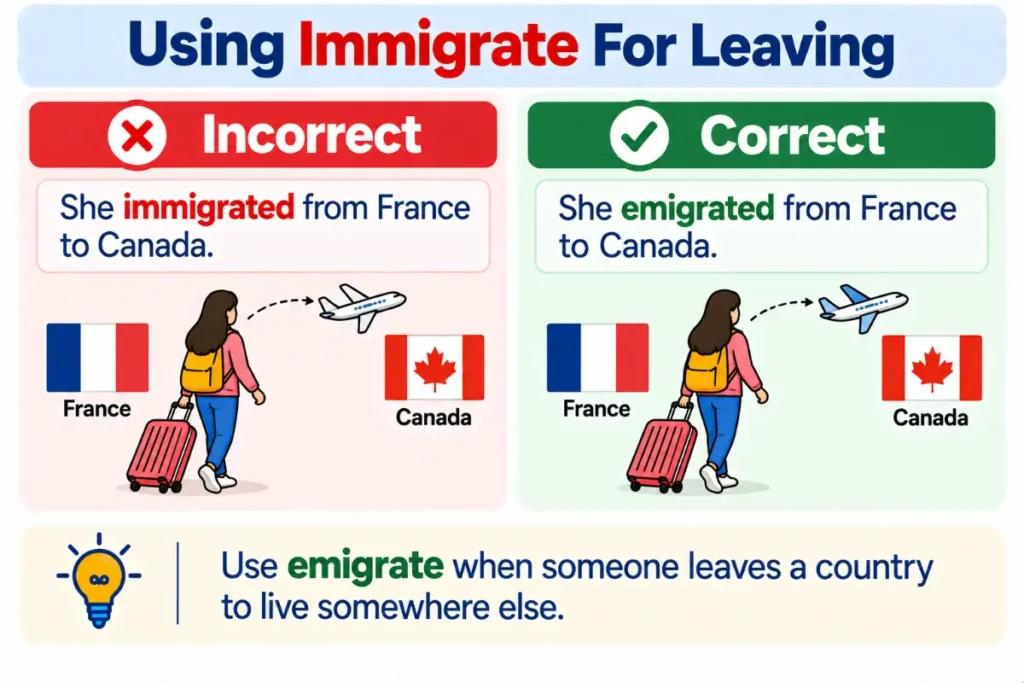
1. Using immigrate for departure. Incorrect: They immigrated from France to describe leaving France. Better: They emigrated from France. The confusion comes from treating both verbs as general terms for moving abroad.
2. Using emigrate for arrival. Incorrect: She emigrated to Canada when the sentence focuses on her arrival there. Better: She immigrated to Canada. The destination is the main focus, so the second verb fits better.
3. Mixing up the nouns. An emigrant leaves a country, while an immigrant enters one. For example, a person leaving Kenya is an emigrant from Kenya and an immigrant to the destination country.
4. Choosing the wrong preposition. Writers often use from and to inconsistently. A simple pattern helps: emigrate from a place and immigrate to a place. The destination can also follow emigrate when the sentence is framed around departure.
5. Confusing immigration with emigration. Immigration refers to entering a country to live there, while emigration refers to leaving one. These nouns are not interchangeable, even though both describe international population movement.
A practical way to catch these mistakes is to ask what the sentence emphasizes. If it describes the place someone leaves, use the departure word. If it describes the country someone enters, use the arrival word.
You may also want to read Borrow vs Barrow Explained With Examples.
Pronunciation Guide
The two verbs sound similar, but their first vowels differ. Learning that small difference can help you recognize each word when speaking and writing.
| Word | IPA | Easy pronunciation guide | Syllables |
|---|---|---|---|
| Emigrate | /ˈɛmɪˌɡreɪt/ | EM ih grayt | Three. |
| Immigrate | /ˈɪmɪˌɡreɪt/ | IM ih grayt | Three. |
The IPA forms above represent common American English pronunciations. The main stress falls on the first syllable in both words. The final part sounds alike, so pay attention to the first vowel rather than trying to hear a major difference across the entire word.
Common Pronunciation Mistakes
Some speakers pronounce the first syllable of both words alike. That can make the distinction harder to hear in fast conversation. The best approach is to practice the opening vowel and then say the complete word naturally.
You don’t need to exaggerate the difference. Keep the first vowel clear, maintain the stress on the opening syllable, and let the rest of the word flow naturally.
Etymology and Word Origin
Both words come from Latin roots associated with movement. Their shared history helps explain why their meanings overlap so closely.
Emigrate developed from Latin emigrare, meaning to move away or depart. The prefix e carries the sense of out or away, while the rest of the word relates to moving from one place to another.
Immigrate developed from Latin immigrare, meaning to move into or enter. The prefix in carries the sense of inward movement. Over time, English adopted both words to describe people moving between countries to live.
These roots provide a useful memory aid. The beginning of emigrate points outward, while the beginning of immigrate points inward. Although modern English usage depends on context rather than Latin alone, the word origins support the same distinction used today.
Regional Usage
The meanings of these verbs remain consistent across major English varieties. American, British, Canadian, and Australian English all use them to distinguish leaving a country from entering another one.
American English
In the United States, immigrate commonly describes moving into the country to live. Emigrate describes leaving another country or the United States to settle somewhere else.
For example, an American family moving to Ireland emigrates from the United States and immigrates to Ireland. A family arriving from Ireland may be described as immigrating to the United States.
In government discussions, immigration often receives more attention because the subject involves people entering the country. That doesn’t make emigration less correct or less useful.
British English
British English follows the same basic distinction. Someone who leaves the United Kingdom to establish a home elsewhere emigrates from the UK. Someone who arrives in the UK to live there immigrates to the UK.
The main difference is the country’s position in the story, not the meaning of the verb. Writers should use the word that reflects the direction being discussed.
Australian English
Australian English also uses both terms in the standard way. A person leaving Australia to settle abroad emigrates from Australia, while a person moving to Australia to establish a home immigrates to Australia.
These words appear in discussions about family history, population change, employment, and international relocation. Their meanings don’t change simply because the destination is Australia.
Canadian English
Canadian English follows the same rule. People moving out of Canada to settle elsewhere emigrate from Canada. People moving into Canada to establish a home immigrate to Canada.
Across all four varieties, the most reliable guide is the same: focus on the starting country for departure and the destination country for arrival.
Grammar Rules and Part of Speech
Both words are verbs, so they describe an action or process. They can appear in the present, past, and future, and they can work with helping verbs such as has, have, will, and had.
Common Sentence Patterns
Use these patterns to build grammatically correct sentences.
- Emigrate from a country. They emigrated from Egypt.
- Immigrate to a country. They immigrated to the United States.
- Plan to emigrate. She plans to emigrate next year.
- Hope to immigrate. He hopes to immigrate to Canada.
- Have emigrated. Several families have emigrated from the area.
- Have immigrated. Many newcomers have immigrated to the region.
The prepositions help readers follow the movement. From usually introduces the place a person leaves, while to usually introduces the destination.
The Related Nouns
Emigration and immigration are nouns. They name the process rather than the action expressed directly by a verb.
For example, a sentence might say that a family emigrated from Greece. A related sentence could describe the family’s emigration from Greece. The first uses a verb, while the second uses a noun.
The same pattern applies to immigration. A family immigrated to the United States, and the family’s immigration took place several years ago. Both forms are correct, but they serve different grammatical roles.
The Related People
Emigrant and immigrant are nouns that describe people from different perspectives. An emigrant is someone who leaves a country to live elsewhere. An immigrant is someone who enters a new country to establish a home.
A single person can fit both descriptions. Someone who leaves Vietnam to settle in the United States is an emigrant from Vietnam and an immigrant to the United States. The labels depend on the country being discussed.
Punctuation and Sentence Position
Neither verb needs special punctuation. Use ordinary sentence structure and punctuation based on the full sentence.
You can start a sentence with either word when the grammar supports it. For example, Emigrating from a familiar place can be difficult. Immigrating to a new country often requires patience. In these examples, the verbs appear in their gerund forms and act as the subjects of the sentences.
Formal and informal writing follow the same basic grammar. The key is to keep the meaning consistent throughout the paragraph.
Real Life Usage Examples
The words appear in many kinds of writing. The following examples show how context changes the perspective.
Daily Conversation
- My uncle emigrated from Lebanon when he was young.
- Her parents immigrated to the United States before she was born.
In casual conversation, people often focus on the country they know best. Someone talking about a relative’s departure may choose one verb, while a person discussing the relative’s new home may choose the other.
Email and Workplace Communication
- Our employee plans to immigrate to Canada and has started reviewing the relevant requirements.
- The meeting will cover relocation plans for staff members who intend to emigrate from the United States.
Workplace communication benefits from precise wording because international moves can involve legal, financial, and personal arrangements. The correct verb helps clarify the direction of travel.
Academic Writing
- The study examines why families emigrated from agricultural communities during periods of economic change.
- Researchers analyzed the experiences of people who immigrated to large urban centers.
Academic writing often examines population movement from several angles. Authors may use both words in the same paper because departures and arrivals answer different research questions.
News and Journalism
- Local officials discussed the reasons residents had emigrated from the region.
- The report examined the challenges faced by families immigrating to the country.
News writers need to describe movement accurately without changing the meaning of the event. The choice of verb should reflect the facts and the perspective of the report.
Literature and Storytelling
- In her memoir, the author describes how her family emigrated from a small European village.
- The novel follows a young man who immigrates to America and struggles to adapt to his new home.
Stories often explore both sides of relocation. One chapter may describe leaving home, while another focuses on building a life in a new country. Using the right verb helps readers follow that journey.
Related and Confused Terms
Several related words describe international movement, the people involved, or the process of settling in a new place. They overlap in meaning, but they don’t all mean the same thing.
1. Migration. This is the broad term for movement from one place to another. It can describe movement within a country or across international borders. Emigration and immigration are specific forms of migration.
2. Migrate. This verb means to move from one place to another, often for an extended period. It can describe people, animals, and even data moving between computer systems. Unlike the two main verbs, it doesn’t always specify a country of departure or arrival.
3. Emigration. This noun describes leaving a country to live elsewhere. It focuses on departure rather than arrival.
4. Immigration. This noun describes entering another country to establish a home. It often appears in discussions about policy, legal procedures, and population trends.
5. Emigrant. This is a person who leaves a country to live in another. The term describes the person from the starting country’s perspective.
6. Immigrant. This is a person who moves into another country to live there. The term describes the person from the destination country’s perspective.
7. Relocation. This means moving from one place to another. It may describe a move across town, to another state, or to another country. It doesn’t necessarily involve crossing an international border.
8. Expatriate. This term often describes someone living outside their country of origin. Its meaning can depend on context, and it doesn’t replace immigrant or emigrant in every sentence. A person living abroad may be called an expatriate while also being an immigrant in the country where they reside.
The most useful distinction is that migration and relocation are broad terms, while the other words identify particular roles or perspectives. Choose the term that communicates the exact idea you want readers to understand.

Expert Editor Insight
An experienced English editor looks beyond spelling and checks the direction of the action. Both verbs are valid, so a spell checker may accept either one even when the sentence uses the wrong word. The best editing trick is to identify the starting country and the destination before choosing a verb. If the sentence describes leaving a country, use emigrate. If it describes entering a country to live, use immigrate. This simple check catches errors that ordinary spelling tools can miss.
Still confused? Compare Moral vs Morale Meaning and Usage Explained.
Conclusion
The difference between emigrate vs immigrate is simple once you focus on direction. Emigrate means leaving a country to live somewhere else, while immigrate means entering another country to establish a home. Both words are correct, and a single person can be an emigrant from one country and an immigrant to another.
Use one practical editing trick whenever you feel unsure. Identify the starting country and the destination before choosing your verb. Remember the pattern emigrate from and immigrate to. With that small habit, you’ll avoid a common word choice mistake and write with greater clarity and confidence.
FAQs
Is Emigrate a Real Word?
Yes. Emigrate is a standard English verb that means leaving one country to establish a home in another. It isn’t a misspelling of immigrate. The two words describe the same kind of international movement from different perspectives. For example, someone moving from Spain to the United States emigrates from Spain and immigrates to the United States.
What Does Immigrate Mean?
Immigrate means entering a country to live there. The word focuses on the destination rather than the country someone leaves. For example, a person who moves from India to Canada to establish a home immigrates to Canada. The term doesn’t automatically indicate citizenship or legal status. Those details depend on the person’s circumstances and the destination country’s laws.
Which Is Correct Emigrate or Immigrate?
Both words are correct. The right choice depends on the direction of the move. Use emigrate when focusing on leaving a country and immigrate when focusing on entering another country to live. For instance, a family moving from Japan to Australia emigrates from Japan and immigrates to Australia. The two verbs describe different sides of the same journey.
How Do You Pronounce Emigrate and Immigrate?
Both words have three syllables and stress the first syllable in common American English pronunciation. Emigrate begins with the vowel sound in the word exit, while immigrate begins with the short vowel sound in in. Their remaining sounds are similar. Practicing the opening vowel can help you distinguish them during conversation.
Can Emigrate or Immigrate Start a Sentence?
Yes. Both words can start a sentence when used in a grammatically correct form. For example, Emigrating from your home country can involve major changes. Immigrating to a new country may require careful planning. These sentences use the ing forms as subjects. You can also begin a sentence with the base verb in a suitable command or instruction.
What Is a Synonym for Emigrate or Immigrate?
Migrate is a broad term that can describe movement from one place to another. Relocate is another useful option when the main idea is moving to a new home. However, neither word always captures the precise direction expressed by the two specific verbs. If the starting country or destination matters, choose the more exact term.
Why Do People Confuse These Two Words?
People confuse these verbs because their spelling and pronunciation are very similar. Both describe international movement, and both can refer to the same person. The difference lies in perspective rather than in the type of journey. Remembering that one word focuses on departure and the other on arrival makes the distinction easier to apply in everyday writing.
Are These Words Appropriate for Formal Writing?
Yes. Both verbs are standard choices for formal writing, including academic papers, news reports, workplace documents, and discussions of population movement. The important point is to use each word accurately. Emigrate describes leaving a country to live elsewhere, while immigrate describes entering another country to establish a home. Precise word choice makes formal writing clearer and more trustworthy.