

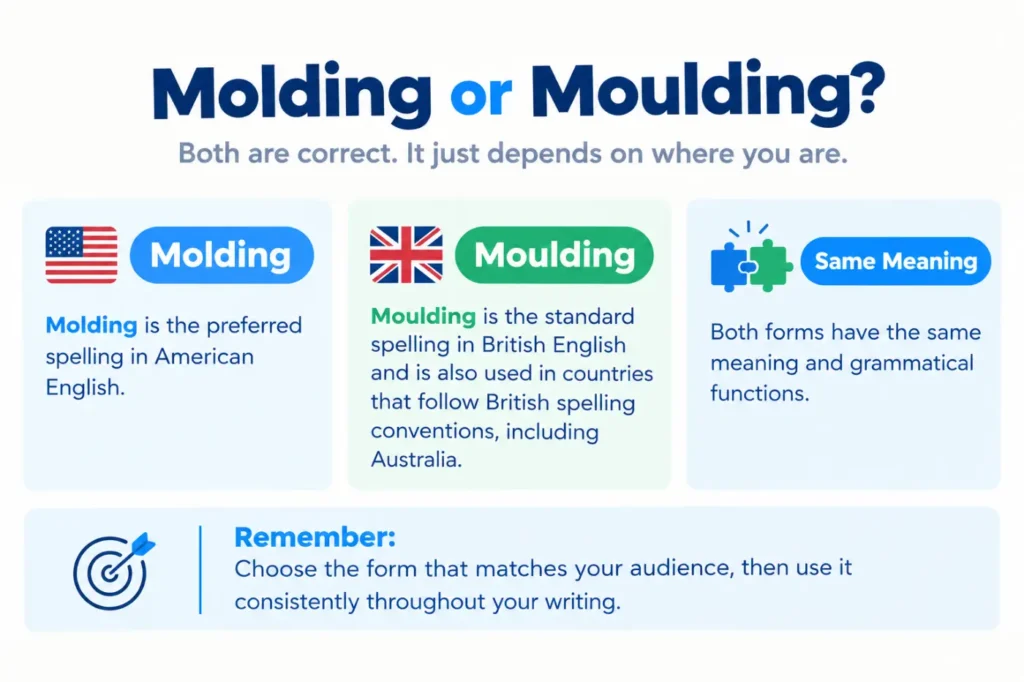
Molding or moulding can be confusing because both spellings are correct, yet they belong to different English spelling traditions. If you write for an American audience, use molding. If you follow British English conventions, use moulding. The meaning stays the same, so the choice depends mainly on your audience and the spelling style you follow.
Both forms can describe decorative trim around doors and windows, the process of shaping a material, or an object made in a mold. The word also appears in construction, manufacturing, art, education, and discussions about how people develop their skills and behavior. Context helps you identify the intended meaning, but it usually does not change the regional spelling rule.
This distinction matters in everyday writing as well as technical documents. A consistent spelling style makes your work easier to read and gives it a more professional finish. Below, you’ll find the definitions, pronunciation, grammar rules, regional differences, common mistakes, and practical examples you need to choose the right form with confidence.
For another common grammar confusion, see loan vs lend The Difference Explained With Examples.
Quick Answer
Molding is the standard American English spelling. Moulding is the standard British English spelling. Both words have the same meaning and pronunciation. Neither spelling is inherently incorrect, but you should choose the version that matches your intended audience and use it consistently throughout your writing.
Comparison Table
| Feature | Molding | Moulding |
|---|---|---|
| Standard variety | American English | British English |
| Meaning | Shaping material or decorative trim | Shaping material or decorative trim |
| Part of speech | Noun and verb form | Noun and verb form |
| Spelling pattern | Uses mold | Uses mould |
| Pronunciation | Same in ordinary usage | Same in ordinary usage |
| Formality | Standard and formal | Standard and formal |
| Common contexts | US construction and manufacturing | UK construction and manufacturing |
| Example | The carpenter installed new molding. | The carpenter installed new moulding. |
Meaning and Definition
The two spellings share the same core meanings. The difference is regional spelling rather than a difference in definition, grammar, or pronunciation.
What Does Molding Mean?
Molding is a noun or a form of the verb mold. Its meaning depends on the sentence.
As a noun, it can refer to decorative material used along walls, ceilings, doors, and windows. This trim can add visual detail, cover small gaps, or create a clean transition between surfaces.
For example, a homeowner might install crown molding along the top of a living room wall. A builder might use base molding to finish the bottom edge of a wall near the floor.
The word also describes the process of shaping a material into a desired form. In manufacturing, a machine may shape heated plastic into a container or another product. In pottery, an artist may shape clay by hand or press it into a form.
As a verb form, molding describes an action that is happening or an activity used to shape something. It can also describe the gradual development of a person’s habits, character, or ideas.
For example, a teacher’s guidance may be molding a student’s confidence. In this figurative sense, the word describes an influence that gradually shapes someone or something.
What Does Moulding Mean?
Moulding has the same meanings as its American counterpart. It is the preferred spelling in British English and appears in construction, design, manufacturing, art, and general writing.
A British homeowner might choose decorative moulding for a hallway. A factory might describe a process used to shape rubber or plastic as injection moulding.
The word can also refer to the act of influencing someone’s development. A person’s early experiences may play a role in moulding their values and behavior.
The spelling with ou is not an error simply because an American reader is more familiar with the shorter form. It reflects a recognized difference between English spelling systems.
Is Either Form Incorrect?
Neither form is generally incorrect. The appropriate choice depends on the language variety required by the reader, publisher, school, business, or organization.
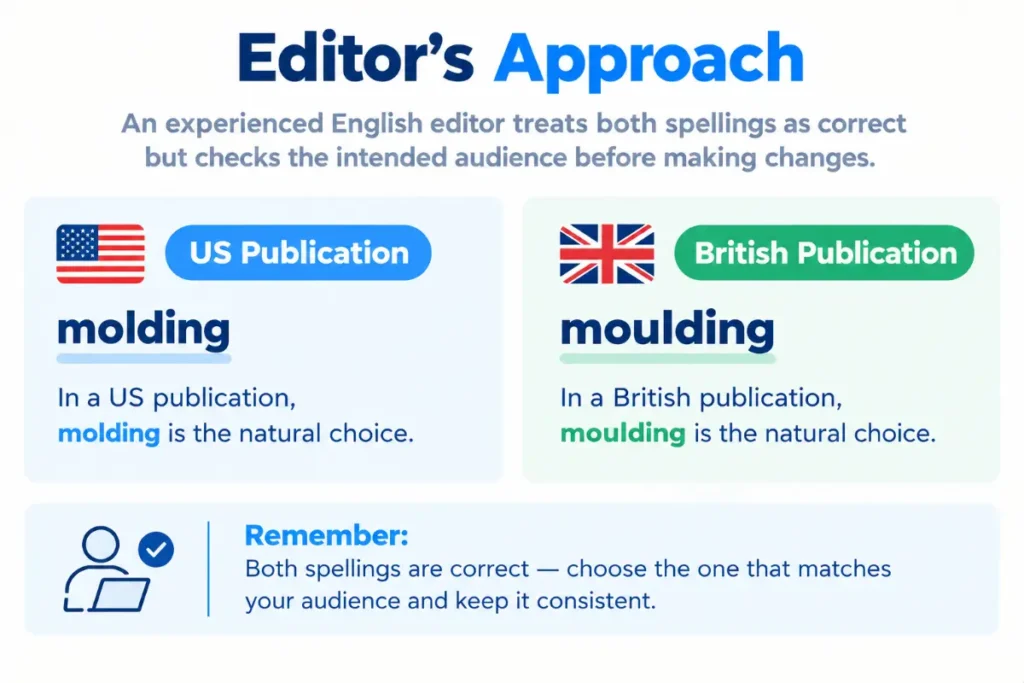
An American magazine would normally use molding. A British publication would normally use moulding. A document intended for a global audience can use either spelling if the choice follows a clear style guide.
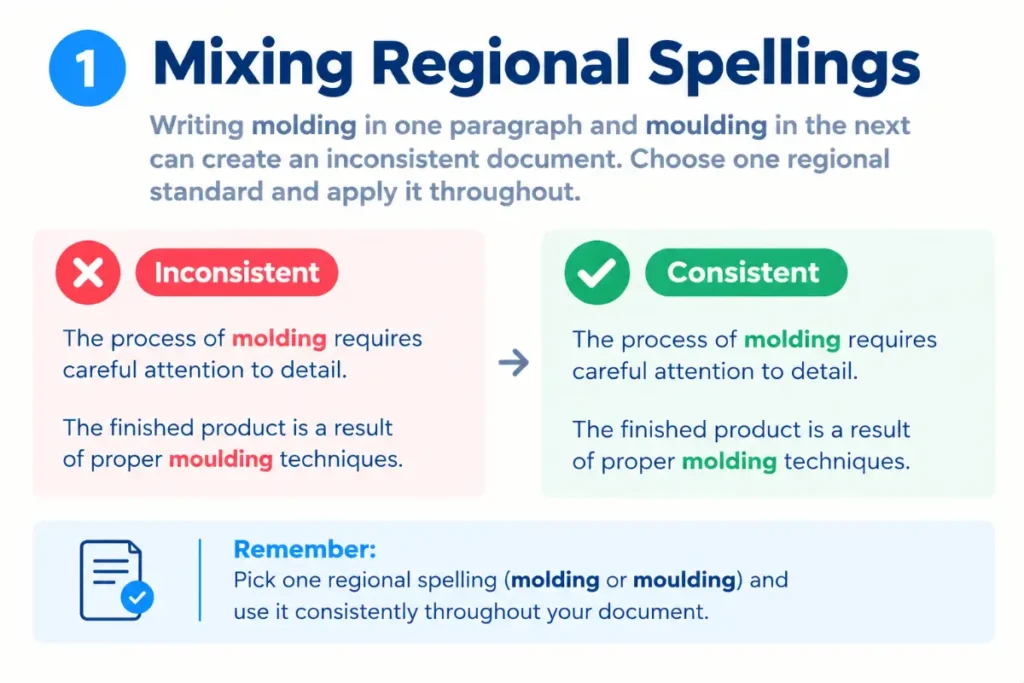
Problems arise when writers switch between the two forms without a reason. For example, using molding in one section and moulding in another may make a document look poorly edited. Consistency is the key.
Key Differences Explained
The distinction is straightforward, but several details are worth understanding.
Spelling
The main difference is the presence of the letter u.
- American English uses mold and molding.
- British English uses mould and moulding.
The same pattern appears in other word families, such as color and colour, or favorite and favourite. These are established regional conventions rather than spelling mistakes.
Meaning
The meanings are the same in ordinary use. Both forms can refer to decorative trim, shaping a material, a shaped object, or the influence that helps something develop.
For instance, an American manufacturer might describe a process as plastic molding. A British manufacturer might call the same process plastic moulding.
The spelling alone does not indicate a different technique, material, or product.
Grammar and Part of Speech
Both forms work as nouns and as the present participle of a verb.
As a noun, the word can identify a decorative feature or a shaping process.
Example: The molding around the window needs repair.
As a verb form, it can describe an ongoing action.
Example: The artist is molding the clay into a bowl.
It can also appear in a figurative expression.
Example: Reading played a major role in molding her outlook.
The grammar stays the same across both regional spellings.
Pronunciation
The two forms are pronounced alike in standard American and British usage. The added u in the British spelling does not create an extra syllable or a separate sound.
Regional accents can affect the pronunciation of the vowel and the final consonant, but those differences come from accent rather than spelling.
Formality and Context
Both spellings are appropriate in formal and informal writing when they match the selected English variety.
Use the American form in US building specifications, product descriptions, school assignments, and business documents that follow American spelling. Use the British form in UK publications, construction plans, and documents written according to British conventions.
In a technical document, consistency matters especially because the same term may appear dozens of times across instructions, diagrams, material lists, and product specifications.
Which Form Is Correct
The correct choice depends on your target variety of English. American English generally favors molding, while British English generally favors moulding. Established dictionaries recognize these regional spelling patterns, so there is no reason to label either form a universal misspelling.
For American readers, follow these practical rules.
- Write molding in US school assignments, business reports, product descriptions, and construction documents.
- Use moulding when reproducing British spelling or writing for a publication that follows British conventions.
- Follow the spelling already used in a client’s style guide, technical manual, or house style.
- Keep related words consistent. If you choose the American form, use mold and molded where appropriate. If you choose the British form, use mould and moulded where appropriate.
Remember that the choice is about spelling conventions, not quality. A well edited British document can use moulding correctly, just as a well edited American document can use molding correctly.
Sentence Examples
The following sentences show how the American spelling works in different situations. You can replace molding with moulding when writing in British English without changing the basic meaning.
- We chose white molding to match the walls in our living room.
- The carpenter replaced the damaged molding around the front door.
- The factory uses a molding process to produce plastic parts.
- She is molding the clay into a small decorative bowl.
- The architect included detailed molding in the renovation plans.
- Our science class studied how heat affects plastic molding.
- The new house has simple molding that gives each room a finished look.
- The company invested in equipment for faster injection molding.
- His early experiences were molding his views about education and responsibility.
- The contractor recommended painting the molding before installing it.
These examples cover decorative trim, manufacturing, art, construction, and figurative language. The surrounding sentence helps readers identify the intended meaning.
Common Mistakes and Spelling Confusion
The most common mistake is treating one regional spelling as incorrect in every setting. Other errors involve related word forms, grammar, or confusion between decorative trim and the material used to create it.
Using the Wrong Regional Spelling
Incorrect for a document following American English: The contractor installed new moulding.
Correct for American English: The contractor installed new molding.
The original sentence is not grammatically wrong. It simply uses the British spelling in a context that calls for American spelling. The reverse applies to British documents.
Mixing Regional Forms
Inconsistent: The carpenter installed new molding and replaced the damaged moulding.
Consistent American version: The carpenter installed new molding and replaced the damaged molding.
Switching forms without a clear reason can distract readers. A consistent style makes the writing look more polished.
Confusing the Noun With the Verb
Incorrect: The worker is mold the plastic into shape.
Correct: The worker is molding the plastic into shape.
The present progressive tense requires is followed by the verb ending in ing. The same rule applies to moulding in British English.
Using an Unnatural Plural
Incorrect in most ordinary contexts: The room has several moldings around the ceiling.
More natural: The room has several pieces of molding around the ceiling.
Moldings is possible when referring to separate types or instances of decorative trim. However, molding often works as a mass noun when referring to trim material in general. Choose the form that fits the intended meaning.
Confusing the Trim With Mold Growth
Incorrect for the intended meaning: Black molding appeared on the damp wall.
Correct if referring to fungal growth: Black mold appeared on the damp wall.
In American English, molding usually refers to shaping or decorative trim, while mold can refer to a type of fungus. British English uses mould for the fungus. The context helps distinguish these meanings.
Pronunciation Guide
Both spellings share the same basic pronunciation. The letter u in the British form changes the written appearance but does not add a syllable.
American English
Many readers also check Farther vs Further Explained With Clear Examples.
Molding
IPA: /ˈmoʊldɪŋ/
British English
Moulding
IPA: /ˈməʊldɪŋ/
Syllables and Stress
Both words have two syllables. The stress falls on the first syllable.
The American pronunciation uses the vowel sound commonly heard in go. The British transcription represents the corresponding vowel in standard British pronunciation. Actual speech varies by region and accent.
The ending sounds like the ing ending in walking or building. It does not need a separate stressed syllable.
Common Pronunciation Mistakes
- Adding an extra syllable because the British spelling contains an additional letter.
- Placing the main stress on the second syllable instead of the first.
- Pronouncing the ending as a separate stressed word rather than an unstressed part of the word.
A useful way to remember the pronunciation is to say the word naturally in a phrase such as decorative molding. Focus on the first syllable and keep the ending light.
Etymology and Word Origin
The history of the word helps explain why both spellings exist. The modern forms developed from older English vocabulary associated with shaping and forming materials.
The noun and verb are connected to mold in American English and mould in British English. The word has historical links to forms used for a shape, pattern, or container into which material can be pressed or poured. It also developed the broader sense of shaping or influencing something.
The spelling difference reflects a wider pattern in English. Words such as color and colour have developed distinct standard forms in American and British usage, even though their meanings remain the same.
American spelling often uses a simpler form without the u found in many British spellings. This pattern became established in US publishing, education, and dictionaries. British English retained the form mould, along with related words such as moulded and moulding.
The key point is that neither modern spelling is a random variation. Each belongs to an established spelling tradition.
Regional Usage
English spelling differs across countries, but the central meaning of this word remains stable. The most useful approach is to follow the spelling norms of your audience.
American English
Molding is the standard spelling in the United States. You will see it in home improvement articles, architectural descriptions, manufacturing documents, classroom materials, and product listings.
Common American expressions include crown molding, base molding, and injection molding. American writers also use molded for the past tense and past participle, as in The plastic was molded into a new shape.
For a US audience, the spelling without u is the safest default.
British English
Moulding is the standard British spelling. It appears in building plans, interior design descriptions, manufacturing documents, and general writing.
British writers typically use crown moulding or other forms of decorative moulding, along with moulded for the past tense and past participle.
The meanings are the same as those used in American English. The main distinction is the spelling system.
Australian English
Australian English generally follows British spelling conventions for this word. As a result, moulding is the usual choice in Australian writing.
However, a business may preserve American spelling in a product name, software interface, quotation, or document that follows a US company’s style guide. In those cases, follow the relevant source or style requirements.
Canadian English
Canadian English uses a mixture of British and American spelling conventions. Moulding is common in Canadian usage, especially in contexts that follow British spelling patterns, while some American spellings also appear in business and technical settings.
If you’re preparing Canadian material, follow the publication’s style guide or the spelling used consistently across its existing content. Don’t assume every Canadian word follows the same regional pattern.
Grammar Rules and Part of Speech
Understanding the word’s grammatical role helps you use it correctly in different sentences.
Using the Word as a Noun
As a noun, the word can refer to decorative trim or the process of shaping a material.
Examples include:
- The molding around the window needs a fresh coat of paint.
- Injection molding produces parts from heated material.
- The designer selected simple molding for the hallway.
In the first and third examples, the word refers to trim. In the second, it refers to a manufacturing process.
Using the Word as a Verb Form
Molding is the present participle of mold. It can appear in progressive verb forms or function as a modifier.
Examples:
- The artist is molding the clay by hand.
- The molding machine is operating at a steady temperature.
- The coach is molding the team into a stronger unit.
The British spelling follows the same pattern. For instance, The artist is moulding the clay by hand is correct in British English.
Using the Word as a Modifier
The word can describe a process or product when it appears before another noun.
Examples include molding equipment, molding process, and molding material. In British English, the corresponding phrases use moulding.
These combinations are common in technical writing because they identify the purpose or function of a product or process.
Singular and Plural Forms
When the word refers to decorative trim as a material, it often behaves like a mass noun. You can say The molding is damaged or We need more molding for the room.
When you mean separate styles or individual decorative features, the plural moldings may be appropriate. The British plural is mouldings.
The best choice depends on the meaning you intend to express. Don’t add a plural ending automatically if you’re talking about the material as a whole.
Verb Tenses
The main American forms are mold, molds, molded, and molding. British English commonly uses mould, moulds, moulded, and moulding.
Examples:
- The machine molds the plastic parts.
- The factory molded the pieces yesterday.
- The machine is molding a new batch.
In British spelling, the same sentences use moulds, moulded, and moulding. Keep the verb forms consistent with the spelling convention used throughout the document.
Real Life Usage Examples
The word appears in many settings, and its meaning often becomes clear from the surrounding details. These examples show how to use it naturally in conversation, professional writing, education, news, and storytelling.
Daily Conversation
- We should replace the old molding before we paint the bedroom.
- I like how the new molding makes the hallway look more finished.
In everyday speech, people often use the word when discussing home repairs, interior design, or changes to a room.
Email and Workplace Communication
- Please include the cost of the window molding in the renovation estimate.
- Our production team needs to inspect the molding equipment before the next shift.
These examples show how the term works in practical business communication. The first concerns construction costs, while the second refers to manufacturing equipment.
Academic Writing
- The study examines how family experiences contribute to molding children’s social behavior.
- The engineering report explains how temperature affects the plastic molding process.
The word can appear in social science and technical writing. In academic work, choose the spelling required by the institution or publication.
News and Journalism
- The renovation project will preserve the building’s original decorative molding.
- The manufacturer plans to upgrade its molding equipment to improve production efficiency.
These sentences illustrate how journalists might describe restoration work or industrial changes. A published article should follow the spelling conventions of its publication.
Literature and Storytelling
- Morning sunlight revealed the fine molding along the old library walls.
- Years of travel were molding her into a patient and thoughtful person.
The first sentence uses the word in a physical description. The second uses it figuratively to describe personal development.
Related and Confused Terms
Several words share meanings or appear in similar contexts. Knowing the differences helps you choose the most precise expression.
Mold and Mould
These are the base forms used in American and British English. They can refer to a shaping material or process, and they can also refer to fungal growth.
Example: The artist used a mold to shape the clay.
Molding and Moulding
These are the corresponding ing forms. They can describe the act of shaping material, decorative trim, or the process of influencing development.
Example: The molding around the fireplace matches the room’s design.
Molded and Moulded
These are past tense and past participle forms. American English usually uses molded, while British English usually uses moulded.
Example: The plastic was molded into a protective cover.
Casting
Casting is a process in which a liquid material is poured into a mold and allowed to solidify. It is related to molding, but the terms do not always describe the same manufacturing method.
Example: Metal casting is commonly used to produce complex metal parts.
Molding Compound
A molding compound is a material prepared for shaping into a product. Depending on the application, it may contain plastic resins, fillers, fibers, or other ingredients.
Example: The factory selected a molding compound designed to withstand heat.
Injection Molding
Injection molding is a manufacturing process that forces molten material into a mold, where it cools or cures into a chosen shape.
Example: The company uses injection molding to produce plastic housings.
Crown Molding
Crown molding is decorative trim installed where a wall meets a ceiling. It can create a traditional or elegant finish in a room.
Example: Crown molding gave the dining room a more formal appearance.
Baseboard
A baseboard is a strip of trim installed along the bottom of an interior wall. It can cover the joint between the wall and floor and protect the wall from everyday damage.
Example: The contractor replaced the damaged baseboard before installing the new flooring.
Expert Editor Insight
An experienced editor treats these spellings as a matter of regional consistency rather than right versus wrong. For American readers, molding is normally the preferred form. For British readers, moulding is generally the better choice. Editors also check related forms such as molded and moulded so that the spelling stays consistent throughout the document. Spellcheckers may accept both forms because both are legitimate English spellings. A useful editing tip is to set the document language before running a spelling check, then review regional variants manually. This prevents a valid word from being flagged simply because it belongs to another English variety.
Still confused? Compare Its vs It’s: Meaning and Correct Usage Explained.
Conclusion
Molding or moulding is a spelling choice based on regional English conventions. Both forms are correct and share the same meaning, pronunciation, and grammatical uses. American English favors molding, while British English generally uses moulding. Neither form is inherently better, and the choice does not change the meaning of the word.
For clear and professional writing, identify your target audience and follow its spelling standards. If you’re writing for readers in the United States, remember the simpler American form without the extra u. Check related words such as molded and moulded during editing to keep your writing consistent from beginning to end.
FAQs
Is Moulding a Real Word?
Yes. Moulding is a standard English spelling used mainly in British English and other varieties that follow British spelling conventions. It can refer to decorative trim, the process of shaping a material, or the act of influencing development. American English generally uses molding for the same meanings, so the British spelling should not automatically be treated as an error.
What Does Molding Mean?
Molding can refer to decorative trim around walls, doors, windows, or ceilings. It can also describe the process of shaping materials such as plastic or clay into a desired form. In a figurative sense, it means influencing how a person or thing develops. The exact meaning depends on the context in which the word appears.
Which Is Correct in American English
Molding is the standard choice in American English. It appears in construction, manufacturing, home improvement, and everyday writing. Moulding is a recognized British spelling rather than a universal misspelling, but it is usually not the preferred form in American documents. For US readers, use molding and keep related spellings consistent.
How Do You Pronounce Molding and Moulding?
Both forms have two syllables and share the same basic pronunciation within a given accent. In standard American English, the IPA transcription is /ˈmoʊldɪŋ/. The main stress falls on the first syllable. The spelling difference does not create an extra syllable, so the British form is not pronounced as a longer word simply because it contains an additional letter.
Can Molding Start a Sentence?
Yes. A sentence can begin with the word when it functions as a noun or a verb form. For example, Molding can improve the appearance of a room uses it as a noun. Molding the clay by hand requires patience uses it as a participle phrase. Capitalize the first letter as you would with any word at the start of a sentence.
What Is a Synonym for Molding?
The best synonym depends on the intended meaning. For the act of shaping something, forming or shaping may work. For decorative trim, trim or decorative edging may be suitable. In manufacturing, casting describes a related process but is not always interchangeable with molding. Choose a substitute based on the material, method, and purpose described.
Why Do People Confuse the Two Spellings?
People confuse these forms because American and British English use different spelling conventions for several familiar words. The added u appears in British forms such as mould and moulding, while American forms omit it. Writers may also copy spelling from websites or product descriptions intended for a different country. Following one consistent style guide helps prevent these switches.
Is Moulding Acceptable in Formal Writing?
Yes. Moulding is appropriate in formal writing that follows British English conventions. It can appear in academic papers, building specifications, business reports, and published articles. In American English documents, molding is normally the preferred choice. The important point is to follow the required language variety and maintain consistency across the entire document rather than mixing forms without a reason.