
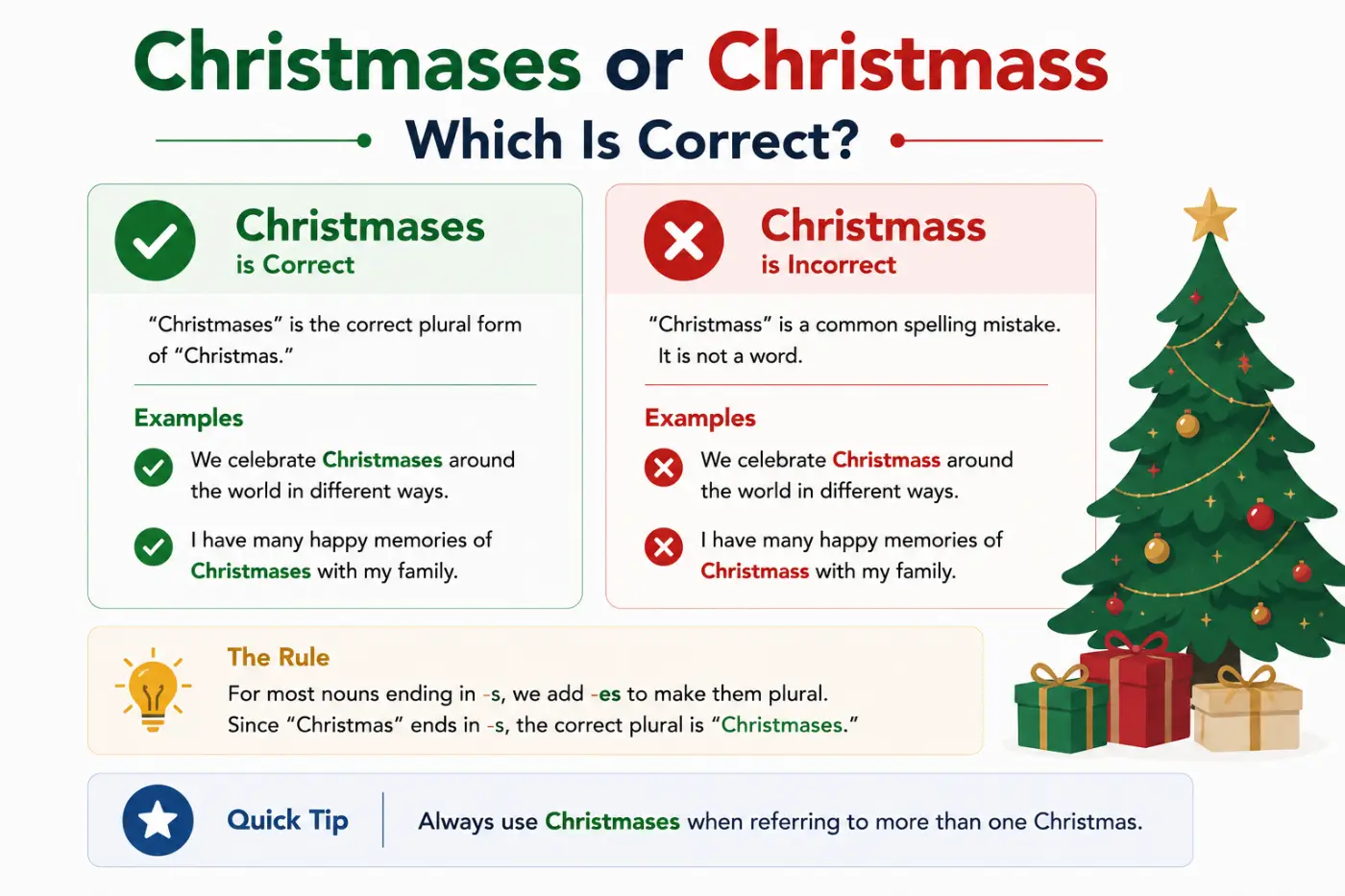
christmases or christmass can look confusing because both forms seem to be built from the familiar word Christmas. The correct plural spelling is Christmases. Christmass is not the standard plural form of Christmas and is normally a spelling error. If you’re talking about more than one Christmas celebration or referring to Christmas celebrations across different years you need the plural form Christmases.
The confusion comes from the unusual ending of Christmas. The word already ends in s so adding the regular plural ending can look awkward on the page. Some writers also assume that a word ending in s should simply take another s. English plural spelling doesn’t always work that way. With Christmas the usual plural form adds es after the existing s.
This guide explains the difference clearly and shows how the plural works in American English. You’ll learn the meaning of each form the correct grammar pronunciation capitalization and common mistakes. You’ll also see natural examples that show when native speakers use Christmases and when another expression may sound smoother.
For another common grammar confusion, see Excited or Exited Correct Spelling Meaning and Usage.
Quick Definition
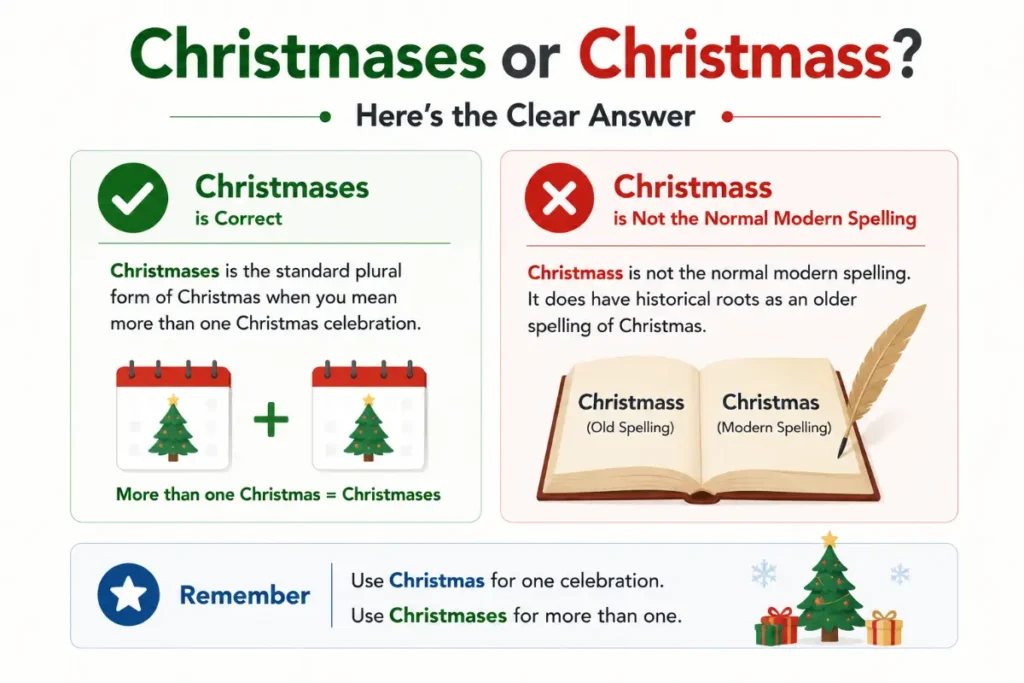
Christmases is the standard plural form of Christmas. It refers to multiple Christmas celebrations or multiple occasions of Christmas. Christmass is not the standard plural spelling. It is usually a spelling error caused by adding an extra s instead of using the regular es ending needed to form the plural.
Quick Answer
The correct plural form is Christmases. The spelling Christmass is normally incorrect when you mean more than one Christmas. Christmas is a proper noun when it refers to the Christian holiday celebrated on December 25. To make it plural you generally add es because the singular word already ends in s.
Comparison Table
| Correct Form | Meaning | Part of Speech | Origin | Usage Frequency | Formality | Common Contexts | Example |
|---|---|---|---|---|---|---|---|
| Christmases | More than one Christmas celebration or occasion | Plural noun | From Old English and later Christian usage | Uncommon but standard | Neutral | Historical writing personal stories comparisons | She spent three Christmases with her grandparents. |
| Christmass | Not the standard plural of Christmas | Nonstandard spelling | Spelling error rather than an established plural form | Common as an error | Not standard | Typing mistakes informal writing | Christmass should be corrected to Christmases. |
Meaning and Definition
Meaning of the Incorrect Form
Christmass is normally a spelling mistake rather than a standard English plural.
The error is easy to understand. Christmas already ends with the letter s. When people want to make it plural they may instinctively add another s and produce Christmass. That creates a form that looks as though it should mean several Christmas celebrations but doesn’t follow the standard spelling pattern.
This kind of mistake is common with words whose singular forms already end in s. English has several different plural patterns and writers sometimes apply the wrong one automatically.
In polished writing you should not use Christmass as the plural of Christmas. If you mean several Christmas celebrations use Christmases.
There is one useful distinction to keep in mind. A spelling can appear somewhere without being a standard English word. A typo in a message or a user created name doesn’t establish a grammatical rule. Context matters.
Meaning of the Correct Form
Christmases is the plural noun form of Christmas.
Christmas refers to the Christian festival traditionally observed on December 25 and to the broader Christmas season in common usage. Christmases refers to more than one such celebration or occasion.
For example:
I remember the Christmases we spent at my grandparents’ house.
The sentence refers to Christmas celebrations that happened in different years.
The plural can also appear when comparing different periods.
Her childhood Christmases were simple but happy.
Here the writer is referring to multiple Christmas occasions rather than one particular holiday.
The form can also be useful in historical writing.
The two families celebrated many Christmases together.
In everyday conversation people often avoid the plural simply because they can express the same idea in another way. Instead of saying We had many Christmases together a speaker might say We spent many Christmas holidays together.
Still Christmases is grammatically valid and useful when the writer wants to focus specifically on separate Christmas occasions.
Key Differences Explained
- Spelling. Christmases is the standard plural form. Christmass is normally a spelling error.
- Number. Christmas is singular while Christmases refers to more than one Christmas occasion.
- Plural formation. Because Christmas already ends in s the standard plural adds es.
- Grammar. Christmas is a noun. Christmases is its plural noun form.
- Pronunciation. The plural has an additional syllable compared with the singular.
- Capitalization. Christmas remains capitalized because it is the name of a holiday. The plural keeps the capital C.
- Formality. Christmases is acceptable in formal and informal writing although it is not especially common in everyday speech.
- Context. The plural is most useful when you need to distinguish several Christmas celebrations across different years or situations.
- Regional usage. Major varieties of English use Christmases as the standard plural spelling.
- Standard usage. Christmass should not be treated as an alternative plural form.
The main rule is simple. Keep Christmas intact and add es to form the plural.
Which Form Is Correct?
Christmases is the correct plural spelling.
The reason is connected to a common English plural pattern. Nouns that end in certain s sounds often form their plural with es rather than simply adding s. Christmas follows this pattern.
Think about the singular and plural forms visually.
Christmas
Christmases
The word keeps its original spelling and receives es at the end.
The incorrect form Christmass does something different. It adds only one extra s. That does not produce the standard plural ending.
The same principle appears in other familiar words.
Bus becomes buses.
Class becomes classes.
Glass becomes glasses.
Christmas becomes Christmases.
The exact spelling pattern varies across English words but the general lesson is useful. A word ending in s may need es to form a natural plural.
There is also a grammatical point worth remembering. Christmas is usually treated as a singular holiday name. You don’t need a plural form simply because Christmas lasts several days as part of a season. You use Christmases when you are talking about separate Christmas occasions.
For example:
We celebrate Christmas every year.
This refers to the holiday as a recurring event.
We spent five Christmases in Florida.
This refers to five separate occasions.
That distinction helps you decide not only how to spell the plural but also when you actually need it.
Sentence Examples
Here are natural examples using the standard plural form.
- We spent several Christmases at my grandparents’ house.
- Her childhood Christmases were full of family traditions.
- The novel follows the family through three difficult Christmases.
- They celebrated many Christmases together before moving abroad.
- I still remember the Christmases when everyone gathered around the old fireplace.
- The museum display shows how Christmases were celebrated in different periods.
- After many Christmases apart the family finally reunited.
- Their first few Christmases as a married couple were especially memorable.
- The children kept photographs from several Christmases in the same album.
- Those Christmases taught him how much family traditions mattered.
Now look at examples containing the incorrect form.
- We spent three Christmass together.
- Her favorite Christmass were the ones at home.
- They celebrated several Christmass in the old house.
- I remember those Christmass very clearly.
- The book describes different Christmass across the years.
In each sentence the standard plural should be Christmases.
However there is an important style point here. Native speakers often choose Christmas celebrations or Christmas holidays instead of Christmases because those expressions can sound more natural in certain sentences.
For example:
We spent several Christmas holidays together.
This can sound smoother than:
We spent several Christmases together.
Both can be grammatical. The best choice depends on what you want to emphasize.
Common Mistakes and Misspellings
Christmass Instead of Christmases
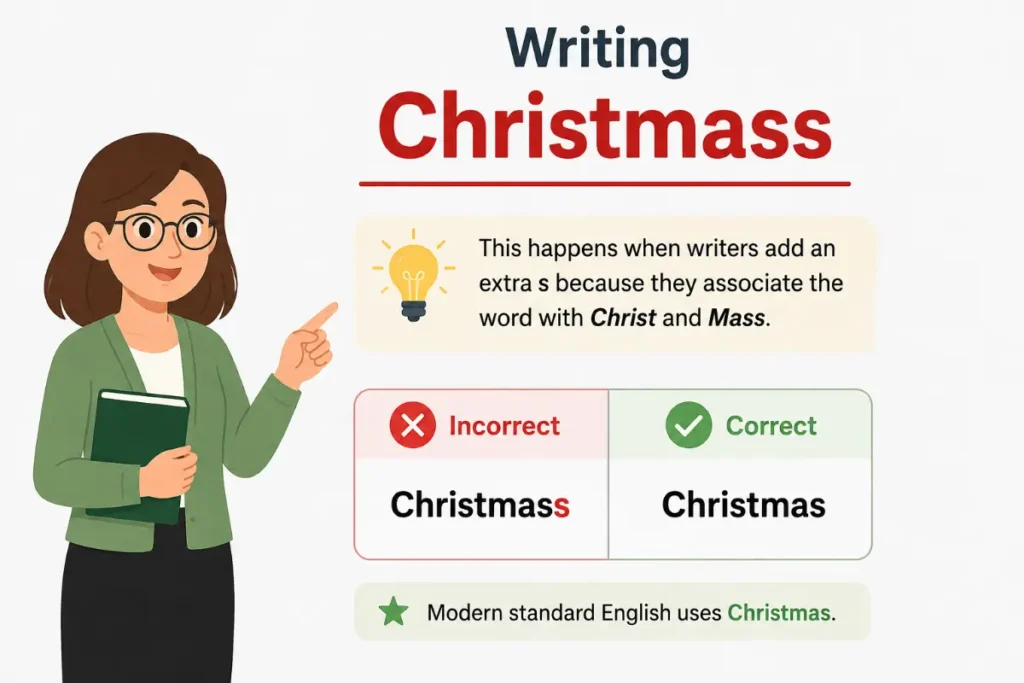
This is the main mistake. Writers add another s because the singular already ends in s.
Incorrect: We celebrated two Christmass together.
Correct: We celebrated two Christmases together.
The fix is to use the plural ending es.
Christmas Instead of Christmases
Sometimes writers understand that they need a plural meaning but leave the word unchanged.
Incorrect: I remember many Christmas from my childhood.
Correct: I remember many Christmases from my childhood.
The singular Christmas can describe the holiday in general but it cannot normally serve as a countable plural in this construction.
Christmas’s For A Plural
Christmas’s is not the normal plural form. The apostrophe indicates possession rather than simple plurality.
For example:
Christmas’s history
This construction may occur in some contexts where the writer is treating Christmas as possessing something but it is not the ordinary way to make the noun plural.
If you simply mean several celebrations use Christmases.
Christmases Without The Capital C
Because Christmas is the name of a holiday the word normally begins with a capital letter.
Incorrect: We spent several christmases together.
Correct: We spent several Christmases together.
The plural ending doesn’t remove the capitalization.
Adding An Unnecessary Apostrophe
Some writers may produce Christmases’ when they only want a plural. The apostrophe should not be added simply because the word ends in s.
Christmases means more than one Christmas.
Christmases’ means something belonging to multiple Christmases when the context requires a possessive plural.
For example:
The Christmases’ traditions were different.
That construction is grammatically possible but much less common because the writer would often choose a clearer expression.
The larger lesson is simple. Don’t add an apostrophe to create a regular plural.
Pronunciation Guide
Christmas is commonly pronounced /ˈkrɪsməs/ in American English.
Christmases is commonly pronounced approximately /ˈkrɪsməsɪz/.
The plural therefore adds another syllable.
You can think of the singular as:
KRIS muss
The plural is closer to:
KRIS muss iz
The main stress stays on the first syllable.
One reason the plural can feel unusual is that the spelling contains many letters that don’t receive their own separate sounds. Christmas is not pronounced exactly as every letter might suggest. The t is not pronounced as a clear t sound in ordinary American pronunciation and the word has a reduced final vowel.
The plural ending is easier to hear because the added sound creates another syllable.
A common mistake is trying to pronounce Christmases as though it were Christmas plus a strong separate es sound. Natural speech is smoother. The final part is usually pronounced like iz.
If you are learning the word for speaking practice say the singular first and then add the plural sound naturally.
Christmas.
Christmases.
The spelling may look complicated but the spoken pattern becomes easier with repetition.
Many readers also check Bellies vs Bellys Which Spelling Is Correct in 2026?.
Etymology and Word Origin
Christmas has a long religious and linguistic history.
The word comes from the expression Christ’s Mass which referred to the Mass celebrated in honor of Christ. Over time the phrase developed into the single word Christmas.
The first part comes from Christ which derives from the Greek term Khristos meaning anointed. The second part comes from Mass which refers to the Christian religious service.
The modern spelling therefore preserves a history that goes back many centuries. What looks like an ordinary holiday name today has roots in Christian religious vocabulary and the development of English.
The plural form follows modern English grammar rather than creating a new historical form. Once Christmas functions as a regular noun that can refer to individual annual celebrations the language can form a plural by adding es.
This gives us a useful connection between meaning and grammar.
One Christmas refers to one occasion.
Several Christmases refers to several occasions.
The historical origin also explains why the word has a structure that may look unusual to modern readers. English has absorbed and reshaped vocabulary from many languages over time. Holiday names are no exception.
Regional Usage
American English
American English uses Christmas as the standard singular form and Christmases as the standard plural. The plural is grammatically correct but appears less often than the singular because people usually talk about Christmas as a recurring holiday rather than count individual celebrations.
A natural American sentence might be:
Those were the best Christmases of my childhood.
Writers may also choose Christmas holidays or Christmas celebrations when they want a clearer phrase.
British English
British English follows the same standard spelling. Christmases is the regular plural when multiple Christmas occasions need to be discussed.
There is no major British spelling difference involving the plural. The distinction is mainly about context and style rather than regional grammar.
Australian English
Australian English also uses Christmases as the standard plural. The same basic grammar applies.
Speakers may choose Christmas holidays Christmas celebrations or Christmases depending on the situation. The single s form is not an established Australian alternative.
Canadian English
Canadian English follows the same general pattern. Christmases is the standard plural form when several individual Christmas occasions are being counted or compared.
There is no meaningful Canadian spelling variant that makes Christmass correct as a plural.
Across these major English varieties the underlying spelling rule stays the same.
Grammar Rules and Part of Speech
Christmas is a proper noun when it refers to the Christian holiday. It is normally capitalized.
Christmases is the plural noun form used when the writer refers to more than one Christmas occasion.
Consider the difference between these sentences.
Christmas is my favorite holiday.
Here Christmas names the holiday generally.
I remember three Christmases from my childhood.
Here Christmases refers to three separate holiday occasions.
The plural form is especially useful when the writer wants to compare different years.
Our first Christmas was quiet.
Our first three Christmases were quiet.
The second sentence clearly refers to three separate celebrations.
When To Use The Plural
Use Christmases when you are treating individual Christmas celebrations as separate events.
For example:
We spent four Christmases in that house.
The writer is counting four occasions.
You can also use it to describe memories across multiple years.
Those Christmases were unforgettable.
Here the word refers to several specific celebrations already known from context.
When Not To Use The Plural
You don’t need Christmases simply because something happens every year.
For example:
We celebrate Christmas every year.
This sentence is natural because Christmas functions as the name of a recurring holiday.
You could technically discuss individual celebrations but the context determines the best form.
Possessive Forms
The singular possessive is Christmas’s in many modern style systems.
For example:
Christmas’s history is fascinating.
However style guides and editorial traditions can differ on possessive treatment for proper nouns ending in s. If a formal publication has a house style follow that style consistently.
The plural possessive is different.
Christmases’ traditions varied from family to family.
The apostrophe comes after the plural ending because Christmases already ends in s.
This distinction is worth remembering.
Christmases means several Christmas occasions.
Christmases’ means something belonging to several Christmas occasions.
That small apostrophe changes the grammatical relationship.
Real Life Usage Examples
Daily Conversation
In everyday speech people often use the plural when talking about memories.
Those were some of the happiest Christmases of my life.
We spent our first few Christmases in our old apartment.
The plural sounds natural when the speaker has several specific celebrations in mind.
Email And Workplace Communication
Professional writing may use the plural when discussing annual events or company history.
The company has hosted several Christmases for local families.
Our previous Christmases at the office were smaller events.
Still a workplace writer may prefer Christmas celebrations because it sounds more precise and neutral.
Academic Writing
Academic writing can use the plural when studying cultural or historical traditions.
The study compares Christmases celebrated by families across several generations.
Historical records provide clues about how Christmases were observed in different communities.
Here the plural helps researchers refer to separate celebrations or periods.
News And Journalism
News writing may use the form when describing multiple holiday periods.
The family spent several Christmases away from home.
The documentary revisits the Christmases that shaped the community.
Journalists may also use Christmas seasons or holiday periods when those phrases better fit the story.
Literature And Storytelling
Stories often use the plural when characters remember earlier holidays.
He thought about the Christmases he had spent with his parents.
The old photographs brought back memories of happier Christmases.
The word can create a strong sense of time passing. Each Christmas becomes a small marker in a person’s life.
Related And Confused Terms
Christmas
Christmas is the singular form and the name of the holiday.
Example: We celebrate Christmas with our family.
Christmas Holiday
Christmas holiday is a broader phrase that can refer to the holiday period surrounding Christmas.
Example: The school closes for the Christmas holiday.
This phrase can sometimes sound more natural than Christmases when discussing a general holiday period.
Christmas Celebrations
Christmas celebrations refers to events or activities connected with the holiday.
Example: The town hosts several Christmas celebrations.
This expression is useful when you want to emphasize events rather than individual years.
Christmas Season
Christmas season refers to the period associated with Christmas.
Example: The stores become busy during the Christmas season.
It isn’t a plural form of Christmas.
Holiday Season
Holiday season is broader than Christmas season. It can include several holidays celebrated around the same time of year.
Example: Many families travel during the holiday season.
Christmases
Christmases refers specifically to multiple Christmas occasions.
Example: She remembers the Christmases of her childhood.
It is more specific than holiday season.
Christmas Eve
Christmas Eve is the evening before Christmas Day.
Example: We usually have dinner together on Christmas Eve.
It should not be confused with the plural form.
Christmas Day
Christmas Day refers specifically to December 25.
Example: The store will be closed on Christmas Day.
Again this is a related expression rather than another plural spelling.
These terms overlap in meaning but they serve different grammatical purposes. Choosing the right expression can make a sentence sound much more natural.
Why The Plural Can Look Strange
There is a visual reason this form often catches people off guard.
Christmas already ends with s.
When you see Christmases the word appears to contain a cluster of s sounds and letters. That can make the spelling look unusual even though the grammatical pattern is ordinary.
English has many words where the plural ending creates a similar visual effect.
Bus becomes buses.
Class becomes classes.
Glass becomes glasses.
Christmas follows the same general pattern.
The spelling becomes easier once you stop thinking of Christmases as a completely new word. Instead think of it as Christmas plus the regular plural ending es.
That approach is useful for spelling because it separates the base word from the grammatical ending.
It also explains why Christmass looks tempting but fails to express the normal plural pattern. Adding one more s doesn’t create the standard ending.
When Christmases Sounds Natural
The plural is most useful when individual celebrations matter.
Suppose someone says:
My childhood Christmases were very different from my children’s Christmases.
That sentence compares two groups of separate holiday occasions. The plural makes sense because the writer is looking across multiple years.
Another natural use appears in personal memories.
I remember the Christmases when my cousins came to stay.
The word refers to specific Christmas occasions connected by a repeated event.
You can also use it in historical or cultural writing.
The novel portrays Christmases in rural England during the nineteenth century.
Here the plural can represent multiple Christmas celebrations across a historical period.
In everyday speech however many people prefer a longer phrase when clarity matters.
Instead of:
We spent many Christmases abroad.
A speaker might say:
We spent many Christmas holidays abroad.
Neither expression is automatically better. The shorter form emphasizes the individual Christmas occasions while the longer phrase can make the meaning more explicit.
When Another Expression Is Better
Correct spelling doesn’t always mean the word is the best stylistic choice.
Christmases is grammatically correct but relatively specific. If you’re writing a sentence that sounds awkward with it you can often rephrase.
For example:
We celebrated five Christmases in New York.
This is correct.
But:
We spent five Christmas holidays in New York.
may sound more natural in a travel or family context.
Likewise:
The Christmases of her childhood shaped her memories.
could become:
The Christmas celebrations of her childhood shaped her memories.
The second version is longer but may be clearer for readers who aren’t already familiar with the context.
Good editing isn’t about choosing the longest or shortest expression. It’s about choosing the form that communicates the intended meaning with the least friction.
That is especially useful when writing for a broad audience. If a reader might pause to figure out what a phrase means you can often make the sentence clearer by adding one simple word.
Expert Editor Insight
From an editing perspective the main issue is rarely grammar knowledge. Most writers who make this mistake already understand that they are talking about multiple Christmas celebrations. The problem is usually the visual shape of the word and the temptation to add another s. Professional editors check the plural ending as well as capitalization and apostrophe use. Spellcheck tools may flag Christmass because it doesn’t match the standard word form. My practical tip is to think of the plural as Christmas plus es rather than trying to remember the entire word from scratch. That small shift makes the spelling much easier to recall.
Still confused? Compare Courtesy Vs Curtesy Which Word Should You Use in 2026.
Conclusion
Christmases is the correct plural form of Christmas while Christmass is normally a spelling mistake. The standard plural keeps the original word intact and adds es because Christmas already ends in s. Use the plural when you are talking about several separate Christmas celebrations or comparing Christmas occasions across different years.
The form is standard across American British Canadian and Australian English. It can appear in personal memories historical writing academic work journalism and storytelling. In casual conversation you may sometimes prefer phrases such as Christmas celebrations or Christmas holidays because they can sound smoother in certain sentences.
A simple editing trick can save you from the common error. Think Christmas plus es. Once you see the plural as the original word followed by the regular ending the spelling becomes much easier to remember.
FAQs
Is Christmass a correct plural spelling?
No. Christmass is not the standard plural spelling of Christmas. If you mean more than one Christmas celebration the standard form is Christmases. The error usually happens because Christmas already ends in s and writers instinctively add another s. In standard school writing professional communication and published content use Christmases when you need the plural.
What is the plural of Christmas?
The standard plural is Christmases. It refers to multiple Christmas celebrations or separate Christmas occasions. For example you can say We spent three Christmases at our grandparents’ house. The word keeps the original spelling of Christmas and adds es to create the plural. In some contexts Christmas celebrations or Christmas holidays may sound more natural.
Why does Christmas become Christmases?
Christmas becomes Christmases because the plural ending is es. The singular word already ends in s and the standard plural pattern adds es rather than simply adding another s. This creates the form Christmases. The same broad pattern appears in words such as bus and class when they become buses and classes.
Is Christmases grammatically correct?
Yes. Christmases is a grammatically correct plural noun. It is used when you are talking about several individual Christmas occasions. For example She remembers the Christmases of her childhood refers to multiple celebrations across different years. The plural is less common than the singular because people often discuss Christmas as a recurring holiday rather than count individual celebrations.
How do you pronounce Christmases?
Christmases is commonly pronounced approximately like KRIS muss iz in American English. The singular Christmas is commonly pronounced /ˈkrɪsməs/ while the plural has an additional syllable and is commonly represented as /ˈkrɪsməsɪz/. The strongest stress remains on the first syllable. The plural ending sounds like iz rather than simply adding another s sound.
Should Christmases have a capital letter?
Yes. Christmas is the name of a holiday so it is normally capitalized. The plural keeps that capitalization. The standard form is Christmases rather than christmases. The plural ending changes the number of the noun but does not change its status as the name of the holiday. The same capitalization applies in formal and informal standard English.
Can I say several Christmases?
Yes. Several Christmases is grammatically correct when you mean several separate Christmas celebrations. For example We spent several Christmases together before moving to another country. The phrase works especially well when the individual celebrations matter. If you simply mean several holiday periods you might prefer several Christmas holidays or several holiday seasons depending on your intended meaning.
Is Christmases common in everyday English?
Christmases is correct but it is less common than Christmas in everyday English. Most people talk about Christmas as a recurring holiday rather than count individual celebrations. The plural becomes useful when someone is comparing memories or discussing several specific years. In those situations Christmases sounds natural and precise, especially when the context clearly involves separate celebrations.