

Perspective or prospective can be confusing because the two words look similar and share several letters. However, they have different meanings, and choosing the wrong one can change the message of your sentence. The good news is that both are correct English words. You simply need to understand when to use each one.
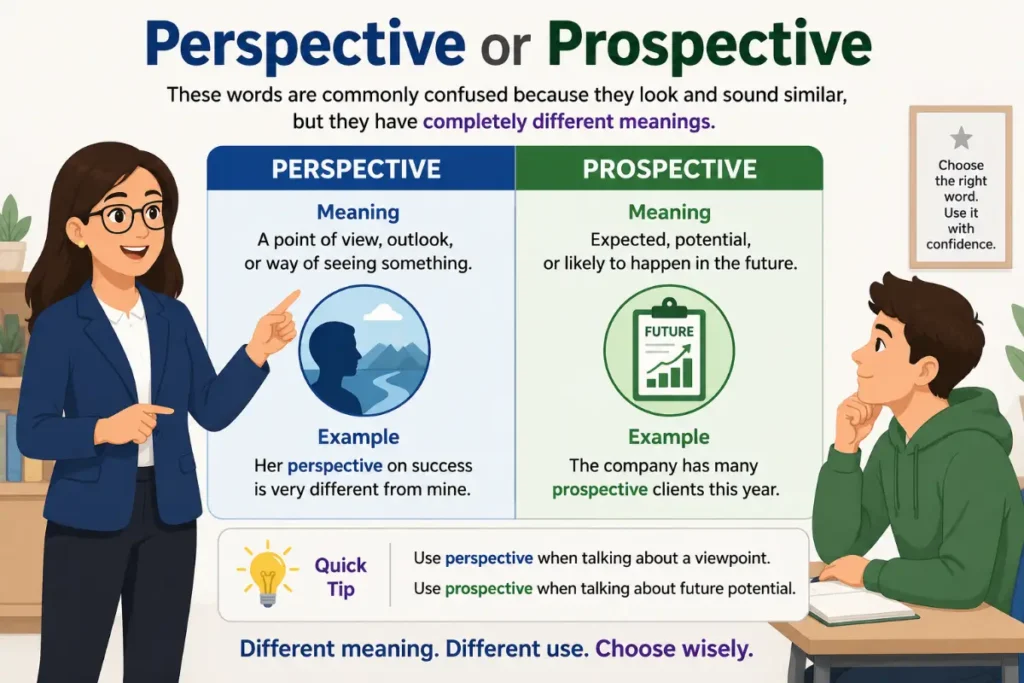
Perspective refers to a point of view, a way of understanding something, or the appearance of depth in art. Prospective describes something expected, possible, or likely to happen in the future. For example, a teacher may offer a new perspective on a difficult subject, while a prospective student is someone who may enroll in a school.
The difference becomes easier to remember once you connect each word to its main idea. One focuses on how you see or understand something. The other focuses on what may happen next. This distinction matters in emails, job applications, academic assignments, business reports, and everyday conversations.
In this guide, you will learn the meanings of both words, how to pronounce them, the grammar rules that govern their use, and how to choose the right form with confidence.
A related grammar guide is former vs latter Explained With Clear Examples.
Quick Answer
Perspective means a point of view or a way of understanding something. Prospective means expected, possible, or likely to become something in the future. Both words are correct, but they serve different purposes. Use perspective when discussing opinions or viewpoints and prospective when describing potential future events, customers, employees, students, or opportunities.
Comparison Table
| Feature | Perspective | Prospective |
|---|---|---|
| Main meaning | A point of view or way of seeing something | Expected or possible in the future |
| Part of speech | Noun, sometimes adjective | Adjective |
| Main focus | Viewpoint, understanding, or visual depth | Future possibility or potential |
| Pronunciation | per SPEK tiv | pruh SPEK tiv |
| Common phrase | From my perspective | Prospective employee |
| Formality | Standard in formal and informal English | Standard in formal and informal English |
| Common contexts | Opinions, art, decisions, analysis | Hiring, education, business, planning |
| Example | Her perspective helped us understand the issue. | The company interviewed a prospective manager. |
Meaning and Definition
What Does Perspective Mean?
Perspective is mainly a noun. It describes the way a person sees, understands, or judges a situation. Your perspective can be shaped by your experiences, knowledge, beliefs, background, and personal circumstances.
For example, two people may watch the same event and interpret it differently. One person may see a decision as necessary, while another sees it as unfair. They are looking at the same situation from different perspectives.
The word also has a visual meaning. In art and drawing, perspective is the technique used to show depth and distance on a flat surface. Objects that are farther away may appear smaller, helping a picture look more realistic.
Perspective can also refer to the ability to understand the relative importance of something. If you gain perspective after a difficult experience, you may begin to see the problem as less overwhelming or understand how it fits into your life.
Here are the main uses of the word.
- Point of view. A person’s opinion or way of understanding an issue. For example, her perspective changed after she spoke with the teacher.
- Understanding and judgment. The ability to assess a situation in a balanced way. For example, a short break helped him put the disagreement into perspective.
- Visual depth. A method for showing distance and spatial relationships in art. For example, the artist used perspective to make the road appear longer.
- A particular viewpoint in analysis. A way of examining a subject. For example, the report considers the problem from an economic perspective.
The central idea is how something is seen, interpreted, or represented.
What Does Prospective Mean?
Prospective is an adjective that describes someone or something that may become a particular thing or may take place in the future. It often refers to a possibility that people are considering but that has not yet become a reality.
For example, a prospective employee is someone who may be hired. A prospective customer is someone who may buy a product or service. A prospective homeowner is someone who may purchase a house.
The word does not guarantee that the event will happen. It signals potential rather than certainty. A prospective employee may receive a job offer, but the person has not necessarily been hired.
Prospective commonly appears in business, education, employment, property, and planning. It is especially useful when people need to discuss future possibilities in a concise and professional way.
Consider these common uses.
- Prospective student. Someone who is considering attending a school or college.
- Prospective employer. A person or organization that may hire someone.
- Prospective buyer. Someone who may purchase a product or property.
- Prospective client. A person or business that may become a customer.
- Prospective benefit. An advantage that may arise in the future.
The central idea is what could happen or what someone could become.
Is Prospective About the Future?
Yes. Prospective usually points toward a possible future situation. It can describe people, relationships, decisions, benefits, or events that are being considered as possibilities.
For example, a prospective business partner is someone who may become a business partner. A prospective plan is a plan being considered for the future, although other expressions may sound more natural depending on the context.
Keep in mind that prospective does not mean the same thing as certain. It describes potential, not a guaranteed result.
Key Differences Explained
The simplest way to distinguish the words is to focus on their main ideas. Perspective concerns a viewpoint or way of understanding something. Prospective concerns a possible future role, event, or outcome.
Difference in Meaning
Perspective describes how someone sees or interprets something. Prospective describes what may happen or what someone may become.
For example, a manager might ask employees to consider a customer’s perspective. The manager wants them to understand the customer’s point of view. A prospective customer, on the other hand, is someone who may buy from the business.
The first word concerns understanding. The second concerns possibility.
Difference in Grammar
Perspective is mainly a noun. It can function as the subject or object of a sentence, and it often appears after prepositions such as from, in, and into.
Examples include:
- Her perspective was helpful.
- We discussed the issue from his perspective.
- The experience gave me a new perspective.
Prospective is an adjective. It usually appears before a noun that it describes.
Examples include:
- The prospective buyer requested more information.
- We invited prospective students to an open house.
- The company contacted a prospective partner.
A useful grammatical clue is the word that follows. If you are describing a person who may fill a role, prospective is often the right choice. If you are naming a viewpoint, perspective is usually correct.
Difference in Pronunciation
The two words have a similar sound, but their opening syllables differ.
- Perspective begins with a sound like “per.”
- Prospective begins with a sound like “pruh” in common American pronunciation.
Both words contain the stressed syllable “spek.” Listening for the opening sound can help you distinguish them, although meaning and grammar provide stronger clues in writing.
Difference in Context
Perspective commonly appears in discussions about opinions, experiences, art, analysis, and decision making. Prospective appears in discussions about hiring, education, sales, planning, and future opportunities.
Compare these sentences.
- The counselor offered a different perspective on the problem.
- The counselor met with a prospective student.
The first sentence refers to a way of understanding an issue. The second refers to someone who may attend a school.
Difference in Formality
Both words are suitable for formal writing, professional communication, and casual conversation. Neither is an informal or incorrect version of the other.
Perspective is common in essays, reports, discussions, reviews, and personal reflections. Prospective is especially common in business and professional language, particularly when describing people or opportunities that may become part of an organization.
Difference in Regional Usage
The meanings are consistent across major varieties of English, including American, British, Canadian, and Australian English. There is no standard regional spelling difference that makes one form replace the other.
The choice depends on meaning and grammar, not on the country where the writer lives.
Which Word Is Correct?
Both words are correct. The right choice depends on what you want to express.
Use perspective when you mean a point of view, a way of interpreting information, or a method of showing depth in art. Use prospective when you describe someone or something that may become part of a future situation.
The distinction follows established English vocabulary and grammar. These are separate words with different meanings, rather than alternative spellings of the same word.
For example, “a prospective employee” refers to a person who may be hired. “An employee’s perspective” refers to that person’s point of view. Replacing one word with the other would change the meaning of the sentence.
If you are unsure, ask yourself what the sentence describes. Is it a viewpoint or a future possibility? That question will usually lead you to the right choice.
Sentence Examples
Here are ten natural examples showing how to use both words correctly.
- Everyday conversation: From my perspective, we should leave early to avoid traffic.
- Personal relationships: Try to understand your friend’s perspective before making a judgment.
- Workplace communication: The manager asked the team to consider the customer’s perspective.
- Hiring: The company invited three prospective employees to a second interview.
- Education: The university held an information session for prospective students.
- Academic writing: The study examines the issue from a historical perspective.
- Business: Our sales team contacted several prospective clients this month.
- Art and design: The artist used perspective to create the illusion of depth.
- Planning: We discussed the prospective benefits of expanding the service.
- Formal communication: Please send the information packet to all prospective applicants.
Notice that perspective often follows expressions such as “from my” or “from a different,” while prospective commonly comes before a noun naming a person, group, event, or outcome.
Common Expressions with Perspective
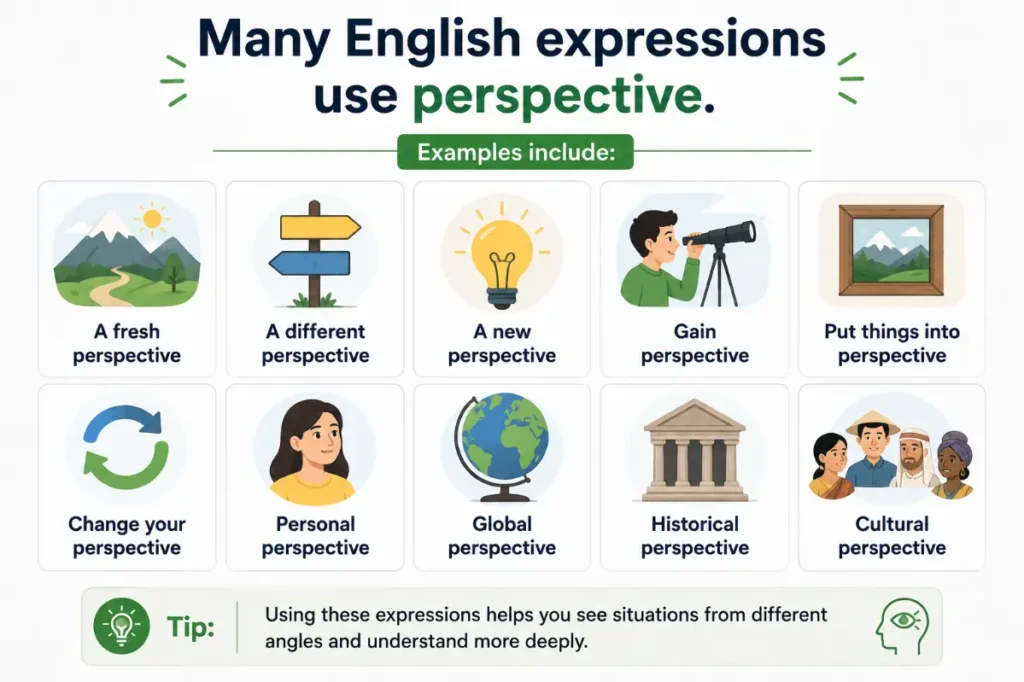
Many English expressions use perspective.
Examples include:
- A fresh perspective
- A different perspective
- A new perspective
- Gain perspective
- Put things into perspective
- Change your perspective
- Personal perspective
- Global perspective
- Historical perspective
- Cultural perspective
Common Mistakes and Confused Usage
The most common problem is not misspelling either word. It is choosing a correctly spelled word that does not match the intended meaning.
Mistake One: Using Prospective for a Point of View
Incorrect: From my prospective, the plan needs more work.
Correct: From my perspective, the plan needs more work.
The phrase “from my perspective” means from my point of view. Prospective does not carry that meaning, so it does not fit this expression.
Mistake Two: Using Perspective for a Potential Employee
Incorrect: We interviewed three perspective employees.
Correct: We interviewed three prospective employees.
The sentence refers to people who may be hired. Prospective is the correct adjective because it describes a possible future role.
Mistake Three: Treating Both Words as Nouns
Incorrect: His prospective was different from mine.
Correct: His perspective was different from mine.
Perspective is the noun needed here. Prospective is usually an adjective and normally modifies another word, as in “prospective candidate.”
Mistake Four: Assuming Prospective Means Certain
Incorrect: The prospective buyer has already purchased the house.
Correct: The prospective buyer may purchase the house.
A prospective buyer is someone who may buy a property. If the purchase has already happened, buyer or new owner may be more appropriate, depending on the context.
Mistake Five: Using the Wrong Phrase in Business Writing
Incorrect: We are looking for a new perspective client.
Correct: We are looking for a new prospective client.
A prospective client is a potential customer. A new perspective client does not express that meaning in standard English.
For another common grammar confusion, see Hanged vs Hung Which Word Is Correct.
Pronunciation Guide
Correct pronunciation can help you recognize the difference between these words when speaking and listening.
How to Pronounce Perspective
The standard American English pronunciation is commonly represented as /pərˈspɛktɪv/.
Break it into syllables like this: per SPEK tiv.
The second syllable carries the main stress. Say the word smoothly, with emphasis on “spek.”
A simple pronunciation guide is “per SPEK tiv.”
Common mistakes include placing the stress on the first syllable or making the final syllable too long. Aim for three syllables, with the middle syllable clearly stressed.
How to Pronounce Prospective
The standard American English pronunciation is commonly represented as /prəˈspɛktɪv/.
Break it into syllables like this: pruh SPEK tiv.
As with perspective, the main stress falls on the second syllable. The key difference is the opening sound. Prospective begins with “pruh,” while perspective begins with “per.”
A Simple Listening Tip
Say the words aloud in short phrases.
- “My perspective.”
- “A prospective student.”
The first phrase refers to a viewpoint. The second describes a person who may enroll. Practicing each word inside a meaningful phrase makes the difference easier to remember than repeating the words on their own.
Etymology and Word Origin
The two words share a historical connection to Latin, which helps explain their similar appearance. However, their meanings developed along different paths.
The Origin of Perspective
Perspective entered English through French and Latin forms connected to seeing or looking through something. The Latin verb perspicere means to look through or see clearly.
Over time, perspective developed meanings related to visual representation, especially the depiction of depth and distance in art. It also came to describe a person’s point of view or way of understanding a subject.
These meanings remain closely related. A visual perspective shows how objects appear from a particular position, while a personal perspective reflects how someone understands an experience from their own position.
The Origin of Prospective
Prospective also traces back through French to Latin. It is associated with the Latin verb prospicere, meaning to look forward or look ahead.
This history fits its modern meaning. A prospective employee is someone considered for a future position. A prospective customer is someone who may become a customer later.
The shared historical connection helps explain why the words look alike. Their modern uses, however, remain distinct. Remembering the idea of looking at something from a position for perspective and looking ahead for prospective can be a useful memory aid.
Regional Usage
The meanings of these words remain stable across major English speaking regions. Differences in usage usually come from the situation, writing style, or professional field rather than from regional rules.
American English
In the United States, perspective is widely used for opinions, interpretation, visual depth, and balanced judgment. Common expressions include “from my perspective,” “a different perspective,” and “put things into perspective.”
Prospective is common in employment, higher education, property sales, and business. Examples include “prospective student,” “prospective employer,” and “prospective buyer.”
Both words are standard in American English.
British English
British English uses the same basic distinction. Perspective refers to a point of view or a way of showing depth, while prospective describes a possible future role or event.
A British university may refer to prospective students, just as an American university does. Writers in both varieties can use perspective when discussing opinions or approaches to a subject.
There is no special British spelling rule that makes these words interchangeable.
Australian English
Australian English follows the same meanings and grammatical patterns. Perspective appears in everyday discussions, education, professional reports, and creative work. Prospective appears in phrases such as “prospective buyer” and “prospective employee.”
The choice remains based on meaning rather than a distinct Australian spelling convention.
Canadian English
Canadian English also uses both words in their standard forms. A Canadian college may welcome prospective students, while a researcher may examine a problem from a social or historical perspective.
For writers across these regions, the safest approach is to select the word that matches the sentence’s intended meaning.
Grammar Rules and Part of Speech
Understanding how each word functions in a sentence is one of the most reliable ways to avoid confusion.
Perspective as a Noun
Perspective usually names an idea, viewpoint, or method of visual representation. It can act as the subject or object of a sentence.
Examples:
- Perspective helps us understand why people disagree.
- I appreciate your perspective.
- The drawing shows accurate perspective.
The word also appears in common phrases that express how someone understands a situation.
“From my perspective” introduces a personal viewpoint. “A different perspective” describes another way of seeing an issue. “Put something into perspective” means to consider it in relation to other facts or circumstances.
For example, a disappointing test result may seem serious at first. Talking with a teacher could help a student put the result into perspective by considering the student’s overall progress.
Prospective as an Adjective
Prospective usually describes a noun. It identifies a person, opportunity, result, or event that may become real in the future.
Examples:
- The prospective tenant viewed the apartment.
- Several prospective partners attended the meeting.
- The report outlines prospective changes to the policy.
In these examples, the adjective provides information about the noun that follows it.
Prospective does not usually work as a noun on its own in ordinary modern English. For instance, “We contacted three prospectives” would sound unusual in general business writing. “We contacted three prospective clients” is clearer and more natural.
Common Grammatical Patterns
Perspective often appears in these patterns.
- From a particular perspective. The proposal looks reasonable from a financial perspective.
- A perspective on something. The book offers a fresh perspective on history.
- Put something into perspective. The conversation put the disagreement into perspective.
- Gain or offer perspective. Travel can give people a broader perspective.
Prospective often appears in these patterns.
- Prospective plus a person or role. Prospective applicants must submit the form.
- Prospective plus a customer or business relationship. The team followed up with prospective clients.
- Prospective plus a future possibility. The report discusses prospective changes to the schedule.
These patterns are helpful because they reveal the intended grammatical role before you finish the sentence.
Adverbs and Related Word Forms
Perspective has related forms such as perspective based, although the exact construction depends on the sentence. In many cases, phrases such as “from a different viewpoint” or “in visual perspective” sound more natural than creating a new form.
Prospective is related in meaning to words such as potential and possible. The noun prospect refers to the chance of something happening or to a person or opportunity under consideration. For example, “The job prospect looks promising” uses prospect as a noun, while “a prospective employee” uses prospective as an adjective.
Do not assume that related words have identical grammar. Potential can function as both a noun and an adjective, while prospective usually functions as an adjective.
Punctuation and Formal Writing
Neither word requires special punctuation. Use normal sentence punctuation and capitalization rules.
In formal writing, choose precise expressions. “From my perspective” is acceptable in a report or essay, but a more specific phrase such as “from an economic perspective” may communicate the point more clearly. Similarly, “prospective applicant” is appropriate in a formal notice when referring to someone who may apply.
The key is to make the relationship between the word and the rest of the sentence clear.
Real Life Usage Examples
Daily Conversation
People often use perspective when talking about opinions or personal experiences.
- “I understand your perspective, but I see the problem differently.”
- “Taking a walk helped me gain some perspective on the argument.”
Prospective is less common in relaxed personal conversation, but it still appears when discussing future possibilities.
- “She is a prospective student at the college.”
- “We have a prospective buyer coming to see the house.”
Email and Workplace Communication
Professional communication often uses both words, but for different reasons.
- “I would appreciate your perspective on the proposed schedule.”
- “Could you review the issue from a customer service perspective?”
These sentences ask for a viewpoint or a way of assessing a situation.
- “We will contact the prospective client after reviewing the proposal.”
- “The hiring manager has scheduled interviews with prospective employees.”
These examples describe people who may become customers or employees.
Academic Writing
Perspective is useful when examining an argument, theory, historical event, or research question.
- “The essay considers the issue from a cultural perspective.”
- “The author’s perspective influences the interpretation of the evidence.”
Prospective may appear in research or planning contexts when describing possible future effects.
- “The researchers discussed the prospective benefits of the new approach.”
- “The university organized a session for prospective graduate students.”
In academic work, precision matters. Make sure the word reflects the relationship you intend to describe.
News and Journalism
News reports use perspective when discussing viewpoints, interpretations, or the wider meaning of events.
- “Residents offered different perspectives on the proposed development.”
- “The analysis places the recent decision in historical perspective.”
Prospective can appear in reporting about jobs, property, business, and education.
- “The company met with prospective investors to discuss its plans.”
- “Prospective homebuyers attended the weekend property exhibition.”
The surrounding noun often makes the intended meaning clear.
Literature and Storytelling
Writers use perspective to describe how a story is told or how a character sees events. In literary discussion, the term can refer to narrative viewpoint as well as a character’s beliefs or understanding.
- “The novel presents the conflict from the child’s perspective.”
- “As the story unfolds, the main character gains a new perspective on her family.”
Prospective can help describe a possible future role or relationship within a story.
- “The young musician met a prospective mentor at the festival.”
- “The family considered the prospective move before making a final decision.”
These examples show how both words can fit naturally into different kinds of writing without sharing the same meaning.
Related and Confused Terms
Learning a few related words can help you choose more precise language. Some are close in meaning to perspective, while others are associated with prospective.
Point of View
Point of view means the position, opinion, or angle from which someone considers something. It is often interchangeable with perspective when discussing opinions.
Example: “From her point of view, the decision was fair.”
Viewpoint
Viewpoint is another word for a particular way of seeing or understanding a subject. It often refers to a person’s opinion or position in a discussion.
Example: “The article presents a different viewpoint.”
Outlook
Outlook can refer to a person’s attitude toward life or to expectations about the future. Unlike perspective, it often emphasizes a general attitude or anticipated direction.
Example: “She has an optimistic outlook.”
Interpretation
Interpretation describes the meaning someone gives to information, events, or a work of art. It is related to perspective, but it focuses more directly on how something is understood.
Example: “His interpretation of the poem differed from mine.”
Potential
Potential refers to the ability or possibility of developing into something or achieving a result. It is closely related to prospective, but it can function as a noun or adjective.
Example: “The candidate has strong potential.”
Possible
Possible means that something can happen or exist. It is a broad word and does not always suggest a specific person or opportunity under consideration.
Example: “We discussed possible solutions.”
Prospect
Prospect is a noun that can refer to a chance of success, a future possibility, or a person being considered as a customer or candidate.
Example: “The company sees a promising prospect in the new market.”
Prospective Candidate
A prospective candidate is someone who may apply for, be considered for, or fill a particular role. The precise meaning depends on the context.
Example: “The committee invited prospective candidates to an information session.”
This expression is related to prospective because it points toward a potential future role. It does not describe the candidate’s point of view.
Expert Editor Insight
An experienced editor looks at meaning before checking spelling. Both words are spelled correctly, so a spelling checker may accept them even when the writer has used the wrong one. The most reliable editing tip is to examine the noun or phrase around the word. If you mean an opinion or way of seeing something, use perspective. If you mean a person or possibility that may become real in the future, use prospective. Reading the sentence aloud can help, but checking the meaning is the final test.
Key Takeaways
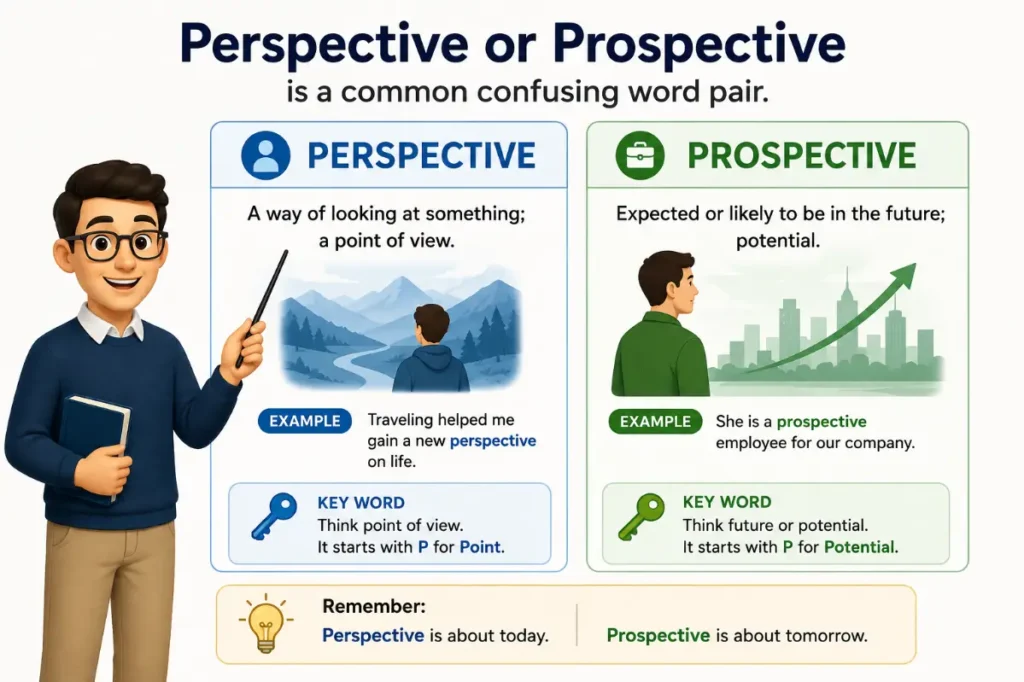
- Perspective or Prospective is a common confusing word pair.
- Perspective is always a noun.
- Prospective is always an adjective.
- Perspective means a point of view or outlook.
- Prospective means future, expected, or potential.
- Perspective often appears after possessive words like my, your, and their.
- Prospective usually appears before nouns such as student, buyer, employee, or customer.
- Learning the Latin origins makes the meanings easier to remember.
- Choosing the correct word improves clarity in academic, business, and everyday writing.
Learn the difference in Than vs Then: Learn the Difference and Use Each Correctly.
Conclusion
Perspective or prospective becomes easy to distinguish once you focus on meaning. Perspective refers to a point of view, a way of understanding something, or the appearance of depth in art. Prospective describes a possible future role, event, or outcome. Both are standard English words, so neither is automatically incorrect.
The key is to match the word to the message you want to express. For a quick editing check, remember the phrase “from my perspective” for opinions and “prospective employee” for a person who may be hired. These examples can help you choose accurately in everyday conversations, academic work, and professional writing.
FAQs
Is Perspective or Prospective the Correct Word?
Both words are correct, but they mean different things. Perspective refers to a point of view, an interpretation, or visual depth. Prospective describes someone or something that may become part of a future situation. Use perspective in phrases such as “from my perspective” and prospective in phrases such as “prospective employee.” The correct choice depends on what your sentence means.
What Does Perspective Mean in Simple English?
Perspective means the way someone sees or understands something. Two people can have different perspectives because they have different experiences, beliefs, or knowledge. The word also describes how artists create the appearance of depth in a picture. For example, “My perspective changed after our conversation” means the conversation changed how I understood the situation.
What Does Prospective Mean in Simple English?
Prospective means possible or expected in the future. It often describes a person who may take on a role or enter a relationship. A prospective student may enroll in a school, and a prospective buyer may purchase a property. The word describes potential, not certainty, so the person or event may not become a reality.
How Do You Remember the Difference Between the Two Words?
Connect perspective with a point of view and prospective with a possible future. You can also remember the phrase “from my perspective,” which refers to your opinion. For the other word, think of a prospective employee who may be hired later. These familiar phrases provide useful clues when you need to choose the right word quickly.
Can Prospective Be Used as a Noun?
Prospective normally functions as an adjective in standard modern English. It describes a noun, as in “prospective customer” or “prospective employee.” The related noun prospect can refer to a possible opportunity or a person being considered. In ordinary writing, use a complete expression such as “prospective applicants” rather than using prospective alone as a noun.
Is Perspective Used in Academic Writing?
Yes. Perspective is common in academic writing because researchers and students often examine topics from different viewpoints. Phrases such as “historical perspective,” “social perspective,” and “economic perspective” help identify the angle of analysis. The word can also describe an author’s point of view. Choose a more specific modifier when it helps readers understand the type of analysis.
Is Prospective Appropriate in Formal Writing?
Yes. Prospective is a standard adjective used in professional, academic, and formal communication. It appears in expressions such as “prospective students,” “prospective employees,” and “prospective clients.” It is especially useful when discussing people or opportunities that may become part of a future arrangement. Make sure the noun it modifies matches the situation you are describing.
Why Do People Confuse Perspective and Prospective?
People confuse the words because they look and sound similar. Both contain the letters “spect,” and both have a stressed middle syllable. However, their meanings and grammatical roles differ. Perspective is mainly a noun related to viewpoints or visual depth, while prospective is an adjective related to future possibilities. Checking the meaning is more reliable than relying on appearance alone.