
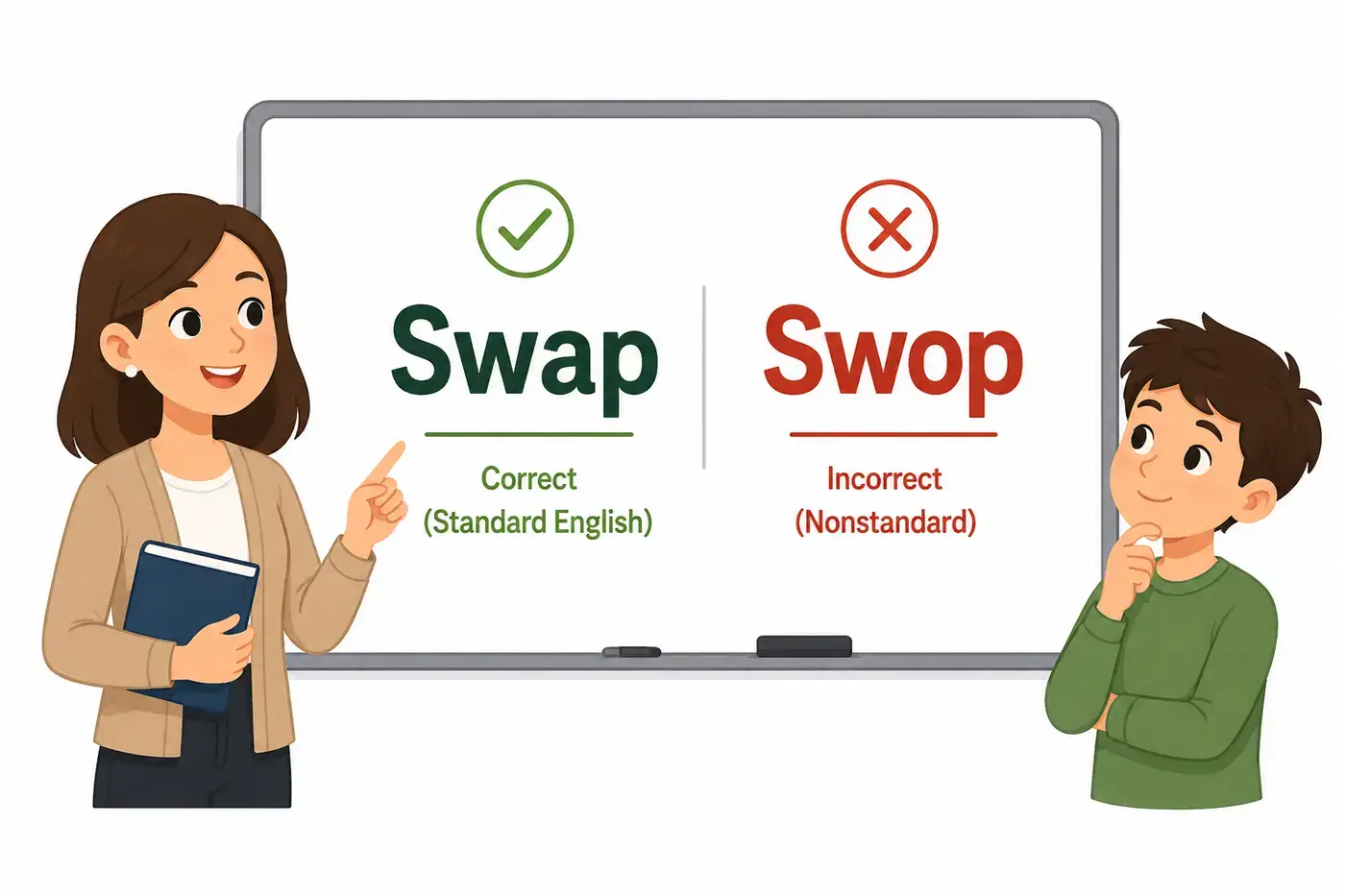
If you’ve seen both spellings and wondered which one is correct, you’re not alone. Swap vs Swop is a common spelling question because the two words look almost identical and share the same basic meaning. The good news is that you don’t need to memorize two different definitions to understand them.
In American English, “swap” is the standard spelling. You use it when you exchange something with another person, trade items, or change one thing for another. The spelling “swop” also exists, mainly in British English and some other varieties, but it appears far less often in American writing.
The difference comes down to regional spelling preferences rather than a major difference in meaning. Both forms can work as verbs and nouns, and both can describe an exchange. Understanding the context will help you choose the right spelling for an email, school assignment, business document, or casual text.
You may also want to read christmases or christmass Correct Spelling and Usage.
Quick Answer.
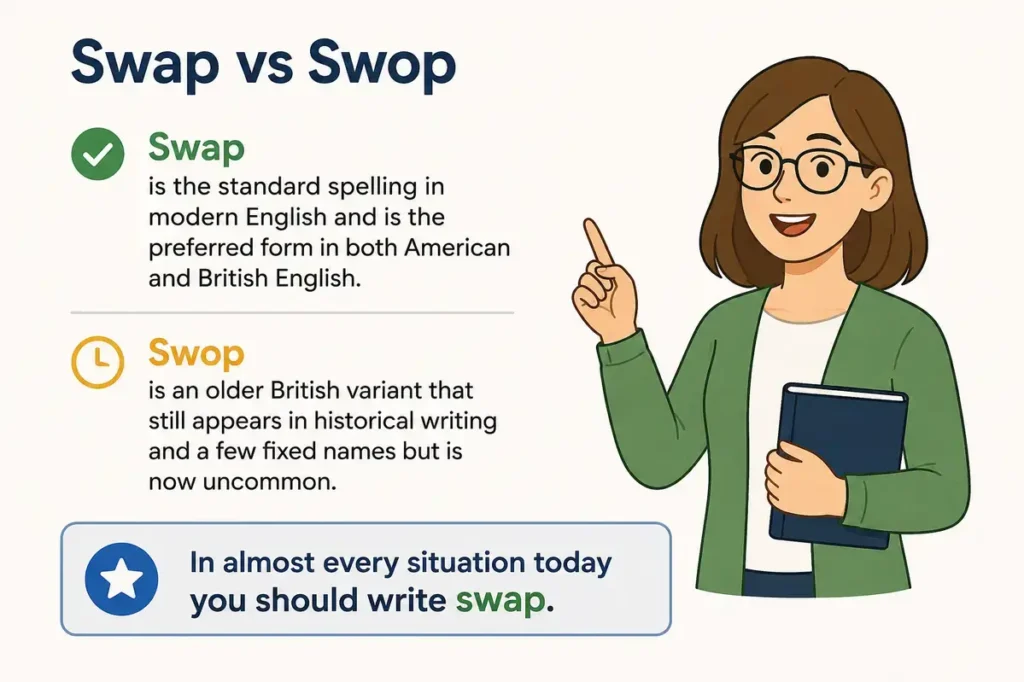
Both spellings are correct. “Swap” is the preferred spelling in American English, while “swop” is an accepted alternative used mainly in British English. Both words mean to exchange one thing for another, and both can function as nouns and verbs. For US readers, “swap” is the safest choice in everyday writing, schoolwork, professional emails, and published content.
Comparison Table
| Feature | Swap | Swop |
|---|---|---|
| Meaning | To exchange or trade | To exchange or trade |
| Part of speech | Verb and noun | Verb and noun |
| Standard in American English | Yes | Recognized but uncommon |
| British English | Standard | Accepted alternative |
| Australian English | Commonly understood | Less common |
| Canadian English | Standard choice | Less common |
| Formality | Suitable for casual and formal writing | More regionally marked |
| Pronunciation | Rhymes with top in British English and has a similar vowel to shop in American English | Generally follows the same regional pronunciation patterns |
| Past tense | Swapped | Swopped |
| Present participle | Swapping | Swopping |
| Common contexts | Trading items, changing places, exchanging information, finance | The same general contexts, mainly in British usage |
The Cambridge Dictionary identifies the second spelling as a mainly British alternative to the first. Oxford’s learner dictionary also recognizes both forms. These entries support the key distinction: the words share a meaning, but their popularity differs by region.
Meaning and Definition
What Does Swap Mean.
Swap means to exchange one thing for another. You give something to another person and receive something in return, or you replace one thing with a different one. The exchange may involve objects, duties, positions, information, ideas, or even stories.
For example, two students might swap books after finishing their assignments. Two coworkers might swap shifts to fit their schedules. Friends can swap phone numbers, and business partners can swap services instead of paying cash.
The word also works as a noun. In that role, it refers to the exchange itself or to something exchanged. If two friends trade baseball cards, they might call the exchange a swap.
The word is flexible because it describes both the action and the result. That makes it useful in everyday conversation as well as in business, technology, and finance.
What Does Swop Mean.
Swop has the same basic meaning as swap. It refers to exchanging one item for another, trading things, or replacing one thing with something else. It can also describe the exchange itself when used as a noun.
For example, a British speaker might write, “Can we swop seats?” An American speaker would usually write, “Can we swap seats?” Both sentences communicate the same request.
The second spelling is not simply a typing error. Established English dictionaries recognize it as a legitimate alternative, particularly in British usage. However, it is less familiar to many American readers, so it may look unusual in US publications.
If you encounter this form in a British book, an online discussion, or a message from someone in the United Kingdom, you do not need to assume the writer made a mistake. The regional context helps explain the choice.
Why the Two Spellings Exist.
English contains many words that have more than one accepted spelling. Some differences reflect regional traditions, while others developed through changes in pronunciation, printing, or everyday use.
In this case, the two forms share a long history and the same central meaning. The spelling with an a is now the usual choice in American English, while the spelling with an o remains an established alternative in British English.
The difference resembles other regional variations in English, although the two forms are not equally common across all regions. The best spelling depends on your audience and the type of English you are writing.
Key Differences Explained.
Spelling.
The main difference is one letter. Swap uses the letter a, while swop uses the letter o. That small change does not create a major difference in meaning.
American readers generally expect the spelling with an a. The alternative may appear in British writing, but it is less familiar to US readers.
Meaning.
Both words describe an exchange or replacement. You can use either form to talk about trading seats, exchanging clothes, changing work shifts, or replacing one item with another.
The meaning usually comes from the sentence rather than the spelling. There is no general rule that assigns one type of exchange to swap and another to swop.
Grammar.
Both forms can serve as verbs and nouns. Their grammatical roles depend on how they appear in a sentence.
As a verb, the word describes an action. In “We swap books after class,” it tells readers what the people do. As a noun, it names the exchange, as in “We made a swap.”
Pronunciation.
The two spellings generally represent the same word in a given regional accent. British speakers commonly pronounce the word with the vowel sound found in words such as lot, while many American speakers use the vowel sound heard in words such as lot or father, depending on their accent.
The exact sound varies by speaker and region. The spelling difference does not normally signal a separate meaning or a distinct pronunciation within the same variety of English.
Formality.
The spelling with an a works well in casual conversation, school assignments, business emails, reports, and formal publications. It is familiar to a wide range of English readers.
The spelling with an o is also a real word, but its regional character makes it less suitable for general American writing. A US editor will usually change it to the more familiar form unless the original wording needs to stay intact.
Regional Usage.
American English favors swap. British English uses swap as well, while also accepting swop. Other English speaking regions may recognize both forms, but the spelling with an a is widely understood and generally the safer choice for international readers.
The important point is that regional preference does not automatically make the less common form wrong. It simply affects how natural the spelling looks to a particular audience.
Which Form Is Correct.
For American English, use swap. It is the familiar and standard spelling for an exchange, a trade, or the act of replacing one thing with another.
Use swop when you are following a British source that uses that spelling or when a publication has a clear regional style preference. You may also see it in names, titles, or direct quotations, where changing the original wording could be inappropriate.
The linguistic reason is straightforward. Dictionaries recognize both forms, but they do not present them as equally common across all varieties of English. Cambridge labels the less common form as mainly British, and Oxford lists it as an alternative to the more widely used spelling.
In practical terms, you do not need to avoid the alternative in every situation. You simply need to match your spelling to your readers.
For US schoolwork, business communication, websites, and general articles, choose swap. That decision keeps your writing familiar and avoids distracting readers with an uncommon regional spelling.
Sentence Examples.
The following examples show how the standard American spelling works in different situations.
1. Everyday conversation. Can we swap seats so I can sit closer to the window.
2. Text messages. Do you want to swap playlists before the party.
3. Workplace communication. Alex and I agreed to swap shifts next Friday.
4. School. The teacher asked the students to swap papers and review each other’s answers.
5. Academic writing. The experiment required researchers to swap the two test conditions to compare the results.
6. Formal writing. The parties agreed to swap the listed items as part of the final settlement.
7. Social situations. We swapped phone numbers after meeting at the conference.
8. Online communication. Members of the group often swap advice about saving money.
9. Technology. The software allows users to swap files between compatible devices.
10. Finance. The company entered into a currency swap to manage its exposure to changes in exchange rates.
Each sentence uses the same basic idea of exchanging, replacing, or trading something. The exact meaning depends on the object being exchanged and the surrounding context.
Common Mistakes and Misspellings.
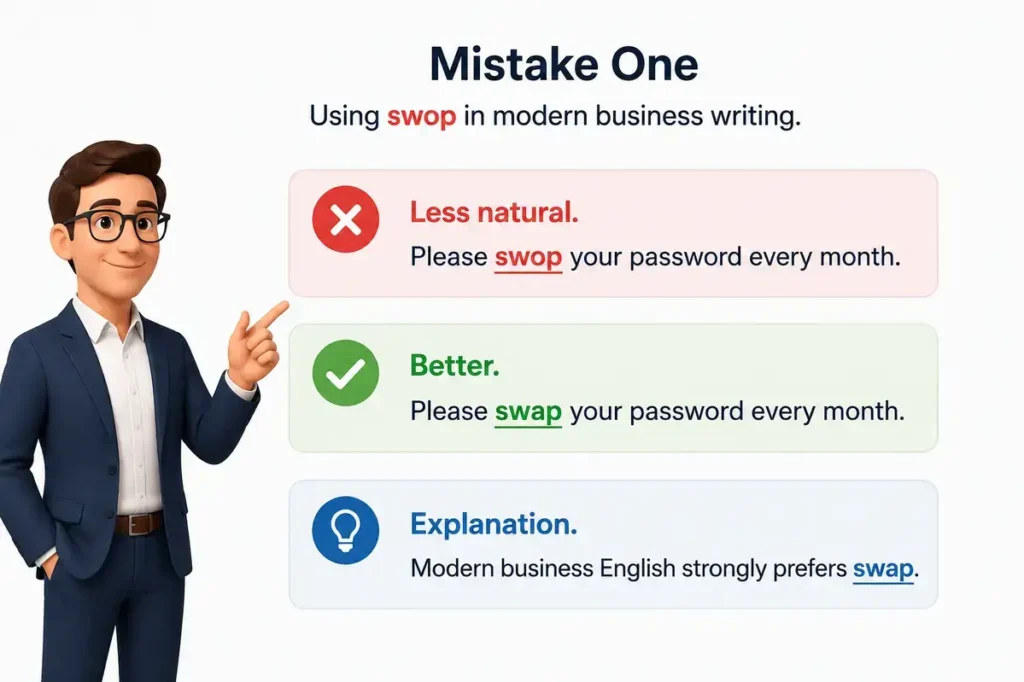
Using Swop in American Business Writing.
Less suitable for a general US audience: We will swop the meeting times next week.
Preferred American form: We will swap the meeting times next week.
The first sentence uses a recognized spelling, but it may look unfamiliar in American professional communication. The second version follows standard US usage and reads naturally to a broader audience.
Adding an Extra Letter.
Incorrect: Swapp the two columns before saving the file.
Correct: Swap the two columns before saving the file.
The base verb has one p. The spelling changes when you add certain endings, which can cause confusion. For example, the past tense is swapped, and the present participle is swapping.
Using the Wrong Past Tense.
Incorrect: We swappped our tickets yesterday.
Correct: We swapped our tickets yesterday.
The past tense requires two p letters followed by ed. Writing three p letters is a typing error rather than a separate accepted form.
Confusing Swap With Switch.
Potentially unclear: We swapped the light off.
Clearer: We switched the light off.
Swap and switch overlap in meaning, but they are not always interchangeable. Swap usually suggests an exchange between two things, while switch often describes changing a setting, state, or choice.
Choosing a Regional Spelling Without Considering the Reader.
Less familiar in US writing: The students will swop their worksheets.
Preferred American form: The students will swap their worksheets.
The problem is not the underlying meaning. The issue is audience expectations. American readers are more accustomed to the spelling with an a, so that version is usually the better editorial choice.
Pronunciation Guide.
Both spellings generally have the same pronunciation within the same regional variety of English. The spelling difference does not usually require a different pronunciation.
American Pronunciation.
In American English, the word is commonly pronounced /swɑp/. It has one syllable and begins with the consonant cluster /sw/, followed by a vowel and the final sound /p/.
A simple guide is to begin with the sound in sweet, move into the vowel heard in many American pronunciations of father, and finish with a clear p sound.
British Pronunciation.
In many British accents, the word is pronounced /swɒp/. The vowel resembles the sound in lot in accents that distinguish this vowel from the one in palm.
The exact vowel depends on the speaker’s accent. British and American speakers may therefore sound different even when they use the same spelling.
Syllables and Stress.
Both forms contain one syllable, so there is no need to divide them into smaller spoken units or identify a stressed syllable. The entire word receives the main stress.
A common mistake is to treat the second spelling as a different word that must have a different sound. In ordinary usage, the two forms represent the same basic word with regional spelling variation.
For another common grammar confusion, see Planing Or Planning Correct Spelling Guide 2026.
Etymology and Word Origin.
The history of these spellings goes back several centuries. The Oxford Advanced Learner’s Dictionary traces the noun swap to Middle English, when the word carried a sense related to striking or hitting. Its later meaning developed through an older use associated with striking hands to confirm an agreement. The modern sense of exchanging things grew from that history.
The alternative spelling swop developed as another written form of the same word. Over time, swap became the more familiar spelling in American English, while swop remained in use in British English.
This history helps explain why both forms exist. They are not two unrelated words that happen to look alike. They are closely related forms with the same central meaning.
Regional Usage.
American English.
In the United States, swap is the preferred spelling in everyday speech and writing. You will see it in conversations, school assignments, company emails, news reports, and technical documents.
For example, an American teacher might ask students to swap papers before checking their answers. A company might swap one payment arrangement for another. In both cases, the spelling with an a is the natural choice.
The alternative spelling is recognized, but it is less common in ordinary American writing. Unless you have a specific reason to preserve it, use swap for a US audience.
British English.
British English accepts both forms. Swap is common, while swop remains a recognized alternative that may appear in everyday writing and conversation.
For example, someone might ask to swop seats on a train or swop one item for another. Another British speaker might write the same sentence with swap. Both versions can express the same idea.
The difference is mainly one of spelling preference. It does not create a separate grammatical rule or a different definition.
Australian English.
Australian English generally uses swap as a familiar and widely understood form. The alternative spelling may also be understood because of its connection with British English, but it is less likely to be the default choice for general writing.
For Australian schoolwork, workplace communication, and public information, swap is a practical choice. It keeps the writing clear and consistent with widely used English conventions.
Canadian English.
Canadian English also uses swap as the standard everyday choice. Canadian spelling includes some British conventions, but that does not mean every alternative British spelling becomes the preferred Canadian form.
For example, a Canadian employee might write, “Can we swap shifts on Monday?” The spelling is familiar and easy to understand. The alternative is possible, but the spelling with an a is the safer choice for a broad Canadian audience.
Grammar Rules and Part of Speech.
Both forms follow the same basic grammar rules. You can use the word as a verb to describe an exchange or as a noun to name an exchange.
Using the Word as a Verb.
The verb can describe an exchange between two people, a replacement, or a change in position. The sentence structure depends on what is being exchanged.
1. Swap something with someone. I swapped books with my friend.
2. Swap something for something else. She swapped her old phone for a newer model.
3. Swap places. The two players swapped places after halftime.
4. Swap something around. We swapped the order of the two presentations.
The verb can also describe an exchange of information or ideas. For example, coworkers might swap suggestions during a meeting, or friends might swap stories about a recent trip.
Using the Word as a Noun.
As a noun, swap refers to the exchange or to an item received through an exchange.
1. An exchange. The two teams agreed to a swap.
2. An exchanged item. These trading cards are swaps from my collection.
3. A work arrangement. We arranged a shift swap for Friday.
The noun often appears with words such as deal, shift, job, and card. These combinations help readers understand the type of exchange being discussed.
Verb Forms and Spelling Changes.
The common verb forms are straightforward.
| Grammar Form | American Standard Spelling | Alternative Form |
|---|---|---|
| Base form | Swap | Swop |
| Third person singular | Swaps | Swops |
| Past tense | Swapped | Swopped |
| Past participle | Swapped | Swopped |
| Present participle | Swapping | Swopping |
The spelling changes because English doubles the final consonant in forms such as swapped and swapping. The final p is doubled before adding ed or ing.
For example, write, “We swapped seats yesterday,” and “We are swapping shifts next week.” Avoid forms such as swaped or swaping because they do not follow the standard spelling pattern.
Punctuation and Sentence Position.
Neither spelling requires special punctuation. You can use it at the beginning, middle, or end of a sentence, depending on the sentence structure.
For example, “Swap your shoes before entering the gym” uses the verb as a command. “The swap went smoothly” uses the noun as the subject.
The word itself does not change the punctuation rules. Follow the normal rules for statements, questions, and commands.
Related and Confused Terms.
Several English words describe exchanges or changes. They overlap in meaning, but each has its own typical use.
1. Exchange. This is a broad term for giving one thing and receiving another. It works well in casual conversation and formal writing.
2. Trade. This often describes exchanging goods, services, or assets. It can suggest a business transaction, but it also works in everyday situations.
3. Switch. This usually means changing from one option, position, or state to another. You might switch seats or switch off a device.
4. Replace. This means removing one thing and putting another in its place. It does not always involve giving something in return.
5. Substitute. This means using one person or thing instead of another. A substitute teacher fills in for the regular teacher.
6. Barter. This refers to exchanging goods or services without using money as the main means of payment.
7. Interchange. This describes exchanging positions, functions, or places. It often sounds more formal than swap.
8. Trade places. This phrase means exchanging positions or taking another person’s place. It can also describe imagining life from another person’s perspective.
These terms can help you choose a more precise word. If two friends exchange jackets, swap works naturally. If a company removes an outdated system and installs a new one, replace may communicate the action more clearly.
Real Life Usage Examples.
Daily Conversation.
People use this word when making simple plans or exchanging everyday items. The meaning is usually clear from the situation.
1. “Can we swap seats so you can see the stage?”
2. “I’ll swap my sandwich for your salad if you’re interested.”
Email and Workplace Communication.
The word can make workplace messages sound direct and natural. It works for schedules, tasks, meeting times, and shared responsibilities.
1. “Could we swap our meeting times to accommodate the client?”
2. “Maya and I agreed to swap shifts next Tuesday.”
Academic Writing.
In academic settings, the word can describe changing experimental conditions, exchanging data, or comparing arrangements. For highly technical work, a more precise term may be preferable when the process involves more than a simple exchange.
1. “The researchers swapped the order of the two tasks to reduce possible order effects.”
2. “Students swapped drafts and provided feedback before submitting their final essays.”
News and Journalism.
News writing often uses the word to describe changes in positions, exchanges between organizations, or financial arrangements. The exact meaning depends on the subject.
1. “The two clubs agreed to swap players before the season began.”
2. “The company plans to swap its older equipment for more energy efficient models.”
Literature and Storytelling.
In stories, exchanges can create humor, tension, or surprise. Characters might trade identities, switch roles, or exchange objects that later become important to the plot.
1. “The twins swapped jackets as part of their plan to fool the guards.”
2. “Before leaving town, the travelers swapped gifts and promised to meet again.”
Expert Editor Insight.
An experienced English editor would treat both forms as legitimate but would pay close attention to the intended audience. In American content, the spelling with an a is the natural default. The alternative may be retained in a direct quotation, a title, or a publication that follows British conventions. Spelling tools may flag the less common form based on their selected language settings, so an editor should check the regional style before treating the alert as proof of an error.
Key Takeaways
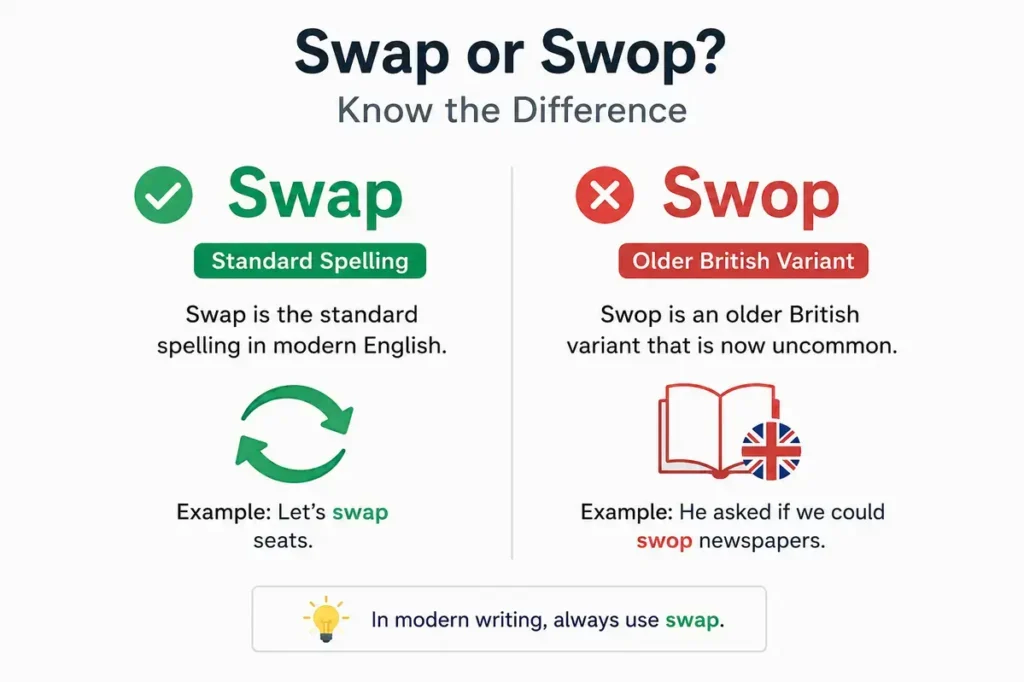
- Swap is the standard spelling in modern English.
- Swop is an older British variant that is now uncommon.
- Both words have exactly the same meaning and pronunciation.
- American English uses swap almost exclusively.
- Modern British English also strongly prefers swap.
- Use swap in business writing, academic work, websites, emails, and everyday communication.
- Keep swop only when quoting historical material or preserving an original title or name.
- Choosing swap makes your writing look current, natural, and professional.
You may also want to read authorization or authorisation Correct Spelling And Usage.
Conclusion.
Swap vs Swop comes down to regional spelling preference rather than a difference in meaning. Both forms are recognized English words that describe exchanging or replacing one thing with another. However, swap is the standard and most familiar choice in American English, while swop remains an accepted alternative used mainly in British English.
For everyday messages, school assignments, professional emails, and general US publications, choose swap. If you are editing British content, follow the publication’s preferred style and keep the spelling consistent. A simple editing tip can help you remember the rule: when writing for American readers, stick with the spelling that uses an a. It is clear, familiar, and widely understood.
FAQs.
Is Swop a Real Word?
Yes. Swop is a recognized English word that means the same thing as swap. Established dictionaries list it as an alternative spelling used mainly in British English. It is less common in American writing, but that does not make it automatically incorrect. For a US audience, the spelling with an a is usually the better choice.
What Does Swap Mean?
Swap means to exchange one thing for another or replace something with an alternative. It can function as both a verb and a noun. For example, two friends can swap books, and the exchange itself can be called a swap. The word appears in everyday conversation, business, technology, education, and finance.
Which Spelling Should I Use in American English?
Use swap in American English. It is the familiar spelling for exchanging items, changing positions, or replacing one thing with another. The alternative spelling is recognized, but it may distract readers or appear unfamiliar in US publications. For schoolwork, business emails, general articles, and professional documents, the spelling with an a is the safest choice.
How Do You Pronounce Both Forms?
Both forms generally share the same pronunciation within a regional accent. In many American accents, the word is pronounced /swɑp/. In many British accents, it is pronounced /swɒp/. Each form has one syllable. The exact vowel sound depends on the speaker’s accent rather than a separate meaning attached to the spelling.
Can Swap Start a Sentence?
Yes. Swap can begin a sentence when you use it as a command or as part of a normal sentence. For example, “Swap the labels before you print the boxes” is a clear instruction. You can also write, “The swap helped both teams.” The first example uses the word as a verb, while the second uses it as a noun.
What Is a Synonym for Swap?
Common synonyms include exchange, trade, switch, and interchange. The best choice depends on the context. Exchange works for many formal and informal situations. Trade often suggests a transaction. Switch usually describes a change from one option to another. Replace works when one item takes the place of another, even if no exchange occurs.
Why Do People Confuse the Two Spellings?
People confuse them because the words look almost identical and share the same meaning. Regional spelling habits also play a role. Readers who encounter British English may see the alternative spelling more often than readers in the United States. Since both forms are recognized, the confusion is about regional preference rather than a simple correct versus incorrect rule.
Is Swap Appropriate for Formal Writing?
Yes. Swap is suitable for formal writing when it accurately describes the exchange. You can use it in business reports, professional emails, academic explanations, and news articles. In highly technical contexts, a more specific term such as exchange, transfer, or substitution may be clearer. Choose the word that describes the action precisely and fits your audience.