
If you’ve ever paused while writing a sentence and wondered which past tense of show sounds right, you’re not alone. Shown vs Showed is a common grammar question because both forms refer to something that someone presented, displayed, or made visible. However, they don’t work the same way in every sentence.
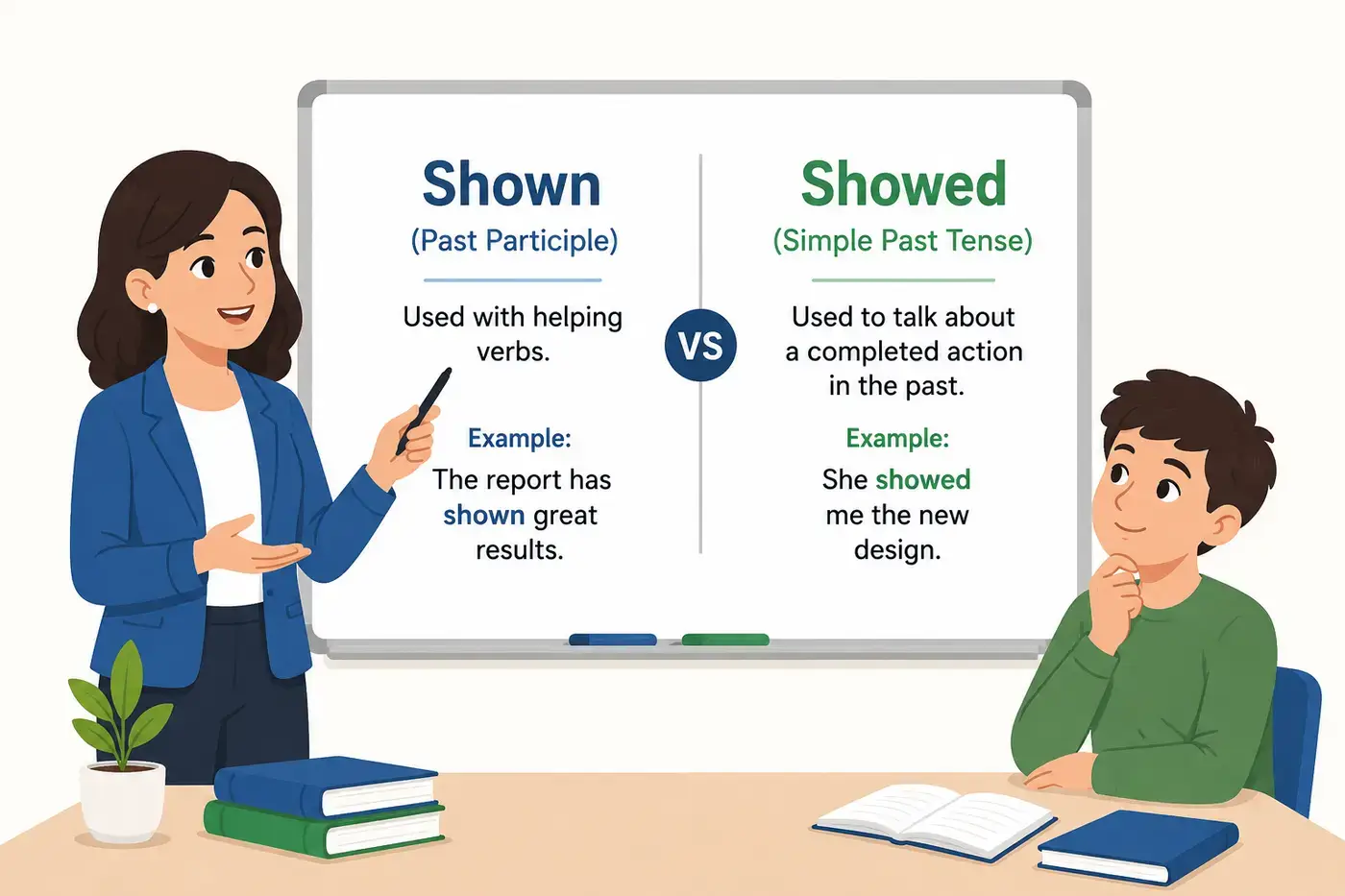
The main difference is simple. Showed is the simple past tense of show, while shown is the past participle. You can say, “She showed me the picture yesterday,” but you would normally say, “She has shown me the picture before.”
The confusion comes from English verb patterns. Some verbs use the same form for the simple past and past participle, while others use different forms. Show belongs to the second group, so choosing the right form depends on the words around it.
Once you understand this rule, you’ll find it easier to write emails, complete school assignments, tell stories, and speak confidently. The examples and explanations below will help you recognize the difference and avoid common grammar mistakes.
A related grammar guide is Cheff or Chef: Definition, Examples and Common Mistakes 2026.
Quick Answer.
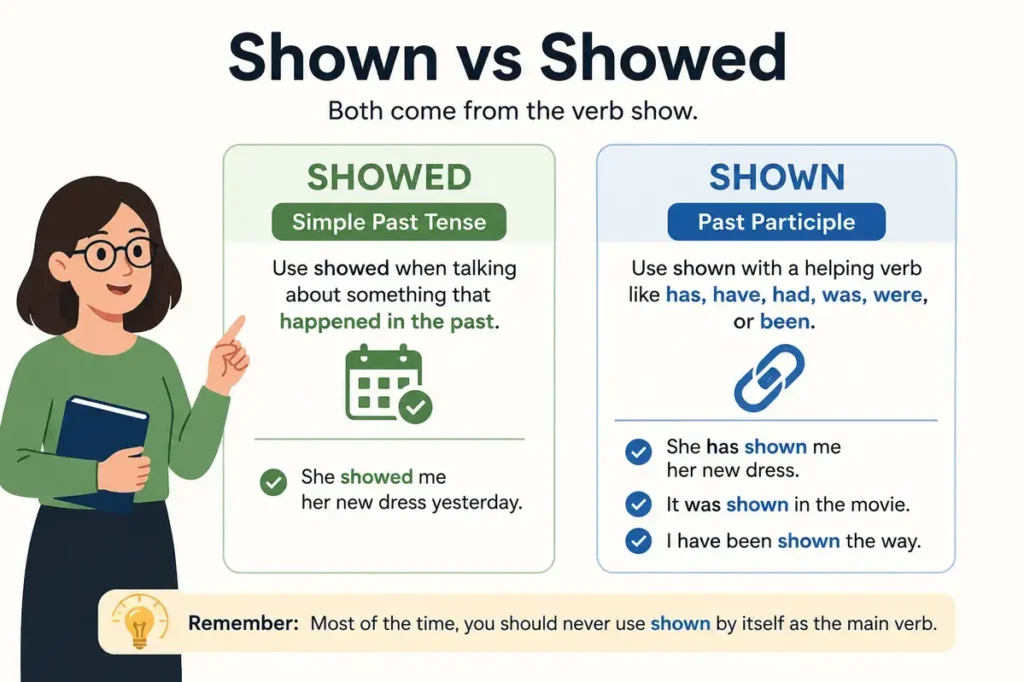
Showed and shown are both correct forms of the verb show, but they serve different grammatical roles. Use showed for a completed action in the simple past tense. Use shown after helping verbs such as has, have, or had, and in passive constructions that require a past participle.
Examples. “He showed us the results yesterday.” “He has shown us the results before.”
Comparison Table for Showed and Shown.
| Feature | Showed | Shown |
|---|---|---|
| Meaning | Presented or displayed something in the past. | Presented or displayed something as a past participle. |
| Part of speech | Simple past verb form. | Past participle of a verb. |
| Main use | Describes a completed past action. | Works with helping verbs and in passive constructions. |
| Common pattern | Subject + showed + object. | Subject + has, have, or had + shown. |
| Example | Maya showed her teacher the drawing. | Maya has shown her teacher the drawing. |
| Formality | Standard in casual and formal English. | Standard in casual and formal English. |
| American English | Correct. | Correct. |
| British English | Correct. | Correct. |
| Common mistake | Using it after has or have in standard grammar. | Using it alone to describe a simple past action. |
The key difference is grammatical rather than a difference in meaning. Both forms come from the same verb and describe the act of presenting or making something visible. The surrounding words tell you which form belongs in your sentence.
Meaning and Definition.
What Does Showed Mean.
Showed is the simple past tense of show. It describes an action that happened in the past and is presented as a completed event.
For example, “Daniel showed his parents the report.” The sentence tells you that Daniel presented the report to his parents at some point in the past. The verb does not need a helping verb because it already carries the past tense.
You can use this form in statements, questions, and negative sentences. For example, “She showed me the way,” “Did she show you the way?” and “She did not show me the way.” Notice that questions and negative sentences use the base form show after did or did not.
The word can describe many kinds of actions. Someone might show a photograph, demonstrate a skill, reveal a result, explain a process, or express a feeling. The exact meaning depends on the context.
What Does Shown Mean.
Shown is the past participle of show. It usually appears with a helping verb such as has, have, or had. It can also appear in passive sentences with forms of be.
Consider this example. “The manager has shown great patience.” The helping verb has combines with shown to form the present perfect tense. The sentence connects a past action or experience to the present.
Now consider this sentence. “The winning design was shown to the judges.” Here, was shown is a passive construction. The sentence focuses on the design and what happened to it rather than on the person who presented it.
Shown also appears in expressions such as “has shown,” “had shown,” “will have shown,” and “is shown.” Each pattern has its own grammatical purpose.
Are Both Forms Real Words.
Yes. Neither form is a spelling mistake, and neither one is less correct by itself. The mistake happens when a writer uses one form in a grammatical pattern that calls for the other.
For example, “I showed him the answer” is correct because the sentence describes a completed past action. “I have shown him the answer” is also correct because have requires the past participle in this verb phrase.
By contrast, “I have showed him the answer” is generally considered nonstandard in edited American English. The standard form is “I have shown him the answer.”
Key Differences Explained.
The Difference in Tense.
Showed directly marks the simple past tense. It places an action in the past without requiring a helping verb.
Example. “The guide showed us the museum.”
Shown does not normally mark the simple past tense on its own. It needs a suitable helping verb to form a tense or voice construction.
Example. “The guide has shown us the museum.”
The first sentence reports a past event. The second uses the present perfect, which connects the past action to the present in a way that depends on context.
The Difference in Grammar.
The easiest way to choose the right form is to look at the words before the verb.
- Use showed for a simple past statement. “Lena showed me her new phone.”
- Use shown after has, have, or had in perfect verb phrases. “Lena has shown me her new phone.”
- Use shown in passive constructions when the grammar calls for a past participle. “The phone was shown during the meeting.”
- Use show after did or did not. “Lena did not show me her phone.”
This last rule matters because English already marks the past through did. Adding showed after did creates an incorrect standard construction. Write “Did Lena show you the phone?” rather than “Did Lena showed you the phone?”
The Difference in Meaning.
The two forms share the same basic meaning. They do not describe two separate actions or different objects. Instead, they help establish the time and grammatical structure of an action.
Compare these sentences.
- “The scientist showed the results last week.”
- “The scientist has shown the results to the team.”
- “The results were shown last week.”
The first sentence uses the simple past. The second uses the present perfect. The third uses the passive voice with a past tense helping verb.
The difference comes from the structure of each sentence, not from a change in the core meaning of show.
The Difference in Pronunciation.
Showed is commonly pronounced /ʃoʊd/ in American English. Shown is commonly pronounced /ʃoʊn/.
Both forms have one syllable. The first sound is the same, and both contain the long o sound heard in words such as go. The ending changes from a voiced d sound in showed to an n sound in shown.
A simple pronunciation tip is to pay attention to the final consonant. The ending in showed sounds like the end of road, while shown ends like the word known.
Standard and Nonstandard Usage.
In standard edited English, use showed as the simple past form and shown as the past participle. This distinction appears in ordinary conversation, schoolwork, professional communication, and formal writing.
You may encounter forms such as “has showed” in informal speech or online writing. Some speakers use patterns that differ from the standard form, but that does not make them the best choice for professional or academic writing.
When you need clear, standard English, follow the established pattern. Write “has shown,” “had shown,” and “was shown.”
Which Form Is Correct.
Both forms are correct. The sentence determines the right choice.
Use showed when you describe an action that happened in the past. Use shown when the verb phrase needs a past participle.
The reason is a basic feature of English verb grammar. Many verbs have a simple past form and a separate past participle. For show, the standard forms are show, showed, and shown.
Other familiar verbs follow similar patterns. Write “I wrote the letter” but “I have written the letter.” Write “She took the bus” but “She has taken the bus.” The pattern for show works the same way.
Remember this practical rule. If you can replace the verb phrase with a structure such as “has completed” or “had finished,” the sentence may need a past participle. If you are simply reporting what happened yesterday, the simple past is usually the right choice.
Context still matters because different sentence structures express different relationships in time. The verb form is only one part of the sentence, but choosing it correctly helps the whole sentence sound natural.
Sentence Examples.
The following examples show how the two forms work in common situations.
Ten Correct Examples.
- Everyday conversation. “My brother showed me how to fix the printer.”
- Text message. “I showed Sam your photo, and he loved it.”
- Workplace communication. “The sales team showed the client three design options.”
- School assignment. “The experiment showed a clear change in temperature.”
- Academic writing. “The findings have shown a link between the two variables.”
- Formal writing. “The records have shown that the payment was received.”
- Social situation. “She showed kindness to everyone at the event.”
- Online communication. “The video showed me how to adjust the settings.”
- Storytelling. “He opened the old box and showed us a collection of letters.”
- Passive construction. “The final results were shown during the presentation.”
Each example uses a form that fits its grammatical structure. The simple past appears in the first group of sentences that report completed events. The past participle appears after helping verbs or in passive constructions.
Five Incorrect Examples and Their Corrections.
These examples show common mistakes. The incorrect versions are included only to explain the grammar.
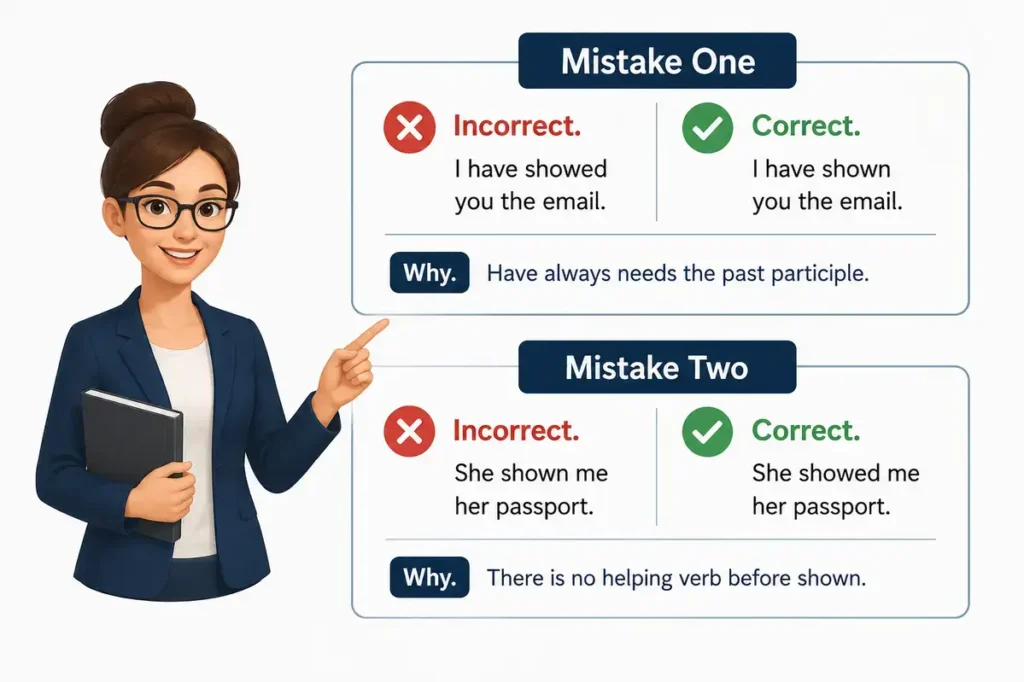
- Incorrect. “She has showed me the schedule.” Correct. “She has shown me the schedule.” Has requires the past participle.
- Incorrect. “They had showed us the room.” Correct. “They had shown us the room.” Had forms the past perfect with a past participle.
- Incorrect. “The results have showed improvement.” Correct. “The results have shown improvement.” Have must be followed by shown in standard English.
- Incorrect. “Did he showed you the receipt?” Correct. “Did he show you the receipt?” Did already marks the past tense.
- Incorrect. “The film was showed at school.” Correct. “The film was shown at school.” This passive construction requires the past participle.
These mistakes often happen because writers remember that the action occurred in the past and assume the verb must end in ed. English grammar does not work that way for every verb form. The helping verb determines which form belongs in the sentence.
Common Grammar Mistakes.
Writers often confuse these forms because English uses several patterns to describe past actions. Here are five mistakes to watch for when you write or edit a sentence.
Using Showed After Has.
The word has normally takes a past participle when it forms the present perfect tense.
Incorrect. “He has showed his work to the teacher.”
Correct. “He has shown his work to the teacher.”
The same rule applies to have and had. If one of these words helps form a perfect tense, use shown rather than showed in standard English.
Using Showed After Had.
Had forms the past perfect tense when it appears with a past participle. This tense helps show that one past action happened before another past event.
Incorrect. “I had showed the room to the guests before dinner.”
Correct. “I had shown the room to the guests before dinner.”
The second sentence clearly places the showing before dinner. The form shown completes the verb phrase correctly.
Using Showed After Did.
Questions and negative statements with did use the base form of the verb. Since did already marks the past tense, you don’t need to mark the main verb again.
Incorrect. “Did she showed you the email?”
Correct. “Did she show you the email?”
The same pattern applies to other verbs. You say “Did he go?” rather than “Did he went?”
Using Shown Without a Helping Verb.
Shown usually needs a helping verb when it functions as a past participle. Using it alone as the main verb in a simple past statement is not standard.
Incorrect. “She shown me the answer yesterday.”
Correct. “She showed me the answer yesterday.”
You can use shown in a passive sentence or a perfect tense, but the surrounding grammar must support it. For example, “She has shown me the answer” is correct.
Assuming Every Past Action Needs an Ed Ending.
English has regular and irregular verbs. Regular verbs usually form the simple past by adding ed, as in walked and opened. Irregular verbs follow different patterns, including show, showed, and shown.
A useful habit is to learn the three main forms of irregular verbs together. That approach helps you remember not just how to describe a past event but also how to build perfect tenses correctly.
Pronunciation Guide.
Both words have one syllable and begin with the same sound. The main difference is the final consonant.
| Word | IPA | Easy pronunciation | Syllables |
|---|---|---|---|
| Showed | /ʃoʊd/ | Shohd | One |
| Shown | /ʃoʊn/ | Shohn | One |
| Show | /ʃoʊ/ | Shoh | One |
The symbol /ʃ/ represents the sh sound heard at the start of ship. The /oʊ/ sound is the vowel heard in go in most American English accents.
To pronounce showed, finish with a clear d sound. To pronounce shown, let the final sound come through your nose as an n. Avoid adding an extra syllable to either word.
These pronunciations are standard in American English. Regional accents may affect the exact vowel quality, but the difference between the final d and n remains useful for distinguishing the words.
Pronunciation can help you recognize the forms when speaking, but grammar should guide your choice in writing. Both words sound similar enough that relying on sound alone may not prevent a tense error.
A related grammar guide is Eccentric vs Eclectic Meaning and Usage (2026).
Etymology and Word Origin.
Show comes from the Old English verb sceawian, which meant to look at, see, or examine. The word developed over time and became associated with presenting something to view, making something visible, or allowing another person to understand something.
The modern forms developed through the history of English. Showed became the regular simple past form, while shown developed as the past participle. This pattern reflects older verb changes that remain in modern English even though many other verbs have become regular.
The same kind of historical development explains why English has pairs such as wrote and written, spoke and spoken, and broke and broken. These forms may seem inconsistent at first, but they follow established patterns inherited from earlier stages of the language.
For everyday writing, you don’t need to memorize the historical details. Learning show, showed, and shown as a set is the most practical way to remember the correct forms.
Regional Usage.
American English.
Both forms are standard in the United States. In everyday American conversation, people commonly use showed to report a past action and shown with has, have, or had.
Examples include “She showed me the new office” and “She has shown me the new office.” In professional writing, school assignments, and published work, the same distinction applies.
British English.
British English follows the same basic rule. Showed is the simple past form, and shown is the past participle used in perfect tenses and appropriate passive constructions.
A British writer would normally write “He showed us the results” and “He has shown us the results.” There is no major regional grammar difference that changes this rule.
Australian English.
Australian English also uses showed and shown according to the same standard verb pattern. The choice depends on the sentence structure rather than a special Australian spelling convention.
For example, “The coach showed the team a new technique” uses the simple past. “The coach has shown the team a new technique” uses the present perfect.
Canadian English.
Canadian English follows the same standard pattern as American and British English. Both forms are accepted, but they serve different grammatical functions.
Across these English varieties, the safest approach is consistent. Use showed for the simple past and shown when the verb phrase calls for a past participle.
Grammar Rules and Part of Speech.
Show is a verb. Showed and shown are two different forms of that verb, and each plays a specific role in a sentence.
The Simple Past Tense.
Use showed to report an action that took place in the past.
Examples.
- “The teacher showed us a map.”
- “I showed my manager the updated report.”
- “The chart showed a sharp increase.”
The action may have happened a minute ago or many years ago. The key point is that the sentence presents it as a past event.
The Present Perfect Tense.
Use has shown or have shown to connect a past action or experience to the present.
Examples.
- “The company has shown steady growth.”
- “They have shown great interest in the project.”
Use has with a singular third person subject, such as he, she, it, or a singular noun. Use have with I, you, we, they, and plural nouns.
The Past Perfect Tense.
Use had shown to describe an action that happened before another point or event in the past.
Example. “By the time the meeting started, the director had shown everyone the proposal.”
The past perfect helps establish the order of events. It makes clear that the showing happened before the meeting began.
Passive Voice.
Use shown in passive constructions when the verb phrase calls for a past participle.
Examples.
- “The painting was shown at the gallery.”
- “The final decision has been shown to the board.”
- “The results will be shown tomorrow.”
The subject receives the action rather than performing it. The person who performed the action may be left out because the result matters more.
Questions and Negative Sentences.
Use show after did and did not.
Examples.
- “Did you show the new employee around?”
- “We did not show the guests the private room.”
- “Why did he show the wrong file?”
This rule applies even when the action happened in the past. The helping verb did carries the past tense, so the main verb stays in its base form.
Punctuation and Sentence Position.
The forms themselves don’t require special punctuation. Use the normal punctuation rules for the sentence you are writing.
For example, “She showed me the photo” ends with a period. “Has she shown you the photo?” ends with a question mark. The grammatical pattern determines the verb form, while the sentence type determines the punctuation.
Real Life Usage Examples.
Daily Conversation.
In everyday conversation, the simple past is useful for telling someone what happened. The past participle helps you talk about experience, results, or events connected to the present.
- “Dad showed me how to change a tire.”
- “You’ve shown me that I can trust you.”
The first sentence reports a completed action. The second describes something that has influenced the speaker’s present understanding.
Email and Workplace Communication.
Workplace writing often describes completed tasks and reports progress. Choosing the right form makes updates easier to understand.
- “I showed the draft to the marketing team yesterday.”
- “We have shown the client the revised proposal.”
The first sentence gives a clear time reference. The second emphasizes that the proposal has been presented to the client.
Academic Writing.
Academic writing often uses shown to describe findings, evidence, and results. Showed remains useful when reporting a specific past action in a study.
- “The trial showed a measurable change in the sample.”
- “The results have shown a consistent pattern across the groups.”
The first sentence reports what the trial revealed. The second connects the findings to a broader set of results.
News and Journalism.
News writing often uses the simple past to report events and the past participle in passive or perfect constructions.
- “The mayor showed reporters the plans for the new library.”
- “The footage has shown new details about the incident.”
Both examples communicate information directly. The verb form fits the grammatical structure of the report.
Literature and Storytelling.
Stories use the simple past to move events forward. The past participle appears when the sentence requires a perfect tense or passive construction.
- “The old woman showed the traveler a hidden path through the woods.”
- “He had shown great courage before the final battle.”
The first sentence describes an event in the story. The second gives background about something that happened before another moment in the narrative.
Related and Confused Terms.
Several English verbs follow the same pattern as this verb. Learning them together can help you choose the correct form more quickly.
1. Show. This is the base form used in the present tense and after modal verbs or the helping verb did. Example. “I show my work to the teacher” and “I did show my work yesterday.”
2. Shown. This is the past participle. It appears in perfect tenses and passive constructions. Example. “The work has been shown to the teacher.”
3. Saw and Seen. Saw is the simple past of see, while seen is its past participle. Say “I saw the picture” and “I have seen the picture.”
4. Wrote and Written. Wrote describes a simple past action. Written follows helping verbs in perfect tenses. Say “She wrote a letter” and “She has written a letter.”
5. Took and Taken. Took is the simple past of take, while taken is the past participle. Say “He took the book” and “He has taken the book.”
6. Spoke and Spoken. Spoke is the simple past of speak. Spoken appears in perfect tenses and other structures that require a past participle. Say “She spoke clearly” and “She has spoken clearly.”
7. Displayed. This is a regular verb form that can replace show in many contexts. Example. “The gallery displayed the painting.” Its simple past and past participle share the same form.
8. Demonstrated. This regular verb often means showing how something works or providing evidence. Example. “The teacher demonstrated the process.” Like displayed, it uses the same form for the simple past and past participle.
These related terms reveal a useful pattern. Some English verbs use different forms for the simple past and past participle, while regular verbs often use the same form for both. Knowing which pattern a verb follows helps you avoid tense errors.
Expert Editor Insight.
An experienced editor checks the entire verb phrase rather than looking at the main verb alone. If a sentence contains has, have, or had, the editor checks for the correct past participle. If it contains did, the editor checks that the main verb stays in its base form. Grammar tools can catch many of these errors, but they may miss problems when the sentence is complex or the intended meaning is unclear. The best editing habit is to read the sentence aloud, identify the helping verb, and confirm that the main verb matches the grammatical pattern.
Key Takeaways
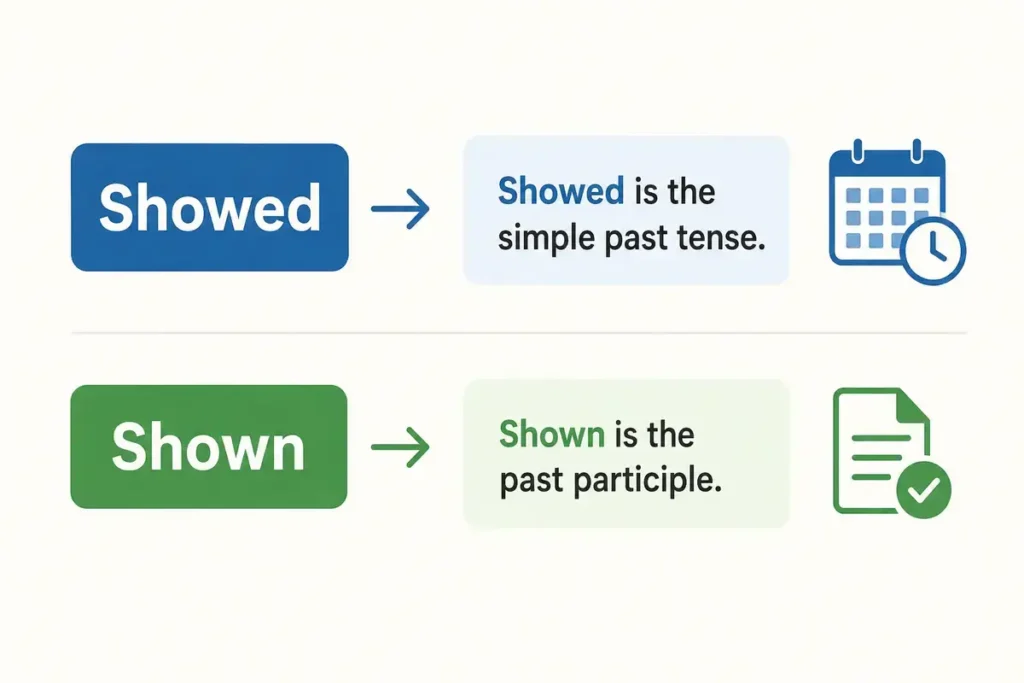
- Showed is the simple past tense.
- Shown is the past participle.
- Showed can stand alone as the main verb.
- Shown always needs a helping verb.
- Present perfect uses has shown or have shown.
- Past perfect uses had shown.
- Passive voice uses shown.
- American English and British English follow the same rule.
- Professional writers choose the verb form based on grammar not appearance.
- Remember the easiest rule. Showed works alone. Shown needs a helper.
A related grammar guide is well-known vs well known Which Form Is Correct.
Conclusion.
Shown vs Showed comes down to one simple grammar rule. Showed is the simple past tense, while shown is the past participle. Both forms are correct, but each belongs in a different sentence structure. Write “She showed me the picture yesterday” to describe a completed past action. Write “She has shown me the picture” when using the present perfect tense. The same rule applies to had shown and passive phrases such as was shown.
Here’s an easy editing tip. Learn the three forms together as show, showed, and shown. Then check the helping verb before choosing your word. With practice, you’ll make the right choice naturally.
FAQs.
Is Showed a Real Word?
Yes. Showed is the standard simple past tense of show. You can use it to describe an action that happened in the past, such as “She showed me her new car.” It is correct in everyday speech, academic writing, and professional communication. The problem arises when writers use it in a verb phrase that requires the past participle shown.
What Does Shown Mean?
Shown is the past participle of show. It commonly appears after has, have, or had, as in “He has shown great patience.” It also appears in passive constructions, such as “The artwork was shown at the museum.” Unlike showed, shown does not normally stand alone as the main verb in a simple past statement.
Which Form Should I Use in a Sentence?
Use showed when you describe a completed past action without a helping verb that requires a past participle. Use shown after has, have, or had in perfect verb phrases and in passive constructions that require a past participle. For example, write “She showed the report yesterday” and “She has shown the report to her manager.”
How Do You Pronounce These Words?
Showed is pronounced /ʃoʊd/ in American English, while shown is pronounced /ʃoʊn/. Both words have one syllable and share the same initial sh sound and long o vowel. The final consonant distinguishes them. Showed ends with a d sound, while shown ends with an n sound.
Can Shown Start a Sentence?
Yes. Shown can start a sentence when it forms part of a suitable grammatical construction. For example, “Shown in the final report, the results support the original conclusion.” Here, shown introduces a shortened passive phrase. However, for a straightforward past statement, write “The results showed a clear change” rather than “The results shown a clear change.”
What Is a Synonym for Showed?
Useful alternatives include displayed, presented, demonstrated, revealed, and pointed out. The best choice depends on the meaning. Displayed often refers to placing something where people can see it. Demonstrated suggests explaining how something works. Revealed means making information known. These words can replace show in some sentences, but they don’t always carry exactly the same meaning.
Why Do People Confuse These Verb Forms?
People often confuse these forms because both refer to past actions and share the same base verb. English also contains many irregular verbs whose past tense and past participle differ. Writers may assume that adding ed always creates the right past form. Remembering show, showed, and shown together helps prevent this mistake.
Is Shown Appropriate in Formal Writing?
Yes. Shown is fully appropriate in formal writing when the sentence calls for a past participle. It commonly appears in reports, academic papers, business documents, and news articles. For example, “The findings have shown a consistent trend” is correct. In formal writing, use the standard verb pattern and avoid constructions such as “has showed.”