
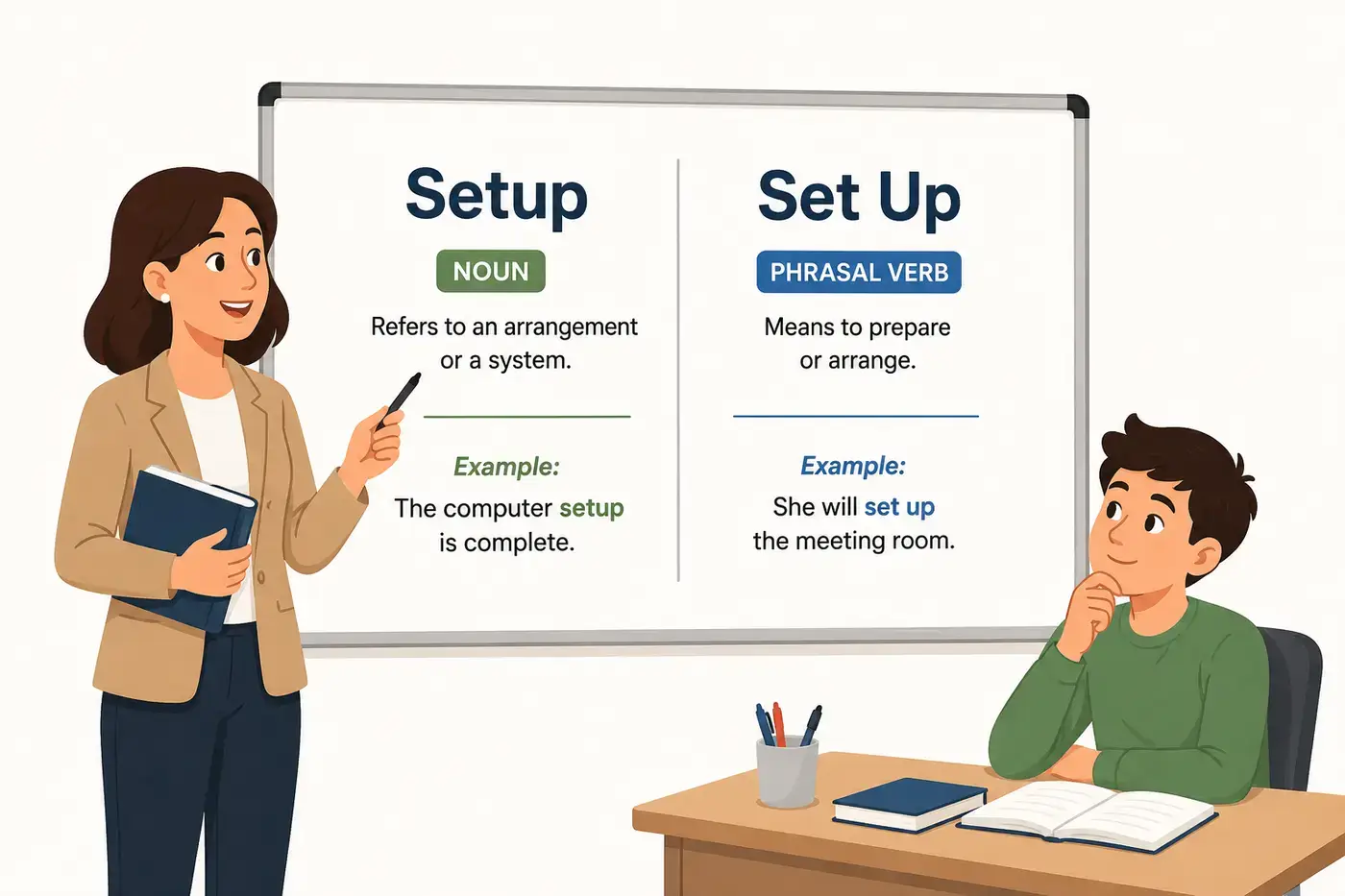
Choosing between Setup vs Set Up can be confusing because both forms are correct in English. The difference comes down to how you use them in a sentence. One word usually names a thing or an arrangement. Two words usually describe an action.
For example, you might need to finish the setup of a new computer before you can use it. You might also need to set up the computer by installing software and connecting it to the internet. The meaning stays closely related, but the grammar changes.
This small spelling difference matters in professional emails, schoolwork, business documents, and everyday messages. Using the right form makes your writing clearer and helps you avoid common grammar mistakes.
The good news is that you don’t need to memorize a long list of rules. Once you learn how nouns and verbs work, the difference becomes easy to spot. A few simple tests can help you choose the correct form every time.

Many readers also check Mather vs Mother Which Spelling Is Correct.
Quick Answer
Setup is usually a noun that refers to an arrangement, configuration, or process. Set up is a verb phrase that means to arrange, install, establish, or prepare something for use. Write one word when naming the arrangement and two words when describing the action.
Comparison Table for Setup and Set Up
| Feature | Setup | Set up |
|---|---|---|
| Main function | Noun | Verb phrase |
| Meaning | An arrangement or configuration | To arrange or prepare something |
| Example | The setup took an hour. | Please set up the printer. |
| Grammar | Can follow an article such as the or a | Can follow words such as please or to |
| Common contexts | Equipment, events, systems, plans | Installing, organizing, preparing |
| Formality | Standard in formal and informal English | Standard in formal and informal English |
| American English | Correct | Correct |
| British English | Correct | Correct |
Both forms are standard English. Neither spelling is automatically wrong. The right choice depends on the role the expression plays in your sentence.
Meaning and Definition
What Setup Means
Setup is a noun that describes the way something is arranged, organized, or prepared. It can refer to a physical arrangement, a computer configuration, a work environment, or the structure of an event.
Consider this sentence.
The office setup makes it easy for everyone to work together.
Here, the word names the arrangement of the office. It does not describe someone performing an action.
The noun can also refer to the process of preparing something. For example, the phrase computer setup may describe the process of configuring a new computer. The word still functions as a noun because it names a process rather than expressing an action directly.
Common uses include the following.
- The setup of a new phone.
- A comfortable home office setup.
- The setup for a business meeting.
- A camera setup for recording videos.
- The setup of an online account.
In casual conversation, people also use the noun to describe a situation or arrangement. Someone might say that a plan has a good setup or that a room has a practical setup.
In another context, setup can describe a trick or a situation designed to mislead someone. For example, a person who believes someone deliberately made them look guilty might say the entire situation was a setup. The exact meaning depends on the surrounding sentence.
What Set Up Means
Set up is a verb phrase made up of the verb set and the particle up. It describes the action of arranging, installing, establishing, or preparing something.
For example.
Please set up the meeting before Friday.
In this sentence, set up describes an action that someone needs to complete. The person must arrange the meeting rather than simply name the arrangement.
The expression works in many everyday situations.
- Set up a new computer.
- Set up an appointment with a doctor.
- Set up a business account.
- Set up chairs for a presentation.
- Set up a payment method.
The verb phrase can also refer to creating something that did not exist before. You might set up a company, establish a support group, or arrange a system for tracking expenses.
Its grammatical form can change with the sentence. For example, you can write set up, sets up, setting up, or set it up. These forms all relate to the same verb phrase.
Is Setup One Word or Two
Both spellings are correct, but they serve different grammatical purposes. Use setup as a noun and set up as a verb phrase in standard American English.
A simple way to remember the difference is to ask yourself what the sentence is doing.
If the sentence names an arrangement or process, use setup. If the sentence describes someone arranging or preparing something, use set up.
Compare these examples.
- The setup looks professional. This sentence names an arrangement.
- We need to set up the room. This sentence describes an action.
The difference becomes much easier to recognize when you focus on meaning rather than spelling alone.
Key Differences Explained
Spelling and Grammar
The main difference is the space between the words. However, that space reflects a difference in grammar rather than a personal writing preference.
Setup functions as a noun. Set up functions as a verb phrase. Treating the forms as interchangeable can make a sentence grammatically incorrect or awkward.
For example, the sentence The setup is ready uses the noun correctly. The sentence We will set up the equipment uses the verb phrase correctly.
Meaning and Context
The two forms share a basic idea of preparation or arrangement. Their meanings overlap, but their sentence roles differ.
A setup can be the finished arrangement or the preparation process itself. To set up something means to perform the work needed to create that arrangement.
Think of a birthday party. The decorations, tables, chairs, and overall arrangement make up the party setup. The act of putting everything in place is the work of setting up the party.
Part of Speech
A noun names a person, place, thing, idea, arrangement, or process. Setup fits this category because it names an arrangement or preparation process.
A verb expresses an action or state. Set up belongs to this category because it describes the act of arranging or preparing something.
This distinction matters because nouns and verbs fit into sentences differently. You can say the setup is complete or that the team will set up the equipment.
Formality and Professional Use
Both forms work in professional and casual writing. Neither is more formal simply because it contains one word or two.
In a business report, you might write The system setup requires additional testing. In an instruction manual, you might write Set up the system before running the test.
The best choice depends on the sentence structure. Formal writing still follows the same basic grammar rule.
Pronunciation
Both forms have the same pronunciation in ordinary American English. Speakers generally pronounce them as /sɛt ʌp/.
The space appears in writing but does not create a meaningful difference in speech. This explains why people sometimes choose the wrong spelling when writing quickly.
Listening alone won’t help you decide which form to write. You need to examine the grammatical role of the expression in the sentence.
Regional Usage
American, British, Canadian, and Australian English all use setup as a noun and set up as a verb phrase.
Some related expressions can vary across English varieties, but the basic distinction remains the same. You don’t need a different rule for these two forms when writing for readers in the United States or other major English speaking regions.
Which Form Is Correct
Both forms are correct in standard English. The noun uses one word, while the verb phrase uses two.
This distinction follows a familiar pattern in English. Some expressions develop different written forms depending on their grammatical function. The noun often appears as one word, while the corresponding verb remains separate.
For instance, you can write a login problem when describing a problem with an account login process. You can also write log in when telling someone to access an account. The exact usage rules differ by expression, so don’t assume every pair follows the same pattern automatically.
With setup and set up, the distinction is straightforward.
- Use setup when the expression names an arrangement, configuration, or preparation process.
- Use set up when the expression describes the action of arranging, configuring, or preparing something.
- Check the complete sentence if both forms seem possible.
A reliable dictionary can confirm the noun and verb entries. Grammar guides also explain the difference between nouns and verb phrases. For everyday editing, though, identifying the function of the expression is usually enough.
Sentence Examples
The following examples show how to use both forms naturally in everyday and professional situations.
Ten Correct Examples
- The setup for the school science fair took most of the afternoon.
- Can you set up my new laptop before the meeting starts?
- Our home office setup gives us enough room to work comfortably.
- I need to set up an appointment with my dentist.
- The restaurant has a simple setup that makes ordering easy.
- Please set up your account before submitting the application.
- The camera setup worked well for our classroom presentation.
- The manager asked the team to set up the conference room.
- A clear setup helps readers understand the purpose of an experiment.
- We plan to set up a shared folder for the project documents.
Notice how the form changes with the sentence. The noun names an arrangement or process. The verb phrase tells the reader what someone needs to do.
Five Incorrect Usage Examples
The following examples are incorrect in their intended meanings. Each one shows a common error and its correction.
- Incorrect: We need to setup the new printer. Correct: We need to set up the new printer. The expression follows to and describes an action.
- Incorrect: The set up is ready. Correct: The setup is ready. The sentence names the completed arrangement.
- Incorrect: Please finish the set up today. Correct: Please finish the setup today. The word follows the noun finish in a structure that calls for a noun.
- Incorrect: They will setup a new account. Correct: They will set up a new account. The words follow will and form the main verb.
- Incorrect: The setup the chairs before lunch. Correct: Set up the chairs before lunch. The corrected sentence uses a verb to give an instruction.
These corrections apply to standard American English. In each case, the surrounding grammar tells you which form belongs in the sentence.

Common Mistakes and Misspellings
Writers often mix up these forms because they sound alike and share the same basic meaning. The errors usually happen when someone focuses on the sound of the phrase instead of its grammatical function.
Mistake One Using One Word as a Verb
Incorrect: I need to setup my new phone.
Correct: I need to set up my new phone.
The word to introduces the verb in this sentence. The action requires two words. The same rule applies to instructions such as set up your account and set up the equipment.
Mistake Two Using Two Words as a Noun
Incorrect: The set up was complicated.
Correct: The setup was complicated.
The sentence describes a process or arrangement. Because the expression acts as a noun, the closed form is the standard choice.
Mistake Three Confusing Setup With Setting Up
Incorrect: Setting setup the equipment took an hour.
Correct: Setting up the equipment took an hour.
Setting up is the participle form of the verb phrase. It describes an ongoing action or an action considered as a process. Setup is a noun and cannot replace the verb phrase in this structure.
Mistake Four Forgetting the Space in an Instruction
Incorrect: Setupthe software before starting the program.
Correct: Set up the software before starting the program.
This error often comes from fast typing or careless editing. A missing space can make an instruction difficult to read and may cause spelling tools to flag the sentence.
Mistake Five Changing the Form Without Checking the Sentence
Incorrect: The technician will complete the set up tomorrow.
Correct: The technician will complete the setup tomorrow.
The verb complete takes a noun as its object in this sentence. The noun setup names the process the technician will finish.
A useful editing habit is to read the whole sentence rather than judging the expression on its own. The surrounding words usually reveal the correct form.
Pronunciation Guide
Both forms sound the same in ordinary American English. The spelling changes, but the pronunciation does not.
| Pronunciation Feature | Details |
|---|---|
| IPA | /sɛt ʌp/ |
| Syllable count | Two |
| Syllable breakdown | set plus up |
| First sound | The s sound in set |
| Main stress | Usually stronger on set in neutral speech |
| Common issue | Confusing the written forms because they sound alike |
The first syllable contains the short vowel sound found in the word set. The second contains the vowel sound found in up.
Say the two parts naturally without adding a pause between them. The written space in the verb phrase doesn’t require a pause in speech.
A common mistake is to expect a different pronunciation from the noun and the verb. English spelling doesn’t always work that way. In this case, pronunciation cannot tell you which form to write.
Instead, pay attention to the sentence. If you are naming an arrangement, write setup. If you are describing an action, write set up.
Still confused? Compare Implicit vs Complicit Which Word Should You Use 2026.
Etymology and Word Origin
The word set has a long history in English. It developed from earlier forms of English and is related to words found in other Germanic languages. Over time, it gained many meanings, including placing something in position, arranging objects, and establishing a condition.
The word up is also an old English word with Germanic roots. It commonly expresses direction, position, completion, or movement toward a higher point. When used with verbs, it can add meaning to the main verb or help form an established expression.
Together, set and up developed the familiar meaning of arranging or preparing something. People use the phrase for physical tasks, such as placing chairs in a room, and for abstract tasks, such as establishing an account or organizing a business.
The noun setup follows a common pattern in English word formation. Two words that work together can develop into a closed compound noun over time. The noun keeps the general idea of arrangement or preparation, while the verb phrase retains its separate spelling.
The exact history of a word can be more complex than its modern spelling suggests. You don’t need to know every historical stage to use these forms correctly. The current grammatical distinction is the practical rule to remember.
Regional Usage
American English
In American English, setup is the standard noun form and set up is the standard verb phrase.
You might write that the setup of a new device was easy. You might then tell someone to set up the same device. Both forms are appropriate in everyday messages, school assignments, business reports, and technical instructions.
American dictionaries recognize the noun and verb phrase as separate grammatical entries or uses. For clear writing, follow the distinction rather than choosing a spelling based on personal preference.
British English
British English uses the same basic distinction. Setup can refer to an arrangement or configuration, while set up describes the act of arranging or establishing something.
You can use the same grammar rule in a British English email or report. There is no need to change the spelling solely because your audience lives in the United Kingdom.
Australian English
Australian English follows the same standard pattern. Writers use setup as a noun and set up as a verb phrase in ordinary writing.
A person might describe a new office setup or ask a colleague to set up a meeting. The grammatical function determines the spelling in both cases.
Canadian English
Canadian English also uses the noun and verb forms in the same way. A writer can refer to a computer setup or ask a coworker to set up a shared workspace.
For all four varieties, the main rule remains consistent. Check the function of the expression instead of looking for a regional spelling difference that doesn’t apply.
Grammar Rules and Part of Speech
Understanding the grammar behind these forms helps you make the right choice without memorizing every possible sentence.
How the Noun Works
The noun setup can appear in several positions within a sentence. It can act as the subject, the direct object, or the object of a preposition.
Consider these examples.
- The setup needs improvement. Here, setup is the subject.
- We finished the setup. Here, setup is the direct object.
- The team discussed the setup of the new system. Here, setup follows the preposition of as part of a larger phrase.
You can also use setup with an article or a describing word. Examples include a simple setup, the current setup, and a professional setup.
The noun can describe something physical, such as a desk arrangement, or something less visible, such as a payment system. Its exact meaning depends on context.
How the Verb Phrase Works
Set up describes an action and changes form according to the sentence.
- I set up the equipment yesterday.
- She sets up the room every morning.
- They are setting up the event now.
- We have set up a new account.
- He will set up the meeting tomorrow.
The form set remains unchanged after certain helping verbs. For example, will set up and can set up are correct. After forms of be, you may use setting up or the past participle set up, depending on the sentence.
The phrase also works in commands. You can tell someone to set up the chairs or set up the printer. The subject you is understood in a direct command.
The Object Can Separate the Words
Set up is a separable phrasal verb. This means you can often place an object between set and up.
For example, both of these sentences are correct.
- Please set up the account.
- Please set the account up.
When the object is a pronoun, the pronoun normally goes between the verb and the particle.
Correct: Please set it up.
Incorrect in standard usage: Please set up it.
This detail is especially useful in spoken English and informal writing. The phrase may move around the sentence, but its verb function remains the same.
How Helping Verbs Affect the Phrase
Helping verbs can make the correct form easier to recognize.
After will, can, should, or must, use the base verb set up.
For example, you can write We should set up the meeting today. You should not write We should setup the meeting today.
After have or has, the past participle is set up. For example, She has set up the new system. The past participle looks identical to the base form, but the helping verb shows the tense and structure.
When a sentence uses the noun, these verb rules do not apply. You can write The setup has changed because setup is the subject of the sentence.
Punctuation and Sentence Position
The noun and verb phrase do not require special punctuation. Standard sentence rules apply.
For example, write The setup is complete. You can also write Please set up the equipment before noon.
A comma may appear for other reasons, such as after an introductory phrase or between items in a list. The spelling choice itself does not require a comma.
Real Life Usage Examples
Different situations call for different sentence patterns. The examples below show how these forms work in ordinary communication.
Daily Conversation
In everyday speech, the difference often becomes clear from the sentence structure.
- Your gaming setup looks great.
- Can you help me set up my new television?
The first sentence names an arrangement. The second asks someone to perform an action.
Email and Workplace Communication
Workplace messages often include instructions about preparing meetings, accounts, and equipment.
- The conference room setup is complete.
- Please set up a call with the sales team for Thursday.
These examples are suitable for both casual workplace messages and more formal business communication.
Academic Writing
Students and researchers may use the noun to describe an experiment or a research environment. They may use the verb phrase to describe the steps involved in preparing a study.
- The experimental setup included three testing stations.
- The research team set up the equipment before collecting data.
Clear grammar helps readers distinguish the arrangement from the action performed by the researchers.
News and Journalism
News writing often describes the organization of an event or explains how a group established a program.
- The event setup allowed reporters to interview guests in a quiet area.
- Officials set up a temporary help center after the storm.
The noun helps describe the situation. The verb phrase communicates what the officials did.
Literature and Storytelling
Writers can use both forms when describing a scene or moving a story forward.
- The strange setup made the detective suspicious.
- Maya set up the room before the guests arrived.
The first example presents an arrangement as part of the story. The second shows a character taking action.
Related and Confused Terms
Several English expressions follow similar patterns or share meanings with these forms. Learning the differences can help you make better spelling choices in other situations.
1. Login and log in. Login is commonly used as a noun or adjective, as in login details. Log in is a verb phrase that describes accessing an account.
2. Backup and back up. Backup is a noun or adjective, as in a backup file. Back up is a verb phrase, as in back up your documents.
3. Checkup and check up. Checkup is a noun for a medical examination. Check up can function as a verb phrase, as in check up on a friend.
4. Makeup and make up. Makeup is a noun that often refers to cosmetics or the composition of something. Make up is a verb phrase that can mean invent, form, or reconcile.
5. Breakdown and break down. Breakdown is a noun that can describe a failure or analysis. Break down is a verb phrase that can mean stop working or divide something into smaller parts.
6. Startup and start up. Startup is a noun that often describes a new business. Start up is a verb phrase that means begin operating or activate something.
7. Workout and work out. Workout is a noun for a period of physical exercise. Work out is a verb phrase that can mean exercise, solve a problem, or develop successfully.
8. Setup process. This phrase combines the noun setup with another noun. It describes the process of preparing or configuring something.
These examples show a useful pattern, but English doesn’t follow one universal rule for every compound. Some words have additional meanings or established spellings. Check the specific expression instead of applying the rule mechanically.
Expert Editor Insight
An experienced editor looks at the job a word performs before checking its spelling. The sound of the phrase can mislead writers because both forms are pronounced alike, especially when people type quickly. Grammar checkers may catch some errors, but they can miss mistakes that form valid words in the wrong context. For example, a spelling tool might accept setup in a sentence that needs the verb phrase. My practical advice is to read the entire sentence and identify its main action. That simple habit catches many errors that a spellchecker cannot.

Key Takeaways
- Set up is a verb phrase.
- Setup is usually a noun.
- Setup can also function as an adjective.
- If someone is performing an action choose set up.
- If the sentence refers to an arrangement choose setup.
- Reading the sentence aloud often makes the correct choice obvious.
- Professional editors identify the grammar role before choosing the spelling.
- The same pattern appears in words like login workout backup and shutdown.
Many readers also check Ladder vs Latter Correct Meaning and Usage Guide.
Conclusion
Setup vs Set Up comes down to one simple grammar rule. Use setup as a noun when you describe an arrangement, configuration, or preparation process. Use set up as a verb phrase when you describe the action of arranging, installing, or preparing something. Both forms are correct in American English, and neither replaces the other in every sentence.
To remember the difference, ask yourself if you’re naming something or describing an action. If you’re naming an arrangement, write setup. If you’re describing the action, write set up. This quick test will help you write more clearly and avoid a common spelling mistake.
FAQs
Is Setup One Word or Two Words?
Setup is one word when it functions as a noun. It describes an arrangement, configuration, or preparation process. Set up is two words when it functions as a verb phrase that describes an action. For example, the computer setup is ready uses the noun, while please set up the computer uses the verb phrase.
What Does Setup Mean?
Setup means an arrangement, configuration, or process of preparation. It can describe a computer system, a home office, a meeting room, or an organized event. In some contexts, it can also refer to a situation designed to mislead someone. The surrounding sentence helps readers understand the intended meaning.
Which Form Is Correct in American English?
Both forms are correct in American English, but they serve different grammatical purposes. Use setup as a noun and set up as a verb phrase. For example, the setup looks good describes an arrangement, while we need to set up the equipment describes an action. Neither form is a universal replacement for the other.
How Do You Pronounce Setup and Set Up?
Both forms are pronounced /sɛt ʌp/ in ordinary American English. They contain two syllables, with the same vowel sounds and consonants. The written space doesn’t create a different pronunciation. Since they sound alike, you should rely on grammar and meaning rather than pronunciation to choose the correct spelling.
Can Setup Be Used as a Verb?
In standard American English, setup is generally used as a noun rather than as the main verb in this expression. Write set up when describing the action of arranging or preparing something. For example, write I need to set up the account rather than I need to setup the account.
What Is a Synonym for Setup?
Useful alternatives include arrangement, configuration, organization, structure, and preparation. The best choice depends on the context. Configuration often suits technical writing, while arrangement works well for rooms and events. Preparation can describe the work involved in getting ready. These words have related meanings, but they don’t fit every sentence in the same way.
Why Do People Confuse These Forms?
People confuse the forms because they sound identical and share a related meaning. Fast typing also encourages writers to join words or insert spaces without thinking about grammar. Spellcheckers may not catch the problem because both forms are valid English. Learning to recognize nouns and verbs is the most reliable way to avoid the mistake.
Is This Distinction Important in Formal Writing?
Yes. The distinction matters in professional reports, academic papers, emails, technical instructions, and other formal documents. Using the wrong form can make a sentence look careless or grammatically incorrect. A quick review of the sentence structure usually fixes the issue. If you name an arrangement, use the noun. If you describe an action, use the verb phrase.