
Should you say, “May I come in?” or “Can I come in?” Both sentences are grammatically correct, but they do not always communicate exactly the same thing. This small difference often creates confusion, especially when asking for permission, talking about someone’s ability, or describing something that might happen.
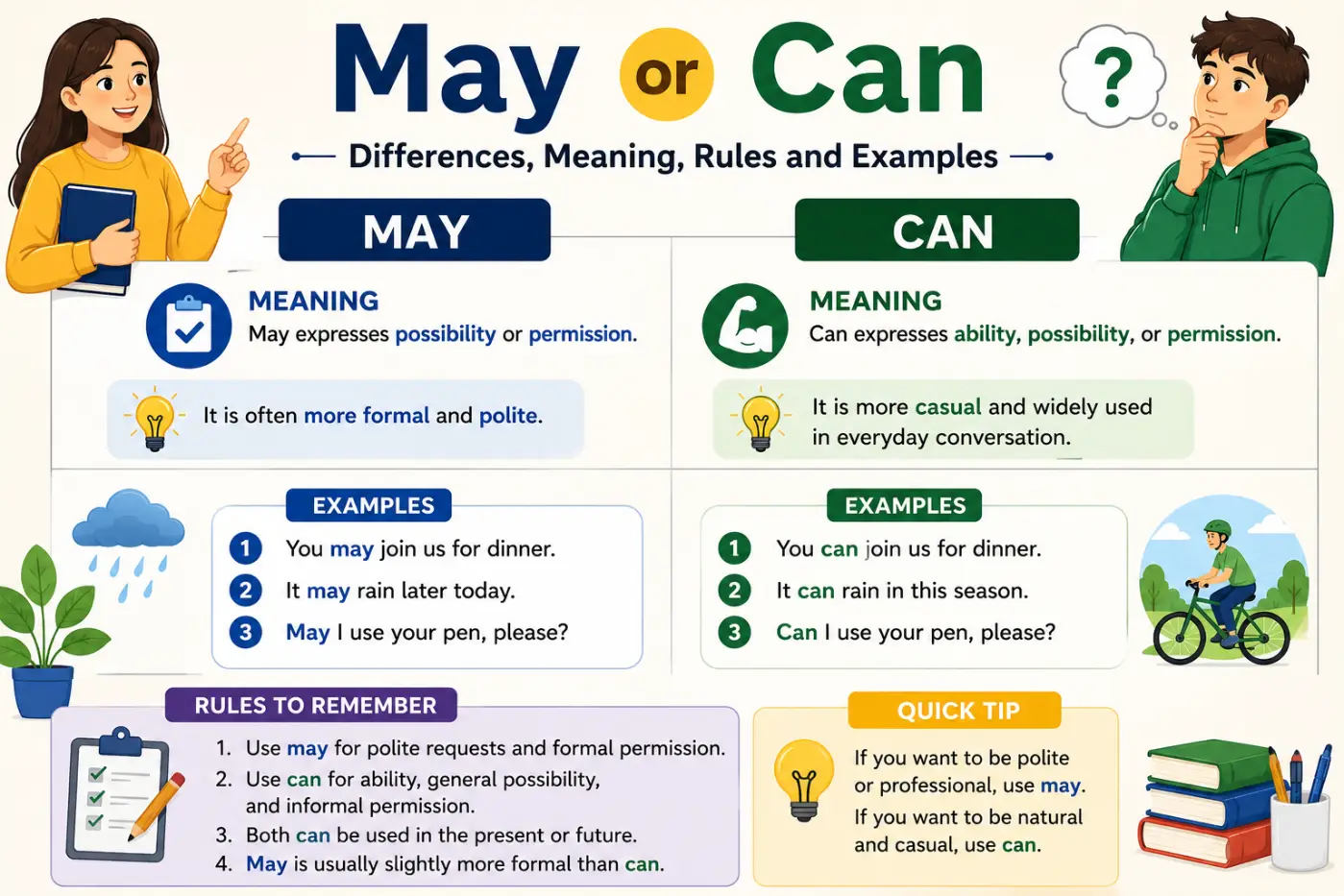
The basic rule is simple: may traditionally expresses permission or possibility, while can usually expresses ability, possibility, or informal permission. However, modern English allows some overlap between these words. For example, asking “Can I borrow your pen?” is perfectly natural in everyday conversation, even though some traditional grammar guides prefer “May I borrow your pen?”
Understanding the distinction will help you choose the right word in conversations, emails, school assignments, professional documents, and formal situations. Below, you will find clear grammar rules, pronunciation guidance, practical examples, common mistakes, and explanations of how native English speakers use both words.
Still confused? Compare christmases or christmass Correct Spelling and Usage.
Quick Answer
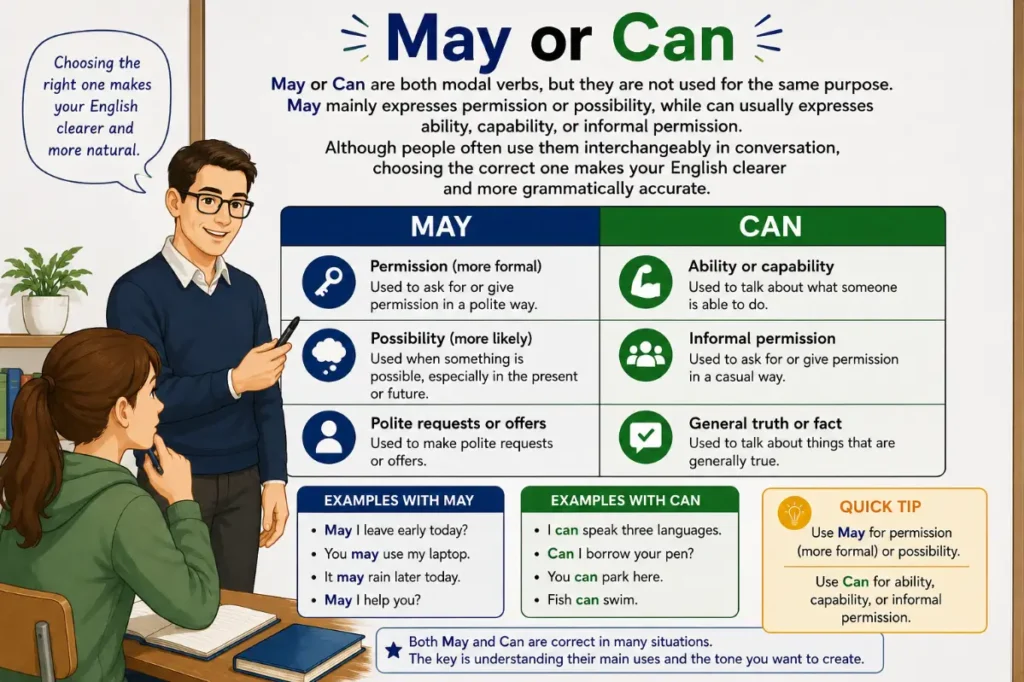
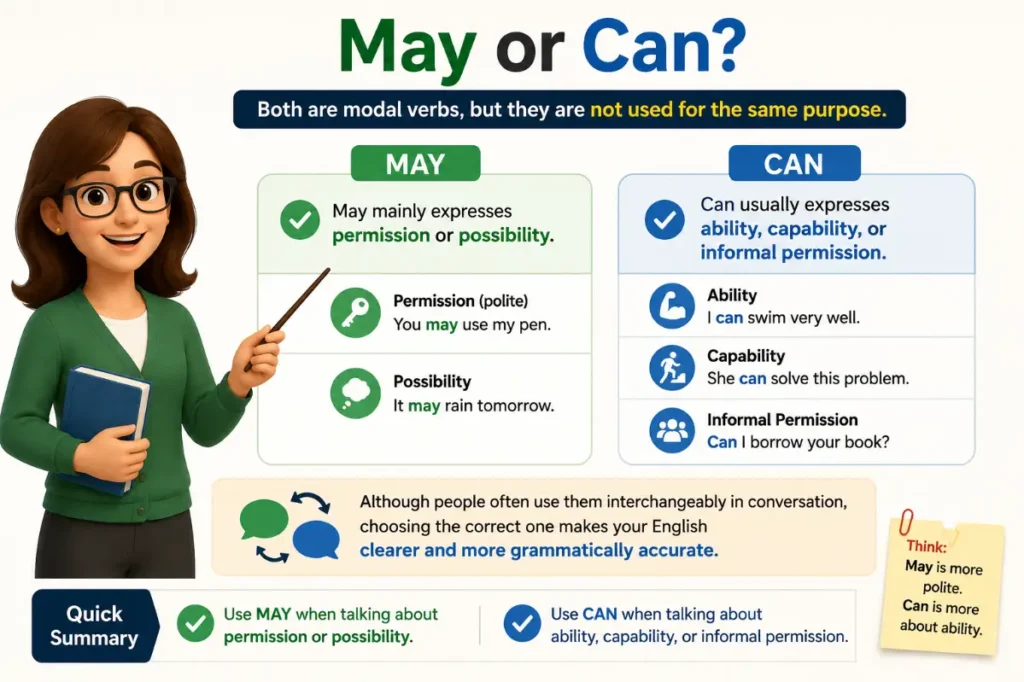
Both words are correct, but their meanings depend on the sentence. Use may to ask for or give permission and to express possibility. Use can to describe ability, possibility, or permission in everyday conversation. For formal requests, may is traditionally preferred, while can is more common in casual speech.
Featured Snippet: What Is the Difference?
May and can are modal verbs with different traditional functions. May commonly expresses permission or possibility, while can expresses ability, possibility, and informal permission. For example, “May I leave early?” asks for permission, whereas “Can you swim?” asks about someone’s ability. Modern English sometimes uses both words when requesting permission.
May or Can: Quick Comparison Table
| Feature | May | Can |
|---|---|---|
| Part of speech | Modal auxiliary verb | Modal auxiliary verb |
| Main meaning | Permission and possibility | Ability and possibility |
| Asking permission | Yes | Yes, especially informally |
| Giving permission | Yes | Yes |
| Expressing ability | Generally not used for physical or learned ability | Yes |
| Expressing possibility | Yes | Yes |
| Formality | Often more formal or polite | Often more conversational |
| Pronunciation | /meɪ/ | /kæn/ or /kən/ |
| Common contexts | Formal requests, permission, uncertainty | Daily conversation, skills, opportunities |
| Example | May I enter the room? | Can you open the door? |
The table shows the traditional distinction, not an absolute rule for every situation. Context, tone, and the intended meaning determine which word sounds most natural.
Meaning and Definition
What Does May Mean?
May is a modal auxiliary verb used mainly to express permission, possibility, or uncertainty. It helps communicate that something is allowed, might happen, or could be true.
Consider these examples:
- You may leave after completing your assignment.
- It may rain this afternoon.
- May I ask you a question?
- She may join us for dinner.
May is especially useful when you want to sound respectful, careful, or professional. It appears frequently in formal conversations, workplace communication, academic writing, official instructions, and polite requests.
It can also express wishes in certain fixed expressions, such as “May you have a wonderful day.” Here, it introduces a wish rather than a request or statement of ability.
What Does Can Mean?
Can is a modal auxiliary verb that commonly expresses physical ability, learned skills, practical possibility, and permission.
Examples include:
- I can speak three languages.
- Can you help me with this project?
- We can finish the work today.
- You can use my laptop.
In the first sentence, it describes a learned skill. The second asks whether someone is able or willing to help. The third expresses a practical possibility, while the fourth grants permission.
Unlike may, can is especially common when discussing what a person or thing is capable of doing. It is also widely accepted in informal permission requests.
For example, “Can I sit here?” is a natural question in everyday American English. Most speakers understand it as a request for permission rather than a question about physical ability.
Are Both Words Real English Words?
Yes. Both are standard English modal verbs, and neither is a misspelling or incorrect form.
The confusion comes from their overlapping meanings. They can both express possibility, and both can appear in requests for permission. However, their grammatical functions and traditional usage patterns are not identical.
The right choice depends on what you want to communicate, rather than on a rule that one word is always correct and the other is always wrong.
Key Differences Explained
1. Permission
The most familiar distinction appears when asking someone for permission.
May traditionally makes a request sound more formal or polite:
- May I use your phone?
- May we enter the building?
- May I speak with the manager?
Can is more common in casual conversations:
- Can I use your phone?
- Can we enter the building?
- Can I speak with the manager?
Both sets of sentences are grammatically acceptable. The difference is mainly one of tone and traditional preference.
In modern American English, people regularly use can when asking permission. It does not automatically sound rude or disrespectful.
2. Ability
Can is the preferred choice when discussing someone’s ability or skill.
For example:
- She can play the piano.
- I can drive a car.
- They can solve difficult problems.
May does not normally replace can in these sentences.
Saying “She may play the piano” usually suggests that she might play it or has permission to play it, depending on context. It does not clearly communicate that she has the skill.
This is one of the most useful distinctions to remember.
3. Possibility
Both words can describe something that might happen.
Examples with may:
- The delivery may arrive tomorrow.
- He may be at home.
- Prices may increase next month.
Examples with can:
- Accidents can happen unexpectedly.
- Weather conditions can change quickly.
- This road can become slippery in winter.
There is a subtle difference in meaning. May often describes a specific uncertain possibility, while can frequently describes a general possibility or something that is possible under certain conditions.
Compare:
- It may snow tonight.
- It can snow in this region during winter.
The first sentence discusses a possible event on a particular night. The second describes something that is generally possible in that location.
4. Formality and Politeness
May has a traditional association with formal requests and polite language. It is often suitable when speaking to someone in a position of authority, addressing an unfamiliar person, or writing a formal message.
Can is more relaxed and conversational. It works naturally with friends, coworkers, family members, and people you know well.
However, politeness is not determined by one word alone. Your tone, phrasing, relationship with the listener, and situation also matter.
For example, “Can you please send me the report?” is a perfectly professional workplace request. Similarly, “May I ask you something?” can sound polite without being overly formal.
5. Giving Permission
Both words can be used to grant permission.
Examples:
- You may leave now.
- You can leave now.
The first sounds more formal or authoritative in many situations. The second is more conversational.
May also appears in rules, official instructions, and policies:
“Employees may request additional training.”
This communicates that employees are permitted to make such a request.
Which Form Is Correct?
Neither word is universally more correct. Both are standard English modal verbs, but they serve different purposes.
Use can when you are talking about:
- Physical ability.
- Learned skills.
- Practical opportunities.
- General possibilities.
- Informal permission.
Use may when you are talking about:
- Formal permission.
- Polite requests.
- Uncertain future events.
- Possible situations.
- Formal rules or official authorization.
Traditional grammar instruction often teaches the question “May I?” for permission and “Can I?” for ability. This distinction is useful for learners, but modern English has developed broader uses.
Established dictionaries recognize permission as one of the meanings of can. Therefore, treating every permission request with can as grammatically incorrect would be misleading.
A good writer chooses the word that best communicates the intended meaning and matches the tone of the situation.
Sentence Examples: May and Can
Here are ten natural examples showing how both words work in different situations.
- May I come in? — A polite request to enter a room.
- Can you help me carry these bags? — A question about someone’s ability or willingness to help.
- You may leave early today. — Permission granted by someone in authority.
- I can finish this assignment before dinner. — A statement about ability or practical capacity.
- It may rain during the weekend. — An uncertain possibility.
- Can we meet at the coffee shop tomorrow? — A casual suggestion or request.
- Students may use calculators during the examination. — A formal statement of permission.
- My brother can play the guitar very well. — A learned ability.
- The meeting may start a little late. — A possibility about a future event.
- You can borrow my jacket if you need it. — An informal offer of permission.
Notice that the correct word changes according to the intended meaning. The goal is not simply to make a sentence sound formal or informal. It is to express the right idea.
Common Mistakes and Misunderstandings
English learners sometimes treat these two verbs as interchangeable. Although their meanings overlap, using one in place of the other can change the message.
Here are five common mistakes to avoid.
1. Using May to Describe a Learned Ability
Incorrect for the intended meaning: “I may speak Spanish fluently.”
Correct: “I can speak Spanish fluently.”
Why? May expresses possibility or permission, not ordinary learned ability. Can is the natural choice when describing a language skill.
2. Assuming Can Is Always Wrong for Permission
Incorrect grammar claim: “You must never say, ‘Can I leave early?'”
Correct understanding: “Can I leave early?” is acceptable in modern everyday English.
Why? Traditional grammar instruction often favors may for permission, but contemporary English commonly uses can in permission requests.
3. Using May When Talking About General Ability
Unnatural for the intended meaning: “Can you may drive a truck?”
Correct: “Can you drive a truck?”
Why? Modal auxiliary verbs generally do not appear together in this way. Can already communicates the ability being asked about.
4. Confusing Permission With Possibility
Potentially confusing: “You may use the computer.”
This can mean that someone has permission to use it. It does not necessarily mean that the person has the technical ability to operate it.
Clearer alternative when ability is intended: “You can use the computer.”
Why? The intended meaning should guide the choice.
5. Adding an Unnecessary Auxiliary Verb
Incorrect: “Do you can help me?”
Correct: “Can you help me?”
Why? Can is already an auxiliary verb. It forms questions by moving before the subject, without adding do.
Remember that modal verbs have special grammar rules. They do not behave exactly like ordinary action verbs.
A related grammar guide is chalet vs chateau Meaning and Key Differences.
Pronunciation Guide
Both words are short, single-syllable words, but their vowel sounds are different.
How to Pronounce May
- IPA: /meɪ/
- Syllables: One
- Easy pronunciation: MAY
- Stress: The entire word receives stress when emphasized.
The vowel sound is similar to the vowel in “day,” “say,” and “play.”
Examples:
- May I help you?
- It may happen tomorrow.
In connected speech, the word may be pronounced quickly, but its main vowel sound remains recognizable.
How to Pronounce Can
- IPA: /kæn/ in its strong form.
- Reduced form: /kən/ in many unstressed positions.
- Syllables: One
- Easy pronunciation: KAN or kuhn.
- Stress: Usually stressed when emphasizing ability or contrast.
The strong form contains a short vowel similar to the sound in “cat.” In ordinary speech, the vowel often becomes weaker.
Examples:
- I can swim.
- Can you help me?
Common Pronunciation Mistakes
Some learners pronounce may with a short vowel, making it sound closer to “meh.” The standard pronunciation has a long vowel glide, as in “day.”
Another common issue occurs with can. Learners sometimes pronounce it too strongly in every sentence, even when native speakers naturally reduce it to /kən/.
Listening to natural conversation helps you understand these differences.
Etymology and Word Origin
Understanding the history of these words provides useful background, although their modern grammatical functions are more important for everyday writing.
Origin of May
May developed from Old English forms associated with the verb meaning to be able or to have power. Its history is connected to older Germanic language forms expressing ability, power, and possibility.
Over time, its meaning developed to include permission and uncertainty. In modern English, it is widely used to express authorization, possibility, and wishes.
Origin of Can
Can also has Old English roots. It developed from an earlier verb associated with knowing, understanding, and being able to do something.
This historical connection helps explain its modern use for skills and ability. Over time, it also developed common uses involving possibility and permission.
Both words have undergone changes in meaning and grammatical use throughout the history of English. Their present-day functions reflect centuries of language development.
Regional Usage
The distinction between these words is broadly similar across major English varieties. There are no major regional spelling differences.
American English
In the United States, can is widely used for ability and informal permission.
Examples:
- Can I borrow your charger?
- Can you drive me to work?
- It may rain this evening.
May is common in formal requests, official statements, and expressions of possibility. However, it is not unusual in ordinary conversations.
American speakers generally understand both forms without difficulty.
British English
British English follows the same basic distinction. Can commonly expresses ability and informal permission, while may is frequently used in formal requests and possibility statements.
For example:
- May I speak to you?
- Can you open the window?
- It may be difficult to find parking.
The difference is mainly contextual rather than regional.
Australian English
Australian English also uses both modal verbs in much the same way. Can is common in everyday requests and statements about ability, while may can sound more formal or cautious.
There is no special Australian spelling rule that changes the distinction.
Canadian English
Canadian English follows broadly similar patterns to American and British English. Can is common in daily speech, while may is useful for formal permission and uncertain possibilities.
The intended meaning and level of formality remain the main factors.
Grammar Rules and Part of Speech
Both words belong to a grammatical category called modal auxiliary verbs. These verbs work with a main verb to express ideas such as ability, permission, possibility, obligation, and expectation.
Understanding their sentence patterns makes it easier to use them correctly.
1. Basic Sentence Structure
The standard structure is:
Subject + modal verb + base form of the main verb.
Examples:
- She may visit us.
- He can swim.
- They may arrive soon.
- We can complete the task.
Notice that the main verb stays in its base form. Do not add -s, -ed, or -ing immediately after the modal.
Incorrect: “She can speaks French.”
Correct: “She can speak French.”
2. Forming Questions
To form a question, place the modal verb before the subject.
Structure:
Modal verb + subject + base verb?
Examples:
- May I ask a question?
- Can you hear me?
- May we leave now?
- Can she drive?
Do not add do or does when forming a question with these modal verbs.
Incorrect: “Does she can swim?”
Correct: “Can she swim?”
3. Making Negative Sentences
Add not after the modal verb to create a negative statement.
Examples:
- You may not enter this room.
- I cannot attend the meeting.
- She may not know the answer.
- We cannot finish the project today.
The negative forms are may not and cannot. The contraction can’t is common in conversation, while cannot is often preferred in more formal writing.
Be careful with may not because it can express two different ideas depending on context:
- You may not enter. This can mean that permission is denied.
- She may not come. This can mean that her arrival is uncertain.
The surrounding sentence helps establish the intended meaning.
4. Using Modal Verbs With Pronouns
The modal verb does not change according to the subject.
For example:
- I can swim.
- You can swim.
- He can swim.
- They can swim.
The same applies to may:
- I may go.
- She may go.
- We may go.
Unlike regular present-tense verbs, these modal verbs do not take an additional -s for third-person singular subjects.
5. Using Modal Verbs in the Past
Can has a related past-tense form: could.
Examples:
- I could swim when I was younger.
- She could read before starting school.
Could is also used for polite requests and hypothetical situations.
May does not have a simple past form used in the same way. Might is a related modal verb commonly used for possibility.
Examples:
- He might visit us tomorrow.
- She might have forgotten the appointment.
The choice between might and may can depend on context and the degree of uncertainty the speaker wishes to express, although their meanings often overlap.
6. Punctuation and Sentence Position
Both words can appear in statements, questions, and negative sentences.
Use a question mark for direct questions:
“May I speak with you?”
Use a period for statements:
“You can use this room.”
In formal writing, maintain consistent punctuation and avoid unnecessary contractions. However, contractions such as can’t are entirely acceptable in conversational writing.
Real-Life Usage Examples
The following examples show how native English speakers use these words in different settings.
Daily Conversation
In casual conversation, can is particularly common when talking about ability or making requests.
- “Can you pick me up after work?”
- “I can make dinner tonight if you’re busy.”
May also appears in everyday speech, particularly when someone wants to sound polite.
- “May I sit next to you?”
- “It may take a few minutes to get there.”
Email and Workplace Communication
Workplace language often requires a balance between clarity and politeness.
- “May I schedule a short meeting with you tomorrow?”
- “Employees may request additional support from the department.”
Can is equally appropriate in many professional situations:
- “Can you review the attached report before Friday?”
- “We can discuss the proposed changes during the meeting.”
The best choice depends on the relationship between the people communicating and the tone of the message.
Academic Writing
In academic writing, both words are useful, but they serve different purposes.
- “The results may indicate a connection between the two variables.”
- “Students may use approved reference materials during the assessment.”
Can commonly describes general abilities or possibilities:
- “This method can produce more consistent results.”
- “Certain environmental factors can influence plant growth.”
Academic writers should select the modal that expresses the intended claim accurately.
News and Journalism
Journalists use may when reporting uncertain events or possible developments.
- “The government may announce new measures next week.”
- “Heavy rainfall may affect travel conditions across the region.”
Can is common when explaining general risks or capabilities:
- “Strong winds can damage buildings and power lines.”
- “The new system can process thousands of requests.”
The distinction helps writers avoid presenting uncertain information as a confirmed fact.
Literature and Storytelling
Both words can help writers establish mood, possibility, and character relationships.
- “You may stay here until the storm passes,” the old woman said.
- “I can find my way through the forest,” the traveler replied.
May can make dialogue sound formal, gentle, or authoritative. Can often creates a more direct and conversational voice.
Writers can use these differences to make character dialogue feel natural.
Related and Confused Terms
Several other English words are connected to permission, ability, and possibility. Understanding them will help you choose more precise language.
1. Could
Could is the past form of can in many contexts. It can also express present or future possibility and make requests sound more polite.
Example: “Could you help me with this assignment?”
Unlike can, it often makes a request sound softer or less direct.
2. Might
Might expresses possibility or uncertainty.
Example: “She might arrive late.”
It is closely related to may, although the two words can carry slightly different shades of meaning depending on context.
3. Must
Must expresses strong obligation, necessity, or a logical conclusion.
Example: “You must wear a helmet.”
It is stronger than may or can when communicating rules or requirements.
4. Should
Should expresses advice, expectation, or a recommended action.
Example: “You should get some rest.”
It does not usually grant permission or describe basic ability.
5. Would
Would is used for polite requests, hypothetical situations, and repeated past actions.
Example: “Would you please close the door?”
It often sounds more indirect and courteous than a straightforward request.
6. Able To
Able to is an expression used to describe capability.
Example: “She is able to complete the task independently.”
It can sometimes replace can, especially when a different tense or verb structure is needed.
For example, “I will be able to attend tomorrow” is natural, while “I will can attend tomorrow” is grammatically incorrect.
7. Allowed To
Allowed to directly expresses permission.
Example: “Visitors are allowed to enter after 9 a.m.”
This expression is useful when you want to discuss rules or authorization without relying on a modal verb.
8. Permitted To
Permitted to is a more formal expression for receiving authorization.
Example: “Only registered members are permitted to use the facility.”
It is common in official rules, policies, legal documents, and formal notices.
These related expressions are not perfect substitutes for one another. Choose the term that communicates your intended meaning most clearly.
Expert Editor Insight
An experienced English editor looks beyond whether a sentence is grammatically correct and considers what the writer actually wants to communicate. A sentence such as “May I use your computer?” is traditionally associated with polite permission, while “Can I use your computer?” sounds more conversational. Both are acceptable in modern English. Grammar and spelling tools may suggest a more formal alternative based on writing style, but an automatic suggestion does not always mean the original sentence is incorrect. The best editing decision considers context, audience, tone, and meaning together.
Key Takeaways
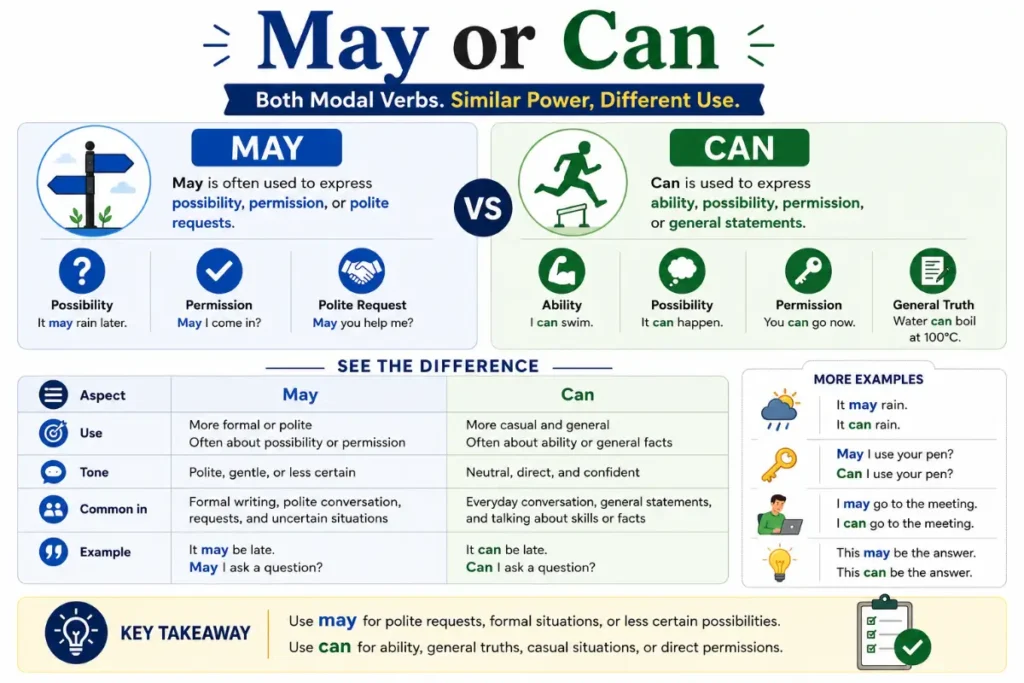
- May or Can are both modal verbs.
- May mainly expresses permission or possibility.
- Can mainly expresses ability or capability.
- Modern English accepts Can I when asking permission in everyday conversation.
- Formal writing usually prefers May I.
- Always use the base form of the verb after both modal verbs.
- Never use to after may or can.
- Context determines the correct choice.
- Choosing the right modal verb makes your English more accurate and natural.
Learn the difference in Bellies vs Bellys Which Spelling Is Correct in 2026?.
Conclusion
May or Can is a common English grammar question because both words express possibility and permission in certain situations. However, their traditional meanings are different. May is generally preferred for formal permission requests and uncertain possibilities, while can is the natural choice for describing abilities, skills, and everyday permission. Modern English accepts both words in many conversational situations, so neither should be treated as universally incorrect.
A simple editing tip is to ask yourself whether your sentence describes ability, permission, or possibility before choosing a modal verb. Understanding that distinction will help you write more clearly and speak with greater confidence.
FAQs
1. Which Is Correct: May or Can?
Both words are correct English modal verbs. May traditionally expresses permission and possibility, while can expresses ability, possibility, and informal permission. The correct choice depends on the meaning of your sentence. For example, use can when asking whether someone has the ability to swim and may when making a traditional formal request for permission.
2. Is Can Grammatically Correct When Asking for Permission?
Yes. Using can to ask for permission is grammatically acceptable in modern English. Questions such as “Can I leave early?” and “Can I borrow your pen?” are common in everyday American conversation. Traditional grammar instruction often recommends may for formal permission requests, but it does not make every use of can incorrect.
3. Does May Sound More Polite Than Can?
May often sounds more formal or traditionally polite than can, especially when asking someone for permission. However, politeness also depends on your tone and the way you phrase your request. For example, “Can you please help me?” is perfectly polite in a workplace conversation and does not sound disrespectful simply because it uses can.
4. Can May and Can Be Used Interchangeably?
Not in every situation. They can overlap when expressing permission or possibility, but they are not interchangeable when describing ability. “I can drive” means that I have the ability to drive. “I may drive” suggests that I might drive or have permission to drive, depending on the context.
5. Can May Be Used at the Beginning of a Sentence?
Yes. May can begin questions, statements, and expressions of wishes. For example, “May I ask a question?” is a polite request, while “May the best team win” expresses a wish. Can also begins questions, such as “Can you help me?” Both words follow normal modal verb sentence patterns.
6. How Do You Pronounce May and Can?
May is pronounced /meɪ/, with a vowel sound similar to the one in day. Can is pronounced /kæn/ in its strong form, although it is often reduced to /kən/ in ordinary speech. Both words have one syllable. The main difference is their vowel sound, which makes them easy to distinguish when spoken clearly.
7. What Is Another Way to Ask for Permission?
You can use expressions such as “Could I,” “Would it be possible to,” “Am I allowed to,” and “Would you mind if I.” For example, “Could I leave a little early today?” is a polite alternative. “Am I allowed to use this room?” directly asks whether a particular action is permitted.
8. Should You Use May or Can in Formal Writing?
May is traditionally preferred when discussing formal permission, official authorization, or uncertain possibilities. However, can is also appropriate in professional and academic writing when describing ability or general possibility. For example, “The software can process large files” is correct. Always choose the word that communicates your intended meaning rather than automatically selecting the more formal option.