
Have you ever wondered whether to write incite vs insight? These two words look almost identical, sound similar, and are easy to mix up when writing quickly. However, they have very different meanings, and choosing the wrong one can change the message of your sentence.
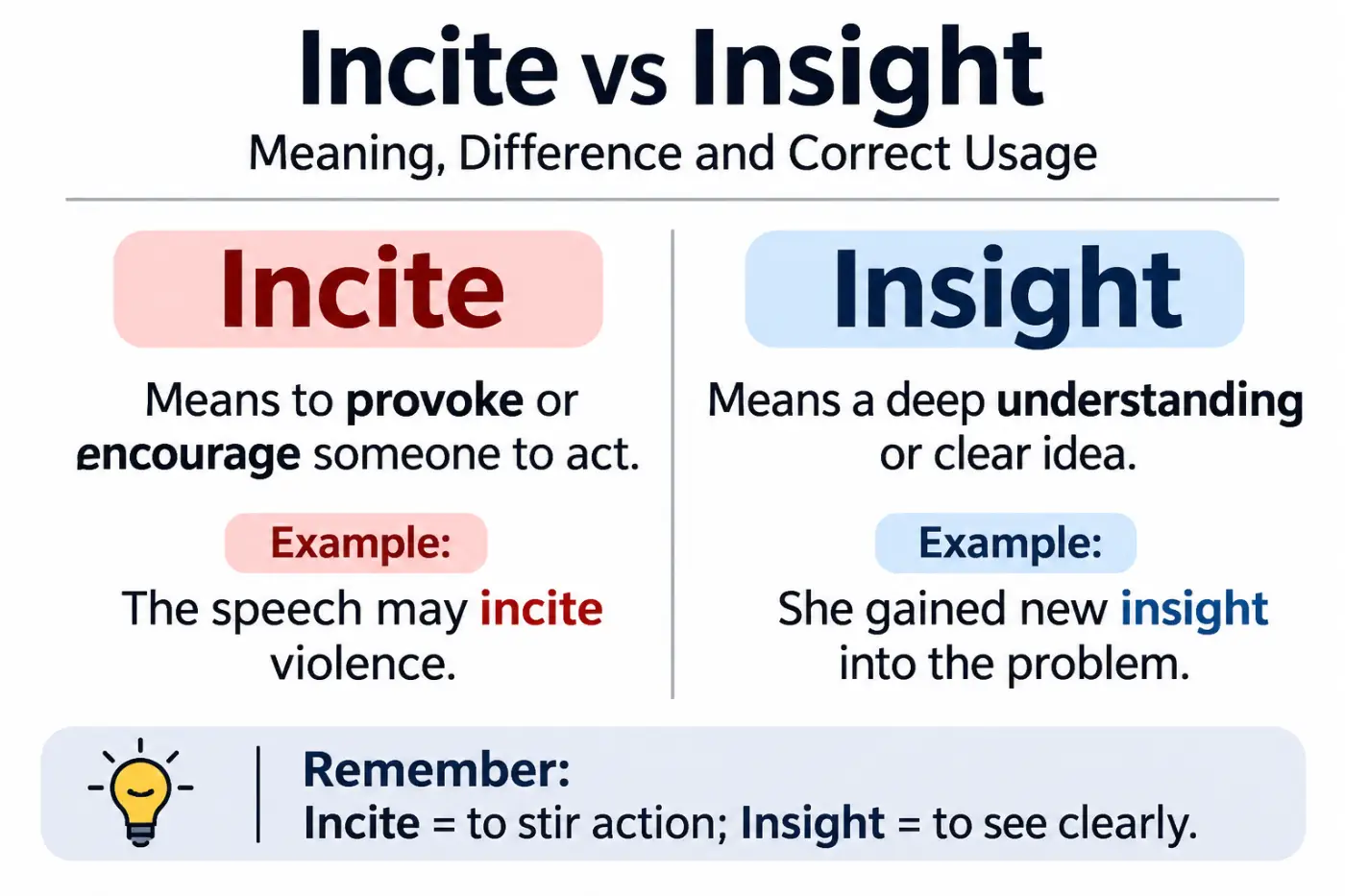
The difference is simple: incite means to encourage or provoke someone to take action, while insight means a deep understanding of something. One is a verb associated with influencing behavior; the other is a noun associated with knowledge and understanding.
This spelling confusion often happens because the words share most of their letters and have similar sounds. However, their meanings, grammar, and sentence patterns make them easy to tell apart once you understand the distinction. Learning how to use each word correctly will help you write clearer emails, school assignments, reports, professional documents, and everyday messages.
A related grammar guide is Hoard vs Horde Meaning, Differences and Examples.
Quick Answer: What Is the Difference?
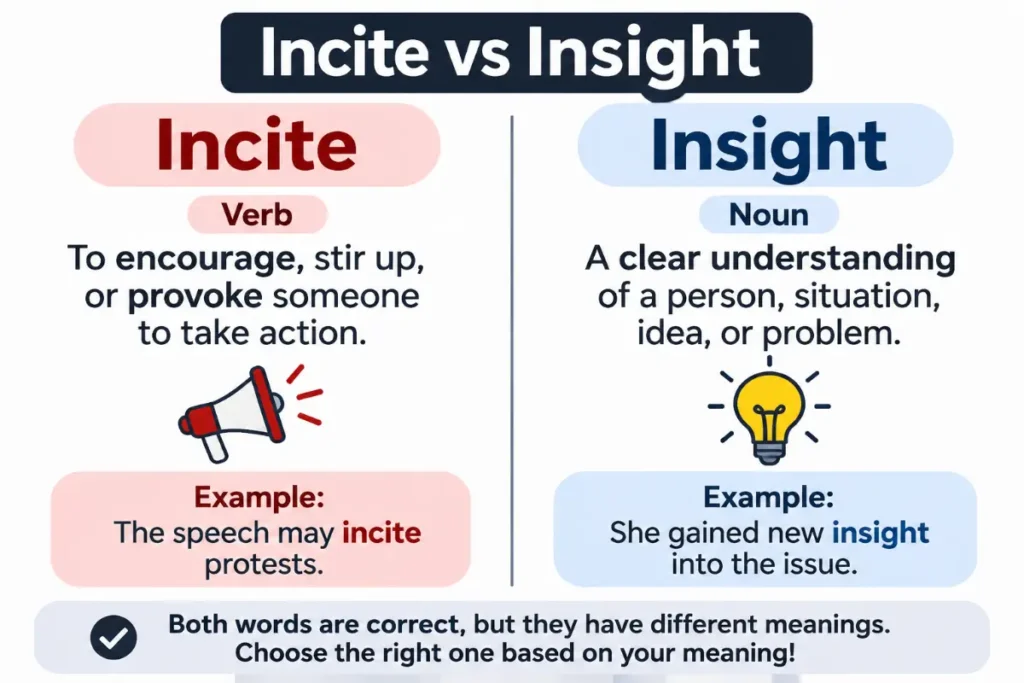
Incite is a verb meaning to encourage, stir up, or provoke someone to take action, often in a strong or negative way. Insight is a noun meaning a clear understanding of a person, situation, idea, or problem. Both are correctly spelled English words, but they cannot be used interchangeably. Choose the word based on whether you mean encouraging action or gaining understanding.
Quick Answer: Which Word Should You Use?
Both spellings are correct, but they serve different purposes.
- Use incite when someone encourages, provokes, or urges others to do something.
- Use insight when referring to understanding, knowledge, awareness, or a valuable observation.
For example:
- The speaker tried to incite the crowd to protest.
- Her research provided valuable insight into human behavior.
A useful memory trick is that incite involves action, while insight involves understanding.
Comparison Table: Incite vs Insight
| Feature | Incite | Insight |
|---|---|---|
| Meaning | To encourage or provoke action | Deep understanding or awareness |
| Part of speech | Verb | Noun |
| Pronunciation | in-SYTE | IN-site |
| Syllables | Two | Two |
| Word ending | -cite | -sight |
| Grammar | Describes an action | Names an idea or understanding |
| Formality | Standard; often used in formal contexts | Standard; common in formal and informal contexts |
| Common contexts | Conflict, protests, reactions, emotions | Research, psychology, business, learning |
| Related words | Provoke, encourage, stimulate | Understanding, awareness, perception |
| Example | His speech could incite anger. | Her advice gave me new insight. |
The main distinction is grammatical as well as semantic. The first word describes something a person does, while the second identifies something a person gains, shares, or develops.
Meaning and Definition
What Does Incite Mean?
Incite means to encourage, provoke, stimulate, or urge someone to take action. It often describes an attempt to create a strong emotional reaction or motivate people to do something.
The action may be positive, negative, or neutral depending on the context, although the word frequently appears in discussions about conflict, anger, violence, protests, and social unrest.
Part of speech: Verb
Common meanings include:
- To encourage someone to act.
- To provoke a particular emotion or reaction.
- To stimulate a group into taking action.
- To persuade or urge people toward a particular behavior.
For example:
- The politician’s comments could incite public anger.
- The coach tried to incite enthusiasm among the players.
- His online post appeared designed to incite an argument.
In each sentence, the word describes an action that influences another person or group.
Common Grammatical Patterns
This verb often appears in the following structures:
Incite + noun
- The speech incited controversy.
- His behavior incited anger.
Incite + someone + to + verb
- They incited the crowd to protest.
- The message incited several people to respond.
Is Incite Always Negative?
No. Although it often carries a negative tone, its meaning depends on the situation.
For example, someone might incite a crowd to violence, which has a harmful meaning. However, a writer could also describe a speech as inciting people to question unfair practices.
Still, in everyday English, the word often suggests strong emotions, provocation, or controversy.
What Does Insight Mean?
Insight refers to the ability to understand something clearly or recognize an important truth that may not be immediately obvious.
It can describe knowledge, awareness, perception, or a valuable understanding gained through experience, observation, research, or reflection.
Part of speech: Noun
Common meanings include:
- A deep understanding of a subject.
- The ability to recognize important details.
- A fresh perspective on a problem.
- A meaningful observation about people or situations.
- Knowledge gained through experience or careful thought.
For example:
- The teacher provided valuable insight into the subject.
- Her experience gave her insight into customer behavior.
- The report offers new insight into the problem.
In these sentences, the word refers to understanding rather than an action that causes someone to behave in a certain way.
Different Types of Insight
The noun appears in several common contexts.
1. Personal insight
Understanding your own feelings, habits, strengths, and weaknesses.
Example: Therapy helped him gain insight into his behavior.
2. Business insight
Knowledge that helps a company understand customers, markets, or business performance.
Example: Customer feedback provided useful insight into buying habits.
3. Academic insight
A deeper understanding gained through research, study, or analysis.
Example: The study offers insight into how children learn languages.
4. Social insight
Understanding other people’s feelings, motivations, and behavior.
Example: Her experience gave her insight into the challenges faced by new employees.
5. Creative insight
A new idea or realization that helps someone approach a problem differently.
Example: The conversation gave the designer fresh insight into the project.
Is Insight Countable or Uncountable?
The word can be used as both a countable and an uncountable noun, depending on the meaning.
When referring to a particular understanding or observation, it is countable.
- She shared an interesting insight.
- The article contains several useful insights.
When referring to general understanding or knowledge, it is often uncountable.
- The experience gave him valuable insight.
- We need more insight into the issue.
Both forms are grammatically correct.
Key Differences Explained
Understanding the following differences will help you choose the right word confidently.
1. Spelling Difference
The two words differ by only one letter in their endings.
- Incite ends with C-I-T-E.
- Insight ends with G-H-T.
This small spelling difference creates two completely different words.
Remember that the letters in the second word form the familiar spelling pattern found in words such as sight and eyesight.
2. Difference in Meaning
Their meanings are not related in everyday usage.
- Incite refers to encouraging or provoking action.
- Insight refers to understanding or awareness.
Compare:
- The announcement may incite panic.
- The announcement provided insight into the situation.
The first sentence describes a possible reaction. The second describes information or understanding.
3. Difference in Grammar
The first word is a verb, while the second is a noun.
A verb expresses an action or state. A noun names a person, place, thing, quality, or concept.
Consider:
- The speech may incite anger.
- The speech offered insight into the issue.
In the first example, the word describes what the speech may do. In the second, it identifies the understanding the speech provides.
4. Difference in Pronunciation
Although their sounds are similar, the stress patterns are different.
- Incite: in-SYTE.
- Insight: IN-site.
The first generally receives stress on the second syllable, while the second receives stress on the first.
Listening carefully to the stressed syllable can help distinguish them in conversation.
5. Difference in Context
Each word appears in different types of writing and conversation.
| Context | Incite | Insight |
|---|---|---|
| News | Incite public unrest | Provide insight into an event |
| Education | Incite students to participate | Gain insight through learning |
| Business | Incite conflict among workers | Gain customer insight |
| Psychology | Incite an emotional reaction | Develop psychological insight |
| Social media | Incite online harassment | Share personal insight |
| Research | Incite a reaction | Offer research insight |
6. Difference in Formality
Both words are acceptable in professional and academic English.
However, they serve different purposes.
Incite is more common in discussions involving strong reactions, social behavior, conflict, or persuasion. Insight appears frequently in professional reports, research papers, presentations, interviews, and everyday conversations.
Neither word is inherently informal or incorrect.
7. Difference in Word Formation
Their related forms also differ.
Forms of incite include:
- Incites
- Incited
- Inciting
- Incitement
- Inciter
Related forms of insight include:
- Insights
- Insightful
- Insightfully
Recognizing these word families can help you identify the intended meaning.
8. Standard vs. Nonstandard Usage
Both forms are standard English. Neither is a misspelling of the other.
The mistake occurs when someone chooses a correctly spelled word that does not fit the meaning of the sentence.
For instance, writing “The report gave us incite into customer behavior” is incorrect in context. The intended word is insight.
Which Form Is Correct?
Both words are correct. The right choice depends on what you want to communicate.
Use incite when the sentence describes an attempt to influence, provoke, or encourage behavior.
Use insight when the sentence refers to knowledge, understanding, or a valuable realization.
The grammatical reason is straightforward: the first is a verb, while the second is a noun.
Established English dictionary conventions recognize both as separate entries with different definitions. Their similar appearance does not make them interchangeable.
Consider these examples:
Incorrect word choice:
The interview gave us incite into the manager’s decision.
Correct word choice:
The interview gave us insight into the manager’s decision.
Here, the sentence requires a noun because it refers to the understanding gained from the interview.
Now consider another example:
Incorrect word choice:
The speaker tried to insight the audience into action.
Correct word choice:
The speaker tried to incite the audience into action.
The sentence requires a verb because it describes an attempt to encourage behavior.
A simple grammar check can often resolve the confusion: ask whether the sentence needs an action or an idea.
Sentence Examples
Here are 10 natural examples showing how to use both words correctly.
Examples Using Incite
- The politician’s remarks were intended to incite anger among voters.
- His social media post could incite unnecessary arguments.
- The coach gave an inspiring speech to incite excitement before the game.
- False information can incite fear and confusion during an emergency.
- The teacher encouraged students to question ideas without trying to incite conflict.
Examples Using Insight
- Her experience gave her valuable insight into the challenges of running a business.
- The research provides new insight into how children develop language skills.
- I gained useful insight from our conversation yesterday.
- The manager shared several insights during the team meeting.
- His personal story offered insight into the importance of family support.
These examples demonstrate that the words belong in different grammatical structures.
Common Mistakes and Misspellings
People often confuse these terms because their spelling patterns are similar. Here are five common mistakes and how to correct them.
1. Using Incite Instead of Insight
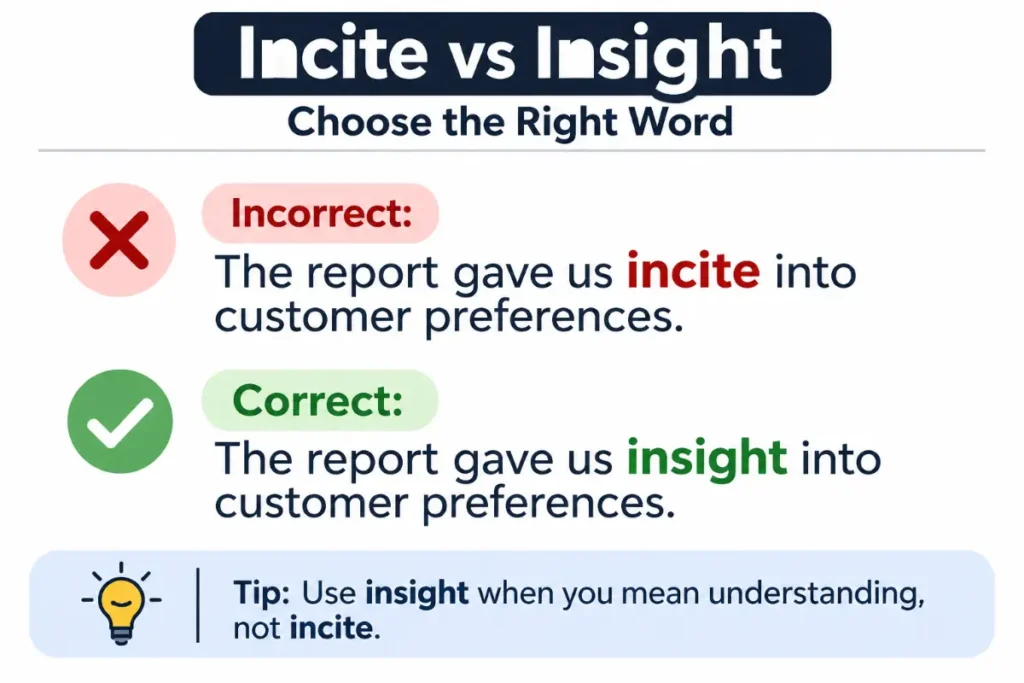
Incorrect: The report gave us incite into customer preferences.
Correct: The report gave us insight into customer preferences.
Why it happens: The writer recognizes that both words sound similar but overlooks the meaning required by the sentence.
Use the noun when referring to knowledge or understanding.
2. Using Insight Instead of Incite
Incorrect: The speech was designed to insight public anger.
Correct: The speech was designed to incite public anger.
Why it happens: The writer chooses the more familiar-looking noun even though the sentence requires an action.
Use the verb when describing the act of provoking or encouraging a reaction.
3. Confusing Insight With Incitement
Incorrect: The investigation revealed an incitement into the problem.
Correct: The investigation revealed an insight into the problem.
Why it happens: Incitement is a noun related to the act of provoking or encouraging something. It does not mean understanding.
Remember:
- Insight = understanding.
- Incitement = the act of provoking or encouraging.
4. Using the Wrong Word Family
Incorrect: Her presentation was very inciting because it explained the topic clearly.
Better: Her presentation was very insightful because it explained the topic clearly.
Why it happens: The writer confuses two related-looking word families.
Insightful describes something that demonstrates understanding or provides useful knowledge.
Inciting describes something that provokes or encourages a reaction.
5. Using the Wrong Grammatical Form
Incorrect: The manager insight the employees to respond.
Correct: The manager encouraged the employees to respond.
Alternative: The manager incited the employees to respond.
Why it happens: Insight is mistakenly treated as a verb.
In standard English, insight is a noun. You gain insight, offer insight, or provide insight. You do not normally insight someone to do something.
Still confused? Compare Who’s vs Whose Meaning and Correct Usage.
Pronunciation Guide
The words have similar sounds, but their stress patterns help separate them.
| Word | IPA | Syllables | Easy Pronunciation |
|---|---|---|---|
| Incite | /ɪnˈsaɪt/ | In-cite | in-SYTE |
| Insight | /ˈɪn.saɪt/ | In-sight | IN-site |
How to Pronounce Incite
Break the word into two parts:
- In
- Cite
The second syllable receives the main stress.
Say it as: in-SYTE.
The final sound rhymes with words such as:
- Light
- Fight
- Write
- Bright
How to Pronounce Insight
Break the word into two parts:
- In
- Sight
The first syllable receives the main stress.
Say it as: IN-site.
The final part sounds like the word sight.
Common Pronunciation Mistakes
Some speakers place equal stress on both syllables, which can make the words harder to distinguish.
Others pronounce them with identical stress patterns.
The most useful distinction in standard pronunciation is the placement of stress:
- Incite: second syllable.
- Insight: first syllable.
Regional accents may affect the exact vowel quality, but the main stress distinction remains useful.
Etymology and Word Origin
Understanding the origins of these words provides another way to remember their differences.
Origin of Incite
Incite entered English through French, with roots in the Latin verb incitare.
The Latin word carried the sense of setting something in motion, urging, or stimulating action.
Its historical development reflects its modern meaning: encouraging someone or something to act.
Related Latin elements are associated with movement and stimulation. This helps explain why the modern English verb is used when describing provocation, persuasion, and strong reactions.
Today, the word appears in discussions of public behavior, politics, conflict, emotions, and social influence.
Origin of Insight
Insight developed from the combination of the English words in and sight.
Historically, the expression carried the idea of seeing inwardly or looking into something. Over time, it developed its modern figurative meaning of understanding something deeply.
This connection between seeing and understanding remains clear in modern English.
For example, when someone gains insight into a difficult problem, they are not literally looking at it with their eyes. They are recognizing something that was previously unclear.
The word is now widely used in education, psychology, research, business, and everyday communication.
Regional Usage
There is no major spelling difference between American, British, Australian, and Canadian English for these words.
Both forms are standard in all four varieties.
American English
In American English, both words are commonly used in conversation, journalism, education, and professional writing.
Examples:
- The comments could incite public outrage.
- The research offers insight into consumer behavior.
American writers follow the same grammatical distinction: one is a verb, and the other is a noun.
British English
British English uses both words in the same way.
Their meanings, spelling, and grammatical functions remain consistent with American English.
Examples:
- The speech appeared to incite public anger.
- The report provides valuable insight into the issue.
There is no special British spelling variation that changes their distinction.
Australian English
Australian English also recognizes both words as standard.
They are used in education, workplace communication, journalism, and everyday conversation without a meaningful difference in spelling or meaning.
Canadian English
Canadian English follows the same usage conventions.
Writers use incite to describe provoking or encouraging action and insight to describe understanding or awareness.
Regional takeaway: Your location does not determine which spelling is correct. The meaning and grammar of the sentence determine the right choice.
Grammar Rules and Part of Speech
The easiest way to avoid confusion is to understand how each word functions in a sentence.
Incite as a Verb
A verb describes an action. Incite expresses the act of encouraging or provoking someone to do something. It can appear in several grammatical forms.
| Verb Form | Example |
|---|---|
| Base form | They may incite a reaction. |
| Third-person singular | He incites unnecessary arguments. |
| Past tense | The speech incited anger. |
| Present participle | The comments are inciting controversy. |
| Past participle | The crowd was incited by the speech. |
Common Sentence Structures
1. Subject + incite + object
The comments incited anger.
2. Subject + incite + person + to + verb
The message incited people to protest.
3. Subject + be + incited + by + agent
The audience was incited by the speaker.
These structures are useful in both formal and informal writing.
Insight as a Noun
Insight names a form of understanding or knowledge.
It often appears with verbs such as:
- Gain insight
- Offer insight
- Provide insight
- Share insight
- Develop insight
- Demonstrate insight
- Reveal insight
Examples:
- The training helped employees gain insight into workplace safety.
- The article provides insight into modern communication.
- Her experience gave her a better understanding of the situation.
Common Prepositions Used With Insight
The word frequently appears with the preposition into.
Examples:
- Insight into human behavior.
- Insight into business operations.
- Insight into the causes of the problem.
It can also appear with about and on, depending on the sentence.
- She shared insight about the challenges of leadership.
- The report offers insight on the subject.
The expression insight into is especially common when describing a deeper understanding of a particular subject.
Singular and Plural Forms
Insight can be singular or plural.
Use insight when referring to general understanding or one particular realization.
Use insights when referring to multiple observations or discoveries.
Examples:
- The discussion gave me valuable insight.
- The discussion produced several useful insights.
Incite follows normal verb conjugation rules rather than taking a plural noun form.
Punctuation and Formal Writing
Neither word requires special punctuation.
However, professional writers should check the surrounding sentence carefully because substituting one for the other can create a serious meaning error.
For example, in a report, writing “the campaign provided insight into public behavior” communicates research-based understanding.
Writing “the campaign incited public behavior” communicates that it provoked or encouraged behavior.
The grammatical difference affects the entire message.
Real-Life Usage Examples
The following examples show how these words work in different situations.
1. Daily Conversation
People commonly use the noun when discussing understanding or a new realization.
- That conversation gave me some insight into why she was upset.
- His comments seemed to incite an argument between the two friends.
In everyday speech, the noun is generally more common in positive or neutral discussions about learning and understanding.
2. Email and Workplace Communication
Professional communication often uses both words, depending on the situation.
- Your feedback provided valuable insight into our customers’ needs.
- The manager warned employees not to incite conflict during the meeting.
The noun is especially useful when discussing reports, feedback, and business decisions.
3. Academic Writing
Academic writing uses these terms in different ways.
- The research offers new insight into the effects of social media on learning.
- The study examined how political messaging can incite public reactions.
The noun frequently appears in research discussions, while the verb may appear in studies of behavior, communication, and social influence.
4. News and Journalism
News reports often use the verb when describing actions that provoke reactions.
- The controversial remarks threatened to incite protests across the region.
- Investigators examined whether the online campaign was intended to incite violence.
The noun appears in analysis and reporting about information.
- The interview provided insight into the events leading up to the decision.
- The investigation offered fresh insight into the causes of the incident.
5. Literature and Storytelling
Writers use both words to describe characters, emotions, and understanding.
- The villain’s speech was designed to incite fear among the villagers.
- The old man’s advice gave the young traveler insight into the meaning of courage.
The first creates movement and reaction within a story. The second reveals knowledge or a deeper understanding.
Related and Confused Terms
Several English words are closely connected to these terms. Learning their differences can improve vocabulary and sentence accuracy.
1. Provoke
Provoke means to cause a reaction, emotion, or response.
Example: His rude comments provoked an angry response.
Difference: Provoke is a close synonym of the verb because both can describe causing a reaction.
2. Stimulate
Stimulate means to encourage activity, interest, growth, or a response.
Example: The teacher used questions to stimulate discussion.
Difference: Stimulate often has a positive or neutral meaning, while incite frequently suggests stronger emotions or controversy.
3. Encourage
Encourage means to give someone support, confidence, or motivation to do something.
Example: Her parents encouraged her to pursue her education.
Difference: Encourage is usually more positive and supportive.
4. Insightful
Insightful is an adjective describing someone or something that demonstrates deep understanding.
Example: The article contained several insightful observations.
Difference: Insight is a noun, while insightful is an adjective.
5. Understanding
Understanding refers to knowledge or awareness of a subject, situation, or person.
Example: She has a strong understanding of workplace communication.
Difference: Understanding is a broad term, while insight often suggests a deeper or more revealing realization.
6. Awareness
Awareness means knowing that something exists or recognizing a particular situation.
Example: The campaign increased awareness of environmental problems.
Difference: Awareness may involve simply knowing about something, while insight often involves understanding its meaning or causes.
7. Perception
Perception refers to the way someone understands, interprets, or experiences something.
Example: His perception of the situation changed after the meeting.
Difference: Perception describes how someone interprets something, while insight often refers to a valuable understanding gained from that interpretation.
8. Incitement
Incitement is a noun referring to the act of encouraging or provoking someone to take action.
Example: The investigation examined the alleged incitement of violence.
Difference: Incite is the verb, while incitement is its related noun.
These distinctions are particularly useful in formal writing because similar words can have different grammatical roles and meanings.
Expert Editor Insight
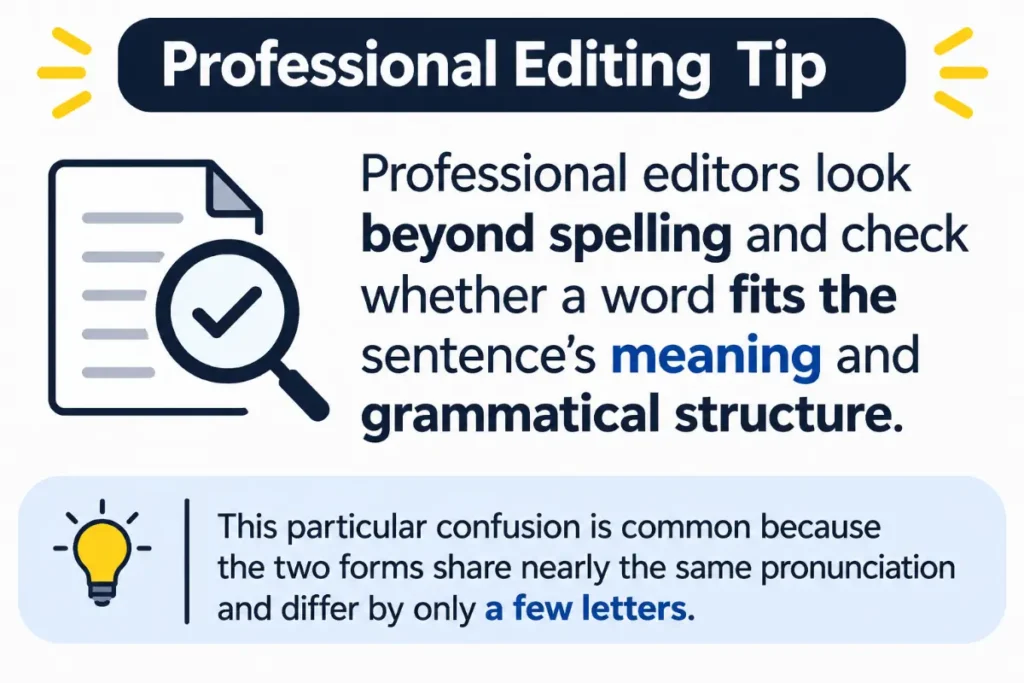
Professional editors look beyond spelling and check whether a word fits the sentence’s meaning and grammatical structure. This particular confusion is common because the two forms share nearly the same pronunciation and differ by only a few letters. Grammar and spell-checking tools may accept both words because both are legitimate English entries, so they may not identify an incorrect choice in context. A useful editing habit is to check the word’s function: if the sentence describes provoking an action, use the verb; if it describes knowledge or understanding, use the noun.
You may also want to read former vs latter Explained With Clear Examples.
Conclusion
Understanding incite vs insight becomes easy once you remember that the words serve different purposes. Incite is a verb that describes encouraging or provoking someone to take action, while insight is a noun that refers to knowledge, awareness, or deep understanding. Neither spelling is incorrect, but using one in place of the other can change the meaning of your sentence.
The simplest editing trick is to ask yourself whether you are describing an action or referring to an idea. If you mean provoking a reaction, choose incite. If you mean gaining understanding, choose insight. This small distinction can make your writing much clearer and more accurate.
FAQs
1. Is Incite a Real Word?
Yes. Incite is a standard English verb meaning to encourage, provoke, or stimulate someone to take action. It is often used when discussing strong emotions, protests, arguments, or public reactions. It is not a misspelling of insight. Both words are legitimate, but they have different meanings and grammatical functions.
2. What Does Insight Mean in Simple Words?
Insight means a clear or deep understanding of something. It can describe a useful realization, an important observation, or knowledge gained through experience or research. For example, if a teacher explains a difficult subject in a way that helps you understand it better, the explanation may give you valuable insight.
3. Which Is Correct: Incite or Insight?
Both are correct English words. Incite is a verb that means to encourage or provoke action, while insight is a noun that means understanding or awareness. The correct choice depends on the sentence. Use the first when describing an action and the second when referring to knowledge or a realization.
4. How Do You Pronounce Incite and Insight?
Incite is pronounced in-SYTE, with the main stress on the second syllable. Insight is pronounced IN-site, with the main stress on the first syllable. Their vowel sounds are similar, but their stress patterns help distinguish them. Listening to the stressed syllable can make the difference easier to recognize.
5. Can Insight Be Used at the Beginning of a Sentence?
Yes. Insight can begin a sentence when it functions as a noun or part of a noun phrase. For example, “Insight into customer behavior helped the company improve its services.” It can also begin a sentence in a phrase such as “An important insight emerged from the research.”
6. What Is a Synonym for Insight?
Common synonyms include understanding, awareness, perception, comprehension, and realization. The best alternative depends on the context. Understanding is a broad substitute, while perception emphasizes interpretation. Realization often describes a moment of discovery. Insight generally suggests a meaningful or deeper level of understanding.
7. Why Do People Confuse These Two Words?
People confuse them because they have similar pronunciations, almost identical spellings, and overlapping letter patterns. Fast typing, autocorrect, and unfamiliarity with their grammatical functions can also contribute to mistakes. Understanding that one is a verb and the other is a noun makes the distinction much easier.
8. Is It Appropriate to Use Both Words in Formal Writing?
Yes. Both are standard English words and are appropriate in academic, professional, and formal writing. Incite is useful when describing provocation or encouragement, while insight is appropriate when discussing knowledge, research findings, or understanding. The key is to select the word that communicates the intended meaning accurately.