

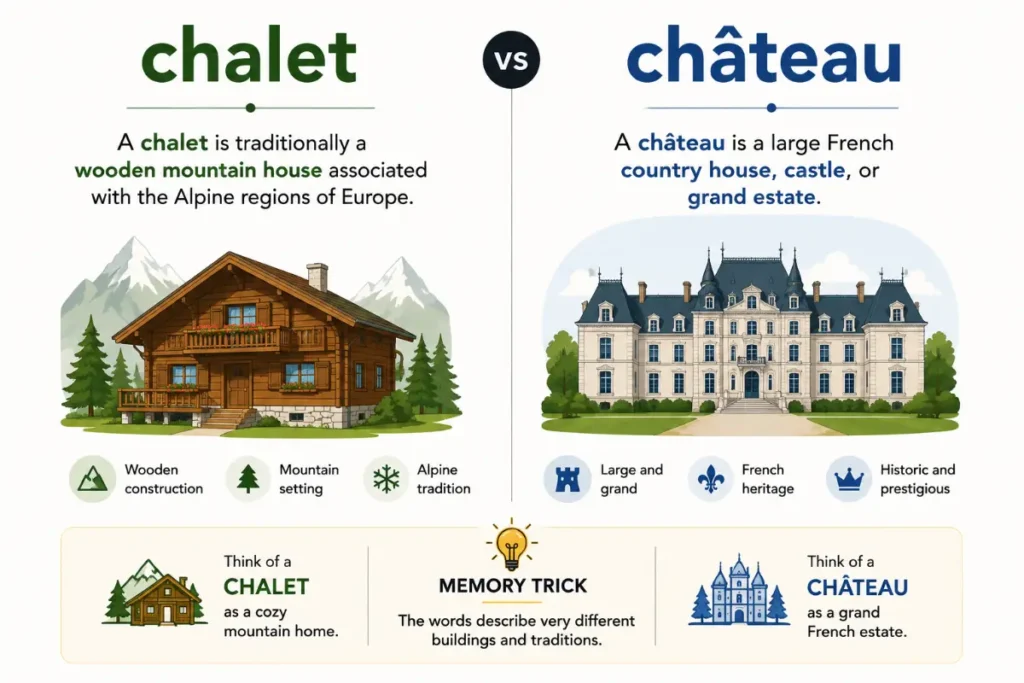
If you’ve ever seen the words chalet and chateau and wondered if they mean the same thing, you’re not alone. Both describe buildings that can look impressive or inviting, but they refer to different styles of property and carry different cultural meanings. The difference between chalet vs chateau comes down to architecture, history, location, and the way people use each building.
A chalet usually brings to mind a cozy mountain house with a sloping roof and wooden details. A chateau often suggests a grand French country residence with elegant rooms, formal gardens, and a long history. However, these images aren’t strict rules. Modern hotels, vacation rentals, and real estate listings sometimes use the terms more loosely.
Understanding the distinction helps you choose the right word when describing a property, planning a vacation, writing a travel article, or searching for accommodation. You’ll also learn how to pronounce both words, where they came from, how American and British English use them, and which details matter most when comparing the two.
Learn the difference in totalling or totaling Which Spelling Should You Use.
Quick Answer
A chalet is typically a cozy mountain house associated with the Alps, while a chateau is a large French manor house, castle, or country estate. The first term emphasizes mountain living and rustic comfort. The second suggests grandeur, historic architecture, and an elegant residence. Both words are correct, but they describe different types of buildings.
Chalet vs Chateau at a Glance
| Feature | Chalet | Chateau |
|---|---|---|
| Main meaning | A mountain house or Alpine style residence | A French manor house, castle, or grand country residence |
| Part of speech | Noun | Noun |
| Language origin | French, with roots in regional Alpine usage | French, from an older word for a castle or fortified residence |
| Typical setting | Mountain villages and ski resorts | French countryside, vineyards, estates, and historic towns |
| Common appearance | Sloping roof, wood, stone, and a cozy interior | Large facade, formal rooms, towers, or landscaped grounds |
| Traditional purpose | Mountain shelter, rural home, or seasonal dwelling | Residence of a landowner, noble family, or wealthy household |
| Modern use | Vacation rental, ski lodge, private home | Historic attraction, private residence, hotel, or event venue |
| General impression | Warm, rustic, relaxed | Grand, elegant, historic |
| Common English pronunciation | shal AY | sha TOH |
| Correct spelling | Chalet | Chateau |
The most useful distinction is simple. A chalet is linked to Alpine architecture and mountain life. A chateau is linked to French country estates and grand residences. A building’s actual design and history matter more than its marketing label.
What Is a Chalet
A chalet is a house traditionally associated with the Alpine regions of Europe. These areas include parts of Switzerland, France, Austria, and nearby mountain regions. Traditional examples often feature timber construction, sturdy stone foundations, wide eaves, and roofs designed to handle heavy snowfall.
The word also describes homes built in a similar style outside Europe. In the United States, a property advertised as a chalet might sit beside a ski slope, in a wooded mountain community, or beside a lake. It doesn’t need to be in the Alps to use the name.
What Makes a Building a Chalet
Several features help people recognize this type of home.
- A sloping roof. Traditional Alpine houses often have steep or broad roofs that help manage snow and rain. Roof shapes vary by region and building age.
- Wooden details. Exposed beams, timber balconies, carved railings, and wood paneling often create a warm and natural appearance.
- Stone and timber construction. Builders historically used local materials that suited mountain conditions. Modern versions may use concrete, steel, or other materials beneath a traditional exterior.
- A comfortable interior. Living rooms often center on a fireplace or a large shared seating area. Many modern vacation properties include open kitchens, large windows, and spaces for groups.
- A mountain setting. Alpine scenery is strongly associated with the term, although modern chalets can appear in many locations.
Not every property needs all these features. A chalet can be modest and practical or large and luxurious. Its identity comes from its architectural tradition and mountain associations rather than its price.
How People Use Chalets Today
The word has expanded beyond its original rural setting. Today, a chalet might be a year round family home, a seasonal mountain retreat, a ski resort rental, or a luxury vacation property.
For example, a family might rent a three bedroom chalet for a week of skiing. A couple might own a small timber house in the mountains and visit during the winter. A real estate agent might describe a modern property as a chalet because its roofline and exterior resemble traditional Alpine homes.
The term doesn’t automatically mean that a building is small, inexpensive, or old. Luxury chalets can have private spas, heated pools, panoramic windows, and concierge services. The architectural style and intended use matter more than the level of comfort.
What Is a Chateau
A chateau is a large French residence that may resemble a castle, manor house, or grand country estate. The term has a broad history in France, so it doesn’t describe one fixed architectural style. Some examples began as fortified residences, while others developed as elegant homes surrounded by farmland, vineyards, or formal gardens.
In English, the word often brings to mind a historic French estate with spacious rooms, decorative stonework, tall windows, and extensive grounds. That image is useful, but it doesn’t cover every building that the French word can describe.
What Makes a Building a Chateau
A traditional example may include several recognizable features.
- A substantial main building. Many are much larger than ordinary private homes, with multiple floors and numerous rooms.
- Formal architecture. Symmetrical facades, decorative stonework, grand entrances, and carefully arranged windows appear in many examples.
- Historic details. Depending on the period, a building may have towers, defensive walls, courtyards, or ornate interiors.
- Extensive grounds. Some estates include formal gardens, parks, farmland, forests, or vineyards.
- A connection to land and status. Historically, many served as the residences of noble families, landowners, or wealthy households.
These features aren’t universal. Some historic residences are relatively simple, and others have changed considerably over the centuries. A chateau doesn’t need towers or a moat to qualify.
How People Use Chateaux Today
Many historic properties remain private homes. Others operate as museums, boutique hotels, wedding venues, restaurants, or wine estates. Some have been restored for tourism, while others continue to serve practical roles in agriculture or local business.
In wine regions, the word can carry a specialized meaning. A wine producer may use chateau in its name to identify an estate associated with vineyards and wine production. The name alone doesn’t guarantee that the property is a castle or that the wine has a particular quality.
Outside France, hotels and event venues sometimes adopt the term to suggest elegance and old world charm. In those cases, the name may be more about branding than a strict architectural classification.
Key Differences Explained
The two building types can share features such as large windows, wooden interiors, fireplaces, and beautiful views. However, their traditional roles and architectural identities differ.
Architecture and Design
A chalet usually favors practical design suited to mountain weather. Sloping roofs, sturdy materials, and balconies help connect the home with its natural surroundings. The interior often feels informal and welcoming.
A chateau generally emphasizes the scale and character of a grand residence. Depending on its age and region, it may feature symmetrical wings, decorative facades, formal reception rooms, and landscaped gardens. Some buildings look like fortresses, while others resemble elegant country mansions.
Modern construction can blur these differences. An architect might combine a chalet’s timber exterior with luxurious interiors, or renovate a historic estate with modern glass extensions. The building’s overall design and history offer better clues than any single feature.
Size and Layout
Chalets come in many sizes, from small mountain shelters to sprawling luxury homes. Their layouts often focus on shared living areas, practical storage, and easy access to outdoor activities.
Chateaux are traditionally larger residences with more rooms and formal spaces. A historic example may contain reception halls, private bedrooms, service areas, libraries, and separate buildings for staff or estate work.
Size alone doesn’t settle the question. A large modern mountain home can still be a chalet, and a relatively modest historic French residence may still be called a chateau.
Location and Setting
Chalets are strongly associated with Alpine landscapes. Think of snow covered slopes, pine forests, mountain villages, and ski resorts. The term also appears in North American real estate and tourism, where it often describes a rustic vacation home.
Chateaux are closely linked to France, especially its historic countryside and wine regions. They can stand near rivers, vineyards, farmland, or established towns. Their setting often reflects the landholding and social role they once served.
Neither word creates an absolute location rule. A chalet can stand far from the mountains, and a French chateau doesn’t need to sit in an isolated rural area.
History and Purpose
Traditional chalets developed around mountain life. Many served as seasonal shelters for people working with livestock or managing Alpine farms. Over time, the style became associated with permanent homes, leisure travel, and mountain tourism.
Chateaux developed through a different history. Some originated as fortified residences that offered protection and helped control surrounding land. Others evolved into prestigious homes built for comfort, display, and the management of large estates.
These different histories explain why the words create different impressions today. One points toward mountain living. The other points toward a grand residence connected with land, wealth, or historical importance.
Comfort and Luxury
Neither term automatically tells you how luxurious a property is. A basic chalet might have simple furnishings and limited facilities. A high end chalet could offer a sauna, private chef, hot tub, and direct access to ski slopes.
A chateau might contain antique furniture and historic decoration, but it could also have modern heating, updated kitchens, and contemporary bathrooms. Some properties offer luxury accommodation, while others need significant restoration.
If you’re booking a stay, check the actual facilities, location, and recent property details instead of relying on the name alone.
Which Word Is Correct
Both words are correct English nouns. The right choice depends on the building you want to describe, not on a spelling rule that makes one form better than the other.
Use chalet for a house associated with Alpine architecture, mountain living, or a similar rustic style. Use chateau for a grand French residence, manor house, castle, or country estate.
Consider these examples.
- Correct. We rented a chalet near the ski lifts for our winter vacation.
- Correct. The historic chateau stands among vineyards and formal gardens.
- Less precise. We booked a chateau for our ski trip when the property was a small Alpine cabin with no connection to a grand estate.
- Less precise. The travel writer called the historic French manor a chalet even though its architecture and history did not support that description.
The last two examples aren’t spelling errors. They’re potential errors in word choice. A property owner can also choose an unusual commercial name, so context matters when a building’s official name differs from its architectural type.
For careful writing, consult a reputable English dictionary for the word’s general meaning. If you need to describe a specific historic building, use reliable property records or architectural information to establish its identity.
Pronunciation Guide
Both words came into English from French, so their pronunciation may look less obvious than their spelling suggests.
How to Pronounce Chalet
The standard English pronunciation is /ˈʃæleɪ/.
Say it as two syllables, with the stress on the first syllable. The opening sound is like the beginning of the word shall, and the second syllable sounds like the word lay.
The final letters do not sound like the English word let. Avoid pronouncing every letter separately.
How to Pronounce Chateau
The standard English pronunciation is /ʃæˈtoʊ/.
Say it as two syllables, with the stress on the second syllable. The first syllable sounds like sha, and the second sounds like toe.
In American English, the final sound resembles the long o in go. French pronunciation differs in some details, so an English speaker’s pronunciation won’t always match a native French speaker’s accent.
An Easy Way to Remember Both Words
Remember the stress pattern.
- Chalet. Stress the first syllable.
- Chateau. Stress the second syllable.
Practicing the words aloud in a sentence can help. Try saying, We rented a chalet near the chateau. The sentence makes you switch between the two stress patterns while keeping the meanings clear.
Etymology and Word Origin
The histories of these terms help explain their modern meanings. Both passed into English from French, but they developed along different paths.
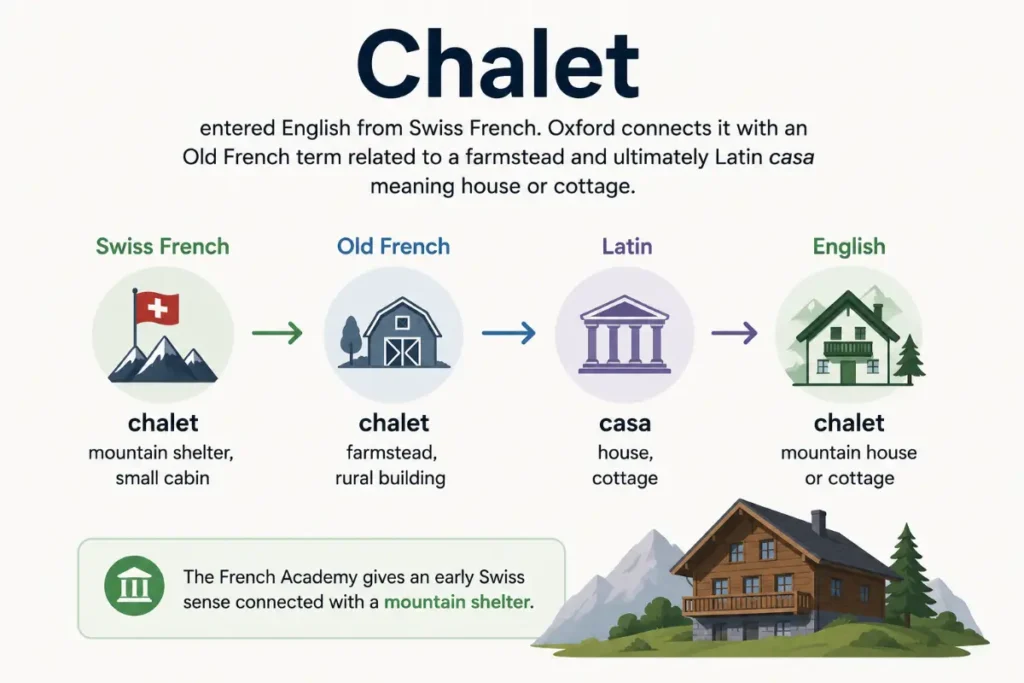
Where the Word Chalet Came From
The English word chalet comes from French. Its earlier use is connected with regional Alpine speech and mountain dwellings, particularly in Switzerland and nearby areas.
Traditional Alpine chalets were often linked to farming and livestock. Some served as seasonal shelters or working buildings rather than luxury homes. Their construction reflected local materials, mountain weather, and the needs of rural life.
As travel and tourism grew, the word became associated with holiday accommodation and mountain resorts. In modern English, it can describe anything from a traditional rural house to an upscale ski property inspired by Alpine design.
The meaning has broadened, but the connection with mountain architecture remains central.
Where the Word Chateau Came From
Chateau also entered English from French. It developed from the Old French word chastel, which came from Latin castellum, a term associated with a fort or castle.
Over time, the French word château came to cover a wider range of substantial residences. Depending on the period and context, it can refer to a castle, a manor house, or an estate residence.
The original fortified meaning doesn’t describe every modern example. Many French chateaux were designed primarily as residences rather than defensive structures. Their architecture reflects changing ideas about wealth, comfort, power, and style.
In English, the spelling often appears without the accent over the a. Both chateau and château are accepted, although the accented form preserves the French spelling.
Learn the difference in Patience vs Patients: Meaning and Correct Usage.
Regional Usage in English
The central distinction remains stable across English speaking regions. However, local real estate markets and tourism businesses can use these words in slightly different ways.
American English
In the United States, chalet commonly describes a mountain home, ski property, or rustic house with Alpine inspired design. The word can also appear in the names of restaurants, hotels, and vacation communities.
Chateau often suggests a French style estate, a grand country home, or a venue designed to look elegant and historic. American businesses sometimes use it for hotels, apartment communities, and event spaces even when the buildings aren’t traditional French estates.
In both cases, the commercial name may be broader than the architectural meaning.
British English
British English uses both words in much the same way. A chalet may describe a small holiday home, a mountain property, or accommodation at a resort. In some British holiday settings, the word can refer to a simple self catering unit rather than a traditional Alpine house.
Chateau often retains its French association with a grand residence or historic estate. British writers may use the term when discussing French architecture, country houses, or wine production.
The main difference is often the setting in which people encounter the words, not a different spelling rule.
Australian English
Australian English also uses both terms with their familiar meanings. A chalet might describe a mountain retreat or holiday accommodation, particularly in areas known for skiing and nature tourism.
Chateau may appear in descriptions of historic European properties, luxury accommodation, and businesses that want to suggest a grand or French inspired style. Local marketing can broaden the term, but it doesn’t replace the traditional distinction.
Canadian English
In Canada, chalet often describes a ski home, lakeside retreat, or vacation property. In Quebec, the French language and local traditions add another layer to its everyday use. A chalet can be a seasonal cottage or recreational home without having every feature of a traditional Alpine building.
Chateau generally keeps its association with French estates and grand residences. Canadian property listings may also use it as a building name or a marketing term.
Across all four regions, the most reliable approach is to choose the word that best describes the property and explain any unusual use when needed.
Grammar Rules and Common Usage
Both words function mainly as countable nouns. You can use them as the subject or object of a sentence, and you can place adjectives before them to describe a property’s appearance, size, age, or location.
Singular and Plural Forms
The usual singular forms are chalet and chateau. Their regular English plurals are chalets and chateaux.
Chateaux is the traditional French plural form commonly used in English. Chateaus also appears as an English plural. If you’re writing for a general American audience, chateaux is a familiar choice for several French estates, while chateaus is a valid regularized alternative.
Examples include the following.
- The chalet has a large stone fireplace.
- Several chalets line the road to the ski resort.
- The chateau overlooks the vineyard.
- The region contains several historic chateaux.
Using Articles and Adjectives
Use a or the according to the context. Because both words begin with a consonant sound in standard English pronunciation, the indefinite article a is appropriate.
For example, write a chalet in the mountains and a chateau in the French countryside. Use the chalet or the chateau when your reader already knows which building you mean.
Adjectives can make your description more specific. Phrases such as a traditional Alpine chalet, a modern mountain chalet, a restored French chateau, and a historic country chateau all work grammatically.
Using the Words in Formal Writing
In formal writing, accuracy matters more than elegance. Don’t call a building a chateau simply because it looks expensive, and don’t call every wooden vacation house a chalet.
If you’re unsure about the building’s history, choose a more neutral term such as house, residence, estate, or vacation property. You can then describe its visible features without making an unsupported claim about its architectural identity.
The same principle applies to travel articles, property listings, academic work, and news reports. A precise noun helps readers form the right picture without needing extra explanation.
Ten Natural Sentence Examples
These examples show how the two terms work in everyday English and more formal settings.
- Everyday conversation. We rented a chalet in Colorado for our family ski trip.
- Text message. The chalet looks great, and the mountain view is even better in person.
- Travel planning. I’d rather stay in a chalet close to the ski lifts than drive across town each morning.
- Work communication. The event team selected a historic chateau because it had enough space for the reception.
- School assignment. Traditional Alpine chalets often reflect the climate and building materials of their regions.
- Academic writing. The estate’s architecture reveals how French country residences changed over several centuries.
- Formal description. The restored chateau features an elegant entrance, formal gardens, and a collection of historic furnishings.
- Social conversation. My friends booked a chalet for the weekend, so we’re planning to go hiking and cook together.
- Travel journalism. The chateau stands among rolling vineyards and offers visitors a glimpse of the region’s architectural history.
- Storytelling. At the edge of the snowy village, a timber chalet glowed beneath the evening sky.
Notice how the setting helps the reader understand each building. The mountain vacation suggests a chalet, while the historic estate and vineyards suggest a chateau.
Common Mistakes and Confused Forms
These words aren’t alternative spellings of the same noun. Most mistakes happen when writers confuse their meanings, copy an unfamiliar spelling, or assume that a building’s name accurately describes its architecture.
Mistake One: Treating the Words as Synonyms
Incorrect usage can occur when a writer switches between the terms without considering the building’s features.
Better approach. Describe a mountain retreat as a chalet when its style or use supports that term. Use chateau for a grand French residence or estate when that description fits.
Mistake Two: Writing Challet
The spelling challet is a common typing error for chalet. The extra l doesn’t belong in the standard English spelling.
Correct example. We booked a chalet for our winter vacation.
Mistake Three: Writing Shateau
Some writers insert an s or h based on how they hear the opening sound. The standard spelling is chateau.
Correct example. The chateau sits on a hill overlooking the village.
Mistake Four: Assuming Every Chateau Is a Castle
A chateau can be a castle, but it can also be a manor house or country residence. Using castle for every example can create a false impression of its history or design.
Better approach. Use the broader term chateau when you don’t know if the building served a defensive role.
Mistake Five: Assuming Every Chalet Sits in the Alps
Traditional chalets have strong Alpine roots, but modern properties around the world use the term. A chalet inspired by Swiss architecture in the United States isn’t automatically misnamed.
Better approach. Consider the building’s design and use, not just its geographic location.
Related and Confused Terms
Several other property terms overlap with these two words. Knowing their differences can make your descriptions more accurate.
| Term | Meaning | Main Difference |
|---|---|---|
| Cabin | A small, often rustic house | Usually emphasizes simplicity and a natural setting |
| Cottage | A modest house, often in a rural or village setting | Doesn’t require Alpine architecture |
| Lodge | A house or building used for recreation, accommodation, or group stays | Often emphasizes hospitality or outdoor activities |
| Villa | A substantial house, often associated with leisure or an attractive setting | Has different historical and architectural traditions |
| Castle | A fortified building or group of buildings | Emphasizes defense and fortification |
| Manor house | A large historic residence linked to an estate | Emphasizes the home and its historical landholding role |
| Mansion | A large and impressive private residence | Emphasizes size and grandeur |
| Estate | A large property that may include land and buildings | Refers to the wider property, not just one architectural style |
Chalet and Cabin
A cabin is usually a simple home in a wooded, rural, or recreational setting. A chalet is more closely linked to Alpine architecture and mountain living. The terms can overlap when a mountain cabin uses traditional chalet features.
Chateau and Manor House
A manor house is a large historic residence associated with an estate or landed household. A chateau can serve a similar role in France, but it may also have a fortified history or a distinctive place in French architectural tradition.
Chateau and Castle
A castle is defined primarily by its defensive character or historical role. A chateau may be a castle, but many chateaux were built or remodeled mainly as residences. The two words overlap without having identical meanings.
Chalet and Lodge
A chalet usually points to a style of house or a mountain retreat. A lodge often refers to accommodation or a gathering place for people visiting a natural area. A resort may offer chalet style lodgings while calling its main hospitality building a lodge.
Expert Editor Insight
An experienced editor looks beyond spelling and asks what picture the word creates in the reader’s mind. If the property is a timber mountain home, chalet may be the clearest choice. If it is a historic French estate, chateau is more precise. Spellcheck tools can catch obvious errors such as challet, but they may not identify a word choice that is grammatically correct yet misleading. Check the property’s actual features and history before settling on a label.
Key Takeaways
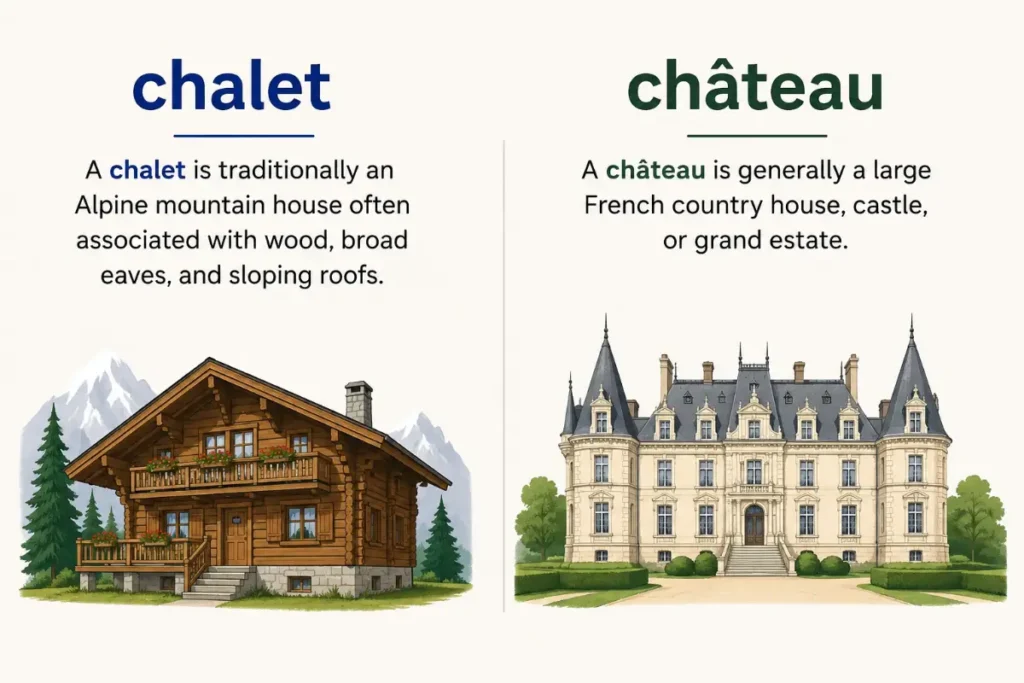
- A chalet is traditionally an Alpine mountain house often associated with wood broad eaves and sloping roofs.
- A château is generally a large French country house castle or grand estate.
- A chalet has strong connections with Switzerland and the wider Alpine region.
- A château has its strongest cultural connection with France.
- Modern chalets are often ski lodges vacation homes and mountain residences.
- Modern châteaux can serve as private homes hotels museums historic attractions or wine estates.
- Chalet and château are nouns.
- American English commonly pronounces chalet close to sha LAY and château close to sha TOE.
- English accepts both château and chateau.
- The easiest memory trick is mountain chalet and grand French estate château.
For another common grammar confusion, see Planing Or Planning Correct Spelling Guide 2026.
Conclusion
The difference in chalet vs chateau comes down to architecture, history, and purpose. A chalet usually describes an Alpine style home or mountain retreat, while a chateau refers to a grand French residence, castle, or country estate. Both words are correct, and neither is a misspelling of the other. The best choice depends on the property you’re describing, not simply its size or price. Remember this simple tip when editing your work. Think of mountains and cozy timber homes for chalet, then picture historic French estates for chateau. That quick mental image makes it easier to choose the right word and describe a building accurately.
FAQs
Is chalet a French word?
Yes. Chalet comes from French and is associated with traditional dwellings in Alpine regions. The word entered English and gradually expanded to describe mountain homes, vacation properties, and buildings inspired by Alpine architecture. Today, English speakers use it around the world, including for homes that aren’t located in the Alps.
What does chateau mean in English?
A chateau is generally a French castle, manor house, or grand country residence. The exact meaning depends on its historical and architectural context. Some chateaux began as fortified buildings, while others served mainly as prestigious homes or estate centers. The word can also appear in the names of hotels, venues, and wine estates.
Which is correct chalet or chateau?
Both are correct words, but they describe different types of buildings. Chalet usually refers to an Alpine style house or mountain retreat. Chateau generally refers to a grand French residence, castle, or country estate. Choose the word that fits the property’s design, history, and purpose rather than treating the two as interchangeable.
How do you pronounce chalet and chateau?
In standard American English, chalet is pronounced /ˈʃæleɪ/, with stress on the first syllable. Chateau is pronounced /ʃæˈtoʊ/, with stress on the second syllable. Both words have two syllables. The spellings reflect their French origins, so the final letters don’t follow every common English spelling pattern.
Can a chalet be a luxury home?
Yes. A chalet can range from a modest mountain shelter to a high end vacation home with large bedrooms, a spa, and panoramic views. The word refers mainly to its architectural style and mountain associations, not its price. A luxury chalet may have modern features while keeping the traditional Alpine look.
Is every chateau a castle?
No. A chateau can be a castle, but it can also be a manor house or an elegant country residence. Some examples have towers and defensive features, while others emphasize comfort, formal gardens, and decorative architecture. Calling every chateau a castle may incorrectly suggest that it served a military or defensive purpose.
What is the plural of chateau?
Chateaux is the traditional French plural commonly used in English. Chateaus is also used as a regular English plural. The singular form is chateau, and both plural forms can be understood. For a general American audience, choose one form and use it consistently throughout your article or document.
Can these words describe buildings outside France and Switzerland?
Yes. A chalet can describe an Alpine inspired home in the United States or another country. The word chateau also appears in property names and commercial branding outside France. However, the historical meanings still matter. A business name alone doesn’t prove that a building has traditional Alpine or French estate architecture.