
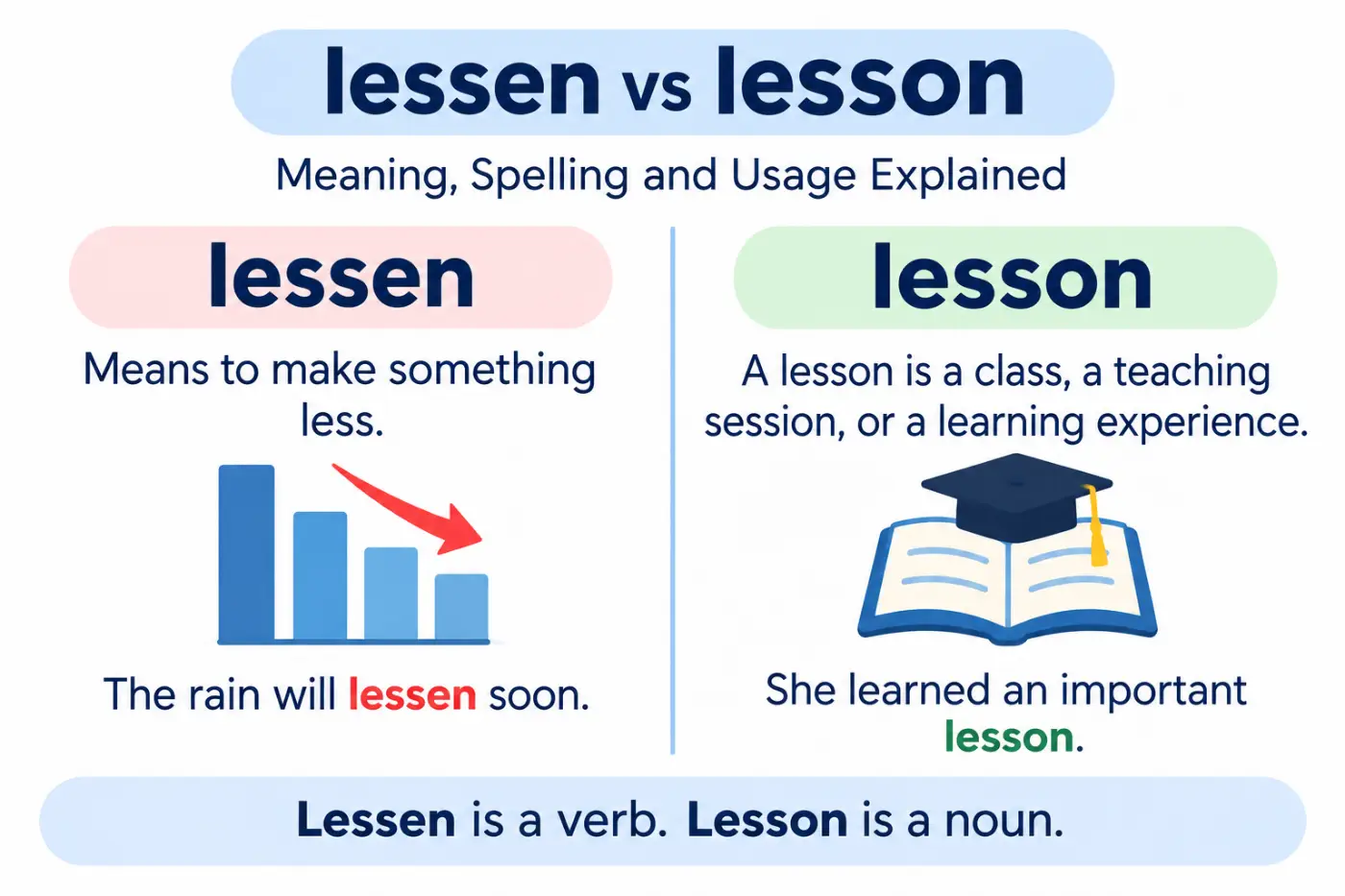
Have you ever paused while writing because you could not decide whether to use lessen vs lesson? These two words look almost identical, and their pronunciation is very similar. However, they have different meanings and serve different purposes in a sentence. The good news is that both spellings are correct English words.
Lessen is a verb that means to reduce something, make it smaller, or decrease its intensity. Lesson is a noun that refers to a period of learning, something taught, or an experience that provides useful knowledge.
The confusion usually comes from their similar sounds and the single extra letter in one spelling. If you understand what each word means and how it functions grammatically, choosing the right one becomes much easier. This guide explains their definitions, differences, pronunciation, origins, and common mistakes. You will also find practical examples that show how to use each word naturally in everyday conversations and professional writing.
You may also want to read Full vs Fill Which Word Is Correct.
Quick Answer
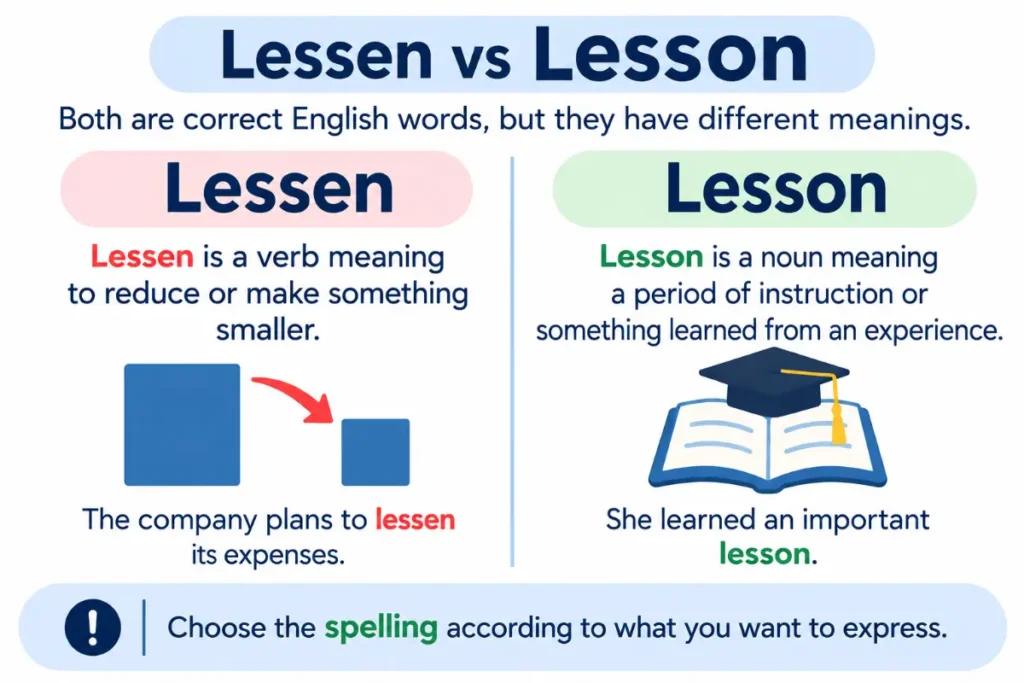
Lessen and lesson are both correct English words, but they have different meanings. Lessen is a verb meaning to reduce or make something smaller, while lesson is a noun meaning a period of instruction or something learned from an experience. Choose the spelling according to what you want to express.
Comparison Table: Lessen vs Lesson
The easiest way to understand these words is to compare their meanings, grammatical roles, and common uses.
| Feature | Lessen | Lesson |
|---|---|---|
| Correct spelling | Lessen | Lesson |
| Meaning | To reduce or decrease something | A period of instruction or something learned |
| Part of speech | Verb | Noun |
| Main function | Describes an action | Names a thing, activity, or experience |
| Pronunciation | LES-uhn | LES-uhn |
| Syllables | Two | Two |
| Word origin | Old English and Germanic roots | Old French and Latin roots |
| Common contexts | Pain, stress, risk, pressure, impact | Education, training, experience, advice |
| Formality | Standard in formal and informal English | Standard in formal and informal English |
| Example | Exercise can lessen stress. | Today’s lesson was helpful. |
The most important distinction is grammatical: one word describes an action, while the other names something.
For example:
- Correct: Regular exercise can lessen anxiety.
- Correct: The teacher prepared an interesting lesson.
Both sentences are grammatically sound because each word performs a different function.
Meaning and Definition
Although the two spellings differ by only one letter, their meanings are not interchangeable. Understanding their definitions is the first step toward using them correctly.
What Does Lessen Mean?
Lessen is a verb that means to make something less, smaller, weaker, lower, or less intense. It describes an action that reduces the amount, degree, effect, or seriousness of something.
The word is commonly used when talking about physical discomfort, emotional feelings, financial pressure, danger, and other conditions that can become less severe.
Examples:
- Drinking enough water may lessen headaches caused by dehydration.
- Better communication can lessen misunderstandings between coworkers.
- The new safety measures should lessen the risk of accidents.
- Taking regular breaks may lessen eye strain.
In each example, the word describes an action that causes a reduction.
It can also refer to something becoming less significant or powerful over time. For instance, public interest in an old controversy may lessen as new events receive attention.
Grammatical Function
This word is a regular verb. It can appear in several grammatical forms:
| Verb Form | Example |
|---|---|
| Base form | lessen |
| Third-person singular | lessens |
| Past tense | lessened |
| Present participle | lessening |
| Past participle | lessened |
Examples in sentences:
- We need to lessen the financial burden.
- The medicine lessens the discomfort.
- The noise lessened after midnight.
- The company is lessening unnecessary expenses.
Notice that the word does not always need a direct object. In the sentence “The pain gradually lessened,” the verb describes a change without specifying what caused it.
What Does Lesson Mean?
Lesson is a noun that refers to something taught or learned. It commonly describes a planned period of instruction, such as a classroom session, a music class, or a driving lesson.
It can also describe knowledge gained through experience, especially after making a mistake or facing a difficult situation.
Examples:
- My English lesson starts at nine.
- The driving instructor explained the lesson clearly.
- Losing that competition taught me an important lesson.
- The experience was a valuable lesson in patience.
The word has two especially common meanings:
1. A period of instruction
This meaning applies to education, training, and skill development.
Examples include:
- A mathematics lesson.
- A piano lesson.
- A swimming lesson.
- An online language lesson.
2. Knowledge gained from an experience
This meaning is often used in everyday conversation and storytelling.
For example, someone who spends too much money might say, “That was an expensive lesson.”
The speaker is not talking about a classroom. They mean that the experience taught them something useful.
Grammatical Function
This word is a countable noun. It can be singular or plural, depending on the number of instructional sessions, ideas, or experiences being discussed.
| Form | Example |
|---|---|
| Singular | lesson |
| Plural | lessons |
| Indefinite article | a lesson |
| Definite article | the lesson |
| Possessive | the teacher’s lesson |
Examples:
- I have a science lesson today.
- She teaches three lessons every afternoon.
- The lesson was easier than expected.
- We learned several useful lessons from the project.
Unlike the verb discussed earlier, this word names something rather than describing an action.
Key Differences Explained
There are several ways to distinguish these words. Their spelling, meaning, grammatical function, and sentence patterns provide useful clues.
1. Spelling Difference
The spelling difference is small but meaningful.
- Lessen contains six letters.
- Lesson contains six letters as well.
Both begin with “les” and end with “en” or “on.” The main difference appears in the middle of the word.
A simple way to remember the distinction is that the verb has a double “s” followed by “e” before its final “n.” The noun has a double “s” followed by “o” and then “n.”
The extra vowel pattern changes the written form, but the pronunciation remains very similar.
2. Meaning Difference
The meanings are entirely different.
- Lessen means to reduce something.
- Lesson means something taught or learned.
Think about what your sentence describes. If you are talking about reducing pain, pressure, stress, or risk, you need the verb. If you are talking about education, instruction, or knowledge gained through experience, you need the noun.
3. Grammatical Difference
One is a verb, and the other is a noun.
A verb describes an action or state. A noun identifies a person, place, thing, concept, or experience.
Compare:
- The new policy may lessen employee stress.
- The manager shared an important lesson with the team.
In the first sentence, the word describes what the policy may do. In the second, it names something the manager shares.
4. Pronunciation Difference
Both words are commonly pronounced almost identically in American English.
They generally sound like “LESS-uhn.” This similarity explains why people sometimes choose the wrong spelling when writing from memory or typing quickly.
The distinction is mainly visible in writing rather than speech.
5. Formality and Context
Neither spelling is more formal than the other. Both are accepted in standard English and appear in academic, professional, and everyday communication.
However, their contexts differ.
Use the verb when discussing reduction:
- Lessen the financial burden.
- Lessen the environmental impact.
- Lessen the chance of failure.
Use the noun when discussing instruction or experience:
- Attend a history lesson.
- Learn a valuable lesson.
- Prepare a training lesson.
6. Regional Usage
There is no major difference between American and British English in the spelling or basic meaning of these words. Both forms are standard in the major varieties of English.
Their grammatical roles also remain the same across regions.
Which Form Is Correct?
Both spellings are correct. Neither is a misspelling of the other.
The correct choice depends on the meaning and grammatical role you need in your sentence.
Use lessen when you want to express a reduction:
- We should lessen unnecessary expenses.
- These changes may lessen the environmental impact.
- A short walk can lessen stress.
Use lesson when you are referring to instruction or knowledge:
- The students enjoyed their history lesson.
- That mistake taught him a valuable lesson.
- I need another driving lesson before my test.
Why Are Both Spellings Accepted?
English contains many words that look and sound similar but have different meanings and origins.
These two forms developed through different linguistic histories. Their similar pronunciation does not make them interchangeable, just as the words “right” and “write” have different meanings despite sounding alike.
Standard dictionaries recognize both spellings as separate entries with distinct definitions and grammatical functions.
The safest approach is to identify the intended meaning before choosing the spelling.
Sentence Examples
The following examples demonstrate how the two words appear in natural English.
10 Examples Using the Correct Forms
- Regular exercise can lessen the effects of stress and improve your overall well-being.
- The company introduced flexible working hours to lessen pressure on its employees.
- A good night’s sleep may lessen feelings of tiredness during the day.
- The new safety rules are designed to lessen the risk of workplace injuries.
- My daughter has a piano lesson every Saturday morning.
- The teacher explained the science lesson using simple experiments.
- One of the most valuable lessons in life is learning to accept mistakes.
- The manager organized a training lesson for new members of the team.
- Our history lesson covered several important events from the past.
- The difficult experience taught me a lesson about patience and responsibility.
These sentences show that the verb is associated with reducing something, while the noun refers to instruction or knowledge.
5 Examples of Common Spelling Errors
The following examples show incorrect usage when the intended meaning requires the other word.
- Incorrect: I learned an important lessen from that experience.
Correct: I learned an important lesson from that experience. - Incorrect: This exercise can lesson back pain.
Correct: This exercise can lessen back pain. - Incorrect: The teacher prepared an interesting lessen for the class.
Correct: The teacher prepared an interesting lesson for the class. - Incorrect: We need to lesson the financial pressure.
Correct: We need to lessen the financial pressure. - Incorrect: That was a valuable lessen about teamwork.
Correct: That was a valuable lesson about teamwork.
The incorrect sentences may still sound natural when spoken because the two words have similar pronunciations. The problem becomes clear when you examine their meanings and grammatical roles.
Common Mistakes and Misspellings
People often confuse these forms because they share several letters and have nearly identical sounds. However, the confusion can also involve related spelling and grammar errors.
Here are five mistakes worth avoiding.
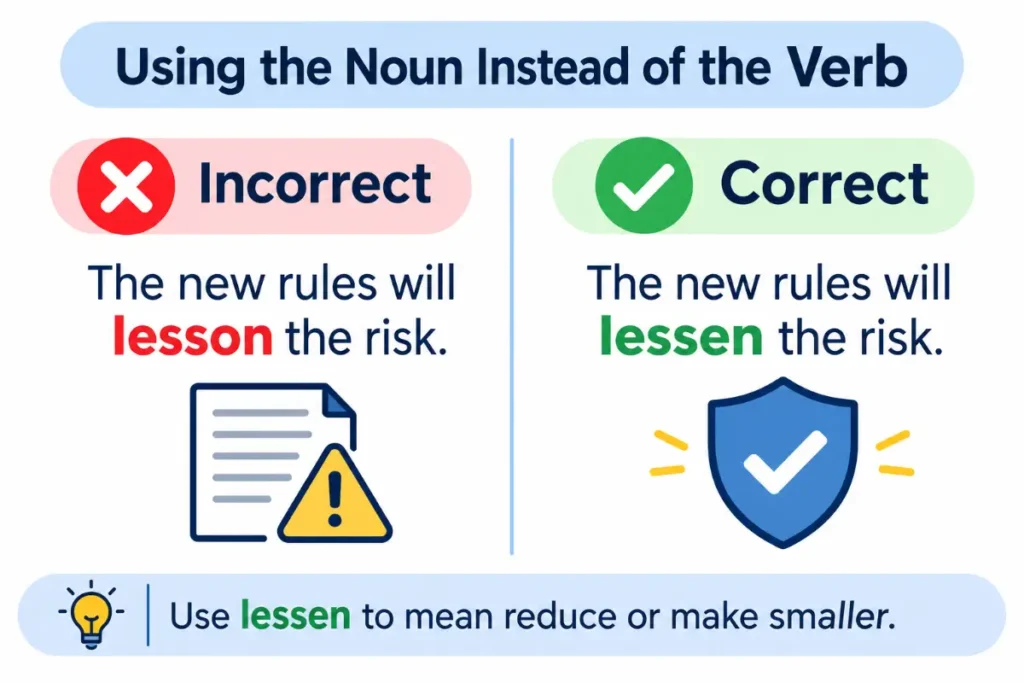
1. Using the Noun Instead of the Verb
Incorrect: The new rules will lesson the risk.
Correct: The new rules will lessen the risk.
The sentence describes a reduction in risk, so it requires an action word. The noun cannot perform that grammatical role.
2. Using the Verb Instead of the Noun
Incorrect: I learned an important lessen today.
Correct: I learned an important lesson today.
The sentence refers to knowledge gained from an experience. Therefore, the noun is necessary.
3. Confusing Similar-Sounding Words
The two spellings are examples of homophones or near-homophones in many English accents, depending on how strictly the term is used.
They sound alike or very similar, but their meanings and spelling patterns differ.
Other examples of similar-sounding English words include:
- Their and there.
- To and too.
- Hear and here.
- Write and right.
The best solution is to check the meaning rather than relying only on sound.
4. Forgetting the Correct Verb Ending
Incorrect: The treatment lesson the discomfort.
Correct: The treatment lessens the discomfort.
The subject “treatment” is singular, so the verb needs the third-person singular ending. The correct form is lessens, not lesson.
Other forms include lessened and lessening.
5. Using the Wrong Plural Form
Incorrect: The teacher prepared several lessen for the students.
Correct: The teacher prepared several lessons for the students.
The noun has a regular plural form. Add “-s” to the singular spelling to refer to more than one instructional session or learning experience.
You may also want to read Challenge vs Challange Which Spelling Is Correct.
Pronunciation Guide
Both words are pronounced very similarly in standard American English. This is one of the main reasons writers confuse them.
| Word | IPA | Syllables | Easy Pronunciation |
|---|---|---|---|
| Lessen | /ˈlɛs.ən/ | Two | LESS-uhn |
| Lesson | /ˈlɛs.ən/ | Two | LESS-uhn |
How to Pronounce the Words
Follow these simple steps:
- Begin with the sound “less.”
- Move naturally into a short, unstressed “uhn” sound.
- Keep the emphasis on the first syllable.
- Avoid making the final syllable too strong.
The stress pattern is the same for both words:
LES-suhn
Common Pronunciation Mistakes
Some speakers may pronounce the final vowel too clearly or give the second syllable unnecessary stress. Others may assume that the different written vowels must produce different spoken sounds.
In ordinary American speech, the pronunciation is generally the same. Context helps listeners identify the intended meaning.
For example, in “I learned a valuable lesson,” the surrounding words make the noun clear. In “Exercise can lessen stress,” the sentence structure identifies the verb.
Etymology and Word Origin
The historical development of these words helps explain why their meanings and spellings differ.
Although they look similar in modern English, they entered the language through different historical pathways.
Origin of Lessen
The verb developed from the English word “less,” which is associated with a smaller amount or degree.
The word “less” has Old English roots in the form “lǣssa,” meaning smaller or less. The verb-forming suffix “-en” was used to create verbs that describe making something possess a particular quality or condition.
Over time, the combination developed into the modern verb meaning to reduce or make less.
This pattern can also be seen in other English verbs, such as:
- Widen: To make wider.
- Deepen: To make deeper.
- Soften: To make softer.
- Strengthen: To make stronger.
The same basic idea applies: a word describing a quality becomes a verb expressing a change in that quality.
Origin of Lesson
The noun entered English through Old French, from the Latin word “lectio,” meaning reading or a reading.
The Latin term comes from “legere,” meaning to read or gather. Its historical development reflects the traditional connection between reading, instruction, and learning.
As education developed, the word became associated with a period of teaching, a subject covered in instruction, and knowledge gained from experience.
Today, its meaning extends beyond formal classrooms. People also use it to describe advice, moral guidance, and personal knowledge gained through difficult situations.
Why Their Origins Matter
Their different histories explain why the words have different meanings despite their similar appearance.
One developed around the idea of making something smaller or less intense. The other developed around reading, instruction, and learning.
Remembering this distinction can make the spelling easier to understand.
Regional Usage
The two words are standard in the main varieties of English. There is no meaningful regional spelling difference between them.
American English
Both forms are widely accepted in the United States.
American writers use the verb when describing a reduction in something:
- The changes may lessen operating costs.
- New policies can lessen workplace stress.
The noun is used for instruction and learning:
- The students enjoyed their first lesson.
- That experience taught me a valuable lesson.
The spelling and grammatical rules remain consistent in formal and informal American English.
British English
British English uses the same spellings and meanings.
There is no standard British alternative spelling for either word. The distinction between the verb and noun remains the same.
For example:
- The new measures could lessen the impact.
- She attended a mathematics lesson.
Some pronunciation details may vary by regional accent, but the basic distinction remains unchanged.
Australian English
Australian English also follows the same spelling conventions.
Both words are common in schools, workplaces, public communication, and everyday conversation.
There is no established Australian spelling change that affects their basic usage.
Canadian English
Canadian English follows the same general rule.
Writers use the verb to describe a decrease and the noun to describe instruction or an experience that provides knowledge.
The difference is grammatical and semantic rather than regional.
Grammar Rules and Part of Speech
Understanding the grammatical role of each word makes it easier to use the right form without memorizing every possible example.
How to Use Lessen as a Verb
This word can be used as a transitive or intransitive verb.
A transitive verb takes a direct object. An intransitive verb does not require one.
Transitive use:
- We need to lessen the pressure.
- The new system may lessen expenses.
- Exercise can lessen muscle tension.
In these sentences, the verb acts on something specific.
Intransitive use:
- The pain gradually lessened.
- Her anxiety lessened over time.
- Public interest in the issue began to lessen.
Here, the verb describes a reduction without requiring a direct object.
Common Verb Patterns
Several grammatical patterns are especially useful:
1. Lessen + noun
- Lessen the burden.
- Lessen the impact.
- Lessen the risk.
2. Subject + lessen
- The noise lessened.
- The tension lessened.
- The pressure lessened.
3. Modal verb + lessen
- We can lessen the problem.
- These changes may lessen the impact.
- Better planning could lessen the risk.
4. Be + lessening
- The pressure is lessening.
- The pain is lessening gradually.
These patterns make the verb easy to use in different sentence structures.
How to Use Lesson as a Noun
The noun commonly appears with articles, adjectives, possessive forms, and plural markers.
Examples:
- A useful lesson.
- The final lesson.
- An important lesson.
- Three lessons.
- My first lesson.
It can also appear in common expressions.
Learn a lesson: To gain knowledge from an experience.
Example: I learned a lesson about managing money.
Teach someone a lesson: To make someone understand something through instruction or experience.
Example: The mistake taught him a lesson about preparation.
Lesson learned: An expression used to describe knowledge gained from a situation.
Example: Lesson learned: Always check your work before submitting it.
Sentence Position
The verb can appear after a subject, following an auxiliary verb, or in an infinitive phrase.
Examples:
- The medicine lessens the pain.
- We should lessen unnecessary spending.
- The discomfort has lessened.
The noun can appear as a subject, direct object, or object of a preposition.
Examples:
- The lesson was useful.
- I enjoyed the lesson.
- We talked about the lesson.
Punctuation and Formal Writing
Neither word requires special punctuation.
Both follow ordinary English punctuation rules. Use commas, periods, and other marks according to the structure of the sentence rather than the spelling of the word.
Both are suitable for professional emails, academic papers, reports, and everyday messages.
Real-Life Usage Examples
Understanding how these words appear in different settings makes the distinction easier to apply in practical communication.
1. Daily Conversation
People commonly use the noun when discussing education, advice, or personal experiences.
- “I have a driving lesson this afternoon.”
- “That mistake taught me a valuable lesson.”
The verb often appears in discussions about feelings or physical conditions.
- “A little rest might lessen your headache.”
- “Talking about the problem may lessen your stress.”
2. Email and Workplace Communication
Professional writing often uses the verb when discussing improvements, costs, and business risks.
Example 1:
“Could we review the proposed changes to see whether they might lessen the financial burden on the department?”
Example 2:
“Thank you for the training lesson. The examples helped me understand the new process.”
The first sentence describes a possible reduction. The second refers to an instructional session.
3. Academic Writing
Academic writing uses both words, depending on the subject and purpose.
Example 1:
“Further research may help lessen the uncertainty surrounding the results.”
Example 2:
“The final lesson focused on the relationship between language development and social interaction.”
The verb is suitable for describing changes in degree or intensity. The noun identifies a teaching session or a specific topic covered during instruction.
4. News and Journalism
Journalists may use the verb when describing measures that reduce the effects of a problem.
Example 1:
“The city introduced new traffic measures to lessen congestion during peak hours.”
Example 2:
“Officials hope the additional funding will lessen pressure on local hospitals.”
The noun can also appear in reporting about education and public experiences.
Example 3:
“The school introduced a new lesson on online safety.”
Example 4:
“The investigation offered an important lesson about the need for stronger oversight.”
5. Literature and Storytelling
In storytelling, the verb can describe a gradual change in emotion, tension, or physical conditions.
Example 1:
“As the evening passed, her fear began to lessen.”
Example 2:
“The sound of the storm slowly lessened until the village became quiet.”
The noun often describes a character’s personal growth or a moral message.
Example 3:
“His journey taught him a lesson about courage.”
Example 4:
“She remembered the lesson her grandmother had taught her many years earlier.”
These examples demonstrate that the words are useful in different types of writing, but their grammatical functions should never be confused.
Related and Confused Terms
Several English words are connected to the meanings of these two forms. Learning their differences can improve your vocabulary and help you choose more precise expressions.
1. Reduce
Reduce is a verb meaning to make something smaller in amount, size, number, or degree.
Example: The company wants to reduce its operating expenses.
It is a close synonym of the verb discussed in this article, although the two words are not interchangeable in every expression.
2. Decrease
Decrease can function as both a noun and a verb. It refers to a reduction in amount, size, or intensity.
Example: The number of complaints began to decrease.
It is useful when describing measurable changes.
3. Diminish
Diminish is a verb meaning to become or make something smaller, weaker, or less important.
Example: His confidence began to diminish after repeated failures.
It can sound slightly more formal than everyday alternatives.
4. Minimize
Minimize means to reduce something to the smallest possible amount or degree.
Example: Wearing protective equipment can minimize the risk of injury.
It is common in professional, technical, and academic writing.
5. Class
A class is a group of students or a period of teaching.
Example: I have an English class at ten.
A class and a lesson are related, but they are not always identical. A class may contain several lessons over time.
6. Tutorial
A tutorial is an instructional session or a guide that explains how to perform a task.
Example: I watched a tutorial about editing photographs.
It often refers to practical or step-by-step learning.
7. Instruction
Instruction refers to the act of teaching, directions, or information about how to do something.
Example: The instructor gave clear instructions before the activity.
It is broader than a single teaching session.
8. Takeaway
A takeaway is an important idea, fact, or message gained from an experience, discussion, or lesson.
Example: My biggest takeaway from the meeting was the value of teamwork.
It is common in workplace communication and informal discussions.
Expert Editor Insight
An experienced English editor looks at meaning and sentence structure rather than pronunciation alone. Because these two words sound almost identical, spell-checking software may not always identify an incorrect choice. Both spellings can pass a basic spelling check even when the sentence uses the wrong one. A useful editing technique is to replace the intended word mentally with a simple synonym: if “reduce” fits, use the verb; if “class” or “something learned” fits, use the noun. This meaning-based check is often more reliable than depending on automatic correction.
Still confused? Compare Elicit vs Illicit Meaning and Usage Explained.
Conclusion
Understanding the difference between lessen vs lesson comes down to recognizing their meanings and grammatical functions. Both are correct English words, but they cannot replace one another. The verb describes reducing something, while the noun refers to instruction or knowledge gained through experience. Their similar pronunciation makes the confusion understandable, especially when typing quickly.
However, a simple editing trick can help: replace the intended word with “reduce” or “learning experience” and see which meaning fits. If you are talking about making something smaller, choose the verb. If you mean education or knowledge, choose the noun. With this simple rule, you can use both confidently in everyday and professional writing.
FAQs
Is “lessen” a real English word?
Yes. It is a standard English verb meaning to reduce something or make it smaller, weaker, or less intense. It is commonly used when discussing stress, pain, pressure, risk, and financial costs. For example, “Regular exercise may lessen stress.” It is not a misspelling of the noun used for instruction or learning.
What does “lesson” mean in English?
A lesson is a period of teaching or an experience that provides knowledge. It can refer to a classroom session, a music class, a training activity, or something learned from a mistake. For example, “The teacher prepared an interesting lesson” uses the word to describe a planned instructional activity.
Which spelling should I use in formal writing?
Both spellings are correct in formal English, but they serve different grammatical purposes. Use the verb when describing a reduction, such as lessening costs or pressure. Use the noun when referring to instruction or knowledge gained from experience. The correct choice depends on the meaning of your sentence, not its level of formality.
Do the two words have the same pronunciation?
In standard American English, they are generally pronounced the same way: /ˈlɛs.ən/. Both have two syllables, with the stress on the first syllable. Their similar pronunciation explains why they are frequently confused in writing. Context and sentence structure usually help readers and listeners understand which meaning is intended.
Can “lessen” be used at the beginning of a sentence?
Yes. It can begin a sentence when used as an imperative verb or an infinitive phrase. For example, “Lessen your screen time before bedtime” is a direct instruction. You can also write, “To lessen the impact, the company introduced new safety measures.” Both constructions are grammatically correct.
What is a synonym for “lessen”?
Common synonyms include reduce, decrease, diminish, lower, ease, and minimize. The best alternative depends on the context. For example, reduce works well when discussing costs, while ease is often natural when talking about pain or discomfort. Although these words share related meanings, they may have slightly different uses.
Why do people confuse these two spellings?
People confuse them mainly because they look similar and have nearly identical pronunciations in many English accents. Both contain the same initial letters, and the spelling difference is easy to overlook while typing. Their different grammatical roles provide the best clue: one describes a reduction, while the other names an instructional activity or learning experience.
Is the noun appropriate for academic and professional writing?
Yes. It is a standard noun used in academic papers, educational materials, workplace training, and professional communication. It can refer to a specific teaching session or a broader idea learned through experience. Expressions such as “key lessons,” “important lessons,” and “lessons learned” are natural in formal and professional contexts.