
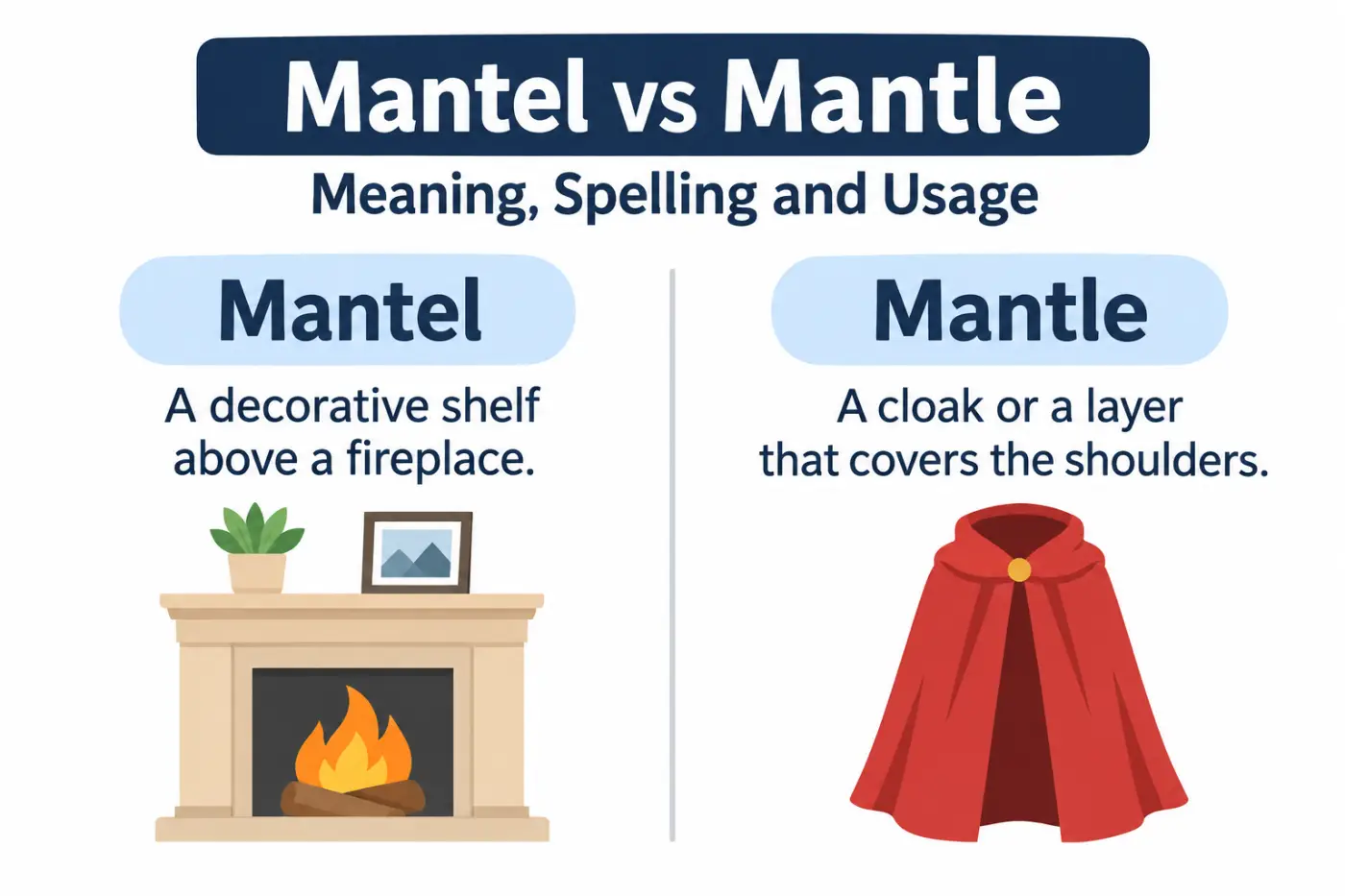
Have you ever wondered whether the shelf above a fireplace is called a mantel or a mantle? The confusion is understandable because the two words look almost identical and sound exactly the same. However, mantel vs mantle is not a case of one correct spelling and one spelling mistake. Both are legitimate English words, but they serve different purposes.
The easiest way to remember the distinction is that a mantel is the structure or shelf surrounding the top of a fireplace, while a mantle is a cloak, covering, layer, or symbolic responsibility. You might decorate a mantel with family photos, but you might say that someone has taken on the mantle of leadership. The difference matters in everyday conversation, home design, science, literature, and professional writing. Once you understand what each word describes, choosing the right spelling becomes much easier.
A related grammar guide is Coarse vs Course Which Word Is Correct.
Quick Answer
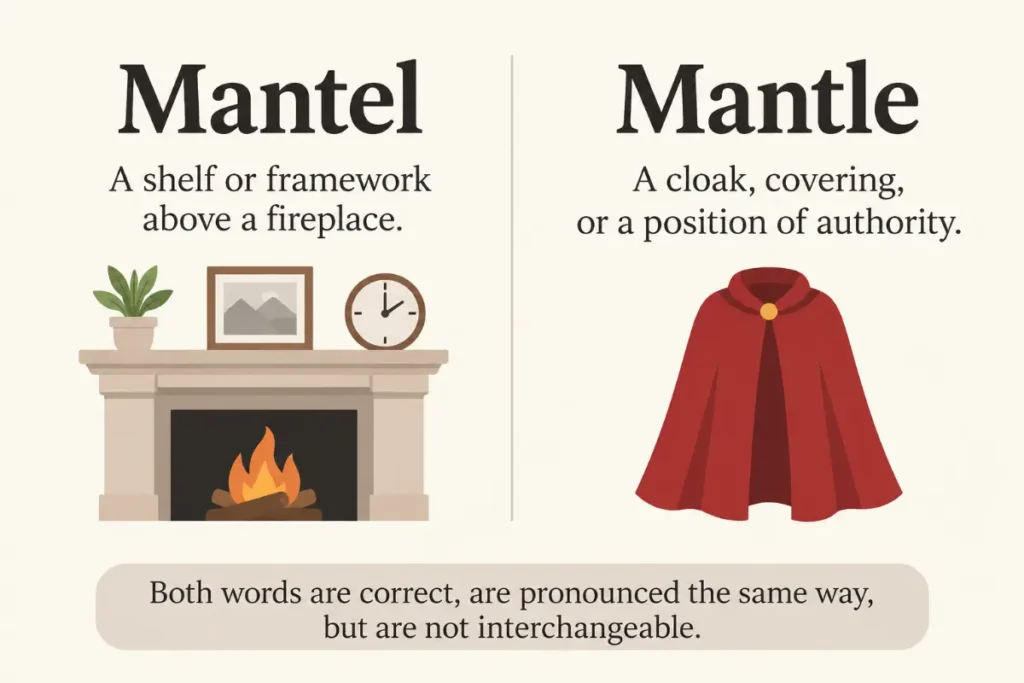
A mantel is the shelf or framework above a fireplace, often used to display decorations, photographs, or clocks. A mantle is a cloak, covering, protective layer, or symbolic position of authority or responsibility. Both words are correct, and they are pronounced the same way, but they are not interchangeable.
Comparison Table: Mantel vs Mantle
| Feature | Mantel | Mantle |
|---|---|---|
| Meaning | Shelf or framework above a fireplace | Cloak, covering, layer, or responsibility |
| Part of speech | Noun | Noun; also used as a verb in specialized contexts |
| Pronunciation | /ˈmæn.təl/ | /ˈmæn.təl/ |
| Origin | Related to the same historical word family as mantle | From Old English and earlier Germanic and Latin-influenced forms |
| Main usage | Home design and architecture | Literature, science, geography, and figurative language |
| Formality | Standard English | Standard English |
| Common contexts | Fireplace, living room, interior design | Earth’s structure, clothing, leadership, protection |
| Example | The family placed a clock on the mantel. | She accepted the mantle of leadership. |
Meaning and Definition
Understanding the meaning of each word is the best way to avoid spelling mistakes. Although their pronunciation is identical, their definitions point to different things.
What Does Mantel Mean?
A mantel is the shelf, ledge, or decorative structure positioned above and around a fireplace. It is often a noticeable feature in a living room and may be made from wood, stone, marble, brick, or another building material.
In many homes, the mantel serves both a practical and decorative purpose. People use it to display photographs, candles, artwork, small plants, family keepsakes, and seasonal decorations. Some fireplaces have a simple horizontal shelf, while others have an elaborate surround with carved details.
The word generally refers to the fireplace feature rather than the entire wall or room.
For example:
- The wedding photograph sits on the mantel.
- We installed a wooden mantel above the new fireplace.
- She placed two candles on either side of the mantel.
In interior design and architecture, this spelling is the standard choice when discussing a fireplace shelf or its surrounding decorative framework.
What Does Mantle Mean?
A mantle has several meanings, but they are connected by the general idea of a covering, layer, or something placed over another thing.
Its traditional meaning is a loose cloak or garment worn over the shoulders. Historically, mantles were used for warmth, protection, and ceremonial dress. The word also appears in literature, historical descriptions, and religious writing.
In modern English, it has several important uses.
1. A cloak or outer covering
A mantle can describe a loose garment worn over the shoulders or a covering placed over something.
Example: The king wore a heavy mantle over his ceremonial clothing.
2. A layer of the Earth
In geology, the mantle is the thick layer of mostly solid rock located between Earth’s crust and its core. It plays a major role in the planet’s internal structure and geological activity.
Example: Heat within Earth’s mantle helps drive the movement of tectonic plates.
3. A symbolic responsibility or position
In figurative language, the word describes an important duty, role, title, or responsibility passed from one person to another.
Example: After the founder retired, the new director took on the mantle of leadership.
4. A covering or protective layer
The word can also describe something that covers, surrounds, or protects another object or surface.
Example: A mantle of snow covered the hills overnight.
These meanings share a central idea: something that covers, surrounds, or represents a role.
Is the Fireplace Word a Misspelling?
No. The fireplace-related word is not a misspelling or an informal variation. It is a separate, established English noun with a specific meaning.
Likewise, using the other spelling for a cloak, geological layer, or symbolic responsibility is not an error. The distinction is based on meaning, not on American versus British spelling rules.
This is why a spellchecker may accept both forms. A spelling tool can recognize that a word exists without knowing whether it fits the meaning of your sentence.
Key Differences Explained
The distinction becomes easier when you compare the words according to their meanings and common contexts.
1. Spelling
The two words differ by only one letter:
- Mantel ends with the letters E and L.
- Mantle ends with the letters L and E.
Because the letters are simply reversed at the end, it is easy to type the wrong form, especially when writing quickly.
However, the spelling difference carries a real difference in meaning. Replacing one with the other can change the meaning of an otherwise correct sentence.
2. Meaning
A mantel refers specifically to a fireplace feature. A mantle generally describes a covering, garment, layer, or symbolic responsibility.
Consider these sentences:
- The vase looks beautiful on the mantel.
- The scientist explained the structure of Earth’s mantle.
The first sentence describes a household feature. The second describes a geological layer. Neither spelling can replace the other without changing the intended meaning.
3. Grammar and Part of Speech
Both words function mainly as countable nouns.
You can use the fireplace term with articles and adjectives:
- A wooden mantel
- The marble mantel
- An antique mantel
The other term also works as a noun:
- A royal mantle
- The Earth’s mantle
- A mantle of responsibility
In specialized scientific and technical contexts, mantle can also appear as a verb, meaning to cover or envelop something. For example, a surface may be described as mantled with sediment.
The fireplace term is overwhelmingly used as a noun.
4. Pronunciation
Both words have the same pronunciation: /ˈmæn.təl/.
They are spoken as two syllables:
- MAN
- TUL
The first syllable receives the main stress. There is no pronunciation difference that helps a listener identify which spelling someone means.
This is a classic example of homophones: words that sound alike but have different spellings and meanings.
5. Formality
Both are standard words suitable for formal and informal writing.
Use the fireplace spelling in architectural descriptions, property listings, home improvement instructions, and interior design articles. Use the other spelling in scientific writing, literary discussions, historical descriptions, and professional communication about responsibility or leadership.
Neither word is inherently more formal than the other.
6. Context
Context is the most reliable way to select the correct spelling.
Look for nearby words that suggest the intended meaning:
- Fireplace, shelf, wood, decoration, and hearth point to the fireplace term.
- Earth, crust, core, rock, geology, and tectonic plates point to the geological meaning.
- Leadership, responsibility, authority, successor, and tradition often point to the figurative meaning.
- Cloak, garment, shoulders, and ceremonial clothing suggest the traditional meaning.
7. Regional Usage
There is no major American-versus-British spelling distinction between these words. Both forms are established in standard English on both sides of the Atlantic.
The difference is semantic rather than regional. A writer in the United States, United Kingdom, Canada, or Australia should use the same basic rule.
Which Form Is Correct?
Both forms are correct. The right choice depends on the object, idea, or concept you want to describe.
Use the fireplace spelling when referring to the shelf or decorative framework above a fireplace. Use the other spelling when referring to a cloak, a covering, Earth’s internal layer, or an important responsibility.
The distinction is supported by established English dictionary usage. Standard dictionaries recognize the two spellings as separate entries with related historical backgrounds but different modern meanings.
Here is a simple way to decide:
- Talking about a fireplace? Choose mantel.
- Talking about a cloak? Choose mantle.
- Writing about Earth’s internal structure? Choose mantle.
- Describing someone accepting an important responsibility? Choose mantle.
- Discussing a decorative shelf above a fireplace? Choose mantel.
A useful test is to replace the word with a simpler description. If you mean shelf, the fireplace spelling is appropriate. If you mean cloak, layer, covering, or responsibility, the other spelling is appropriate.
Sentence Examples
The following examples show how each spelling works in natural English. Pay attention to the context rather than the sound of the word.
10 Correct Example Sentences
- My grandmother keeps a collection of family photographs on the living room mantel.
- We hired a carpenter to build a custom oak mantel for our new fireplace.
- The Christmas stockings were hanging from the mantel before the children woke up.
- A small antique clock looked beautiful in the center of the marble mantel.
- The interior designer recommended painting the mantel white to match the walls.
- After years of service, the principal passed the mantle of leadership to her successor.
- The astronauts learned about the Earth’s mantle during their geology training.
- A thick mantle of snow covered the mountain village throughout the night.
- The king wore a golden mantle during the official ceremony.
- The young captain accepted the mantle of responsibility after the team’s former leader retired.
These examples demonstrate that the fireplace-related spelling belongs in home and architectural contexts, while the other form works in clothing, science, nature, and figurative expressions.
Examples of Commonly Confused Usage
Both spellings are legitimate, so an incorrect example depends on the meaning intended.
| Incorrect usage | Correct usage | Reason |
|---|---|---|
| She placed the vase on the fireplace mantle. | She placed the vase on the fireplace mantel. | The sentence refers to a fireplace shelf. |
| The Earth’s mantel contains hot rock. | The Earth’s mantle contains hot rock. | The sentence refers to a geological layer. |
| He accepted the mantel of leadership. | He accepted the mantle of leadership. | The expression describes responsibility. |
| The king wore a ceremonial mantel. | The king wore a ceremonial mantle. | The sentence describes a garment. |
| We decorated the fireplace mantle for Christmas. | We decorated the fireplace mantel for Christmas. | The reference is to the fireplace feature. |
The incorrect versions are useful for spotting errors, but they should not be treated as alternative spellings.
Common Mistakes and Misspellings
Even experienced writers sometimes confuse these words. The problem usually comes from their similar appearance and identical pronunciation.
Here are five common mistakes and ways to avoid them.
1. Using the Fireplace Spelling for a Geological Layer
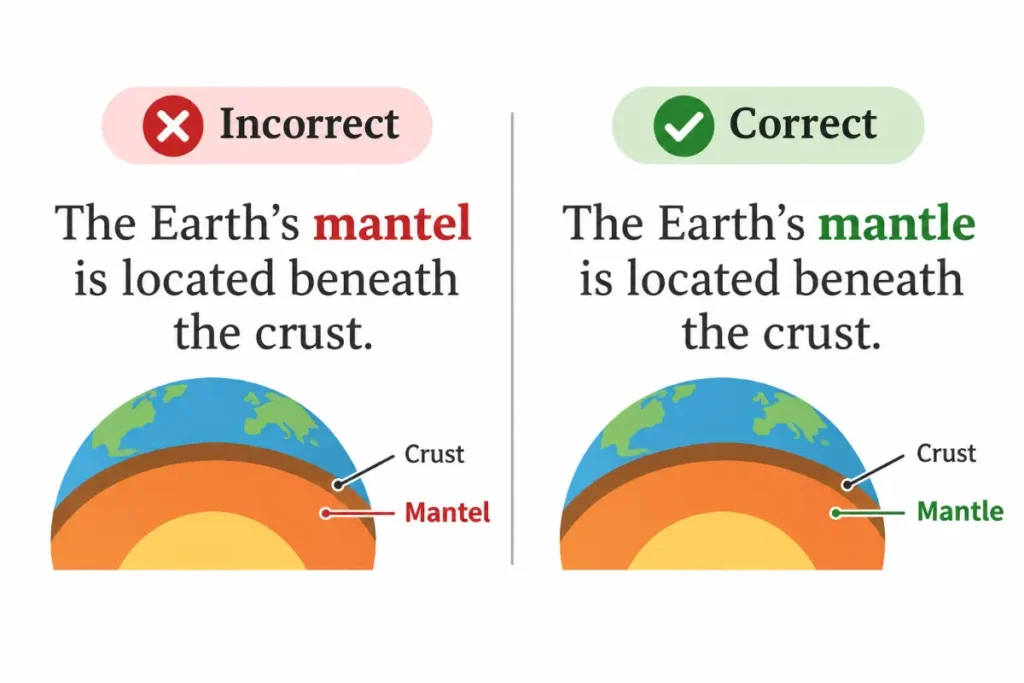
Incorrect: The Earth’s mantel is located beneath the crust.
Correct: The Earth’s mantle is located beneath the crust.
The mistake happens because writers remember the sound but not the meaning. In geology, the word describes the thick layer between the crust and the core.
Remember: Earth science requires the spelling associated with a covering or layer.
2. Using the Layer Spelling for a Fireplace Shelf
Incorrect: The family displayed their holiday decorations on the fireplace mantle.
Correct: The family displayed their holiday decorations on the fireplace mantel.
A fireplace shelf is a physical architectural feature. The spelling ending in EL is the established term for it.
Remember: If you can place a photograph, clock, or candle on it, use the fireplace spelling.
3. Confusing the Expression About Leadership
Incorrect: The new manager took on the mantel of leadership.
Correct: The new manager took on the mantle of leadership.
The phrase describes an important role or responsibility. It does not refer to a physical shelf.
This expression is especially common in formal speeches, news reports, biographies, and discussions about succession.
Remember: Responsibility is a symbolic covering or role, so use mantle.
4. Assuming One Spelling Is British and the Other Is American
Incorrect assumption: Mantel is American English, while mantle is British English.
Correct understanding: Both forms are standard in American and British English.
This confusion may develop because many English words have different spellings across regions. However, this is not one of those cases.
The meaning determines the spelling, regardless of the country in which you are writing.
5. Trusting Automatic Spellcheck Without Checking Meaning
Incorrect approach: Accepting whichever spelling a writing tool suggests without reviewing the sentence.
Correct approach: Check whether the word describes a fireplace feature, garment, layer, or responsibility.
Most spelling tools can recognize both forms. However, recognizing a word does not mean the software understands whether it belongs in a particular sentence.
Remember: Use grammar and spelling tools as assistants, not as replacements for meaning-based editing.
Pronunciation Guide
Both words are pronounced exactly alike. This is one reason people confuse them when writing.
Pronunciation
/ˈmæn.təl/
IPA transcription for both words
Syllable breakdown
Need another quick comparison? Read desert vs dessert Explained With Simple Examples.
MAN
First syllable
Stressed
tul
Second syllable
Unstressed
Easy pronunciation: MAN-tul
How to Pronounce Both Words
Start with the word man, then add a soft, unstressed ending that sounds like tul. Keep the pronunciation smooth and avoid placing equal stress on both syllables.
The first syllable carries the emphasis:
- MAN-tul
- Not man-TUL
The ending is not pronounced as a separate, strongly stressed word. In ordinary American speech, both spellings sound the same.
Common Pronunciation Mistakes
Some speakers may try to pronounce the final letters differently because the words look different. However, the spelling distinction does not create a difference in standard pronunciation.
You should not pronounce one with a hard T and the other with a silent T. Both begin with the same consonant sound and follow the same two-syllable pattern.
If you hear someone say the word aloud, you usually cannot determine which spelling they intend without additional context.
Etymology and Word Origin
The history of these words helps explain why their spelling and pronunciation are so similar.
Both belong to the same historical word family associated with a cloak or covering. Their development reflects the movement of words through Old English, French, and Latin-influenced forms.
Historical Background
The traditional word for a cloak or covering has roots in older Germanic and Latin-influenced vocabulary. Old English used the form mentel, while related forms appeared in medieval French and other European languages.
Over time, the word developed into the familiar modern spelling mantle. Its original connection with clothing and coverings remained visible in its meaning.
The fireplace term developed from the same historical word family. Its modern spelling became associated with the architectural feature above a fireplace.
This shared history explains why the two words look almost identical. They are not unrelated words that simply happen to sound alike. Their meanings developed along different paths from a common historical background.
How Their Meanings Developed
The traditional meaning of a cloak or covering provided the foundation for several later uses.
For example:
- A garment worn over the shoulders was a mantle.
- A layer covering or surrounding something could also be described using the same word.
- The geological layer beneath Earth’s crust became known as the mantle.
- The idea of wearing or receiving an important role developed into the figurative expression about accepting a mantle of responsibility.
The fireplace meaning became more specialized. It refers to the shelf or decorative structure associated with a fireplace rather than a general covering.
The key lesson is that shared origins do not mean two modern words have identical meanings.
Regional Usage
Writers sometimes wonder whether the difference is based on American, British, Australian, or Canadian English. It is not.
Both forms are recognized in major English varieties. Their meanings remain broadly consistent across regions.
American English
In the United States, both spellings are standard.
Homeowners, builders, architects, and interior designers use the fireplace spelling when describing the shelf above a fireplace. The other spelling appears in American geology textbooks, literary writing, and expressions involving leadership or responsibility.
Examples:
- The contractor installed a new stone mantel.
- The president discussed the mantle of public service.
American dictionaries recognize both as separate words.
British English
British English follows the same basic distinction.
The fireplace spelling is used for the shelf or decorative structure above a fireplace. The other form describes a cloak, covering, geological layer, or symbolic role.
There is no general British spelling rule that reverses the two meanings.
Australian English
Australian English also maintains the distinction. Writers use the fireplace spelling in descriptions of homes and the other form in scientific, literary, and figurative contexts.
No special Australian spelling variation changes the basic rule.
Canadian English
Canadian English follows the same usage pattern. Both words are accepted, and the intended meaning determines the correct choice.
A Canadian writer discussing a fireplace should use the same spelling as an American or British writer. A Canadian geologist should use the standard geological spelling.
Regional takeaway: These are meaning-based spelling differences, not national spelling variations.
Grammar Rules and Part of Speech
Both words are nouns in their most common uses. Understanding how they function in a sentence makes it easier to choose the correct form.
1. Using Mantel as a Noun
The fireplace term is a countable noun. It can refer to one fireplace shelf or more than one in a discussion about several rooms or buildings.
Examples:
- The mantel needs a fresh coat of paint.
- We compared three different fireplace mantels.
- Her favorite decoration sits on the wooden mantel.
It can appear as a subject, direct object, or object of a preposition.
As a subject:
The mantel adds character to the living room.
As a direct object:
They cleaned the mantel before the guests arrived.
As an object of a preposition:
The photographs are arranged above the mantel.
2. Using Mantle as a Noun
The other word is also commonly used as a countable noun, although some scientific uses describe a particular continuous layer.
Examples:
- The mantle was decorated with gold embroidery.
- Scientists study the Earth’s mantle.
- She accepted the mantle of leadership.
The word can also appear in expressions that describe a covering or surrounding layer.
For example, a mantle of clouds may cover a mountain, while a mantle of snow may describe a thick layer across a landscape.
3. Common Grammatical Patterns
Several phrases are especially useful to remember:
| Expression | Meaning |
|---|---|
| Fireplace mantel | Shelf or framework above a fireplace |
| Wooden mantel | Fireplace shelf made of wood |
| Mantle of leadership | Responsibility of leading others |
| Mantle of responsibility | Important duty or obligation |
| Earth’s mantle | Geological layer beneath the crust |
| Mantle of snow | A covering layer of snow |
| Ceremonial mantle | Traditional or formal garment |
| Take up the mantle | Accept a role or responsibility |
Learning these expressions as complete phrases can be more effective than memorizing the spellings separately.
4. Can Either Word Be Plural?
Yes. Both can form regular plurals.
- One mantel, two mantels.
- One mantle, two mantles.
Examples:
The historic house has several decorative mantels.
The museum displays ceremonial mantles from different periods.
The plural endings do not change the difference in meaning.
5. Can Mantle Be Used as a Verb?
Yes, although its verbal use is less common in everyday conversation.
As a verb, mantle can mean to cover, envelop, or spread over something.
Example: Fog mantled the hills before sunrise.
Another example: The walls were mantled with thick ivy.
This usage appears more often in descriptive, literary, or technical writing.
The fireplace term is generally not used as a verb in standard contemporary English.
6. Capitalization and Punctuation
Neither word normally requires capitalization unless it appears at the beginning of a sentence, in a title, or as part of a proper name.
For example:
- The mantel needs repairing.
- The mantle of leadership passed to the new director.
In the phrase Earth’s mantle, Earth is commonly capitalized when referring to the planet. The noun mantle remains lowercase.
Neither spelling requires special punctuation. Ordinary plural rules and possessive apostrophes apply:
- The mantel’s surface was damaged.
- The mantle’s outer covering was embroidered.
Real-Life Usage Examples
Looking at the words in different settings makes their meanings easier to recognize. Here are practical examples from everyday life, work, academic writing, journalism, and storytelling.
Daily Conversation
People often use the fireplace spelling when talking about decorating, cleaning, or arranging a room.
- “Can you move the picture frame to the center of the mantel?”
- “We should put some flowers on the mantel before the family arrives.”
The other spelling appears in ordinary speech when someone discusses an important role or a covering.
- “She has finally taken on the mantle of leadership.”
- “The hills looked beautiful under their mantle of snow.”
Email and Workplace Communication
In professional communication, the two forms can appear in very different situations.
Example 1: Interior design email
“We recommend installing a custom wooden mantel to complement the fireplace and match the living room furniture.”
Example 2: Workplace announcement
“Following the director’s retirement, Michael will assume the mantle of leadership beginning next month.”
The first sentence discusses a physical feature. The second describes a professional responsibility.
Academic Writing
Scientific and academic writing often uses the second form in geology, environmental science, and literature.
Example 1: Geology
“The Earth’s mantle plays a central role in heat transfer and the processes that influence tectonic plate movement.”
Example 2: Literary studies
“The author uses the mantle as a symbol of authority, inherited responsibility, and social expectation.”
In academic work, precise word choice is especially important because readers expect technical terms to retain their established meanings.
News and Journalism
News writing may use both words depending on the subject.
Example 1: Home and property reporting
“The renovated Victorian home features an original marble mantel that has been carefully restored.”
Example 2: Leadership reporting
“The incoming party leader will take up the mantle as the organization prepares for its next election.”
These examples show why a writer should consider the subject of a news story before choosing a spelling.
Literature and Storytelling
In fiction and descriptive writing, the traditional and figurative meanings can add detail to a scene.
Example 1: Physical description
“The traveler wrapped a dark wool mantle around his shoulders before stepping into the winter wind.”
Example 2: Figurative description
“After her mentor’s death, she carried the mantle of his unfinished work with quiet determination.”
The fireplace spelling may also appear in a story when describing a room:
“The old clock ticked softly above the wooden mantel as the fire burned low.”
Related and Confused Terms
Several words and expressions are closely connected to these two spellings. Learning their differences can improve vocabulary and make your writing more precise.
1. Hearth
A hearth is the floor area in front of or within a fireplace, often made of stone or brick. It is different from the shelf above the fireplace.
Example: The children sat on the hearth to warm their hands.
2. Fireplace Surround
A fireplace surround is the decorative or structural area around the fireplace opening. It may include stone, tile, wood, or other materials.
Example: The marble fireplace surround gives the room a classic appearance.
3. Chimney
A chimney is the vertical structure or passage that carries smoke and combustion gases away from a fireplace or heating system.
Example: The chimney needs inspection before winter.
4. Cloak
A cloak is a loose outer garment worn over other clothing. It is one of the closest traditional synonyms for the clothing-related meaning.
Example: The traveler wore a thick cloak during the journey.
5. Covering
A covering is something placed over or spread across another object or surface.
Example: A covering of fresh snow made the garden look completely different.
This is a broad synonym, so it does not always replace the more specific word naturally.
6. Layer
A layer is a thickness or level of material that lies over or beneath another substance.
Example: The mantle forms a major layer within the Earth.
The word layer is especially useful when explaining scientific concepts in simpler language.
7. Responsibility
Responsibility refers to a duty or obligation that someone is expected to handle.
Example: The new manager accepted responsibility for the department.
In figurative expressions, the mantle can represent this type of duty.
8. Leadership
Leadership is the ability or responsibility to guide a group, organization, or community.
Example: The organization needs strong leadership during the transition.
The expression mantle of leadership describes the role or authority passed to a new leader.
These related terms are not all direct synonyms. Some describe parts of a fireplace, while others explain the meanings associated with a garment, covering, or symbolic role.
Expert Editor Insight
An experienced English editor treats these as two distinct vocabulary items, not as competing regional spellings. Native speakers may pronounce them identically, so the intended meaning is usually clear from context, but writers still need to select the correct form. In editing, the first step is to identify the object or idea being described. A reference to a fireplace, decoration, or architectural feature calls for the fireplace spelling; a reference to geology, clothing, or responsibility calls for the other. Spellcheckers may accept both, which is why a careful meaning-based review is more reliable than automatic correction.
For another common grammar confusion, see Bailer or Baler Meaning and Correct Usage.
Conclusion
Understanding mantel vs mantle becomes simple once you connect each spelling to its meaning. Use mantel when discussing a fireplace shelf or decorative framework. Choose mantle when referring to a cloak, covering, Earth’s geological layer, or an important responsibility. Both words are correct, share the same pronunciation, and are used in American and British English.
The easiest editing trick is to replace the word with its meaning before finalizing your sentence. If you mean a fireplace shelf, write mantel. If you mean a layer, cloak, or responsibility, write mantle. Remembering this small distinction will help you write more clearly and confidently.
FAQs
1. Is mantel a real word?
Yes. Mantel is a standard English word that refers to the shelf or decorative framework above a fireplace. It is commonly used in architecture, home improvement, and interior design. It is not an incorrect version of the other spelling. Both are legitimate words, but the fireplace-related meaning belongs specifically to this form.
2. What does mantle mean in simple English?
A mantle is a cloak, covering, or layer. It can also describe an important duty or position that someone accepts or inherits. For example, Earth’s mantle is the thick layer beneath its crust, while the mantle of leadership describes the responsibility of guiding an organization or group.
3. Which is correct: mantel or mantle?
Both are correct, but they have different meanings. Use mantel for the shelf or decorative structure above a fireplace. Use mantle for a cloak, covering, geological layer, or symbolic responsibility. The choice is not based on American or British spelling. It depends entirely on what you are describing.
4. How do you pronounce both words?
Both words are pronounced /ˈmæn.təl/, which sounds like MAN-tul. They contain two syllables, with the stress on the first. Their identical pronunciation makes them homophones. You generally cannot tell which spelling someone means by listening, so you must rely on the context of the conversation.
5. Is mantle used only for clothing?
No. Although its traditional meaning refers to a cloak or outer garment, the word has several modern uses. It describes Earth’s geological layer, a covering such as a mantle of snow, and an important responsibility or position. These meanings are connected by the general idea of covering, surrounding, or assuming a role.
6. Why do people confuse these two spellings?
People confuse them because they differ by only two final letters arranged in a different order. They also share the same pronunciation and historical word background. Automatic spellcheckers may accept both forms because neither is inherently incorrect. Remembering the meaning associated with each spelling is the most reliable way to avoid mistakes.
7. Can I use mantel and mantle interchangeably?
No. Although they sound alike and share historical roots, their modern meanings are different. Using the fireplace spelling for Earth’s internal layer or the geological spelling for a fireplace shelf would be incorrect. Always choose the form that matches the intended meaning, especially in academic, professional, and published writing.
8. Is the fireplace spelling different in American and British English?
No. Both American and British English use the same basic distinction. The fireplace shelf takes the spelling ending in EL, while the spelling ending in LE describes a cloak, covering, geological layer, or symbolic responsibility. Canadian and Australian English follow the same general convention as well.