
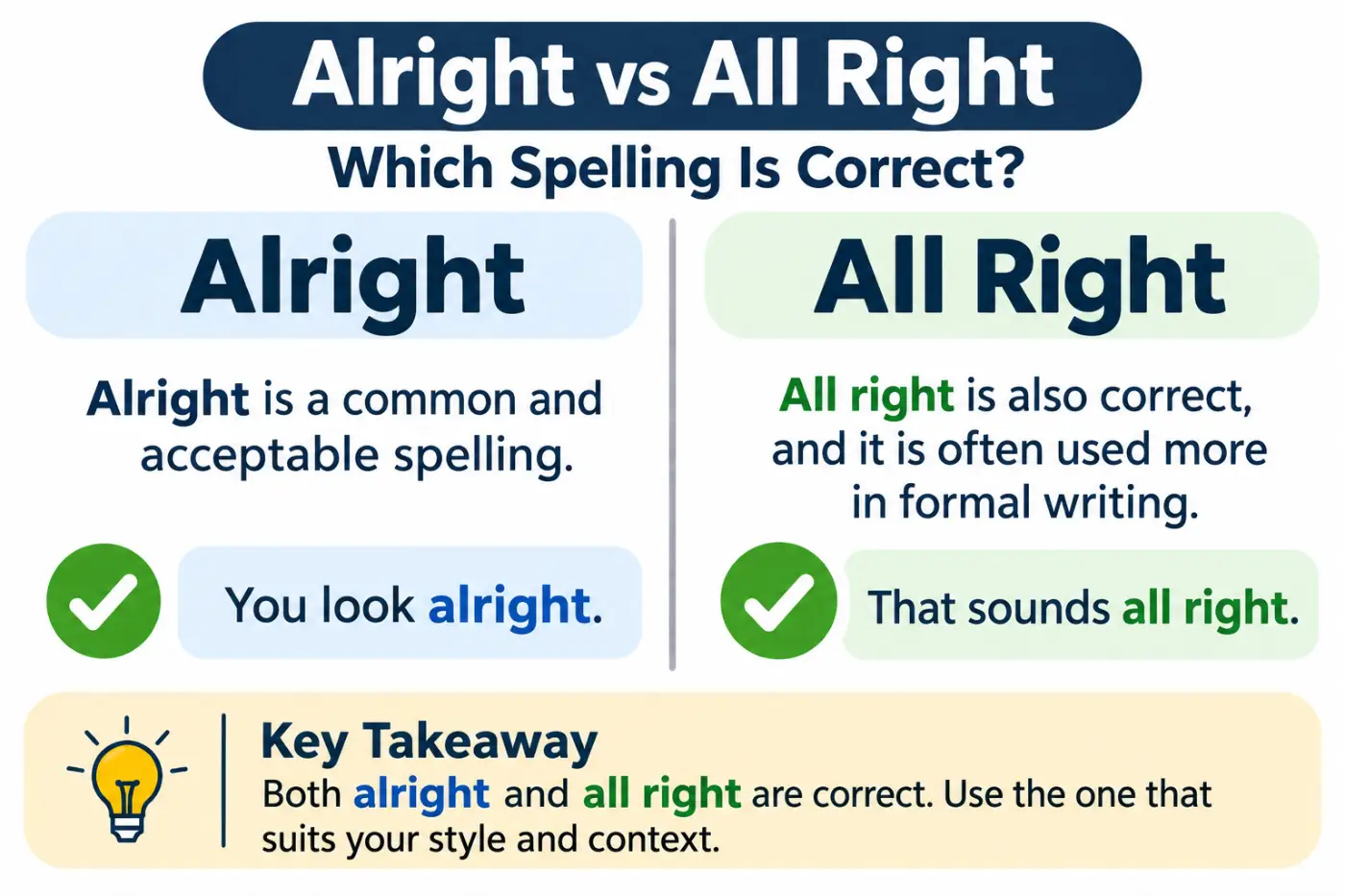
If you’ve ever wondered about alright vs all right, you’re not alone. Both forms appear in everyday English, and they sound exactly the same when spoken. However, their spelling, history, and acceptance in formal writing are not quite the same. The good news is that both are recognized forms, but they aren’t always treated equally.
All right is the traditional and widely accepted standard form. It can mean satisfactory, correct, safe, or in good health. Alright is also an established spelling, mainly used in informal writing, where it carries much the same meaning. However, some editors and style guides still prefer the two word version, especially in academic and professional documents.
The confusion often comes from English spelling patterns. People naturally combine familiar expressions into single words, particularly when they are used frequently in conversation. Understanding the difference will help you choose the right form for emails, school assignments, articles, text messages, and other types of writing.
Need another quick comparison? Read labour or labor Which Spelling Is Correct in 2026.
Quick Answer
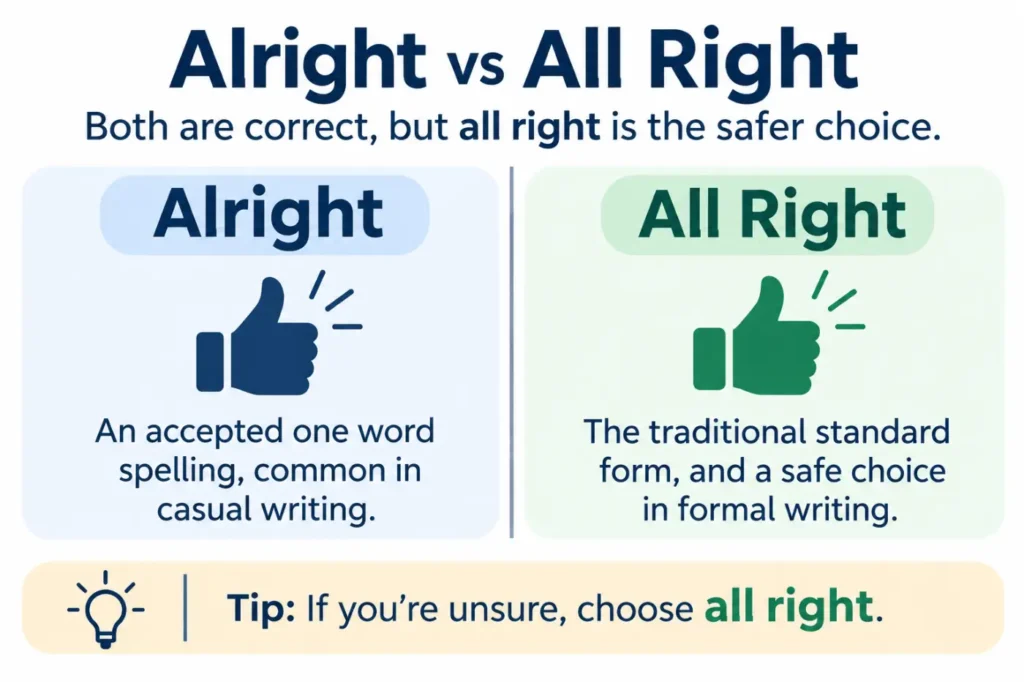
Both alright and all right are recognized English spellings. However, all right is the traditional standard form and the safer choice in formal writing. Alright is an accepted one word alternative, particularly in casual communication. If you’re unsure which to use, choose all right because it is widely accepted across different writing styles.
Comparison Table: Alright and All Right
| Feature | All Right | Alright |
|---|---|---|
| Spelling | Two words | One word |
| Meaning | Satisfactory, correct, safe, or well | Generally the same |
| Part of speech | Adjective, adverb, and conversational expression | Mainly adjective and adverb |
| Grammar status | Traditional standard form | Accepted alternative |
| Formality | Suitable for formal and informal writing | More common in informal writing |
| Pronunciation | /ɔːl ˈraɪt/ | /ɔːl ˈraɪt/ |
| Common contexts | Academic writing, business, conversation | Text messages, dialogue, casual writing |
| Editorial preference | Preferred by many editors | Sometimes avoided by style guides |
| Example | Everything is all right. | Everything is alright. |
The main difference is not pronunciation or basic meaning. It is the spelling convention and the level of formality associated with each form.
Meaning and Definition
Understanding both expressions starts with their meaning. Although they look different on the page, they usually communicate the same idea.
Meaning of All Right
All right is a standard English expression that means satisfactory, acceptable, correct, safe, or in good condition. It can also describe someone’s physical or emotional state.
It functions as an adjective, an adverb, or part of a conversational expression, depending on how you use it.
Here are some examples:
- Your homework looks all right.
- Is your little brother all right?
- The movie was all right, but the ending was disappointing.
- Everything will be all right after some rest.
- You did all right on your first driving test.
The expression can also indicate agreement or permission.
For example:
- All right, I’ll meet you at six.
- All right, you can borrow my laptop.
- All right, let’s begin the lesson.
In these sentences, it works as a conversational response that shows acceptance, agreement, or readiness.
Meaning of Alright
Alright is a one word spelling with essentially the same meaning as its two word counterpart. It is commonly used to describe something satisfactory or to indicate that a person is doing well.
For example:
- The food was alright.
- I’m feeling alright today.
- Everything is alright now.
- Your presentation looks alright.
- Alright, let’s get started.
The one word form developed through a common English spelling process called word formation. Frequently used expressions sometimes become combined into a single written word over time.
Although this spelling is recognized in modern English, it remains less widely accepted in some formal editorial settings.
Is Alright a Real Word?
Yes. Alright is a real English word, not simply a typing mistake or an accidental spelling combination. It appears in modern dictionaries and is used by many English speakers.
However, recognition does not mean every editor accepts it in every situation. Some traditional style guides continue to recommend the two word spelling. This is why you may see the one word version in novels, online articles, advertisements, and informal messages but not in certain academic publications.
Key Differences Explained
The two forms share a meaning, but several practical differences help determine which one belongs in your sentence.
1. Spelling Difference
The most obvious difference is the number of words.
- All right: Written as two separate words.
- Alright: Written as one combined word.
The two word version follows the traditional spelling convention. The single word version represents a later development in English.
Neither spelling changes the way the expression sounds.
2. Meaning and Usage
Both forms can describe something satisfactory or acceptable.
For example:
- Your answer is all right.
- Your answer is alright.
Both sentences communicate that the answer is acceptable.
The same applies when describing a person’s condition:
- My mother is all right.
- My mother is alright.
The meaning remains the same. Your choice mainly depends on the writing style you want to follow.
3. Grammar and Part of Speech
Both expressions can function in similar grammatical roles.
As an adjective:
- The weather is all right.
- The weather is alright.
The two word version has a longer history in standard written English, so it is often the preferred choice in carefully edited work.
4. Pronunciation
There is no meaningful pronunciation difference between the two spellings.
Both are pronounced as one spoken expression. The first part sounds like the word all, while the second part sounds like right.
This similarity is one reason writers sometimes struggle to decide how to spell the expression.
5. Formality
Formality is one of the most useful factors when choosing between the two forms.
All right works well in:
- Academic essays.
- Business reports.
- Professional emails.
- Newspaper articles.
- Formal letters.
- Edited books and publications.
Alright is more commonly associated with:
- Text messages.
- Social media posts.
- Informal emails.
- Casual conversations represented in writing.
- Dialogue in fiction.
- Personal blogs.
This does not make the single word spelling automatically incorrect in formal writing. It simply means that some editors prefer the traditional form.
6. Regional Usage
The distinction is not based on American versus British spelling. Both forms are found in different varieties of English.
However, individual publishers and editorial standards may make different choices.
7. Standard vs. Informal Usage
The two word spelling is the safest general recommendation because it has broad acceptance in edited English.
The one word spelling is established and widely understood, but its acceptance varies by context and editorial preference.
If your goal is consistency and traditional correctness, use the two word form.
Which Form Is Correct?
Both spellings are correct in modern English, but they do not have exactly the same editorial standing.
All right is the preferred standard spelling, particularly in formal and academic writing. Alright is an accepted alternative, but some traditional editors and style guides discourage its use.
The reason comes down to the history of the expression and established writing conventions.
The two word spelling has been used for much longer. The combined form developed later as English speakers increasingly joined familiar expressions into single words.
This pattern can also be seen in other English expressions:
- Already.
- Always.
- Altogether.
- Although.
However, these examples do not mean that every expression can be combined freely. English spelling conventions develop over time, and each word has its own history.
For practical writing, follow these guidelines:
- Use all right in school assignments and academic essays.
- Prefer all right in professional documents unless your organization follows another style.
- Use alright in casual messages if it matches your preferred writing style.
- Follow the publication’s style guide when editing articles or books.
- Avoid switching between the two spellings randomly within the same document.
10 Natural Example Sentences
The following examples show how the traditional spelling works in different everyday situations.
- Everyday conversation: Are you all right after falling off your bicycle?
- Text message: Don’t worry about me; everything is all right.
- Workplace communication: The manager confirmed that the final report was all right.
- School: My teacher said that my answers were all right.
- Academic writing: The results suggest that the experimental procedure was all right for the initial test.
- Family conversation: Your grandmother will be all right after getting some rest.
- Social situation: It’s all right if you arrive a little late.
- Travel: The hotel room was all right, but the service could have been better.
- Professional email: All right, I will review the updated document this afternoon.
- Storytelling: He looked at his daughter and asked quietly, “Are you all right?”
These examples demonstrate how the expression can describe a condition, evaluate quality, provide reassurance, or show agreement.
Common Mistakes and Misspellings
Writers sometimes confuse these spellings with other expressions or use them in situations where a different phrase would communicate the meaning more clearly.
Here are five common mistakes to watch for.
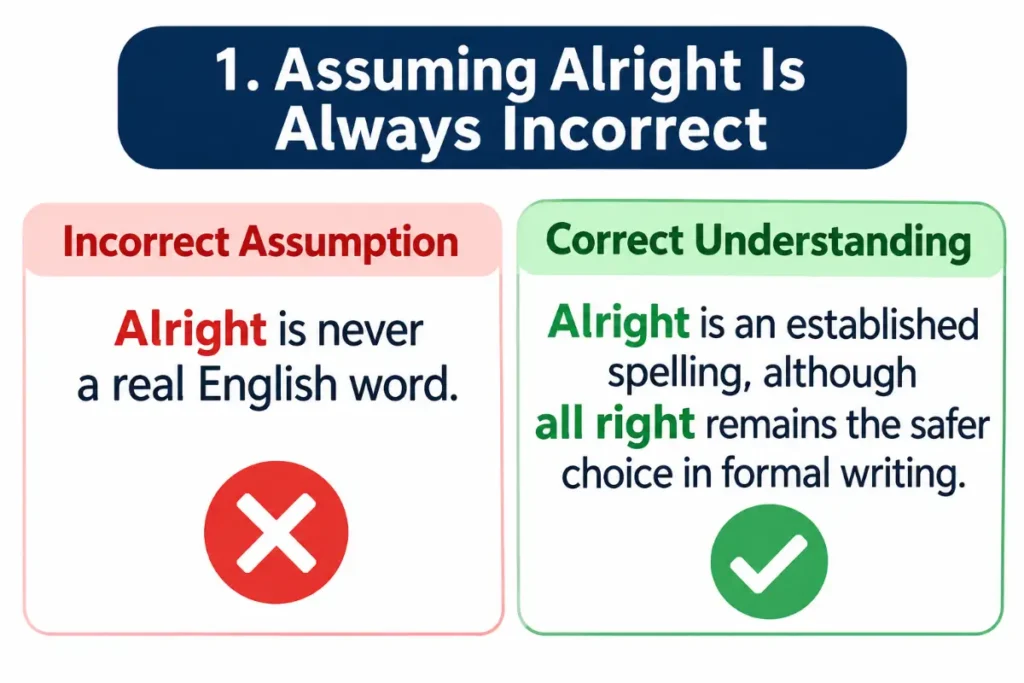
1. Assuming Alright Is Always Incorrect
Incorrect assumption: Alright is never a real English word.
Correct understanding: Alright is an established spelling, although all right remains the safer choice in formal writing.
Some people learn the traditional spelling first and assume that the combined version must be a mistake. That is not accurate.
2. Assuming Both Forms Are Always Equally Preferred
Incorrect assumption: Both forms are equally suitable for every type of writing.
Better approach: Consider the audience and writing style.
For example:
- Academic paper: The results are all right.
- Casual message: Everything is alright.
Both sentences are understandable, but the first follows the more traditional editorial convention.
3. Writing Allright
Incorrect: Everything will be allright.
Correct: Everything will be all right.
The spelling allright is generally considered nonstandard. It combines the expression without following the accepted one word spelling.
Remember that the traditional form uses a space, while the recognized alternative is written as alright.
4. Using All Right When You Mean All the Rights
Incorrect: All right to the property belong to the owner.
Correct: All rights to the property belong to the owner.
The word rights refers to legal or moral entitlements. It is different from the expression all right, which can mean satisfactory or acceptable.
This is a spelling mistake that changes the meaning of the sentence.
5. Confusing All Right With Already
Incorrect: I am all ready finished with my homework.
Correct: I am already finished with my homework.
Already means something has happened before the present time or an expected time. All right has a different meaning and cannot replace it.
A related distinction is the difference between all ready and already. All ready means completely prepared, while already refers to time.
You may also want to read Me Either Vs Me Neither Examples and Meanings 2026.
Pronunciation Guide
Both spellings have the same pronunciation in standard American English.
Pronunciation details
/ɔːl ˈraɪt/
Common American English IPA representation
| Feature | Explanation |
|---|---|
| Syllables | Two |
| Breakdown | All + right |
| Easy pronunciation | Awl RYTE |
| Stress | Second syllable |
| Sound | Identical for both spellings |
Syllable Breakdown
The expression contains two syllables:
- All: Sounds like the word call without the initial c.
- Right: Sounds like the word write.
The second syllable receives the stronger stress.
Common Pronunciation Mistakes
Some English learners pronounce the two parts as separate words with a noticeable pause. In natural speech, they usually flow together smoothly.
Another mistake is changing the pronunciation of the expression based on its spelling. Remember that combining the letters does not change the spoken sound.
Etymology and Word Origin
The history of these spellings helps explain why one is more widely preferred in traditional writing.
Origin of All Right
The expression all right developed from two familiar English words: all and right.
The word all comes from Old English eall, which referred to the whole amount or everything. The word right comes from Old English riht, which carried meanings connected to correctness, justice, and proper conduct.
When used together, the expression developed meanings such as completely correct, satisfactory, or in good condition.
Over time, it became a common expression in spoken and written English.
Origin of Alright
The spelling alright developed later through the process of combining two words into one.
English has many examples of this type of spelling development. Frequent use can cause a phrase to become a single written unit, particularly when speakers treat it as one familiar expression.
However, the development of a combined spelling does not always mean that traditional editors immediately accept it.
The one word form gained wider use during the development of modern English, but it continued to face criticism from some writers and editors.
This historical background explains why both forms exist today and why the two word version remains the safer editorial choice.
Regional Usage
There is no major difference in meaning between the two spellings across the main English speaking regions. The choice is mostly influenced by editorial standards and writing context.
American English
In American English, all right is the traditional standard form.
It is widely suitable for school assignments, professional communication, news writing, and everyday conversation.
Alright is also common in informal American writing, including dialogue, messages, and online communication.
If you are writing for a US academic or professional audience, the two word form is generally the better choice.
British English
British English also recognizes both spellings.
The traditional form all right remains widely accepted in formal writing. The combined version appears in informal communication and some published works.
There is no special British pronunciation that separates the two.
Australian English
Australian English generally follows the same distinction.
Both forms can be understood, but all right is the more traditional choice for formal and carefully edited documents.
In casual communication, the single word version is also used.
Canadian English
Canadian English follows the same general spelling convention.
All right is a safe choice for professional and academic writing, while alright is common in less formal contexts.
There is no significant difference in meaning based on Canadian usage.
Grammar Rules and Part of Speech
Understanding how the expression functions in a sentence makes it easier to use it correctly.
1. Using All Right as an Adjective
An adjective describes a noun or provides information about a subject.
The expression can describe someone or something as satisfactory, safe, or in good condition.
Examples:
- Your new shoes look all right.
- Is your father all right?
- The room was all right for a short stay.
In these sentences, the expression describes the condition or quality of the subject.
2. Using All Right as an Adverb
An adverb can describe how an action is performed.
For example:
- She did all right in the interview.
- The team played all right despite the difficult conditions.
- I hope you slept all right last night.
Here, the expression describes the result or manner of an action.
3. Using All Right to Show Agreement
The expression can also appear at the beginning of a sentence to show agreement, acceptance, or readiness.
Examples:
- All right, I’ll call you tomorrow.
- All right, let’s move to the next question.
- All right, you can have another chance.
In these cases, it works as an interjection or conversational response.
4. Sentence Position
The expression can appear in different parts of a sentence.
At the beginning:
All right, we can start the meeting now.
In the middle:
I think your suggestion is all right.
At the end:
Don’t worry, everything is all right.
Its position depends on the role it plays in the sentence.
5. Punctuation Rules
Punctuation depends on how the expression is used.
When it introduces a statement as a conversational response, a comma often follows it.
Example:
All right, I’ll send the files this evening.
When it appears as part of the main sentence, no special punctuation is needed.
Example:
Your explanation is all right.
A question mark is appropriate when the expression appears in a question.
Example:
Are you all right?
6. Formal and Informal Grammar
The grammatical function is broadly similar for both spellings. The main difference is editorial preference.
In formal writing, use the traditional two word form unless your required style guide specifically permits the alternative.
In casual writing, either spelling can work, provided you use it consistently.
Real Life Usage Examples
The following situations demonstrate how the expression appears naturally in different types of communication.
Daily Conversation
In everyday speech, people commonly use the expression to ask about someone’s condition or reassure another person.
- Are you all right, or do you need some help?
- It’s all right. You don’t have to apologize.
These examples show its use in questions and reassuring statements.
Email and Workplace Communication
Professional communication often requires a clear and polite tone. The traditional spelling works well in business emails and workplace discussions.
- All right, I’ll update the presentation before the meeting.
- The proposed schedule looks all right to me.
The expression can show agreement without making the message sound overly formal.
Academic Writing
In academic writing, the expression may describe an acceptable result or condition. However, more precise words are often better for technical explanations.
- The initial results were all right, although further testing was required.
- The experimental conditions were all right for the preliminary assessment.
In a formal research paper, words such as acceptable, satisfactory, or adequate may communicate the intended meaning more precisely.
News and Journalism
Journalists may use the expression in quotations, interviews, and reported conversations.
- The witness said that everyone in the building was all right.
- “All right, we have enough information to continue,” the spokesperson said.
The two word spelling is a reliable editorial choice in published news content.
Literature and Storytelling
In fiction, the expression can communicate emotion, reassurance, hesitation, or agreement.
- “Are you all right?” Sarah asked as she helped him stand.
- All right, he thought, perhaps tomorrow would bring better news.
Writers may choose the one word spelling in dialogue to reflect their preferred style, but the traditional form works equally well.
Related and Confused Terms
Several English expressions look or sound similar but have different meanings. Understanding them can prevent spelling and grammar mistakes.
1. All Ready
All ready means completely prepared.
Example: We are all ready to leave for the airport.
The word all emphasizes that everyone or everything is prepared.
2. Already
Already is an adverb that refers to something that has happened before a particular time.
Example: She has already completed her assignment.
It is not interchangeable with all right.
3. All Right
This expression means satisfactory, acceptable, correct, or safe.
Example: Everything is all right now.
It is the traditional spelling discussed throughout this article.
4. Alright
This is the accepted one word alternative to all right.
Example: The food was alright.
It has nearly the same meaning but may be less suitable for some formal writing styles.
5. All Rights
All rights refers to every entitlement, permission, or legal claim.
Example: The author owns all rights to the book.
The final word contains an s because it refers to rights rather than the adjective right.
6. Okay
Okay means acceptable, satisfactory, or agreed.
Example: Your plan sounds okay to me.
It is a useful alternative in everyday communication.
7. Fine
Fine can mean satisfactory, healthy, or acceptable.
Example: I’m fine, thanks for asking.
It often replaces the expression when describing someone’s condition.
8. Acceptable
Acceptable means good enough to meet a particular standard or requirement.
Example: Your final assignment is acceptable.
It is more precise than all right in many formal and academic situations.
Expert Editor Insight
An experienced English editor usually treats all right as the safest choice because it follows the traditional spelling convention and is accepted across formal writing styles. The confusion exists because the two forms sound identical and communicate nearly the same meaning. Spelling and grammar tools may accept both, so an automatic correction does not always reflect a publication’s style requirements. My practical advice is to check the context first. If you’re writing an academic paper, business report, or professional article, use all right. If you’re writing casual dialogue or a personal message, alright can work naturally. Consistency matters more than switching between the forms without a reason.
A related grammar guide is Offered Vs Offerred Meaning Usage And Correct Form.
Conclusion
The choice between alright vs all right comes down to spelling conventions and writing style. Both forms are recognized in modern English, and they generally have the same meaning. However, all right remains the traditional standard spelling and the safest option for academic, professional, and formal communication. Alright works well in casual writing, informal messages, and some types of published content.
The easiest way to remember the distinction is to use all right whenever you want the most widely accepted form. If you’re editing an important document, follow its style guide and keep your spelling consistent throughout.
FAQs
Is Alright a Real Word?
Yes, alright is a recognized English word. It is a one word alternative to the traditional expression all right. Both generally communicate the same meaning, including satisfactory, acceptable, or safe. However, some editors and style guides still prefer the two word spelling, particularly in academic, professional, and formal writing.
Which Is Correct: Alright or All Right?
Both spellings are accepted in modern English, but all right is the traditional standard form. Alright is a recognized alternative that appears frequently in informal writing. If you are unsure which spelling to choose, use all right. It is widely accepted and is unlikely to conflict with a formal editorial style.
What Does All Right Mean?
All right means satisfactory, acceptable, correct, or in good condition. It can describe a person’s health, the quality of something, or an acceptable situation. It can also express agreement or readiness. For example, saying “I’m all right” means you are fine, while “All right, let’s go” shows agreement.
Can Alright Be Used in Formal Writing?
Although alright is a recognized spelling, it is not the preferred choice in every formal setting. Some academic institutions, publishers, and professional editors recommend all right instead. Before using the single word version in a formal document, check the required style guide. The traditional spelling is the safer option when no specific guidance is available.
How Do You Pronounce Alright?
Alright is pronounced /ɔːl ˈraɪt/ in standard American English. It has two syllables, with the stronger stress on the second part. The pronunciation is the same as all right. You can remember it by saying all followed by right, with both parts flowing naturally together.
Can All Right Start a Sentence?
Yes, all right can begin a sentence. It is often used to show agreement, acceptance, or readiness. For example, “All right, let’s begin the meeting” is a natural sentence. A comma usually follows the expression when it introduces the main statement as a conversational response.
What Is a Synonym for All Right?
Several words can replace all right, depending on the intended meaning. Okay, fine, acceptable, satisfactory, and adequate are useful alternatives. For example, “Your work is all right” could become “Your work is satisfactory.” However, these words are not always interchangeable, so consider the sentence before choosing a replacement.
Why Do People Confuse Alright and All Right?
People confuse these forms because they sound exactly alike and have nearly identical meanings. English also contains many expressions that have developed into single words over time. This makes the combined spelling seem natural. However, traditional editorial conventions still favor the two word form, especially in formal and academic writing.