
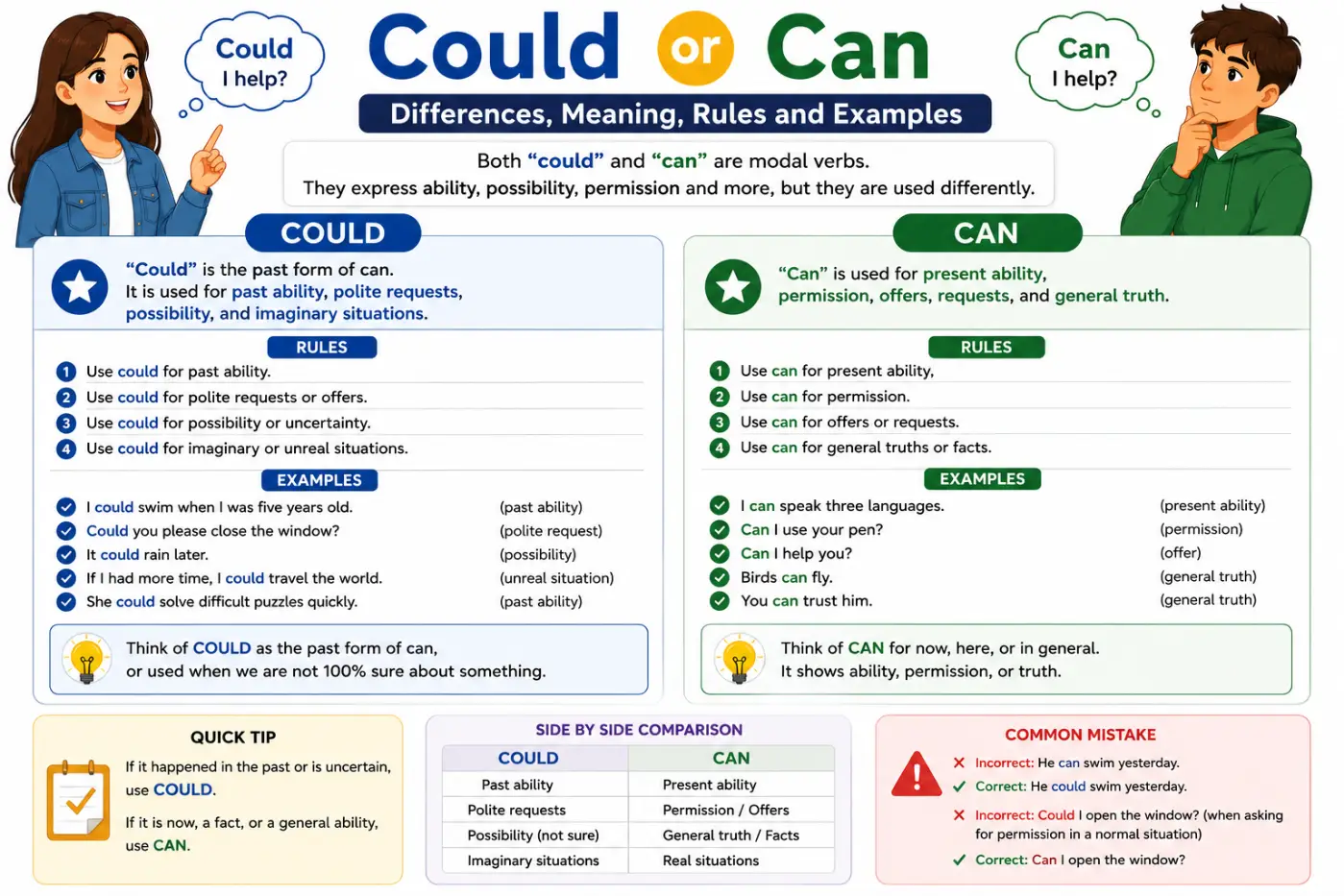
Choosing between “could” and “can” can be confusing, especially when both words seem to fit the same sentence. For example, should you say, “Can you help me?” or “Could you help me?” Both sentences are grammatically correct, but they do not create exactly the same impression. One is more direct, while the other usually sounds more polite.
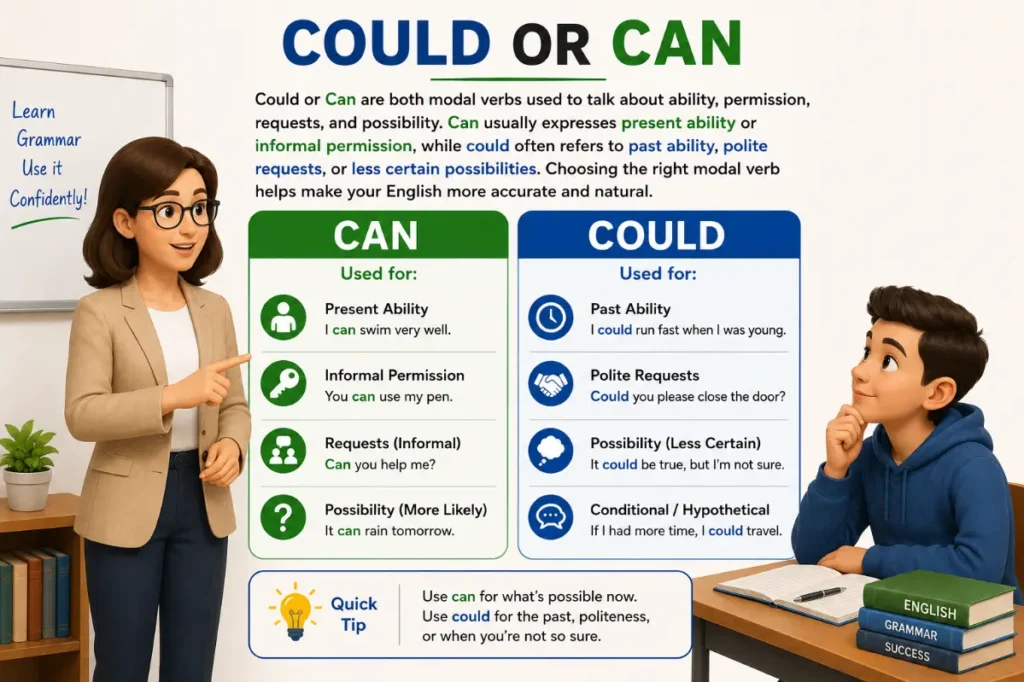
The main difference is that “can” generally expresses present ability, permission, or possibility, while “could” often expresses past ability, a possible situation, or a polite request. However, English grammar allows some overlap, so the correct choice depends on what you want to communicate.
Understanding these two modal verbs will help you speak more naturally, write clearer sentences, and avoid common grammar mistakes. Below, you will find simple rules, practical examples, pronunciation guidance, and everyday situations that explain when each word works best.
You may also want to read World Class vs World-Class Which Form Is Correct.
Quick Answer
“Can” expresses present ability, permission, or possibility. “Could” is commonly used for past ability, hypothetical situations, uncertain possibilities, and polite requests. Both are correct English words, but they serve different purposes. Choose the one that matches your intended meaning, time frame, and level of politeness.
Quick Answer: Can vs. Could
If you are asking someone to do something, both forms are acceptable:
- Can you open the window? (Direct and natural.)
- Could you open the window? (More polite and slightly softer.)
If you are talking about a present ability, use “can”:
- I can swim.
And If you are describing an ability in the past, use “could”:
- I could swim when I was five.
If you are imagining a possible situation, use “could”:
- We could travel abroad next year.
The easiest rule to remember is that “can” usually relates to present ability, while “could” often relates to past ability, possibility, or polite communication.
Comparison Table: Can vs. Could
| Feature | Can | Could |
|---|---|---|
| Part of speech | Modal auxiliary verb | Modal auxiliary verb |
| Main meaning | Ability, permission, possibility | Past ability, possibility, polite request |
| Time reference | Usually present or future possibility | Past, present, or future possibility |
| Ability | Present ability | Past ability or conditional ability |
| Permission | Direct permission or request | More polite permission request |
| Possibility | General or realistic possibility | Potential or less certain possibility |
| Politeness | Direct and conversational | Often softer and more polite |
| Formality | Common in everyday and formal English | Common in everyday and formal English |
| Pronunciation | /kæn/ or /kən/ | /kʊd/ |
| Example | She can drive. | She could drive at sixteen. |
The table shows that these words are closely related but not interchangeable in every situation. Their meaning changes according to the sentence and the speaker’s intention.
Meaning and Definition
What Does Can Mean?
“Can” is a modal auxiliary verb used to express ability, permission, possibility, and sometimes a general fact. It commonly refers to something a person is able to do now or something that is possible under current conditions.
For example:
- I can speak Spanish.
- Can I use your phone?
- It can get very cold here in winter.
- You can find the answer in the textbook.
In these sentences, the word communicates an ability, asks for permission, describes a general possibility, or gives someone an option.
It is one of the most frequently used modal verbs in everyday English. People use it in conversations, emails, instructions, questions, and informal writing.
What Does Could Mean?
“Could” is the past form of “can,” but its meaning is not limited to the past. It can describe a previous ability, a hypothetical situation, an uncertain possibility, or a polite request.
For example:
- I could run much faster when I was younger.
- We could visit the museum tomorrow.
- Could you explain this question?
- It could rain later today.
Notice that the last three examples refer to the present or future rather than the past. This is why understanding context is more useful than simply memorizing that one word is present tense and the other is past tense.
“Could” is also used in conditional sentences:
- If I had more time, I could learn another language.
Here, it describes an ability or opportunity that depends on an imagined condition.
Key Differences Explained
1. Present Ability vs. Past Ability
One of the clearest differences involves the time of an action.
Use “can” when someone has an ability in the present:
- My brother can play the guitar.
- I can solve this problem.
- She can drive a car.
Use “could” when describing a general ability someone had in the past:
- My brother could play the guitar when he was young.
- I could solve difficult puzzles as a child.
- She could drive before moving abroad.
However, there is an important grammar detail. “Could” commonly describes general past ability, not necessarily one successful action on a particular occasion.
For a specific successful action in the past, English often uses “was able to” or “managed to.”
For example:
- I was able to finish the exam before the deadline.
- She managed to unlock the door.
This distinction helps prevent awkward sentences in more advanced writing.
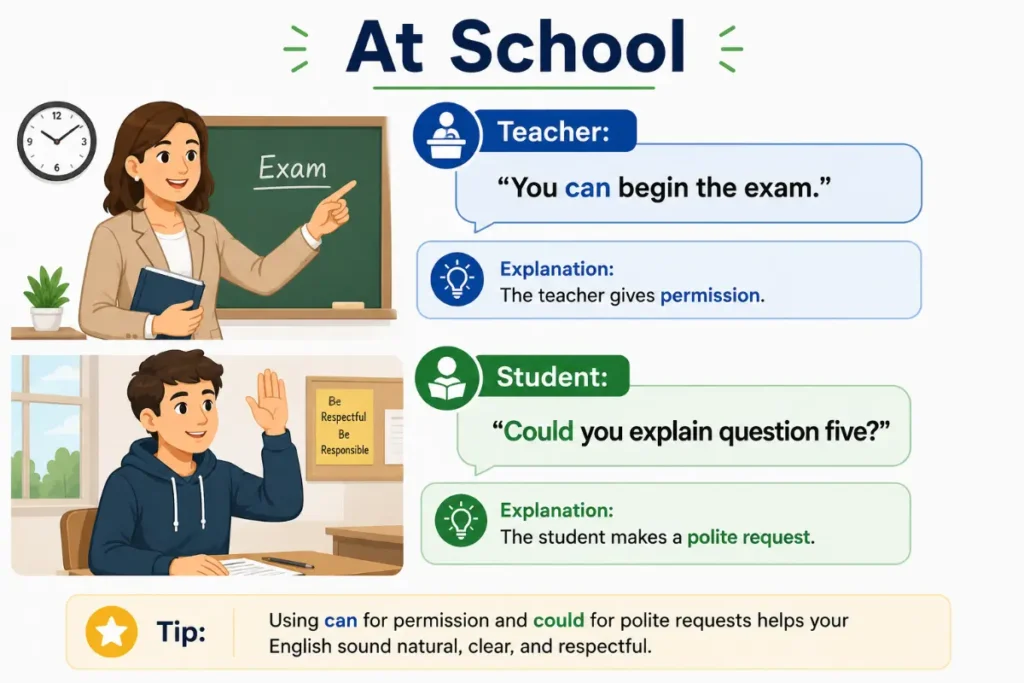
2. Permission and Requests
Both forms can ask for permission, but they create different tones.
“Can” is direct and natural:
- Can I sit here?
- Can we leave early?
- Can I borrow your pen?
“Could” is generally more polite:
- Could I sit here?
- Could we leave a little early?
- Could I borrow your pen?
The second form sounds softer because it presents the request less directly. It is especially useful when speaking to strangers, customers, teachers, managers, or people you do not know well.
Remember that politeness does not automatically make a sentence grammatically better. The right choice depends on the relationship and situation.
3. Possibility and Uncertainty
Both modal verbs can express possibility, but they often communicate different levels or types of possibility.
Use “can” for general possibilities:
- Driving at night can be dangerous.
- Anyone can make a mistake.
- Winter weather can change quickly.
Use “could” when discussing a potential outcome or an uncertain situation:
- The weather could improve tomorrow.
- We could miss the train if we leave late.
- This decision could affect the entire project.
“Could” often sounds more tentative because it presents an outcome as possible rather than stating a general fact.
However, it does not always mean that something is less likely. The actual degree of certainty depends on the context.
4. Hypothetical Situations
“Could” is especially useful when imagining situations that are not necessarily real.
Examples:
- I could buy a new car if I saved enough money.
- We could move to another city if necessary.
- She could become a successful writer with more practice.
These sentences describe possible actions or outcomes that depend on certain conditions.
Although “can” can also appear in conditional sentences, it generally describes a real ability or available possibility:
- If you finish your work early, you can join us.
Compare that with:
- If I had more free time, I could join you.
The first sentence describes a realistic opportunity. The second describes an imagined or less certain situation.
5. Politeness and Formality
“Could” is often preferred when you want to sound respectful, especially when making requests.
Compare:
- Can you send me the report?
- Could you send me the report?
Both are correct. The second is usually softer and may sound more considerate in workplace communication.
However, both forms are acceptable in professional writing. You do not need to avoid “can” in formal situations. For example, “Employees can access the building using their ID cards” is perfectly appropriate.
The important distinction is between the purpose of the sentence and its tone, not simply whether the situation is formal or informal.
6. Negative Forms
The negative forms are “cannot” or “can’t” and “could not” or “couldn’t.”
Examples:
- I cannot attend the meeting today.
- She can’t swim.
- We could not find the address.
- He couldn’t understand the instructions.
“Cannot” is commonly used in formal writing, while “can’t” is more conversational. “Could not” is also suitable for formal writing, and “couldn’t” is common in everyday communication.
The meaning depends on context. “Cannot” usually describes present inability or lack of permission, while “could not” can describe past inability or a situation that is not possible.
Which Form Is Correct?
Both words are correct. Neither is a spelling mistake or an incorrect version of the other.
The correct choice depends on the message you want to express:
- Use “can” for present ability: I can cook.
- Use “could” for past ability: I could cook when I was younger.
- Use “can” for direct permission: Can I leave now?
- Use “could” for a polite request: Could I leave a little earlier?
- Use “could” for hypothetical situations: We could move if we wanted to.
- Use “can” for general possibilities: Exercise can improve your fitness.
A useful grammar principle is that both words are modal auxiliary verbs. They help the main verb express ability, possibility, permission, or other meanings.
They also follow a special grammatical pattern: a modal verb is normally followed by the base form of another verb.
For example:
- She can dance.
- She could dance.
Not:
- She can dances.
- She could to dance.
This rule is consistent in standard English.
Sentence Examples
Here are ten natural sentences that demonstrate the different uses of these modal verbs.
- I can finish this assignment before dinner.
- Could you please close the door?
- My grandfather could speak four languages when he was young.
- You can use my laptop if you need it.
- We could visit the beach this weekend if the weather is nice.
- Can you help me carry these shopping bags?
- This new software could make our work much easier.
- Students can submit their projects online.
- I couldn’t understand the question during the exam.
- If we leave early, we can avoid the morning traffic.
These examples cover ability, permission, requests, possibility, past experience, and conditional situations. Reading them aloud can help you recognize how each form works in everyday English.
Common Mistakes and How to Avoid Them
Even fluent English speakers sometimes confuse these words, especially when writing quickly. Here are five common mistakes and the correct alternatives.
1. Using Could for Every Present Ability
Incorrect: I could speak English fluently now.
Correct: I can speak English fluently now.
Why: The sentence describes a current ability. The present modal is the natural choice. However, “could” may be correct if the speaker is describing a hypothetical ability or making a more tentative statement.
2. Using Can for a Past Ability
Incorrect: When I was a child, I can swim very well.
Correct: When I was a child, I could swim very well.
Why: The sentence refers to a general ability in the past. The past-form modal is needed to match the time reference.
3. Adding To After a Modal Verb
Incorrect: She could to finish the project today.
Correct: She could finish the project today.
Why: Modal auxiliary verbs are followed directly by the base form of the main verb. Do not insert “to” between them.
An exception occurs in expressions such as “be able to,” which is a different grammatical construction.
4. Adding an -S Ending to the Main Verb
Incorrect: He can speaks French.
Correct: He can speak French.
Why: The main verb stays in its base form after a modal auxiliary, even when the subject is he, she, or it.
The same rule applies to the other form:
- Incorrect: She could drives.
- Correct: She could drive.
5. Confusing Politeness With Grammar
Incorrect assumption: Can you help me? is grammatically wrong because it is not as polite as could you help me?
Correct understanding: Both sentences are grammatically correct.
Why: The difference is mainly tone. One is more direct, while the other usually sounds more polite. Choose according to the situation rather than treating one as universally correct.
Still confused? Compare Than vs Then: Learn the Difference and Use Each Correctly.
Pronunciation Guide
Although these two words are written with similar structures, their vowel sounds are different.
Pronunciation of Can
- IPA: /kæn/ in its strong form.
- Syllables: One syllable.
- Easy pronunciation: Kan.
- Stress: The single syllable carries the word’s stress.
In normal conversation, “can” is often pronounced /kən/ when it is unstressed.
For example:
- I can help you.
- She can drive.
In fast speech, the vowel may sound weaker than it does when the word is emphasized.
Pronunciation of Could
- IPA: /kʊd/.
- Syllables: One syllable.
- Easy pronunciation: Kud.
- Stress: The single syllable carries the word’s stress.
The vowel sounds similar to the vowel in “good” and “book” in many standard American pronunciations.
The final letter combination is not pronounced as it appears in spelling. The letter L is silent.
Common Pronunciation Mistakes
Some learners make these mistakes:
- Pronouncing the L in “could.” The standard pronunciation does not include an audible L.
- Using the vowel sound from “cat” when pronouncing “could.” The vowel should be different.
- Pronouncing every occurrence of “can” with equal emphasis. In natural speech, its vowel is often reduced when unstressed.
A helpful practice is to say “can” and “could” slowly, then place each word into a complete sentence.
Etymology and Word Origin
The two words have a shared historical connection through the development of English modal verbs.
Origin of Can
“Can” developed from Old English “cunnan,” a verb meaning to know or understand how to do something. Over time, its meaning became closely associated with knowledge, skill, and ability.
Its modern use expanded to include permission and possibility.
This historical development explains why the word is still commonly connected with what a person knows how to do or is able to accomplish.
Origin of Could
“Could” developed as the past form associated with “can.” Its spelling reflects changes that took place in the history of English.
Although it now serves as a past-form modal, its modern grammatical functions have expanded beyond past ability. It is also used for polite requests, hypothetical situations, and possible outcomes.
The connection between the two words remains clear in modern English, even though their uses are not limited to present and past time.
Regional Usage
There is no major difference in the basic meaning or standard spelling of these words across major English varieties.
American English
In American English, both forms are standard and widely used.
“Can” is common in everyday requests, conversations, and descriptions of ability. “Could” is often preferred for softer requests and hypothetical situations.
Examples:
- Can you pick me up after work?
- Could we reschedule the meeting?
Both sound natural to American English speakers.
British English
British English follows essentially the same grammar rules.
Speakers use “can” for present ability and permission and “could” for past ability, polite requests, and hypothetical situations.
For example:
- I can drive.
- I could drive when I was seventeen.
There is no meaningful regional spelling difference between the two forms.
Australian English
Australian English also uses both modal verbs in the same general way.
Everyday expressions may vary according to conversational style, but the basic grammar remains consistent with standard English.
For example:
- Can you give me a hand?
- Could you help me with this?
Canadian English
Canadian English follows the same standard grammatical patterns.
Both forms are used in everyday communication, workplace writing, education, and formal situations. There is no special Canadian spelling rule that changes their use.
Overall, the difference is grammatical and contextual rather than regional.
Grammar Rules and Part of Speech
Both words belong to a special group of verbs called modal auxiliary verbs.
Modal verbs work with main verbs to express meanings such as ability, permission, possibility, necessity, and advice.
1. Use the Base Form of the Main Verb
After either modal, use the base form of the main verb.
Correct:
- She can sing.
- They could travel.
- He can swim.
- We could wait.
Incorrect:
- She can sings.
- They could to travel.
- He can swimming.
This rule applies regardless of the subject.
2. Do Not Add -S for Third-Person Subjects
Unlike ordinary verbs, modal verbs do not change their form for different subjects.
Correct:
- I can work.
- She can work.
- They can work.
The same pattern applies to the past-form modal:
- I could work.
- He could work.
- We could work.
3. Form Questions by Changing Word Order
To make a question, place the modal verb before the subject.
Examples:
- Can you help me?
- Could she attend the meeting?
- Can they finish today?
- Could we discuss this tomorrow?
You do not normally need an additional helping verb such as “do” or “does.”
Incorrect: Do you can swim?
Correct: Can you swim?
4. Form Negative Sentences
Place “not” after the modal verb.
Examples:
- I cannot understand the instructions.
- She cannot attend the event.
- We could not find the information.
- They couldn’t finish the assignment.
Both contracted and uncontracted forms are grammatically acceptable. Choose according to the style and tone of your writing.
5. Understand Conditional Sentences
“Could” is frequently used in conditional statements.
For example:
- If I practiced every day, I could become a better singer.
- If we had enough money, we could buy a bigger house.
It describes an ability or possibility that depends on a condition.
However, “can” can also be used in a real conditional sentence:
- If you finish your work, you can go home.
The first example describes a hypothetical situation, while the second describes a realistic opportunity.
6. Use Could Have for Past Possibilities
The structure “could have” is used when discussing something that was possible in the past.
Examples:
- You could have called me earlier.
- She could have missed the train.
- We could have won the competition.
Depending on context, this construction may express an unrealized opportunity, a possible past event, or criticism.
Do not confuse it with “could of,” which is a common spelling error caused by the pronunciation of “could’ve.”
The correct written form is “could have.”
Real-Life Usage Examples
The best way to understand modal verbs is to see how people use them in different situations.
Daily Conversation
In everyday conversation, “can” is often used to ask direct questions or describe personal abilities.
- I can meet you after lunch.
- Can you tell me where the nearest grocery store is?
“Could” often makes a request sound more considerate.
- Could you wait for a minute?
- We could order pizza instead of cooking tonight.
Email and Workplace Communication
In professional communication, both forms are useful. The choice depends on whether you are describing an ability, offering an option, or making a request.
Examples:
- You can access the updated documents through the company system.
- Can you review the attached report before Friday?
For softer requests:
- Could you share the revised schedule with the team?
- We could arrange another meeting to discuss the proposal.
These examples demonstrate that neither word is limited to informal conversation.
Academic Writing
Academic writing often uses modal verbs to discuss possibility, limitations, and potential outcomes.
Examples:
- This approach can improve the accuracy of the results.
- The findings could indicate a relationship between the two variables.
“Can” is useful for describing general capabilities or effects. “Could” is useful when discussing possible interpretations without presenting them as proven facts.
News and Journalism
News writing often uses modal verbs to communicate potential developments or general risks.
Examples:
- Heavy rainfall can cause flooding in low-lying areas.
- The proposed policy could affect thousands of small businesses.
The first statement describes a general possibility. The second presents a potential consequence of a particular proposal.
Literature and Storytelling
Writers use both forms to describe abilities, possibilities, and imagined situations.
Examples:
- The young musician could play beautiful melodies even without reading sheet music.
- Perhaps we can find a way out before sunset.
The choice affects how readers understand a character’s abilities, opportunities, and possible actions.
Related and Confused Terms
Several other English expressions are closely connected to these modal verbs. Understanding them can help you express your ideas more accurately.
1. May
“May” expresses possibility or permission.
Example:
- It may rain tomorrow.
- May I come in?
Compared with “can,” it often sounds more formal when asking for permission.
2. Might
“Might” expresses a possibility that is uncertain or tentative.
Example:
- We might visit our relatives next weekend.
It is similar to “could” in some contexts, although the exact meaning depends on the sentence.
3. Would
“Would” is commonly used for hypothetical situations, polite requests, and imagined results.
Example:
- Would you like some coffee?
- I would travel more if I had enough money.
It does not simply mean the same thing as either modal verb.
4. Should
“Should” expresses advice, expectation, or something considered appropriate.
Example:
- You should get more sleep.
Unlike the ability expressed by “can,” this word focuses on what is advisable or expected.
5. Must
“Must” expresses strong necessity, obligation, or logical deduction.
Example:
- You must wear a seat belt.
It communicates a stronger requirement than the usual use of either comparison word.
6. Be Able To
“Be able to” expresses ability and can be used in grammatical situations where a modal verb may not fit.
Examples:
- I will be able to attend tomorrow.
- She has been able to solve the problem.
It is especially useful when talking about ability in perfect tenses or after another modal.
7. Manage To
“Manage to” means successfully doing something, often despite difficulty.
Example:
- We managed to finish the project before the deadline.
It is useful when describing a specific successful action in the past.
8. Be Allowed To
“Be allowed to” expresses permission.
Examples:
- Students are allowed to use calculators.
- We were allowed to leave early.
This expression can be more precise than using a modal verb when the focus is on rules or official permission.
Expert Editor Insight
An experienced English editor looks beyond whether a sentence is grammatically correct and considers what the writer actually wants to communicate. Both forms are standard English, so the editor checks the time reference, level of certainty, and intended tone before making a change. Grammar tools may suggest one form over the other, but they cannot always understand the full context. A useful editing tip is to replace the modal temporarily with a clearer expression, such as “am able to,” “was able to,” or “might be possible.” If the sentence’s meaning changes, reconsider your original choice.
Key Takeaways
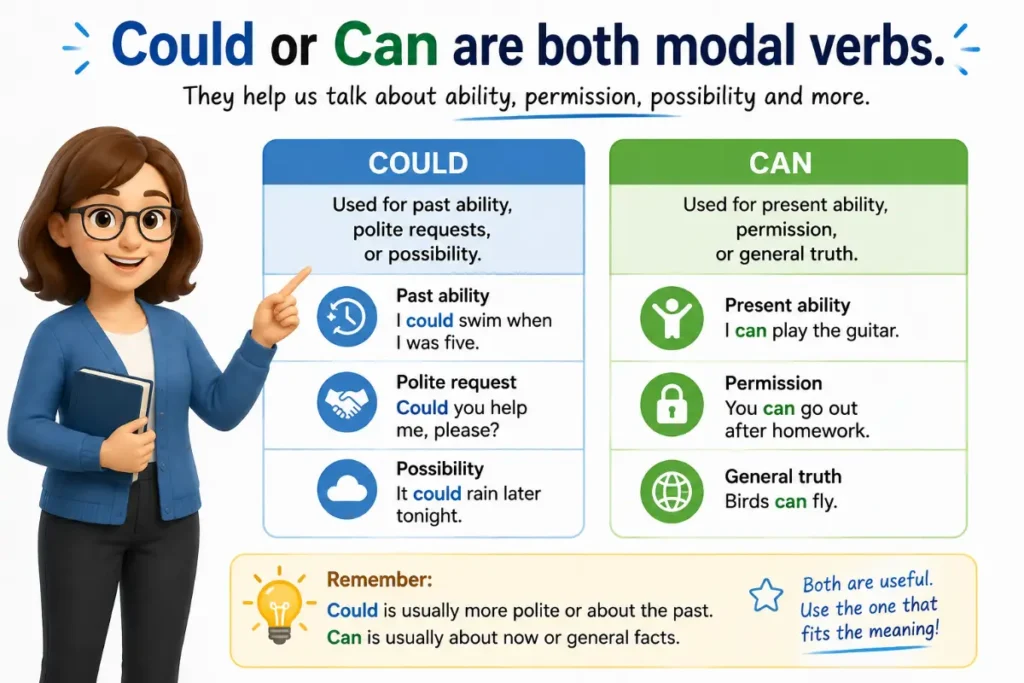
- Could or Can are both modal verbs.
- Can usually expresses present ability and informal permission.
- Could commonly expresses past ability, polite requests, suggestions, and possibility.
- Could sounds more polite than can in requests.
- Use can for abilities you have now.
- Use could for abilities you had in the past.
- Always use the base form of the main verb after both modal verbs.
- Never add to after can or could.
- Context determines the exact meaning.
Learn the difference in Piece of Mind or Peace of Mind Which Is Correct.
Conclusion
Understanding Could or Can becomes much easier when you focus on the meaning of your sentence rather than memorizing a simple present-versus-past rule. Use “can” for present ability, permission, and general possibilities. Choose “could” for past abilities, hypothetical situations, uncertain outcomes, and requests that need a softer tone.
Both forms are grammatically correct, and neither should be treated as a universal replacement for the other. A simple editing tip is to check the time, intention, and level of politeness before choosing. With regular practice, you will naturally know which form makes your message clearer and more appropriate.
FAQs
1. Which Is Correct: Can or Could?
Both words are correct English. The choice depends on the intended meaning. Use “can” for present ability, direct permission, and general possibility. Use “could” for past ability, hypothetical situations, uncertain possibilities, and polite requests. Neither is universally better, and the surrounding sentence determines which one communicates your meaning accurately.
2. Is Could Just the Past Tense of Can?
“Could” is historically and grammatically the past-form counterpart of “can,” but it has several modern uses beyond the past. It can describe hypothetical situations, present or future possibilities, and polite requests. For example, “I could swim as a child” refers to the past, while “Could you help me?” is a present request.
3. Is Could More Polite Than Can?
Generally, yes. “Could” often sounds softer and more considerate when making a request. For example, “Could you help me with this?” is usually more polite than “Can you help me with this?” However, both are grammatically correct, and the direct form is perfectly acceptable in friendly conversations and everyday communication.
4. Can You Use Could for Present Situations?
Yes. Although the word can refer to past ability, it can also describe present or future possibilities, hypothetical situations, and polite requests. For example, “We could discuss this now” refers to a possible present action. The meaning comes from the context rather than the word’s historical connection to past tense.
5. Can You Start a Sentence With Can or Could?
Yes. Both words can begin questions and certain other sentence structures. For example, “Can you explain the instructions?” and “Could we meet tomorrow?” are correct questions. In both cases, the modal verb comes before the subject. Starting a sentence with either form is completely normal in standard English.
6. What Is the Difference Between Could and Might?
Both words can express possibility, but they are not identical. “Could” can describe an available option, potential ability, or possible outcome. “Might” generally emphasizes uncertainty about whether something will happen. For example, “We could travel tomorrow” suggests an option, while “We might travel tomorrow” expresses an uncertain plan.
7. Is Could Have or Could Of Correct?
“Could have” is the correct grammatical construction. “Could of” is a common writing mistake caused by the pronunciation of the contraction “could’ve,” which sounds similar to “could of” in casual speech. Use “could have” in formal and informal writing, or “could’ve” when a contraction suits the tone.
8. Should You Use Can or Could in Formal Writing?
Both forms are appropriate in formal writing. Use “can” when discussing present abilities, general facts, or available options. Use “could” when expressing tentative conclusions, hypothetical outcomes, past abilities, or polite requests. In academic and professional writing, choose the form that accurately reflects the certainty and meaning of your statement.