

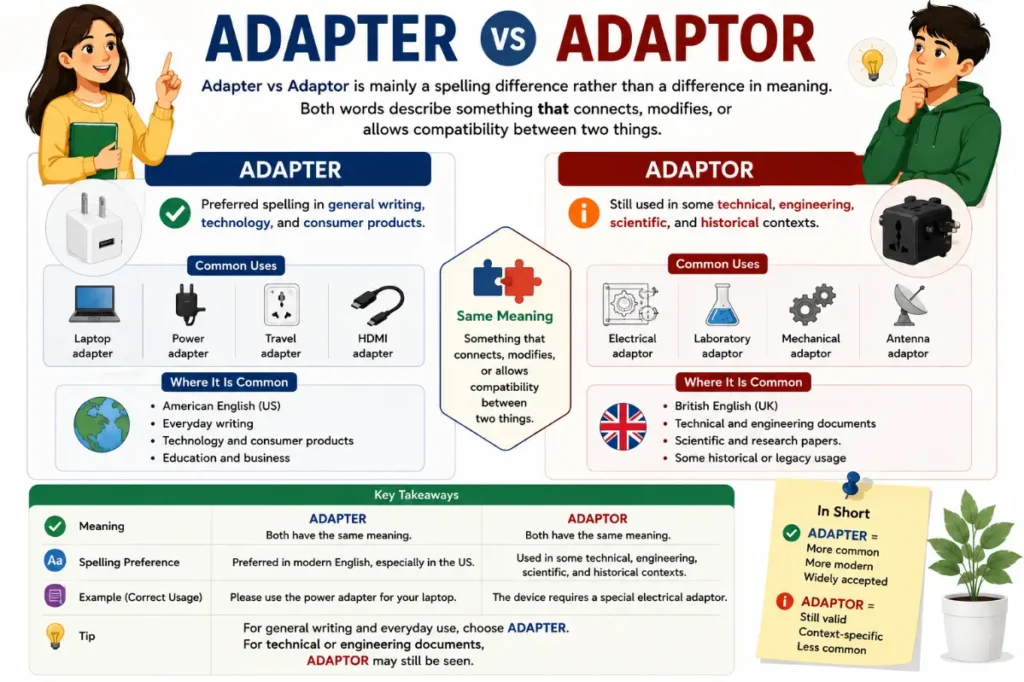
Confused about Adapter vs Adaptor? The good news is that both spellings are correct in English. They refer to a person or thing that adapts something, and they often describe the same kinds of devices, including electrical accessories, computer components, and connectors. The difference is mainly a matter of spelling preference and usage rather than meaning.
In American English, “adapter” is generally the more familiar choice, especially in everyday writing and technical descriptions. “Adaptor” is also a legitimate word, though it may appear less often in some contexts. British English uses both forms, and technical documents may follow the spelling chosen by a manufacturer, industry, or style guide.
Choosing the right form becomes easier when you consider your audience and the context. If you are writing about a phone charger, a travel accessory, a computer connection, or a software component, consistency matters more than treating one spelling as universally wrong. This guide explains the meaning of both forms, their pronunciation, their regional use, and the practical rules that help you choose the right one.
Need another quick comparison? Read Imply vs Infer The Difference Explained.
Quick Answer
Both “adapter” and “adaptor” are accepted English spellings. They usually have the same meaning and can refer to a device that allows two parts, systems, or connections to work together. “Adapter” is the usual choice for general American English, while “adaptor” is an accepted alternative. Follow the spelling used by a product maker or the style guide relevant to your work.
Comparison Table
| Feature | Adapter | Adaptor |
|---|---|---|
| Correct spelling | Yes | Yes |
| Meaning | A person or thing that adapts something | A person or thing that adapts something |
| Part of speech | Noun | Noun |
| Pronunciation | /əˈdæptər/ | /əˈdæptər/ |
| American English | Common and widely preferred | Correct, but often less common |
| British English | Used | Also used |
| Technical writing | Common in many fields | Used in some fields and product names |
| Electrical devices | Common | Also acceptable |
| Software and computing | Common | Also acceptable |
| Formal writing | Appropriate | Appropriate |
| Main difference | Preferred spelling in many contexts | Alternative spelling |
Meaning and Definition
What Does Adapter Mean
An adapter is a person, device, or component that changes something so it can work with a different system, purpose, or set of conditions. In everyday life, the word most often refers to a device that connects items that would not otherwise fit or work together.
For example, a power adapter can help connect an electronic device to a suitable power supply. A travel adapter allows a plug to fit a different type of electrical outlet. In computing, an adapter can connect different hardware components or allow one system to communicate with another.
The word also has uses beyond technology. A person who adapts a book into a film may be called an adapter. In this context, the person changes the original work to suit a new format while preserving important parts of its content.
The noun comes from the verb “adapt,” which means to change something to make it suitable for a new purpose or situation. The ending “er” commonly forms nouns that identify a person or thing performing an action.
Examples include the following.
- I bought a new power adapter for my laptop.
- The film adapter changed several scenes from the original novel.
- The network adapter connects the computer to the network.
What Does Adaptor Mean
“Adaptor” has the same basic meaning. It can describe a device that connects incompatible parts, a component that helps two systems work together, or a person who changes an existing work for a new purpose.
For example, a travel adaptor may allow a plug from one country to fit an outlet in another country. An adaptor can also refer to a component used in mechanical, electronic, or other technical systems.
The spelling uses the ending “or” instead of “er.” English has many nouns with these endings, and the choice is not always governed by a single rule. Words such as “actor,” “creator,” and “operator” end in “or,” while “teacher,” “writer,” and “builder” end in “er.” The accepted form of each word depends on established usage and word history.
In this case, both spellings are established. The spelling with “or” is not automatically incorrect simply because a writer is accustomed to seeing the other form.
Examples include the following.
- The travel adaptor fits the outlet in the hotel room.
- The technician replaced a damaged adaptor.
- The adaptor connects two parts with different fittings.
Is Adaptor a Misspelling
No. “Adaptor” is a legitimate English word, not simply a typing error or an incorrect version of “adapter.” Both forms appear in established English usage, and they can carry the same meaning.
However, an accepted spelling is not always the most suitable choice in every situation. A company may use “adapter” throughout its product documentation, while a particular manufacturer may label its product an “adaptor.” A technical team may also follow an industry convention that favors one form.
The important distinction is between correctness and preference. Both forms can be correct, but one may fit your audience, document, or product terminology better. If you are editing a text, do not automatically change every instance of “adaptor” to “adapter” without checking the context.
Key Differences Explained
Spelling
The most visible difference is the final part of each word. “Adapter” ends in “er,” while “adaptor” ends in “or.” The spelling difference does not usually create a difference in meaning.
Both forms are built around the same word, “adapt.” Their endings reflect alternative accepted forms of the noun rather than two separate actions.
If you are writing for a broad American audience, “adapter” is usually the simplest choice. It is widely recognized in product descriptions, everyday communication, and technical writing. That preference does not make the alternative spelling wrong.
Meaning
In ordinary use, the two words mean the same thing. Both can refer to a device that makes two connections compatible, a component that links systems, or a person who adapts material for a different purpose.
Consider these sentences.
- I need an adapter for my headphones.
- I need an adaptor for my headphones.
Both sentences can communicate the same idea. The surrounding context tells the reader what kind of device is needed.
Some specific organizations, industries, or manufacturers may assign a preferred spelling to a particular item. In such cases, follow that convention rather than assuming that every use of the two words must be interchangeable in every technical document.
Grammar and Part of Speech
Both forms are nouns. They can serve as the subject or object of a sentence and can appear after articles and adjectives.
For example, “The adapter is missing” uses the noun as the subject. In “Please bring an adaptor,” it functions as the object of the verb “bring.”
Both forms can also modify another noun. In the phrase “adapter cable,” the first noun tells the reader what kind of cable is being discussed. A similar phrase can use “adaptor” if that is the preferred spelling in the relevant context.
The verb remains “adapt.” You write “adapt a story,” not “adapter a story.” The noun names the person or thing associated with the action.
Pronunciation
In standard American English, the two spellings are generally pronounced alike. Both are commonly pronounced /əˈdæptər/, with the main stress on the second syllable.
The first syllable sounds like a relaxed “uh,” the second sounds like “dapt,” and the last sounds like “er.” The spelling of the ending does not normally change the spoken form.
Because the words sound alike, listening alone may not help you decide which spelling someone has used. In written communication, the choice depends on spelling conventions and context.
Formality
Neither form is inherently more formal than the other. Both are suitable for professional and academic writing when they fit the relevant style or terminology.
A technical manual, business email, school assignment, or product description can use either form. The key is to apply the chosen spelling consistently and respect established names or house style rules.
For general American writing, “adapter” is the more practical default. If an official product label or company document uses “adaptor,” preserving that spelling can be more accurate than changing it for consistency with a general preference.
Context
The context often makes the preferred spelling clear. Everyday American references to power supplies, phone accessories, computer hardware, and connection devices commonly use “adapter.”
The alternative can appear in the same broad areas, including descriptions of electrical and mechanical components. It may also appear in product names and technical documents.
When writing about a specific item, check its packaging, instruction manual, or official documentation. When writing generally, choose the form that your intended readers are most likely to recognize and then use it consistently.
Standard and Nonstandard Usage
Both spellings are standard English forms. This is different from a pair in which one spelling is a recognized word and the other is merely a common error.
The practical issue is not deciding which form is valid. It is deciding which form suits the document. For many American readers, “adapter” will feel more familiar, but “adaptor” remains a valid alternative.
Which Form Should You Use
For most general writing in the United States, use “adapter.” It is widely recognized and works well in everyday, professional, and technical contexts. Choose “adaptor” when it is the spelling used by a product maker, a relevant organization, a publication’s style guide, or the technical terminology you need to preserve.
This approach follows a basic principle of good editing: distinguish a spelling error from an accepted variation. An editor should correct errors, but should not label a valid form incorrect simply because another form is more common.
If you are writing a general article about a phone accessory, for example, “phone adapter” is a natural choice for an American audience. If you are documenting a named product whose official instructions use “adaptor,” retaining that spelling helps readers match the text to the product.
For longer documents, consistency is useful. Choose a preferred form at the beginning, check whether the subject requires a specific spelling, and apply that choice throughout the text. Consistency makes writing easier to read, even when more than one spelling is accepted.
Sentence Examples
The following examples show how the more common American spelling works in different situations.
- Everyday conversation: I need an adapter to connect my old headphones to my new phone.
- At home: The laptop adapter is on the desk beside the window.
- Travel: Remember to pack a plug adapter before leaving for another country.
- Text message: Can you bring the USB adapter when you come over?
- Work: Please check that the adapter is compatible with the equipment we ordered.
- School: The computer needs a network adapter to connect to the lab system.
- Technical writing: The adapter converts the input connection to a format supported by the device.
- Customer service: Our team can help you identify the correct adapter for your model.
- Academic writing: The study examined how a software adapter enabled communication between two systems.
- Creative work: The adapter kept the main ideas of the novel while changing its structure for the stage.
The alternative spelling can also be used in natural sentences when it fits the relevant convention.
- The travel adaptor fits the electrical outlet in the hotel.
- The technician ordered a replacement adaptor for the equipment.
- The adaptor connects the two components securely.
- Please read the instructions before using the adaptor.
- The company lists the item as an adaptor in its product catalog.
These examples are not intended to suggest that one spelling is always right and the other is always wrong. They show how the two forms can be used in similar contexts. In a real document, follow the preferred spelling for your audience or source.
Common Spelling Mistakes
Because the two forms are accepted, the main mistake is often not choosing one over the other. It is treating a valid spelling as incorrect, mixing forms without a reason, or confusing the noun with a related word.
Mistake One Treating Adaptor as Incorrect
Incorrect claim: “Adaptor is always a misspelling.”
Better explanation: Both “adapter” and “adaptor” are accepted forms. The first is generally the safer choice for broad American usage, but the second is not automatically an error.
For example, if a product manual consistently uses “adaptor,” an editor should consider keeping that spelling.
Mistake Two Changing the Spelling in the Middle of a Document
Inconsistent usage: “The adapter connects the cable. Replace the adaptor if it stops working.”
Consistent version: “The adapter connects the cable. Replace the adapter if it stops working.”
The original wording is understandable, but switching forms without a reason may distract readers. Choose one form for general writing unless a name, quotation, or technical convention requires the other.
Mistake Three Confusing the Noun With the Verb
Incorrect: “Please adapter the document for younger readers.”
Correct: “Please adapt the document for younger readers.”
“Adapt” is the verb that means to change something for a new purpose. “Adapter” and “adaptor” are nouns that name a person or thing associated with adaptation.
Mistake Four Assuming the Ending Always Follows One Rule
Incorrect assumption: Every noun formed from a verb must end in “er.”
Correction: English uses several noun endings, including “er” and “or.” The correct spelling depends on the accepted form of each word. In this case, both spellings are established, so there is no need to force one ending based on a general rule.
Mistake Five Ignoring Official Product Terminology
Potential editing mistake: Changing a product’s official name from “Adaptor X” to “Adapter X” in a catalog.
Better approach: Preserve the official product name. A general preference for one spelling should not override a manufacturer’s established name, model label, or technical documentation.
A Simple Way to Avoid These Errors
Before editing, ask three practical questions.
- Is the word being used as a noun or is the writer trying to use the verb “adapt.”
- Does the product, organization, or style guide specify a spelling.
- If no specific convention applies, would “adapter” be the clearer choice for the intended American audience.
These checks resolve most usage questions without turning an accepted spelling variation into a false grammar rule.
Pronunciation Guide
Both spellings usually have the same pronunciation in standard American English.
| Feature | Pronunciation |
|---|---|
| Word | Adapter or adaptor |
| IPA | /əˈdæptər/ |
| Syllables | a dap ter |
| Easy guide | uh DAP ter |
| Main stress | Second syllable |
The first syllable has a short, relaxed sound, similar to the beginning of “about.” The second syllable sounds like “dap,” and the final syllable sounds like “ter” in American English.
The stress falls on the second syllable. Saying “AD ap ter” with strong stress on the first syllable may sound unnatural to many American listeners.
Since both spellings are generally pronounced alike, there is no reliable pronunciation trick for remembering which ending to write. It is more useful to remember that the noun has two accepted forms and that the spelling with “er” is a common American default.
Still confused? Compare Bailer or Baler Meaning and Correct Usage.
Etymology and Word Origin
Both forms come from the verb “adapt,” which means to change something to make it suitable for a new use or situation. The verb entered English through French and ultimately traces back to Latin, from a word built around the idea of fitting or adjusting something to a purpose.
The noun endings “er” and “or” are used in English to form words for people or things associated with an action. Their history is complex, so the spelling of a noun cannot always be predicted by applying one simple rule to its verb.
In this case, both forms developed into accepted English usage. Their meanings overlap, and the difference in spelling does not normally indicate a difference in function. The spelling with “er” is especially familiar in modern American descriptions of electronic accessories and computer components.
The history helps explain why both spellings exist, but you do not need to know the full history to use the word correctly. For practical writing, the audience and context are more helpful guides than trying to derive the spelling from a general rule.
Regional Usage
American English
In the United States, “adapter” is generally the preferred spelling in everyday writing. It is common in descriptions of phone accessories, computer equipment, power supplies, audio connections, and other devices.
American writers also use the word for people who change an existing work for a new purpose. For instance, someone who adapts a novel for the stage may be called an adapter.
“Adaptor” remains a valid alternative. However, writers aiming for a consistent American style will usually find “adapter” to be the more familiar default. If a product label or official document uses the other spelling, retaining that form may be appropriate.
British English
Both spellings are used in British English. The spelling with “er” is common, while the form with “or” also appears in general and technical contexts.
It is not accurate to claim that all British writers prefer “adaptor” or that “adapter” belongs only to American English. Actual usage varies by context, organization, and product terminology.
If you are writing for a British audience, check the style guide or technical source relevant to the subject. For a general article, either form may be acceptable, provided you use it consistently.
Australian English
Australian English also recognizes both forms. The spelling used in a particular document may depend on the organization, product maker, or technical field.
There is no need to assume that “adaptor” is the only correct Australian spelling. If you are preparing instructions or product information for Australian readers, the terminology used by the manufacturer is a useful guide.
Canadian English
Both spellings can be encountered in Canadian English. Canadian writers may follow conventions found in American technical material, British influenced publications, or local organizational style guides.
For a general Canadian audience, “adapter” is a clear and widely recognizable option. Still, an official name or a technical specification should take priority over a broad spelling preference.
Does the Spelling Change the Meaning by Country
Usually, no. The two forms generally describe the same person, device, or component. Regional preferences affect which spelling may feel more familiar, but they do not create a reliable difference in basic meaning.
The safest rule is to match the convention of the audience and the specific source you are discussing.
Grammar Rules and Part of Speech
Both Forms Are Nouns
The two words are countable nouns when they refer to individual devices or people. A singular countable noun normally needs a determiner, such as “a,” “an,” “the,” or a possessive word.
Correct examples include these sentences.
- I bought an adapter for the monitor.
- The adaptor is inside the storage box.
- Her adapter stopped working during the meeting.
- We need two adapters for the new equipment.
The choice between the two spellings does not change these grammatical patterns.
Using the Word as a Subject
A noun can serve as the subject of a sentence by naming the person or thing that performs an action or occupies a role.
For example, “The adapter connects the two devices” uses “adapter” as the subject. The sentence tells the reader what the component does.
You can use the alternative form in the same position. “The adaptor connects the two devices” follows the same grammatical structure.
Using the Word as an Object
A noun can also serve as the object of a verb or preposition.
For example, “Please bring the adapter” uses the noun as the object of “bring.” In “The cable fits into the adaptor,” the noun follows the preposition “into.”
The spelling does not affect the noun’s role in either sentence.
Using the Word Before Another Noun
English often uses one noun to describe another noun. This pattern appears in phrases such as “adapter cable,” “adapter plug,” and “adapter card.”
In these phrases, the first noun identifies the type or purpose of the second noun. The full phrase acts as a unit, but the first word remains a noun.
The same pattern can use “adaptor” if that spelling is preferred. The main goal is to make the relationship between the two items clear.
Singular and Plural Forms
The usual plural of “adapter” is “adapters.” The usual plural of “adaptor” is “adaptors.”
Examples include “three adapters” and “several adaptors.” Both plurals follow the normal English pattern of adding “s” to the singular noun.
Do not combine the two forms in a way that creates confusion. If the document uses “adapter” as its standard spelling, use “adapters” for the plural unless an official name requires a different form.
Formal and Informal Writing
Both forms are suitable for formal and informal writing. You can use the noun in a text message, a workplace email, a technical report, a school assignment, or an instruction manual.
The more important question is whether the chosen spelling matches the document’s audience and conventions. Formal writing benefits from consistency, especially when the same term appears many times.
Punctuation and Capitalization
The words are normally lowercase unless they begin a sentence or appear in a proper name, title, or branded product name.
For example, “adapter” is lowercase in “The adapter is ready.” It begins with a capital letter in “Adapter compatibility varies by model” because it starts the sentence.
Neither form needs special punctuation simply because it is a technical term. Use ordinary sentence punctuation and capitalize it according to standard English rules.

Real Life Usage Examples
The following examples show how the word appears in everyday situations and professional settings. They also demonstrate why the spelling should be chosen based on the audience and the source.
Daily Conversation
Example One
“Do you have an adapter I can borrow for my phone.”
This is a natural way to ask for a device that makes a connection possible. In everyday American conversation, the spelling with “er” is a familiar choice when writing the request.
Example Two
“I bought a travel adaptor, but it does not fit this outlet.”
This sentence uses the alternative spelling in a travel situation. It is understandable and grammatically correct, although an American writer may choose “adapter” for a general audience.
Email and Workplace Communication
Example One
“Please confirm that the adapter is compatible with the equipment before placing the order.”
This sentence works well in a workplace email because it identifies the item and gives a clear instruction. The word is used as a noun, and the sentence follows standard grammar.
Example Two
“The adaptor listed in the inventory does not match the model shown in the service notes.”
This version uses the alternative form. If the inventory system uses that spelling, retaining it can help employees match the email to the record.
Academic Writing
Example One
“The network adapter enabled the computer to exchange data with the local system.”
This sentence uses a technical term to describe the role of a component. The wording is direct and suitable for a report, provided the term matches the hardware being discussed.
Example Two
“The researcher designed an adapter to connect the experimental equipment to the measurement system.”
This example uses the noun in an academic context. If the report defines the component using a different official term, the writer should follow that terminology throughout.
News and Journalism
Example One
“The company recalled the adapter after reports that some units overheated during normal use.”
A news report would use this wording to identify the product involved in a recall. The spelling should match reliable product information so readers can recognize the item.
Example Two
“Officials advised travelers to check that their plug adapters were suitable for the electrical outlets at their destinations.”
This sentence illustrates the term in a public information context. The plural form “adapters” is appropriate because the sentence refers to multiple devices.
Literature and Storytelling
Example One
“Mara searched the desk for the adapter, hoping to restore power to the small radio.”
Here, the noun appears as part of a narrative. It helps explain what the character needs without interrupting the flow of the story.
Example Two
“The adaptor lay beside the old camera, its metal edges worn from years of use.”
This sentence uses the alternative spelling in a descriptive passage. The spelling does not change the object’s role in the story.
Related and Confused Terms
Understanding nearby words can help you describe the exact item you mean. These terms are connected to the idea of connecting, converting, or adjusting things, but they are not all interchangeable.
Adapter and Converter
An adapter helps two parts fit or work together. A converter changes something from one form to another, such as a signal, file format, or type of power.
The terms can overlap in product descriptions, but they do not always mean the same thing. A travel plug adapter may change the shape of a plug without converting the electrical supply. A voltage converter, by contrast, changes voltage.
Adapter and Connector
A connector is a part that joins two items. An adapter can include connectors, but its main purpose is to make two otherwise incompatible connections work together.
For example, a connector may join two matching cables. An adapter may allow a cable with one type of plug to connect to a device with a different socket.
Adapter and Charger
A charger supplies or manages the power used to recharge a battery. A power adapter provides a suitable electrical supply to a device.
Some products combine these functions, which can make the terms seem interchangeable. Still, they describe different roles, so check the product specifications before using one term in place of the other.
Adapter and Transformer
A transformer changes the voltage of alternating current through electromagnetic induction. An adapter may contain a transformer, but many adapters use other electronic components or perform a different function.
This distinction matters when choosing electrical equipment. The appearance of a device alone does not tell you if it changes voltage or simply provides a compatible connection.
Adapter and Interface
An interface is a point or system through which two things interact. In computing, an interface can refer to hardware, software, or a set of rules that allows components to communicate.
An adapter may provide an interface between two systems, but the terms describe different ideas. The interface is the point or method of interaction, while the adapter is the component that enables or supports it.
Adapter and Plug
A plug is the part that enters a socket or outlet to establish an electrical connection. An adapter may provide a different plug shape or allow one connector type to fit another.
A plug is not automatically an adapter. The terms describe different components, even though a single product may contain both.
Adapter and Driver
In computing, a driver is software that helps an operating system communicate with a hardware device. An adapter is often a physical component, such as a network adapter or display adapter.
The distinction is useful when troubleshooting a computer. A hardware adapter may be present and connected, yet the device may still need a working software driver to function correctly.
Adapter and Adaptor
These are alternative spellings of the same noun in ordinary usage. Neither one consistently names a different kind of device, and the final letters do not usually affect pronunciation.
For general American writing, “adapter” is a practical default. Use the alternative when it appears in an official name, source document, or established convention you need to follow.
Expert Editor Insight
An experienced editor treats these spellings as a usage choice, not as a simple right or wrong pair. The first step is to identify the intended meaning, then check for an official product name, a house style rule, or a technical convention. If none applies, “adapter” is a sensible default for an American audience. Spelling tools may mark “adaptor” as less common or suggest a preferred form, but an automated suggestion does not prove that a valid word is incorrect. Good editing protects meaning, respects context, and keeps terminology consistent.
Key Takeaways
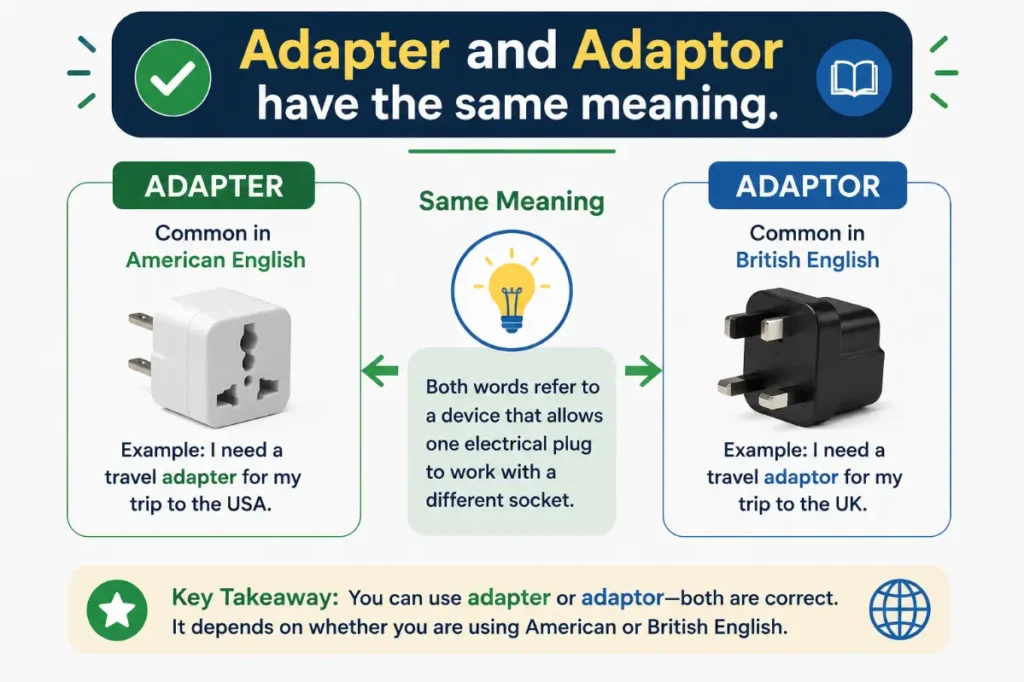
- Adapter and adaptor have the same meaning.
- Both spellings are recognized by major dictionaries.
- Adapter is the preferred spelling in modern American English and most general writing.
- Adaptor survives mainly in engineering, manufacturing, scientific, and some British technical contexts.
- Technology products almost always use adapter.
- If you are referring to a branded product, match the manufacturer’s spelling.
- Avoid mixing both spellings in the same document.
- For a general audience, adapter is usually the safest and clearest choice.
You may also want to read Farther vs Further Explained With Clear Examples.
Conclusion
Adapter vs Adaptor is a comparison between two accepted spellings, not a choice between a correct word and a misspelling. Both forms usually describe a device or person that helps something work with a different system or purpose. For general American English, “adapter” is the most practical default, while “adaptor” remains valid in suitable contexts.
The key is to consider your audience, follow official product terminology, and maintain consistency throughout your writing. A simple editing tip is to check the spelling used in the relevant manual or style guide before making changes. If no specific rule applies, choose “adapter” and use it consistently.
FAQs
Is Adaptor a Real Word?
Yes, “adaptor” is a real English word. It is an accepted alternative spelling of “adapter” and usually carries the same meaning. It can describe a device that connects different components or a person who adapts material for another purpose. Although “adapter” is generally more familiar in American English, the alternative spelling is not automatically incorrect.
What Is the Difference Between Adapter and Adaptor?
The main difference is spelling, not meaning. Both forms usually refer to the same kind of device or person. “Adapter” is commonly preferred in American English, while “adaptor” is another accepted form. The best choice depends on your audience, the document’s style, and any official terminology associated with a particular product or technical field.
Which Spelling Is Better for American English?
For general American English, “adapter” is usually the safer choice. It is widely recognized in everyday writing, product descriptions, and technical communication. You can still encounter “adaptor” in legitimate usage. If you are writing for a company, publication, or specific product, follow its established spelling convention instead of changing the word automatically.
How Do You Pronounce Adapter and Adaptor?
Both words are generally pronounced the same way in American English: /əˈdæptər/. Divide the word into three syllables, roughly “uh DAP ter,” with the strongest stress on the second syllable. The different endings do not normally change the sound. Since the pronunciation is alike, you must rely on spelling conventions and context when writing the word.
Can Adaptor Be Used in Formal Writing?
Yes. “Adaptor” can appear in formal writing because it is an accepted English spelling. The important consideration is consistency and context. If your organization or technical source uses “adaptor,” follow that convention. For general American prose without a specific house style, “adapter” is usually a straightforward choice that readers will readily recognize.
What Is a Synonym for Adapter?
There is no single synonym that fits every use. “Connector” may work for a component that joins two parts, while “converter” describes something that changes one form into another. “Interface” can describe a point of interaction between systems. Choose a substitute only after checking the device’s actual function, because these terms do not always mean the same thing.
Why Are Adapter and Adaptor Both Correct?
English has many nouns with different accepted endings, and spelling does not always follow one simple rule. Both forms became established in usage, so the difference cannot be explained as a straightforward spelling mistake. Their meanings overlap, and neither ending creates a consistent distinction between types of devices. Audience preference and established terminology usually guide the choice.
Should I Write Power Adapter or Power Adaptor?
For a general American audience, “power adapter” is usually the more familiar choice. However, “power adaptor” can also be correct, particularly when it matches a product label or established technical wording. Check the manufacturer’s documentation if you are referring to a specific model. In a general article, choose one spelling and use it consistently throughout the text.