
Have you ever stopped while writing a sentence because you weren’t sure if you needed than vs then? You’re not alone. These two words look almost identical, sound similar in many American accents, and appear frequently in everyday writing. Yet one small spelling difference can change the meaning of a sentence.
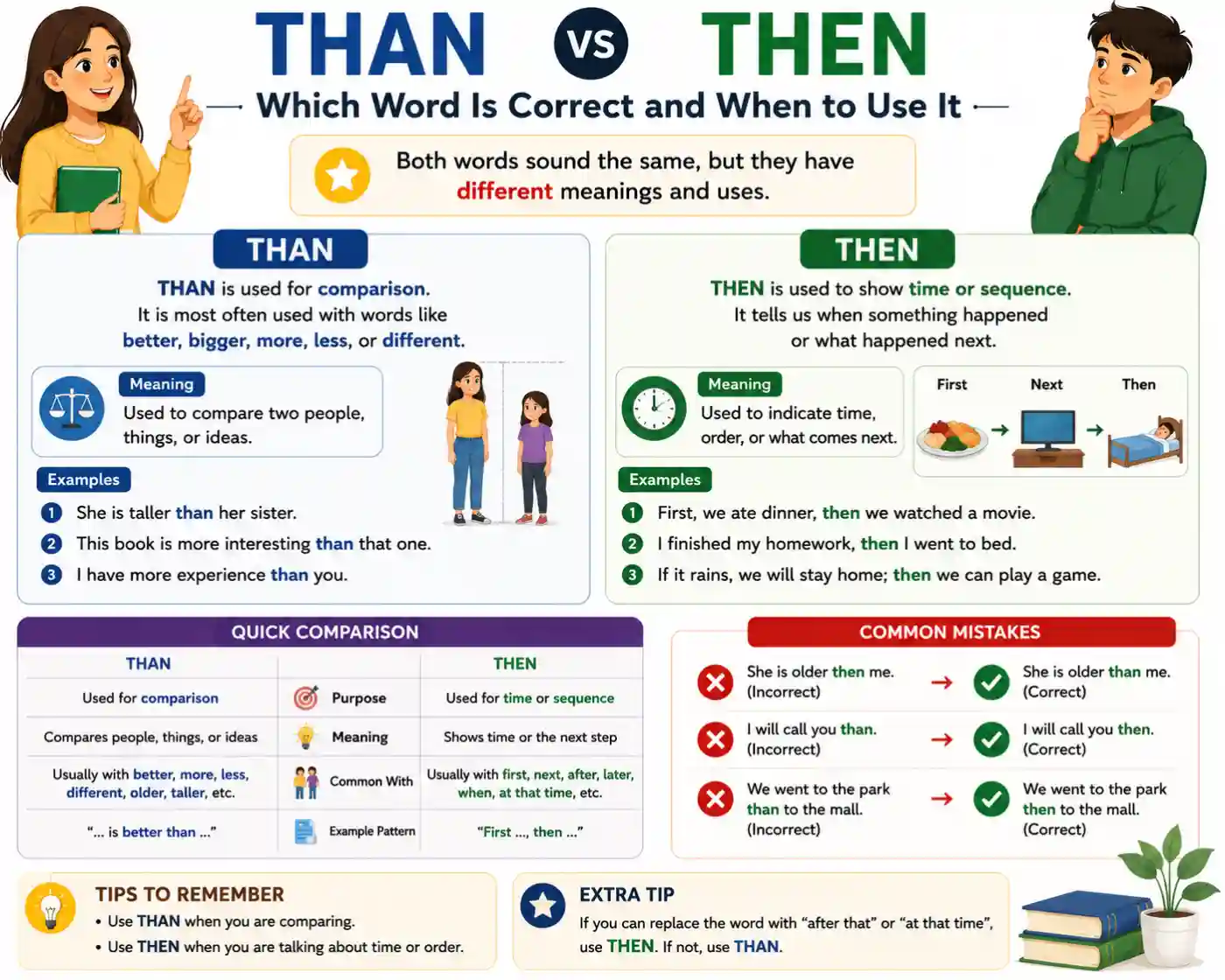
The rule is simple once you understand what each word does. Then usually refers to a time, the next step in a sequence, or a result. Than connects two parts of a comparison. You might say you finished your homework and then went outside, but you’d say you finished your homework faster than your brother.
The challenge is that both words appear in many different sentence patterns. Then can describe a past moment, a future step, or a logical consequence. Than can compare people, objects, quantities, preferences, and actions. Learning their grammatical roles will help you choose the right spelling without second guessing yourself. A few practical examples and a simple memory trick can make the distinction stick.
For another common grammar confusion, see Molding or Moulding Which Spelling Is Correct.
Short Answer
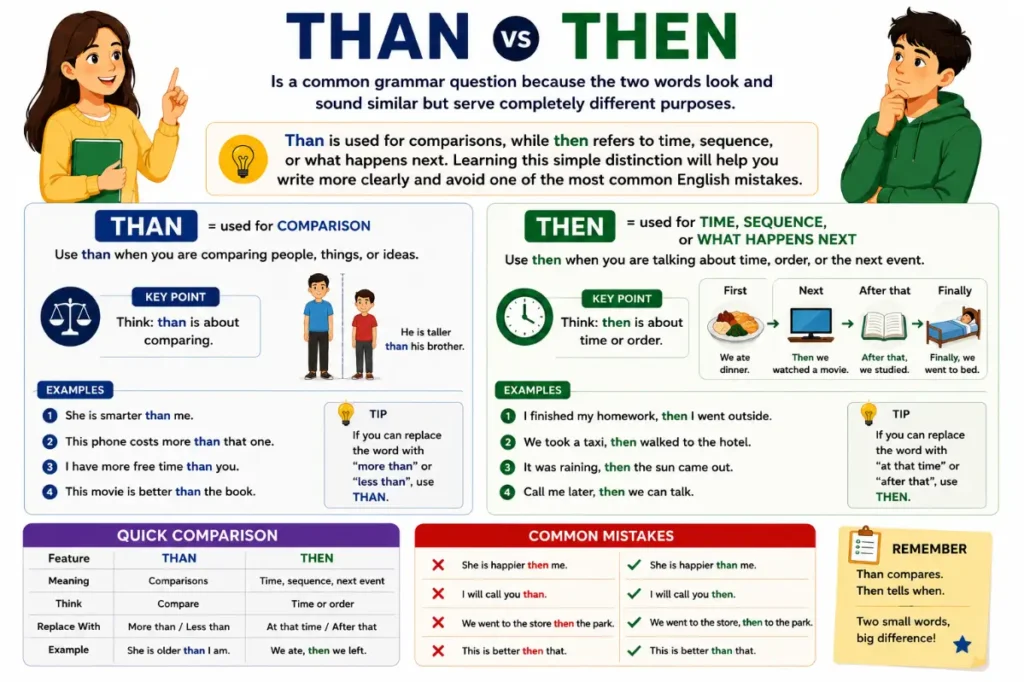
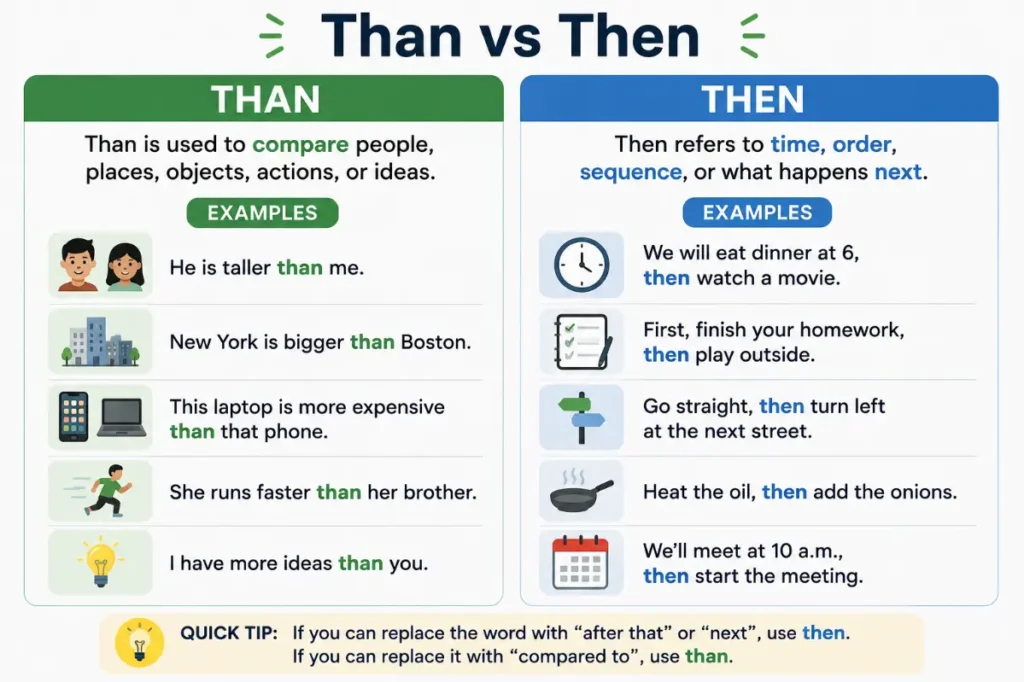
Then refers to time, sequence, or a result. Than introduces a comparison. Write We ate dinner then watched a movie to show what happened next. Write This movie is better than the last one to compare two movies. Both words are correct English, but they aren’t interchangeable. The easiest rule is to remember that then often answers when or what happened next, while than connects two things being compared.
What Is the Difference Between the Two Words?
The difference comes down to meaning and grammatical function. One word places events or ideas in time or sequence. The other establishes a comparison.
- Then means at that time, next, afterward, or as a result. For example, Finish your work then take a break tells someone what to do next.
- Than introduces a comparison. For example, A break is better than working without rest compares two options.
You can use both words in the same sentence when the meaning calls for it.
She was taller than her brother then.
In this sentence, than introduces the comparison, while then refers to a particular time. The sentence means that she was taller than her brother at that point in the past.
| Feature | Then | Than |
|---|---|---|
| Main meaning | At that time, next, afterward, or as a result | Used to compare two things |
| Grammatical role | Usually an adverb and sometimes a conjunction | Usually a conjunction and sometimes a preposition |
| Main purpose | Shows time, order, or consequence | Shows comparison |
| Common phrases | Back then, then again, and if…then | Better than, more than, less than |
| Example | We ate lunch then returned to work. | Lunch is better than skipping a meal. |
| Main question | When? What happened next? What follows? | Compared with what? |
| Typical mistake | Using it to introduce a comparison | Using it to describe the next event |
Meaning and Definition of Then
Then is an English word with several related uses. It commonly refers to a particular time, the next event in a sequence, or a consequence that follows from a condition.
Then as a Time Word
Use then when referring to a past, present, or future time that is clear from the surrounding context.
Examples include:
- I lived in Chicago back then.
- The store was smaller then.
- I’ll call you then.
- Things were different then.
In each example, the word points to a time. The exact time comes from the surrounding sentence or conversation.
For instance, I lived in Chicago back then refers to an earlier period already known to the reader. It doesn’t compare Chicago with another city.
Then to Show Sequence
You can also use the word to show that one event follows another.
Consider these examples.
- First, wash the vegetables. Then, cut them into small pieces.
- She finished her assignment and then went to bed.
- Open the document, then select Print.
- We checked the address and then called the customer.
The word helps readers follow the order of events. It works especially well in instructions, recipes, stories, and explanations.
In many sentences, then can be replaced by next or afterward without changing the basic meaning.
For example, We ate dinner then watched a movie means the movie came after dinner. You could also write We ate dinner and afterward watched a movie.
Then to Show a Result
Sometimes then means that a particular result follows from a condition or decision.
Examples include:
- If you need help, then ask your teacher.
- If the road is closed, then we’ll take another route.
- If that’s your final decision, then I’ll respect it.
- If the payment arrives today, then we can ship the order tomorrow.
In these sentences, the word connects a condition with its expected result. It doesn’t introduce a comparison.
In everyday English, you can often leave out then in an if sentence without changing its meaning.
If it rains, we’ll stay home.
If it rains, then we’ll stay home.
Both sentences are correct. The second version places a little more emphasis on the connection between the condition and the result.
Then as a Conversation Word
Then also appears in common expressions that help people respond to information or reconsider an idea.
For example:
- Then again, we could leave a little earlier.
- What happened then?
- I guess we’ll have to wait until then.
- If you don’t want to go, then I’ll go alone.
In then again, the word introduces another thought or possibility. In What happened then?, it asks about the next event or a particular moment.
These uses are natural in conversation, emails, stories, and other forms of writing.
Meaning and Definition of Than
Than introduces a comparison between people, things, actions, quantities, or ideas. It often follows words such as better, worse, more, less, older, and younger.
For example:
This laptop is cheaper than that one.
The sentence compares the prices of two laptops. The word than connects the comparison.
Than With Comparative Adjectives
Comparative adjectives describe differences between two people or things. Many short adjectives form their comparative with er, while others use more.
Examples include:
- My sister is taller than I am.
- This room is brighter than the other one.
- The second test was easier than the first.
- Her explanation was more helpful than mine.
The word introduces the second part of each comparison.
You wouldn’t use then in these sentences because the meaning isn’t about time or sequence.
Than With Comparative Adverbs
Comparisons can also describe how someone performs an action.
Examples include:
- He runs faster than I do.
- She arrived earlier than expected.
- The new computer works more efficiently than the old one.
- I finished the task sooner than my coworker.
Here, the comparisons involve actions and their timing or manner. Even when a sentence mentions time, than remains correct if the sentence compares two things.
This is a useful point to remember. A sentence about time doesn’t automatically require then. The grammatical job of the word matters more than the general topic.
Than With Quantities
Use than to compare amounts, numbers, or degrees.
Examples include:
- More than 100 people attended the event.
- The repair cost less than $50.
- We waited longer than an hour.
- She has fewer books than her brother.
The word connects the quantity being described with the amount used for comparison.
In the phrase more than 100 people, the sentence means that the number of attendees exceeded 100. It doesn’t tell you what happened next.
Than With Preferences and Choices
People often use than when explaining preferences or comparing possible actions.
Examples include:
- I’d rather walk than drive.
- She prefers reading to watching television.
- I’d sooner stay home than go out in the rain.
- He would rather save his money than spend it on something unnecessary.
In these examples, than introduces the alternative being compared with the preferred action.
The word can also appear in comparisons involving nouns, pronouns, and entire clauses. Its main job remains the same: connecting the parts of a comparison.
Which Word Is Correct in Your Sentence?
Both spellings are correct. The right choice depends on what you want to say.
Use then if you mean at that time, next, afterward, or as a result.
Use than if you are comparing two people, objects, actions, quantities, or ideas.
Try these quick tests.
- If you can replace the word with next or afterward, use then. For example, We finished lunch and then left works because the departure followed lunch.
- If you can replace the word with compared with, use than. For example, This route is shorter than the other route compares two routes.
- If neither replacement works, look at the complete sentence. Some expressions have special patterns, and the meaning may depend on the words around the blank.
Don’t choose based on spelling alone. The two words are both standard English, and neither is a misspelling of the other.
Grammar Rules and Sentence Patterns
Understanding the common sentence patterns makes the choice more reliable.
Common Patterns With Then
You can use then in several ways.
Time expression: Subject + verb + then.
I was living in Texas then.
Sequence: First event + then + second event.
She packed her bag then left the house.
Condition and result: If + condition, then + result.
If you finish early, then you can leave.
Conversation expression: Then again + another thought.
Then again, we might be better off waiting.
The word can appear at the beginning, middle, or end of a sentence, depending on the intended meaning.
For example, Then I remembered where I had parked begins with the word to move the story forward. I remembered where I had parked then refers to the time when the memory occurred.
Common Patterns With Than
The word often follows comparative forms.
Comparative adjective + than: My new phone is lighter than my old one.
More or less + than: The trip took more than three hours.
Comparative adverb + than: She speaks more clearly than I do.
Rather or sooner + than: I’d rather read than watch television.
Other than: No one other than Maria knew the answer.
The last example shows that than appears in established expressions too. It can mean except for or apart from, depending on the context.
Real Life Examples
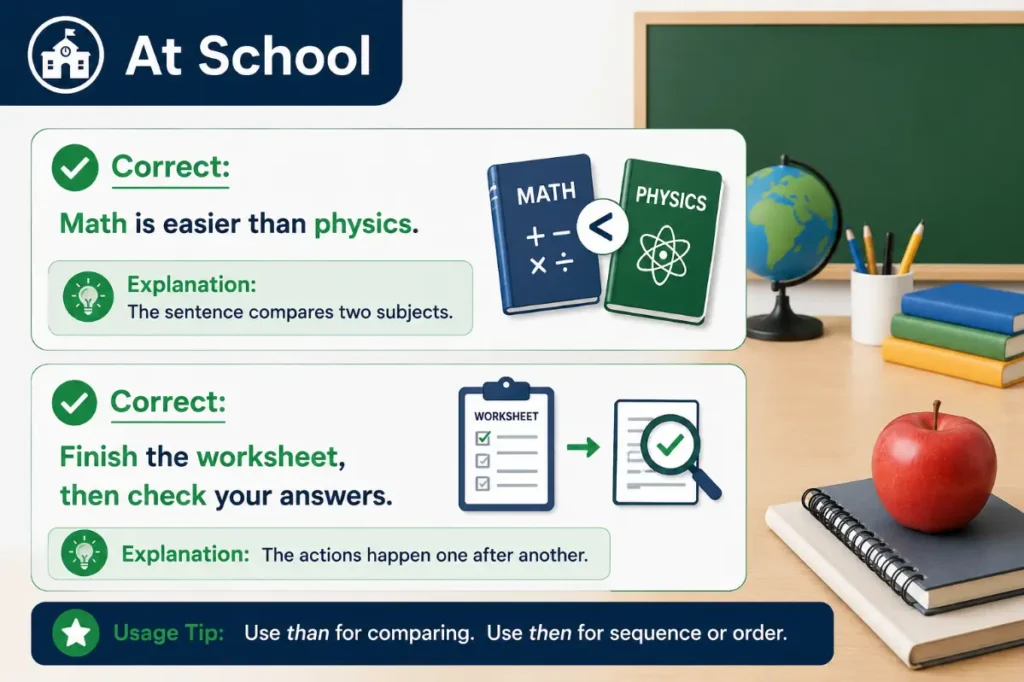
At School
Correct:
- Math is easier than physics.
Explanation:
The sentence compares two subjects.
Correct:
- Finish the worksheet, then check your answers.
Explanation:
The actions happen one after another.
At Work
Correct:
- This project is more challenging than the previous one.
Explanation:
Two projects are compared.
Correct:
- Send the email, then schedule the meeting.
Explanation:
The second task follows the first.
Is Than Always a Conjunction?
No. In modern English, than can function as a conjunction or a preposition, depending on the construction and the grammatical analysis being used.
For example:
She is older than I am.
Here, than introduces a clause with its own subject and verb.
She is older than me.
Here, than is followed by the object pronoun me. Many modern grammar descriptions analyze this use as a preposition.
Both forms are widely used in standard English. The choice depends on sentence structure, style, and the level of formality.
Can Then Start a Sentence?
Yes. Then can start a sentence when it introduces the next event, refers to a time, or connects a result to a previous statement.
For example:
Then we heard a loud noise.
The word moves the story to the next event.
You can also write:
Then, after several minutes, the lights came back on.
The commas help mark the introductory phrase, but punctuation depends on the full sentence. A comma isn’t automatically required after every opening use of then.
Common Mistakes and How to Fix Them
The most common errors happen when writers focus on how the words look or sound rather than what they mean.
Mistake One: Using Than to Show Sequence
Incorrect: We ate dinner than watched a movie.
Correct: We ate dinner then watched a movie.
The sentence describes two events in order. The movie came after dinner, so then is the correct choice.
Mistake Two: Using Then in a Comparison
Incorrect: My car is faster then yours.
Correct: My car is faster than yours.
The sentence compares the speed of two cars. The word than introduces the second item in the comparison.
Mistake Three: Confusing Time With Comparison
Incorrect: She arrived earlier then I did.
Correct: She arrived earlier than I did.
The sentence compares two arrival times. Although the topic involves time, the grammatical purpose is comparison.
Mistake Four: Using Than After an If Clause to Show a Result
Incorrect: If you study hard, than you’ll improve.
Correct: If you study hard, then you’ll improve.
The sentence gives a condition and its result. The word then connects the two ideas.
Mistake Five: Assuming One Word Is More Formal
Incorrect reasoning: Than is more formal than then.
Correct understanding: Both are standard words with different functions.
Neither word is a formal alternative to the other. The sentence meaning determines which spelling you need.
Many readers also check Who’s vs Whose Meaning and Correct Usage.
Pronunciation Guide
The two words are often pronounced similarly in American English, which contributes to confusion.
| Word | Standard American IPA | Easy guide | Syllables |
|---|---|---|---|
| Then | /ðɛn/ | Then | One |
| Than | /ðæn/ | Than | One |
Both words begin with the voiced dental fricative /ð/, the sound heard at the start of this and that. The main vowel difference is that then typically uses /ɛ/, as in bed, while than uses /æ/, as in cat.
In some American accents, the vowels can sound close enough that listeners may not notice the distinction in quick conversation. Pronunciation also varies by speaker and region.
The best way to learn the difference is to practice each word in a full sentence.
We ate and then left.
We ate more than we needed.
Listen for the vowel, but rely on grammar and meaning when choosing the spelling. A spelling decision should never depend on pronunciation alone when two words sound similar.
Etymology and Word Origins
The two words have different histories, even though their modern forms look alike.
Then comes from Old English forms related to the idea of that time or at that point. Over time, its uses expanded to include sequence and consequence. Those meanings remain connected in modern English because an event that happens next is also later in time.
Than developed from an Old English comparative form related to the idea of then or at that time. Its modern role became closely tied to comparison. The spelling and meaning developed along different paths, leaving English with two similar looking words that now perform separate jobs.
You don’t need to memorize the history to use the words correctly. Still, it helps explain why their spellings are similar while their grammatical functions differ.
Regional Usage in English
There is no major difference in the basic meanings of these words across standard American, British, Canadian, and Australian English. Both are standard spellings, and the same central rule applies: then refers to time, sequence, or result, while than introduces a comparison.
American English
In the United States, both words appear in everyday conversation, workplace writing, school assignments, and published material. Writers should use then for sequence and than for comparison.
British English
British English follows the same distinction. Some pronunciation details may differ by accent, but the spelling and core grammatical functions remain the same.
Canadian English
Canadian English also uses both words with the same standard meanings. The choice depends on the sentence rather than a Canadian spelling rule.
Australian English
Australian English follows the same usage pattern. There is no separate Australian spelling convention that makes one word a substitute for the other.
Real Life Usage Examples
Daily Conversation
People use these words naturally when explaining plans, telling stories, or comparing choices.
I’ll stop at the store then come home.
The sentence shows the order of two actions.
This coffee tastes better than the one I had yesterday.
The sentence compares two drinks.
Email and Workplace Communication
Both words are useful in clear professional instructions.
Please check the attached figures then send the final report.
The word shows the next step in a work process.
The revised proposal is more detailed than the original version.
The word introduces a comparison between two documents.
Academic Writing
In academic writing, the distinction remains the same. Then can describe a sequence in a method or historical account. Than can compare results, theories, or measurements.
The researchers collected the samples then examined them under a microscope.
The sentence gives the order of the research steps.
The second treatment group showed a lower response rate than the first.
The sentence compares two research outcomes.
News and Journalism
News writing often uses then to move through a sequence of events and than to compare figures or conditions.
The fire spread to the second floor and then reached the roof.
The word marks the next event.
The city recorded more rainfall this month than it did last month.
The word compares rainfall amounts.
Literature and Storytelling
Writers use then to guide readers through events. They use than when characters or narrators compare people, places, or experiences.
She opened the old letter. Then she sat quietly beside the window.
The word moves the story forward.
He trusted his old friend more than anyone else.
The word compares the level of trust he felt toward different people.
Related and Confused Terms
Several other English words and expressions can help clarify the meaning of these two forms.
Than and Then Again
Than introduces a comparison, while then again is an expression used to introduce another thought or possibility.
The blue shirt is cheaper than the red one.
Then again, the red one may last longer.
The first sentence compares prices. The second introduces a new consideration.
Then and Next
Both words can show sequence, but they don’t fit every sentence in exactly the same way.
We ate dinner then watched a movie.
We ate dinner. Next, we watched a movie.
Both describe order. Next often sounds more natural in step by step instructions, while then works across a wider range of time and result meanings.
Then and Afterward
Afterward means after an event or time. It can often replace then when the word shows sequence.
We finished the meeting and then went to lunch.
We finished the meeting and went to lunch afterward.
Both versions are correct.
Than and Compared With
Than commonly follows a comparative form. Compared with can introduce a similar relationship.
This model is cheaper than the older version.
Compared with the older version, this model costs less.
The sentence structure changes, but the basic comparison stays the same.
More Than
More than describes an amount that exceeds another amount or limit.
More than 50 students joined the club.
The phrase means the number was greater than 50.
Less Than
Less than describes a smaller amount, degree, or value.
The drive took less than an hour.
The phrase indicates that the trip lasted under an hour.
Rather Than
Rather than introduces an alternative or preferred choice.
She decided to walk rather than wait for the bus.
The phrase contrasts walking with waiting.
Other Than
Other than can mean except for or apart from.
No one other than Sam knew the answer.
The sentence excludes Sam from the group of people who did not know.
Expert Editor Insight
Experienced editors don’t choose between these words by looking at the sentence length or the subject alone. They check the relationship between ideas. If the sentence moves from one event to another, then is usually right. If it compares a person, action, amount, or quality with something else, than is the correct choice. Grammar checkers can catch many mistakes, but they may miss a wrong word when both spellings are valid. Reading the sentence for meaning remains the most reliable final check.
Key Takeaways
- Than refers to time, sequence, or a result.
- Then introduces a comparison.
- Both spellings are correct English words.
- Use then in sentences that describe what happened next.
- Use than after comparative expressions such as better, more, less, older, and faster.
- Both words have one syllable, but their main vowel sounds differ in standard American English.
- Spelling tools may miss the wrong choice because both words are valid.
- Read the sentence for meaning before deciding which word to use.
You may also want to read function vs functionality Which Word Should You Use.
Conclusion
The difference between than and then is simple once you focus on the relationship between the ideas in your sentence. Use then to describe a time, the next event, or a result. Use than to compare people, things, actions, or amounts. Both words are standard English, so neither is automatically wrong.
The mistake happens when you use the right spelling for the wrong meaning. Remember this practical test: if you mean next, try then. If you’re making a comparison, use than. Read the sentence aloud and check its meaning before you finish writing.
FAQs
Is then or than correct?
Both words are correct, but they have different meanings. Use then for time, sequence, or results. Use than to compare people, things, actions, quantities, or ideas. For example, We ate then left shows order, while We ate more than usual compares the amount of food.
What is a simple trick to remember the difference?
Think of then as the word for what happens next. Think of than as the word used to compare things. If you can replace the word with next, try then. If you are comparing two things, choose than. Check the complete sentence if the replacement doesn’t make sense.
Can then and than appear in the same sentence?
Yes. Both words can appear in one sentence when they serve different purposes. For example, She was taller than her brother then uses than to compare their heights and then to refer to a particular time. Each word is correct because the sentence needs both comparison and time.
Is than a real word?
Yes. Than is a standard English word, not a misspelling of then. It usually introduces a comparison, as in This road is shorter than the highway. It also appears in expressions such as rather than, other than, more than, and less than.
Can then start a sentence?
Yes. You can start a sentence with then to show that the next event follows an earlier one. For example, Then we heard a knock at the door. It can also refer to a particular time. Use punctuation based on the sentence structure rather than adding a comma automatically.
How do you pronounce then and than?
Both words have one syllable and begin with the voiced sound /ð/. In standard American pronunciation, then commonly uses /ɛ/, like the vowel in bed, while than uses /æ/, like the vowel in cat. Some accents make the difference less obvious, so meaning and grammar are useful guides.
Why do people confuse these two words?
The words look almost identical and may sound similar in fast speech. Both also appear frequently in everyday English, so writers often type one when they mean the other. Since both spellings are valid, basic spell checkers may not flag the error. Reviewing the sentence’s meaning helps catch it.
Is one word more formal than the other?
No. Both words are standard in formal and informal English. The choice depends on meaning rather than tone. Use then in a formal report to describe a sequence of events and than to compare results or amounts. Neither word is a formal replacement for the other.