
Have you ever paused while writing an email because you couldn’t decide between accept vs except? You’re not alone. These words look and sound similar, but they express different ideas. Choosing the wrong one can change the meaning of a sentence, sometimes in a way that readers notice immediately.
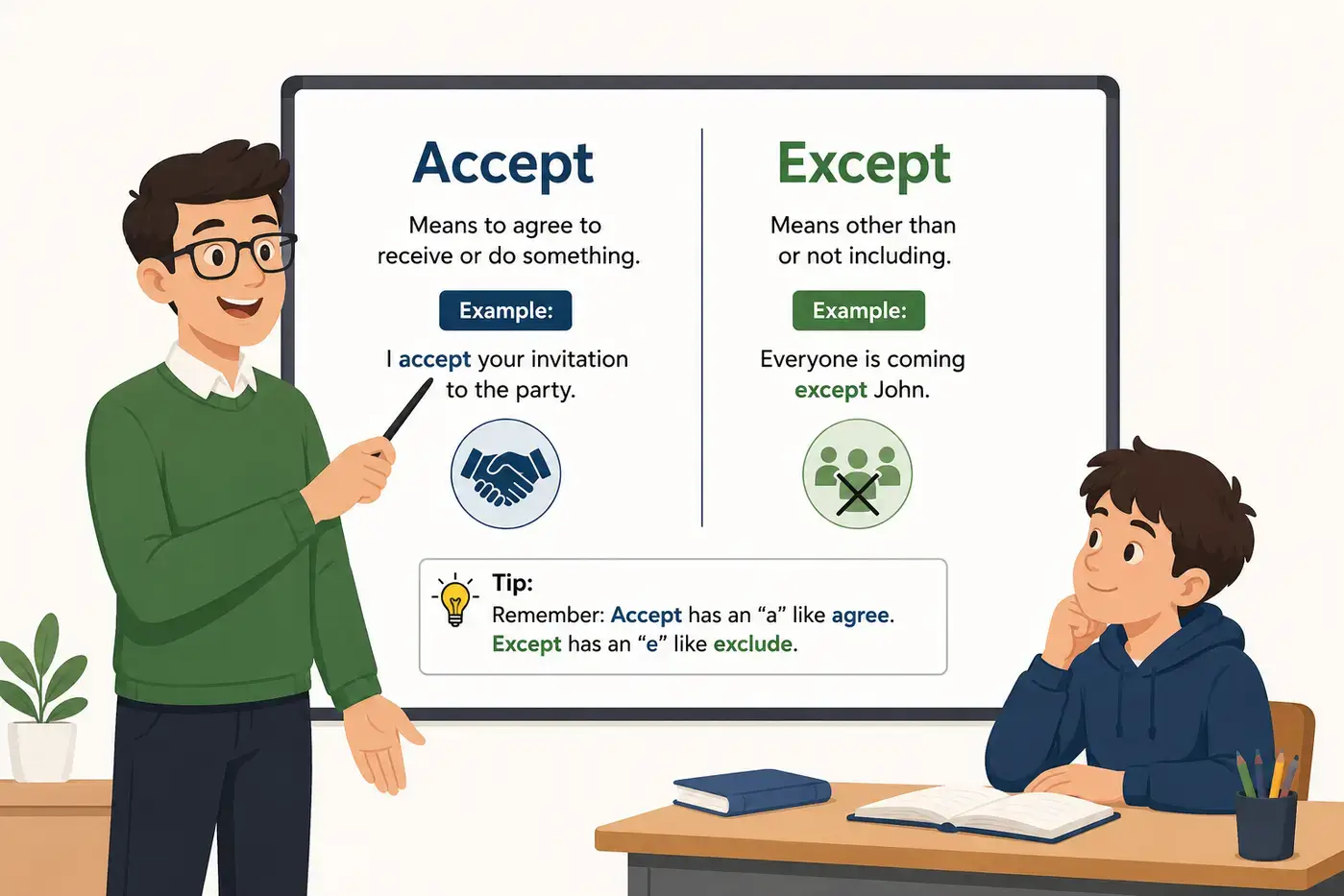
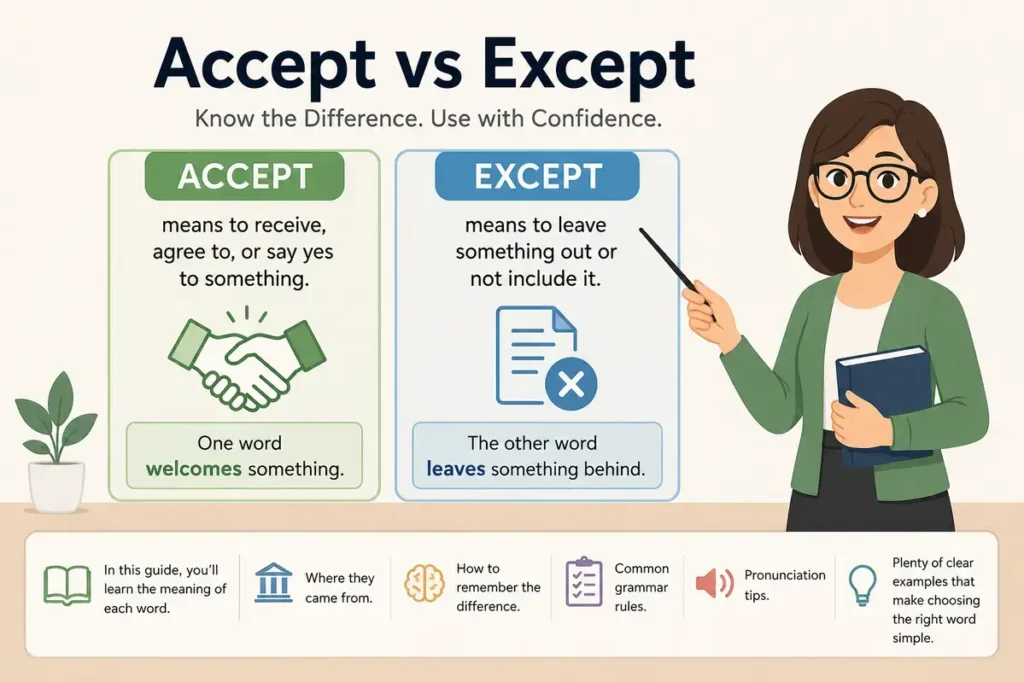
The main difference is simple. Accept means to receive something, agree to something, or recognize something as true. Except means to leave someone or something out of a group or statement. You might accept a job offer, for example, but invite every coworker except the person who is on vacation. The first word expresses agreement or receipt. The second creates an exception.
Both words appear in everyday conversation, school assignments, business emails, legal documents, and formal writing. Once you understand their meanings and grammatical roles, choosing the right one becomes much easier. You’ll also learn how to pronounce them, recognize common errors, and use each word naturally in American English.
Need another quick comparison? Read former vs latter Explained With Clear Examples.
Quick Answer
Accept means to receive, agree to, or recognize something. Except means to exclude someone or something. For example, you can accept an invitation, but you might invite everyone except your neighbor. Both words are correct, but they have different meanings and grammatical uses. The easiest way to choose is to remember that accept means receive and except means leave out.
Comparison Table
| Feature | Accept | Except |
|---|---|---|
| Main meaning | Receive or agree to | Exclude or leave out |
| Part of speech | Verb | Usually a preposition or conjunction |
| Common use | Accept an offer | Everyone except Mia |
| Pronunciation | /əkˈsɛpt/ | /ɪkˈsɛpt/ |
| Example | I accept your apology. | Everyone came except Noah. |
| Memory clue | Receive | Exclude |
| Common phrase | Accept responsibility | All except one |
The most useful distinction is grammatical as well as semantic. Accept describes an action, while except usually introduces an exclusion. Their similar spelling doesn’t make them interchangeable.
Meaning and Definition
What Does Accept Mean
Accept is a verb that means to receive something willingly, agree to an offer or proposal, or recognize something as valid or true. The exact meaning depends on the sentence, but the central idea involves receiving, agreeing, or acknowledging.
Here are the main ways people use it.
1. To receive something.
When you accept something, you take it or agree to receive it.
Examples.
- She accepted the gift from her friend.
- The university accepted his application.
- He accepted the package at the front desk.
In each sentence, someone receives something that is offered or submitted.
2. To agree to an offer or invitation.
Accept also describes a decision to say yes to an opportunity, request, or proposal.
Examples.
- I accepted the job offer.
- They accepted our invitation to dinner.
- She accepted the terms of the agreement.
The person agrees to the offer rather than rejecting it.
3. To recognize something as true.
You can accept a fact, explanation, or situation even when you don’t like it.
Examples.
- We must accept the facts.
- He accepted that he had made a mistake.
- She found it difficult to accept the news.
Here the word refers to acknowledging something as real or true.
4. To take responsibility.
Accept commonly appears in phrases about responsibility, blame, and consequences.
Examples.
- He accepted responsibility for the error.
- The manager accepted the blame.
- She accepted the consequences of her decision.
These expressions show a willingness to acknowledge an obligation or outcome.
5. To allow or approve something.
An organization may accept a payment, document, application, or form of identification.
Examples.
- The store accepts credit cards.
- The school accepts late applications under certain conditions.
- The website accepts several file formats.
In these examples, accept means to allow something to be submitted, used, or approved.
What Does Except Mean
Except means excluding someone or something from a group, statement, or action. It often identifies the person or item that doesn’t belong with the others.
Examples.
- Everyone attended except Daniel.
- I eat every vegetable except mushrooms.
- The store is open every day except Sunday.
Each sentence names a group or general situation and then identifies an exception.
Except can function as a preposition, a conjunction, and, in some uses, a verb. The preposition use is especially common in everyday English.
1. Except as a preposition.
A preposition connects a word or phrase to the rest of a sentence. In this use, except means excluding or leaving out.
Examples.
- All the students passed except Jake.
- The office is open every day except Saturday.
- I invited everyone except my cousin.
The words after except identify the person or thing excluded.
2. Except as a conjunction.
A conjunction connects clauses or ideas. Except can introduce a clause that explains an exception.
Examples.
- I would have called you, except my phone was dead.
- She agreed to help, except she couldn’t arrive before noon.
- We would have finished earlier, except the computer stopped working.
In these sentences, the second part explains the condition or problem that prevented the expected result.
3. Except in the expression except for.
The phrase except for identifies something that doesn’t fit the general statement.
Examples.
- The room was clean except for the muddy floor.
- Except for one small mistake, your report looks excellent.
- The trip went well except for the rain.
The phrase often highlights a single difference within an otherwise accurate description.
Key Differences Explained
The difference between these words becomes clearer when you compare their meanings and roles.
Meaning
Accept means receive, agree to, or acknowledge. Except means exclude or leave out.
Compare these sentences.
- The teacher accepted my assignment.
- Everyone submitted the assignment except Mark.
In the first sentence, the teacher receives the work. In the second, Mark is the only person excluded from the group that submitted it.
Part of Speech
Accept is a verb. It expresses an action or state of agreement.
Except is most often a preposition or conjunction. It introduces an exclusion or an exception.
For example, you can write, “I accept your offer.” You can also write, “Everyone agreed except me.” The first sentence needs a verb to show agreement. The second uses except to identify the person who didn’t agree.
Sentence Structure
Accept usually takes an object, such as a gift, offer, apology, or responsibility.
Examples.
- She accepted the invitation.
- We accept cash payments.
- He accepted the decision.
Except often appears after a general statement.
Examples.
- Everyone except Sam arrived early.
- I like all the colors except orange.
- The building is open except on holidays.
This pattern makes except especially useful when you’re describing a group with one or more exclusions.
Spelling
Both words contain six letters and share the ending cept. The first vowel sound and letter differ.
Accept begins with ac. Except begins with ex.
A useful memory clue is to connect the first letter of each word to its meaning. Accept is about accepting something. Except is about excluding something. The clue isn’t a strict spelling rule, but it helps you remember the difference.
Pronunciation
Both words have two syllables and end with the same stressed sound, /sɛpt/. Their first syllables differ slightly in pronunciation.
Accept is commonly pronounced /əkˈsɛpt/. Except is commonly pronounced /ɪkˈsɛpt/.
The stress falls on the second syllable in both words. Because the words sound similar in fast speech, context often helps listeners identify the intended meaning.
Formality
Both words are standard English and work in formal and informal writing.
Accept appears in business agreements, school communications, personal messages, and everyday conversation.
Except appears in instructions, schedules, contracts, descriptions, and casual speech.
Neither word is more formal than the other by default. The right choice depends on the meaning you want to express.
Regional Usage
Accept and except have the same basic meanings in American, British, Canadian, and Australian English. There is no major regional spelling difference to learn.
Some expressions may vary by region or context, but the core distinction remains stable. Writers in all these varieties use accept for receiving or agreeing and except for excluding.
Which Form Is Correct
Both forms are correct. The right choice depends on the meaning and grammar of your sentence.
Use accept when someone receives something, agrees to a proposal, or recognizes a fact.
Use except when you need to exclude a person, item, day, or situation from a general statement.
Consider these examples.
- Correct: I accept your apology.
- Correct: Everyone accepted the invitation except Chris.
- Correct: The restaurant accepts reservations.
- Correct: The restaurant is open every day except Monday.
The second example uses both words correctly. Everyone accepted the invitation describes agreement. Except Chris identifies the person excluded from the group.
A spelling checker may recognize both words as valid. That doesn’t mean the word fits the sentence. You need to check the intended meaning as well as the spelling.
Ten Natural Sentence Examples
These examples show how to use each word in common situations.
Examples With Accept
1. Everyday conversation.
“I accept your offer to help me move.”
Accept means the speaker agrees to receive help.
2. Text messages.
“Thanks for the invitation. I’d be happy to accept.”
The speaker agrees to attend or take part in an event.
3. Workplace communication.
“Our department accepts requests through the online form.”
Accept means the department allows people to submit requests.
4. School.
“The teacher accepted my late assignment.”
The teacher agreed to receive the assignment despite its late arrival.
5. Formal writing.
“Both parties accept the terms of the agreement.”
The parties agree to the conditions in the document.
Examples With Except
6. Everyday conversation.
“Everyone is ready except my brother.”
The brother is the only person who isn’t ready.
7. Text messages.
“I’m free all weekend except Saturday morning.”
The speaker is available at other times but not during Saturday morning.
8. Workplace communication.
“All employees must attend the meeting except those on approved leave.”
Employees on approved leave are excluded from the attendance requirement.
9. School.
“I answered every question except the last one.”
The last question is the only one the student didn’t answer.
10. Formal writing.
“The policy applies to all departments except those listed in Appendix B.”
The listed departments are excluded from the policy.
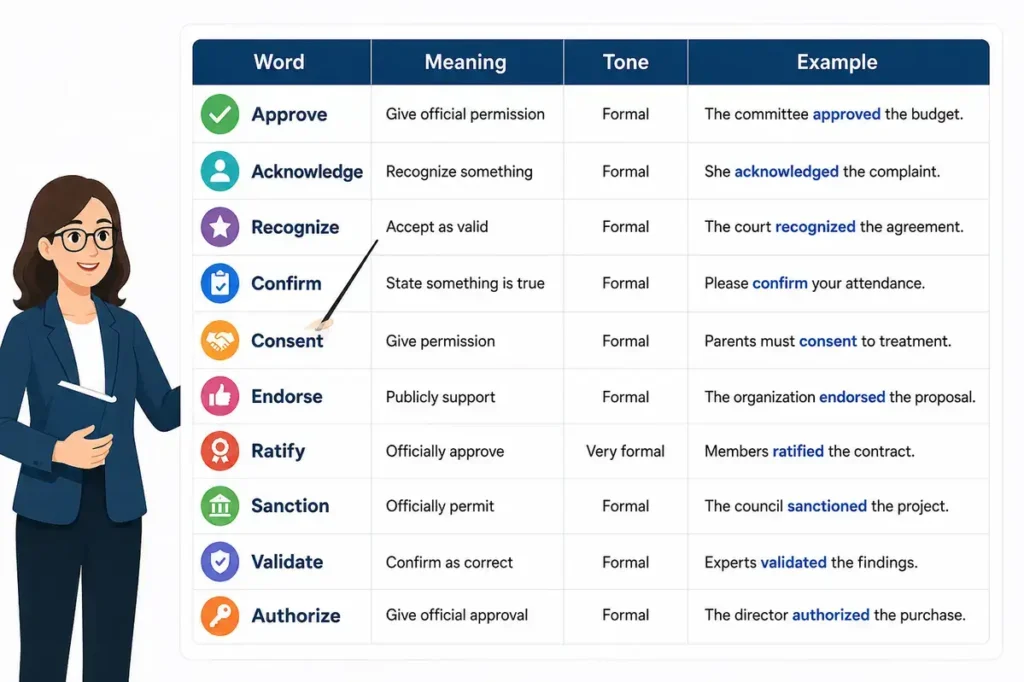
Formal Synonyms for Accept
These words are common in business, academic, legal, and professional writing.
| Word | Meaning | Tone | Example |
|---|---|---|---|
| Approve | Give official permission | Formal | The committee approved the budget. |
| Acknowledge | Recognize something | Formal | She acknowledged the complaint. |
| Recognize | Accept as valid | Formal | The court recognized the agreement. |
| Confirm | State something is true | Formal | Please confirm your attendance. |
| Consent | Give permission | Formal | Parents must consent to treatment. |
| Endorse | Publicly support | Formal | The organization endorsed the proposal. |
| Ratify | Officially approve | Very formal | Members ratified the contract. |
| Sanction | Officially permit | Formal | The council sanctioned the project. |
| Validate | Confirm as correct | Formal | Experts validated the findings. |
| Authorize | Give official approval | Formal | The director authorized the purchase. |
Common Mistakes and Misspellings
These are some frequent errors involving the two words.
Mistake One Using Except Instead of Accept
Incorrect: “She excepted the job offer.”
Correct: “She accepted the job offer.”
The sentence describes agreeing to an offer, so the verb accept is needed. Except does not mean agree to or receive.
Mistake Two Using Accept Instead of Except
Incorrect: “Everyone came accept Maria.”
Correct: “Everyone came except Maria.”
The sentence identifies someone who didn’t come. Except introduces the exclusion.
Mistake Three Confusing Acceptance With Exception
Incorrect: “There is one acceptance to the rule.”
Correct: “There is one exception to the rule.”
Acceptance means the act of accepting or agreeing. Exception means something excluded from a rule or general statement.
Mistake Four Writing Except When You Mean Expect
Incorrect: “I except you to arrive at noon.”
Correct: “I expect you to arrive at noon.”
Expect means to believe something will happen or to consider something likely. It is another similar looking word, but its meaning differs from both accept and except.
Mistake Five Using Accept When You Mean Except For
Incorrect: “The report was complete accept for two missing pages.”
Correct: “The report was complete except for two missing pages.”
The phrase identifies the missing pages as the only problem. The verb accept cannot serve that purpose.
Pronunciation Guide
Both words have two syllables, and both receive their strongest stress on the second syllable.
| Word | IPA | Easy pronunciation guide | Stress |
|---|---|---|---|
| Accept | /əkˈsɛpt/ | uhk SEPT | Second syllable |
| Except | /ɪkˈsɛpt/ | ik SEPT | Second syllable |
The first syllable is the main sound difference. In accept, it begins with a relaxed vowel similar to the first sound in about. In except, it begins with a short vowel similar to the one in sit.
Don’t rely on pronunciation alone when the words appear in fast conversation. The sounds are close enough that the sentence’s meaning can be a better clue.
For example, “I accept everyone” and “I expect everyone” sound different in careful speech, but a listener may need the full sentence to understand a speaker in a noisy room. The best way to improve recognition is to practice each word in a complete sentence.
Need another quick comparison? Read Conscience vs Conscious Which Word Is Correct.
Etymology and Word Origin
The words have different histories, even though their spellings overlap.
The Origin of Accept
Accept comes through French from Latin acceptare, a form related to accipere, meaning to receive or take. Its modern English meanings developed around receiving something, agreeing to an offer, or acknowledging something as true.
This history fits its present use. When you accept a gift, you receive it. When you accept a proposal, you agree to it.
The Origin of Except
Except comes through French from Latin excipere, meaning to take out or exclude. Its parts are associated with the idea of taking something out from a larger group.
That history connects directly to the modern meaning. When you invite everyone except one person, you leave that person out. When a rule applies to all items except one, that item is excluded.
The shared letters can make the words look almost interchangeable, but their origins reflect two different ideas: receiving and excluding.
Regional Usage
American English
Both words are standard in the United States. Americans use accept in phrases such as accept an invitation, accept responsibility, accept payment, and accept an apology.
Except appears in phrases such as everyone except me, open every day except Sunday, and all except one. These expressions are common in conversation and professional writing.
British English
British English uses the same basic distinction. Accept means to receive or agree to something, while except means to exclude. There is no meaningful difference in standard spelling between British and American English for these words.
Australian English
Australian English also uses both words in the same general way. Accept appears in everyday and formal settings, while except identifies an exclusion or exception.
Canadian English
Canadian English follows the same pattern. Writers use accept for agreement or receipt and except for exclusion. Local style preferences may affect the wording of a sentence, but not the central meaning of these words.
Grammar Rules and Part of Speech
Understanding grammar makes the choice easier because the two words perform different jobs.
How Accept Works in a Sentence
It is a verb. It can appear in several common patterns.
Accept + noun.
- She accepted the invitation.
- The store accepts returns.
Accept + pronoun.
- I accept it.
- They accepted them.
With that clause.
- He accepted that he was wrong.
- She accepted that the plan needed changes.
Accept + responsibility or another abstract noun.
- He accepted responsibility.
- The company accepted liability.
In each case, accept describes receiving, agreeing, or acknowledging.
How Except Works in a Sentence
Except often acts as a preposition.
Everyone or everything + except + noun.
- Everyone except Alex stayed.
- Everything except the blue box was packed.
All or every + noun + except + noun.
- All the rooms except the kitchen were clean.
- Every student except Lily finished the quiz.
Except for + noun phrase.
- Except for the traffic, the trip was easy.
- The essay was strong except for its conclusion.
Except can also introduce a clause.
- I would have joined you, except I had another appointment.
- The event went well, except the microphone stopped working.
Punctuation depends on sentence structure. A comma is often used before except when it introduces a separate explanatory clause, but it is not required in every sentence. Avoid adding a comma automatically before a simple exclusion such as “everyone except Alex.”
Real Life Usage Examples
Daily Conversation
“Can you accept this package for me?”
Accept means to receive the package on someone else’s behalf.
“Everyone is coming except Ryan.”
Except shows that Ryan isn’t included in the group.
Email and Workplace Communication
“Please accept the attached document as the final version.”
Here accept means to receive or approve the document as final.
“All team members must attend except those who have already received approval to be absent.”
Except introduces the group excluded from the requirement.
Academic Writing
“The researcher accepted the revised hypothesis after reviewing the evidence.”
Accept means to agree that the hypothesis is suitable.
“All samples except the control sample were exposed to the treatment.”
Except identifies the sample excluded from the treatment.
News and Journalism
“The organization accepted donations from several local businesses.”
Accept means the organization received the donations.
“The road is closed to all traffic except emergency vehicles.”
Except identifies the vehicles that are allowed through.
Literature and Storytelling
“After a long discussion, the king accepted the messenger’s proposal.”
Accept describes the king’s decision to agree.
“Every window was dark except the one in the tower.”
Except creates a contrast by identifying the only lit window.
Eight Related and Confused Terms
These words and expressions can help you understand the difference more deeply.
1. Acceptance
Acceptance is a noun related to accept. It means the act of receiving, agreeing to, or recognizing something.
Example: “Her acceptance of the offer surprised everyone.”
2. Exception
Exception is a noun related in meaning to except. It refers to a person or thing excluded from a general rule.
Example: “The manager made an exception to the policy.”
3. Expect
Expect means to believe that something will happen or to consider it likely.
Example: “I expect the package to arrive tomorrow.”
It is not a substitute for accept or except.
4. Reject
Reject means to refuse, dismiss, or decline something. It is often the opposite of accept.
Example: “The committee rejected the proposal.”
5. Receive
Receive means to get something that is given, sent, or delivered. It overlaps with one meaning of accept, but accept often suggests willingness or approval.
Example: “I received the package yesterday.”
6. Exclude
Exclude means to keep someone or something out of a group, activity, or process. It is a useful synonym for except in many contexts.
Example: “The rules exclude visitors under the age of twelve.”
7. Approve
Approve means to officially agree to or authorize something. Accept can sometimes have a similar meaning, but approval often focuses on permission or judgment.
Example: “The supervisor approved the request.”
8. Apart From
Apart from can mean excluding or in addition to, depending on context. When it means excluding, it can sometimes replace except for.
Example: “Apart from one typo, the report was ready.”
These related terms are useful, but they aren’t interchangeable in every sentence. Always check the exact meaning and grammatical pattern.
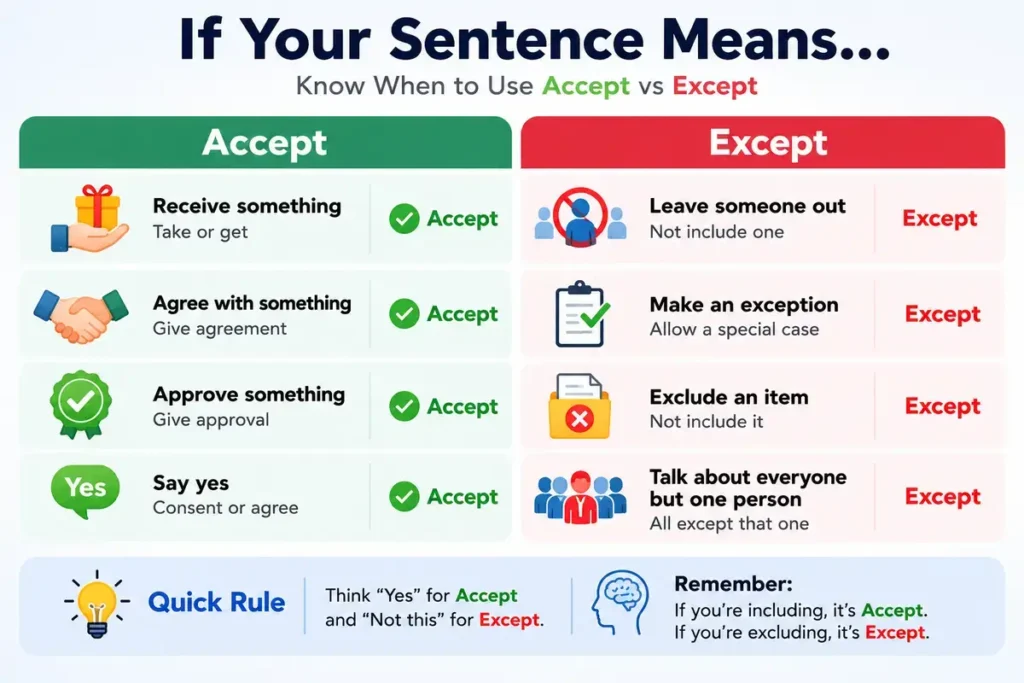
Accept vs Except Cheat Sheet
| If Your Sentence Means… | Use |
|---|---|
| Receive something | Accept |
| Agree with something | Accept |
| Approve something | Accept |
| Say yes | Accept |
| Leave someone out | Except |
| Make an exception | Except |
| Exclude an item | Except |
| Talk about everyone but one person | Except |
Expert Editor Insight
An experienced editor checks meaning before changing either word. Both are standard English, so a spelling checker may accept both even when one doesn’t fit the sentence. Read the sentence and identify its purpose. If someone is receiving or agreeing to something, use accept. If the sentence leaves a person or item out, use except. This quick meaning check is more reliable than choosing a word based only on how it looks or sounds.
Still confused? Compare Arised or Arose Which Is Correct.
Conclusion
The difference between accept and except comes down to meaning. Accept is a verb that describes receiving something, agreeing to an offer, or recognizing a fact. Except usually means excluding a person or item from a group or statement. Both are correct English words, and neither should replace the other.
To choose the right word, ask what your sentence means. If someone is receiving or agreeing to something, use accept. If you’re leaving someone or something out, use except. Remember the simple pairing accept means receive, and except means exclude. With that quick check, you can write clearer emails, assignments, reports, and everyday messages with confidence.
FAQs
Is accept or except correct?
Both are correct words, but they have different meanings. Accept is a verb meaning to receive, agree to, or acknowledge something. Except usually means excluding someone or something. Choose the word that matches the meaning of your sentence rather than treating one spelling as incorrect.
What does accept mean in simple English?
Accept means to receive something, say yes to an offer, or recognize something as true. You can accept a gift, accept a job, accept an apology, or accept responsibility. The word usually describes an action involving receipt, agreement, or acknowledgment.
What does except mean in simple English?
Except means leaving someone or something out of a group or general statement. For example, “Everyone attended except Maya” means Maya did not attend, while everyone else did. The word is useful when describing rules, groups, schedules, and situations with exclusions.
How do you pronounce accept and except?
Accept is pronounced /əkˈsɛpt/, while except is pronounced /ɪkˈsɛpt/ in standard American English. Both have two syllables and stress the second syllable. Their first vowel sounds differ, but they can sound similar in fast speech, so context also helps you identify the correct word.
Can except start a sentence?
Yes. Except can start a sentence or introductory phrase, especially when used with for. For example, “Except for the rain, the picnic was perfect.” This structure identifies one detail that differs from the general situation. Make sure the rest of the sentence expresses a complete and clear idea.
What is a synonym for accept?
Depending on the context, synonyms for accept include receive, approve, agree to, admit, and acknowledge. These words have slightly different meanings. Receive emphasizes getting something, approve emphasizes authorization, and acknowledge emphasizes recognizing something as true. Choose a synonym that preserves the meaning of the original sentence.
Why do people confuse accept and except?
People confuse these words because they share similar spellings and nearly identical sounds. Both contain the letters c, e, p, and t in a similar pattern. However, their meanings and grammatical roles differ. Learning one example for each word and connecting accept with receive and except with exclude can help prevent errors.
Is accept appropriate in formal writing?
Yes. Accept is standard in formal and informal English. Writers use it in business agreements, academic papers, legal documents, and everyday messages. Common formal expressions include accept responsibility, accept the terms, accept an application, and accept the findings. The key is to use it only when the sentence expresses receipt, agreement, or acknowledgment.