
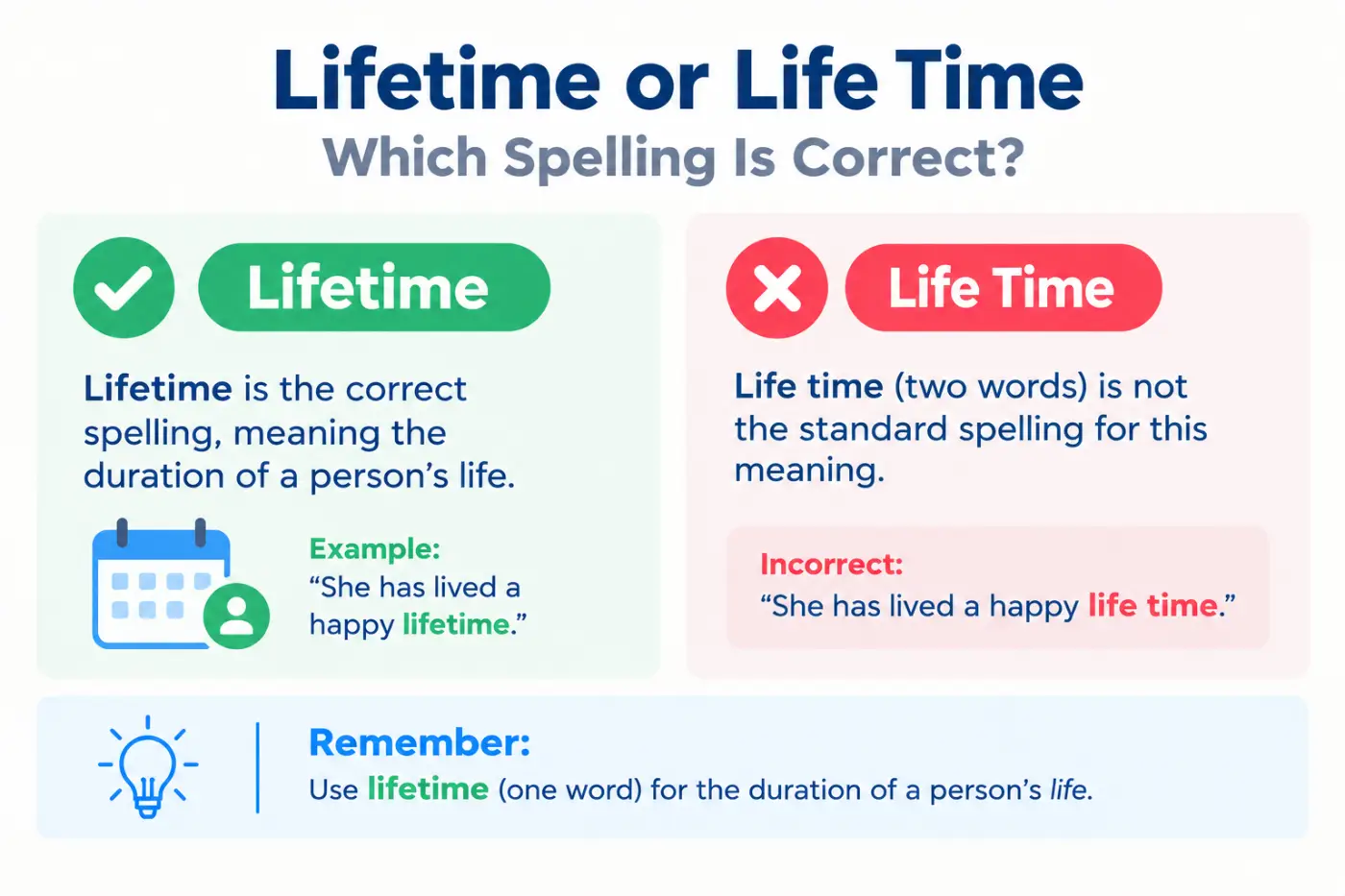
If you’ve ever wondered if you should write lifetime or life time, you’re not alone. The words look similar, and English often allows compound words to appear as one word, two words, or hyphenated forms. However, not every spelling variation is equally accepted in standard writing. For the usual meaning of a person’s entire life or the duration of something, lifetime is the preferred spelling.
You can use this word to describe a person’s years on Earth, the period a product lasts, or an experience that feels especially rare. For example, a lifetime of hard work can lead to a major achievement, and a lifetime warranty promises coverage under certain conditions for a defined period. The exact meaning depends on the phrase and its context.
Understanding this spelling helps you write more clearly in emails, school assignments, articles, product descriptions, and everyday messages. You’ll also learn how the word works as a noun and an adjective, how to pronounce it, which related expressions to use, and why the two word form can cause confusion.
For another common grammar confusion, see tonite or tonight Which Spelling Is Correct.
Quick Answer
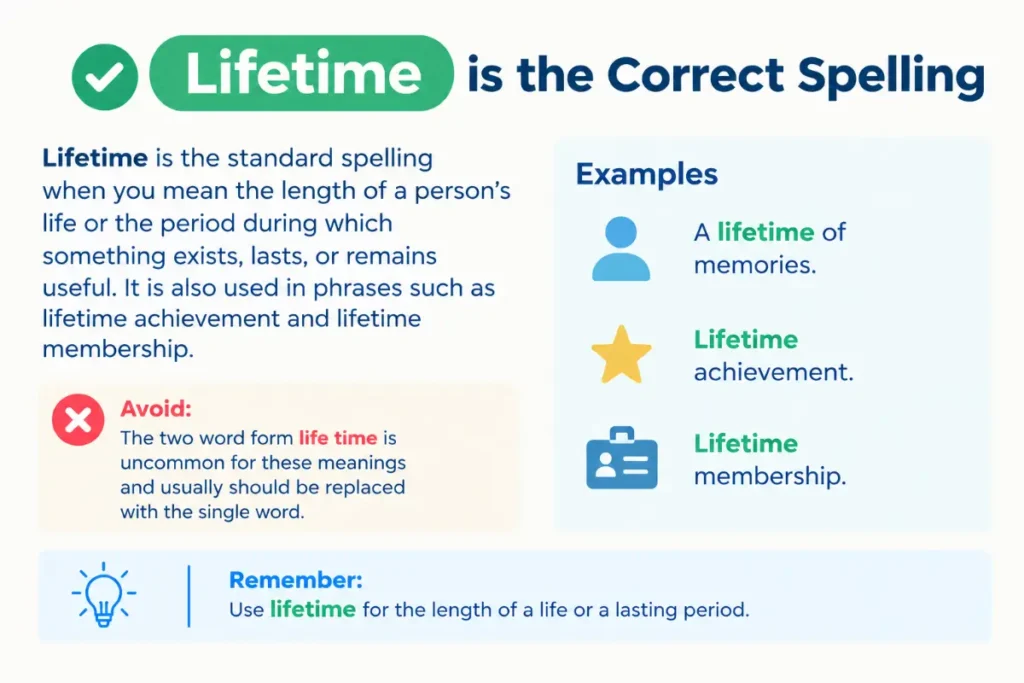
Lifetime is the standard spelling when you mean the length of a person’s life or the period during which something exists, lasts, or remains useful. It is also used in phrases such as lifetime achievement and lifetime membership. The two word form life time is uncommon for these meanings and usually should be replaced with the single word.
Meaning and Definition
What Lifetime Means
Lifetime is a noun that usually means the period during which a person lives or the period during which something exists or remains active. It can also refer to a period associated with a particular experience, activity, or commitment.
Here are three common meanings.
- The length of a person’s life.Example: She spent her lifetime helping others.The sentence refers to the years she lived and the work she did during those years.
- The period during which something lasts or remains in use.Example: The battery has a long lifetime.Here the word refers to how long the battery is expected to function.
- A period in which someone experiences or achieves something significant.Example: Winning the championship was a lifetime dream.The sentence describes a goal the person had held for many years.
The meaning can shift slightly with context, but the core idea involves a period of time connected to a life, object, experience, or commitment.
What Life Time Means
Life time is a two word combination that may appear in specialized contexts or when a writer is treating life and time as separate grammatical elements. However, it is not the usual spelling for the standard noun meaning the length of a life or the period something lasts.
For example, in ordinary writing, this sentence is preferred.
Correct: He devoted his lifetime to teaching.
Less appropriate: He devoted his life time to teaching.
The single word is the established form for this meaning.
A two word combination can sometimes occur in technical writing, where life describes a specific kind of time or where the terms have been defined separately. In such cases, the writer should follow the terminology used in the relevant field. That specialized use does not make the two word form the standard choice in everyday English.
Lifetime or Life Time Comparison
| Feature | Lifetime | Life time |
|---|---|---|
| Standard spelling | Yes | Usually not for the ordinary noun |
| Main meaning | The length of a life or the duration of something | A literal combination of life and time in a specific context |
| Part of speech | Noun and adjective | Depends on the sentence |
| Common usage | Everyday and professional English | Limited or specialized contexts |
| Formal writing | Preferred for the standard meaning | Avoid unless the context specifically requires two words |
| Common phrases | Lifetime achievement, lifetime membership, once in a lifetime | No common general expression uses this form |
| Example | She received a lifetime achievement award. | Use only when a technical or grammatical context supports the separate words |
Which Spelling Should You Use
Use lifetime in ordinary English when referring to a person’s life or the duration of something.
The reason is straightforward. English has many established compound words that are written as one word. Lifetime is one of them. Dictionaries recognize it as a standard noun and adjective, and common expressions consistently use the single word.
Consider these examples.
- He saved money throughout his lifetime.
- The company offers a lifetime warranty on selected products.
- She earned a lifetime achievement award.
- It was the opportunity of a lifetime.
- They became lifetime members of the organization.
In each sentence, the single word is natural and standard.
If you’re writing an essay, business email, website article, report, or product description, choose lifetime for these meanings. You don’t need to add a space simply because the word contains the familiar words life and time.
How the Word Works in a Sentence
Lifetime as a Noun
The most common use is as a noun. It names a period of time associated with a person’s life or the duration of something.
Example: He wrote three books during his lifetime.
Here, lifetime refers to the years he was alive.
Example: The device has an estimated lifetime of ten years.
Here, it refers to the expected period during which the device remains useful.
Example: I’ve learned a lifetime’s worth of lessons from my grandparents.
The expression suggests that the lessons are valuable and numerous enough to fill many years of experience.
The noun can appear as a subject, object, or part of a longer phrase.
- A lifetime can pass quickly.
- She dedicated her lifetime to research.
- The project required a lifetime of patience.
- He received recognition late in his lifetime.
The word remains a noun in all these examples.
Lifetime as an Adjective
Lifetime can also work as an adjective before another noun. In this role, it describes something that lasts for a person’s life or relates to a long term commitment or achievement.
Common examples include lifetime membership, lifetime access, lifetime warranty, lifetime achievement, and lifetime subscription.
Example: She received lifetime membership in the association.
The adjective describes the type of membership.
Example: The manufacturer provides a lifetime warranty.
The adjective describes the warranty, although the actual coverage depends on the written terms.
Example: He won a lifetime achievement award.
The phrase describes an award recognizing major achievements over a person’s career or life.
As a general rule, lifetime is written as one word in both noun and adjective uses.
Lifetime in Compound Expressions
English uses lifetime in several familiar phrases. Learning them as complete expressions can help you remember the spelling.
- A lifetime ago. This means a very long time ago.Example: We moved to this city what feels like a lifetime ago.
- Once in a lifetime. This describes an event or opportunity that is extremely rare.Example: Seeing the northern lights was a once in a lifetime experience.
- Lifetime achievement. This refers to recognition for a person’s major accomplishments over many years.Example: The actor received a lifetime achievement award.
- Lifetime membership. This describes membership that lasts for the member’s lifetime under the relevant rules.Example: She was granted lifetime membership in the club.
- Lifetime warranty. This refers to a warranty whose coverage period is defined by its terms, often in relation to the product’s expected life or the owner’s life.Example: Read the conditions before relying on a lifetime warranty.
- Lifetime savings. This refers to money saved over many years or throughout a person’s life.Example: He invested his lifetime savings in a small business.
These expressions all use the standard single word spelling.
Ten Natural Example Sentences
The following examples show how lifetime works in different situations.
- Everyday conversation: I’ve known her for what feels like a lifetime.This means the speaker feels they have known her for a very long time. It does not necessarily mean they have known her for their entire life.
- Family life: My grandfather shared stories from his lifetime.The word refers to the years he lived and the experiences he collected.
- Work: She received a lifetime achievement award for her work in education.Here, lifetime describes an award recognizing accomplishments over many years.
- School: The scientist’s lifetime research changed how people understood the subject.The phrase points to research carried out over much of the scientist’s life.
- Technology: The software update may extend the lifetime of the device.The sentence refers to how long the device can remain useful.
- Shopping: The product comes with a lifetime warranty, subject to the manufacturer’s terms.Lifetime describes the warranty period, but the terms determine the actual coverage.
- Travel: Visiting the Grand Canyon was a trip of a lifetime.This expression describes an exceptional experience the traveler may never repeat.
- Personal goals: Publishing her first novel was a lifetime dream.The phrase means the dream had been important to her for many years.
- Formal writing: The report examines the lifetime costs of maintaining the equipment.Here, lifetime describes costs considered across the equipment’s expected period of use.
- Social situations: They celebrated a friendship that had lasted a lifetime.The word emphasizes the long duration of their friendship.
These examples show that the word works across personal, professional, academic, and everyday contexts. Its spelling remains the same even when the meaning changes slightly.
Common Spelling Mistakes
Writing Life Time as Two Words
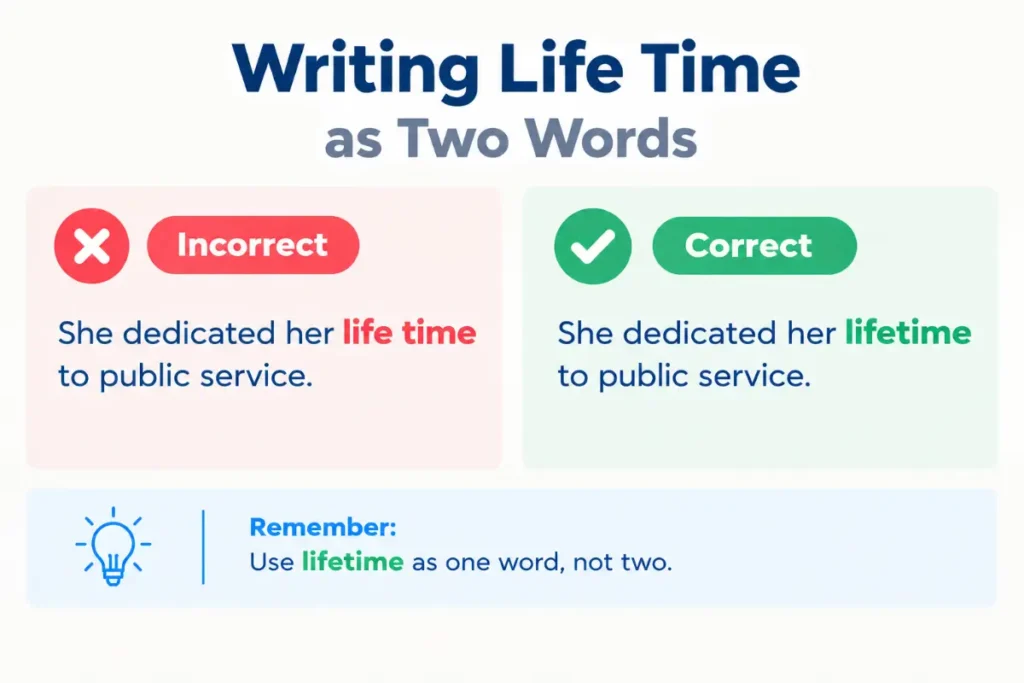
Incorrect: She dedicated her life time to public service.
Correct: She dedicated her lifetime to public service.
The mistake happens because writers recognize life and time as separate words and assume the combination should also have a space. In standard English, the established compound noun is written as one word.
Adding a Hyphen Without a Reason
Less appropriate: He received a life time achievement award.
Correct: He received a lifetime achievement award.
The hyphen or space does not belong in this standard expression. Use the established single word form.
Confusing Lifetime With Lifelong
Incorrect: She has a lifetime friend from childhood.
More natural: She has a lifelong friend from childhood.
Lifetime usually names a period or describes a type of award, membership, or warranty. Lifelong is an adjective that means lasting throughout a person’s life. The best choice depends on the intended meaning.
Confusing Lifetime With Lifespan
Incorrect: The lifespan of his lifetime is seventy years.
Correct: The expected lifespan of the animal is seventy years.
Lifespan refers to the length of life expected or experienced by a person, animal, or other living thing. Lifetime refers to the period of a particular life or the duration of something more broadly.
Misusing Lifetime Warranty
Incorrect: The product has a lifetime warranty, so every repair will be free forever.
Better: The product has a lifetime warranty. Check the terms to see what the warranty covers and how long the coverage lasts.
The spelling is not the problem in this example. The mistake is assuming that lifetime always means unlimited coverage. A warranty’s legal terms define the protection it offers.
Pronunciation Guide
Lifetime is pronounced with two syllables in standard American English.
IPA: /ˈlaɪf.taɪm/
Easy pronunciation: LIFE time.
The primary stress falls on the first syllable. The first part rhymes with life, and the second part rhymes with time.
Say the word naturally as one connected word rather than pausing between its parts. Although life and time are recognizable within the spelling, the compound has a familiar, established rhythm.
Common pronunciation mistakes include placing equal stress on both syllables or pausing so much that the word sounds like two separate words. A brief pause is not normally needed.
The pronunciation does not change based on its grammatical role. You pronounce lifetime the same way when referring to a person’s life, a warranty, an achievement, or a long lasting experience.
For another common grammar confusion, see optimize or optimise Correct Spelling And Usage.
Etymology and Word Origin
Lifetime combines life and time. Both elements have long histories in English, and their combination follows a familiar pattern in which two existing words form a compound with a related meaning.
Life comes from Old English līf, which referred to life or living existence. Time comes from Old English tīma, which referred to a period or occasion. Over time, English formed compounds that describe periods connected with a particular condition, activity, or existence.
The compound lifetime developed into a standard noun for the duration of a life. Its meaning later extended naturally to the duration of other things, such as machines, products, and opportunities. The adjective use also became common in phrases describing lasting membership, warranties, and recognition for achievements.
This history helps explain why the modern spelling is one word. The compound has become an established unit in English rather than a casual phrase created each time a writer wants to combine life and time.
Regional Usage
American English
Lifetime is the standard spelling in the United States. It appears in everyday speech, school writing, business documents, product descriptions, and formal publications.
Examples include lifetime warranty, lifetime achievement award, and once in a lifetime opportunity. American writers generally use the single word for the standard meaning.
British English
British English also uses lifetime as the standard spelling. There is no major regional difference in the ordinary meaning or spelling of the word.
A British writer would normally write a lifetime of experience or a lifetime membership just as an American writer would.
Australian English
Australian English follows the same general spelling convention. Lifetime is standard for the duration of a life or the period something lasts.
Canadian English
Canadian English also uses lifetime as the usual single word form. The spelling does not change simply because the writer is using Canadian rather than American English.
Across these varieties, the main distinction remains the same. Use the compound noun for the standard meaning, and reserve the separate words for a context that specifically calls for them.
Grammar Rules and Usage Patterns
When to Use Lifetime
Use lifetime when the word refers to a person’s years of life or the duration of an object, activity, or experience. It can appear in several positions in a sentence.
- As the subject. A lifetime is too short to learn everything.
- As the object. She spent her lifetime serving her community.
- After a preposition. He achieved a great deal during his lifetime.
- Before another noun. The company offers lifetime access to the training program.
- In a fixed expression. This was the chance of a lifetime.
These patterns show that lifetime can function as a noun or an adjective. Its grammatical role depends on how it relates to the other words in the sentence.
When to Use a Different Word
Sometimes lifetime is spelled correctly but still isn’t the best word for the sentence. Choosing the right related term can make your meaning more precise.
For example, use lifespan when discussing the expected length of life of an organism or the useful life of a system. Use lifelong when describing a relationship, interest, or commitment that lasts throughout a person’s life. Use lifetime when referring to the entire period of a particular life or to the duration of something.
Compare these sentences.
- The turtle has a long lifespan.
- She is a lifelong supporter of the team.
- He received an award for his lifetime of service.
Each sentence uses a different word because each expresses a slightly different idea.
Punctuation and Compound Words
The standard spelling does not require a hyphen in ordinary expressions such as lifetime achievement, lifetime membership, and lifetime warranty.
The word remains one word when it appears before a noun as an adjective. You don’t need to add a hyphen simply because it describes the noun that follows.
For example, write a lifetime opportunity rather than a life time opportunity. However, once in a lifetime is a phrase containing the compound noun and a prepositional phrase. It is not written as once in a lifetime with extra hyphens.
Real Life Usage Examples
Daily Conversation
People often use the word in conversation to describe long periods or rare experiences.
- I’ve waited a lifetime for this moment.
- That concert was an experience of a lifetime.
The first example expresses impatience or a long wait, often with exaggeration. The second describes an event as unusually memorable.
Workplace Communication
In a workplace, the word often appears in discussions about service, benefits, products, and long term costs.
- The company presented her with a lifetime achievement award.
- Please review the lifetime cost of maintaining the equipment.
The first sentence recognizes work carried out over many years. The second refers to expenses across the period the equipment is expected to remain in use.
Academic Writing
Academic writers may use the term to describe a person’s years of activity or the duration of a scientific process.
- The study examined changes in health across a person’s lifetime.
- Researchers estimated the lifetime of the material under normal operating conditions.
The first sentence focuses on changes over human life. The second concerns the period the material is expected to remain useful under specified conditions.
News and Journalism
Journalists use the word when reporting on achievements, milestones, and major public events.
- The musician received a lifetime achievement award at the ceremony.
- The historic discovery became the opportunity of a lifetime for the research team.
The first example describes formal recognition. The second emphasizes how rare and valuable the discovery was.
Literature and Storytelling
In stories, the word can help describe the weight of an experience or the passage of time.
- In a single afternoon, she learned lessons that would guide her for a lifetime.
- They had known each other for what seemed like a lifetime.
The first sentence connects one experience to its lasting influence. The second uses figurative language to describe a long friendship.
Related Words and Expressions
Several words are closely related to lifetime, but each serves a different purpose.
Lifespan
Lifespan means the length of time a person, animal, or other living thing lives or is expected to live. It can also describe the useful duration of an object or system in some contexts.
Example: The average lifespan of the species is about twelve years.
Use lifespan when you want to focus on the length of life itself.
Lifelong
Lifelong is an adjective meaning lasting throughout a person’s life.
Example: He has a lifelong interest in music.
Use lifelong to describe a quality, relationship, interest, or commitment that continues throughout life.
Lifetime Achievement
A lifetime achievement is a major accomplishment or body of work recognized over many years. The expression often appears in awards and professional honors.
Example: She received a lifetime achievement award for her contributions to medicine.
Once in a Lifetime
Once in a lifetime describes an opportunity or experience that is extremely rare.
Example: Watching a total solar eclipse from the path of totality was a once in a lifetime experience.
The phrase often emphasizes the special value of an event.
Lifelong Learning
Lifelong learning means continuing to gain knowledge and skills throughout life.
Example: Reading widely can support lifelong learning.
This expression focuses on an ongoing process rather than the length of life itself.
Lifetime Member
A lifetime member is someone whose membership continues for a defined lifetime under the organization’s rules.
Example: The association named her a lifetime member.
The exact rights and conditions depend on the organization’s membership policy.
Useful Life
Useful life refers to the period during which an asset, tool, or piece of equipment is expected to remain useful for its intended purpose.
Example: The engineer estimated the useful life of the machine at fifteen years.
This expression is common in business, accounting, and engineering.
Life Expectancy
Life expectancy is the average number of years a person or group is expected to live under particular conditions.
Example: Improvements in public health can affect life expectancy.
Unlike lifetime, which can refer to one person’s entire life or the duration of something, life expectancy usually describes an estimate based on a population or set of conditions.
Expert Editor Insight
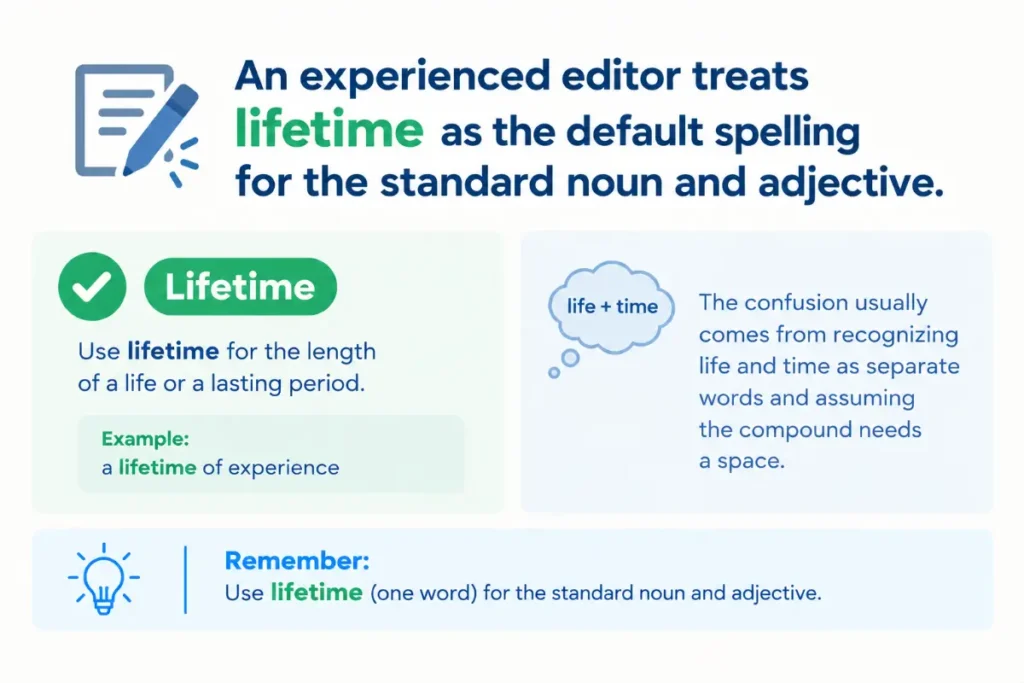
An experienced editor treats lifetime as the default spelling for the standard noun and adjective. The confusion usually comes from recognizing life and time as separate words and assuming the compound needs a space. A spellchecker may catch the two word form in some sentences, but it cannot always judge context or specialized terminology. Editors check the intended meaning, established expressions, and dictionary usage before changing a spelling. For ordinary American English, the single word is the safest choice.
Key Takeaways
- Lifetime is the standard one word spelling for the duration of a life or the period something lasts.
- Life time is generally not the preferred form for this meaning in everyday English.
- Lifetime works as both a noun and an adjective.
- The standard pronunciation has two syllables, with the main stress on the first.
- Lifespan, lifelong, life expectancy, and useful life have related but distinct meanings.
- American, British, Australian, and Canadian English generally follow the same spelling convention.
- Expressions such as lifetime achievement, lifetime warranty, and once in a lifetime use the single word form.
- For ordinary writing, choose lifetime unless a specific technical context requires another construction.
Many readers also check Cryer vs Crier Which Spelling Is Correct 2026.
Conclusion
Lifetime is the standard spelling for the length of a person’s life or the period something lasts. The two word form life time is generally not appropriate for these everyday meanings, although separate words can occur in specialized contexts.
The single word also appears in familiar expressions such as lifetime achievement, lifetime membership, and once in a lifetime. Remember the simple rule: when you mean the duration of a life or the existence of something, write lifetime. If you’re unsure, check the full sentence and choose the established form that matches your meaning.
FAQs
Is lifetime one word or two words?
Lifetime is one word in standard English when you mean the length of a person’s life or the period something lasts. The two word form is uncommon for this meaning. In everyday writing, use lifetime in expressions such as lifetime achievement, lifetime warranty, and once in a lifetime.
Is life time ever correct?
The separate words may appear in specialized technical contexts or in a sentence where life and time have distinct grammatical roles. However, life time is not the usual spelling of the standard compound noun. For ordinary writing about a person’s life or the duration of something, use lifetime.
What does lifetime mean?
Lifetime means the period during which a person lives or the length of time something exists or remains useful. It can also describe a commitment or recognition associated with a person’s life. For example, a lifetime achievement award recognizes important accomplishments over many years.
How do you pronounce lifetime?
Lifetime has two syllables and is pronounced /ˈlaɪf.taɪm/ in standard American English. The first syllable carries the main stress. Say the word as one connected unit, with the first part rhyming with life and the second part rhyming with time.
Is lifetime an adjective or a noun?
Lifetime can function as both a noun and an adjective. As a noun, it refers to the duration of a life or something’s existence. As an adjective, it describes a related product, benefit, or commitment, as in lifetime warranty, lifetime access, and lifetime membership.
What is the difference between lifetime and lifespan?
Lifetime refers to the entire period of a particular life or the duration of something. Lifespan usually focuses on how long a living thing lives or how long something is expected to last. For example, a person’s lifetime covers their years of life, while life expectancy estimates average years of life in a population.
Is lifetime appropriate in formal writing?
Yes. Lifetime is a standard word used in formal reports, academic writing, business documents, and professional awards. Expressions such as lifetime achievement and lifetime cost are common in formal contexts. Use the single word spelling unless a specialized technical convention requires a different form.
What is a synonym for lifetime?
The best alternative depends on the sentence. Lifespan can describe the length of life, duration can refer to the time something lasts, and a person’s years can describe their life in plain language. Lifelong is useful as an adjective for something that continues throughout life, but it cannot replace lifetime in every expression.