
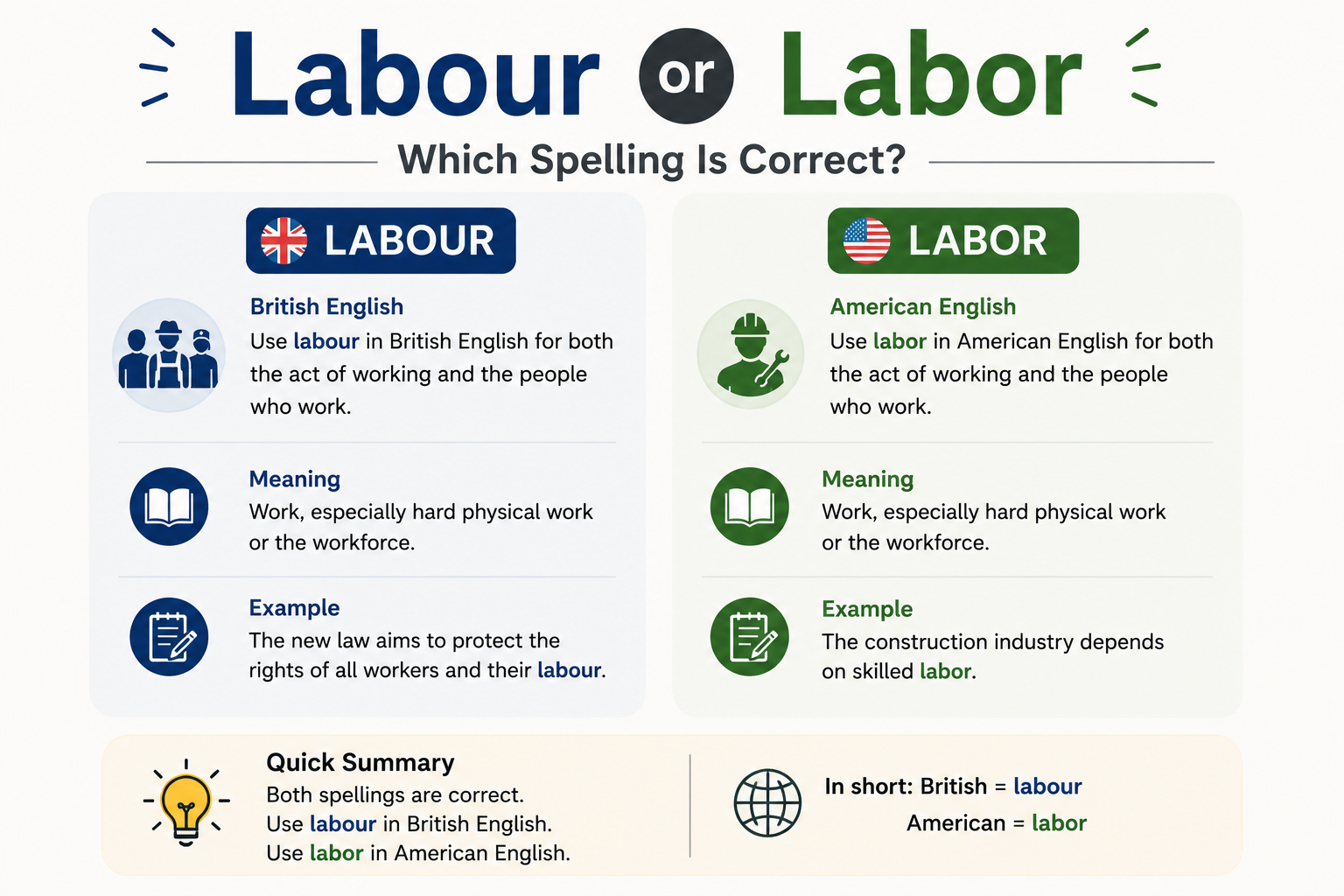
Both labor and labour are correct English spellings. The difference comes mainly from regional English rather than meaning. Labor is the standard spelling in American English, while labour is the standard spelling in British English and is also used in other English varieties that follow British spelling conventions.
The two forms have the same core meanings. They can refer to physical or mental work, effort, workers as a group, or the process of giving birth. The verb can also mean to work hard or struggle to complete something. Cambridge lists labor as the US spelling and labour as the UK spelling.
This spelling difference often catches people off guard because the words sound essentially the same in standard American and British pronunciation. The extra u in the British form is part of a broader spelling pattern found in words such as colour, favour, and honour. If you’re writing for readers in the United States, use labor. If you’re following British English, use labour. The important point is consistency.
A related grammar guide is goodmorning or good morning Correct Spelling And Usage.
Quick Answer
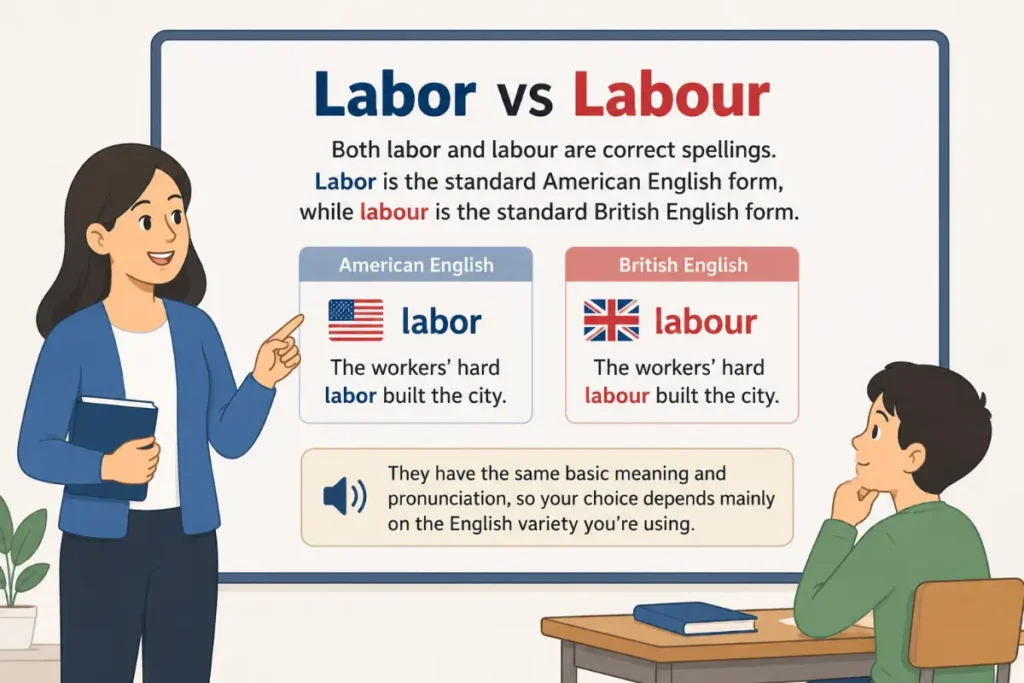
Both labor and labour are correct spellings. Labor is the standard American English form, while labour is the standard British English form. They have the same basic meaning and pronunciation, so your choice depends mainly on the English variety you’re using.
Labour Or Labor At A Glance
The easiest way to remember the difference is to connect the spelling with the variety of English.
Neither spelling is a misspelling when it appears in the English variety that uses it. Merriam Webster identifies labour as chiefly the British spelling of labor. Cambridge likewise identifies labor as the US spelling of labour.
That distinction matters because spelling isn’t always about right versus wrong. English has several accepted regional standards. A spelling can look unusual to an American reader and still be completely standard in British English.
What Labor And Labour Mean
The word has several related meanings. Its central idea is work or effort.
As a noun, it can mean physical work that requires effort. For example, a construction project may involve a large amount of manual labor. A company may also calculate labor costs as part of the total cost of a product or service.
The word can also refer to workers considered as a group. Expressions such as skilled labor, unskilled labor, and labor shortage are common in American English. British English commonly uses the corresponding spelling skilled labour, unskilled labour, and labour shortage.
Another important meaning relates to childbirth. In American English, people commonly say:
She went into labor last night.
In British English, the same sentence uses the other spelling:
She went into labour last night.
The meaning doesn’t change.
The word also works as a verb. It can describe hard physical work or an activity that takes considerable effort.
For example:
The rescue workers labored for hours to clear the road.
In British English, the spelling becomes:
The rescue workers laboured for hours to clear the road.
The spelling changes, but the underlying word and meaning remain the same.
Why The Spelling Is Different
The extra u isn’t random. It reflects a broader difference between American and British spelling traditions.
Words ending in our in British English often appear with or in American English. Common examples include:
- colour becomes color.
- favour becomes favor.
- honour becomes honor.
- humour becomes humor.
- labour becomes labor.
This doesn’t mean American English simply removes every u from English words. Many words don’t follow this pattern. Words such as author, sailor, and error keep their existing spellings in both major varieties.
The difference developed through the history of English spelling. American spelling was strongly influenced by efforts to simplify and standardize certain forms. Noah Webster played an important role in promoting American spelling conventions. The change wasn’t simply a matter of making words shorter. It reflected a broader approach to spelling and dictionary making in the United States.
Which Form Should You Use
For a US audience, choose labor.
That includes most American business writing, school assignments, websites, news writing, professional documents, and everyday communication.
For a British audience, choose labour.
That includes standard writing in the United Kingdom and publications that follow British spelling conventions.
The same principle applies to related forms.
American English uses:
- labor.
- laborer.
- laboring.
- labored.
British English uses:
- labour.
- labourer.
- labouring.
- laboured.
The spelling system should stay consistent within the same piece of writing. If an article follows American English, using labor alongside British forms such as labour can make the writing look inconsistent.
There are exceptions for proper names and official titles. A business name, organization name, book title, historical name, or political party should normally keep its established spelling.
For example, the Labour Party is the name used by the major British political party. You wouldn’t change its spelling to Labor Party simply because you’re writing for an American audience. Cambridge identifies Labour as the British political party name.
Spelling Difference Between American And British English
This pair belongs to a larger family of regional spelling differences.
American English often uses or where British English uses our in certain words. The pattern is especially noticeable because these words are common.
Consider these examples:
- American English uses color. British English uses colour.
- American English uses favor. British English uses favour.
- American English uses honor. British English uses honour.
- American English uses behavior. British English uses behaviour.
- American English uses labor. British English uses labour.
The pattern makes the difference easier to remember. Think of the American form as the version without the extra u.
Still, don’t apply the rule mechanically to every word. English spelling has many historical exceptions, so individual words should be checked when you’re unsure.
Pronunciation Guide
The two forms are pronounced almost identically.
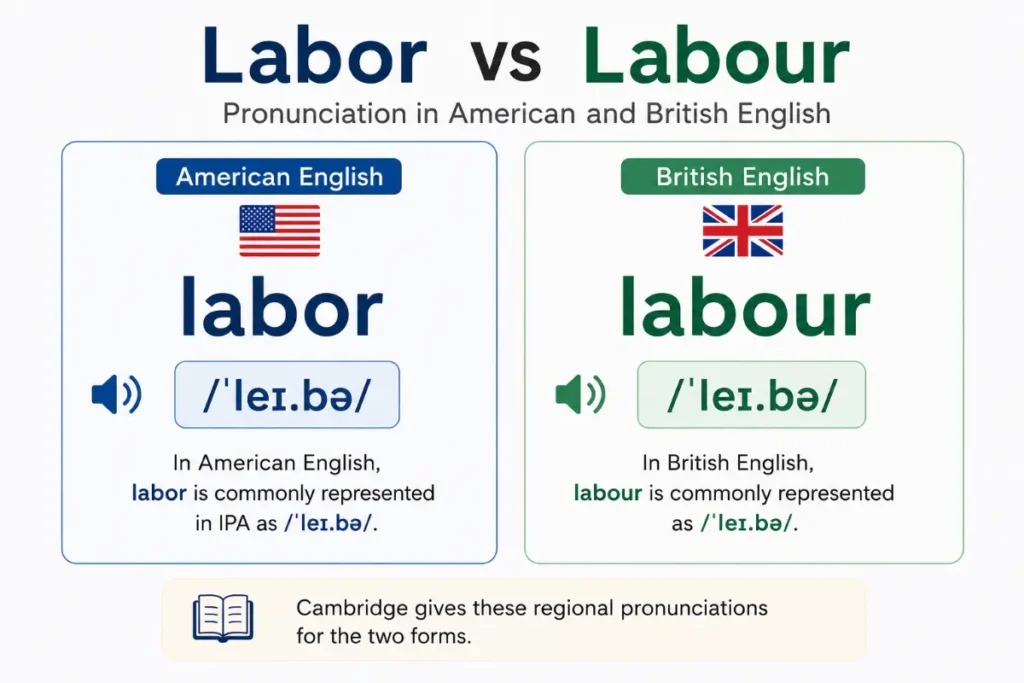
In American English, labor is commonly represented in IPA as /ˈleɪ.bɚ/.
In British English, labour is commonly represented as /ˈleɪ.bə/. Cambridge gives these regional pronunciations for the two forms.
An easy pronunciation guide is:
labor sounds like LAY ber.
labour sounds like LAY buh in many British accents.
The exact final sound can vary by accent. In a typical American pronunciation, the final r is pronounced. In many British accents, the final r isn’t pronounced unless the sound connects to a following vowel.
The first syllable carries the main stress:
LA bor
or
LA bour
The spelling difference doesn’t create a major difference in the core pronunciation. That’s one reason learners sometimes wonder why the words look different.
Ten Natural Sentence Examples
Here are examples using the American spelling.
- The company needs more labor to finish the project on time.
- Manual labor can be physically demanding.
- The contractor included labor costs in the final estimate.
- The factory is facing a shortage of skilled labor.
- She went into labor early in the morning.
- The workers labored through the night to repair the bridge.
- The machine reduces the amount of labor required for the job.
- His success came from years of hard labor and careful planning.
- The new system saves time and labor.
- The team labored over the report before sending it to the client.
If you’re writing in British English, you would normally replace the American spelling with labour and use the corresponding British forms where needed.
Common Mistakes And Confusions
The most common problem isn’t actually spelling the word incorrectly. It’s choosing the spelling that doesn’t match the intended English variety.
Using Labour In American Writing
A US writer may use labour because they’ve seen it in British books or websites. The spelling isn’t wrong in English, but it may look unusual in standard American writing.
For a US audience, write:
The company has high labor costs.
Instead of:
The company has high labour costs.
Using Labor In British Writing
The reverse can happen when an American spelling appears in British English.
For a British audience, the conventional form is:
The company has high labour costs.
Using labor may signal American spelling.
Mixing Regional Spellings
A bigger editorial problem appears when a document switches between regional systems.
For example, an article might use color in one section and colour in another. It might also use labor in one paragraph and labour later.
Each individual form can be correct. The inconsistency is the problem.
Changing Proper Names
Don’t automatically change a name because its spelling follows another regional convention.
If an organization officially uses Labour in its name, preserve that spelling. Proper names have their own identity and shouldn’t be edited like ordinary vocabulary.
Assuming The Extra U Changes The Meaning
It doesn’t.
The two forms generally carry the same meanings. The main difference is regional spelling.
A related grammar guide is inhouse or in-house Correct Spelling and Usage.
Grammar Rules And Part Of Speech
The word can function as a noun or a verb.
As a noun, it can refer to work or effort.
Example:
The project requires a lot of labor.
It can also refer to workers as a group.
Example:
The industry needs more skilled labor.
It can describe the process of childbirth.
Example:
She was in labor for several hours.
As a verb, it means to work hard or struggle with something.
Example:
They labored for weeks to complete the building.
The verb can also describe an action that requires slow and difficult effort.
Example:
He labored over the final chapter of his book.
The grammatical function stays the same across American and British English. The main change is spelling.
Regional Usage
American English
Labor is the standard spelling in American English. It appears in ordinary vocabulary as well as professional and academic writing.
American readers will commonly see expressions such as labor costs, manual labor, labor force, labor market, labor shortage, and child labor.
The same spelling appears in the medical expression labor and delivery.
If you’re writing for a US audience, labor should be your default choice.
British English
British English normally uses labour.
Common expressions include labour costs, manual labour, labour force, labour market, labour shortage, and child labour.
British English also uses labour in the medical sense related to childbirth.
Cambridge explicitly identifies labour as the UK form and labor as the US form.
Australian English
Australian English generally follows British spelling conventions in this area, so labour is standard.
One notable proper name is the Australian Labor Party, which uses the American style spelling in its official name. Cambridge also identifies Labor as the spelling used in the name of the Australian political party.
This is a useful reminder that proper names don’t always follow the general spelling pattern of the surrounding variety.
Canadian English
Canadian English can show influence from both American and British spelling traditions. Labour is commonly used in Canadian English in contexts that follow Canadian British influenced spelling conventions.
The safest approach in professional Canadian writing is to follow the style guide or publication standard you’re working with. Consistency matters more than trying to force Canadian English into a simple American or British box.
Etymology And Word Origin
The word has a long history.
English labor comes through Middle English and Anglo French from Latin labor, meaning toil, exertion, hardship, or effort. The verb ultimately connects with Latin laborare, meaning to work, exert oneself, or struggle.
The word entered English centuries ago. Merriam Webster records the first known use of the noun in the 14th century. The verb also dates to the 14th century.
The British spelling labour reflects an older spelling pattern involving our. The difference between or and our became part of the broader contrast between American and British spelling systems.
The history is useful because it shows why the two spellings are so closely related. They aren’t separate words that happen to look alike. They are regional forms of the same word.
Real Life Usage
Daily Conversation
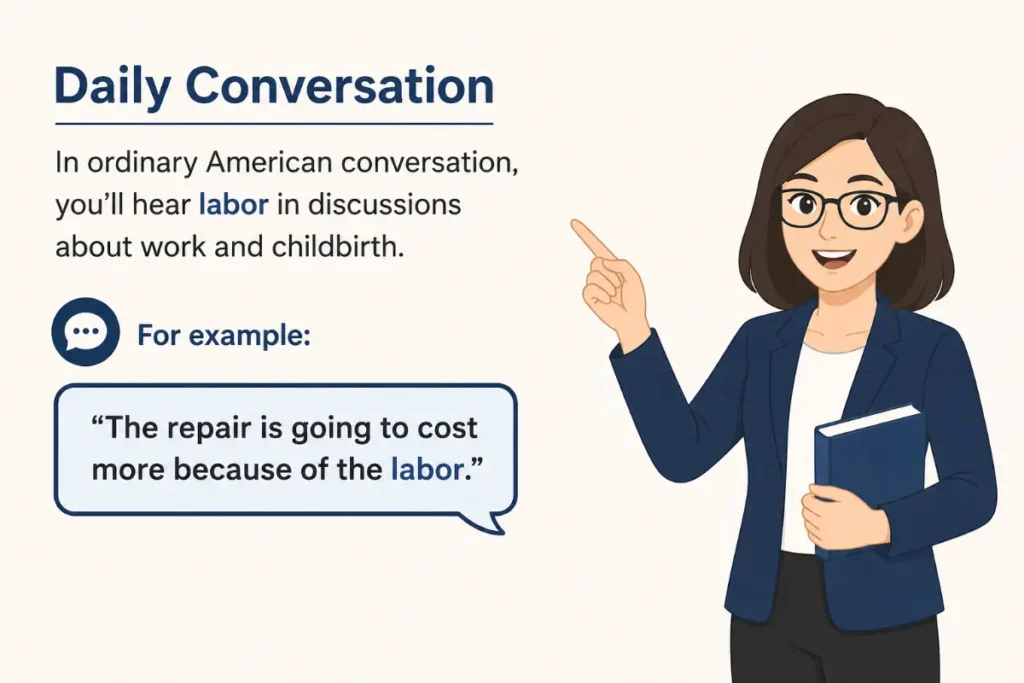
In ordinary American conversation, you’ll hear labor in discussions about work and childbirth.
For example:
The repair is going to cost more because of the labor.
She went into labor around midnight.
In British English, the spelling changes to labour, but the meaning remains the same.
Workplace Communication
The word appears frequently in discussions about staffing and costs.
A manager might write:
We need to reduce labor costs without reducing quality.
A British manager might write:
We need to reduce labour costs without reducing quality.
The word fits naturally into business writing because it can refer to both human work and the workers who perform it.
Academic Writing
Academic writing may use the term in economics, history, sociology, political science, business, and other fields.
For example:
The study examines changes in the labor market.
A British publication may use:
The study examines changes in the labour market.
The key editorial decision is to follow the spelling system required by the publication or institution.
News Writing
News organizations often follow a defined editorial style. American publications generally use labor, while British publications generally use labour.
This difference becomes especially visible in political reporting.
The British Labour Party keeps its established name. American news writing may discuss British political events while still preserving the official spelling of the party.
Literature And Storytelling
The word can also appear in literary language.
For example:
Years of hard labor had changed his hands.
A British edition may print the same sentence with labour.
Older literature can contain spelling conventions that differ from modern American usage. That’s another reason readers may encounter both forms.
Related Words And Expressions
Several words and phrases belong to the same semantic field.
Work
Work is the broadest everyday term. It can describe almost any productive activity.
Effort
Effort focuses more on the energy someone puts into an activity than on the activity itself.
Toil
Toil suggests difficult and tiring work. It often has a stronger emotional tone than labor.
Exertion
Exertion describes the use of physical or mental energy. It’s common in more formal writing.
Workforce
Workforce refers to the people who work for a company industry or economy. It doesn’t mean the work itself.
Employee
An employee is an individual who works for an employer. The term is more specific than labor when discussing a person.
Employment
Employment refers to the state or condition of having a job. It can also describe the use of workers.
Industry
Industry can refer to economic activity or a particular business sector. It often appears alongside terms related to workers and production.
Knowing these distinctions helps you choose a more precise word. Sometimes work is the natural choice. Sometimes labor is more specific. Good writing isn’t about choosing the longest or most formal word. It’s about choosing the word that fits the meaning.
Common Expressions
The word appears in many established expressions.
Labor force refers to people who are working or actively available for work within a particular population.
Labor market describes the system in which employers seek workers and people seek jobs.
Manual labor refers to work that involves physical effort, especially work performed with the hands.
Skilled labor refers to work that requires specialized training or ability.
Child labor refers to work performed by children in contexts where the term is used to discuss harmful or exploitative working conditions.
Labor costs refer to the cost associated with employing workers.
Labor Day is the US federal holiday observed on the first Monday of September. In British English, labour also appears in other contexts, but the American holiday name uses Labor Day.
These expressions show how deeply the word is connected to work and employment vocabulary.
Expert Editor Insight
An experienced editor usually treats labor and labour as a style decision rather than a simple spelling mistake. The first question is the intended audience and the second is the style standard being followed. For American readers, labor is the natural choice. For British readers, labour is expected. The biggest mistake is mixing the two systems without a reason. A spelling checker may flag one form based on its selected language setting, so always check the document’s language and style before changing the word.
A Simple Memory Trick
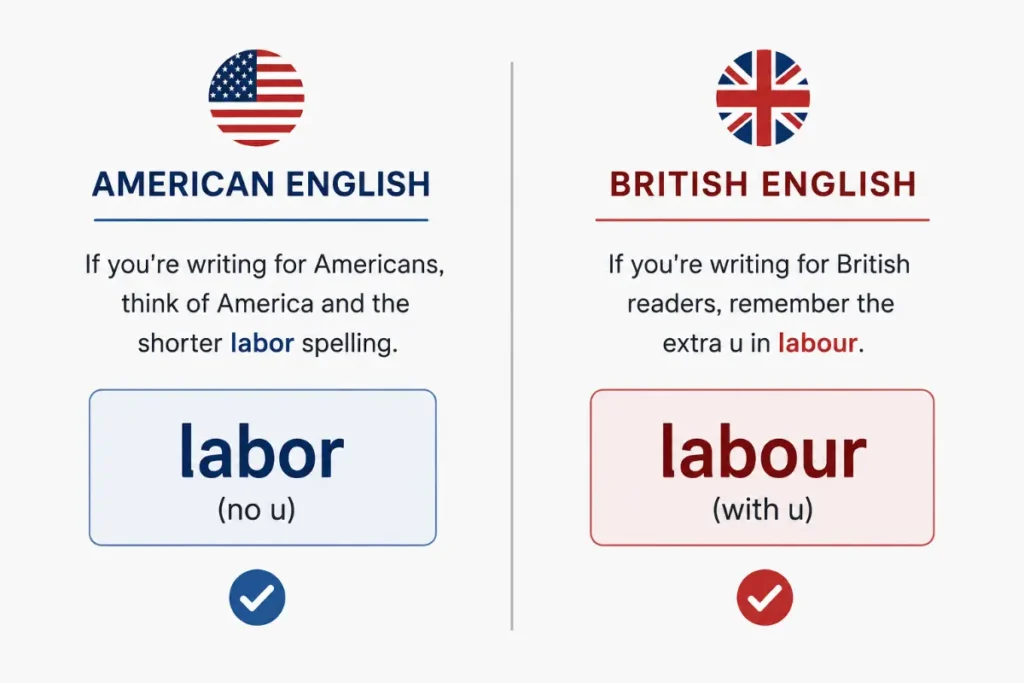
If you’re writing for Americans, think of America and the shorter labor spelling.
If you’re writing for British readers, remember the extra u in labour.
You can use the same memory trick with several related pairs:
- color and colour.
- favor and favour.
- honor and honour.
- behavior and behaviour.
- labor and labour.
The American forms generally drop the u in this group. The British forms keep it.
This isn’t a universal rule for every English word. It’s a useful pattern that helps with this particular family of spellings.
Need another quick comparison? Read Realist vs Realest Dictionary Meaning and Usage 2026.
Final Takeaway
Both labor and labour are correct. The main difference is regional spelling. American English uses labor, while British English generally uses labour. The meaning and grammatical functions stay essentially the same.
For US readers, choose labor in normal writing. If you’re following British English, use labour. Keep your spelling consistent throughout the document and preserve established spellings in official names.
A simple editing trick can save you time. If your audience is American, remember labor without the extra u. If your audience follows British spelling, keep the u and write labour.
FAQs
Is Labour a correct English word?
Yes. Labour is a correct English spelling. It is the standard form in British English and is also used in other English varieties influenced by British spelling. American English normally uses labor instead. The two forms have the same basic meanings.
Is Labor the correct spelling in American English?
Yes. Labor is the standard American English spelling. It can refer to work effort workers as a group or childbirth. It also functions as a verb meaning to work hard or struggle with a difficult task.
Is Labour wrong in the United States?
Not exactly. Labour is a legitimate English spelling, but it isn’t the normal American spelling. In a document written for a US audience, labor will usually look more natural and consistent with American spelling conventions.
What does labor mean?
Labor can mean physical or mental work, effort, or workers considered as a group. It also refers to the final stage of pregnancy before birth. As a verb, it can mean to work hard or struggle with a task. The exact meaning depends on the sentence.
How do you pronounce labor?
In American English, labor is commonly pronounced approximately like LAY ber and is represented in IPA as /ˈleɪ.bɚ/. The British form labour has a closely related pronunciation. The main difference in speech comes from regional accents rather than the spelling itself.
Why does British English use Labour?
The British spelling reflects an older our spelling pattern. American spelling developed different conventions that favored or in words such as labor, color, and favor. The difference is historical and regional rather than a difference in meaning.
Can Labor start a sentence?
Yes. Labor can start a sentence when it functions as a noun. For example, Labor costs have increased this year. It can also appear at the beginning of a sentence when used as a verb. Capitalization doesn’t change the underlying grammar.
Is Labor appropriate in formal writing?
Yes. Labor is completely appropriate in formal American writing. It appears naturally in academic work, business documents, journalism, government writing, and professional communication. The main requirement is to use the spelling consistently with the English variety and style standard you’re following.