
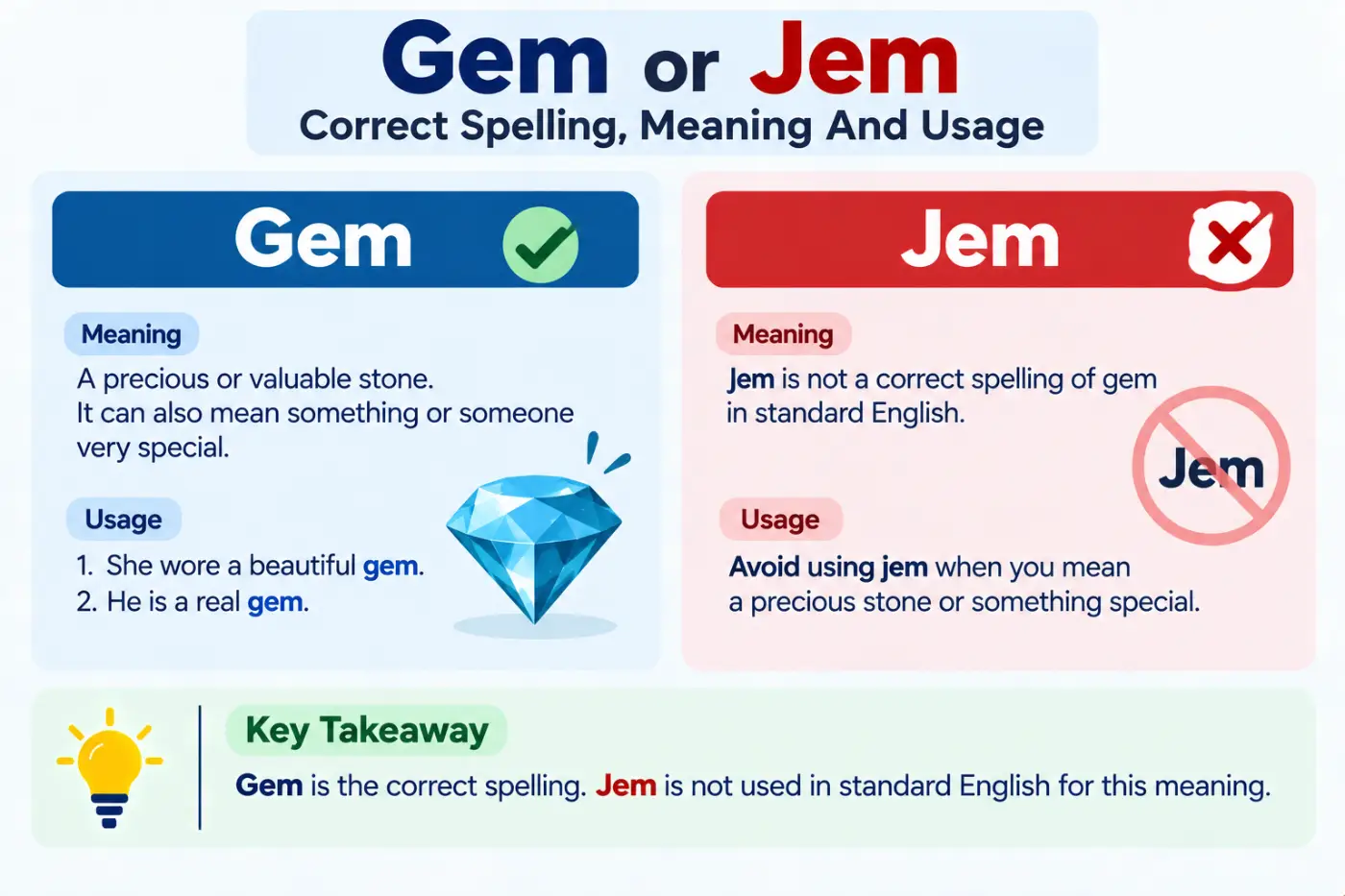
gem or jem is a common spelling question because the two forms sound almost identical in ordinary speech. The standard English spelling is gem when you mean a precious stone, a valuable object, or a person or thing that is especially wonderful. Jem is not the standard spelling of that common noun, although it can appear as a personal name, character name, or intentional informal spelling.
The confusion makes sense because English pronunciation does not always tell you which letters belong on the page. The sound at the beginning of gem is a soft j sound, even though the word begins with the letter g. That same sound appears in words such as general and gentle, which can make spelling from pronunciation tricky. Still, gem has a long established spelling in standard English.
In this guide, you’ll learn the meaning of gem, why jem is usually incorrect as a spelling of the common word, how each form is pronounced, where the word came from, and how native speakers use it. You’ll also see natural examples, common spelling mistakes, regional usage, grammar guidance, related terms, and practical editing tips.
A related grammar guide is Realist vs Realest Dictionary Meaning and Usage 2026.
Quick Definition
Gem is the standard English spelling for a precious or semiprecious stone. It can also describe something highly valued or exceptionally good, such as a gem of a book. Jem is not the standard spelling of this common word, but it can be a proper name or an intentional variant in specific contexts.
Quick Answer
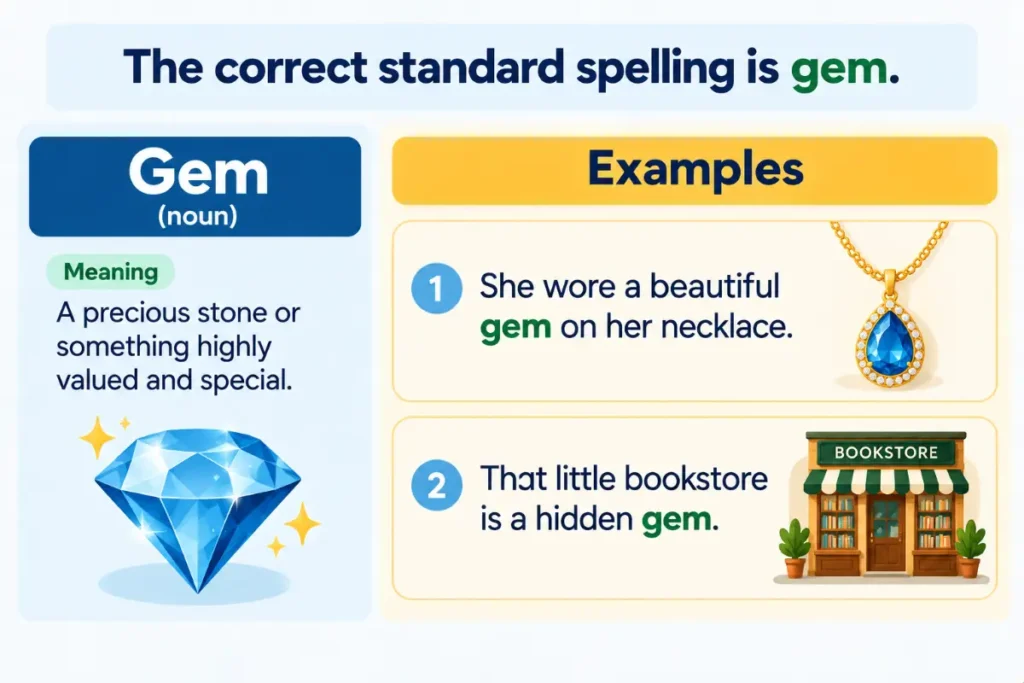
Gem is the correct standard spelling when you mean a precious stone or something highly valuable or delightful.
Jem is generally not the standard spelling of the common English noun. However, it can be a personal name or fictional character name. If you are writing about a diamond, ruby, emerald, or something you describe as a hidden treasure, use gem.
For example:
The ring contains a beautiful gem.
Not:
The ring contains a beautiful jem.
The second spelling would normally be treated as an error unless Jem is being used as a specific name.
Comparison Table For Gem And Jem
| Form | Meaning | Part of Speech | Origin | Usage Frequency | Formality | Common Contexts | Example |
|---|---|---|---|---|---|---|---|
| Gem | A precious or semiprecious stone or something highly valued | Noun and sometimes adjective in compounds | Middle English from Old French and Latin | Very common | Neutral | Jewelry, literature, everyday speech, descriptions | She found a beautiful gem. |
| Jem | Usually a personal name or specialized spelling | Proper noun in many uses | Varies by name or specific usage | Much less common as an ordinary English word | Context dependent | Names, fiction, titles, intentional variants | Jem is the name of a character. |
The key point is simple. Gem is the ordinary English word. Jem requires a special context.
Meaning And Definition
Meaning Of Jem
Jem is not normally the standard English spelling of the noun meaning a precious stone.
If you see jem in an ordinary sentence such as:
She bought a beautiful jem.
the writer most likely intended gem.
However, that does not mean every appearance of Jem is an error. Capitalized Jem can be a person’s name. It can also be the name of a fictional character, business, project, product, or other proper noun.
A famous literary example is Jem Finch, a character in Harper Lee’s novel To Kill a Mockingbird. In that context, Jem is a name and therefore has nothing to do with the spelling of the noun gem.
The lowercase form jem may also appear as an intentional informal spelling or in specialized names. The meaning depends on the context. That is why a good editor should not automatically change every instance of jem to gem without checking what the writer means.
Meaning Of Gem
Gem is a noun with several related meanings.
The most literal meaning is a precious or semiprecious stone that has been cut and polished for use in jewelry or decoration.
Common examples include diamonds, rubies, sapphires, emeralds, and certain other valuable stones.
For example:
She wore a necklace with a blue gem.
Gem can also refer to a valuable or especially attractive object.
The museum has several historical gems.
The word can go beyond physical objects. English speakers often use gem metaphorically for something they consider especially good, valuable, charming, or impressive.
For example:
That little restaurant is a gem.
Here gem does not mean a stone. The speaker means that the restaurant is unusually good or valuable in some way.
You can also describe a person as a gem.
Your assistant is a real gem.
This usually means the person is kind, helpful, reliable, or wonderful.
The metaphor works because a gem is something considered valuable and worth appreciating.
The Main Difference
The difference between these forms is mainly about standard spelling and context.
- Gem is the standard English noun. Use it for a precious stone or something metaphorically valuable.
- Jem is not the standard spelling of that noun. If you mean a precious stone, writing jem will normally be considered a spelling error.
- Jem can be a name. A person, fictional character, company, product, or other named entity may legitimately use Jem.
- Both forms can have the same basic pronunciation. This creates much of the spelling confusion.
- Capitalization can provide a clue. Jem with a capital J often signals a proper name, although capitalization alone cannot determine the intended meaning.
The safest approach is to look at the meaning before correcting the spelling. If the sentence is about jewelry, minerals, value, or an excellent person or place, gem is almost certainly the intended word.
Which Spelling Is Correct?
Gem is the correct standard spelling when you mean a precious or semiprecious stone.
It is also the correct spelling when you use the word metaphorically to describe something especially valuable, attractive, useful, or excellent.
For example:
This old bookstore is a gem.
The word gem belongs to the established English vocabulary and appears in major English dictionaries.
Jem does not replace gem in standard spelling. If a spelling checker marks jem in a sentence about jewelry, that is usually because the writer has accidentally used the wrong form.
However, context matters. If the sentence says:
Jem Finch is one of the main characters.
changing Jem to Gem would be a mistake because Jem is a proper name.
This distinction is an important part of careful editing. A word can look like a spelling mistake while actually being correct for a particular context.
How To Remember The Correct Spelling
A simple memory trick can help.
Think of the phrase gemstone.
Gem + stone = gemstone.
You would never write jemstone in standard English.
That connection gives you a strong visual reminder that the common word begins with g.
Another useful clue is the word family.
Gem.
Gemstone.
Gems.
Gemlike.
Once you recognize the root spelling as gem, related forms become easier to write.
You can also remember the pronunciation rule. In English, the letter g can make a soft j sound before certain vowels. That is why gem begins with the sound /dʒ/ even though the spelling begins with g.
Sentence Examples
Here are ten natural examples using the standard form.
- She wore a necklace with a small green gem.
- The jeweler examined the gem under a bright light.
- We discovered a hidden gem of a restaurant downtown.
- That old bookstore is a real gem.
- Her grandmother gave her a beautiful family gem.
- The museum displayed several rare gems.
- He has a gem of an idea for the project.
- This quiet beach is one of the hidden gems of the coast.
- The blue gem looked almost purple under the lights.
- My new coworker is a gem and always helps the team.
These examples show how flexible the word can be. It can describe a physical stone, a place, an idea, or a person.
Examples Of Jem As A Name
Jem can be correct when it is used as a proper name.
- Jem Finch is a character in a well known American novel.
- Jem introduced himself before the meeting began.
- The story follows Jem as he grows up.
- Jem’s family moved to another town.
- Everyone at school knew Jem by his nickname.
In these examples, changing Jem to gem would change the meaning because the word identifies a person.
Common Mistakes And Misspellings
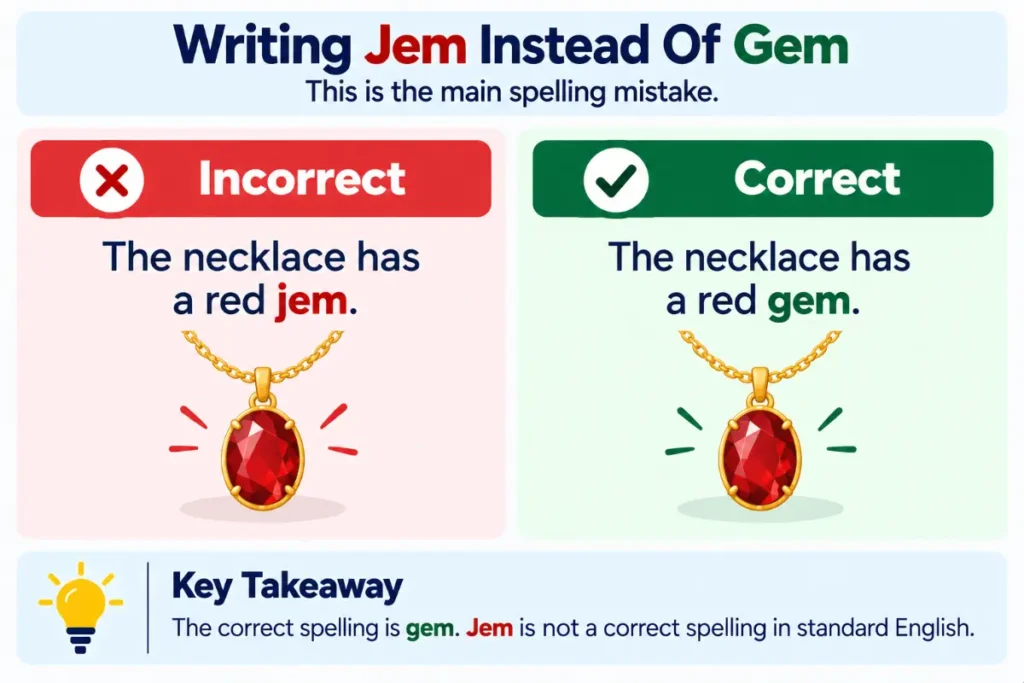
Writing Jem For A Precious Stone
Incorrect:
She bought a beautiful jem.
Correct:
She bought a beautiful gem.
The mistake usually comes from pronunciation. The initial sound is a soft j sound, so writers may instinctively choose j instead of g.
Confusing Gem With Gems
The singular form is gem.
The plural form is gems.
For example:
She found a gem.
She found several gems.
The spelling stays consistent when you add the plural ending.
Writing Gemstone Incorrectly
The standard compound is gemstone.
A common mistake is to write jemstone because the writer carries the sound based spelling into the compound.
Remember the root word.
Gem + stone = gemstone.
Confusing Gem With General
Gem and general both begin with g pronounced with a soft j sound.
This is a useful spelling pattern to recognize. English often uses g before certain vowels to represent the /dʒ/ sound.
That does not mean every j sound is spelled with g. It simply explains why gem can feel surprising to learners.
Changing A Proper Name
If a person’s name is Jem, changing it to Gem is not a spelling correction.
For example:
Jem Finch.
The name must remain Jem.
Editors need to distinguish ordinary vocabulary from proper nouns before making corrections.
Pronunciation Guide
Gem is pronounced /dʒɛm/ in standard American English.
It is a one syllable word.
A simple pronunciation guide is:
JEM.
The vowel sounds like the vowel in words such as bed and red.
The first sound is the soft j sound found in words such as jump and job.
So although the word starts with g in writing, it begins with a /dʒ/ sound in speech.
Jem as a name is normally pronounced the same way.
This identical pronunciation explains why the spelling confusion is so common. If you only hear the word, you cannot know from the sound alone if the writer intends gem or the name Jem.
The surrounding context provides the answer.
Etymology And Word Origin
Gem has a long history in English.
The word entered Middle English through Old French and ultimately traces back to Latin gemma. The Latin word referred to a precious stone or jewel and also carried related meanings connected with something valuable.
Over time, English developed both the literal and figurative uses that are familiar today.
The literal meaning remained connected with precious stones and jewelry.
The figurative meaning developed naturally from the idea of something rare and valuable. Calling a person, place, book, or idea a gem suggests that it has special worth.
This is a good example of how metaphor grows from a physical meaning. People first recognize the value of a physical object and then use that idea to describe something valuable in a broader sense.
The spelling gem became established in English even though its pronunciation begins with a j sound.
Need another quick comparison? Read Capital or Capitol Which One Is Correct 2026.
Why Gem Starts With G
One of the most interesting spelling points is the relationship between the letter g and the sound /dʒ/.
English g can have different sounds depending on the letters that follow it.
Compare:
go with a hard g sound.
game with a hard g sound.
gem with a soft j sound.
gentle with a soft j sound.
giant with a soft j sound.
This pattern is sometimes called hard g and soft g.
The soft g pattern often appears before e i and y. There are exceptions, so it is not a perfect rule, but it is a useful spelling clue.
That explains why gem is spelled with g even though it sounds like it starts with j.
Grammar And Part Of Speech
Gem is primarily a noun.
A noun names a person, place, thing, or idea. In its literal sense, gem names a precious or semiprecious stone.
For example:
The gem is expensive.
Here gem is the subject of the sentence.
You can also use it as an object.
She bought a gem.
The word can be singular or plural.
Singular:
That gem is beautiful.
Plural:
Those gems are beautiful.
Gem can also appear in common noun phrases.
gemstone
gem dealer
gem collection
gem cutter
gem market
The word can also form metaphorical expressions.
a hidden gem
a rare gem
a little gem
a gem of an idea
a gem of a restaurant
These expressions are grammatical because gem remains a noun while the surrounding words explain its figurative meaning.
Figurative Meaning And Everyday English
Native speakers frequently use gem in a figurative way.
If someone says:
This café is a hidden gem.
they usually mean the café is excellent but not widely known.
If someone says:
She is a real gem.
they usually mean she is an unusually kind or helpful person.
If someone says:
That book is a gem.
they mean the book is especially good or valuable.
This figurative use is common because the physical idea of a valuable stone transfers naturally to things that people appreciate.
It also gives ordinary conversation a little color without sounding overly dramatic.
Compare:
This restaurant is very good.
This restaurant is a gem.
The second sentence feels more expressive. It suggests that the restaurant is not merely good but worth discovering and appreciating.
Real Life Usage Examples
Daily Conversation
That little coffee shop is a hidden gem.
My neighbor is a gem. She always helps when someone needs a hand.
These uses sound natural in casual American English.
Workplace Communication
The new employee has been a real gem during the busy season.
The report contains a few useful gems of information.
The first describes a person. The second uses gem metaphorically to describe valuable information.
Academic Writing
The discovery provided a valuable insight into the region’s history.
Researchers described the manuscript as a rare historical treasure.
Formal academic writing often prefers precise terms such as valuable evidence or significant finding instead of metaphorical language. Still, gem can appear when the tone allows figurative expression.
News Writing
The small theater has become a cultural gem in the neighborhood.
Visitors often describe the historic building as a hidden gem.
News writing can use the word naturally in feature stories and descriptive reporting.
Literature And Storytelling
A small red gem caught the light as she opened the old box.
He considered the handwritten letter a precious gem from his family’s past.
Literary writing often uses the literal and figurative meanings together.
Regional Usage
American English
Gem is the standard spelling in American English for the noun referring to a precious stone or something highly valued.
The spelling does not change based on American pronunciation.
Jem may appear as a personal name or other proper noun. American readers are likely to understand that context quickly when the word is capitalized.
British English
British English also uses gem as the standard spelling.
There is no major British spelling variant that changes gem to jem for the ordinary noun.
Jem can still occur as a personal name or specialized term.
Australian English
Australian English uses gem as the standard spelling for the common noun.
The same basic distinction applies. Jem may be valid as a name or special usage, but it does not replace gem in ordinary standard English.
Canadian English
Canadian English also uses gem as the standard noun spelling.
As in other major English varieties, jem can appear as a proper name while gem remains the normal spelling for the common noun.
The regional pattern is therefore very consistent. The ordinary word is gem across major English varieties.
Gem In Formal And Informal Writing
Gem works well in both formal and informal writing, but the figurative use is more dependent on tone.
The literal meaning is completely neutral.
For example:
The necklace contains a natural gemstone.
That sentence is suitable for professional writing.
The figurative use can be more conversational.
That restaurant is a hidden gem.
This is perfectly natural in a review or casual article, but a scientific report might use a more precise description instead.
The word itself is not informal. Its tone depends partly on how you use it.
A useful editing question is simple. Are you describing a real stone or using the stone as a metaphor?
If it is literal, gem is straightforward.
If it is figurative, check the tone of the surrounding writing.
Related And Confused Terms
Jewel
Jewel can refer to a precious stone or a valuable ornament containing one or more stones. It can also have a figurative meaning similar to gem.
Gemstone
Gemstone is the broader compound term for a mineral or other material used as a gem because of its beauty, rarity, durability, or value.
Crystal
Crystal can refer to a solid material with an ordered atomic structure. In everyday speech, people also use it for decorative or transparent mineral objects. Not every crystal is a gem.
Diamond
Diamond is a specific gemstone and a crystalline form of carbon. It is one type of gem rather than a synonym for every gem.
Ruby
Ruby is a red variety of the mineral corundum. It is another specific gemstone.
Emerald
Emerald is a green variety of beryl. Like ruby and diamond, it is a specific type of gemstone.
Sapphire
Sapphire is another variety of corundum and is commonly associated with blue color. Other colors also exist.
Treasure
Treasure means something considered very valuable or precious. It can overlap with gem in figurative language but has a broader meaning.
These related words help show why gem is useful. It can refer to a specific physical category while also carrying a broader metaphorical sense.
Gem As A Metaphor
The metaphorical use deserves special attention because it appears frequently in everyday English.
When you call something a gem, you are comparing it to a precious stone.
For example:
That old camera shop is a gem.
The shop is not literally a gemstone. Instead, the speaker suggests that the shop is valuable, special, charming, or worth discovering.
The phrase hidden gem adds another layer.
A hidden gem is something excellent that is not widely known.
You might describe:
a hidden gem of a restaurant
a hidden gem in a neighborhood
a hidden gem of a book
a hidden gem in a collection
The expression works because people naturally associate gems with rarity and value.
Gem In Compound Words
Gem appears in several useful compound words.
Gemstone
A stone used as a gem.
Gemologist
A specialist who studies gems and gemstones.
Gemology
The study of gems.
Gemstone Jewelry
Jewelry that contains gemstones.
Gem Cutter
A person who cuts and shapes gemstones.
These compounds reinforce the standard spelling. If you remember gemstone, you have an easy visual anchor for the base word.
Expert Editor Insight
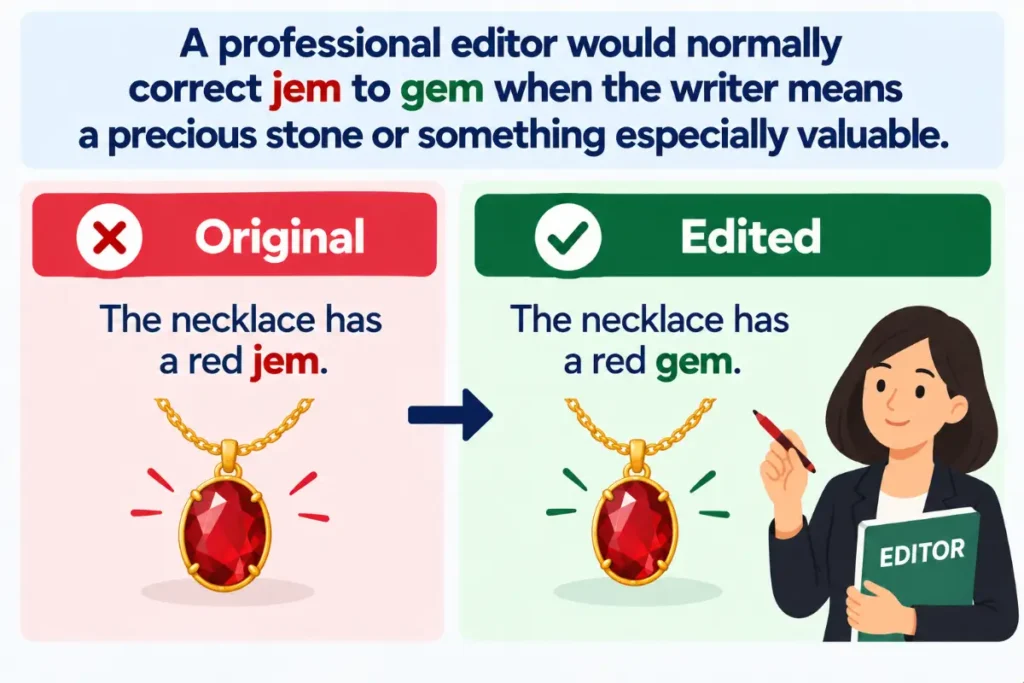
An experienced editor would normally change lowercase jem to gem when the sentence clearly refers to a precious stone or something valuable. The spelling confusion comes mainly from pronunciation because gem begins with the same soft j sound represented by the letter g in words such as gentle and general. A careful editor also checks capitalization and context before making a correction. Jem can be perfectly correct as a person’s name or another proper noun, so context matters more than a spelling checker alone.
For another common grammar confusion, see Brite vs Bright Which Spelling Should You Use in 2026.
Conclusion
gem or jem has a straightforward answer when you mean the ordinary English word for a precious stone. Gem is the standard spelling. Jem is generally not the correct spelling for that meaning, although it can be completely valid as a personal name, fictional character name, or other special term.
The main reason people make the mistake is pronunciation. Gem begins with a soft j sound even though it starts with g in writing. That pattern appears in several English words and can make spelling from sound unreliable.
The easiest memory trick is to connect gem with gemstone. If you mean a valuable stone or something metaphorically precious, write gem. Before correcting Jem, however, check the context because it may be a proper name rather than a mistake.
FAQs
Is jem a correct spelling of gem?
Jem is not the standard spelling of the common English noun meaning a precious stone. The standard form is gem. However, Jem can be completely correct when it is a person’s name, fictional character name, brand, or another proper noun. Always check the context before correcting it because a name should not be changed simply because it resembles a common spelling mistake.
Why is gem spelled with a g?
Gem is spelled with g because English uses g to represent both hard and soft sounds. Before certain vowels, including e, g can represent the /dʒ/ sound. That is the sound heard at the beginning of gem. Similar patterns appear in words such as gentle and general. English spelling has many such sound and letter relationships.
How do you pronounce gem?
Gem is pronounced /dʒɛm/ in standard American English. It is a one syllable word and sounds like jem when spoken. The first sound is the soft j sound found in jump and job. The vowel is similar to the sound in bed and red. This identical pronunciation explains why people sometimes confuse the written forms.
What does gem mean?
Gem literally means a precious or semiprecious stone that is valued for its beauty, rarity, or other qualities. The word can also have a figurative meaning. You might call a restaurant a gem to say that it is unusually good or worth discovering. You can also describe a kind person as a gem.
Is gem only used for jewelry?
No. Gem has a literal connection with precious stones and jewelry, but English speakers also use it figuratively. A book, restaurant, idea, place, or person can be called a gem when the speaker considers it especially valuable, excellent, useful, or delightful. The surrounding context tells you which meaning the writer intends.
Is Jem a name?
Yes. Jem can be a personal name and is also used as a fictional character name. A well known example is Jem Finch from Harper Lee’s To Kill a Mockingbird. In such cases, Jem is not an alternative spelling of the common noun. It is a proper name and should keep its original spelling.
What is a synonym for gem?
Depending on the meaning, possible synonyms include jewel, gemstone, treasure, precious stone, find, beauty, or prize. The best choice depends on context. Jewel and gemstone work well for the literal meaning. Treasure and find can work for figurative uses. A person described as a gem may be called a treasure or a wonderful person.
What is a hidden gem?
A hidden gem is something excellent, valuable, or appealing that is not widely known. The phrase is common in everyday English and often describes restaurants, stores, travel destinations, books, or local attractions. It uses the idea of a rare precious stone as a metaphor for something special that people may overlook.