
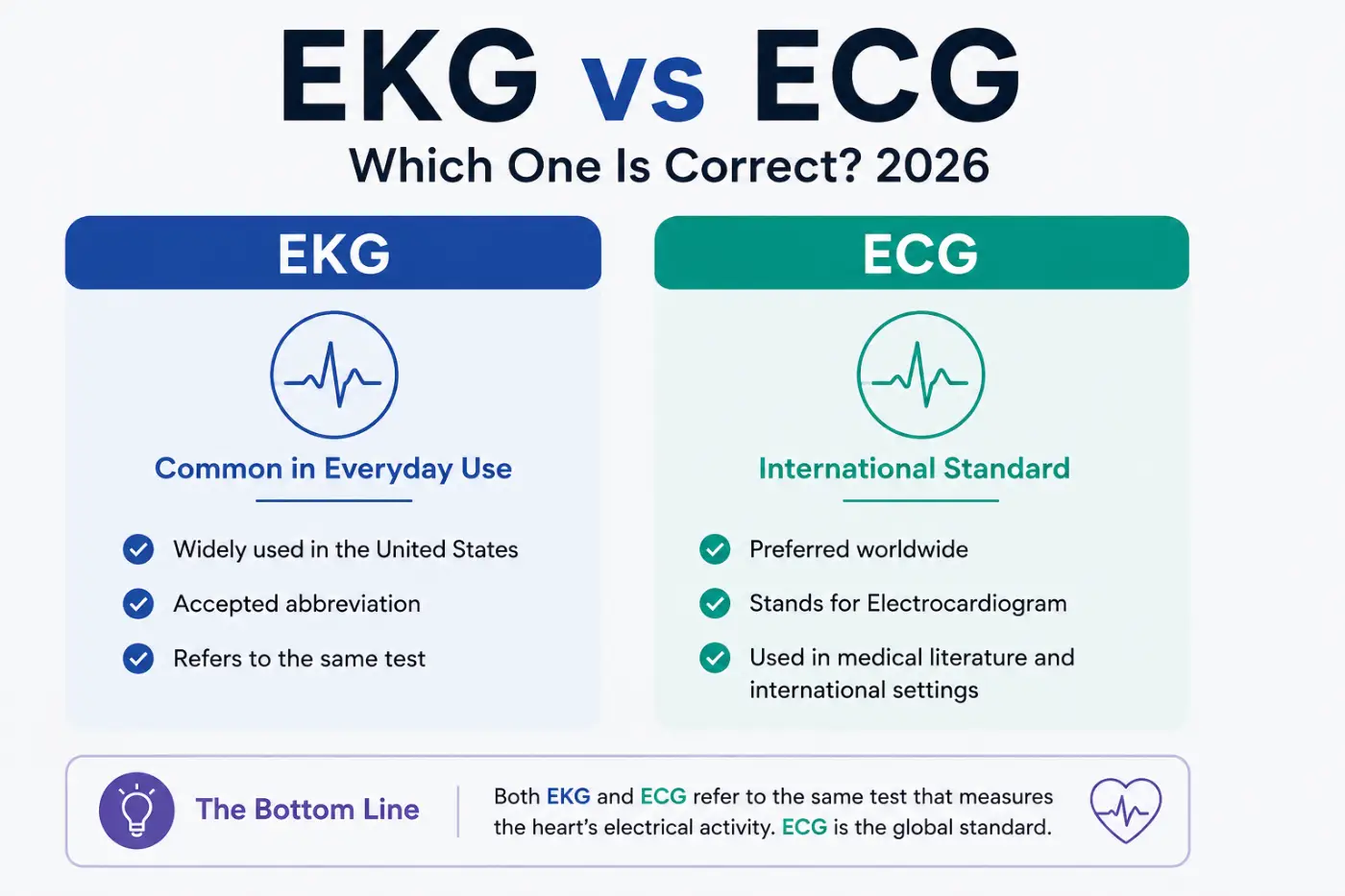
If you’ve ever seen both EKG vs ECG on a medical form you may have wondered if doctors are talking about two different heart tests. The good news is simple. EKG and ECG refer to the same medical test called an electrocardiogram. The difference is mainly the abbreviation used for the word.
The confusion comes from the way the abbreviation was formed. ECG follows the English spelling of electrocardiogram. EKG comes from the German spelling Elektrokardiogramm. The K in EKG comes from the German word for heart rather than the English spelling.
That small language difference has created two abbreviations that are both accepted in medicine. Mayo Clinic uses ECG and EKG for the same test and explains that an electrocardiogram records the electrical signals of the heart.
In this guide you’ll learn what each abbreviation means why both forms exist how they’re pronounced where they’re commonly used and how to avoid confusing them with an echocardiogram. You’ll also see practical examples that show how doctors writers patients and medical editors use these terms.
Still confused? Compare Protestors or Protesters Which Spelling Is Correct.
Quick Definition
An ECG and an EKG are two abbreviations for the same test called an electrocardiogram. The test records the electrical activity of the heart and can help healthcare professionals evaluate heart rate rhythm and certain signs of heart problems. The difference between the abbreviations comes from language and spelling rather than medical function.
Quick Answer
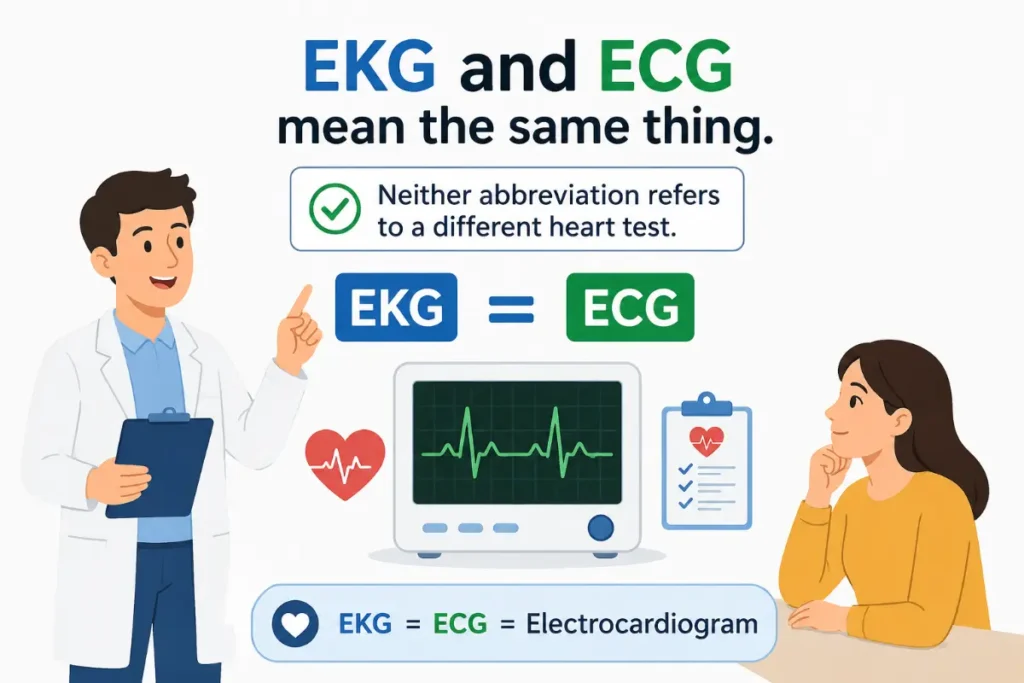
EKG and ECG mean the same thing. Neither abbreviation refers to a different heart test.
ECG is formed from the English term electrocardiogram. EKG comes from the German term Elektrokardiogramm. Both forms are recognized medical abbreviations and both describe a test that records the heart’s electrical activity.
Comparison Table For EKG And ECG
| Correct Form | Meaning | Part of Speech | Origin | Usage Frequency | Formality | Common Contexts | Example |
|---|---|---|---|---|---|---|---|
| ECG | Electrocardiogram | Abbreviation | English | Very common | Medical and professional | Hospitals clinics research and medical writing | The doctor ordered an ECG. |
| EKG | Electrocardiogram | Abbreviation | German influenced form | Very common | Medical and professional | Hospitals clinics patient records and everyday American usage | The nurse performed an EKG. |
| Electrocardiogram | A recording or test of the heart’s electrical activity | Noun | Medical English | Common | Formal | Medical records reports education and patient care | The electrocardiogram showed a regular rhythm. |
| Electrocardiograph | A device used to record cardiac electrical activity | Noun | Medical terminology | Less common in everyday speech | Formal | Technical and clinical writing | The electrocardiograph recorded the signal. |
Meaning And Definition
Meaning Of EKG
EKG is an accepted abbreviation for electrocardiogram. It isn’t a misspelling of ECG and it doesn’t describe a different procedure.
The abbreviation has German roots. Merriam Webster lists EKG as an abbreviation for electrocardiogram and electrocardiograph. Its word history identifies the German term Elektrokardiogramm as the source.
The reason for the K becomes easier to understand when you look at the German spelling. The German word for heart is Herz in ordinary language but the medical combining form uses the Greek derived Kardio form. The abbreviation EKG preserves the K from Kardiogramm.
This explains something that can look strange to English speakers at first. English speakers normally expect the word heart related to cardiology to produce a C. Yet EKG contains K because the abbreviation follows the German form.
So if you write EKG in a medical context you’re not making a spelling mistake.
Meaning Of ECG
ECG is the abbreviation formed from electrocardiogram using the letters E C and G. Merriam Webster defines ECG as an abbreviation for electrocardiogram.
The term describes a test that records electrical signals produced by the heart. Mayo Clinic explains that electrodes placed on the body detect these signals and that the resulting waves can provide information about heart rate rhythm and certain heart conditions.
ECG is especially common in international medical writing. You’ll see it frequently in clinical research medical education hospital documentation and professional publications.
There is no difference in the procedure simply because a clinician calls it an ECG instead of an EKG. The equipment and purpose can be the same.
Key Differences Explained
- Spelling.
ECG follows the English spelling of electrocardiogram. EKG reflects the German form Elektrokardiogramm. The different middle letter comes from the language behind the abbreviation.
- Grammar role.
Both ECG and EKG function primarily as nouns when they refer to the test. You can say that a patient had an ECG or that a doctor ordered an EKG. The abbreviation can also appear as a modifier in phrases such as ECG results or EKG machine.
- Meaning.
There is no meaningful difference in medical meaning. Both refer to an electrocardiogram.
- Tone.
Both forms are professional and medically acceptable. Neither one is inherently informal. A hospital record may use EKG while a research paper may use ECG.
- Context.
Usage varies by country institution profession and personal preference. American medical sources use both forms. Mayo Clinic itself uses ECG and EKG when describing the same procedure.
Which Form Is Correct
Both ECG and EKG are correct.
The safest way to remember this is to think of them as two linguistic paths leading to the same medical term. ECG follows English. EKG reflects German.
Merriam Webster gives separate entries for ECG and EKG and identifies both as abbreviations connected to electrocardiography. Its EKG entry specifically traces the abbreviation to German Elektrokardiogramm.
The full word electrocardiogram is also a noun. Merriam Webster defines it as the tracing made by an electrocardiograph and also as the procedure for producing that tracing. The dictionary records its first known use in 1895.
From an editing perspective the key rule is consistency. If you’re writing a medical article and choose ECG then keep using ECG unless a source or context specifically requires EKG. Don’t alternate between them randomly because you think one is more medically correct.
Sentence Examples
Natural Examples With ECG
- The doctor ordered an ECG after the patient reported chest discomfort.
- Her ECG showed a normal heart rhythm.
- The nurse explained that the ECG would only take a few minutes.
- The cardiologist reviewed the ECG before discussing the next step.
- An ECG can provide useful information about the heart’s electrical activity.
- The patient brought a copy of his previous ECG to the appointment.
- The physician compared the new ECG with an earlier recording.
- The clinic performs ECG tests during routine cardiac evaluations.
- The report included the patient’s heart rate and ECG findings.
- The doctor said the ECG was reassuring but recommended follow up testing.
Mayo Clinic explains that an electrocardiogram can help evaluate heart rate and rhythm and can provide clues about conditions such as arrhythmias and previous heart attacks.
Examples Showing The Misspelling Finaly
The form finaly is unrelated to ECG and is included here only because it appears in the original comparison template. It is a common misspelling of finally and isn’t an accepted alternative spelling of that English adverb.
- Incorrect: The patient finaly received the results.
- Correct: The patient finally received the results.
- Incorrect: She finaly called the clinic.
- Correct: She finally called the clinic.
- Incorrect: The doctor finaly explained the results.
- Correct: The doctor finally explained the results.
These examples highlight why context matters when editing. A medical article can contain several completely different spelling questions and each one needs to be handled according to its own vocabulary and meaning.
Common Mistakes And Misspellings
People rarely confuse ECG and EKG because they sound different. The confusion usually comes from assuming that two abbreviations must represent two different tests.
- Assuming EKG is incorrect.
It isn’t. EKG is an established abbreviation with German roots. Merriam Webster lists it as a standard medical abbreviation.
- Assuming ECG is the only professional form.
That isn’t correct either. ECG is standard medical terminology and EKG is also widely recognized.
- Confusing an ECG with an echocardiogram.
These tests are not the same. An electrocardiogram records electrical activity. An echocardiogram uses ultrasound to create images of the heart. Mayo Clinic describes the echocardiogram as a test that uses sound waves to create moving images of the heart.
- Treating EKG as a spelling error.
The K has a historical reason. It comes from the German form of the word.
- Switching between ECG and EKG without a reason.
In casual conversation this rarely causes a problem. In professional writing consistent terminology makes your work easier to read and more polished.
NLP confusion can also arise because related medical terms share similar patterns. ECG EKG electrocardiogram electrocardiography echocardiogram cardiogram and electrocardiograph belong to closely connected semantic groups. A reader who recognizes only the first letters may assume they all describe the same thing.
Pronunciation Guide
The abbreviations are usually pronounced letter by letter.
ECG is pronounced ee see gee.
EKG is pronounced ee kay gee.
Merriam Webster gives the pronunciation of EKG as ˌē ˌkā ˈjē.
The full word electrocardiogram is much longer.
A useful syllable breakdown is:
e lec tro car di o gram.
The main stress falls on the part associated with cardiogram. In everyday speech most people use the abbreviation instead of saying the entire word.
If a doctor says get an ECG you normally hear the three letters separately. The same applies to EKG. You don’t normally pronounce either abbreviation as one ordinary word.
A common pronunciation mistake is to treat ECG like a word and blend the letters together. That’s not the standard pronunciation in medical English.
Etymology And Word Origin
The history of these abbreviations explains the entire EKG versus ECG question.
The full term electrocardiogram combines elements associated with electricity heart and a record or tracing. The cardi element has Greek roots. Merriam Webster traces cardi to Greek kardia meaning heart.
The ending gram is connected to a record or something written or drawn. Merriam Webster identifies the combining form gram as coming through Latin from Greek gramma meaning a letter or written record.
The medical term developed into electrocardiogram in modern medical English. Merriam Webster records 1895 as its first known use.
The abbreviation ECG is straightforward. Take the first letter of electrocardiogram and then use the C and G from the important parts of the word.
EKG followed another linguistic route. German uses Elektrokardiogramm. That form produces EKG rather than ECG. Merriam Webster directly identifies German Elektrokardiogramm as the etymology of EKG.
This is a good example of how abbreviations preserve language history. A single letter can act like a small fossil from another language.
Regional Usage In The US UK AU And CA
United States
Both forms appear in American medical English. EKG has a long history of use in the United States while ECG is also common in hospitals clinics research and medical education. Mayo Clinic uses both abbreviations for the same test.
If you’re writing for a general US audience either abbreviation can be understood. EKG may feel especially familiar to patients because many American healthcare settings use the term EKG in ordinary conversation.
United Kingdom
ECG is widely used in British medical English. Healthcare professionals and medical publications commonly use ECG when referring to an electrocardiogram.
That doesn’t make EKG wrong in Britain. It simply means ECG is often the more expected abbreviation in British clinical language.
Australia
ECG is also common in Australian medical usage. Patients may encounter ECG on medical websites forms test instructions and clinical documents.
The preference fits the English abbreviation pattern and is easy to connect to the spelling electrocardiogram.
Canada
Canadian medical English commonly uses ECG. EKG is still understandable because it is an established international medical abbreviation.
The important point is that regional preference doesn’t create two different tests. It changes the abbreviation people are more likely to encounter.
For another common grammar confusion, see Bellies vs Bellys Which Spelling Is Correct in 2026?.
Grammar Rules And Part Of Speech
ECG and EKG are abbreviations used as nouns. You can use them after verbs such as have order perform review read and interpret.
For example:
The patient had an ECG.
The doctor ordered an EKG.
The nurse performed the ECG.
The cardiologist reviewed the EKG.
You can also use the abbreviations before another noun as modifiers.
ECG results were reviewed by the physician.
The EKG machine was ready for the next patient.
The ECG report was added to the medical record.
When you introduce the term in formal writing you can write electrocardiogram followed by the abbreviation. After that you can normally use the abbreviation consistently.
For example:
An electrocardiogram or ECG records the electrical activity of the heart.
The ECG was then reviewed by the physician.
Notice that the abbreviation doesn’t change the grammar of the sentence. It simply shortens the medical term.
Capitalization also matters. ECG and EKG are normally written in uppercase letters because they are initialisms.
Real Life Usage Examples
Daily Talk
- My doctor wants me to get an EKG before the procedure.
- They did an ECG because I was having palpitations.
In everyday conversation patients often use whichever term their doctor or clinic uses.
- Please bring your previous ECG report to your appointment.
- The clinic confirmed that an EKG is included in the evaluation.
Medical emails tend to favor the terminology used by the healthcare organization.
Academic Writing
- The researchers analyzed ECG recordings from the study participants.
- The study examined changes in EKG patterns during exercise.
Academic writers usually define an abbreviation when it first appears and then use it consistently.
News
- Doctors performed an ECG after the athlete reported chest discomfort.
- An EKG helped physicians identify an abnormal heart rhythm.
News writing often chooses the abbreviation that best matches its editorial style and audience.
Literature
- The hospital corridor was quiet when the nurse checked the patient’s ECG.
- The doctor glanced at the EKG before speaking.
Literary writing can use either abbreviation when the medical setting calls for it. The choice often depends on the voice of the character and the setting.

Related And Confused Terms
- At last.
This phrase can mean finally after a period of waiting. It has no medical connection to ECG or EKG.
- Eventually.
Eventually refers to something that happens after some time. It can overlap with finally in certain sentences but doesn’t describe a heart test.
- Ultimately.
Ultimately refers to the final result or outcome. It is often used in formal writing.
- At the end.
This phrase points to the final part of something. It can describe time position or sequence.
- Conclusively.
Conclusively means in a way that settles an issue or establishes something firmly. It is more formal than finally.
- In the end.
This phrase often introduces the final result of a situation.
- Lastly.
Lastly usually introduces the final point in a sequence.
- Electrocardiogram.
This is the full medical term represented by both ECG and EKG. It refers to a recording or procedure involving the heart’s electrical activity.
A related medical term worth remembering is echocardiogram. Despite the similar spelling it is a different test. An echocardiogram uses ultrasound to produce images of the heart while an electrocardiogram records electrical activity.
Expert Editor Insight
As a senior editor I would treat ECG and EKG as equivalent medical terms rather than competing spellings. The better choice depends on audience and editorial context. If you’re writing for a US patient audience EKG may feel especially familiar. If you’re writing international medical content ECG may be the cleaner default. The key is to define the term once and remain consistent. Never change the abbreviation simply to make a sentence look different. In medical writing consistency beats unnecessary variation.
An expert tip is to remember the language behind the middle letter. ECG follows English electrocardiogram. EKG reflects German Elektrokardiogramm. Once you understand that connection you don’t need to memorize two unrelated abbreviations.
Why ECG And EKG Cause So Much Confusion
At first glance the difference between ECG and EKG looks like a spelling dispute. It isn’t.
The two abbreviations were shaped by different languages. English gives us electrocardiogram and therefore ECG. German gives us Elektrokardiogramm and therefore EKG.
This is similar to finding two roads that lead to the same destination. The routes look different but the destination remains the same.
That distinction matters because patients sometimes see one form on a medical website and another on a hospital document. It can create the impression that one test is more advanced or that doctors are using different equipment.
That isn’t the case simply because the abbreviation changed.
Mayo Clinic describes an electrocardiogram as a test that records electrical signals from the heart. It also explicitly uses both ECG and EKG for the same procedure.
The test can help healthcare professionals evaluate heart rate and rhythm and investigate signs that may be associated with certain heart conditions.
ECG And EKG Versus An Echocardiogram
One of the most useful distinctions to remember is the difference between an electrocardiogram and an echocardiogram.
An ECG or EKG records electrical activity.
An echocardiogram creates images of the heart using sound waves.
The names look similar because both involve the heart. The tests themselves use different methods and provide different types of information.
Mayo Clinic explains that an echocardiogram uses an ultrasound transducer to send sound waves through the chest and create moving images of the heart.
This distinction can prevent a surprisingly common misunderstanding. If a doctor orders an ECG you shouldn’t assume that the test will produce an ultrasound image. The test is designed to capture electrical signals and display them as wave patterns.
Why Medical Sources Use Both Abbreviations
Medical language isn’t always built from one universal abbreviation system.
Some terms have several accepted abbreviations because they developed across languages and medical traditions. ECG and EKG are a clear example.
Merriam Webster recognizes ECG as an abbreviation for electrocardiogram. It also recognizes EKG and traces it to the German Elektrokardiogramm.
Major medical institutions may select one form as their editorial preference while still recognizing the other. That is normal.
For readers this means a different abbreviation doesn’t automatically signal a different diagnosis test or procedure.
For writers it creates a simple editorial rule. Pick the form that matches your intended audience or source style and use it consistently.
What An Electrocardiogram Can Show
An electrocardiogram provides information about the electrical activity associated with each heartbeat. The resulting pattern can help a healthcare professional assess heart rate and rhythm.
Mayo Clinic notes that ECG results can help identify unusually fast or slow heart rates and irregular rhythms. They can also provide information that may help with the evaluation of heart attacks and other cardiac concerns.
The test is commonly performed using adhesive electrodes placed on the body. Wires connect the electrodes to equipment that displays or records the electrical signals.
A standard test is quick and noninvasive. Mayo Clinic notes that the electrodes themselves don’t send electricity into the body.
That information explains why ECG and EKG are so common in clinical settings. The test provides a quick way to capture information about the heart’s electrical activity.
Still a single test doesn’t provide a complete picture of every heart condition. A healthcare professional may recommend additional testing based on symptoms history and the initial findings.
How To Choose Between ECG And EKG In Your Writing
If you’re writing a general medical article for American readers you can use either ECG or EKG. EKG is highly recognizable in American healthcare language.
If your content targets an international medical audience ECG may be a useful default because it aligns closely with international English usage.
If you’re quoting or summarizing a source use the abbreviation that appears in that source when accuracy and attribution matter.
After that choose one form and stay with it.
For example:
An electrocardiogram or ECG records the electrical activity of the heart.
The ECG can then be discussed throughout the rest of the article.
This approach keeps the writing clean. It also prevents readers from wondering if a change from ECG to EKG signals a change in the medical procedure.
A Simple Memory Trick
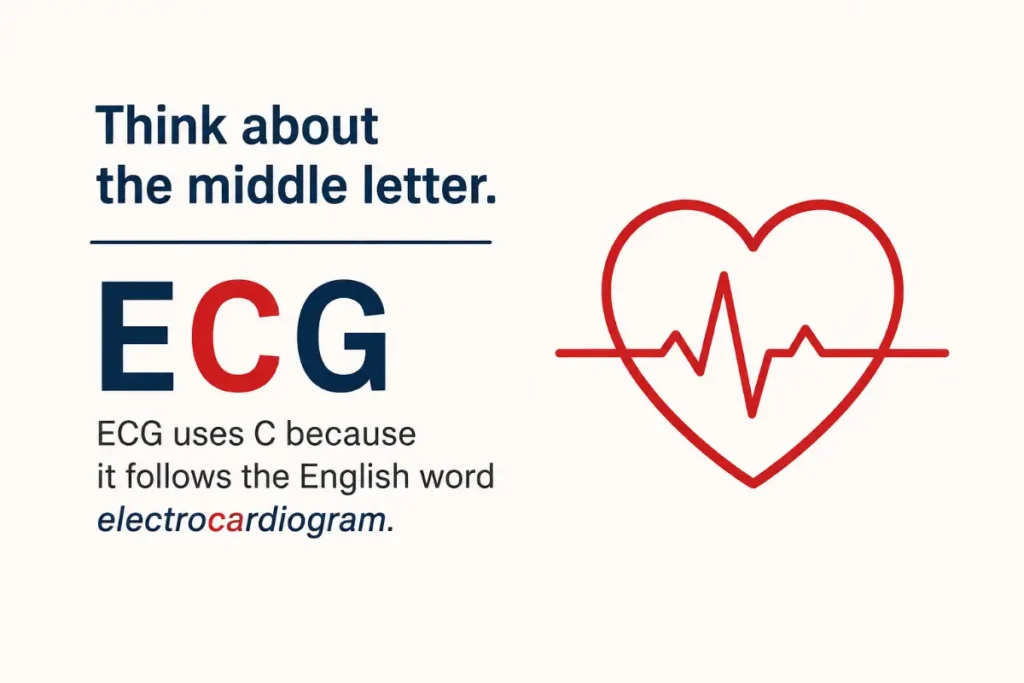
Think about the middle letter.
ECG uses C because it follows the English word electrocardiogram.
EKG uses K because it comes from the German form Elektrokardiogramm.
That’s the whole mystery.
You don’t need to memorize a complicated medical rule. Just remember that the two abbreviations come from different language traditions.
If you remember that one detail you can recognize both forms confidently the next time you see them on a medical document.
Many readers also check infront or in front Correct Spelling Meaning and Usage.
Conclusion
EKG and ECG are two correct abbreviations for the same medical test. Both refer to an electrocardiogram that records the electrical activity of the heart. The difference comes from language rather than medical function. ECG follows the English spelling of electrocardiogram while EKG reflects the German Elektrokardiogramm.
For everyday writing either form can work. Your best choice depends on your audience and editorial style. The practical tip is simple. Pick one abbreviation and use it consistently. If you remember that the K in EKG comes from the German form you’ll never need to wonder again why two different abbreviations describe the same heart test.
FAQs
Is EKG or ECG correct?
Both EKG and ECG are correct. They refer to the same medical test that records the heart’s electrical activity. ECG is the standard term used internationally, while EKG is especially common in American English.
What does EKG stand for?
EKG comes from the German term Elektrokardiogramm. It refers to an electrocardiogram, a test that records the heart’s electrical signals.
What does ECG stand for?
ECG stands for electrocardiogram. It comes from the English term for the test that measures and records the heart’s electrical activity.
Are EKG and ECG the same test?
Yes. EKG and ECG describe the same test. The difference is mainly the abbreviation used, not the medical procedure itself.
Why do doctors use EKG instead of ECG?
EKG is commonly used in the United States because it comes from the German spelling Elektrokardiogramm. It also helps distinguish the abbreviation from other medical terms that begin with ECG.
Which term is more common in the United States?
EKG is widely used in the United States, especially in hospitals, clinics, and everyday medical conversations. ECG is also correct and widely understood.
Which term is preferred internationally?
ECG is generally the more widely recognized international abbreviation. Medical literature and healthcare settings outside the United States commonly use ECG.
How do you pronounce EKG and ECG?
EKG is pronounced by saying each letter: “E K G.” ECG is also pronounced by saying each letter: “E C G.”
Is EKG a spelling mistake for ECG?
No. EKG is not a spelling mistake. It is an established abbreviation for the same test as an ECG.
Should I use EKG or ECG in medical writing?
Use the term that matches your audience and context. ECG is widely recognized internationally, while EKG is very familiar in American healthcare. Both are medically valid abbreviations.