
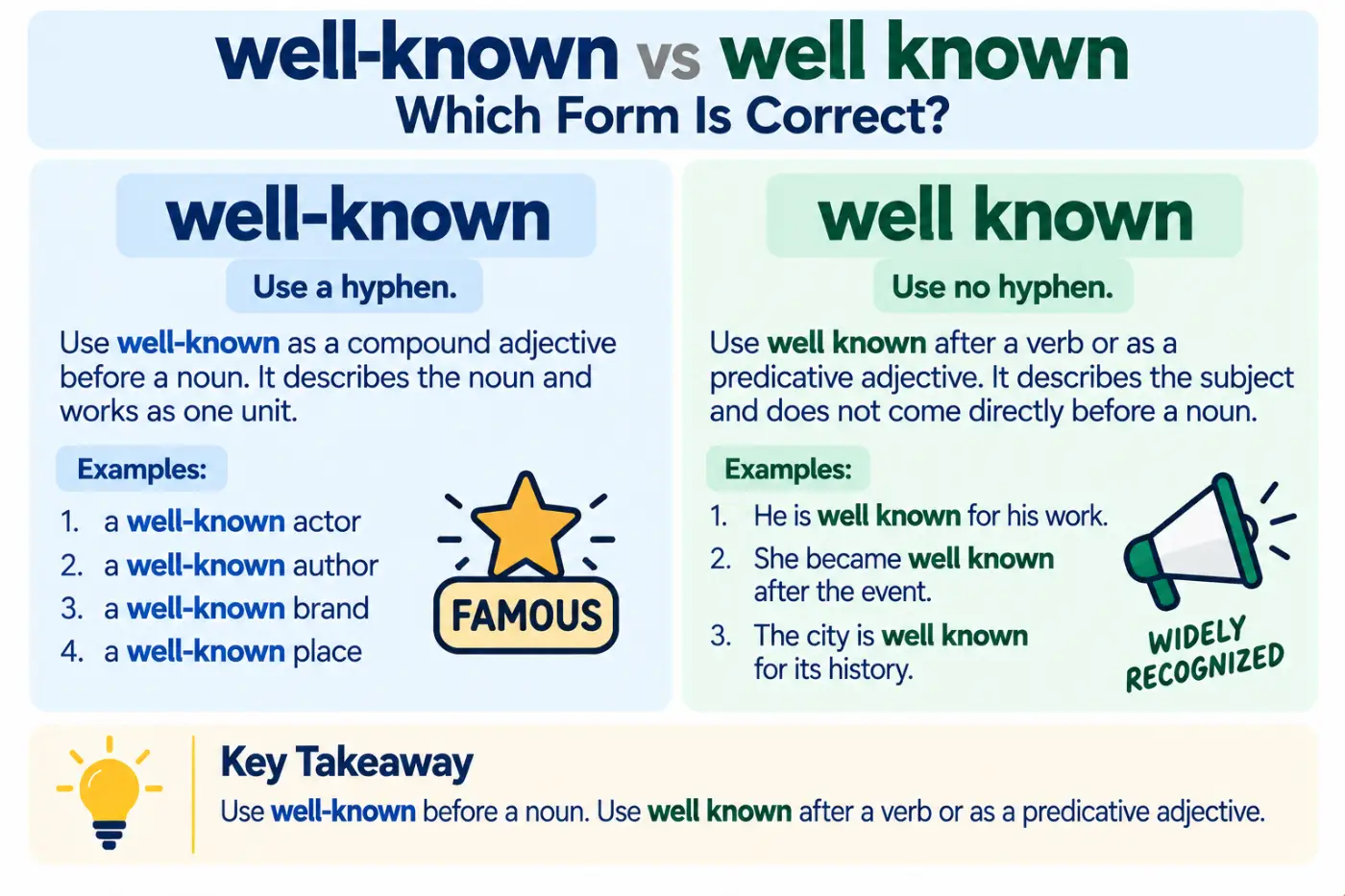
well-known vs well known is a common grammar question because the answer changes with the word’s position in a sentence. Both forms can be correct. The key difference is simple. Use the hyphenated form before a noun when the two words work together as one adjective. Use the open form after a linking verb when it describes the subject.
For example you can write a well-known author but you should write The author is well known. The meaning stays almost the same but the grammatical structure changes. This small distinction causes confusion because many writers learn the expression as one fixed phrase and then use the same form everywhere.
Once you understand the role of the words in the sentence the choice becomes much easier. You’ll learn the spelling rule the difference between attributive and predicative adjectives the most common mistakes and practical examples for school work business writing emails articles and everyday conversation. You’ll also see how American English handles the expression and how to remember the rule without memorizing dozens of examples.
You may also want to read Home Made Or Homemade Which One Is Correct?(2026).
Quick Definition
Well-known is normally hyphenated when it comes directly before a noun and acts as a compound adjective. For example she is a well-known writer. Well known is normally written without a hyphen after a linking verb such as is seems or became. For example she is well known.
Quick Answer
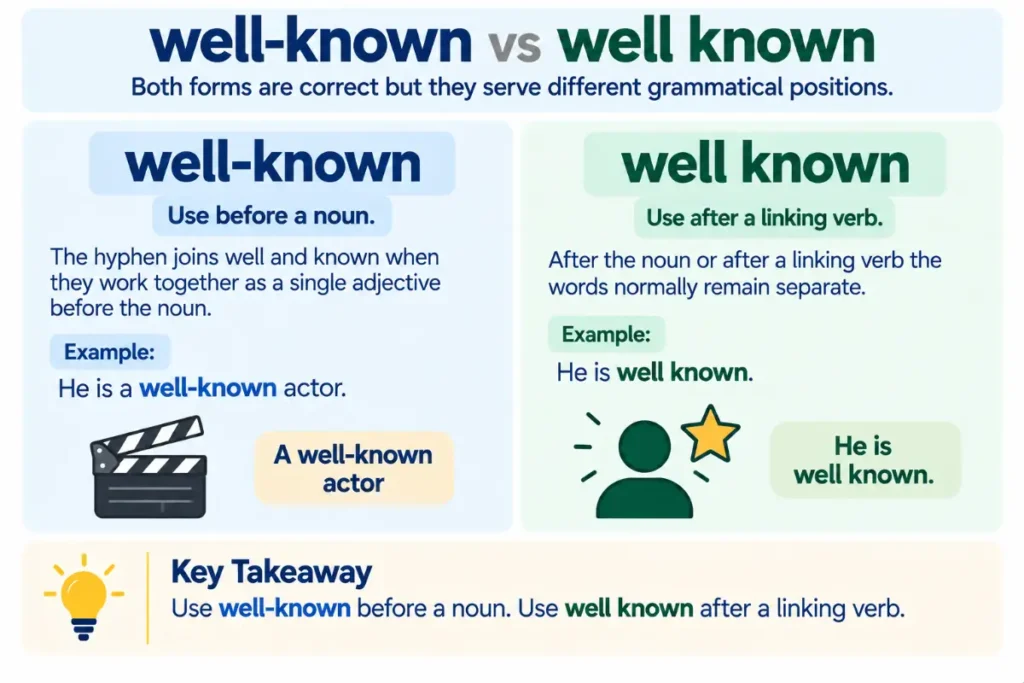
Both forms are correct but they serve different grammatical positions. Use well-known before a noun. Example: He is a well-known actor. Use well known after a linking verb. Example: He is well known. The hyphen joins well and known when they work together as a single adjective before the noun. After the noun or after a linking verb the words normally remain separate.
Comparison Table well-known or well known
| Form | Meaning | Part of Speech | Grammar Role | Usage Frequency | Formality | Common Contexts | Example |
|---|---|---|---|---|---|---|---|
| Well-known | Familiar or recognized by many people | Compound adjective | Usually appears before a noun | Very common | Neutral and formal | Articles descriptions biographies business writing | She is a well-known scientist. |
| Well known | Familiar or recognized by many people | Adjective phrase | Usually follows a linking verb | Very common | Neutral and formal | Conversation essays reports journalism | She is well known for her research. |
Meaning and Definition
Meaning of The Hyphenated Form
Well-known means widely recognized or familiar to many people. It describes someone or something that has gained recognition.
The form with the hyphen is generally used before the noun it modifies.
She interviewed a well-known musician.
In this sentence well-known describes musician. The two words work together as one descriptive unit. The hyphen makes that relationship clear to the reader.
The expression can describe people places organizations ideas products events or facts.
A well-known university opened a new campus.
They visited a well-known landmark.
He works for a well-known company.
A well-known fact appeared in the report.
The important point is position. When the compound adjective comes directly before the noun it modifies the hyphen usually helps show that the words belong together.
Meaning of The Open Form
Well known carries the same basic meaning. The difference comes from grammar rather than meaning.
Look at this sentence.
The musician is well known.
Here well known comes after the linking verb is. It describes the subject musician but it does not sit directly in front of a noun as a compound modifier. Because of that structure the hyphen is normally unnecessary.
You can also see the same pattern with other linking verbs.
The actor became well known after the film.
Her work remains well known today.
The restaurant seems well known among local residents.
The phrase still describes recognition or familiarity. Only its grammatical position has changed.
The Main Difference Explained
The easiest way to understand the distinction is to look at what comes next.
- Before a noun use the hyphenated form.
She wrote a well-known book. - After a linking verb use the open form.
The book is well known. - Before a noun use the compound adjective as one descriptive unit.
They hired a well-known designer. - After the noun keep the words open.
The designer is well known. - The meaning usually stays the same.
The main change involves grammatical position and punctuation.
This rule applies to many compound adjectives in English. The hyphen helps readers understand that two or more words function together before a noun.
Why The Hyphen Matters
A hyphen can make a sentence easier to read because it shows which words belong together.
Consider this example.
She works with a well known teacher.
The sentence may still be understood. However standard edited English generally uses a hyphen when the compound adjective comes directly before the noun.
She works with a well-known teacher.
The hyphen tells the reader that well and known form one descriptive unit modifying teacher.
This becomes even more useful with longer expressions.
They hired a highly respected teacher.
They hired a well-known teacher.
In the second example the compound structure is visually clear.
Hyphens are not decoration. They can prevent ambiguity and show how words function together.
Which Form Should You Use
Use well-known when the expression comes directly before a noun.
She met a well-known author.
Use well known when the expression follows a linking verb.
The author is well known.
This distinction is especially useful in formal writing because editors pay close attention to compound modifiers.
A simple editing test can save you time. Look at the word immediately after the expression.
If a noun follows the expression and the two words describe that noun together use the hyphenated form.
If the expression follows a linking verb and describes the subject use the open form.
Compare these examples.
He is a well-known journalist.
He is well known as a journalist.
The first expression comes before journalist so it uses a hyphen. The second expression follows is so the words remain separate.
Sentence Examples
The following examples show how the two forms work naturally in different settings.
- She is a well-known doctor in the community.
- The doctor is well known for treating complex cases.
- They stayed at a well-known hotel near the airport.
- The hotel is well known for its excellent service.
- He gave an interview to a well-known newspaper.
- The newspaper is well known across the country.
- We visited a well-known museum during our trip.
- The museum is well known for its historic collection.
- She studied under a well-known professor.
- The professor is well known among researchers.
Notice the pattern. The first sentence in each pair places the compound adjective before a noun. The second places the adjective phrase after a linking verb.
That pattern is more useful than memorizing individual sentences.
Common Mistakes and Misspellings
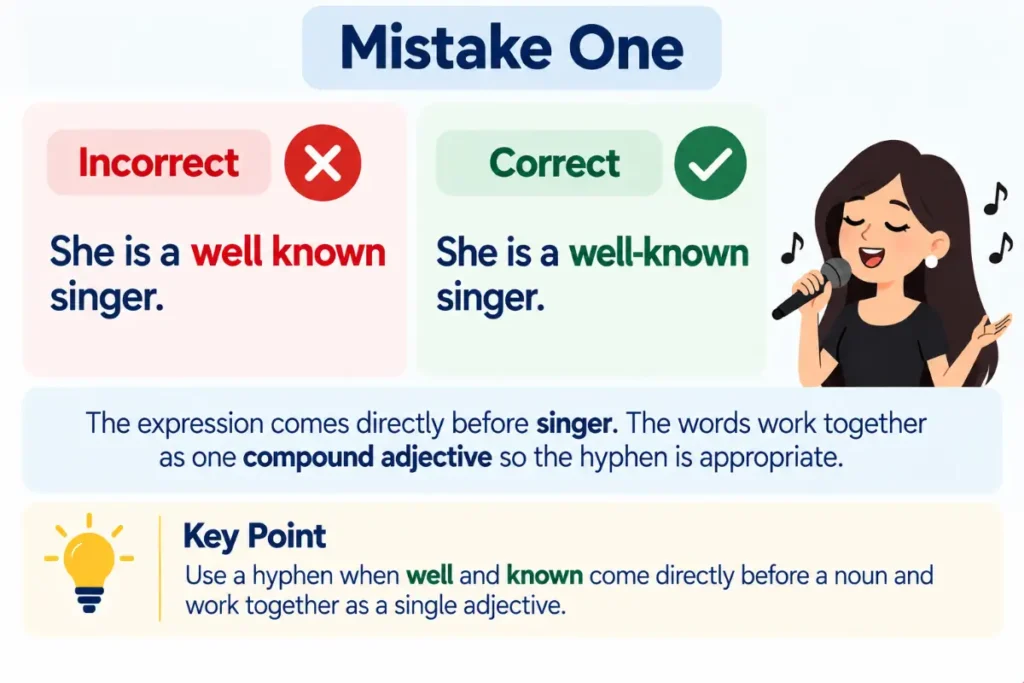
Mistake One
Incorrect: She is a well known singer.
Correct: She is a well-known singer.
The expression comes directly before singer. The words work together as one compound adjective so the hyphen is appropriate.
Mistake Two
Incorrect: She is a well-known.
Correct: She is well known.
When there is no noun immediately following the adjective phrase the hyphen is normally unnecessary.
Mistake Three
Incorrect: The well known actor arrived.
Correct: The well-known actor arrived.
Actor is the noun being described. The compound modifier appears before it so the hyphen helps connect the two words.
Mistake Four
Incorrect: The actor is well-known.
Correct: The actor is well known.
After the linking verb is the adjective phrase is predicative rather than an attributive compound placed before a noun. The open form is the normal choice.
Mistake Five
Incorrect: This is a well known fact.
Correct: This is a well-known fact.
Fact is the noun being modified. The compound adjective appears directly before it.
These errors often come from treating the expression as one fixed spelling. English compound modifiers do not always work that way. Their punctuation can depend on their position in a sentence.
Pronunciation Guide
The pronunciation is essentially the same in both forms because the hyphen changes the written structure rather than creating a different spoken word.
Well-known can be pronounced approximately as:
well NOHN
The expression contains two main parts. The first is well. The second is known.
In normal American speech the words often flow together naturally. You do not need to pause between them just because a hyphen appears in writing.
The word known contains a silent k. It sounds like nohn.
A common pronunciation mistake is to pronounce the k in known. Another mistake is to treat the hyphen as a reason to add a strong pause. You normally say the expression smoothly.
The pronunciation does not tell you when to use the hyphen. Grammar and sentence position determine that choice.
Grammar Rules and Part of Speech
The expression works as an adjective. More precisely it can function as a compound adjective when the two words appear together before a noun.
For example:
She is a well-known artist.
Here well-known modifies artist.
This is called an attributive use because the adjective appears before the noun it describes.
Now compare:
The artist is well known.
Here well known follows the linking verb is. It describes the subject but does not directly sit before the noun as a compound modifier.
This is commonly called a predicative use.
The same distinction appears with other linking verbs.
The singer became well known after the competition.
The singer seems well known to the audience.
In each example the expression follows a linking verb.
Position Before A Noun
When the phrase comes immediately before a noun use the hyphenated form.
A well-known writer visited the school.
A well-known restaurant opened downtown.
Position After A Linking Verb
When the phrase follows a linking verb the open form is normally preferred.
The writer is well known.
The company became well known.
The restaurant is well known.
When A Noun Appears Later
Sometimes the structure can become slightly more complex.
She is well known as a writer.
Here well known follows the linking verb is. The phrase as a writer gives additional information about her role.
Compare this with:
She is a well-known writer.
The grammar changes because writer follows the compound adjective directly.
Punctuation And Hyphenation
Hyphenation is mainly a clarity tool in this expression.
Before a noun:
A well-known author spoke at the event.
After a linking verb:
The author is well known.
The difference is easy to see once you identify the noun being modified.
There is no need to add a hyphen simply because the two words often appear together. Their position determines the usual punctuation.
This is a broader English writing principle. Compound modifiers placed before nouns often receive hyphens when the punctuation helps show that the words function as one unit.
Consider:
a high quality product
In edited writing this is often written as:
a high-quality product.
But after a linking verb:
The product is high quality.
The same grammatical pattern helps explain the difference between the two forms discussed here.
You may also want to read Busyness Vs Business Which Word Should You Use in 2026?.
Real Life Usage Examples
Daily Conversation
People commonly use the expression when talking about people places products and events.
My brother is a well-known photographer.
That photographer is well known around here.
The first sentence describes the photographer before the noun. The second comments on the photographer after a linking verb.
Workplace Communication
Professional writing uses both structures naturally.
We invited a well-known consultant to speak at the meeting.
The consultant is well known for helping companies improve their training programs.
The distinction is subtle but it gives professional writing a polished appearance.
Academic Writing
Academic writing often uses compound adjectives to describe researchers theories studies and institutions.
The paper examines the work of a well-known linguist.
The linguist is well known for research into language development.
The second structure can be especially useful when the writer wants to focus on the person first and then explain their reputation.
News Writing
News reports frequently describe public figures organizations and locations with this expression.
A well-known author announced a new book.
The author is well known for several bestselling novels.
Journalistic writing often switches between the two structures within the same paragraph.
Literature And Storytelling
Writers can use the expression to establish a character’s reputation quickly.
A well-known traveler arrived in the small village.
The traveler was already well known to the local people.
The two forms can create smooth variation while keeping the meaning clear.
American English
American English follows the same basic distinction.
Use the hyphenated form before a noun.
She is a well-known lawyer.
Use the open form after a linking verb.
She is well known as a lawyer.
American style guides generally treat hyphenation as a matter of grammatical function and clarity rather than personal preference alone. Exact editorial style can vary in complicated constructions but this basic distinction is reliable.
You’ll see both forms regularly in American newspapers books websites business documents and academic writing.
British English
British English also uses both forms according to grammatical position.
A well-known actor arrived at the theater.
The actor is well known throughout the country.
There is no major British spelling difference here. The central rule remains the same.
British editors may follow different style manuals for detailed hyphenation decisions but the basic compound adjective pattern remains familiar.
Australian English
Australian English follows the same general pattern.
A well-known company opened a new office.
The company is well known across the region.
There is no standard Australian alternative that removes the grammatical distinction. Writers still need to consider the position of the compound modifier.
Canadian English
Canadian English also uses the same basic pattern.
A well-known researcher presented the findings.
The researcher is well known in the field.
Canadian writing can follow different editorial styles depending on the publication or institution. However the distinction between a compound modifier before a noun and an adjective phrase after a linking verb remains useful.
Etymology And Word Origin
The word well has a long history in English and can function in several ways. In this expression it contributes the sense of being well or strongly known. The word known is the past participle of know.
The expression therefore has a fairly transparent structure. Something that is well known is known by many people or is widely recognized.
The modern compound developed naturally from the combination of well with known. English has many similar compound adjectives in which an adverb and adjective work together before a noun.
The hyphen helps signal this compound relationship when the expression comes before the noun.
Unlike some English words with unusual historical spellings this expression does not require a complicated etymological explanation to understand its modern grammar. The most useful point is that the two words form a compound modifier in one position and an adjective phrase in another.
Related And Confused Terms
Several expressions are closely related to this phrase. They can overlap in meaning but each has its own shade.
- Widely known. This emphasizes that many people know about someone or something.
- Famous. This usually suggests a high level of public recognition. It can be stronger than simply being well known.
- Recognized. This can mean known or identified. Context determines the exact meaning.
- Notable. This describes someone or something worthy of attention or notice.
- Prominent. This often suggests an important or influential position.
- Popular. This means liked or supported by many people. A popular person may also be well known but the meanings are not identical.
- Established. This can describe a person organization or idea that has gained a stable position or reputation.
- Renowned. This means widely admired or recognized and often carries a stronger sense of distinction.
These words are useful alternatives but they shouldn’t be treated as perfect replacements in every sentence. Context determines the best choice.
When The Hyphen Is Not Needed
The most useful rule is to look at the grammatical position rather than the meaning.
Consider these examples.
She is a well-known teacher.
The teacher is well known.
They hired a well-known designer.
The designer is well known.
He wrote about a well-known scientist.
The scientist is well known.
In every pair the meaning is nearly identical. The punctuation changes because the grammatical structure changes.
This is why saying that one form is always correct would be misleading. Both forms belong to standard English. The correct choice depends on how the expression functions in the sentence.
A Simple Memory Trick
Think of the noun as a signpost.
If the expression comes before the noun and describes it as one unit use the hyphen.
A well-known actor.
If the expression comes after the linking verb use the open form.
The actor is well known.
You can remember the rule as:
Before the noun join the words. After the linking verb leave them open.
This isn’t a rule you need to memorize through dozens of examples. Once you understand the grammatical structure you can apply it to new sentences.
How Editors Check The Form
Professional editing starts with sentence structure rather than a spelling checker.
An editor sees:
She is a well known author.
The first question is what well known modifies. It modifies author and sits directly before that noun. The editor therefore adds the hyphen.
Then the editor sees:
The author is well-known.
Now the expression follows the linking verb is. The editor removes the hyphen.
This kind of correction is different from fixing a simple spelling error. Both words are spelled correctly. The issue is their relationship inside the sentence.
That distinction matters because automated grammar tools can identify many common patterns but may not always understand the writer’s intended meaning in complex sentences. A human reader should still check the sentence as a whole.
Expert Editor Insight
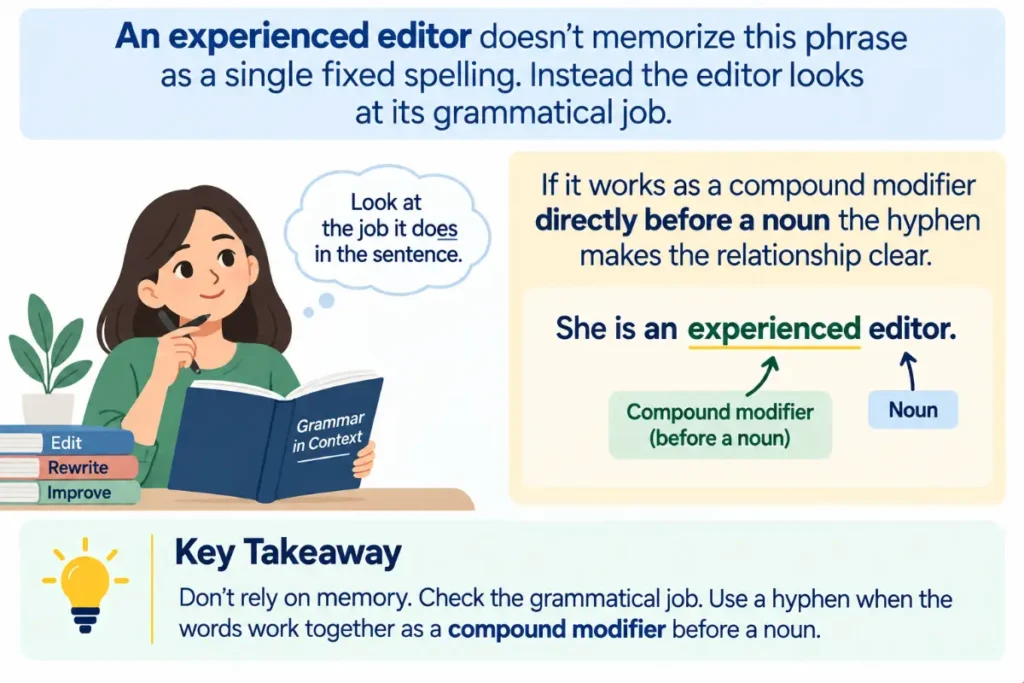
An experienced editor doesn’t memorize this phrase as a single fixed spelling. Instead the editor looks at its grammatical job. If it works as a compound modifier directly before a noun the hyphen makes the relationship clear. If it follows a linking verb the open form is normally cleaner. My practical tip is to circle the noun being described. If the expression sits directly before that noun treat it as a compound modifier and check the hyphen.
Learn the difference in Oversite vs Oversight Which Is Correct.
Conclusion
well-known vs well known has a straightforward answer once you look at sentence structure. Both forms are correct but they belong in different positions. Use the hyphenated form before a noun when the words act together as a compound adjective. Use the open form after a linking verb when the phrase describes the subject.
The easiest examples are a well-known writer and the writer is well known. The meaning stays almost identical but the grammar changes the punctuation. That small distinction explains most mistakes writers make with this expression.
For a quick editing check look at the word after the phrase. If a noun follows and the phrase describes it directly use the hyphen. If the phrase follows a linking verb leave it open. Once you make that habit automatic you’ll choose the right form naturally.
FAQs
Is well-known always hyphenated?
No. The hyphen depends on sentence position. Use the hyphenated form when the expression works as a compound adjective before a noun. For example she is a well-known artist. Use the open form after a linking verb. For example the artist is well known. Both forms are standard when used in the right grammatical structure.
Is well known grammatically correct?
Yes. Well known is grammatically correct when it follows a linking verb or functions as an adjective phrase rather than a compound modifier before a noun. You can write the author is well known or the company became well known. The lack of a hyphen does not make the expression incorrect.
Which is correct before a noun?
The hyphenated form is normally correct before a noun when well and known work together as one compound adjective. For example you can write a well-known actor or a well-known restaurant. The hyphen shows that the two words function together to modify the noun that follows.
Which form should I use after is?
Use the open form after is in the usual construction. For example write she is well known rather than she is well-known. The same pattern applies after other linking verbs such as became remained and seems. The expression describes the subject rather than forming a compound modifier directly before a noun.
Can I use the phrase in formal writing?
Yes. Both forms are common in formal writing. You can use the expression in academic papers reports business documents news articles biographies and professional correspondence. The key is to use the correct form for the sentence structure. Formal writing benefits from consistent hyphenation because clear punctuation makes complex sentences easier to read.
Is well-known an adjective?
Yes. Well-known can function as a compound adjective when it appears before a noun. In a sentence such as she is a well-known author the compound adjective describes author. The related form well known also functions adjectivally after a linking verb as in the author is well known.
Why does the hyphen disappear?
The hyphen disappears because the grammatical relationship changes. Before a noun the words work together as one compound modifier. After a linking verb they function as an adjective phrase. Compare a well-known actor with the actor is well known. The meaning remains similar but the sentence structure determines the punctuation.
Is the pronunciation different?
No significant pronunciation difference exists between the two forms. The hyphen is a writing mark rather than a signal for a separate spoken sound. Both forms are normally pronounced with the same basic rhythm. The main difference appears on the page because the hyphen shows that the words function together as a compound modifier before a noun.