
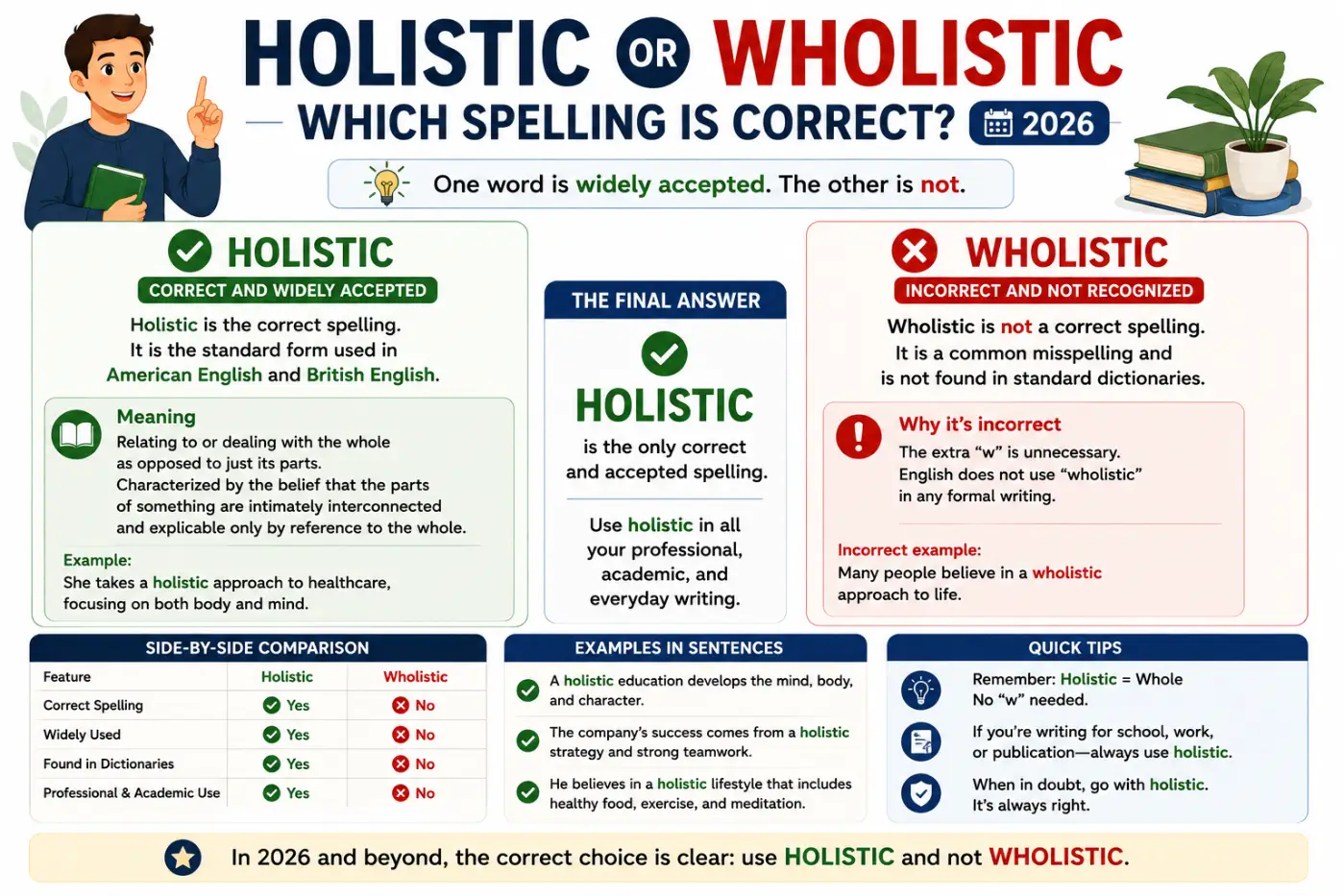
Have you come across holistic or wholistic and wondered if they mean the same thing or if one spelling is actually wrong? You’re not alone. These two words appear in books, health websites, education, business, psychology, and wellness discussions, yet many writers hesitate before choosing one.
The short answer is that holistic is the standard and overwhelmingly preferred spelling in modern English. Wholistic is also recognized by many dictionaries, but it is a much less common variant that some writers use to emphasize the idea of the “whole” person or system. Since both words refer to considering something as an integrated whole rather than as separate parts, the difference is largely one of spelling, convention, and frequency of use rather than meaning.
In this guide, you’ll learn the difference between holistic or wholistic, discover which spelling editors recommend, compare their meanings, explore their origins, examine pronunciation and grammar, and see plenty of real-world examples. By the end, you’ll know exactly which word to use in academic writing, professional communication, and everyday English.
A related grammar guide is cleverer vs more clever Which Form Should You Use.
Featured Snippet
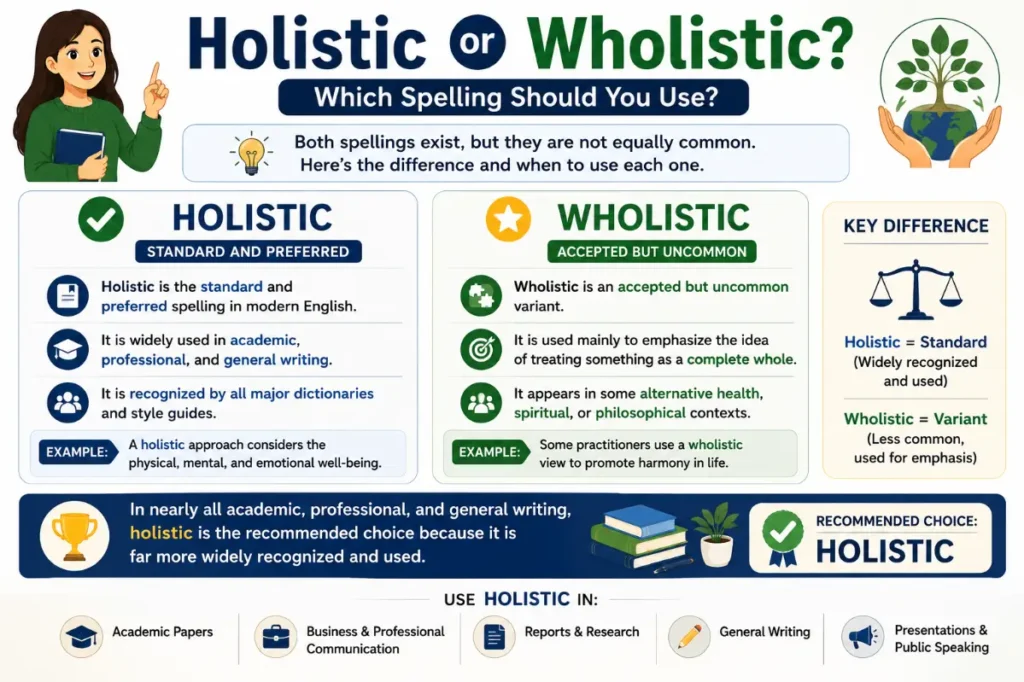
Holistic is the standard and preferred spelling in modern English. Wholistic is an accepted but uncommon variant used mainly to emphasize the idea of treating something as a complete whole. In nearly all academic, professional, and general writing, holistic is the recommended choice because it is far more widely recognized and used.
Quick Answer
If you’re deciding between holistic or wholistic, choose holistic unless you have a specific reason to use the alternative spelling.
- Holistic is the standard spelling.
- Wholistic is a recognized variant but is much less common.
- Both words share essentially the same meaning.
- Most dictionaries, editors, style guides, and publishers recommend holistic.
- Holistic is the better choice for academic, medical, business, and professional writing.
Holistic or Wholistic Comparison Table
| Feature | Holistic | Wholistic |
|---|---|---|
| Correct form | Standard spelling | Accepted variant spelling |
| Meaning | Considering the whole rather than individual parts | Same meaning with emphasis on the whole |
| Part of speech | Adjective | Adjective |
| Origin | Derived from holism | Variant influenced by the word whole |
| Usage frequency | Extremely common | Relatively uncommon |
| Formality | Suitable in all contexts | Less common in formal writing |
| Academic writing | Strongly preferred | Rarely used |
| Professional writing | Preferred | Occasionally used |
| Medical writing | Standard | Rare |
| Wellness industry | Very common | Sometimes used |
| Dictionary status | Standard entry | Usually listed as a variant |
| Example | A holistic treatment plan considers physical and mental health. | Some wellness centers advertise a wholistic approach to healing. |
Meaning of Holistic
Holistic describes an approach that considers an entire person, system, or situation instead of focusing on individual parts in isolation. The central idea is that understanding the complete picture leads to better decisions, deeper understanding, or more effective solutions. The word appears in many fields because complex issues rarely exist in isolation. Instead, different factors often influence one another.
Common areas where holistic is used include:
- Healthcare.
- Education.
- Psychology.
- Business management.
- Environmental science.
- Nutrition.
- Personal development.
- Social sciences.
For example, a doctor using a holistic approach may consider a patient’s physical symptoms, emotional health, lifestyle, nutrition, stress levels, and family history instead of treating only one symptom. Similarly, a teacher using holistic assessment evaluates not only test scores but also creativity, communication, participation, critical thinking, and personal growth.
Definition
Holistic means considering something as a complete and interconnected whole rather than concentrating on separate parts.
Context
You will commonly encounter holistic in discussions about:
- Holistic healthcare.
- Holistic medicine.
- Holistic education.
- Holistic development.
- Holistic learning.
- Holistic planning.
- Holistic management.
- Holistic thinking.
- Holistic marketing.
- Holistic wellness.
In nearly every professional field, holistic communicates the idea of integration rather than fragmentation.
Meaning of Wholistic
Wholistic carries essentially the same meaning as holistic. It also describes viewing something as an integrated whole instead of focusing on isolated elements. Some writers intentionally choose wholistic because its spelling visually highlights the word whole. They believe this reinforces the concept of completeness, balance, and interconnectedness. Despite that intention, the meaning does not differ in any meaningful way from holistic. Most readers understand both words as synonyms.
Definition
Wholistic means considering the complete person, system, or situation rather than individual components.
Context
The spelling wholistic appears most often in:
- Alternative medicine.
- Wellness programs.
- Spiritual healing.
- Personal growth literature.
- Holistic coaching.
- Integrative health practices.
- Some educational philosophies.
Although the variant is legitimate, many professional editors still replace it with holistic to match standard usage and improve consistency.
Holistic or Wholistic Key Differences
Although these words have nearly identical meanings, there are several practical differences worth understanding.
Meaning Difference
There is virtually no difference in meaning. Both words describe considering the complete picture rather than isolated parts.
Spelling Difference
The primary distinction is spelling. Holistic follows the traditional form derived from holism. Wholistic is a later variant influenced by the spelling of whole.
Usage Difference
Holistic dominates newspapers, academic journals, university publications, government documents, business writing, and professional communication. Wholistic appears more often in wellness websites, holistic health communities, and some personal development materials.
Reader Expectations
Most English speakers immediately recognize holistic because it is the spelling they encounter most often. Some readers may assume wholistic is a typo simply because they rarely see it.
Editorial Preference
Professional editors usually standardize documents by changing wholistic to holistic unless an organization intentionally uses the alternative spelling as part of its branding or philosophy.
Holistic or Wholistic Which One Is Correct?
The best answer is simple. Holistic is the correct and preferred spelling for almost every situation. That does not mean wholistic is incorrect. Many respected dictionaries acknowledge it as a legitimate variant. However, language is shaped by actual usage, and holistic has become the established standard across English-speaking countries. If your goal is clear, professional communication, holistic is almost always the safest choice.
Choose holistic when writing:
- Academic papers.
- Business reports.
- Medical documents.
- Research articles.
- School assignments.
- Government publications.
- Professional emails.
- News articles.
- Marketing materials.
- Technical writing.
You might encounter wholistic when:
- Reading wellness blogs.
- Visiting alternative medicine clinics.
- Exploring spiritual literature.
- Reading personal coaching materials.
- Looking at company names that intentionally use the variant spelling.
Even in these contexts, many organizations still prefer holistic.
Holistic or Wholistic Pronunciation Guide
One interesting fact is that both spellings are pronounced exactly the same.
Holistic
IPA: /həˈlɪstɪk/
Syllables: ho • lis • tic
Pronunciation: huh LIST ik
Wholistic
IPA: /həˈlɪstɪk/
Syllables: who • lis • tic
Pronunciation: huh LIST ik
Although wholistic begins with the letters wh, English speakers do not pronounce it differently from holistic.
Common Pronunciation Mistakes
- Pronouncing the wh as a separate sound.
- Stressing the first syllable instead of the second.
- Saying whole LIST ic with an exaggerated whole sound.
- Overpronouncing the h at the beginning.
Native speakers naturally place the primary stress on the second syllable.
Still confused? Compare Investor vs Investee Which Is the Difference? 2026.
Holistic or Wholistic Etymology and Word Origin
Understanding the history of these words helps explain why both spellings exist today. The story begins with the noun holism, a term introduced in the early twentieth century by the South African statesman and philosopher Jan Smuts. He used holism to describe the principle that natural systems should be understood as integrated wholes rather than as collections of separate parts. From holism, English developed the adjective holistic, which quickly became the accepted standard spelling. Later, some writers introduced wholistic because they felt the spelling more clearly reflected the English word whole. Their intention was not to create a new meaning but to make the connection between holistic and whole more obvious to readers.
Holistic or Wholistic Examples in Sentences
One of the easiest ways to understand the difference between holistic or wholistic is to see how each word appears in natural sentences. Although both words share the same meaning, you’ll notice that holistic is the version used much more often in everyday English and professional writing.
10 Examples Using Holistic
- The doctor recommended a holistic treatment plan that included medication, exercise, and stress management.
- Our school follows a holistic approach to student development by focusing on both academic and personal growth.
- The company adopted a holistic strategy to improve customer satisfaction across every department.
- A holistic understanding of climate change requires studying environmental, economic, and social factors together.
- The therapist believes holistic care should address emotional and physical well-being at the same time.
- Successful leaders often take a holistic view of business instead of concentrating on short-term profits alone.
- Nutritionists encourage a holistic lifestyle that combines healthy eating, regular exercise, and adequate sleep.
- The architect designed a holistic community that balanced housing, transportation, and green spaces.
- Researchers used a holistic framework to evaluate the long-term effects of the new education program.
- A holistic review of the project revealed strengths that individual reports had overlooked.
10 Examples Using Wholistic
- The wellness center promotes a wholistic philosophy that supports mind, body, and spirit.
- She prefers a wholistic approach to healing that combines traditional and alternative therapies.
- The retreat advertises wholistic wellness programs for people seeking balance in their lives.
- Some coaches encourage wholistic personal development through mindfulness and healthy habits.
- The organization describes its counseling services as wholistic and client centered.
- Several practitioners believe wholistic care leads to better long-term health outcomes.
- The clinic uses wholistic methods alongside conventional medical treatments.
- Their wholistic philosophy emphasizes treating the entire person instead of isolated symptoms.
- The author explains wholistic living through examples from nutrition, psychology, and spirituality.
- A few healthcare organizations intentionally use wholistic in their branding to emphasize completeness.
Holistic or Wholistic Common Mistakes
Even experienced writers occasionally hesitate when choosing between these spellings. Most confusion comes from the relationship between the words whole, holism, and holistic. The following mistakes are especially common.
1. Assuming Wholistic Is the Only Correct Form
Because wholistic visibly contains the word whole, some people believe it must be the correct spelling. In reality, holistic is the standard form used throughout modern English.
2. Believing Holistic and Wholistic Have Different Meanings
Some readers assume each spelling represents a different concept. That is not the case. Both words describe viewing something as an integrated whole.
3. Mixing Both Spellings in One Document
Consistency matters. Using holistic in one paragraph and wholistic in another makes writing appear inconsistent. Choose one spelling and use it throughout your document. In most situations, holistic is the better choice.
4. Thinking Wholistic Is a Misspelling
Although uncommon, wholistic is recognized by many dictionaries as a legitimate variant spelling. Calling it a spelling mistake is inaccurate.
5. Choosing Wholistic for Formal Writing
Many writers use wholistic in research papers or business documents because it seems more descriptive. Professional editors generally recommend holistic because it matches standard usage.
6. Overusing the Term
Because holistic has become popular in many industries, it is sometimes added where a more precise adjective would communicate the idea better. Instead of repeating holistic, consider alternatives such as:
- Comprehensive.
- Integrated.
- Complete.
- Systemwide.
- Balanced.
- Broad.
- Interconnected.
- All encompassing.
Using varied vocabulary improves readability and avoids repetition.
Holistic or Wholistic Grammar Rules
Understanding the grammar behind these words helps you use them correctly in every context.
Part of Speech
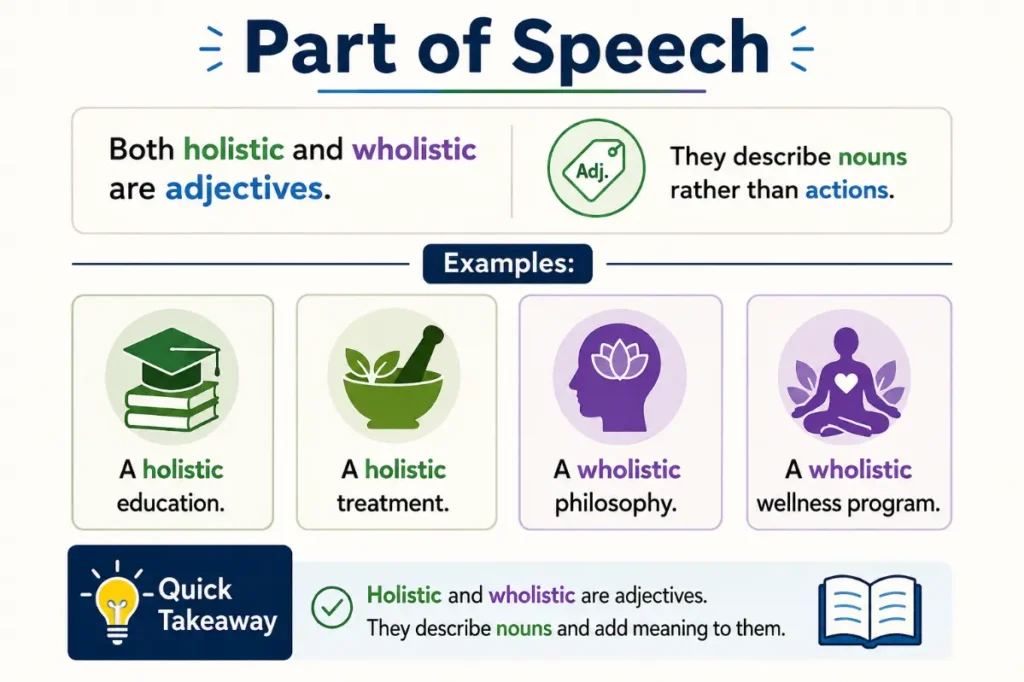
Both holistic and wholistic are adjectives.
They describe nouns rather than actions.
Examples:
- A holistic education.
- A holistic treatment.
- A wholistic philosophy.
- A wholistic wellness program.
Comparative and Superlative Forms
These adjectives are rarely used in comparative or superlative forms.
Instead of writing:
- more holistic
- most holistic
Many writers simply rephrase the sentence.
For example:
Instead of:
“This program is more holistic.”
You could write:
“This program takes a broader and more integrated approach.”
Still, expressions like more holistic are grammatically acceptable when comparisons are necessary.
Plural Forms
Adjectives do not have plural forms.
Correct:
- holistic approaches
- holistic solutions
- wholistic programs
Incorrect:
- holistics approaches
- wholistics methods
Position in a Sentence
These adjectives usually appear before the noun they describe.
Examples:
- A holistic assessment.
- A holistic strategy.
- A wholistic philosophy.
They can also appear after linking verbs.
Examples:
- Their approach is holistic.
- The treatment feels holistic.
- The program remains wholistic in its design.
Common Sentence Patterns
You will often see these structures.
- Holistic approach.
- Holistic care.
- Holistic education.
- Holistic learning.
- Holistic development.
- Holistic medicine.
- Holistic management.
- Holistic planning.
- Holistic health.
- Holistic review.
These combinations are widely accepted in professional English.
Holistic or Wholistic Regional Usage
English is spoken across many countries, but the preference for holistic remains remarkably consistent.
American English
American English strongly favors holistic. Medical schools, universities, publishers, newspapers, businesses, and government organizations almost always use this spelling. Wholistic appears mainly in alternative health communities and business names.
British English
British English also overwhelmingly prefers holistic. It appears regularly in education, healthcare, psychology, and public policy. The alternative spelling is uncommon.
Canadian English
Canadian publications follow the same pattern. Professional writing almost always uses holistic, while wholistic appears only occasionally in wellness marketing.
Australian English
Australian English likewise treats holistic as the standard spelling. Government agencies, universities, and healthcare organizations consistently choose holistic.
Global Preference
Across English-speaking countries, holistic is the dominant form by a wide margin. If your writing has an international audience, holistic is the safest and most recognizable choice.
Holistic or Wholistic Real Life Usage Examples
Looking at real-world contexts makes the distinction even clearer.
Daily Conversation
“I’ve started taking a more holistic approach to my health by exercising, eating better, and getting enough sleep.” “My coach encourages wholistic wellness instead of focusing only on physical fitness.”
Academic Writing
“The researchers adopted a holistic framework for evaluating student achievement.” Academic publications almost never substitute wholistic here because consistency and standard spelling are important.
Professional Communication
“Our organization uses a holistic strategy to improve customer experience across every department.” Business writing almost always favors holistic because it is widely recognized.
Healthcare
“The hospital promotes holistic patient care by integrating physical, emotional, and social support.” Some private clinics intentionally advertise wholistic healing services as part of their branding, but the underlying concept remains the same.
Literature
Modern authors frequently use holistic when discussing philosophy, psychology, education, and social systems. The variant wholistic appears much less often and is usually a deliberate stylistic choice.
Media and Marketing
News organizations, educational websites, and major publishers overwhelmingly use holistic. Meanwhile, wellness blogs and holistic health businesses occasionally choose wholistic because they believe it visually reinforces the idea of treating the whole person.
Holistic or Wholistic Related Words and Confused Terms
Many words are connected to holistic because they express ideas of completeness, integration, or broad thinking.
Closely Related Words
- Comprehensive.
- Integrated.
- Balanced.
- Unified.
- Inclusive.
- Broad.
- Complete.
- Interconnected.
- Coordinated.
- Multidimensional.
Words Commonly Used Alongside Holistic
- Healthcare.
- Medicine.
- Wellness.
- Healing.
- Education.
- Learning.
- Assessment.
- Development.
- Planning.
- Management.
- Nutrition.
- Psychology.
- Sustainability.
- Leadership.
- Therapy.
Commonly Confused Terms
Holism
The noun referring to the philosophy or principle of viewing systems as integrated wholes.
Example:
“Holism has influenced modern healthcare.”
Holistically
The adverb form.
Example:
“The teacher evaluates students holistically rather than relying only on test scores.”
Whole
A noun, adjective, or determiner referring to something complete.
Example:
“The whole family attended the event.”
Although whole inspired the variant spelling wholistic, the standard adjective remains holistic.
Holistic or Wholistic Expert Language Insight
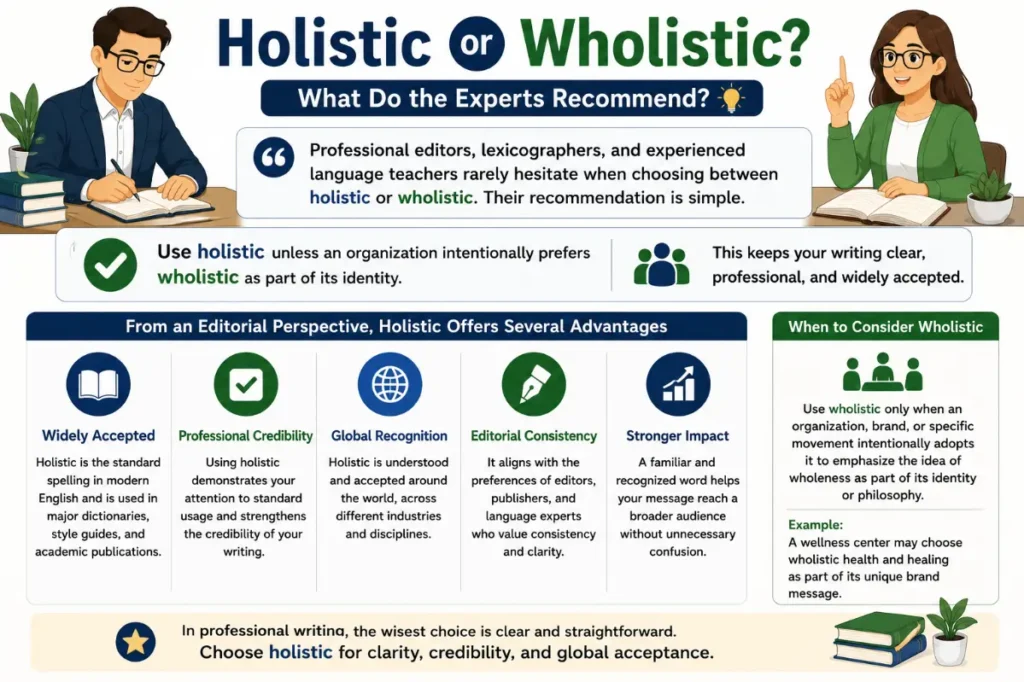
Professional editors, lexicographers, and experienced language teachers rarely hesitate when choosing between holistic or wholistic. Their recommendation is simple. Use holistic unless an organization intentionally prefers wholistic as part of its identity. From an editorial perspective, holistic offers several advantages.
- It matches the spelling used in major dictionaries.
- It aligns with academic and professional writing standards.
- It is instantly familiar to readers around the world.
- It reduces the chance that readers will mistake the word for a spelling error.
- It creates consistency across formal documents.
Native English speakers generally do not associate different meanings with the two spellings. Most people see wholistic as a stylistic variation rather than a separate word. If you’re writing an article, business report, school assignment, research paper, website, or email, holistic is almost always the stronger editorial choice.
Many readers also check alter vs altar The Complete Difference Guide 2026.
Conclusion
If you’re deciding between holistic or wholistic, the safest and most widely accepted choice is holistic. It is the standard spelling used in dictionaries, academic publications, healthcare, business, education, and everyday English. While wholistic is a legitimate variant, it appears far less frequently and is often limited to specific wellness communities, organizations, or brand names.
The two words share essentially the same meaning. Both describe an approach that considers the complete person, system, or situation instead of examining individual parts in isolation. The difference lies in convention rather than definition. Holistic has become the established form through decades of consistent use, making it the spelling most readers recognize immediately.
For students, professionals, writers, and anyone aiming for clear communication, holistic is almost always the best option. Reserve wholistic only when you are referring to an organization’s official name, quoting a source, or intentionally following a style that uses the variant spelling.
Frequently Asked Question
Is holistic or wholistic the correct spelling?
Holistic is the standard and preferred spelling in modern English. Wholistic is a recognized variant, but it appears much less often. For academic writing, professional communication, business documents, and most published content, holistic is the recommended choice because it is the spelling readers expect.
Do holistic and wholistic mean the same thing?
Yes. Both words describe an approach that considers the whole person, system, or situation instead of focusing on individual parts. Although wholistic visually emphasizes the word whole, there is no meaningful difference in definition or everyday usage.
Why do some people use wholistic instead of holistic?
Some writers and organizations choose wholistic to make the connection with the word whole more obvious. This spelling is especially common in certain wellness, coaching, and alternative medicine communities. Even so, holistic remains the dominant form across dictionaries, universities, and professional publications.
Is wholistic a misspelling?
No. Wholistic is not a misspelling. Many dictionaries recognize it as an acceptable variant of holistic. However, because it is far less common, some readers may mistakenly assume it is an error. Using holistic helps avoid that confusion.
Which spelling should I use in academic writing?
Use holistic in essays, research papers, journal articles, reports, and other academic work. It is the standard spelling used by educational institutions, scholarly publishers, and professional editors. Choosing holistic also improves consistency and readability.
Is holistic used in healthcare only?
No. Although holistic is widely associated with healthcare, it is also common in education, psychology, business, environmental science, leadership, social work, marketing, and many other fields. The word simply describes an approach that considers all relevant factors together.
Are holistic and holism related?
Yes. Holistic is the adjective form derived from the noun holism, which refers to the philosophy that systems should be understood as integrated wholes rather than as collections of separate parts. The adjective describes anything that follows this principle.
How can I remember the correct spelling?
A simple memory tip is to connect holistic with holism. Since the adjective comes directly from holism, the standard spelling is holistic. Although wholistic looks like it comes from whole, it is only a less common variant and is not the preferred choice in most writing.