
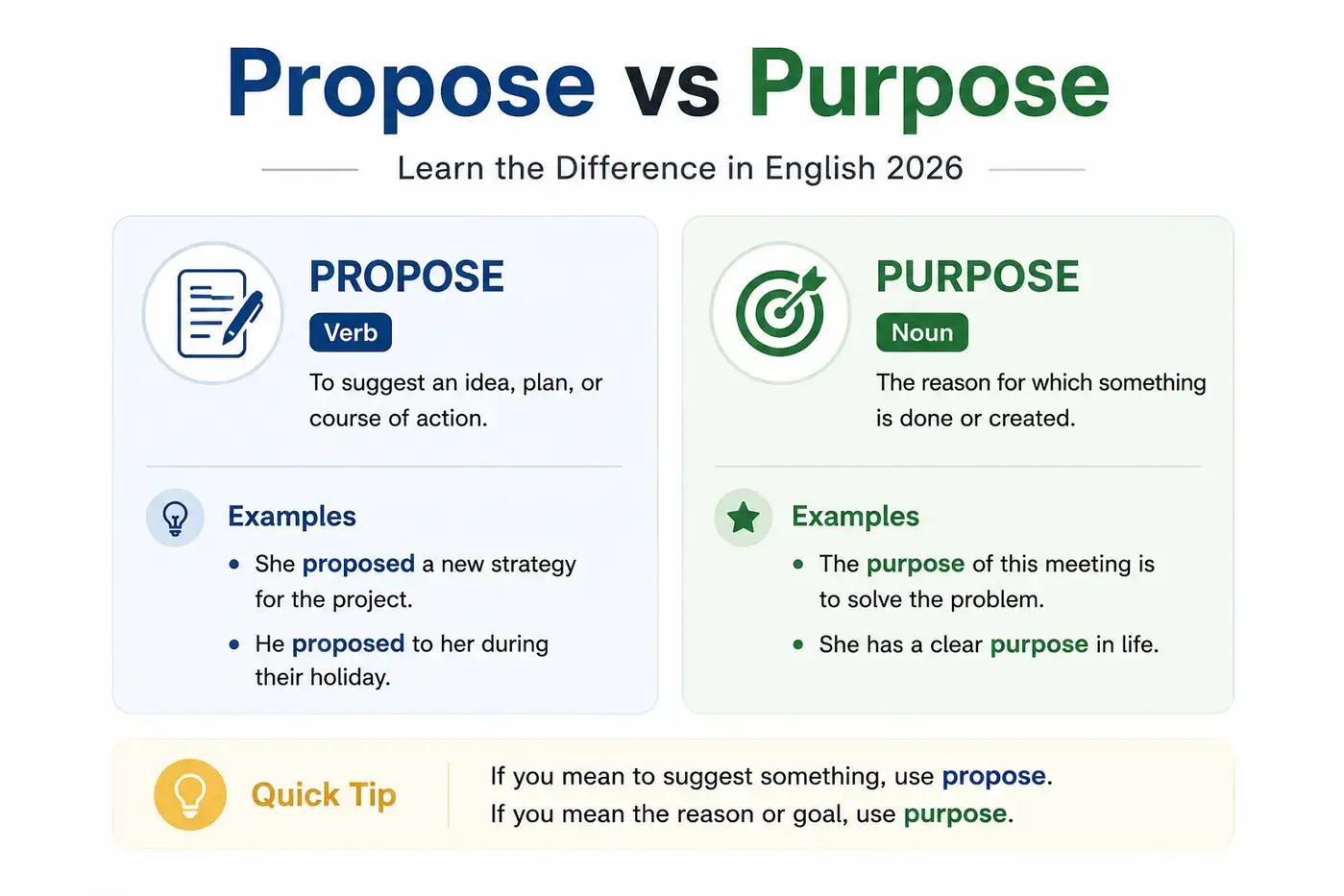
The confusion between propose vs purpose catches many English learners and even native speakers off guard. At a quick glance, the words look related. They share similar letters, have comparable pronunciation patterns, and both appear frequently in formal writing. Despite these similarities, they mean completely different things. Propose usually means to suggest an idea, plan, solution, or course of action. Purpose refers to a reason, goal, intention, or objective behind something.
Mixing them up can completely change the meaning of a sentence. Someone might propose a new business strategy, but the purpose of that strategy could be increasing revenue. One word describes an action. The other describes an intention.
Understanding this distinction helps you write more clearly, speak more confidently, and avoid one of the most common vocabulary mistakes in English. In this guide, you’ll learn the exact difference between propose and purpose, their meanings, pronunciation, grammar rules, origins, examples, regional usage, and expert tips for using them correctly every time.
Still confused? Compare Naive vs Nieve: Meaning, Usage, and Differences 2026..
Quick Definition
Propose means to suggest, recommend, or put forward an idea, plan, or action. Purpose means the reason, intention, goal, or objective behind something. Propose is usually a verb, while purpose is most commonly a noun. Although the words look similar, they serve completely different functions in English.
Propose Vs Purpose Quick Answer
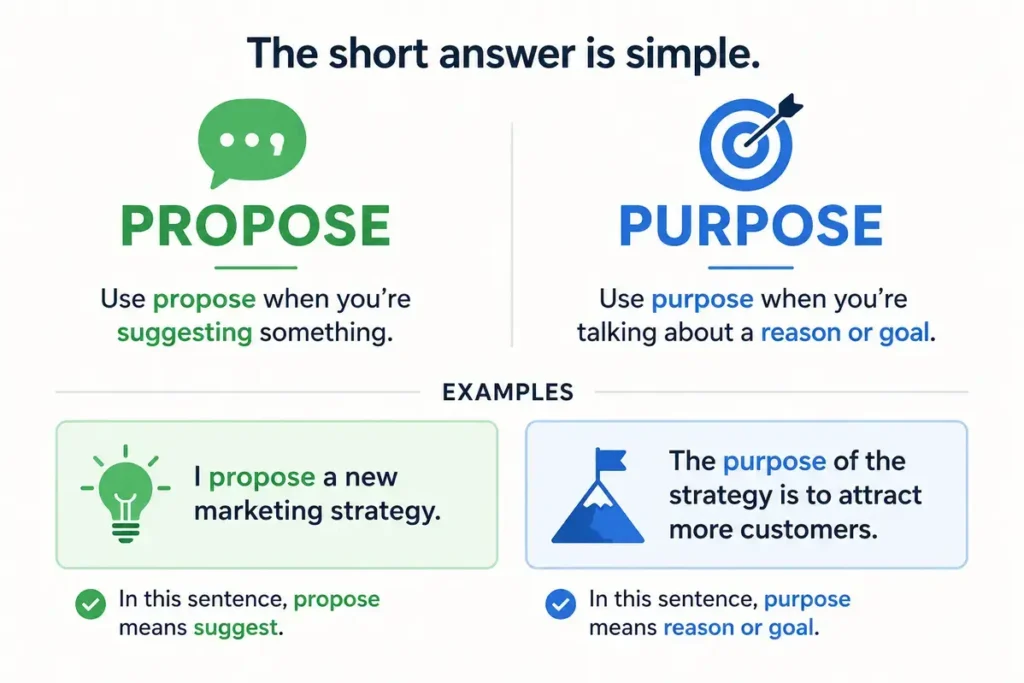
The short answer is simple. Use propose when you’re suggesting something. Use purpose when you’re talking about a reason or goal.
Examples:
- I propose a new marketing strategy.
- The purpose of the strategy is to attract more customers.
In the first sentence, propose means suggest. In the second sentence, purpose means objective. That’s the core difference.
Propose Vs Purpose Comparison Table
| Feature | Propose | Purpose |
|---|---|---|
| Correct Word | Yes | Yes |
| Main Meaning | To suggest or recommend | A reason or objective |
| Part Of Speech | Usually a verb | Usually a noun |
| Origin | Latin through Old French | Latin through Old French |
| Usage Frequency | Common | Very common |
| Formality Level | Neutral to formal | Neutral |
| Common Contexts | Suggestions, plans, marriage proposals | Goals, intentions, functions |
| Typical Question | What are you suggesting? | Why does it exist? |
| Example | I propose a solution. | The purpose is clear. |
Meaning Of Propose Vs Purpose
What Does Propose Mean?
Propose is a verb that means to suggest, recommend, present, or put forward an idea for consideration.
People propose plans, policies, projects, solutions, changes, and even marriage.
Examples:
- The manager proposed a new schedule.
- Scientists proposed a different theory.
- He proposed marriage during dinner.
- The committee proposed several changes.
- She proposed a creative solution.
In every example, propose involves presenting an idea or suggestion.
What Does Purpose Mean?
Purpose is usually a noun that refers to a reason, goal, aim, intention, or objective.
It answers the question why.
Examples:
- The purpose of the meeting was to solve the problem.
- Every tool has a specific purpose.
- Her purpose was to help others.
- The purpose of education extends beyond exams.
- The campaign’s purpose was raising awareness.
Unlike propose, purpose focuses on motivation and intended outcomes.
Key Differences Between Propose Vs Purpose
Although these words share some visual similarities, they differ in several important ways.
Meaning Difference
- Propose means to suggest something.
- Purpose means a reason or objective.
Grammar Difference
- Propose is primarily a verb.
- Purpose is primarily a noun.
Function Difference
- Propose describes an action.
- Purpose describes an intention.
Question Difference
- Propose answers what is being suggested.
- Purpose answers why something exists.
Context Difference
- Propose appears in discussions, recommendations, meetings, and planning.
- Purpose appears in discussions about goals, missions, and objectives.
Example Comparison
Consider these sentences:
- I propose reducing costs.
- The purpose of reducing costs is increasing profits.
The first sentence presents an idea.The second explains the reason behind that idea.
Propose Vs Purpose In Everyday Communication
This distinction becomes very clear in daily life.Imagine a workplace meeting.An employee might propose a new workflow.The purpose of that workflow could be saving time.Imagine a classroom.A student might propose a group project.The purpose of the project could be improving collaboration.Imagine a family discussion.Someone might propose taking a vacation.The purpose of the vacation could be spending quality time together.In every case, propose introduces an idea while purpose explains the goal behind it.
Propose Vs Purpose In Business Writing
Business communication frequently uses both words.
Examples include:
- We propose expanding into new markets.
- The purpose of expansion is increasing revenue.
- Management proposed a revised budget.
- The purpose of the budget adjustment is reducing expenses.
- The company proposed several improvements.
- The purpose of the improvements is enhancing customer satisfaction.
Because both words appear in professional writing, confusion can occur. Understanding their roles helps ensure clear communication.
Propose Vs Purpose In Academic Writing
Academic writing often relies on precise language. Researchers commonly use propose when introducing theories, hypotheses, or recommendations.
Examples:
- Researchers propose a new framework.
- Scholars propose an alternative interpretation.
- The study proposes a revised model.
Purpose appears when discussing objectives.
Examples:
- The purpose of the research was evaluating outcomes.
- The purpose of the experiment was measuring performance.
- The purpose of the analysis was identifying trends.
This distinction remains consistent across academic disciplines.
Which Word Appears More Often?
Purpose generally appears more frequently in everyday English because people regularly discuss goals, reasons, and intentions. However, propose is also common, especially in professional, academic, political, and formal contexts. Both words remain essential parts of modern English vocabulary.The key is understanding that they serve different jobs in a sentence.
Which One Is Correct In Propose Vs Purpose?
One of the most common questions people ask is which word is correct. The answer is simple. Both propose and purpose are correct English words. The problem isn’t correctness. The problem is choosing the right word for the right meaning. Use propose when you’re suggesting an idea, recommendation, plan, or action. Use purpose when you’re talking about a reason, goal, aim, mission, or objective.
Consider these examples:
Correct:
- I propose a different solution.
- The purpose of the solution is reducing costs.
Incorrect:
- I purpose a different solution.
- The propose of the solution is reducing costs.
The incorrect examples confuse the meanings and grammatical roles of the words. A simple memory trick can help. Think of propose as presenting an idea. Think of purpose as explaining a reason. If you’re introducing something, use propose. If you’re explaining why something exists, use purpose.
You may also want to read Bony Vs Boney Which Spelling Is Correct 2026.
Propose Vs Purpose Examples In Sentences
Seeing both words in real sentences makes the difference much easier to understand.
Propose Examples
- I propose a new approach to the project.
- The committee proposed several policy changes.
- She proposed a solution during the meeting.
- Scientists proposed a new explanation for the results.
- The mayor proposed building another public park.
- Our team proposed extending the deadline.
- The teacher proposed a different learning strategy.
- They proposed improvements to the software.
- He proposed a partnership between the companies.
- The researchers proposed a revised model.
Purpose Examples
- The purpose of the project is improving efficiency.
- Every business should have a clear purpose.
- The purpose of the meeting was solving the issue.
- Education serves a greater purpose than passing tests.
- The campaign’s purpose was increasing awareness.
- Her purpose in life was helping others.
- The purpose of the tool is simplifying the process.
- The website’s purpose is providing useful information.
- Their purpose remained unchanged despite challenges.
- The purpose of the study was gathering data.
Common Mistakes In Propose Vs Purpose
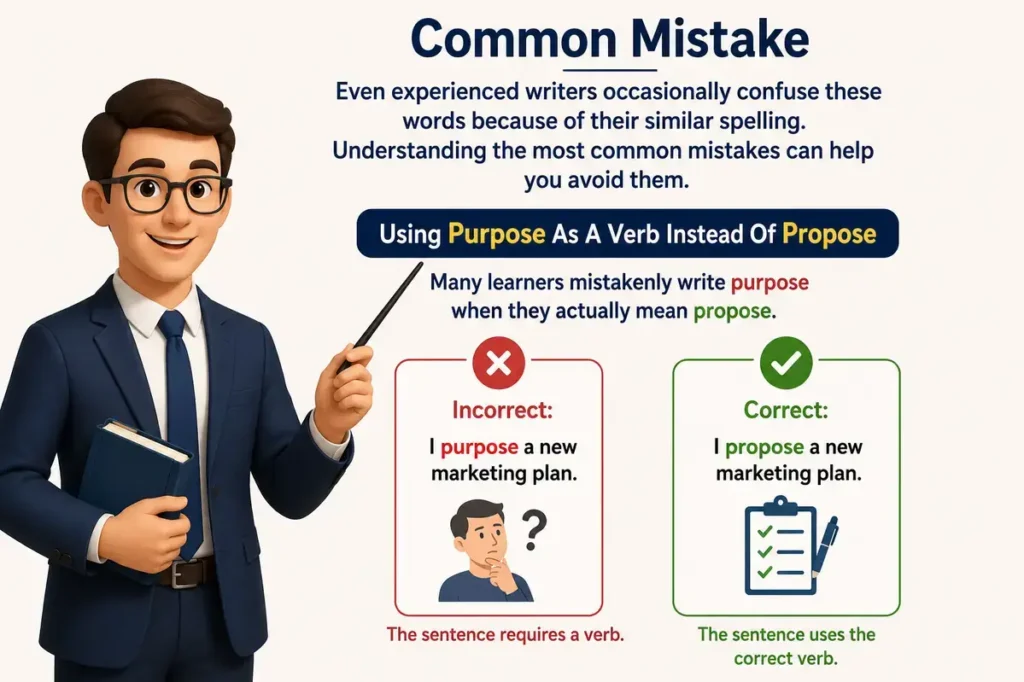
Even experienced writers occasionally confuse these words because of their similar spelling. Understanding the most common mistakes can help you avoid them.
Using Purpose As A Verb Instead Of Propose
Many learners mistakenly write purpose when they actually mean propose.
Incorrect:
- I purpose a new marketing plan.
Correct:
- I propose a new marketing plan.
The sentence requires a verb meaning suggest, so propose is correct.
Using Propose As A Noun Instead Of Purpose
Another common error is replacing purpose with propose.
Incorrect:
- The propose of the meeting was discussing sales.
Correct:
- The purpose of the meeting was discussing sales.
The sentence needs a noun that means reason or objective.
Assuming The Words Are Interchangeable
Because the words look similar, some people think they can replace each other.
They cannot.
Examples:
- We propose a solution.
- The purpose of the solution is helping customers.
Switching the words would create incorrect sentences.
Confusing Similar Pronunciations
Fast speech sometimes causes people to hear these words incorrectly. This is especially common among English learners who rely heavily on sound patterns. Paying attention to the meaning of the sentence usually solves the problem.
Forgetting The Different Parts Of Speech
A helpful reminder:
- Propose is usually a verb.
- Purpose is usually a noun.
Remembering this simple rule prevents many grammar mistakes.
Propose Vs Purpose Pronunciation Guide
Although these words look somewhat similar, their pronunciations differ noticeably. Learning the correct pronunciation helps with speaking, listening, presentations, and voice search queries.
Propose Pronunciation
IPA:
/prəˈpoʊz/
Syllable Breakdown:
Pro • pose
Pronunciation Tip:
The second syllable receives the stress.
Say it like:
pruh POHZ
Words that rhyme with propose include:
- Close.
- Suppose.
- Compose.
Purpose Pronunciation
IPA:
/ˈpɜːr.pəs/
Syllable Breakdown:
Pur • pose
Pronunciation Tip:
The first syllable receives the stress.
Say it like:
PUR pəs
Common Pronunciation Mistakes
- Stressing the first syllable in propose.
- Stressing the second syllable in purpose.
- Pronouncing purpose exactly like propose.
- Dropping the middle vowel sound in purpose.
Listening to native speakers can help reinforce the distinction.
Etymology And Word Origin Of Propose vs Purpose
The history of these words reveals why they look related but developed different meanings.
Origin Of Propose
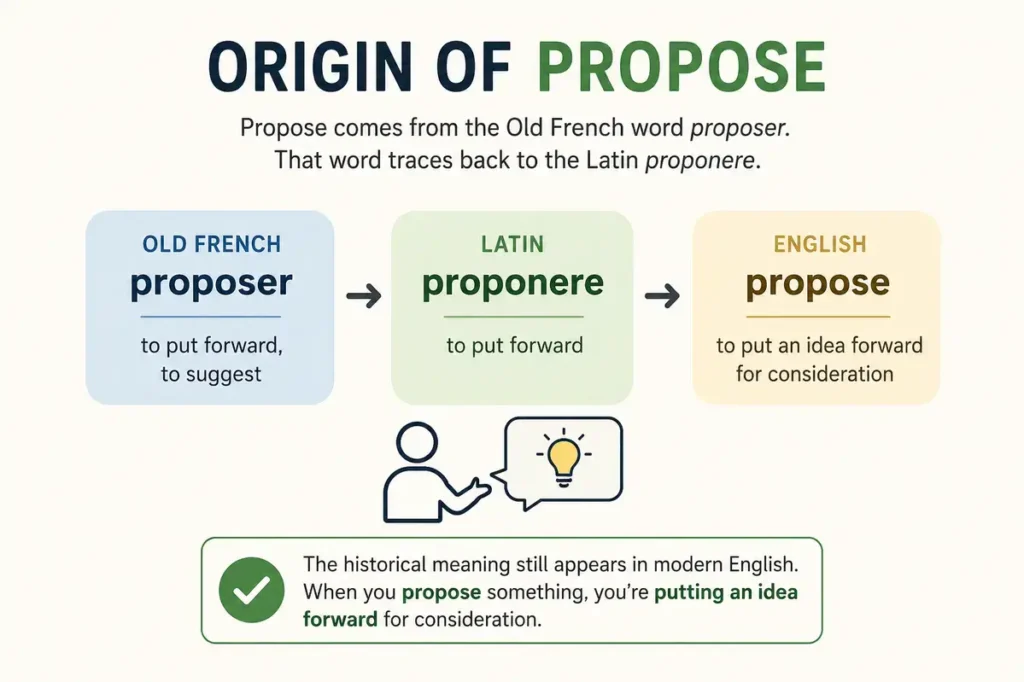
Propose comes from the Old French word proposer. That word traces back to the Latin proponere. The Latin roots mean to put forward. This historical meaning still appears in modern English. When you propose something, you’re putting an idea forward for consideration.
Origin Of Purpose
Purpose entered English through Old French and Latin influences as well.It ultimately developed from concepts involving intention, aim, and design.Over time, purpose became the standard English word for a person’s objective, reason, or goal.
Why The Words Look Similar
Both words share Latin ancestry.That shared history explains why they resemble each other visually.However, centuries of language evolution gave them different meanings and grammatical functions.Today, they operate as separate words with distinct purposes in communication.
Propose or Purpose Regional Usage
One interesting aspect of these words is their consistency across English speaking countries.Unlike some vocabulary differences between regions, propose and purpose maintain similar meanings worldwide.
American English
American speakers use propose and purpose exactly as defined in standard English.
Examples:
- I propose a new strategy.
- The purpose is increasing productivity.
British English
British English follows the same pattern.
Examples:
- The committee proposed several reforms.
- The purpose of the reforms was improving efficiency.
Australian English
Australian English also uses propose and purpose in identical ways.
Examples:
- They proposed changing the schedule.
- The purpose was reducing delays.
Canadian English
Canadian English mirrors American and British usage.
Examples:
- We propose updating the policy.
- The purpose of the update is improving clarity.
Regional Preference Summary
There are no major regional differences in meaning.
Across English speaking countries:
- Propose means suggest.
- Purpose means reason or objective.
This consistency makes the words easier to learn and apply.
Propose and Purpose Grammar Rules
Grammar provides one of the clearest ways to distinguish these words.
Part Of Speech
Propose is primarily a verb.
Purpose is primarily a noun.
Examples:
- I propose a solution.
- The purpose is clear.
Verb Forms Of Propose
Present:
- Propose.
- Proposes.
Past:
- Proposed.
Present Participle:
- Proposing.
Examples:
- She proposes new ideas regularly.
- They proposed several changes yesterday.
- We are proposing an alternative plan.
Purpose As A Noun
Purpose can be singular or plural.
Examples:
Singular:
- The purpose is obvious.
Plural:
- The purposes of the study were clearly stated.
Purpose As A Verb
Purpose can occasionally function as a verb in formal English.
Examples:
- He purposed to finish the work.
- She purposed a life of service.
However, this usage is uncommon in modern American English and may sound old fashioned.Most modern writers use purpose as a noun.
Common Sentence Structures
Using Propose:
- Subject plus propose plus object.
- Subject plus propose plus clause.
Examples:
- They propose a new system.
- We propose that the policy be revised.
Using Purpose:
- The purpose of plus noun.
- Purpose plus verb phrase.
Examples:
- The purpose of the training is improving skills.
- Our purpose is serving customers.
Editor’s Grammar Observation
From an editing perspective, confusion between propose and purpose often happens because writers focus on spelling rather than sentence function.
A quick test solves the problem.
Ask yourself:
- Am I suggesting something?
- Am I explaining a reason?
If you’re suggesting something, choose propose.If you’re explaining a reason, choose purpose.That simple distinction eliminates almost every mistake involving these two words.
Propose or Purpose In Real Life Usage
Understanding grammar is helpful, but seeing how native speakers use these words in real situations makes the distinction much easier to remember.
Propose Vs Purpose In Daily Conversation
People use both words regularly, but for different reasons.
Examples:
- I propose ordering food instead of cooking tonight.
- The purpose of tonight’s gathering is celebrating your promotion.
- She proposed taking a different route home.
- The purpose of the detour was avoiding traffic.
- My friend proposed starting a book club.
- The purpose of the club is encouraging people to read more.
Notice the pattern.
One person introduces an idea. Another sentence explains the reason behind it.
Propose Vs Purpose In Academic Writing
Academic writing relies heavily on both words.
Researchers often propose theories, frameworks, explanations, and recommendations.
Examples:
- The researchers propose a new method for analyzing data.
- The study proposes an alternative interpretation of the findings.
- Several scholars propose different explanations for the phenomenon.
Purpose appears when discussing objectives.
Examples:
- The purpose of the study was evaluating customer behavior.
- The purpose of the experiment was testing the hypothesis.
- The purpose of the survey was gathering public opinion.
Propose or Purpose In Professional Communication
Business communication frequently uses both words.
Examples:
- I propose revising the project timeline.
- The purpose of the revision is improving efficiency.
- Management proposed expanding the product line.
- The purpose of the expansion is reaching new customers.
- The team proposed several improvements.
- The purpose of these improvements is enhancing performance.
Using the correct word improves clarity and professionalism.
Propose and Purpose In Literature
Writers often use purpose when discussing themes, character motivations, and life goals.
Examples:
- The character searched for purpose throughout the novel.
- Her purpose became clear near the end of the story.
- The author’s purpose was exploring human resilience.
Propose appears when characters introduce plans or ideas.
Examples:
- The king proposed an alliance.
- The hero proposed a daring strategy.
- The council proposed a peaceful solution.
Propose and Purpose In Media
Journalists, commentators, and broadcasters regularly use both words.
Examples:
- Lawmakers proposed new legislation.
- The purpose of the legislation is reducing costs.
- Experts proposed several solutions.
- The purpose of those solutions is addressing the issue.
This usage remains consistent across newspapers, television, podcasts, and online media.
Related Words And Confused Terms
People who search for propose vs purpose often encounter other words that create similar confusion.Understanding these related terms strengthens vocabulary and improves writing accuracy.
Proposal
Proposal is the noun form of propose.
Examples:
- The proposal received approval.
- We reviewed the proposal carefully.
Proposed
Proposed is the past tense and past participle form of propose.
Examples:
- She proposed a new strategy.
- The proposed changes were accepted.
Objective
Objective is closely related to purpose.
Both refer to goals or intended outcomes.
Examples:
- Our objective is growth.
- Our purpose is growth.
Goal
Goal is another common synonym for purpose.
Examples:
- The goal is improving performance.
- The purpose is improving performance.
Mission
Mission often refers to a broader organizational purpose.
Examples:
- The company’s mission is serving customers.
- The company’s purpose is serving customers.
Intent
Intent refers to planned purpose or motivation.
Examples:
- His intent was helping others.
- His purpose was helping others.
Suggest
Suggest is one of the closest synonyms for propose.
Examples:
- I suggest a different approach.
- I propose a different approach.
Recommend
Recommend and propose frequently overlap.
Examples:
- Experts recommend additional testing.
- Experts propose additional testing.
Understanding these related terms helps build semantic depth and stronger vocabulary.
Expert Language Insight On Propose or Purpose
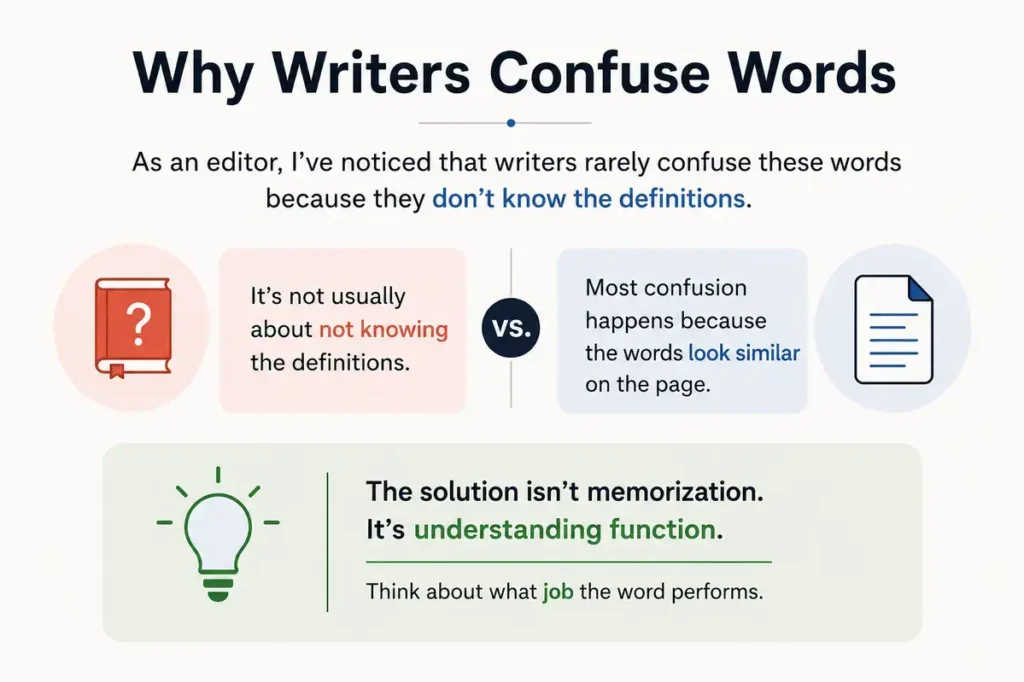
As an editor, I’ve noticed that writers rarely confuse these words because they don’t know the definitions.Most confusion happens because the words look similar on the page.The solution isn’t memorization. It’s understanding function.Think about what job the word performs.If the sentence involves introducing an idea, use propose.If the sentence explains a reason, use purpose.Native speakers don’t consciously analyze this distinction every time they write. They instinctively recognize the difference because the words occupy separate roles in communication.Here’s a practical editing tip.Replace propose with suggest.If the sentence still makes sense, propose is probably correct.
Example:
- I propose a new policy.
- I suggest a new policy.
Both work.
Now try the same test with purpose.
- The purpose of the policy is improving efficiency.
- The suggest of the policy is improving efficiency.
The sentence falls apart immediately.
Another useful test involves the word reason.
- The purpose of the meeting was solving the problem.
- The reason for the meeting was solving the problem.
The meaning remains almost identical.
These substitution techniques are simple but highly effective when proofreading.Strong writers focus on clarity first. Choosing the correct word isn’t about sounding sophisticated. It’s about making your meaning obvious to the reader.
Many readers also check EKG vs ECG Which One Is Correct 2026.
Conclusion
The debate around propose vs purpose becomes much easier once you understand the role each word plays.Both words are correct and widely used. Each term has a recognized place in standard English. The difference comes down to meaning and function.Use propose when you’re presenting an idea, recommendation, plan, or suggestion. Use purpose when you’re discussing a reason, objective, intention, or goal.A helpful way to remember the distinction is this:
People propose ideas. Ideas have a purpose. That simple connection captures the relationship perfectly. If you focus on what the sentence is trying to accomplish, choosing the correct word becomes almost automatic. Clear writing depends on precise word choice.Understanding the difference between propose and purpose helps you communicate more effectively, avoid common mistakes, and sound more confident in both speech and writing.
Frequently Asked Questions About Propose Vs Purpose
What is the difference between propose and purpose?
Propose means to suggest or put forward an idea, plan, or recommendation. Purpose means the reason, goal, aim, or intention behind something. One introduces an idea, while the other explains why that idea exists.
Is propose or purpose correct?
Both words are correct. The appropriate choice depends on the sentence. Use propose when suggesting something. Use purpose when discussing a reason, objective, or goal.
Can propose and purpose be used interchangeably?
No. They have different meanings and grammatical functions. Replacing one with the other often creates an incorrect sentence or changes the intended meaning completely.
Is propose a noun or a verb?
Propose is primarily a verb. It describes the action of suggesting, recommending, or presenting an idea for consideration.
Examples:
- We propose a solution.
- They proposed several changes.
Is purpose a noun or a verb?
Purpose is most commonly a noun meaning reason, objective, or goal. Although it can function as a verb in rare formal contexts, modern English typically uses it as a noun.
Why do people confuse propose and purpose?
People confuse these words because they look similar and share some historical language roots. Their spellings resemble each other, but their meanings and grammatical roles are very different.
What is a simple way to remember propose vs purpose?
Remember this:
- Propose equals suggest.
- Purpose equals reason.
If you’re introducing an idea, choose propose. If you’re explaining why something exists, choose purpose.
Which word is more common in everyday English?
Purpose generally appears more frequently because people often discuss goals, intentions, and reasons. However, propose is also common in business, education, government, and professional communication.