
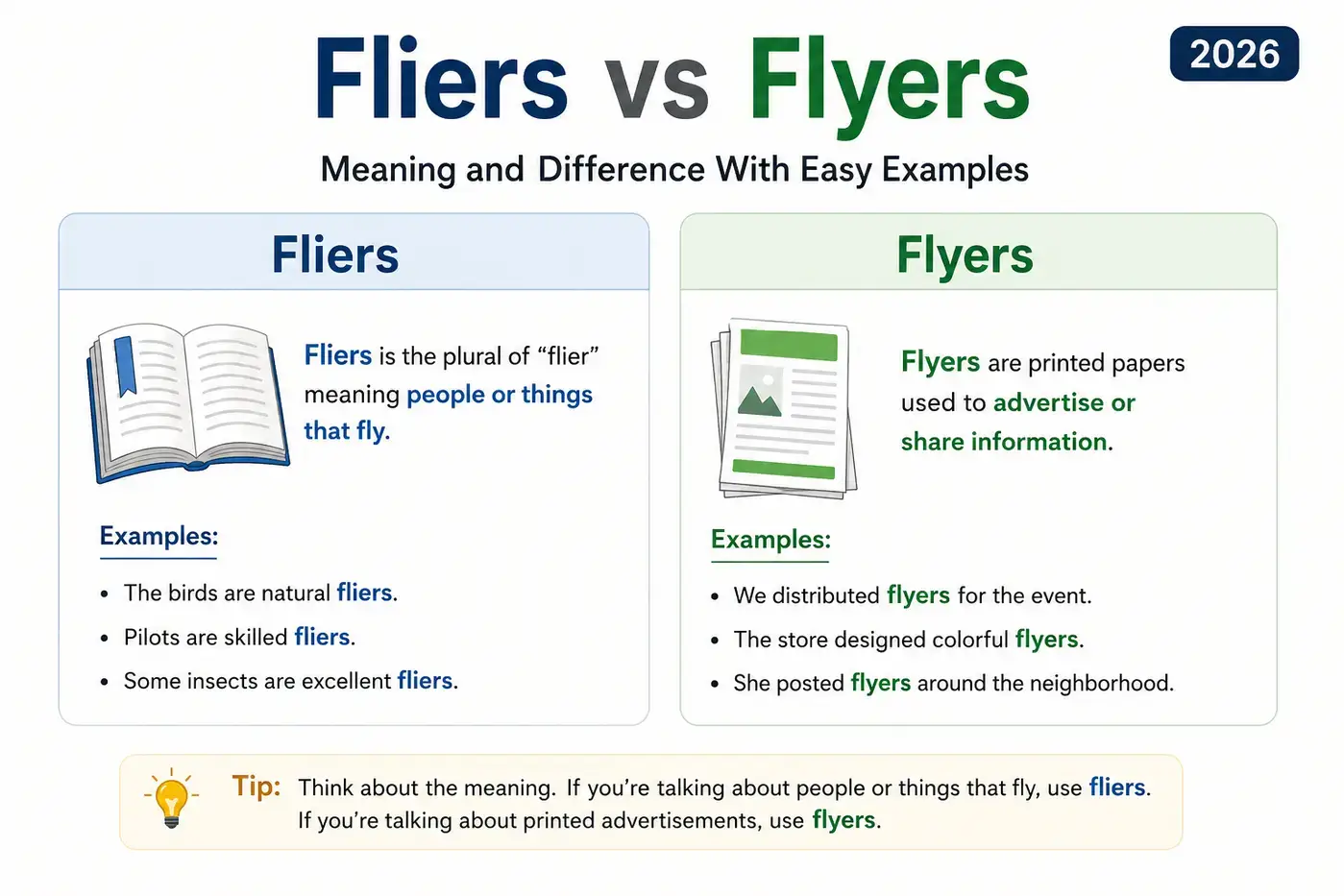
The debate over fliers vs flyers has puzzled writers, marketers, students, and business owners for years. Open one dictionary and you’ll see both spellings listed. Browse marketing websites and you’ll find companies using flyers for advertising materials while others use fliers. It’s no surprise people wonder which version is actually correct. The good news is that both words are legitimate.
The tricky part is understanding when each spelling sounds more natural. In modern English, both fliers and flyers can refer to people, animals, machines, or objects that fly. However, flyers has become the dominant spelling for promotional handouts, advertisements, and printed marketing materials. Fliers still appears regularly, especially when referring to people or things that fly.
This article explains the complete difference between fliers and flyers, including definitions, grammar rules, pronunciation, origins, regional preferences, examples, common mistakes, and expert usage advice. By the end, you’ll know exactly which spelling fits your audience and purpose.
A related grammar guide is Shinning or Shining Which Is Correct in 2026?.
Fliers Vs Flyers Quick Definition
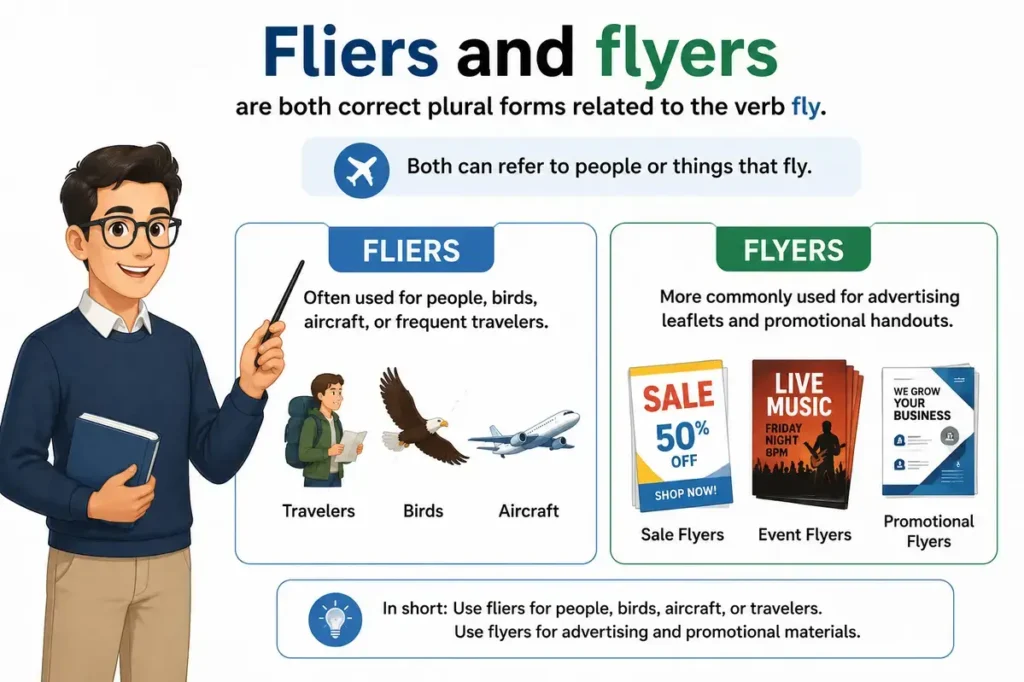
Fliers and flyers are both correct plural forms related to the verb fly. Both can refer to people or things that fly. In modern usage, flyers is more commonly used for advertising leaflets and promotional handouts, while fliers often appears when referring to people, birds, aircraft, or frequent travelers.
Fliers Vs Flyers Quick Answer
If you’re talking about advertising materials, flyers is usually the preferred spelling.
Examples:
- We printed 5,000 flyers for the event.
- The company distributed flyers across town.
If you’re talking about people or things that fly, either spelling may be correct.
Examples:
- Birds are excellent fliers.
- Birds are excellent flyers.
Most modern style guides accept both forms, but flyers has become more common overall.
Fliers Vs Flyers Comparison Table
| Feature | Fliers | Flyers |
|---|---|---|
| Correct Spelling | Yes | Yes |
| Part Of Speech | Noun | Noun |
| Related Verb | Fly | Fly |
| Meaning | People or things that fly | People or things that fly |
| Advertising Handouts | Less common | More common |
| General Usage | Accepted | Accepted |
| American Usage | Common | Very common |
| British Usage | Accepted | Accepted |
| Formal Writing | Accepted | Accepted |
| Usage Frequency | Lower | Higher |
Meaning Of Fliers Vs Flyers
What Does Fliers Mean?
Fliers is the plural form of flier.
A flier can refer to:
- A person who flies.
- A bird or flying animal.
- An aircraft operator.
- Someone who travels frequently by air.
- In some cases, a promotional leaflet.
Examples:
- The airline rewards frequent fliers.
- Experienced fliers handled the difficult weather conditions.
- Migratory birds are remarkable fliers.
- The military trained skilled fliers.
- Several fliers were handed out at the event.
Historically, fliers was once the more common spelling in many contexts.
What Does Flyers Mean?
Flyers is the plural form of flyer.
It can refer to:
- Advertising leaflets.
- Promotional handouts.
- People who fly.
- Birds or flying creatures.
- Individuals who travel frequently by air.
Examples:
- We distributed flyers throughout the neighborhood.
- The store printed promotional flyers.
- The club designed colorful flyers.
- The birds were graceful flyers.
- Frequent flyers receive travel benefits.
Today, flyers is often the preferred spelling for marketing materials.
Key Differences Between Fliers Vs Flyers
This comparison is more about convention than strict grammar.
Meaning Difference
Most dictionaries recognize both words as having the same core meaning. Both relate to flying.
Marketing Difference
This is where the biggest distinction appears. Many businesses and publishers prefer flyers when referring to:
- Advertising sheets.
- Promotional leaflets.
- Event announcements.
- Marketing handouts.
Examples:
- Concert flyers.
- Real estate flyers.
- Business flyers.
Aviation Difference
When discussing people who fly, some writers prefer fliers.
Examples:
- Frequent fliers.
- Military fliers.
- Skilled fliers.
That preference is not universal, but it remains common.
Frequency Difference
In modern English, flyers appears more often overall. Marketing usage has significantly increased its popularity.
Style Difference
Some organizations adopt one spelling consistently for branding and editorial purposes. The key is maintaining consistency throughout a document.
Why Fliers Vs Flyers Causes Confusion
The confusion exists because English accepts both spellings. Most spelling debates involve one correct form and one incorrect form. This isn’t one of those cases. Both words appear in dictionaries and newspapers. Each one appears in books and professional writing. The overlap in meaning creates uncertainty.
For example:
- Frequent flyers.
- Frequent fliers.
Both versions are widely understood. Now consider advertising:
- Event flyers.
- Event fliers.
Again, both can be understood, although flyers tends to be preferred. Because there is no strict universal rule, writers often encounter conflicting advice online.
Fliers Vs Flyers In Marketing
Marketing professionals overwhelmingly prefer flyers.
Examples:
- Promotional flyers.
- Business flyers.
- Advertising flyers.
- Event flyers.
- Political campaign flyers.
Why?
Partly because usage trends have established flyers as the dominant marketing spelling. When readers see flyers, they immediately think of promotional materials. That instant recognition helps communication.
Fliers Vs Flyers In Aviation
Aviation provides a different perspective.
Examples:
- Frequent fliers earn airline rewards.
- Military fliers require extensive training.
- Skilled fliers can handle challenging conditions.
Many aviation publications historically preferred fliers in these contexts. However, flyers is also widely accepted. The distinction is often stylistic rather than grammatical.
Which Spelling Appears More Often?
Modern usage data generally shows flyers appearing more frequently than fliers.
Several factors contribute to this trend:
- Marketing usage.
- Business advertising.
- Event promotion.
- Online printing services.
- Digital marketing content.
As a result, many readers encounter flyers more often in daily life. That increased exposure sometimes leads people to assume fliers is incorrect. It isn’t. Both remain valid English words.
Both Fliers and Flyers Are Correct
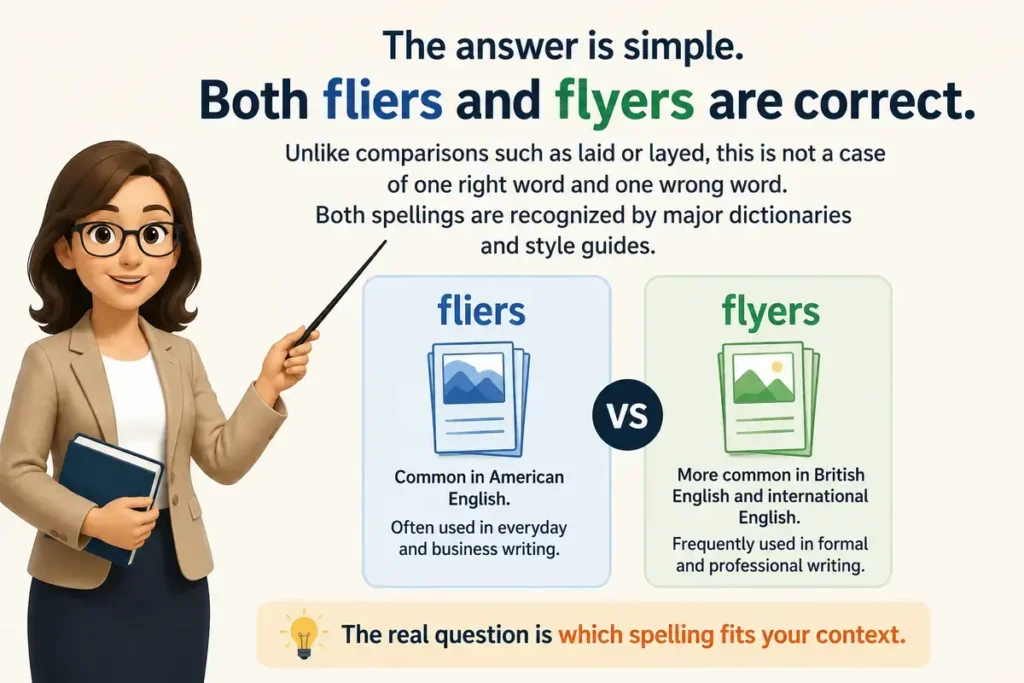
The answer is simple. Both fliers and flyers are correct. Unlike comparisons such as laid or layed, this is not a case of one right word and one wrong word. Both spellings are recognized by major dictionaries and style guides. The real question is which spelling fits your context.
Use Flyers For Advertising Materials
In modern English, flyers is usually preferred for:
- Promotional leaflets.
- Event announcements.
- Marketing handouts.
- Business advertisements.
- Sales promotions.
Examples:
- We printed 2,000 flyers for the grand opening.
- Volunteers distributed flyers around town.
- The campaign created informational flyers.
Most readers immediately associate flyers with printed advertising materials.
Use Fliers For People Or Things That Fly
Many writers prefer fliers when referring to:
- Pilots.
- Airline travelers.
- Birds.
- Flying animals.
- Aviation professionals.
Examples:
- Frequent fliers receive travel rewards.
- The military trained skilled fliers.
- Eagles are powerful fliers.
That said, flyers is also acceptable in these situations.
The Best Rule
If you’re discussing marketing, choose flyers. If you’re discussing aviation or flying individuals, fliers may feel slightly more natural. Either way, consistency matters more than the spelling itself.
You may also want to read scraped vs scrapped Meaning Difference And Usage.
Fliers Vs Flyers Examples In Sentences
Examples make the distinction easier to understand.
Fliers Examples
- Frequent fliers often earn free upgrades.
- The airline rewarded its loyal fliers.
- Experienced fliers navigated difficult weather.
- Migratory birds are remarkable fliers.
- The military honored several veteran fliers.
- Skilled fliers completed the training program.
- The competition attracted talented fliers from around the world.
- Young fliers practiced emergency procedures.
- Early aviation history celebrated daring fliers.
- Professional fliers undergo extensive preparation.
Flyers Examples
- We printed colorful flyers for the event.
- The restaurant distributed promotional flyers.
- Volunteers handed out flyers downtown.
- The campaign produced informational flyers.
- Event flyers were posted on community boards.
- Local businesses use flyers to attract customers.
- The charity created fundraising flyers.
- Students designed creative flyers for the school fair.
- The company mailed advertising flyers to residents.
- Real estate agents often use flyers to market properties.
These examples reflect the most common modern usage patterns.
Common Mistakes In Fliers Vs Flyers
Although both spellings are correct, writers still make several common mistakes.
Assuming One Spelling Is Wrong
This is the biggest misconception. Some people believe flyers is correct and fliers is wrong. Others believe the opposite. In reality, both words are legitimate.
Switching Spellings Randomly
Consistency matters.
Example:
- We printed flyers for the event.
- The fliers were distributed later.
Using both spellings in the same document without a reason can confuse readers. Choose one style and stick with it.
Ignoring Context
While both spellings are accepted, readers often expect flyers for advertising materials. Using fliers in a marketing brochure isn’t wrong, but it may feel less familiar to modern readers.
Treating The Difference As A Strict Grammar Rule
Many websites claim that flyers must refer to advertisements and fliers must refer to people who fly. English usage isn’t that rigid. The distinction is largely a matter of convention and preference.
Following Outdated Style Advice
Language evolves. Some older publications strongly favored fliers. Many modern organizations now prefer flyers, especially in marketing contexts. Current audience expectations matter more than historical preferences.
Fliers Vs Flyers Pronunciation Guide
One reason these spellings create confusion is that they sound exactly the same.
Fliers Pronunciation
IPA:
/ˈflaɪ.ərz/
Syllable Breakdown:
Fly • ers
Pronounced as:
FLY ərz
Flyers Pronunciation
IPA:
/ˈflaɪ.ərz/
Syllable Breakdown:
Fly • ers
Pronounced as:
FLY ərz
Common Pronunciation Mistakes
- Assuming the spellings produce different sounds.
- Adding an extra syllable.
- Overemphasizing the second syllable.
Native speakers pronounce both words identically. The distinction exists only in writing.
Etymology And Word Origin Of Fliers Vs Flyers
The history behind these spellings explains why both continue to exist today.
The Origin Of Fly
Both words originate from the verb fly. The verb has ancient roots that trace back through Old English and Germanic languages. Historically, fly referred to movement through the air.
Development Of Flier
Flier emerged as a noun referring to:
- A person who flies.
- A flying creature.
- Something capable of flight.
For many years, flier was the dominant noun form.
Development Of Flyer
Flyer later gained popularity as an alternative spelling. Over time, publishers, advertisers, and businesses increasingly adopted flyer. As printing and marketing industries expanded, flyers became especially common for promotional materials.
Why Both Spellings Survived
Many alternative spellings disappear over time. Fliers and flyers both survived because:
- Major dictionaries accepted both.
- Publishers used both.
- Different industries favored different forms.
- Readers understood both versions.
Today, both remain standard English.
Fliers Vs Flyers Regional Usage
Regional differences exist, although they are not as strong as differences like theater and theatre.
American English
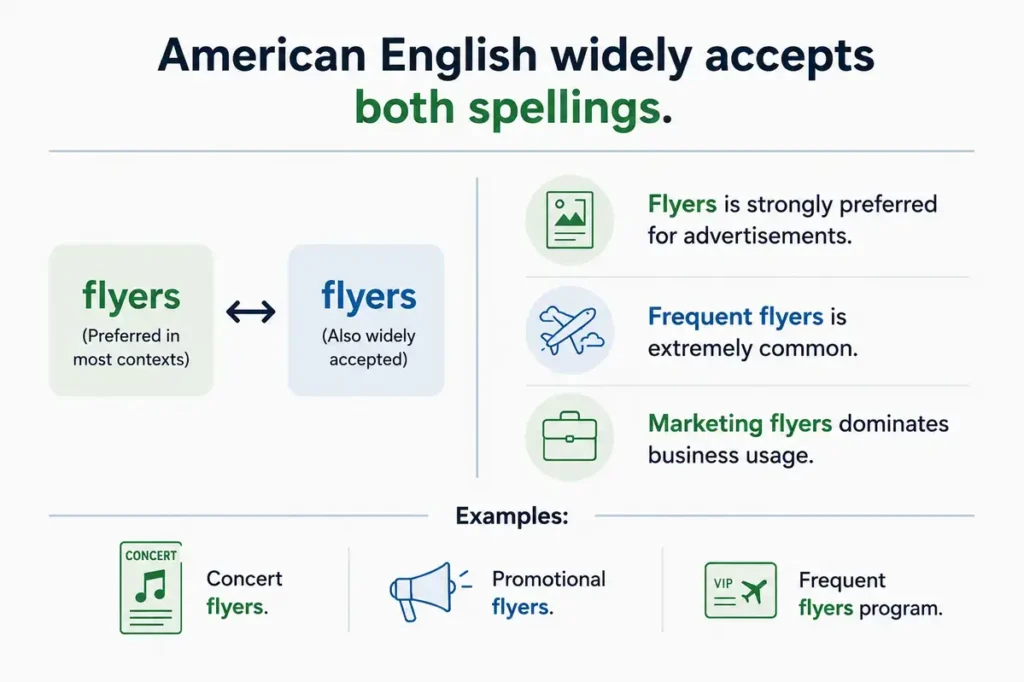
American English widely accepts both spellings.
However:
- Flyers is strongly preferred for advertisements.
- Frequent flyers is extremely common.
- Marketing flyers dominates business usage.
Examples:
- Concert flyers.
- Promotional flyers.
- Frequent flyers program.
British English
British English also recognizes both spellings. Many British publications use flyers for promotional materials.
Examples:
- Advertising flyers.
- Event flyers.
- Promotional flyers.
Australian English
Australian English generally follows similar patterns.
Examples:
- Community flyers.
- Promotional flyers.
- Airline frequent flyers.
Canadian English
Canadian English accepts both spellings and often mirrors American usage.
Examples:
- Real estate flyers.
- Business flyers.
- Frequent flyers program.
Global Trend
Across English speaking countries, flyers appears to be gaining broader acceptance and visibility. Marketing and advertising have contributed significantly to that trend.
Fliers Vs Flyers Grammar Rules
Understanding the grammar behind these words helps writers use them confidently.
Part Of Speech
Both fliers and flyers function as plural nouns.
Examples:
- The fliers completed training.
- The flyers promoted the event.
Singular Forms
The singular versions are:
- Flier.
- Flyer.
Examples:
- He is an experienced flier.
- We designed a flyer for the fundraiser.
Plural Forms
The plural versions are:
- Fliers.
- Flyers.
Examples:
- Skilled fliers attended the conference.
- Colorful flyers advertised the festival.
Common Sentence Structures
Subject + Verb
Examples:
- The fliers arrived early.
- The flyers attracted attention.
Adjective + Noun
Examples:
- Experienced fliers.
- Promotional flyers.
Noun + Noun
Examples:
- Frequent fliers program.
- Flyers campaign strategy.
Editor’s Grammar Observation
As an editor, I’ve noticed that most readers rarely question the spelling when it matches the context. When readers see flyers in advertising content, it feels natural. When readers encounter frequent fliers in aviation discussions, it also feels natural. The bigger issue is consistency. Once you choose a spelling, maintain it throughout the article, report, advertisement, or publication. Consistent usage always creates a more professional impression.
Fliers Vs Flyers In Real Life Usage
Understanding how native speakers use these words in everyday situations makes the distinction much easier to remember.
Fliers Vs Flyers In Daily Conversation
In casual speech, most people don’t think much about the spelling because both words sound identical.
Examples:
- I picked up several flyers from the community center.
- The airline offers rewards for frequent fliers.
- We saw promotional flyers near the entrance.
- Those birds are excellent fliers.
- The event organizers handed out flyers all afternoon.
In conversation, context usually tells listeners exactly what the speaker means.
Fliers Vs Flyers In Academic Writing
Academic writing tends to favor clarity and consistency.
Examples:
- Researchers distributed informational flyers to participants.
- The study examined migration patterns among long distance fliers.
- Educational flyers helped increase awareness.
- Scientists observed the behavior of skilled fliers.
- The university published recruitment flyers.
Most academic institutions accept either spelling when used appropriately.
Fliers Vs Flyers In Professional Communication
Businesses commonly use flyers when discussing marketing materials.
Examples:
- The marketing team designed new flyers.
- Sales flyers were mailed to customers.
- Promotional flyers increased attendance.
- The company updated its advertising flyers.
- Event flyers were distributed across the city.
In aviation industries, fliers often appears naturally.
Examples:
- Frequent fliers qualify for additional benefits.
- Experienced fliers attended the conference.
- Professional fliers completed advanced training.
Fliers Vs Flyers In Literature
Authors use both spellings depending on context.
Examples:
- The young fliers crossed the mountains at dawn.
- Flyers announcing the fair covered every storefront.
- The brave fliers faced dangerous conditions.
- Colorful flyers decorated the village square.
- Early fliers inspired future generations.
Fliers Vs Flyers In Media
News outlets and publications regularly use both forms.
Examples:
- Flyers advertising the concert appeared throughout downtown.
- Frequent fliers expressed concerns about delays.
- Community flyers promoted local events.
- Veteran fliers shared stories from their careers.
- The campaign released informational flyers.
Modern media tends to favor flyers for advertising related content.
Related Words And Confused Terms
People searching for fliers vs flyers often encounter several related terms that create additional confusion.
Flyer
The singular form of flyers.
Examples:
- I designed a flyer for the fundraiser.
- The store posted a flyer in the window.
Flier
The singular form of fliers.
Examples:
- He is a skilled flier.
- The flier handled the aircraft confidently.
Leaflet
A printed sheet used for advertising or information.
Examples:
- The business distributed leaflets.
- The campaign produced informational leaflets.
Leaflet is often interchangeable with flyer in marketing contexts.
Brochure
A folded informational publication.
Examples:
- The hotel created a brochure.
- The company distributed brochures at the event.
Brochures usually contain more information than flyers.
Advertisement
A broader term that includes many promotional formats.
Examples:
- The advertisement appeared online.
- The advertisement increased sales.
Flyers are one type of advertisement.
Poster
A larger printed display.
Examples:
- The poster advertised the concert.
- Event posters covered the walls.
Posters and flyers often serve similar promotional purposes.
Pamphlet
A small informational publication.
Examples:
- The organization distributed pamphlets.
- Educational pamphlets explained the program.
Pamphlets are generally more detailed than flyers.
Expert Language Insight On Fliers Vs Flyers
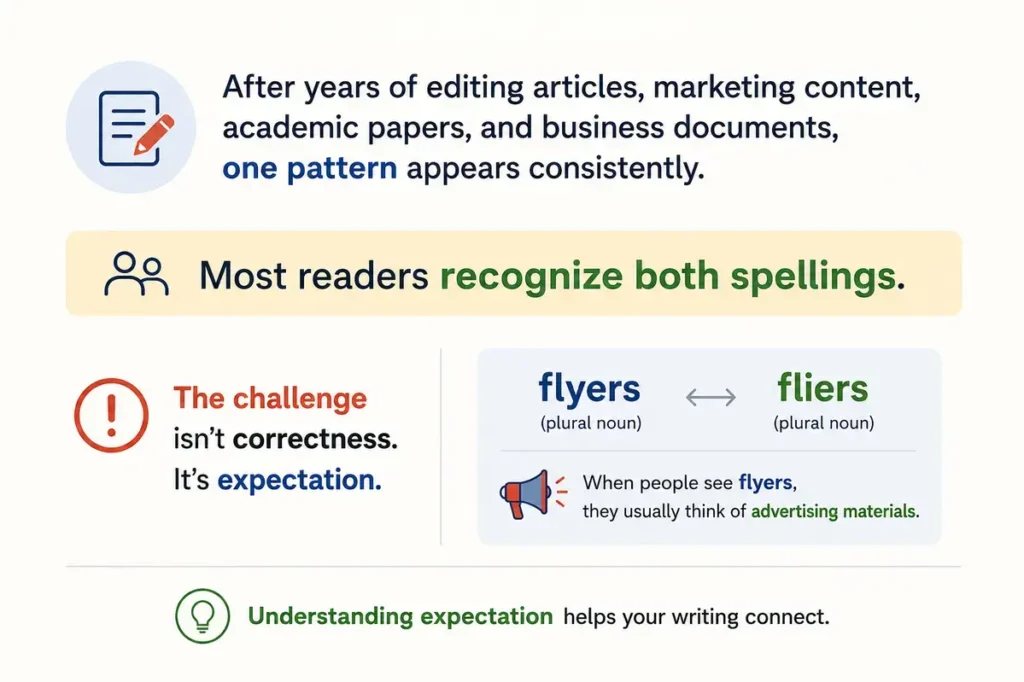
After years of editing articles, marketing content, academic papers, and business documents, one pattern appears consistently. Most readers recognize both spellings. The challenge isn’t correctness. It’s expectation. When people see flyers, they usually think of advertising materials. When they see frequent fliers, they often associate the word with aviation, travel, or people who fly. That association has developed through decades of usage rather than formal grammar rules.
Language works much like traffic patterns. People naturally follow the routes they see most often. In marketing, flyers has become the dominant route. In aviation, fliers still has a strong presence. Another important observation is that readers rarely object to either spelling when it matches the surrounding context. Problems arise when writers switch between spellings in the same article without a clear reason.
Professional editors generally focus on consistency first and preference second. If you’re creating promotional content, flyers is usually the safest choice because it aligns with modern reader expectations. If you’re discussing pilots, birds, aviation history, or frequent air travelers, either spelling works, though fliers may feel slightly more traditional. The best writing communicates clearly. In this case, clarity matters far more than choosing one spelling over the other.
Frequently Asked Questions About Fliers Vs Flyers
Is it fliers or flyers?
Both fliers and flyers are correct spellings. The choice depends largely on context and style preference. Flyers is more common for advertising materials, while fliers is often associated with people or things that fly.
Which spelling is more common today?
Flyers is generally more common in modern English. Its popularity comes largely from widespread use in advertising, marketing, event promotion, and business communication.
Are fliers and flyers interchangeable?
In many situations, yes. Both words can refer to people or things that fly. However, readers often expect flyers when discussing promotional handouts and printed advertisements.
Do dictionaries accept both spellings?
Yes. Major dictionaries recognize both fliers and flyers as correct English words. Neither spelling is considered incorrect in standard usage.
Should I use flyers for advertising materials?
Yes. Flyers is the preferred choice for most advertising, marketing, and promotional content. It aligns with modern business and publishing conventions.
Is frequent fliers or frequent flyers correct?
Both forms appear in published writing. However, frequent flyers has become extremely common because many airline loyalty programs use that spelling.
Is one spelling American and the other British?
Not exactly. Both American English and British English accept both spellings. The difference is more about usage preference than regional grammar rules.
Which spelling should businesses use?
Most businesses should use flyers when referring to promotional materials. It matches current marketing conventions and is the spelling most customers expect to see.
Many readers also check sale vs sell Meaning Difference And Usage.
Conclusion
The answer to fliers vs flyers isn’t about right versus wrong. Both spellings are correct. The difference comes down to context, convention, and audience expectations. For advertising materials, promotional handouts, and marketing content, flyers is usually the preferred choice. It’s the spelling most readers recognize immediately in business and promotional settings.
For people, birds, pilots, travelers, and things that fly, both fliers and flyers are acceptable. Some writers prefer fliers in aviation related contexts, but the distinction is largely stylistic. The most important rule is consistency. Choose the spelling that best fits your audience and purpose, then use it consistently throughout your writing. That’s the approach professional editors, marketers, publishers, and experienced writers follow every day.
1 thought on “Fliers vs Flyers Meaning and Difference With Easy Examples 2026”