
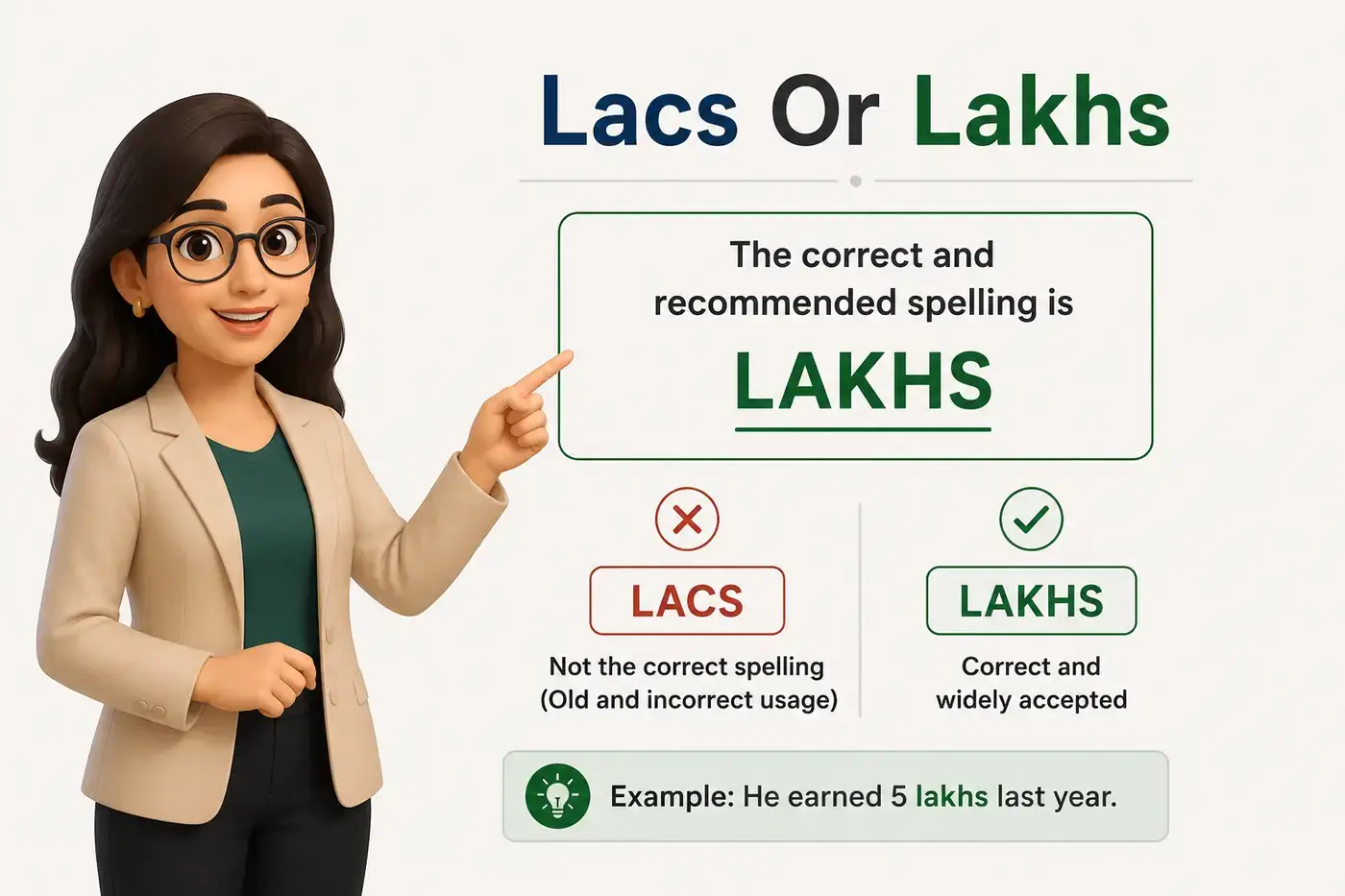
The question of lacs or lakhs confuses many writers, students, job seekers, business professionals, and English learners. You may come across 5 lakh rupees, 10 lakhs, and 20 lacs in different places, making it seem as though they have different meanings. In reality, they all refer to the same number. The confusion comes from spelling differences, regional usage, and the rules for singular and plural forms.
Understanding lacs or lakhs is important because these terms appear regularly in banking, business, real estate, education, government documents, and financial news across South Asia. If you write for an international audience, using the correct form helps your content look more professional, improves readability, and prevents misunderstandings.
In this guide, you’ll learn everything you need to know about these words, including the correct spelling, meaning, pronunciation, grammar, singular and plural usage, regional preferences, common mistakes, and real world examples. By the end, you’ll know exactly which form to use in every situation with confidence.
A related grammar guide is treet vs treat Correct Spelling Meaning And Usage.
Quick Definition
Both words refer to multiples of one lakh, which equals 100,000. However, lakhs is the preferred and more widely accepted plural form in modern English and South Asian English. While lacs appears in older texts and some publications, lakhs is generally considered the standard choice today.

Lacs Or Lakhs Quick Answer
If you’re writing in modern English, lakhs is usually the preferred plural form.
Examples:
- The company earned 50 lakhs in revenue.
- The property was sold for 80 lakhs.
- The government allocated several lakhs for the project.
Although lacs is not technically incorrect, lakhs is more common in contemporary usage.
Lacs vs Lakhs Comparison Table
| Feature | Lacs | Lakhs |
|---|---|---|
| Correct Form | Yes | Yes |
| Meaning | Multiple units of one lakh | Multiple units of one lakh |
| Numerical Value | Multiples of 100,000 | Multiples of 100,000 |
| Part Of Speech | Noun | Noun |
| Origin | Variant spelling of lakh | Standard modern spelling |
| Usage Frequency | Less common today | More common today |
| Formality Level | Acceptable | Preferred |
| Common Contexts | Older publications | Modern finance and business |
| Example | The project cost 20 lacs. | The project cost 20 lakhs. |
Meaning Of Lacs Or Lakhs
Meaning Of Lacs
Lacs is the plural form of lac. Historically, English borrowed the word lac from South Asian languages. Older British records, colonial documents, trade reports, and administrative texts frequently used lac and lacs.
Examples:
- The estate generated several lacs annually.
- The company reported profits in the lacs.
Today, this spelling appears less frequently.
Meaning Of Lakhs
Lakhs is the plural form of lakh.
A lakh equals 100,000.
Examples:
- Ten lakhs equals one million.
- Twenty lakhs equals two million.
- Fifty lakhs equals five million.
This spelling dominates modern business, journalism, finance, banking, and everyday communication throughout South Asia.
Lacs Or Lakhs Meaning Differences
One reason this topic confuses writers is that there is virtually no difference in meaning.
Both Represent The Same Number
- One lakh equals 100,000.
- Ten lakhs equals 1,000,000.
- Twenty lakhs equals 2,000,000.
The value never changes.
The Difference Is Primarily Spelling
The distinction is similar to historical and modern spelling variations found in many languages. Both forms communicate the same quantity.
Modern Preference Favors Lakhs
Most contemporary readers expect to see lakhs instead of lacs. That preference influences style guides, newspapers, financial publications, and business reports.
Lacs vs Lakhs Key Differences
Meaning Differences
There are no meaningful differences in definition.
Tone Differences
- Lacs can sound older or more traditional.
- Lakhs sounds modern and familiar to most readers.
Grammar Differences
- Both function as plural nouns.
- Both refer to multiple units of one lakh.
Regional Differences
- Lakhs dominates current usage in India, Pakistan, Bangladesh, Nepal, and Sri Lanka.
- Lacs appears occasionally in older records and legacy publications.
Context Differences
- Modern journalism usually prefers lakhs.
- Historical documents may contain lacs.
- Financial reporting generally favors lakhs.
Which One Is Correct
Both forms are technically correct. However, if you’re writing today, lakhs is usually the better choice.
Why?
Because modern readers recognize it immediately. Most newspapers, business publications, government reports, and educational materials use lakhs. When professional editors review financial content, they typically standardize the spelling as lakh and lakhs. Using the more common form improves readability and avoids unnecessary confusion.

Lacs Or Lakhs In Finance And Business
The Indian numbering system plays a major role in financial communication.
Examples include:
- Salaries.
- Investments.
- Real estate prices.
- Government budgets.
- Company revenue.
Examples:
- The startup raised 25 lakhs in funding.
- The apartment costs 90 lakhs.
- The annual budget exceeded several hundred lakhs.
In professional writing, lakhs overwhelmingly dominates.
Lacs Or Lakhs In Everyday Language
People across South Asia regularly use lakh and lakhs in conversation.
Examples:
- He earns twelve lakhs a year.
- The wedding cost several lakhs.
- They invested twenty lakhs in the business.
In casual speech, many speakers rarely think about alternative spellings because lakhs feels natural and familiar.
Understanding Lakh In The Numbering System
The Indian numbering system differs from the international numbering system used in many Western countries.
Important conversions include:
- One lakh equals 100,000.
- Ten lakhs equals 1,000,000.
- One crore equals 10,000,000.
- One crore equals 100 lakhs.
This system appears throughout South Asia and in international reporting involving the region.
Memory Trick
A simple memory trick can help. Think of the singular form first.
- One lakh.
- Two lakhs.
- Five lakhs.
- Ten lakhs.
Since modern English usually starts with lakh, the plural naturally becomes lakhs. That pattern matches what most readers expect to see.
You may also want to read stoped or stopped Correct Spelling And Usage.
Lakhs to USD
The term lakhs is commonly used in India and Pakistan, while USD refers to the United States Dollar. Converting lakhs to USD requires the current exchange rate because the value of the dollar changes daily. Since 1 lakh equals 100,000, you first convert lakhs into the total number of rupees, then divide that amount by the latest USD exchange rate. Using an up to date exchange rate ensures an accurate conversion for travel, business, investments, or international payments.
One Lakh Rupees in Number
One lakh rupees is written as 100,000 rupees. In the Indian and Pakistani numbering system, 1 lakh = 100,000 = 1,00,000. The comma placement differs from the international system, but the value remains the same. This number is commonly used when discussing salaries, property prices, business transactions, investments, and personal finances across South Asia.
Examples In Sentences
The best way to understand the difference between these words is to see them used in real sentences.
Lacs Examples In Sentences
- The company reported profits of 15 lacs last year.
- The project required several lacs in funding.
- The property was valued at 25 lacs.
- Investors contributed 40 lacs to the venture.
- The organization spent 12 lacs on development.
- The estate generated many lacs in annual revenue.
- Historical records mention payments of 50 lacs.
- The contract was worth several lacs.
- The merchant accumulated numerous lacs through trade.
- The report estimated losses of 30 lacs.
Lakhs Examples In Sentences
- The company earned 15 lakhs in profit last year.
- The family purchased a house for 75 lakhs.
- She invested 10 lakhs in mutual funds.
- The government allocated 200 lakhs for infrastructure.
- The startup secured funding worth 50 lakhs.
- The scholarship program helped students with lakhs of rupees.
- The hospital received donations totaling several lakhs.
- They spent 20 lakhs renovating the property.
- The business crossed annual revenue of 100 lakhs.
- The award carries a cash prize of 5 lakhs.
Common Mistakes
Many errors occur because writers mix singular and plural forms or switch between numbering systems.
Mistake One Using Lakh And Lakhs Incorrectly
Incorrect:
- Five lakhs rupees.
Correct:
- Five lakhs rupees.
- Five lakh rupees.
In many South Asian English styles, both forms appear, but consistency is important.
Mistake Two Mixing Lacs And Lakhs In The Same Article
Incorrect:
- The company earned 20 lacs and later reached 50 lakhs.
Choose one style and use it consistently throughout the document.
Mistake Three Assuming They Mean Different Numbers
Some readers believe that both words represent different values. They do not. Both refer to multiples of 100,000.
Mistake Four Using The Wrong Numbering System
Writers sometimes switch between lakhs and millions without explanation.
Example:
- The company earned 50 lakhs, or 5 million.
This is incorrect.
Fifty lakhs equals 5 million rupees only because:
- Ten lakhs equals one million.
- Fifty lakhs equals five million.
Always verify conversions.
Pronunciation Guide
Fortunately, pronunciation is much simpler than spelling.
Lac Pronunciation
IPA:
/læk/
Sounds Like:
Lack
Lakh Pronunciation
IPA:
/lɑːk/ or /læk/
Depending on regional accents, it may sound similar to:
Lock
or
Lack
Lacs Pronunciation
IPA:
/læks/
Sounds Like:
Lacks
Lakhs Pronunciation
IPA:
/lɑːks/ or /læks/
Sounds Like:
Locks or Lacks
Common Pronunciation Mistakes
The most common mistake occurs when speakers unfamiliar with South Asian English try to pronounce lakh as two separate syllables. In reality, it is typically spoken as a single syllable.
Etymology And Word Origin
The history of these words stretches back centuries.
Origin Of Lakh
The word lakh comes from the Sanskrit word laksha. Historically, the term represented a large number and eventually came to mean one hundred thousand. The concept became deeply embedded in South Asian commerce, administration, taxation, and trade.
Origin Of Lac
English speakers and colonial administrators often adapted local words into alternative spellings. As a result, lac emerged as a simplified spelling in English documents. Older government records, trade documents, and British publications frequently used lac and lacs.
Evolution Into Modern English
Over time, lakh became the dominant spelling. Today, most dictionaries, news organizations, financial institutions, and educational resources prefer lakh and lakhs.
Lacs vs Lakhs Regional Usage
Regional usage plays a major role in this spelling debate.

Indian English
Indian English overwhelmingly favors:
- Lakh.
- Lakhs.
Examples:
- Five lakhs.
- Twenty lakhs.
- Fifty lakhs.
This is the standard form used in newspapers, banking, real estate, and government communication.
LPakistani English
Pakistani English also strongly prefers:
- Lakh.
- Lakhs.
The term appears regularly in finance, education, property listings, and business reporting.
Bangladeshi English
Bangladeshi English follows the same pattern. Modern publications overwhelmingly use lakhs.
British English
British English occasionally encounters the term in international reporting. Most publications use lakh and lakhs because these forms align with current South Asian usage.
American English
American English rarely uses lakh or lakhs in domestic contexts. When discussing South Asian finance or business, journalists generally retain the spelling lakhs.
Australian English
Australian publications covering South Asian markets usually adopt lakhs as well.
Lacs Or Lakhs Grammar Rules
Understanding the grammar helps eliminate confusion.
Part Of Speech
Both forms function as nouns.
Examples:
- The project cost several lakhs.
- Historical documents mention many lacs.
Singular Form
The singular form is:
- One lakh.
Examples:
- The car costs one lakh rupees.
- He invested one lakh in the business.
Plural Form
The preferred modern plural form is:
- Lakhs.
Examples:
- The company earned several lakhs.
- The property sold for many lakhs.
Common Sentence Structures
Examples:
- Subject plus verb plus number plus lakhs.
- Subject plus verb plus amount in lakhs.
Sentences:
- The company earned 30 lakhs last year.
- They invested 15 lakhs in expansion.
- The fund distributed 50 lakhs among beneficiaries.
Lacs Or Lakhs In Real Life
Daily Conversation
People frequently discuss:
- Salaries.
- Property prices.
- Investments.
- Savings.
Example:
- He earns twelve lakhs annually.
Academic Writing
Researchers often use lakhs when discussing demographics, economics, and public policy.
Example:
- The program benefited several lakhs of citizens.
Professional Communication
Business professionals regularly use lakhs in reports and presentations.
Example:
- Revenue increased by 25 lakhs this quarter.
Literature
Writers use the term to reflect authentic regional speech and financial realities.
Example:
- The inheritance amounted to several lakhs.
Media And Journalism
News outlets frequently report budgets, investments, and earnings in lakhs.
Example:
- The government announced a package worth 500 lakhs.
Related Words And Confused Terms
Several terms often appear alongside lakh and lakhs.
Related Financial Terms
- Thousand.
- Million.
- Billion.
- Crore.
- Revenue.
- Capital.
- Investment.
- Budget.
Related Numbering Terms
- One lakh equals 100,000.
- Ten lakhs equals one million.
- One crore equals ten million.
- One crore equals 100 lakhs.
Commonly Confused Terms
- Lac and lakh.
- Lacs and lakhs.
- Million and crore.
- Thousand and lakh.
- Billion and crore.

Expert Language Insight
As an editor, I recommend using lakh and lakhs in almost every modern context. The reason is simple. Readers recognize these forms immediately. They appear in contemporary journalism, government publications, banking documents, financial reports, educational materials, and business communication.
While lac and lacs remain historically valid spellings, they often feel dated to modern readers. Language evolves through usage. Today’s usage clearly favors lakh and lakhs. If you’re writing for an international audience, consistency matters even more. Using the modern standard spelling helps readers understand your content without hesitation.
For most writers, the safest approach is:
- One lakh.
- Two lakhs.
- Ten lakhs.
- Fifty lakhs.
That style aligns with current editorial practice across South Asia and international reporting.
For another common grammar confusion, see Skeptical vs Sceptical Which Spelling Is Correct.
Conclusion
In the lacs or lakhs debate, the answer is simple. Both terms represent the same numerical value of 100,000, but lakhs is the preferred plural form in modern English. It is the spelling most readers expect to see and the one commonly used in current publications.
Today, lakhs appears far more often in business reports, banking documents, government publications, educational materials, real estate listings, and news articles. Although lacs is not incorrect and still appears in some older documents and regional contexts, it has largely fallen out of favor in contemporary writing.
For clear, professional, and consistent communication, use one lakh, two lakhs, ten lakhs, and fifty lakhs. Following this convention aligns your writing with modern editorial standards and makes your meaning immediately clear to readers in both South Asia and around the world.
Frequently Asked Questions
Is It Lacs Or Lakhs?
Both forms are correct, but lakhs is the preferred modern plural form. Most newspapers, financial institutions, and professional publications use lakhs instead of lacs.
What Is The Difference Between Lacs And Lakhs?
There is no difference in numerical value. Both refer to multiples of one lakh, which equals 100,000. The distinction is mainly spelling and modern usage preference.
Is Lacs An Incorrect Word?
No. Lacs is a valid word and appears in older English texts and historical records. However, lakhs is more common in contemporary writing.
Which Spelling Should I Use In Professional Writing?
Lakhs is usually the better choice. It reflects current usage and aligns with modern editorial standards.
How Much Is One Lakh?
One lakh equals 100,000. In numerical form, it is written as 100,000.
How Many Lakhs Make One Million?
Ten lakhs equal one million. This conversion is widely used in finance and business reporting.
Why Does South Asia Use Lakhs Instead Of Millions?
The Indian numbering system developed independently and remains deeply rooted in regional culture, finance, commerce, and government administration.
Do International Publications Use Lakhs?
Yes. Major international publications often use lakhs when reporting on South Asian economies, businesses, real estate markets, and government programs.
Why Is Lakhs More Common Than Lacs?
Lakhs has become the standard spelling because it better reflects the pronunciation and is widely used in India, Pakistan, Bangladesh, Nepal, and modern English publications.
Is Lacs Still Used Today?
Yes, but much less often. You may find lacs in older books, historical documents, or outdated financial records, while lakhs is the modern standard.
Which Spelling Do Dictionaries Recommend?
Most modern dictionaries recognize both spellings, but lakhs is generally shown as the preferred plural form for current English usage.
Can I Use Lakhs In International Business Writing?
Yes, if your audience is familiar with the South Asian numbering system. For a global audience, you can also write 10 lakhs (1 million) the first time for clarity.
Is It 5 Lacs Or 5 Lakhs?
The preferred modern form is 5 lakhs. Although 5 lacs is understandable, 5 lakhs is considered more standard in current writing.
2 thoughts on “Lacs Or Lakhs Which Is Correct in 2026?”