
The confusion around bearer vs barer is more common than many people realize. At first glance, the two words look almost identical. They differ by just one letter, yet their meanings are completely different. Many writers, students, professionals, and English learners accidentally use one when they mean the other. Spell checkers don’t always catch the mistake because both words are legitimate English terms. That makes the error easy to miss.
The good news is that the distinction is straightforward once you understand how each word works. One word relates to carrying, holding, possessing, or transmitting something. The other relates to being more exposed or less covered. If you’ve ever paused while writing an email, report, essay, or social media post and wondered which spelling to choose, you’re in the right place.
This guide explains bearer vs barer in plain English. You’ll learn the meaning of each word, how they’re used, why people confuse them, pronunciation differences, grammar rules, real-world examples, and expert writing tips that help you avoid mistakes for good.
You may also want to read Loose Or Lose Which Word Is Correct (2026).
Quick Definition
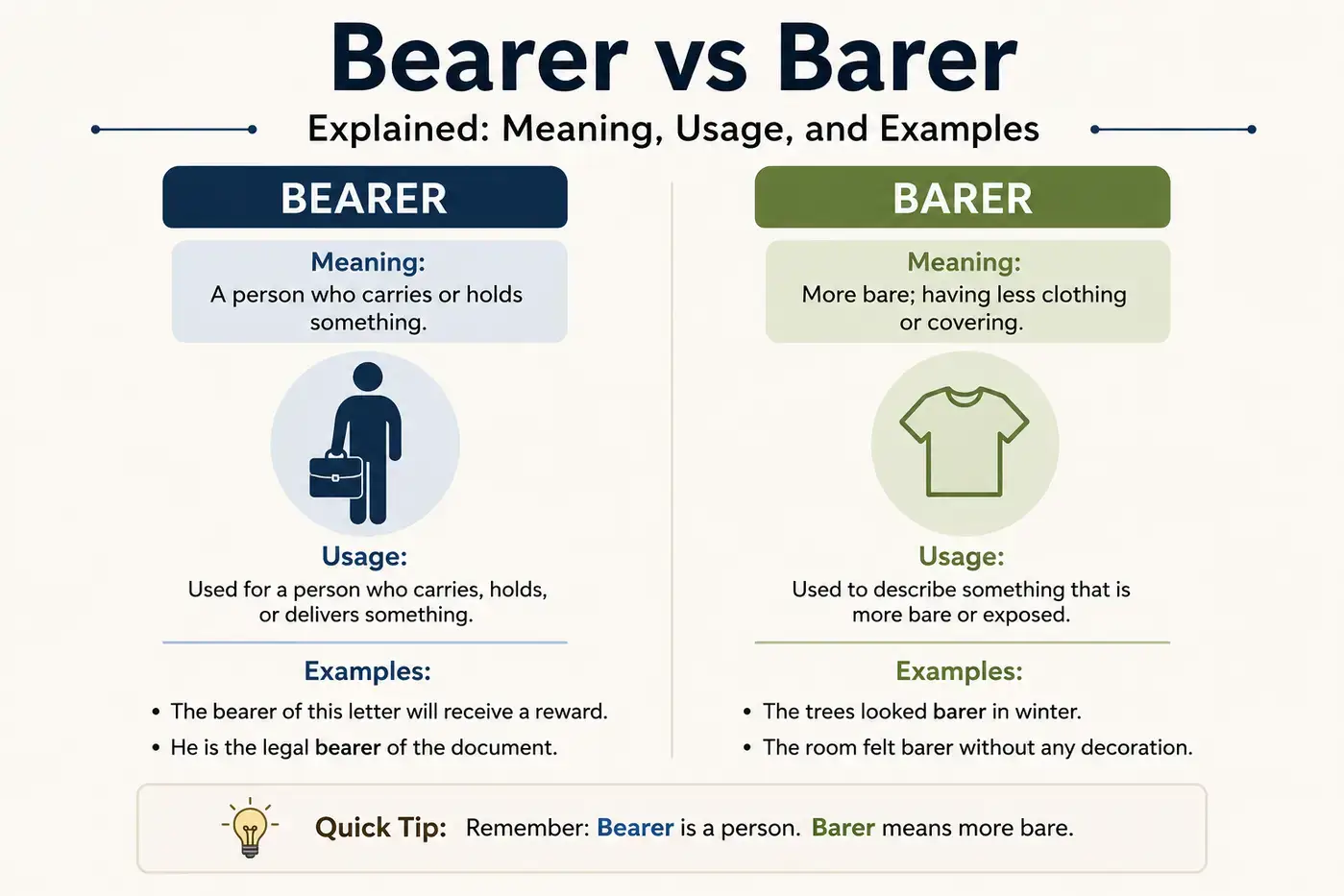
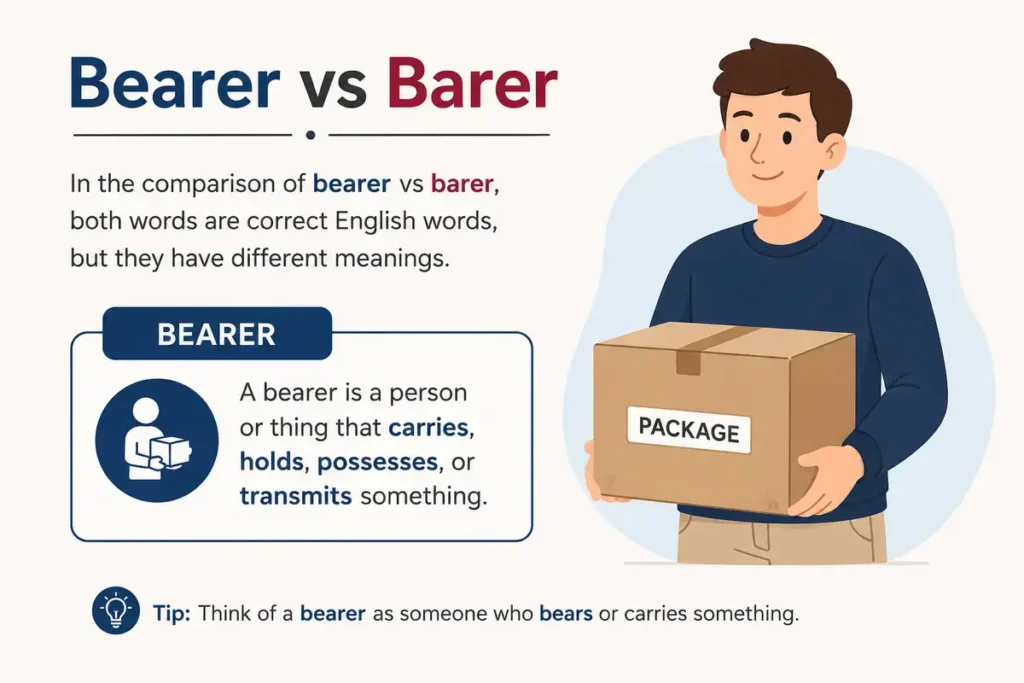
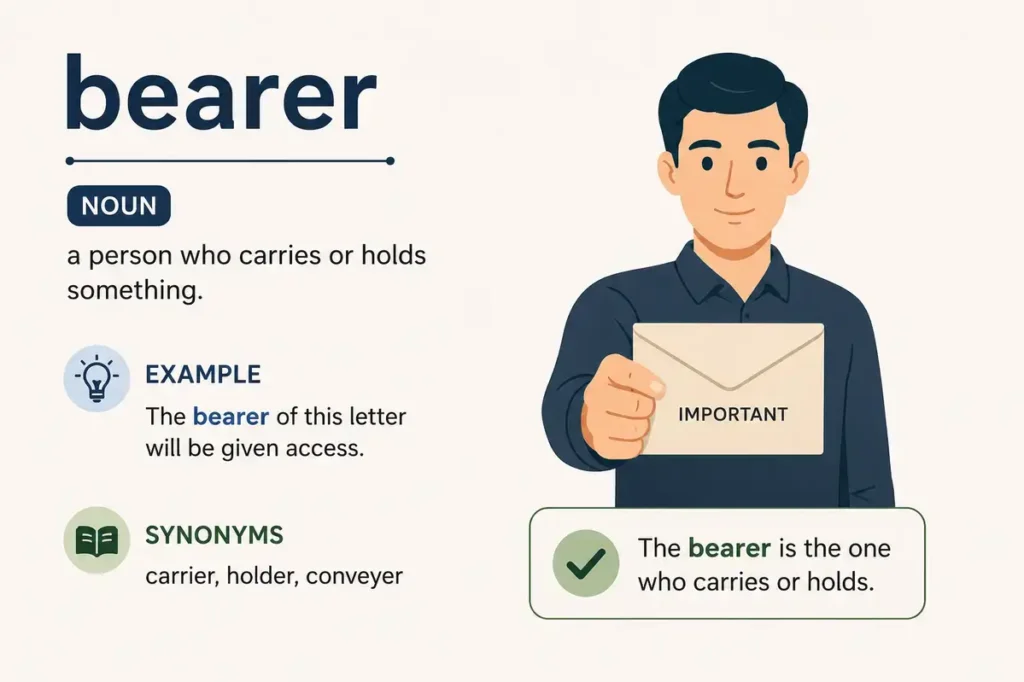
In the comparison of bearer vs barer, both words are correct English words, but they have different meanings. A bearer is a person or thing that carries, holds, possesses, or transmits something. A barer refers to someone or something that makes something bare or more exposed. In most everyday writing, bearer appears far more often than barer.
Bearer Vs Barer Quick Answer
The correct word depends on your intended meaning.
- Use bearer when referring to someone who carries, delivers, possesses, transmits, or supports something.
- Use barer when referring to something that is more bare, less covered, or more exposed.
Examples:
- She was the bearer of good news.
- The trees looked barer after the storm.
Most writing situations require bearer, not barer.
Bearer Vs Barer Comparison Table
| Feature | Bearer | Barer |
|---|---|---|
| Correct Form | Yes | Yes |
| Meaning | One who carries or possesses something | More bare or less covered |
| Part Of Speech | Noun | Adjective comparative form |
| Root Word | Bear | Bare |
| Usage Frequency | Very common | Much less common |
| Formality Level | Used in formal and informal writing | Mostly descriptive writing |
| Common Contexts | Documents, communication, finance, news, ceremonies | Appearance, nature, clothing, descriptions |
| Example | The bearer delivered the message. | The room looked barer after renovation. |
| Related Meaning | Carrier, holder, owner | Less covered, more exposed |
| Common Confusion | Mistaken for barer | Mistaken for bearer |
Meaning Of Bearer Vs Barer
Meaning Of Bearer
A bearer is a person, object, or entity that carries, holds, possesses, conveys, or transmits something. The word comes from the verb bear, which has existed in English for centuries. In this context, bear means to carry, support, transport, endure, or possess.
Common uses include:
- Message bearer.
- Gift bearer.
- Flag bearer.
- Bearer bond.
- Disease bearer.
- News bearer.
Examples:
- He became the bearer of important information.
- The flag bearer led the parade.
- The document grants rights to the bearer.
In professional and legal writing, bearer appears regularly.
Meaning Of Barer
Barer is the comparative form of the adjective bare. It means more bare, less covered, more exposed, or more empty than something else.
Examples:
- The hills looked barer during winter.
- Her office seemed barer after the move.
- The second design appeared barer than the original version.
Unlike bearer, barer is primarily descriptive.
Writers use it when comparing levels of exposure, simplicity, emptiness, or lack of covering.
Bearer Vs Barer Meaning Differences
Understanding the meaning difference is the easiest way to avoid mistakes.
Bearer Involves Carrying Or Possessing
A bearer carries, holds, transmits, or possesses something.
Examples:
- The bearer delivered the package.
- She was the bearer of a warning.
- The bearer bond belongs to whoever possesses it.
Barer Involves Exposure Or Lack Of Covering
Barer describes something that has less covering or protection.
Examples:
- The landscape became barer after the drought.
- The room looked barer after removing the furniture.
- His explanation felt barer and less detailed.
Think of it this way.
Bearer carries.
Barer compares exposure.
That simple distinction solves most confusion.
Bearer Vs Barer Grammar Differences
Grammar provides another easy clue.
Bearer Is A Noun
A noun names a person, thing, or role.
Examples:
- The bearer arrived early.
- The bearer received instructions.
- The bearer carried the documents.
Barer Is An Adjective
An adjective describes a noun.
Examples:
- The walls looked barer.
- The apartment became barer.
- The landscape seemed barer.
A quick test works well.
If you’re describing a person or thing that carries something, use bearer.
If you’re comparing how exposed or uncovered something looks, use barer.
Which One Is Correct
This question causes most of the confusion. The truth is simple.
Both bearer and barer are correct English words. The correct choice depends entirely on context. Choose bearer when discussing:
- Carriers.
- Holders.
- Possessors.
- Messengers.
- Transmitters.
Choose barer when discussing:
- Less covering.
- More exposure.
- Greater emptiness.
- Simpler appearance.
- Reduced decoration.
In everyday writing, bearer appears much more frequently than barer. That’s why many readers instinctively assume bearer is the intended word whenever they encounter confusion.
Bearer Vs Barer In Professional Writing
Professional writers rarely confuse these words because their functions differ significantly.
Common Professional Uses Of Bearer
- Bearer instruments.
- Bearer securities.
- Bearer bonds.
- Flag bearer.
- Standard bearer.
- Message bearer.
Examples:
- The certificate is payable to the bearer.
- She served as the standard bearer for the organization.
- The bearer presented identification.
Common Professional Uses Of Barer
Barer appears less frequently in professional communication.
Typical uses include:
- Design reviews.
- Architectural descriptions.
- Marketing comparisons.
- Visual analysis.
Examples:
- The updated logo has a barer appearance.
- The new office layout feels barer than before.
- The revised design looks barer and cleaner.
Bearer Vs Barer In Literature
Writers often use these words for very different stylistic purposes.
Bearer In Literature
Bearer often symbolizes responsibility, honor, burden, duty, or authority.
Examples include:
- Bearer of truth.
- Bearer of hope.
- Bearer of secrets.
- Bearer of light.
These expressions create powerful imagery because the bearer carries something important.
Barer In Literature
Barer frequently creates visual imagery.
Writers use it to describe:
- Winter landscapes.
- Empty rooms.
- Minimalist settings.
- Exposed emotions.
Example:
“The garden looked barer with every passing week.” The focus shifts from carrying something to revealing something.
Common Contexts Where Bearer Is Used
You’ll encounter bearer in many areas of life.
Legal Documents
- Payable to bearer.
- Bearer instruments.
- Bearer certificates.
Ceremonies
- Ring bearer.
- Flag bearer.
- Torch bearer.
Communication
- Message bearer.
- News bearer.
- Information bearer.
Healthcare
- Disease bearer.
- Virus bearer.
Business
- Document bearer.
- Credential bearer.
- Certificate bearer.
These examples explain why bearer is far more common than barer.
Learn the difference in Gait vs gate and the correct usage.
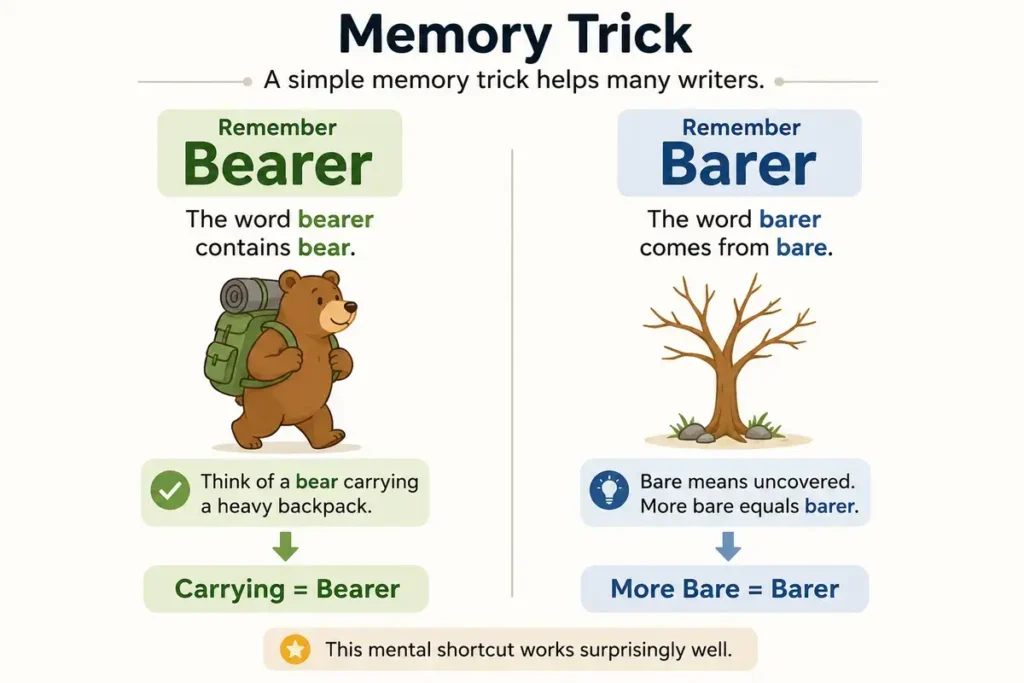
Bearer Vs Barer Memory Trick
A simple memory trick helps many writers.
Remember Bearer
The word bearer contains bear.
Think of a bear carrying a heavy backpack.
Carrying equals bearer.
Remember Barer
The word barer comes from bare.
Bare means uncovered.
More bare equals barer.
This mental shortcut works surprisingly well.
Bearer Vs Barer Examples In Sentences
Learning through examples is often the fastest way to remember the difference between bearer vs barer.
Bearer Examples In Sentences
- The bearer delivered the confidential documents before noon.
- She was the bearer of exciting news for the entire team.
- The flag bearer proudly led the athletes into the stadium.
- The bearer presented the certificate at the front desk.
- He became the bearer of responsibility after the manager retired.
- The letter stated that payment would be made to the bearer.
- The messenger acted as the bearer of an urgent warning.
- The torch bearer continued running despite the rain.
- The bearer carried the package across the city.
- The award recognized him as a bearer of positive change.
Barer Examples In Sentences
- The mountains looked barer after the wildfire.
- The office appeared barer once the decorations were removed.
- Winter made the garden look barer than usual.
- The second version of the design felt barer and cleaner.
- The room seemed barer after the furniture was sold.
- The walls looked barer without family photographs.
- The landscape became barer during the dry season.
- Her new style was barer and more minimalist.
- The shelves appeared barer after the holiday rush.
- The updated layout looked barer but more organized.
Common Mistakes With Bearer Vs Barer
Because the words sound alike, people often substitute one for the other.
Mistake One Using Barer Instead Of Bearer
Incorrect:
- She was the barer of good news.
Correct:
- She was the bearer of good news.
The sentence refers to someone carrying news, so bearer is required.
Mistake Two Using Bearer Instead Of Barer
Incorrect:
- The room looked bearer after the renovation.
Correct:
- The room looked barer after the renovation.
The sentence compares appearance and level of furnishing, so barer is correct.
Mistake Three Assuming One Word Is Always Wrong
Some writers believe only bearer is a legitimate word.
That’s not true.
Both words exist in standard English dictionaries. They simply serve different purposes.
Mistake Four Ignoring Context
Context determines the correct choice.
Always ask:
- Is someone carrying or possessing something?
- Or is something becoming more bare?
The answer points you to the correct spelling.
Bearer Vs Barer Pronunciation Guide
Although the meanings differ, the pronunciations are nearly identical in most English accents.
Bearer Pronunciation
IPA:
/ˈbeərər/
Syllable Breakdown:
Bear • er
Sounds Like:
Bair er
Barer Pronunciation
IPA:
/ˈbeərər/
Syllable Breakdown:
Bar • er
Sounds Like:
Bair er
In most American, British, Canadian, and Australian accents, the two words are pronounced the same way. That makes them homophones. Homophones are words that sound alike but have different meanings and spellings.
Other common English homophones include:
- Their and there.
- Right and write.
- Flower and flour.
- Peace and piece.
Common Pronunciation Mistakes
The biggest issue isn’t pronunciation. The challenge is choosing the correct spelling when writing. Since both words sound identical, writers must rely on meaning rather than sound.
Bearer Vs Barer Etymology And Word Origin
Understanding where these words come from makes their meanings easier to remember.
Origin Of Bearer
Bearer comes from the verb bear.
Old English used the word beran, meaning:
- To carry.
- To support.
- To transport.
- To bring forth.
Over centuries, English speakers added the suffix er, creating bearer, meaning a person or thing that carries or possesses something.
This structure appears in many English words:
- Teach becomes teacher.
- Drive becomes driver.
- Work becomes worker.
- Bear becomes bearer.
Origin Of Barer
Barer comes from the adjective bare. The word traces back to Old English bær, meaning:
- Naked.
- Exposed.
- Uncovered.
- Empty.
When English forms comparisons, many adjectives add er.
Examples include:
- Tall becomes taller.
- Small becomes smaller.
- Bare becomes barer.
That’s exactly how barer developed. The two words evolved from entirely different roots despite their similar appearance.
Bearer Vs Barer Regional Usage
One interesting aspect of bearer vs barer is that the distinction remains consistent across major English speaking regions.
American English
American English uses bearer frequently in:
- Legal documents.
- Finance.
- Business communication.
- News reporting.
Barer appears mostly in descriptive writing.
British English
British English follows the same pattern.
Common examples include:
- Bearer bonds.
- Standard bearers.
- Flag bearers.
Barer remains relatively uncommon outside descriptive contexts.
Canadian English
Canadian English treats both words similarly. Bearer dominates everyday usage, while barer appears mainly in comparisons involving appearance or exposure.
Australian English
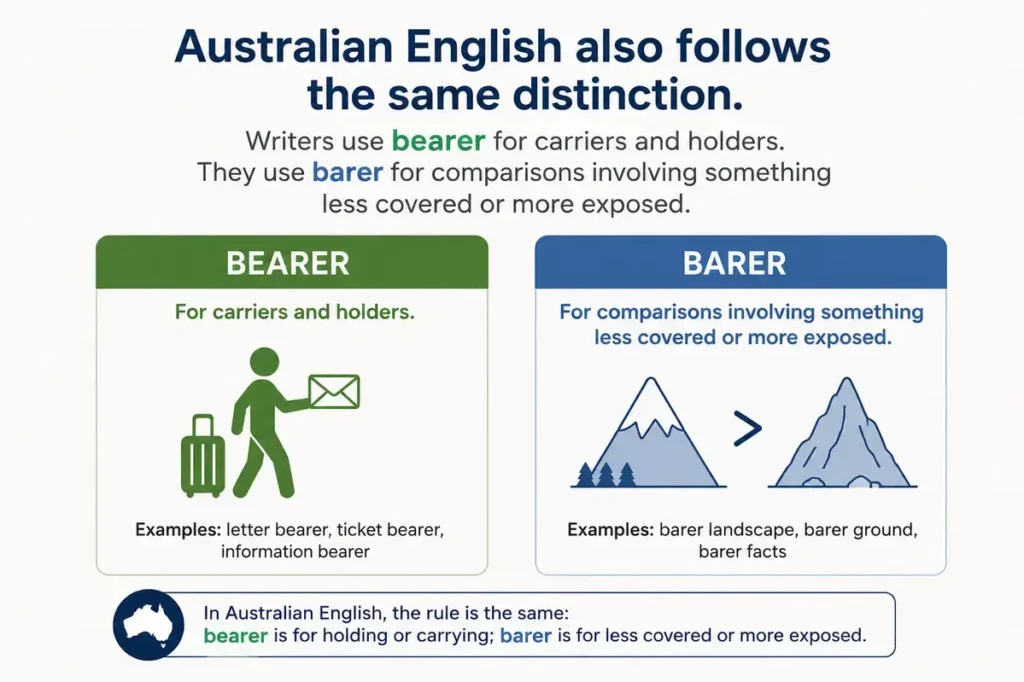
Australian English also follows the same distinction. Writers use bearer for carriers and holders. They use barer for comparisons involving something less covered or more exposed.
Is There A Regional Preference
No significant regional preference exists. All major English varieties recognize the same meanings and grammatical functions.
Bearer Vs Barer Grammar Rules
Grammar offers another reliable way to distinguish these words.
Bearer As A Noun
Bearer functions as a noun.
A noun identifies:
- A person.
- A place.
- A thing.
- A role.
Examples:
- The bearer arrived.
- The bearer signed the form.
- The bearer carried the package.
Plural Form:
Bearers.
Examples:
- Several bearers carried the ceremonial platform.
- The bearers entered the hall together.
Barer As An Adjective
Barer functions as a comparative adjective. Comparative adjectives compare two things.
Examples:
- This room is barer than the previous one.
- The landscape appears barer today.
- The second design looks barer.
Common Sentence Structures
Bearer:
- The bearer of the message arrived.
- The bearer carried the document.
- The bearer presented identification.
Barer:
- The room looked barer.
- The walls became barer.
- The garden appeared barer after winter.
Real Life Usage Of Bearer Vs Barer
Let’s see how native speakers use these words in everyday situations.
Daily Conversation
Bearer:
- He was the bearer of some good news.
Barer:
- The apartment feels barer without the artwork.
Academic Writing
Bearer:
- The carrier acted as the primary bearer of the information.
Barer:
- The revised model presents a barer framework for analysis.
Professional Communication
Bearer:
- Access is granted to the bearer of this badge.
Barer:
- The new office design appears barer but more efficient.
Literature
Bearer:
- He became the bearer of ancient wisdom.
Barer:
- The hills grew barer as winter advanced.
Media And Journalism
Bearer:
- The flag bearer led the delegation.
Barer:
- The streets looked barer after businesses closed.
Bearer Vs Barer Related Words And Confused Terms
Several words create confusion because they resemble bearer or barer.
Related To Bearer
- Carrier.
- Holder.
- Messenger.
- Possessor.
- Custodian.
- Transporter.
- Conductor.
- Deliverer.
Related To Barer
- Bare.
- Exposed.
- Uncovered.
- Naked.
- Sparse.
- Minimal.
- Empty.
- Plain.
Commonly Confused Words
- Bear and bare.
- Bearer and barer.
- Bearing and baring.
- Borne and born.
- Barely and bearably.
These pairs cause many spelling mistakes because their pronunciations overlap.
Bearer Vs Barer Expert Language Insight
After years of editing articles, reports, academic papers, and business documents, one pattern appears repeatedly. Most mistakes happen because writers think about sound rather than meaning. Since bearer and barer sound alike, people often choose the spelling that feels familiar. In real world English, bearer is significantly more common.
Native speakers regularly encounter:
- Flag bearer.
- Torch bearer.
- Bearer bond.
- Bearer of news.
- Standard bearer.
By contrast, barer appears mainly in descriptive comparisons. An experienced editor rarely needs to question bearer when discussing a person, role, or object carrying something. The only time barer becomes correct is when the discussion focuses on something becoming more bare, exposed, empty, or uncovered. A useful editing habit is to replace the word mentally. If carrier fits, choose bearer. If more exposed fits, choose barer. That simple test works almost every time.
Bearer Vs Barer FAQs
Is Bearer Or Barer The Correct Spelling?
Both are correct spellings. Bearer refers to a person or thing that carries, possesses, or transmits something. Barer is the comparative form of bare and means more exposed or less covered.
What Is The Difference Between Bearer And Barer?
Bearer functions as a noun that refers to a carrier or holder. Barer functions as an adjective that compares levels of exposure, simplicity, or lack of covering.
Is Barer A Real Word?
Yes. Barer is a legitimate English word. It is the comparative form of bare and means more bare than something else.
Why Do People Confuse Bearer And Barer?
People confuse them because they are homophones. They sound almost identical in everyday speech but have completely different meanings and grammatical functions.
How Do You Use Bearer In A Sentence?
A common example is: The bearer delivered the documents to the office. In this sentence, bearer refers to the person carrying the documents.
How Do You Use Barer In A Sentence?
A common example is: The landscape looked barer after the storm. Here, barer compares the amount of vegetation before and after the storm.
Is Bearer More Common Than Barer?
Yes. Bearer appears far more frequently in business, legal, financial, ceremonial, and everyday communication. Barer is relatively uncommon and mainly appears in descriptive writing.
Are Bearer And Barer Pronounced Differently?
In most English accents, they are pronounced the same way. Their meanings and spellings differ, but their spoken forms are usually identical.
Learn the difference in Focussing or Focusing Which Spelling Is Correct 2026.
Conclusion
The debate around bearer vs barer isn’t really about one word being right and the other being wrong. Both words are correct. The key is understanding what each one means. Use bearer when referring to someone or something that carries, possesses, delivers, transmits, or supports something. This is the word you’ll encounter most often in everyday communication, legal documents, business writing, and formal contexts.
Use barer when comparing how exposed, uncovered, empty, or minimal something appears. It serves as the comparative form of bare and is mostly used in descriptive writing. A simple memory trick can help. If the idea involves carrying something, choose bearer. If the idea involves being more bare, choose barer. Once you focus on meaning instead of sound, choosing the correct word becomes second nature.
1 thought on “Bearer vs Barer Explained: Meaning, Usage, and Examples 2026”