
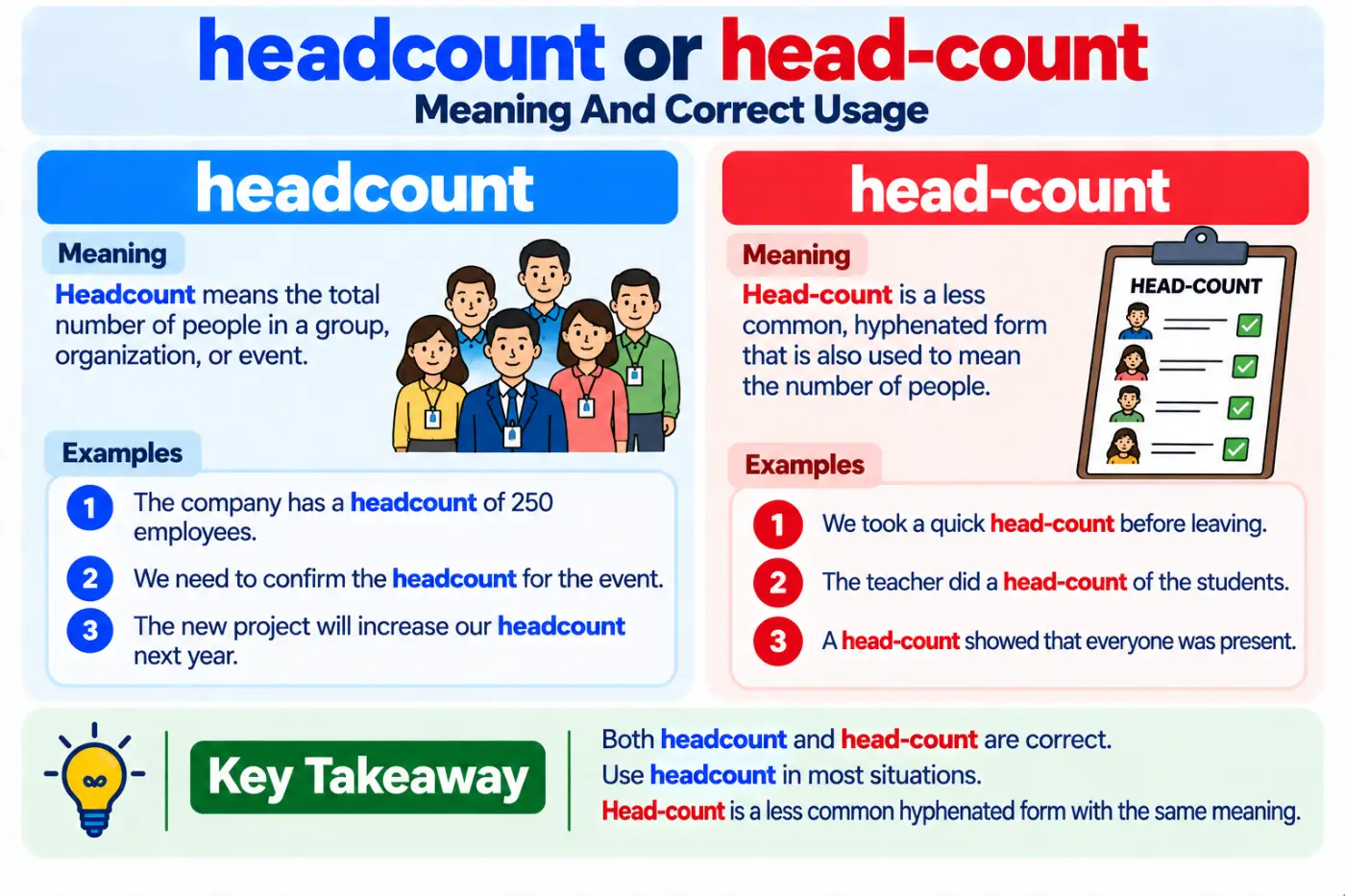
Confused about headcount or head count? Both spellings are correct in standard English. They refer to the number of people in a group or the process of counting them. The main difference is how writers choose to present the term, not its basic meaning.
In American English, the one word form is common in business settings, especially in human resources, workforce planning, hiring, and financial reports. The two word form is also widely accepted and often appears in everyday situations, such as counting students before a field trip or checking the number of guests at an event. However, these are usage tendencies rather than strict grammar rules.
The good news is that you don’t need to memorize two different definitions. Both forms can describe the same basic idea, and major English dictionaries recognize both spellings. Your best choice depends on the sentence, the intended audience, and the style you want to maintain.
This guide explains the meaning, spelling, grammar, pronunciation, and everyday use of the term. You’ll also learn how to use it naturally in professional writing and avoid common mistakes.
Need another quick comparison? Read Focussing or Focusing Which Spelling Is Correct 2026.
Quick Answer
Headcount and head count are both correct spellings. They refer to the number of people in a group or the act of counting people. In American business writing, the one word form is a practical choice for employee totals and workforce planning, while the two word form is also natural when describing a counting activity.
Meaning and Definition
The term refers to a count of people rather than a count of objects, money, or measurements. It can describe a group of people who are physically present or the total number of employees in an organization.
For example, a teacher might count students before leaving a museum. A company manager might check how many employees work in each department. Both situations involve the same basic idea, although the purpose of the count differs.
The term has two closely related meanings.
1. The act of counting people. This meaning focuses on the process of checking how many individuals belong to a group or are present at a location.
2. The total number of people. This meaning focuses on the result of the count. It can refer to the people attending a meeting, participating in an event, or working for a company.
Consider these sentences.
- The teacher performed a quick headcount before the students boarded the bus.
- The company’s headcount increased after it opened a new office.
The first sentence emphasizes the act of checking the group. The second gives information about the size of the workforce.
What Does Headcount Mean in Business
In business, the term often refers to the number of employees working for a company, department, or team. Managers use this figure to plan recruitment, assign resources, monitor staffing levels, and understand the size of an organization.
For example, a department with 25 employees has a headcount of 25. If the department hires five more people and nobody leaves, its total rises to 30.
However, this number doesn’t automatically tell you how many full time positions a company has. A workforce can include full time employees, part time employees, and people working different schedules. The reporting method matters, so organizations should explain which workers their totals include.
What Does Head Count Mean in Everyday English
In everyday conversation, the term often describes a quick check to make sure everyone is present. Teachers, tour guides, event organizers, coaches, and group leaders may use it for this purpose.
For example, a tour guide might say, We need to do a head count before the bus leaves. The guide wants to confirm that everyone in the group is accounted for.
The phrase can also describe the final number. If 42 people attend a workshop, the organizer might report a head count of 42.
Comparison Table for Both Spellings
| Feature | Headcount | Head count |
|---|---|---|
| Correct spelling | Yes | Yes |
| Part of speech | Noun | Noun |
| Main meaning | Number of people or act of counting them | Number of people or act of counting them |
| Business use | Common in staffing and workforce reports | Also accepted in business writing |
| Everyday use | Natural and widely understood | Natural and widely understood |
| Formality | Suitable for professional writing | Suitable for professional writing |
| Plural form | Headcounts | Head counts |
| Example | Our current headcount is 120. | We took a head count before leaving. |
The table shows that the two forms share the same basic meaning. Neither spelling is inherently incorrect or limited to informal writing. The most useful approach is to select one form and use it consistently throughout a document.
Key Differences Explained
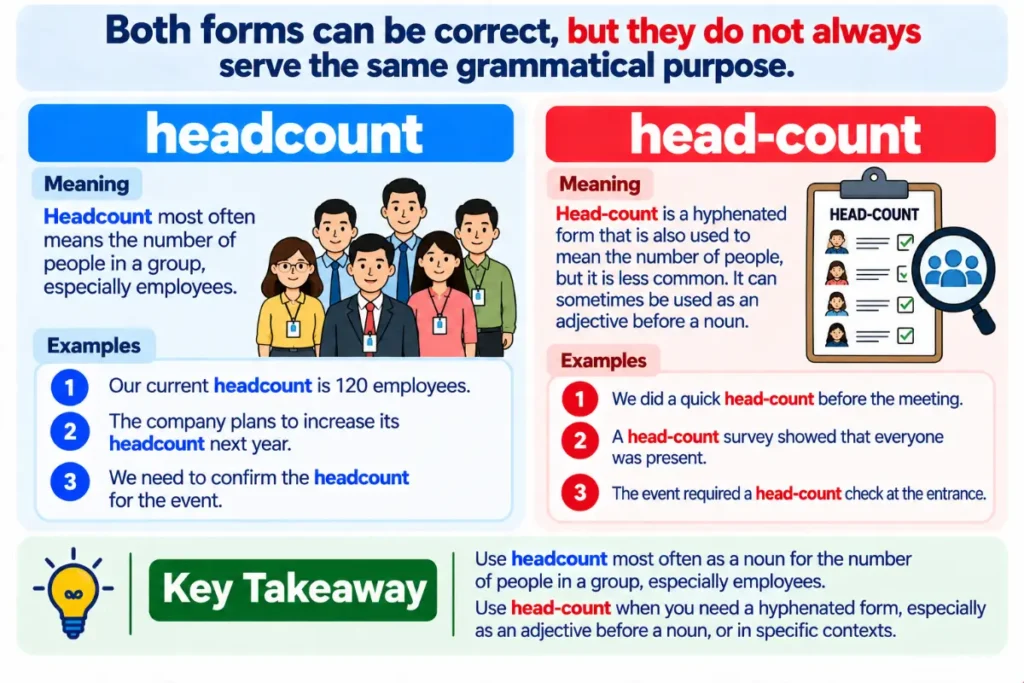
The difference between the two forms is mainly visual and stylistic. Their meanings overlap, and neither spelling has an exclusive grammatical function.
Spelling
The one word form combines two familiar words into a single compound noun. The two word form keeps them separate. English has many compounds that appear in more than one written form, and their spelling can vary as usage develops.
Both forms are recognized in established dictionaries. You don’t need to treat the two word version as a mistake simply because a spell checker prefers the other form.
Meaning
Both spellings can describe the number of people present, the process of counting them, or the number of employees in an organization.
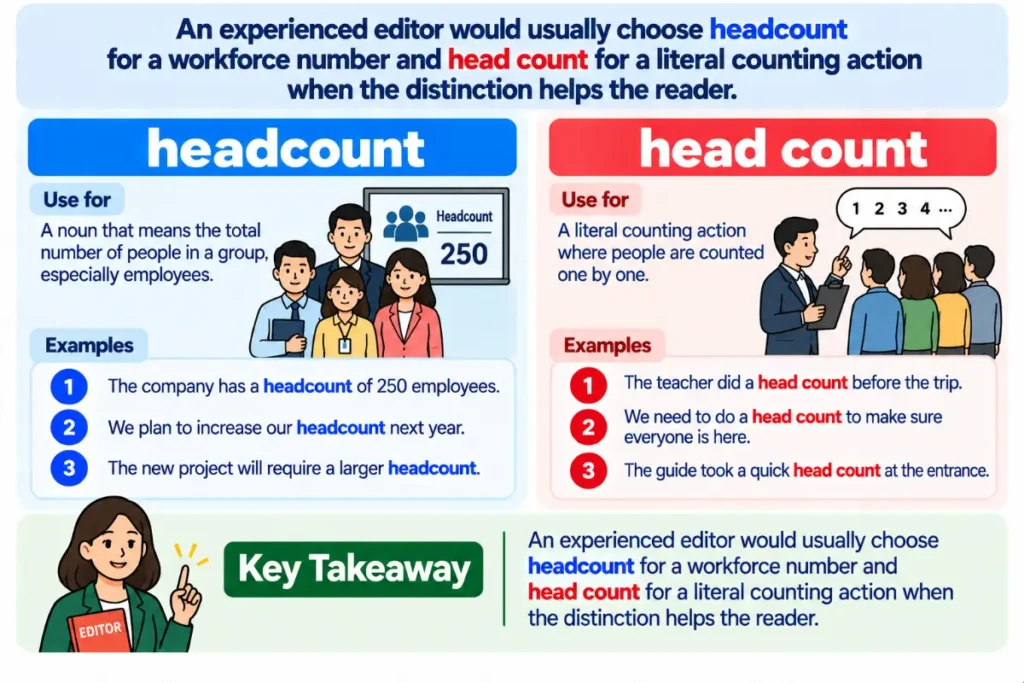
Some writers favor the one word form when discussing workforce size and the two word form when describing an actual counting activity. This can help with style, but it isn’t a fixed distinction in English grammar.
Grammar
Both forms function as nouns. They can appear as subjects, objects, or complements in a sentence.
For example, The headcount has increased uses the term as the subject. We checked the head count uses it as the object. The wording changes, but the grammatical role remains the same.
Pronunciation
Both forms have the same standard pronunciation. The spelling difference doesn’t change the sounds or the stress pattern.
Formality
Both forms work in professional and casual writing. A company report can use headcount, and an event checklist can use head count. The more important issue is consistency and clarity.
Regional Usage
American and British English recognize both spellings. The choice isn’t a simple difference between US and UK spelling conventions. Writers should follow their organization’s style guide if it specifies one form.
Which Form Is Correct
Both spellings are correct. Major dictionaries, including Cambridge, Collins, and American Heritage, recognize the one word form or list it alongside the two word form. Dictionary.com also identifies headcount as a variation of head count.
For most modern workplace documents, headcount is a sensible default. It works well in employee reports, recruitment plans, budgets, staffing updates, and discussions about organizational growth.
For example, you could write, Our current headcount is 250 employees. You could also write, We completed a head count before the event began. Both sentences are correct.
The key is to avoid making an absolute rule where none exists. The two word form isn’t wrong, and the one word form isn’t limited to business writing.
If your company has an established editorial style, follow it. If it doesn’t, choose the form that reads naturally and use it consistently.
Ten Natural Example Sentences
These examples show how the term works in everyday communication, business writing, education, and formal reports.
1. Workplace. Our headcount will increase by three employees next month.
2. Human resources. The HR team reviewed the current headcount before approving new positions.
3. Everyday conversation. Let’s take a quick head count before we leave the park.
4. School. The teacher checked the headcount before allowing the students to board the bus.
5. Event planning. Please confirm the final head count so we can order enough meals.
6. Email. Could you send me the latest headcount for each department by Friday?
7. Financial planning. The finance team included projected headcount changes in next year’s budget.
8. Journalism. The report said the company’s headcount had fallen during the previous quarter.
9. Academic writing. Researchers recorded the head count at each session to monitor attendance.
10. Team management. Our headcount remains unchanged, but two employees have moved to different departments.
Notice that both spellings appear in these examples. The sentences remain clear because the meaning comes from the surrounding context rather than from the spacing alone.
Common Mistakes and Spelling Confusion
Because English compound nouns don’t all follow the same spelling pattern, writers sometimes hesitate over this term. The following mistakes are worth avoiding.
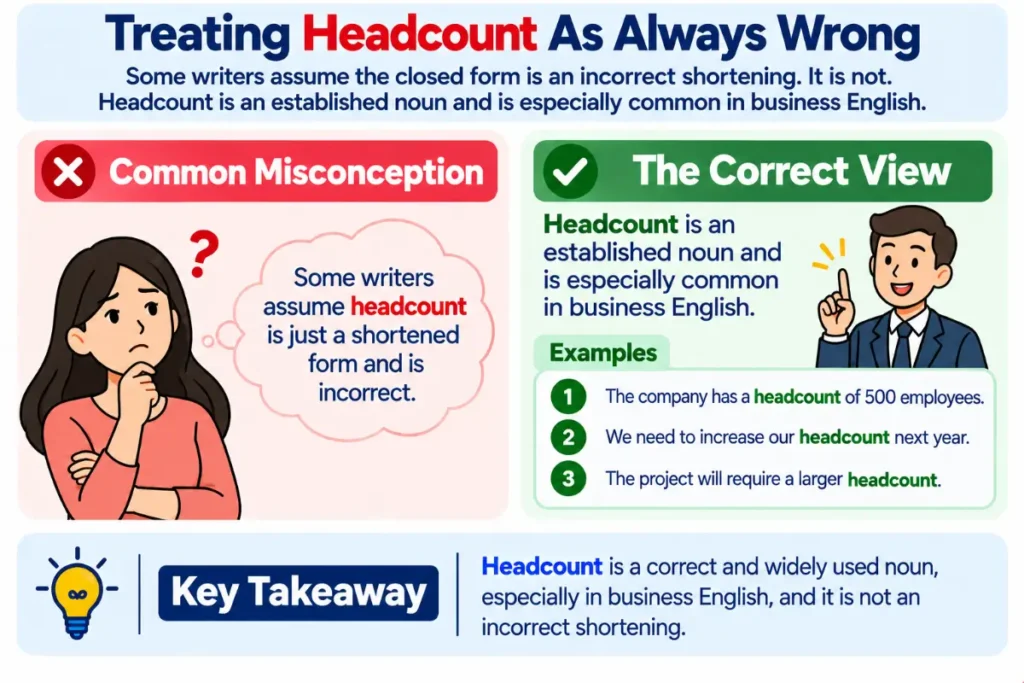
1. Treating head count as incorrect. Both forms are accepted. If your document uses the two word form consistently, you don’t need to change every instance to the one word form.
2. Assuming headcount always means employees. The term can refer to people at an event, in a classroom, or in any other group. The surrounding sentence determines the intended meaning.
3. Confusing a headcount with a full time equivalent. A headcount measures people under a defined counting method. A full time equivalent, often called an FTE, measures work capacity relative to a full time schedule. A company with ten employees who all work part time might report ten people but fewer than ten full time equivalents.
4. Using an unclear plural. When you mean several separate counting events, headcounts and head counts are both possible plural forms. When you mean the total number of employees in one company, the singular form is normally appropriate.
5. Changing spellings throughout the same document. Switching between the one word and two word forms without a reason can make a report look poorly edited. Choose one form for the document and stick with it unless a quotation or another specific reason requires a change.
A further point concerns the hyphenated form. You generally don’t need to write the term with a hyphen in ordinary modern English. Use one of the two established spellings instead.
Still confused? Compare Ensure vs Insure Meaning, Usage and Key Differences 2026.
Pronunciation Guide
Both spellings have the same pronunciation in standard American English.
Pronunciation
1×PlayStop
headcount
HED kownt
Add to flashcards
Give feedback
The word has two syllables, with the main stress on the first syllable. The first part sounds like the word head, while the second sounds like count.
The International Phonetic Alphabet transcription for American English is approximately /ˈhɛdˌkaʊnt/. The first syllable carries the main stress, and the second has lighter stress.
To pronounce the term naturally, say the two parts together without inserting a pause. The vowel in the second syllable is the same diphthong heard in words such as house and out.
A common pronunciation mistake is to place too much stress on the second part. Another is to pause between the two parts as if they were unrelated words. In normal speech, the term flows as a single unit.
Etymology and Word Origin
The term combines two familiar English words, head and count. Their combination reflects an old and straightforward way of thinking about the number of people in a group: count the heads to establish how many individuals are present.
The word head has a long history in English and can refer to the physical part of the body. It also appears in expressions that refer to people as individuals or units. For example, a company may discuss the cost per head when describing an expense for each person.
The word count refers to the act of finding a total by counting. It developed from older French and Latin forms associated with counting, reckoning, and calculation.
Together, these elements form a compound noun whose meaning is easy to understand. The expression first makes sense as a practical way to count people, then extends naturally to the total number of people in a group or organization.
Modern workplace use builds on that same idea. Instead of counting people in a room, a company can count its employees across several offices and departments.
The spelling variation reflects a broader pattern in English. Compound nouns may appear as separate words or as a single word, and dictionaries record accepted forms as usage develops. You don’t need to assign a different origin or meaning to each spelling.
Regional Usage
The two spellings are used across major varieties of English. There is no simple regional rule that makes one spelling exclusively American and the other exclusively British.
American English
In the United States, both forms are standard. The one word form is especially useful in business communication, including human resources documents, staffing plans, and reports on employee totals.
For example, an American company might state that its headcount rose by 12 employees during the year. A teacher might instead ask a class to take a head count before going outside.
These choices are natural, but they don’t establish a strict difference in meaning.
British English
British English also uses both forms. The two word spelling is well established, and the one word form appears in workplace and general contexts.
British companies may discuss employee headcount, and teachers or group leaders may perform a head count. The intended meaning is generally clear from the sentence.
Australian English
Both forms are understood in Australian English. Writers can use either spelling, with consistency being the main concern. Local workplace policies or editorial guides may prefer one form.
Canadian English
Canadian English also recognizes both spellings. In business reports, the one word form is a convenient choice, while the two word form remains acceptable in general writing.
Across these varieties, the difference is primarily one of spelling preference and editorial style. You shouldn’t assume that a writer has made a regional spelling error simply because the spacing differs from your preference.
Grammar Rules and Part of Speech
The term functions as a noun. It names a count of people or the total number of people in a group.
Understanding its grammatical role helps you use it correctly in a sentence.
Using It as a Subject
A noun can serve as the subject of a sentence. In this position, the term tells the reader what the sentence is about.
For example, The headcount increased after the company hired six employees. The noun is the subject, and the verb increased explains what happened to the total.
Using It as an Object
A noun can also receive the action of a verb. For example, The manager checked the head count before approving the schedule.
Here, the manager performs the action, and the count is the thing being checked.
Using It With an Article
You can use a or the before the noun when the sentence calls for an article.
- We completed a headcount before the meeting.
- The headcount remained stable throughout the year.
The article depends on the sentence and the meaning. You don’t need a special grammar rule for either spelling.
Using It in Compound Expressions
The term often appears beside other nouns to create useful business expressions.
- Headcount report. A document that gives the number of people in a group or organization.
- Headcount planning. The process of deciding how many employees a business needs.
- Headcount reduction. A decrease in the number of people employed.
- Headcount growth. An increase in the number of people employed.
- Headcount limit. A maximum number of people permitted or approved.
These expressions are common in business communication. They help writers describe staffing decisions without using long explanations every time.
Singular and Plural Forms
The singular form is appropriate when referring to one total or one counting activity. The plural form can refer to multiple totals or separate counting events.
For example, The department’s headcount is 40 refers to one workforce total. The teachers performed two head counts refers to two separate checks of the group.
Both spellings form their plurals in the usual way. Add s to the end of the chosen form.
Agreement With Verbs
When the noun refers to one total, use a singular verb.
For example, The headcount is 75.
When referring to multiple separate counts, use a plural verb.
For example, The head counts were completed before lunch.
The verb agrees with the noun as it appears in the sentence. The spelling variation doesn’t change this rule.
Punctuation and Style
Neither established spelling requires special punctuation. In ordinary writing, don’t add quotation marks or a hyphen simply to emphasize the term.
In professional documents, consistency matters more than choosing a supposedly universal winner. If you use headcount in a report heading, keep the same form in the body text unless there’s a clear editorial reason to change it.
Real Life Usage Examples
The term appears in many situations, but its meaning becomes clearer when you see how people use it in context.
Daily Conversation
In everyday speech, people often use the term when checking attendance or making sure a group is complete.
- The camp leader did a quick head count before the hikers started walking again.
- We need one final headcount before we reserve the restaurant.
The first example describes checking who is present. The second uses the term to establish the number of people expected to attend.
Email and Workplace Communication
In the workplace, the term often appears in messages about staffing, hiring, budgets, and team changes.
- Please confirm the current headcount for your department before the planning meeting.
- Our headcount report shows that the support team added four employees this quarter.
These sentences give readers specific information without unnecessary explanation. The first asks for a number, while the second reports a change in staffing.
Academic Writing
Schools, universities, and researchers may use the term to describe attendance or the number of people involved in a study.
- The research team recorded the head count at each session.
- The university reported a higher student headcount for the fall term.
In academic writing, define the counting method when precision matters. For example, a report might explain if the total includes registered students, enrolled students, or only those who attended a particular session.
News and Journalism
Journalists use the term when reporting changes in employment, attendance, and organizational size.
- The company reported a lower headcount after closing two regional offices.
- Organizers completed a head count before reopening the event area.
The surrounding details help readers understand what is being counted. In business news, the term often refers to employees. In event coverage, it may refer to people who are present at a particular location.
Literature and Storytelling
Writers can use the term in a story to establish the size of a group or build tension around a missing person.
- The captain ordered a head count before the crew left the island.
- After the storm passed, Mara performed another headcount and realized one camper was missing.
These examples show how a simple count can serve a practical purpose in a story. It can confirm that everyone is present or reveal that something has gone wrong.
Related and Confused Terms
Several words describe similar ideas, but they don’t all mean the same thing. Choosing the right one helps you communicate more precisely.
1. Headcount. The number of people in a group or the process of counting them. It often refers to employees in a business setting.
2. Head count. An alternative spelling with the same basic meaning. It works in general writing and professional contexts.
3. Attendance. The fact that people are present at a place or event. Attendance records may show who arrived, while a count may simply report the total number present.
4. Workforce. The people who work for a company, industry, or organization. The term describes the group itself rather than the numerical count.
5. Staffing level. The number of workers assigned to a team or operation. It may describe current staffing or the level needed to run a service.
6. Employee count. A direct expression for the number of employees in an organization. It can be useful when readers need a clear term without business shorthand.
7. Census. A systematic count and collection of information about a population. A national census covers a much broader group than a routine workplace count.
8. Full time equivalent. A measure of work capacity based on full time hours. It differs from a simple count of individuals because several part time employees may add up to one full time equivalent.
These distinctions matter in reports and planning documents. A business with 100 employees doesn’t necessarily have 100 full time equivalents, and a room with 100 registered guests may not have 100 people present.
Expert Editor Insight
An experienced editor treats both spellings as legitimate and looks first at the intended meaning. In a staffing report, the one word form often fits neatly into expressions such as headcount growth and headcount planning. In a sentence about checking a group before departure, the two word form can feel equally natural. A spell checker may accept one form or flag the other based on its dictionary settings, so don’t assume that every automated suggestion reflects a genuine spelling error. Follow the document’s style guide, check the sentence for clarity, and keep the spelling consistent.
Learn the difference in Is There Any Vs Are There Any.
Conclusion
The choice between headcount or head count is simple because both spellings are correct. They refer to the number of people in a group or the act of counting them. In American English, headcount is a practical choice for business reports, employee totals, and workforce planning, while head count remains equally acceptable in general writing. Neither form is restricted to a single region or grammatical function.
To remember the rule, focus on meaning and consistency rather than treating one spelling as a mistake. If your workplace has a style guide, follow it. Otherwise, choose the form that reads naturally and use it consistently throughout your document.
FAQs
Is Headcount One Word or Two Words?
Both spellings are correct in standard English. Headcount is written as one word, while head count is written as two. Both forms can refer to the number of people in a group or the act of counting them. For business reports, choose one form and use it consistently throughout the document.
What Does Headcount Mean in a Job Description?
In a workplace setting, the term usually refers to the number of employees in a company, department, or team. A job description may mention an approved headcount to explain how many positions a department can fill. Keep in mind that an approved position and an actual employee are not necessarily the same thing.
Is Head Count Incorrect in American English?
No. The two word form is accepted in American English and appears in established dictionaries. You can use it when describing an attendance check or the total number of people in a group. The one word form is also standard. Your choice should reflect the context and any style rules that apply to your document.
How Do You Pronounce Headcount?
The term has two syllables and is pronounced with the main stress on the first syllable. In American English, its pronunciation is approximately represented by /ˈhɛdˌkaʊnt/. Both spellings sound the same. Say the two parts together as one natural expression rather than pausing between them.
What Is the Plural of Headcount?
The plural of headcount is headcounts. The plural of head count is head counts. Use the plural when you mean several separate counts or totals. For a single organization’s total number of employees, the singular form is usually appropriate, as in The company’s headcount is 350.
Can You Use Headcount in Formal Writing?
Yes. The term is suitable for business reports, workforce plans, staffing updates, and other professional documents. It is also used in journalism and general writing. If your audience may not know business terminology, employee count or number of employees can be clearer alternatives. Choose wording that suits the reader and the purpose of the document.
What Is Another Word for Headcount?
Useful alternatives include employee count, number of employees, staffing level, and workforce size. For an event, attendance total or number of people present may fit better. These expressions overlap in meaning, but they aren’t always interchangeable. For example, attendance usually focuses on people who show up, while employee count refers to people employed by an organization.
Why Do People Confuse Headcount and Head Count?
English compound nouns don’t follow one simple spelling rule. Some are written as one word, others as two, and some have more than one accepted form. Since both spellings are recognized, the confusion isn’t proof that one is misspelled. A consistent style guide is the easiest way to avoid unnecessary changes in a report or article.